36) Accumulated other comprehensive income:
A) is a liability.
B) might include prior service cost from pension plan amendments.
C) includes unrealized gains and losses on equity securities.
D) is reported in the income statement.
37) A statement of comprehensive income does not include:
A) Net income.
B) Losses resulting from the return on pension assets exceeding expectations.
C) Losses from changes in estimates regarding the PBO.
D) Prior service cost.
38) Accumulated other comprehensive income is reported:
A) In the balance sheet as an asset.
B) In the balance sheet as a liability.
C) In the balance sheet as a component of shareholders’ equity.
D) In the statement of comprehensive income.
39) A statement of comprehensive income does not include:
A) Gains resulting from the return on pension assets exceeding expectations.
B) Gains and losses on unsold held-to-maturity debt securities.
C) Adjustments from foreign currency translation.
D) Prior service cost of pensions.
40) Characteristics of the corporate form that have led to the growth of this form of business
ownership include all of the following except:
A) Ease of raising capital.
B) Low government regulation.
C) Limited liability.
D) Ease of ownership transfer.
41) The preemptive right refers to the shareholder’s right to:
A) Maintain a proportional ownership interest in the corporation.
B) Vote for members of the board of directors.
C) Receive a share of dividends.
D) Share in profits proportionally with all other stockholders.
42) Common shareholders usually have all of the following rights except:
A) To share in the profits.
B) To share in assets upon liquidation.
C) To elect a board of directors.
D) To participate in the day-to-day operations.
43) The par amount of shares issued is normally recorded in the:
A) Paid-in capital in excess of par account.
B) Common stock account.
C) Retained earnings account.
D) Appropriated retained earnings account.
44) Authorized common stock refers to the total number of shares:
A) Outstanding.
B) Issued.
C) Issued and outstanding.
D) That can be issued.
45) The par amount of common stock represents:
A) The arbitrary dollar amount assigned to a share of stock.
B) The liquidation value of a share.
C) The book value of a share of stock.
D) The amount received when the stock was issued.
46) When stock traded on an active exchange is issued for a machine:
A) No entry is recorded until restrictions are lifted.
B) An asset is recorded for the fair value of the stock.
C) An asset is recorded for the appraised value of the machine.
D) Paid-in capital is increased by the appraised value of the machine.
47) Paid-in capital in excess of par is reported:
A) As a reduction of shareholders’ equity.
B) As a noncurrent asset.
C) As a noncurrent liability.
D) As an increase in shareholders’ equity.
48) Share issue costs refer to the costs of obtaining the legal, promotional, and accounting
services necessary to effect the sale of shares. The costs reduce the net cash proceeds from
selling the shares and thus paid-in capital—excess of par, and are:
A) Not recorded separately.
B) Recorded as an asset.
C) Recorded as a liability.
D) Amortized over time.
49) When stock is issued in exchange for property, the best evidence of fair value might be any
of the following except:
A) The appraised value of the property received.
B) The selling price of the stock in a recent transaction.
C) The price of the stock quoted on the stock exchange.
D) The average book value of outstanding stock.
50) When more than one security is sold for a single price and the total selling price is not equal
to the sum of the market prices, the cash received is allocated between the securities based on:
A) Relative book values.
B) Par amounts
C) Relative market values.
D) The earnings per share.
51) The owners of a corporation are its shareholders. If a corporation has only one class of
shares, they typically are labeled common shares. Each of the following are ownership rights
held by common shareholders, unless specifically withheld by agreement, except:
A) The right to vote on policy issues.
B) The right to share in profits when dividends are declared (in proportion to the percentage of
shares owned by the shareholder).
C) The right to dividends equal to a stated rate time par (if dividends are paid).
D) The right to share in the distribution of any assets remaining at liquidation after other claims
are satisfied.
52) The 12/31/2018 balance sheet of Despot Inc. included the following:
Common stock, 25 million shares at $20 par
$
500
million
Paid-in capital—excess of par
3,000
million
Retained earnings
980
million
In January 2018, Despot recorded a transaction with this journal entry:
Cash
150
million
Common stock
100
million
Paid-in capital—excess of par
50
million
The transaction was for the:
A) Issue of 2 million shares of common stock at par.
B) Issue of common stock for $150 million in cash.
C) Receipt of $20 per share for a new stock issue.
D) All of these answer choices are correct.
53) The 12/31/2018 balance sheet of Despot Inc. included the following:
Common stock, 25 million shares at $20 par
$
500
million
Paid-in capital—excess of par
3,000
million
Retained earnings
980
million
In January 2018, Despot recorded a transaction with this journal entry:
Cash
150
million
Common stock
100
million
Paid-in capital—excess of par
50
million
In February 2018, Despot declared cash dividends of $12 million to be paid in April of that year.
What effect did the April transaction have on Despot’s accounts?
A) Decreased assets and liabilities.
B) Decreased assets and shareholders’ equity.
C) Increased liabilities and decreased shareholders’ equity.
D) None of these answer choices are correct
54) The 12/31/2018 balance sheet of Despot Inc. included the following:
Common stock, 25 million shares at $20 par
$
500
million
Paid-in capital—excess of par
3,000
million
Retained earnings
980
million
In January 2018, Despot recorded a transaction with this journal entry:
Cash
150
million
Common stock
100
million
Paid-in capital—excess of par
50
million
Despot declared a property dividend to give marketable equity securities to its common
stockholders. The securities had cost Despot $7 million and currently have a fair value of $16
million. Which of the following would be included in recording the property dividend
declaration?
A) Increase in a liability for $16 million.
B) Decrease in retained earnings for $7 million.
C) Decrease in marketable securities by $16 million.
D) All of these answer choices are correct.
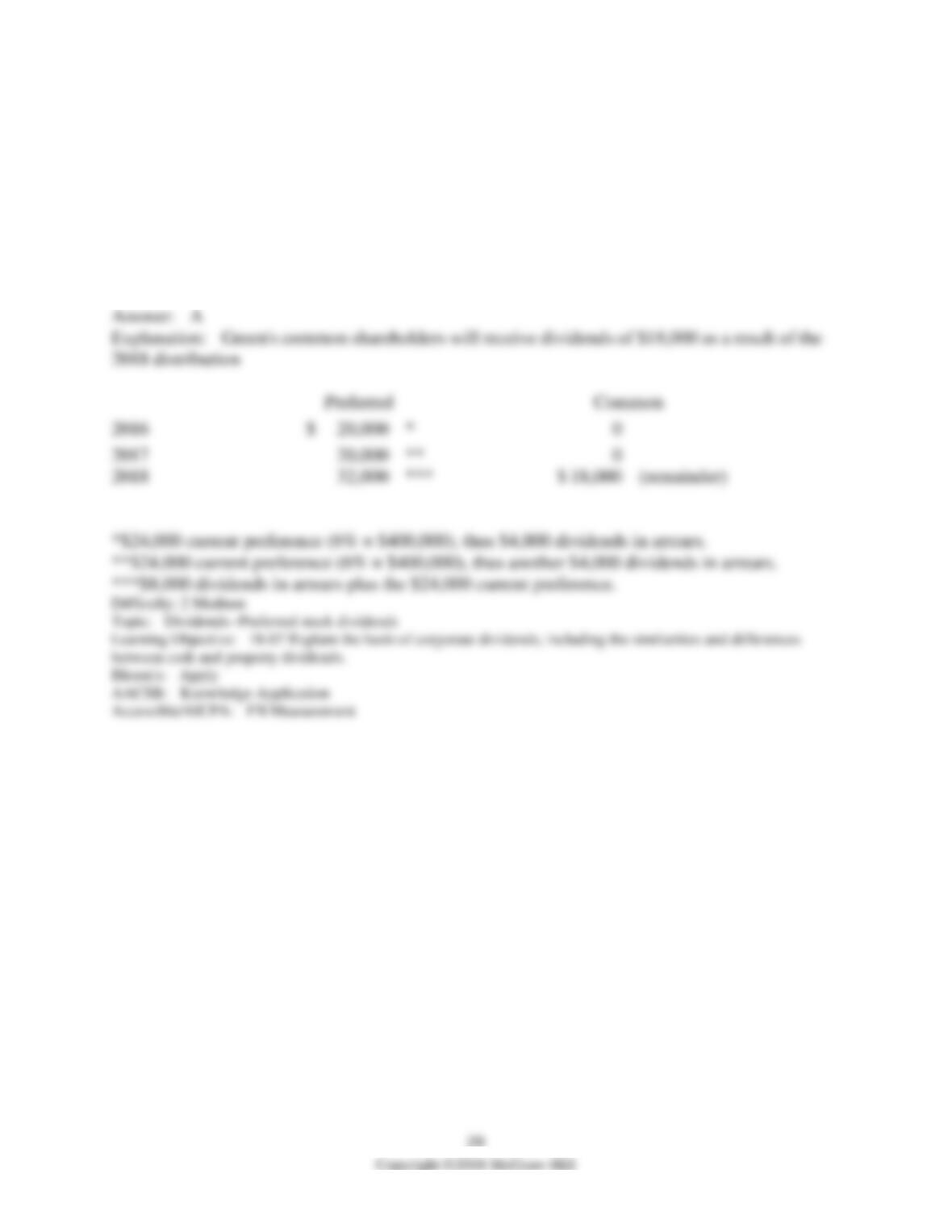
55) The shareholders’ equity of Green Corporation includes $200,000 of $1 par common stock
and $400,000 par of 6% cumulative preferred stock. The board of directors of Green declared
cash dividends of $50,000 in 2018 after paying $20,000 cash dividends in each of 2017 and
2016. What is the amount of dividends common shareholders will receive in 2018?
A) $18,000.
B) $26,000.
C) $28,000.
D) $32,000.
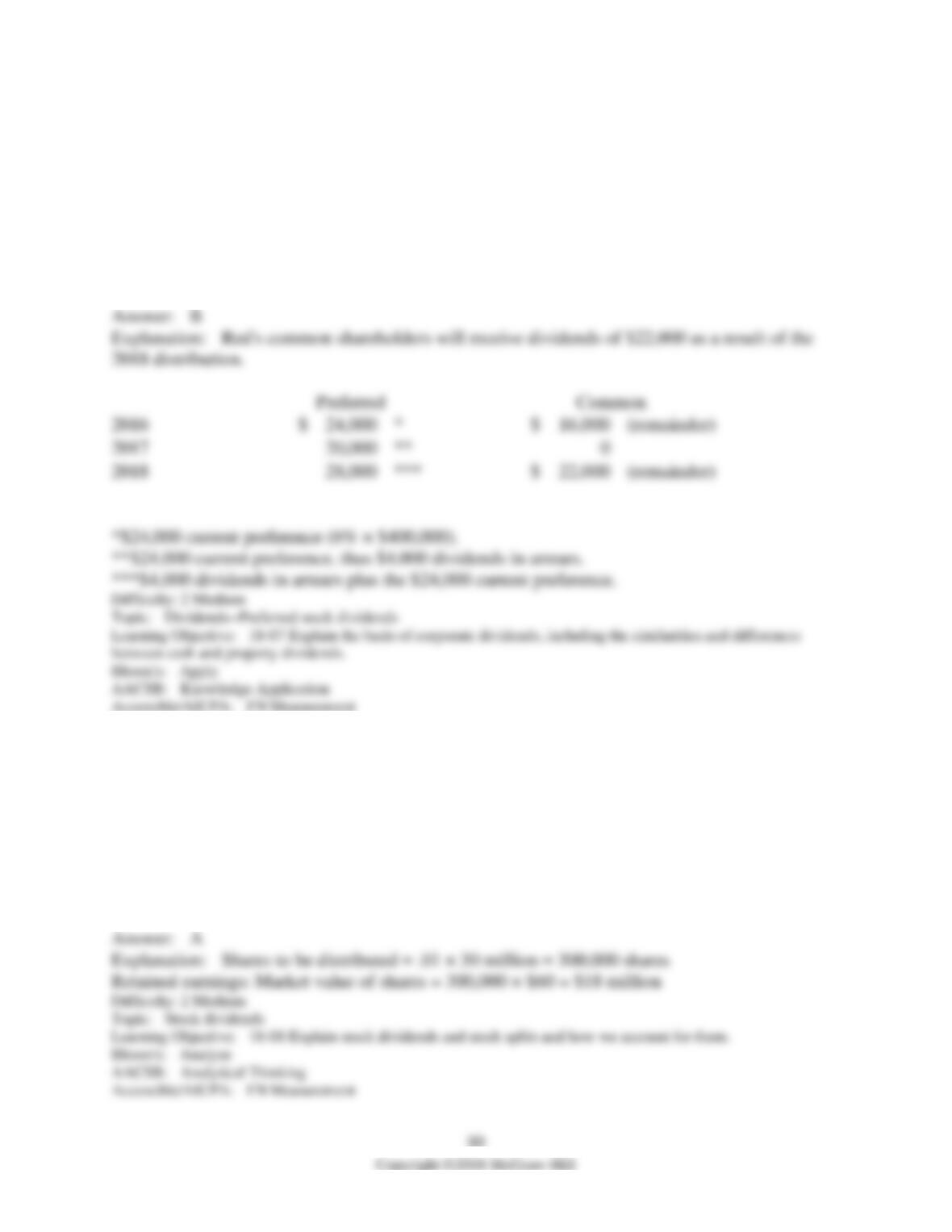
56) The shareholders’ equity of Red Corporation includes $200,000 of $1 par common stock and
$400,000 par of 6% cumulative preferred stock. The board of directors of Red declared cash
dividends of $50,000 in 2018 after paying $20,000 cash dividends in 2017 and $40,000 in 2016.
What is the amount of dividends common shareholders will receive in 2018?
A) $18,000.
B) $22,000.
C) $26,000.
D) $28,000.
57) Rick Co. had 30 million shares of $1 par common stock outstanding at January 1, 2018. In
October 2018, Rick Co.’s Board of Directors declared and distributed a 1% common stock
dividend when the market value of its common stock was $60 per share. In recording this
transaction, Rick would:
A) Debit retained earnings for $18 million.
B) Credit paid-in capital—excess of par for $18 million.
C) Credit common stock for $18 million.
D) None of these answer choices are correct
58) Which of the following transactions decreases retained earnings?
A) A property dividend.
B) A stock dividend.
C) A cash dividend.
D) All of these answer choices are correct.
59) Poodle Corporation was organized on January 3, 2018. The firm was authorized to issue
100,000 shares of $5 par common stock. During 2018, Poodle had the following transactions
relating to shareholders’ equity:
Issued 30,000 shares of common stock at $7 per share.
Issued 20,000 shares of common stock at $8 per share.
Reported a net income of $100,000.
Paid dividends of $50,000.
What is total paid-in capital at the end of 2018?
A) $420,000.
B) $370,000.
C) $470,000.
D) $320,000.
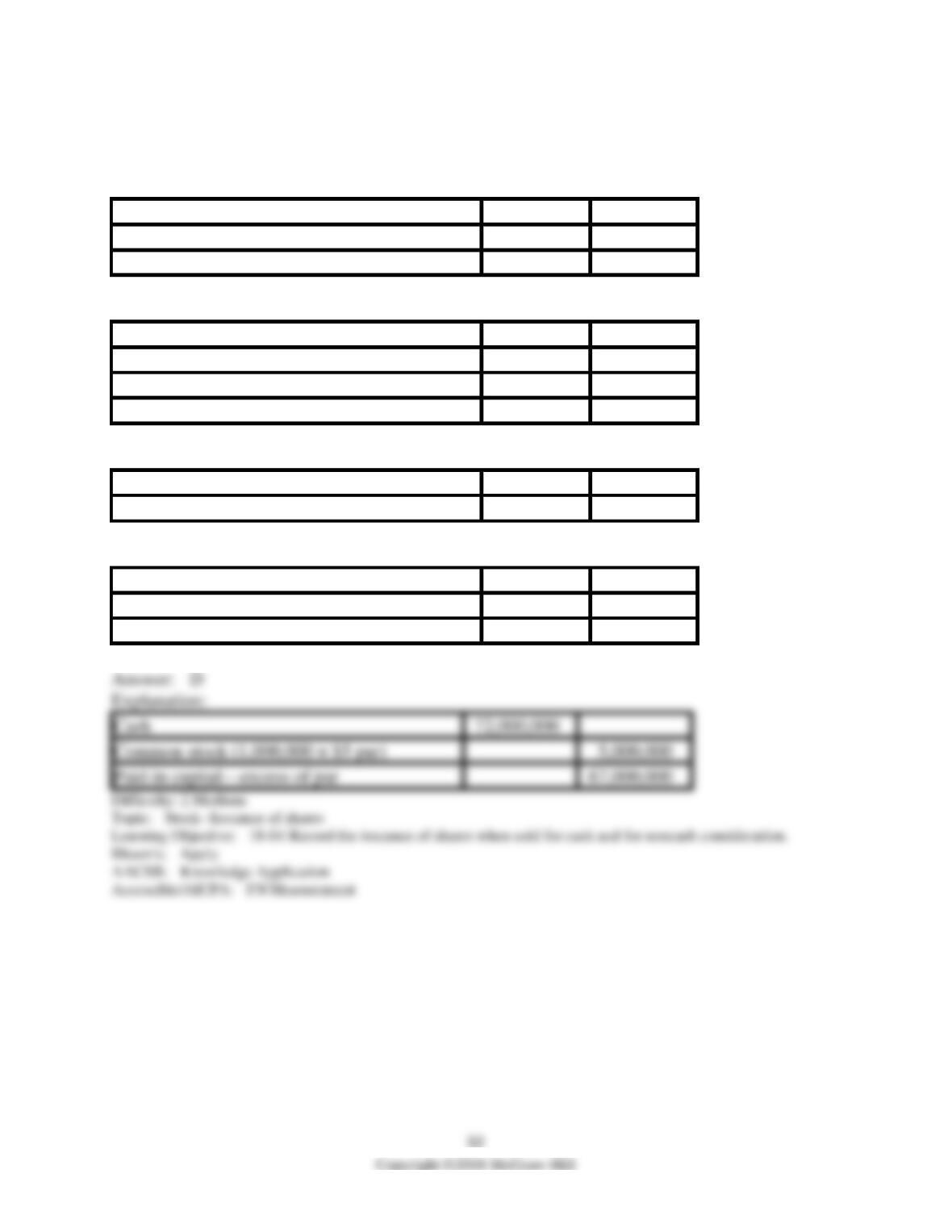
60) Olsson Corporation received a check from its underwriters for $72 million. This was for the
issue of one million of its $5 par stock that the underwriters expect to sell for $72 per share.
Which is the correct entry to record the issue of the stock?
A)
Cash
72,000,000
Stock issue expense
20,000,000
Stock contract receivable
52,000,000
B)
Cash
72,000,000
Deferred stock issue revenue
20,000,000
Common stock
5,000,000
Paid-in capital—excess of par
47,000,000
C)
Cash
72,000,000
Common stock
72,000,000
D)
Cash
72,000,000
Common stock
5,000,000
Paid-in capital—excess of par
67,000,000
Cash
Common stock (1,000,000 × $5 par)
5,000,000
Paid-in capital—excess of par
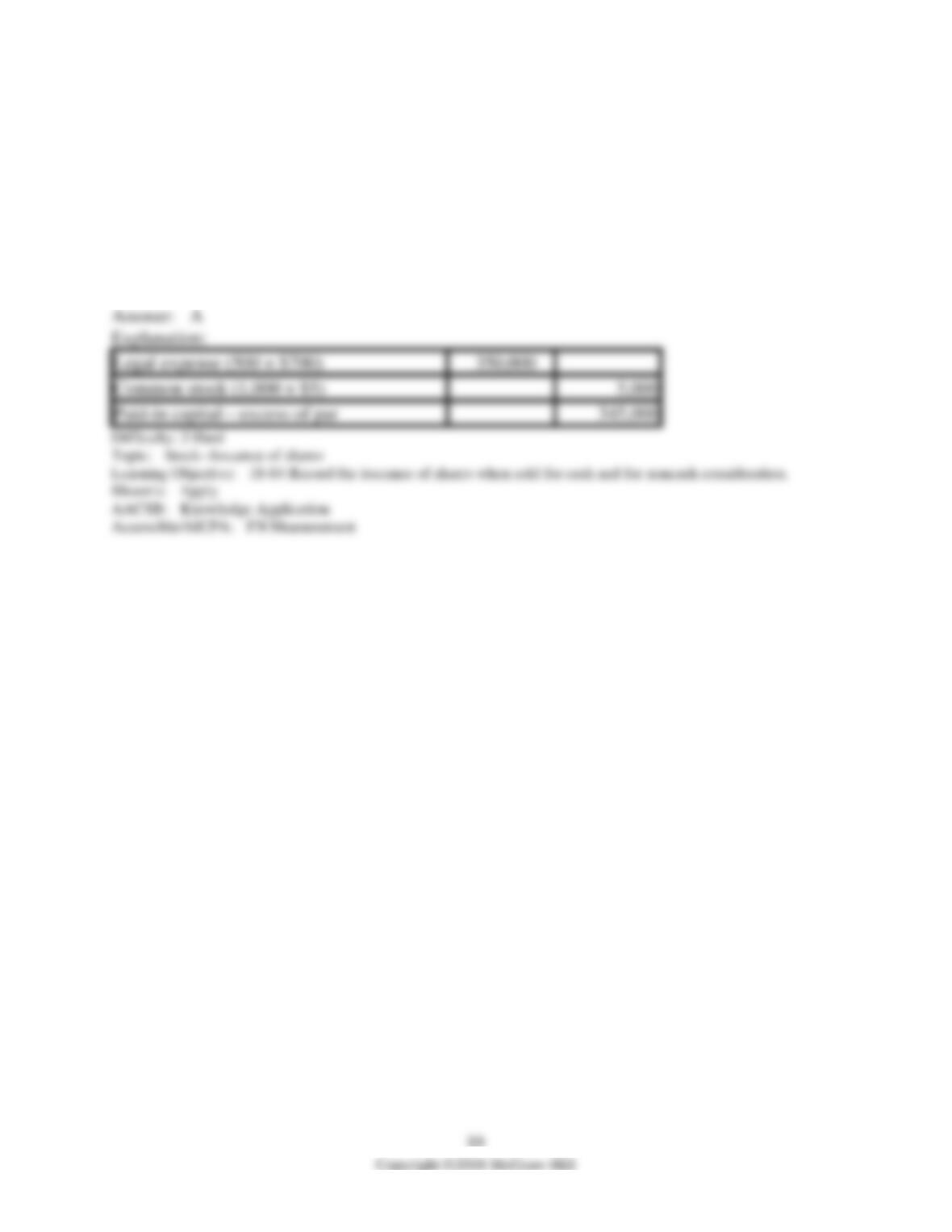
61) Montgomery & Co., a well-established law firm, provided 500 hours of its time to Fink
Corporation in exchange for 1,000 shares of Fink’s $5 par common stock. Montgomery’s usual
billing rate is $700 per hour, and Fink’s stock has a book value of $250 per share. By what
amount will Fink’s paid-in capital—excess of par increase for this transaction?
A) $345,000.
B) $295,000.
C) $350,000.
D) $300,000.
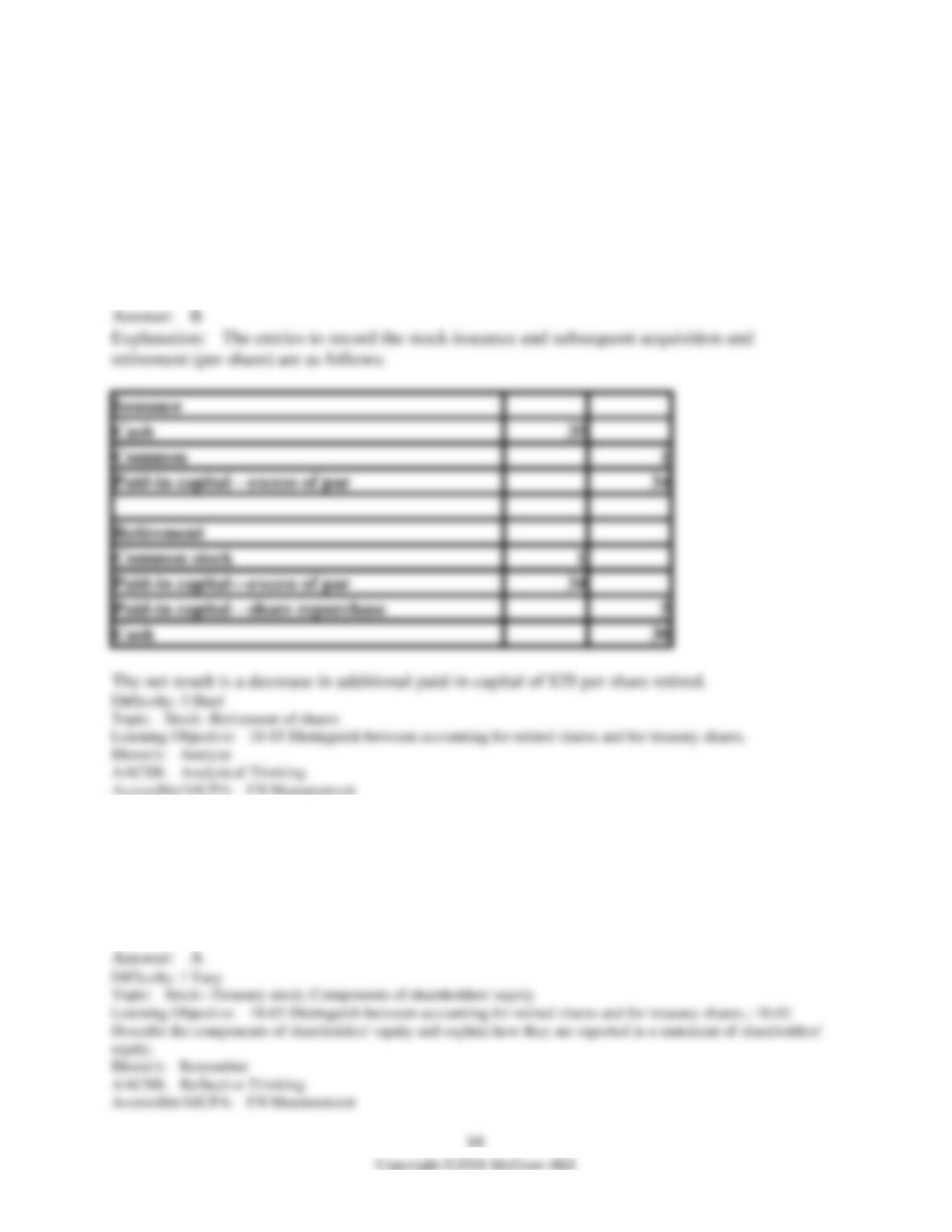
62) In 2016, Winn, Inc., issued $1 par common stock for $35 per share. No other common stock
transactions occurred until July 31, 2018, when Winn acquired some of the issued shares for $30
per share and retired them. Which of the following statements correctly states an effect of this
acquisition and retirement?
A) 2018 net income is decreased.
B) Additional paid-in capital is decreased.
C) 2018 net income is increased.
D) Retained earnings is increased.
63) Treasury shares are most often reported as:
A) A reduction of total shareholders’ equity.
B) A reduction of total paid-in capital.
C) A reduction of retained earnings.
D) An expense in the income statement.
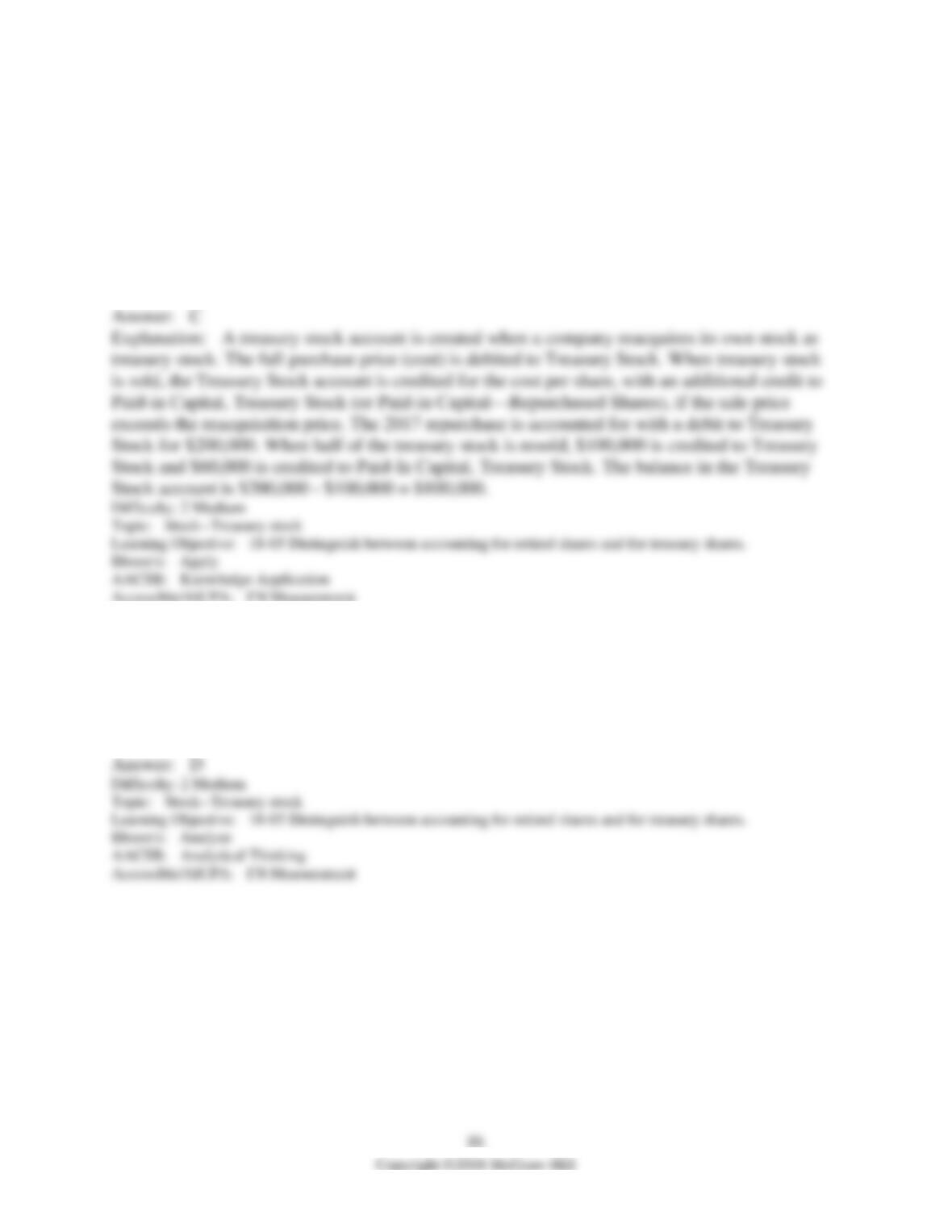
64) Coy, Inc. initially issued 200,000 shares of $1 par stock for $1,000,000 in 2016. In 2017, the
company repurchased 20,000 shares for $200,000. In 2018, 10,000 of the repurchased shares
were resold for $160,000. In its balance sheet dated December 31, 2018, Coy, Inc.’s treasury
stock account shows a balance of:
A) $0.
B) $40,000.
C) $100,000.
D) $200,000.
65) When treasury shares are sold at a price above cost:
A) A gain account is credited.
B) A loss is reported.
C) A revenue account is credited.
D) Paid-in capital is increased.
66) When treasury shares are resold at a price below cost:
A) Paid-in capital and/or retained earnings is reduced.
B) Paid-in capital and/or retained earnings is increased.
C) Retained earnings is always reduced.
D) A loss is reported on the income statement
67) When treasury stock is purchased for an amount greater than its par, what is the effect on
total shareholders’ equity?
A) Increase.
B) Decrease.
C) No effect.
D) Cannot tell from the given information.
68) When preferred stock is purchased by the issuing corporation at a price below the original
issue price and the stock is retired, the transaction:
A) Increases net income for the year.
B) Increases retained earnings.
C) Increases revenue for the year.
D) Increases paid-in capital—share repurchase.
69) Retained earnings represent:
A) Earned capital.
B) Cash.
C) Assets.
D) Net assets.
70) Retained earnings represent a company’s:
A) Undistributed net income.
B) Undistributed net assets.
C) Extra paid-in capital.
D) Undistributed cash.
71) The retained earnings balance reported in the balance sheet typically is not affected by:
A) Net income.
B) A prior period adjustment.
C) Dividends paid.
D) Restrictions.
72) Boxer Company owned 20,000 shares of King Company that were purchased in 2016 for
$500,000. On May 1, 2018, Boxer declared a property dividend of 1 share of King for every 10
shares of Boxer stock. On that date, there were 50,000 shares of Boxer stock outstanding. The
market value of the King stock was $30 per share on the date of declaration and $32 per share on
the date of distribution. By how much is retained earnings reduced by the property dividend?
A) $0.
B) $150,000.
C) $160,000.
D) $300,000.
73) On October 1, 2018, Chief Corporation declared and issued a 10% stock dividend. Before
this date, Chief had 80,000 shares of $5 par common stock outstanding. The market value of
Chief Corporation on the date of declaration was $10 per share. As a result of this dividend,
Chief’s retained earnings will:
A) Decrease by $80,000.
B) Not change.
C) Decrease by $40,000.
D) Increase by $80,000.
74) Preferred stock is called preferred because it usually has two preferences. These preferences
relate to:
A) Dividends and voting rights.
B) Par and dividends
C) The preemptive right and voting rights.
D) Assets at liquidation and dividends.
75) When dividends are declared in one fiscal year and paid in the next fiscal year, the liability
for the dividend should be recorded as of the:
A) Date the dividend is declared.
B) Last day of the fiscal year.
C) Date of record.
D) Date of payment.
76) Any dividend that is considered to be a liquidating dividend will:
A) Reduce retained earnings.
B) Reduce paid-in capital.
C) Increase paid-in capital.
D) Reduce the common stock account.
77) On June 1, 2018, Blue Co. distributed to its common stockholders 200,000 outstanding
common shares of its investment in Red Inc, an unrelated party. The book value on Blue’s books
of Red’s $1 par common stock was $2 per share. Immediately after the declaration, the market
price of Red’s stock was $2.50 per share. In its income statement for the year ended June 30,
2018, what amount should Blue report as gain before income taxes on disposal of the stock?
A) $0.
B) $100,000.
C) $400,000.
D) $500,000.
78) Which of the following statements is true when dividends are not declared or paid on
cumulative preferred stock?
A) The shareholders must be allowed to convert their shares to common stock.
B) The unpaid dividends are accrued as a liability.
C) The unpaid dividends are reported in a note to the financial statements.
D) The unpaid dividends accrue interest until paid.