Chapter 18—Income Recognition and Measurement of Net Assets
Key
1. Net assets increase from cost to selling price when revenue is recognized
During
At Time
At Time of
Production
of Sale
Cash Receipt
I.
Yes
Yes
Yes
II.
Yes
Yes
No
III.
Yes
No
No
IV.
No
No
No
2. Revenue recognition issues are studied because
3. Inventory is increased from cost to selling price when revenue is recognized
During
At Time
At Time of
Production
of Sale
Cash Receipt
I.
No
No
No
II.
Yes
No
Yes
III.
No
No
Yes
IV.
Yes
No
No
4. If revenue is not recognized at the time of sale, which of the following accounts may be affected at the time
of sale?
Accounts
Deferred
Receivable
Gross Profit
I.
No
No
II.
Yes
Yes
III.
No
Yes
IV.
Yes
No
5. In selecting the appropriate method of recognizing revenue, which of the following qualitative characteristics
of useful accounting information is paramount to the decision?
6. Which of the following situations would require the recognition of revenue to be deferred?
7. Realization occurs when
8. The importance the economic substance of an event taking precedence over the legal form refers to revenue
being
9. Theoretically, for revenue to be recognized the risks and benefits of ownership must have been transferred to
the buyer. This refers to
10. Accrual accounting is usually associated with
11. The installment method is usually associated with
12. The proportional performance method is usually associated with
13. The deposit method is usually associated with
14. Which of the following revenue recognition methods can be used by long-term construction companies in
all circumstances?
Percentage of
Completed
Completion
Contract
I.
Yes
No
II.
No
Yes
III.
No
No
IV.
Yes
Yes
15. When a company uses the percentage-of-completion method for revenue recognition, the most difficult
approach to determine the percentage completed is using
16. Anticipated losses are recognized immediately under which of the following methods of recognizing
revenue?
Percentage of
Completed
Completion
Contract
I.
Yes
No
II.
No
No
III.
Yes
Yes
IV.
No
Yes
17. Under the completed-contract method of revenue recognition, the partial billings account is closed out
against the
18. Under the completed-contract method of revenue recognition, Partial Billings could be reported on the
balance sheet as a
Contra Asset
Current Liability
I.
Yes
Yes
II.
Yes
No
III.
No
Yes
IV.
No
No
19. Inventory is reported at cost plus gross profit recognized to date under which of the following revenue
recognition methods?
20. When Partial Billings exceeds Construction in Progress, under the completed-contract method the two
accounts are reported together on the balance sheet in the
21. A Provision for Loss on Contract is reported in the financial statements as a(n)
22. When there is not assurance that the buyer can be expected to satisfy its obligations under a contract, which
of the following revenue recognition methods is preferable?

23. Exhibit 18-1
In 2010, Alpha Construction began work on a contract with a price of $850,000 and estimated costs of
$595,000. Data for each year of the contract are as follows:
2010
2011
2012
Costs incurred during the year
$238,000
$319,600
$105,000
Estimated costs to complete
357,000
139,400
-0-
Partial billings
260,000
210,000
380,000
Collections
240,000
200,000
410,000
Refer to Exhibit 18-1. Under the percentage-of-completion method of revenue recognition, gross profit in 2010 would be
24. Exhibit 18-1
In 2010, Alpha Construction began work on a contract with a price of $850,000 and estimated costs of
$595,000. Data for each year of the contract are as follows:
2010
2011
2012
Costs incurred during the year
$238,000
$319,600
$105,000
Estimated costs to complete
357,000
139,400
-0-
Partial billings
260,000
210,000
380,000
Collections
240,000
200,000
410,000
Refer to Exhibit 18-1. Under the percentage-of-completion method of revenue recognition, the balance in Construction in Progress at the end of
2011 would be
25. Exhibit 18-1
In 2010, Alpha Construction began work on a contract with a price of $850,000 and estimated costs of
$595,000. Data for each year of the contract are as follows:
2010
2011
2012
Costs incurred during the year
$238,000
$319,600
$105,000
Estimated costs to complete
357,000
139,400
-0-
Partial billings
260,000
210,000
380,000
Collections
240,000
200,000
410,000
Refer to Exhibit 18-1. Under the percentage-of-completion method of revenue recognition, the net amount reported for construction in progress
inventory at the end of 2011 would be
26. Which one of the following types of cost is not a typical service cost involved with long-term service
contracts?
27. Which one of the following types of service costs are deferred and expensed only when the related service
revenue is recognized?
28. An excess of Construction in Progress over Partial Billings for long-term contracts accounted for on the
percentage-of-completion method should be shown as a
29. The percentage-of-completion method does not
30. In early 2010, the Miami Company signed a contract for construction of an industrial park to be completed
in three years. At that time, estimated total costs were $2,250,000, and estimated total revenues were
$4,000,000. During 2010, Miami incurred costs of $960,000 and collected $1,100,000. In December 2010,
Miami recalculated total costs for the project to be $3,200,000 while estimated total revenues remained
unchanged. What amount of profit (loss) should be recognized by Miami for 2010, using the
percentage-of-completion method?
31. The Key Largo Company uses the percentage-of-completion method to recognize profits on long-term
contracts. At the end of the second year of the contract, a project was 70% complete and an overall loss of
$100,000 was expected. A $20,000 profit had been recognized in the first year of the contract. The loss to be
recognized in the second year is
32. The Naples Company uses the percentage-of-completion method and the cost-to-cost method for its
long-term construction contracts. On one such contract, Naples expects total revenues of $260,000 and total
costs of $200,000. During the first year, Naples incurred costs of $50,000 and billed the customer $30,000
under the contract. At what net amount should Naples’ Construction in Progress for this contract be reported at
the end of the first year?
33. Exhibit 18-2
The following information relates to a project of the Sarasota Construction Company:
2010
2011
2012
Construction costs incurred
$136,000
$546,500
$200,000
Estimated costs to complete
714,000
227,500
—
The contract price was $1,000,000. Sarasota used the percentage-of-completion method of revenue recognition.
Refer to Exhibit 18-2. What amount of gross profit was recognized in 2010?
34. Exhibit 18-2
The following information relates to a project of the Sarasota Construction Company:
2010
2011
2012
Construction costs incurred
$136,000
$546,500
$200,000
Estimated costs to complete
714,000
227,500
—
The contract price was $1,000,000. Sarasota used the percentage-of-completion method of revenue recognition.
Refer to Exhibit 18-2. What amount of gross profit was recognized in 2012?
35. Which one of the following entries would you probably not see if an entity used the
percentage-of-completion method?
36. Exhibit 18-3
On January 1, 2010, Dunedin Co. sold 100 contracts at $500 each. Each contract permitted the buyer to use a
repair bay six times and a paint bay nine times.
Additional information:
Initial direct costs
$5,000
Annual indirect costs
1,000
Direct cost per service act:
Repair
30
Paint
20
In 2010, the repair bay was used 180 times and the paint bay was used 162 times.
Refer to Exhibit 18-3. How much revenue should be recognized by Dunedin in 2010?
37. Exhibit 18-3
On January 1, 2010, Dunedin Co. sold 100 contracts at $500 each. Each contract permitted the buyer to use a
repair bay six times and a paint bay nine times.
Additional information:
Initial direct costs
$5,000
Annual indirect costs
1,000
Direct cost per service act:
Repair
30
Paint
20
In 2010, the repair bay was used 180 times and the paint bay was used 162 times.
Refer to Exhibit 18-3. What net income (loss) should be recognized by Dunedin in 2010?
38. A company may recognize revenue in full at the time of a sale if
39. The deferred gross profit on installment sales is reported on the balance sheet as a
40. When merchandise previously sold under an installment contract is repossessed, it is recorded at
41. When there is a very high degree of uncertainty about the collectibility of the sales price in a sale, the
preferred method of revenue recognition is the
42. Exhibit 18-4
The following information is provided for Tampa Company:
2010
2011
Cost of goods sold
$ 8,000
$ 9,000
Cash collected:
On 2010 sales
4,000
5,000
On 2011 sales
2,000
Sales
10,000
12,000
Tampa used the installment sales method.
Refer to Exhibit 18-4. How much gross profit did Tampa Company report in 2010?
43. Exhibit 18-4
The following information is provided for Tampa Company:
2010
2011
Cost of goods sold
$ 8,000
$ 9,000
Cash collected:
On 2010 sales
4,000
5,000
On 2011 sales
2,000
Sales
10,000
12,000
Tampa used the installment sales method.
D. $2,000
44. Exhibit 18-4
The following information is provided for Tampa Company:
2010
2011
Cost of goods sold
$ 8,000
$ 9,000
Cash collected:
On 2010 sales
4,000
5,000
On 2011 sales
2,000
Sales
10,000
12,000
Tampa used the installment sales method.
45. Which one of the following statements is not true?
46. Givens, Inc. repossessed an item it sold in 2010 with a gross profit of 40%. The fair value of the repossessed
item was $140. The remaining receivable amounted to $400. What account had the smallest amount debited to
it?
47. On January 1, 2010, Walters, Inc. purchased a risky investment for $100. It was decided to use the cost
recovery method of revenue recognition. Cash collections on accounts receivable related to the asset were as
follows:
2010
$70
2011
40
2012
30
Which of the following represent the realized gross profit that Walters should recognize for each year?
2010
2011
2012
I.
$ 0
$ 10
$30
II.
$70
$ 40
$30
III.
$ 0
$ 30
$30
IV.
$ 0
$110
$30
48. In 2010, Rogers Company offered its goods to retailers on a consignment basis. The following information
is provided regarding Rogers Company’s 2010 operations:
Beginning inventory
$102,000
Purchases
560,000
Freight in
10,000
Transportation to consignees
5,000
Freight out
35,000
Ending inventory-Held by Rogers
45,000
Ending inventory-Held by consignees
20,000
What is Rogers’ cost of goods sold for 2010?
49. When a sufficient transfer of the risks and benefits of ownership does not exist in a sales transaction, the
preferred revenue recognition method is the
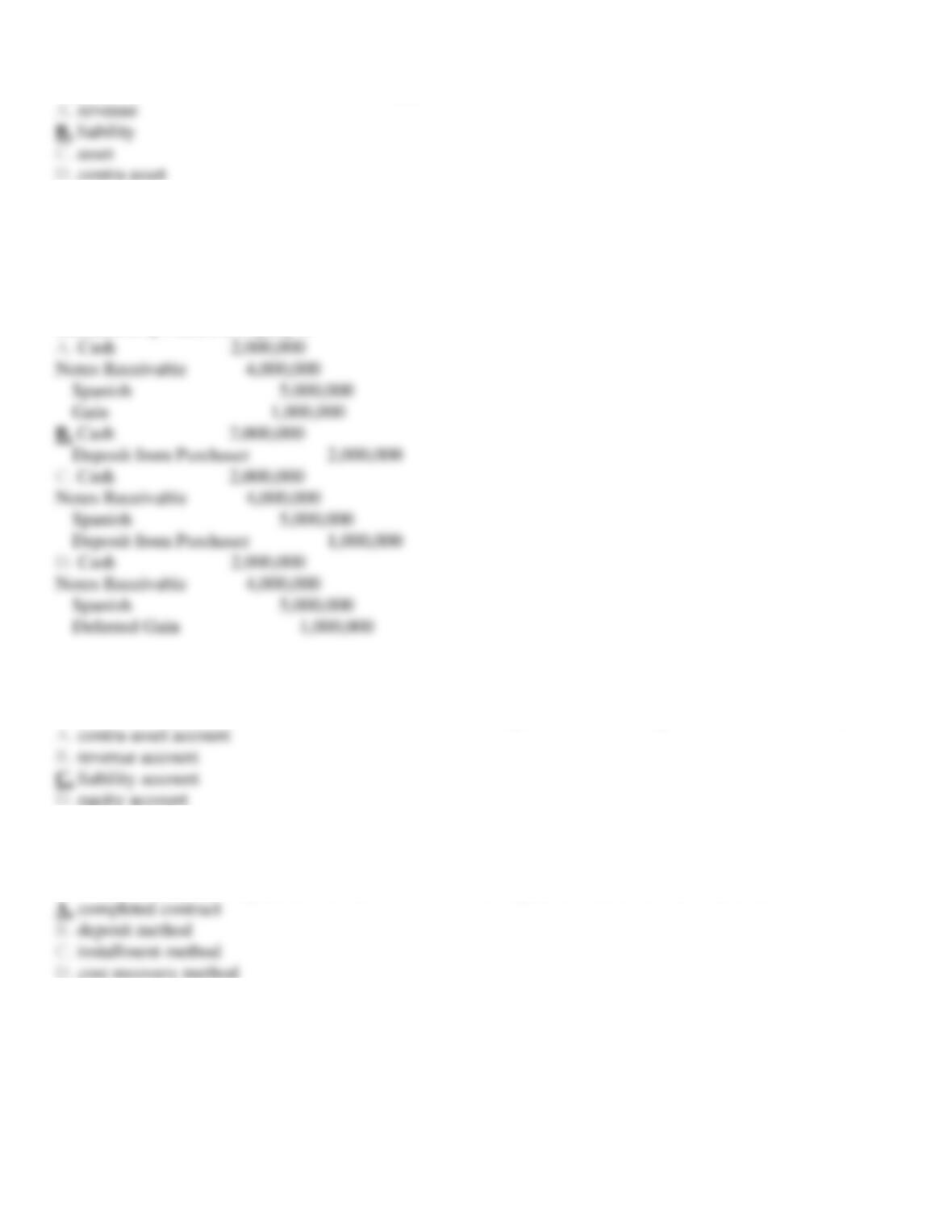
50. When a down payment is received, the deposit from purchaser account used under the deposit method is
reported on the balance sheet of the seller as a(n)
51. French Company sells its subsidiary, Spanish Company, to Italian, Inc. French has net assets of $50 million
and Spanish has net assets of $5 million. The sales price is $2 million down and a 10% note for $4 million.
Italian has the right to cancel over the next year and uses the deposit method. The proper accounting for this
transaction by French Company is
52. If the consignment-in account has a credit balance, it is reported on the consignee’s balance sheet as a(n)
53. Which of the following methods could not be used to recognize revenue on a real estate sale?
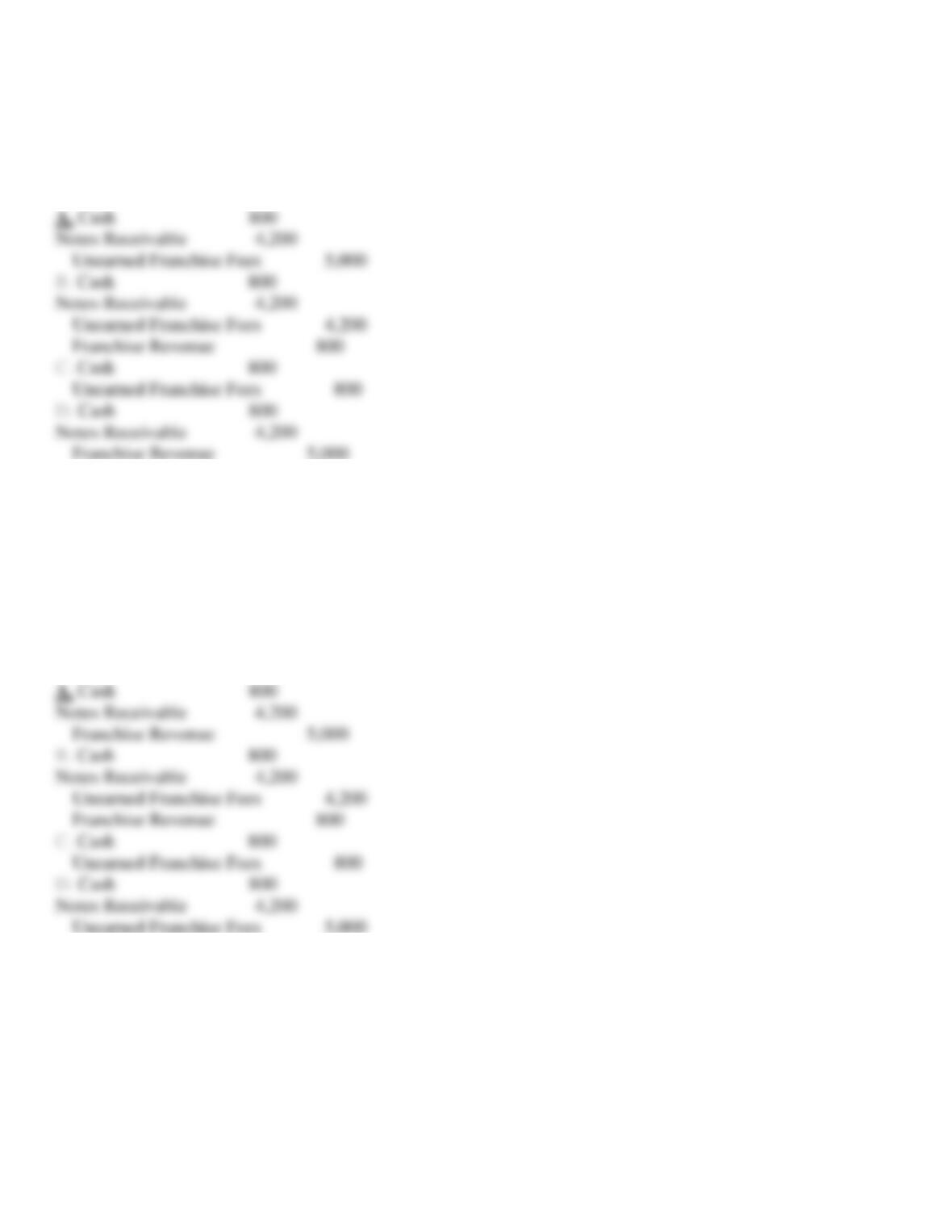
54. Exhibit 18-5
Morris Co. sold a franchise at an initial franchise fee of $5,000. A down payment of $800 was received with the
balance covered by the issuance of a $4,200, 6% note, payable by the franchisee in four equal annual
installments. The refund period has expired and the collectibility of the note is reasonably assured.
Refer to Exhibit 18-5. If all material services have not been substantially performed, which entry to record the
franchise is correct?
55. Exhibit 18-5
Morris Co. sold a franchise at an initial franchise fee of $5,000. A down payment of $800 was received with the
balance covered by the issuance of a $4,200, 6% note, payable by the franchisee in four equal annual
installments. The refund period has expired and the collectibility of the note is reasonably assured.
Refer to Exhibit 18-5. If all material services have been substantially performed, which entry to record the
franchise is correct?
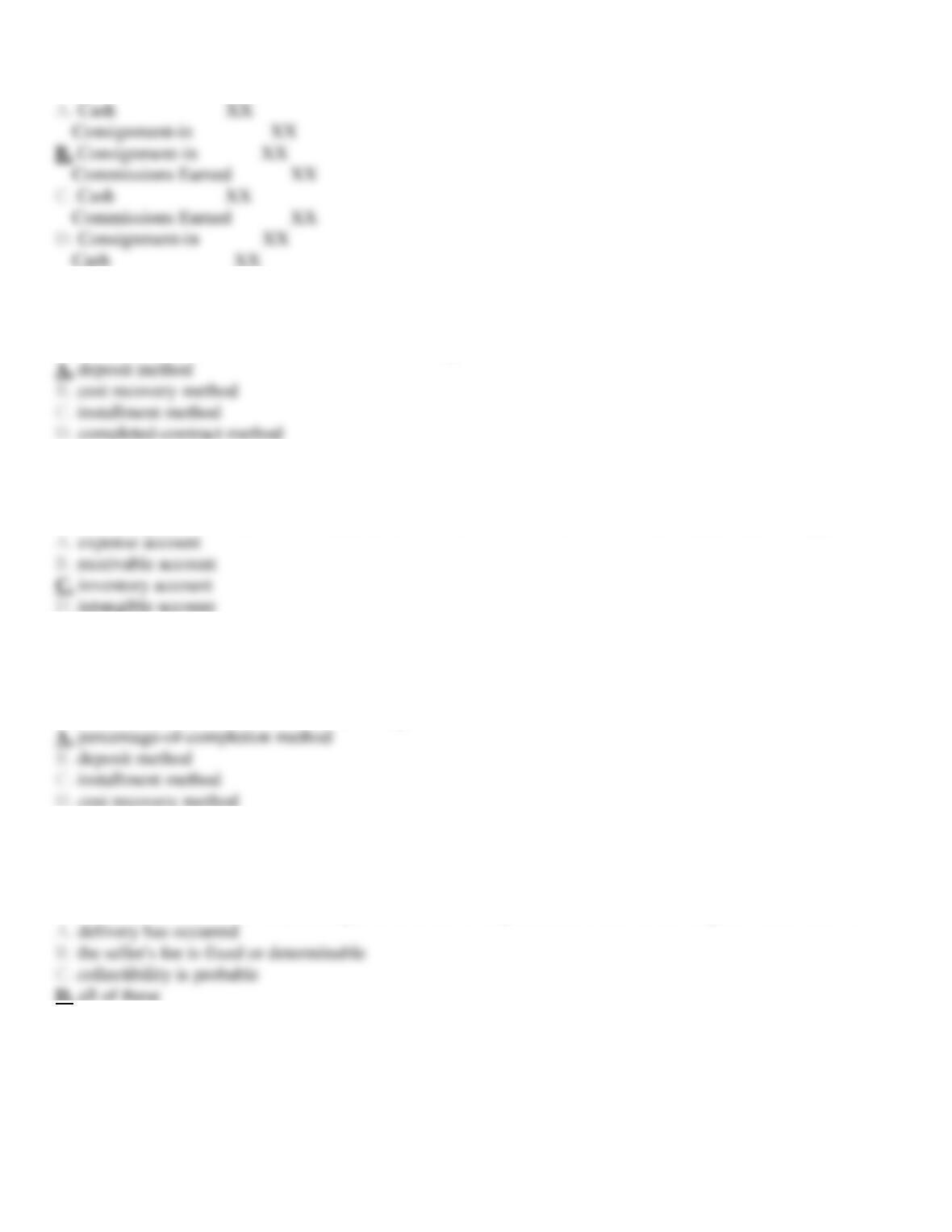
56. The entry that the consignee makes to record the commission earned on a sale of goods held on consignment
is
57. In real estate sales, what method of revenue recognition must be used if the sale is not consummated?
58. If Consignment-out has a debit balance, the account should be disclosed on the balance sheet as a(n)
59. If a company had an agreement to deliver software that requires significant production, modification, or
customization, which method of revenue recognition should it use?
60. If a company has an agreement to deliver software that does not require significant production,
modification, or customization, it recognizes revenue when persuasive evidence of an agreement exists and
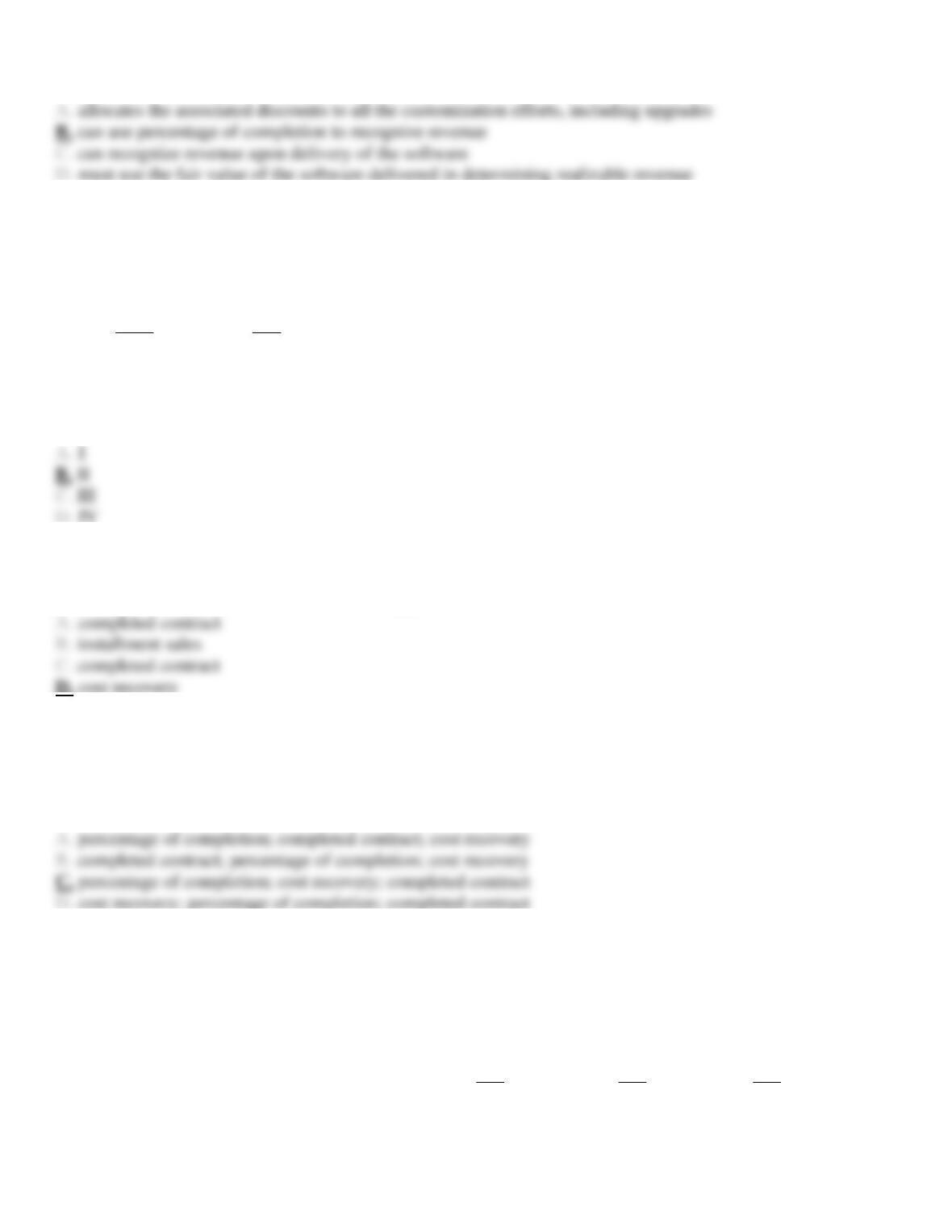
61. Smith sells computer software to Miller that requires significant construction. When recognizing revenue,
Smith
62. Specific industry guidance regarding revenue recognition is prevalent in
GAAP
IFRS
I.
Yes
Yes
II.
Yes
No
III.
No
Yes
IV.
No
No
63. Which method of revenue recognition do IFRS require for construction contracts when the
percentage-of-completion method cannot be applied?
64. IFRS and GAAP will sometimes differ in the method of revenue recognition applied to construction
contracts. Three different methods are involved: percentage of completion, cost recovery, and completed
contract. The fastest to slowest revenue recognition among the methods is
65. Brooksville Construction began a construction project in 2010. The contract price was $1,250,000, and the
estimated costs were $1,000,000. Data for each year of the contract are as follows:
2010
2011
2012
Costs incurred during the year
$250,000
$600,000
$190,000
Estimated costs to complete
750,000
212,500
-0-
Partial billings
375,000
500,000
375,000
Collections
187,500
469,000
593,500