Required:
a.
Assuming Brooksville
uses the
percentage-of-completi
on method of revenue
recognition, determine:
(1)
The balance of Construction in Progress at the end of 2010.
(2)
How the net amount for construction in progress inventory should be reported on the 2011 balance sheet.
(3)
The gross profit for 2012.
b.
Assuming Brooksville
uses the
completed-contract
method of revenue
recognition, determine:
(1)
The balance of Construction in Progress at the end of 2010.
(2)
How the net amount for construction in progress inventory should be reported on the 2011 balance sheet.
(3)
The gross profit for 2012.
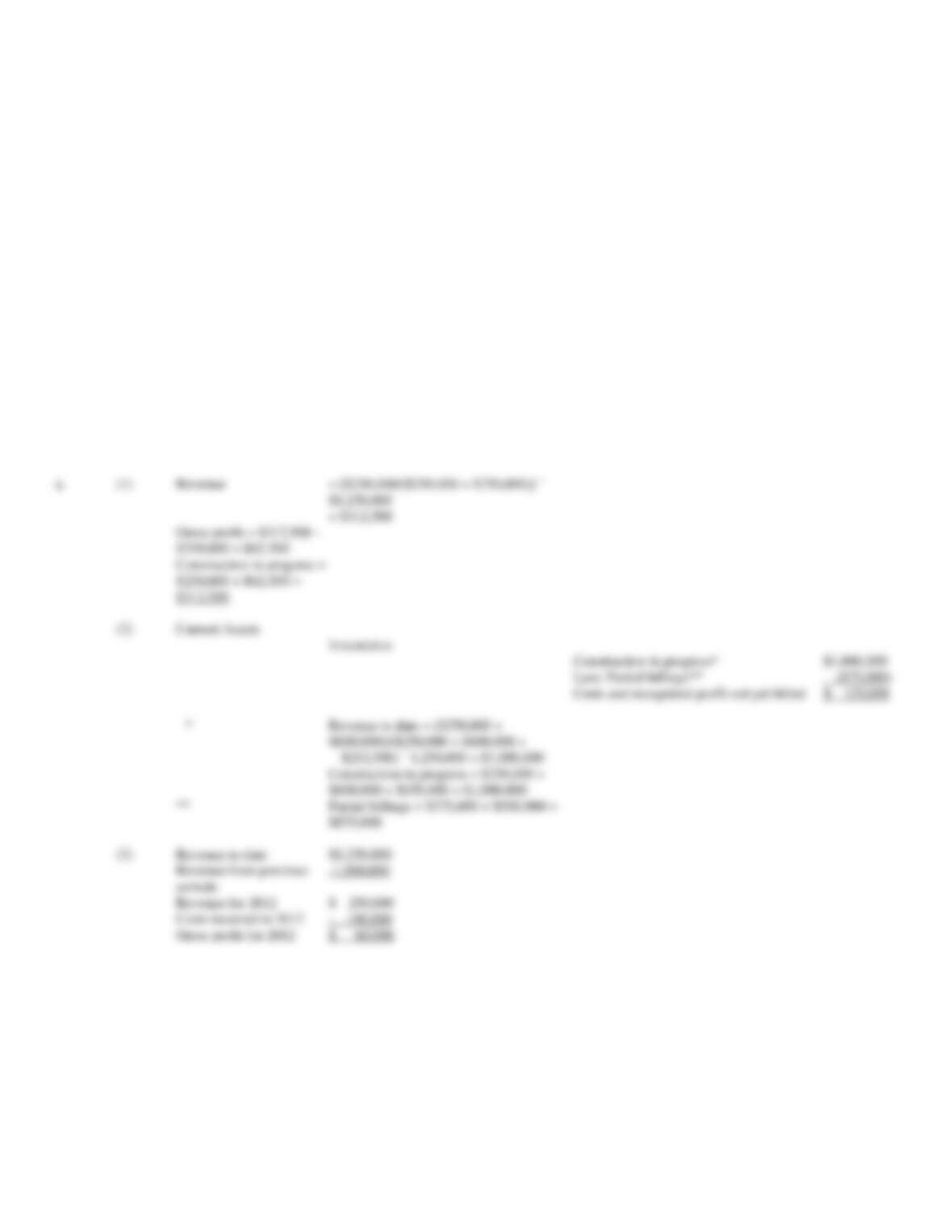
(1)
Revenue
= [$250,000/($250,000 + $750,000)] ´
$1,250,000
= $312,500
Gross profit = $312,500 –
$312,500
(2)
Current Assets
Construction in progress*
$1,000,000
Less: Partial billings**
(875,000)
Costs and recognized profit not yet billed
$ 125,000
*
Revenue to date = ($250,000 +
$212,500) ´ 1,250,000 = $1,000,000
Partial billings = $375,000 + $500,000 =
$875,000
(3)
Revenue to date
$1,250,000
Revenue from previous
-1,000,000
Revenue for 2012
$ 250,000
Costs incurred in 2012
– 190,000
Gross profit for 2012
$ 60,000
66. The Daytona Company is involved in a three-year long-term contract. The following data relate to this
contract:
2010
2011
2012
Total
Contract price
$160,000
Cost incurred each year
$24,000
$24,000
$ 56,000
104,000
Cost incurred to date
24,000
48,000
104,000
Estimated cost to complete
96,000
48,000
0
Partial billings each year
12,000
48,000
100,000
Cash collected from billings
8,000
52,000
100,000
Required:
Prepare the journal entries to reflect the percentage-of-completion method for each of the following:
2011 Entries
a.
Construction costs for the year.
b.
Partial billings.
c.
Cash collections.
d.
Gross profit.
2012 Entries
a.
Construction costs for the year.
b.
Partial billings.
c.
Cash collections.
d.
Gross profit and closing of construction accounts.
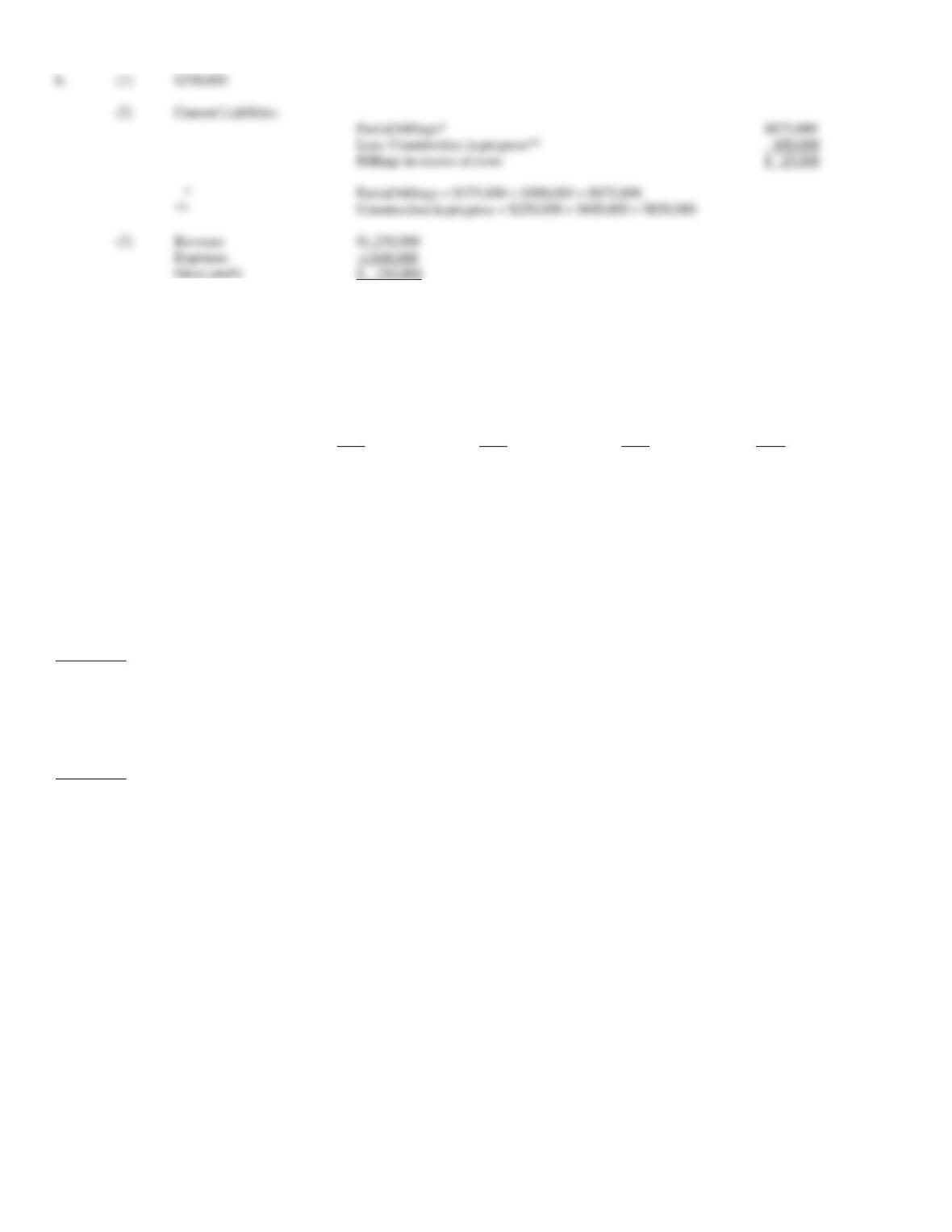
b.
(1)
$250,000
(2)
Current Liabilities
Partial billings*
Less: Construction in progress**
Billings in excess of costs
$ 25,000
*
Partial billings = $375,000 + $500,000 = $875,000
Construction in progress = $250,000 + $600,000 = $850,000
(3)
Revenue
$1,250,000
Expenses
-1,040,000
Gross profit
$ 210,000
67. Oldsmar Construction Co. signed a contract to build a road over a period of three years for a price of
$600,000. Information relating to the performance of the contract is summarized below:
2010
2011
Construction costs incurred during the year
$110,000
$226,000
Estimated costs to complete
330,000
224,000
Billings during the year (all collected in cash)
100,000
290,000
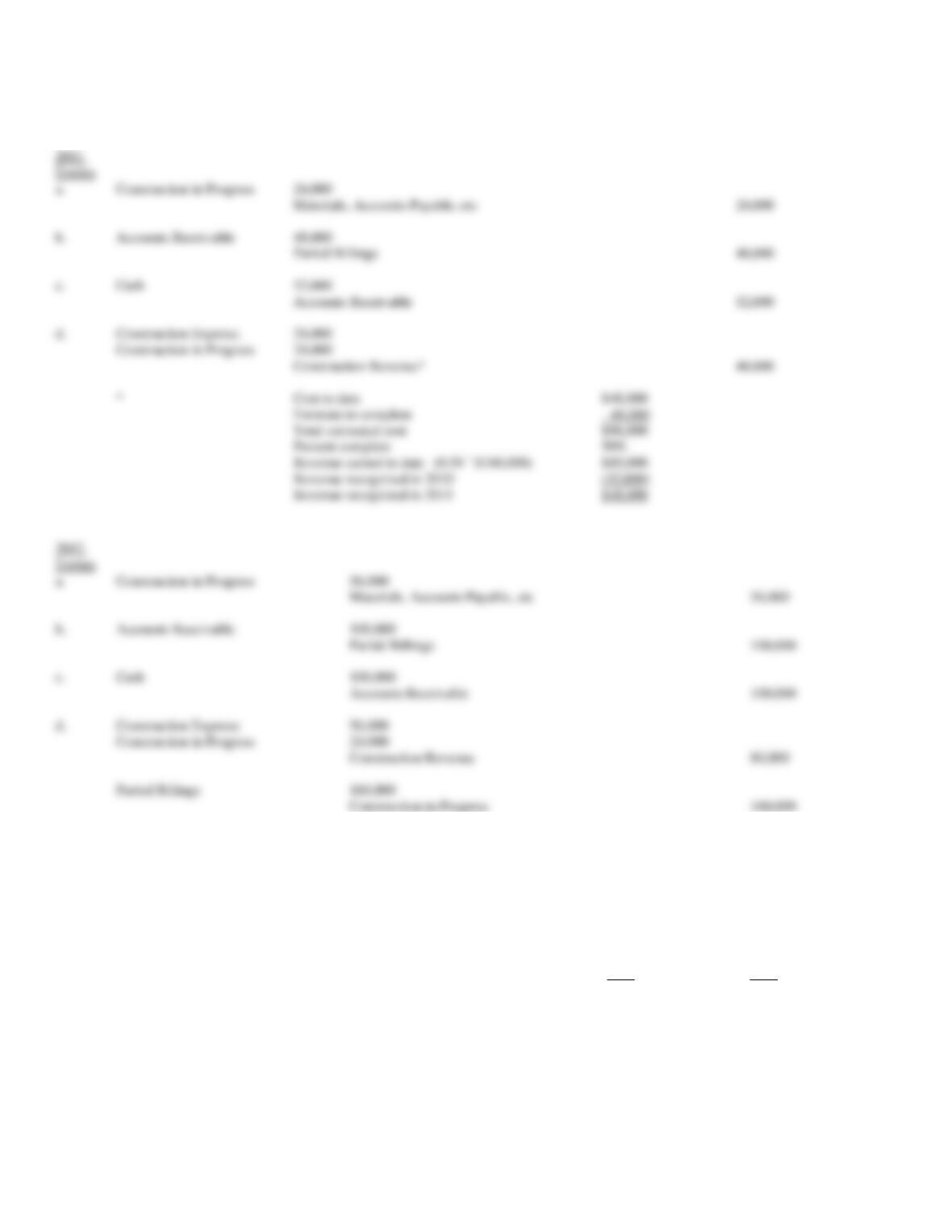
Entries
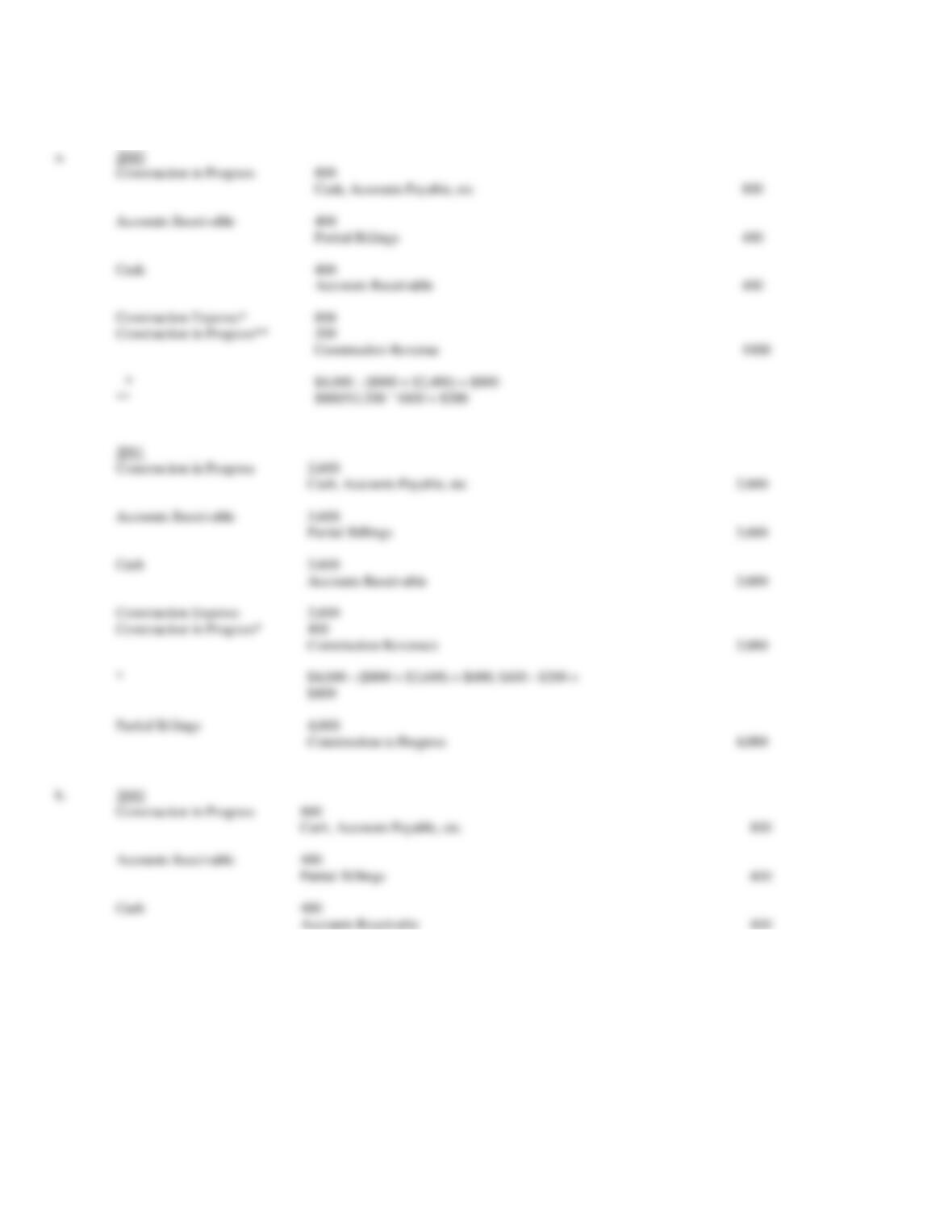
Construction in Progress
24,000
Materials, Accounts Payable, etc
24,000
Accounts Receivable
48,000
Partial Billings
48,000
Cash
52,000
Accounts Receivable
52,000
Construction Expense
24,000
Construction in Progress
24,000
Construction Revenue*
48,000
*
Cost to date
$48,000
Estimate to complete
48,000
Total estimated cost
$96,000
Percent complete
50%
Revenue earned to date (0.50 ´ $160,000)
$80,000
Revenue recognized in 2010
(32,000)
Revenue recognized in 2011
$48,000
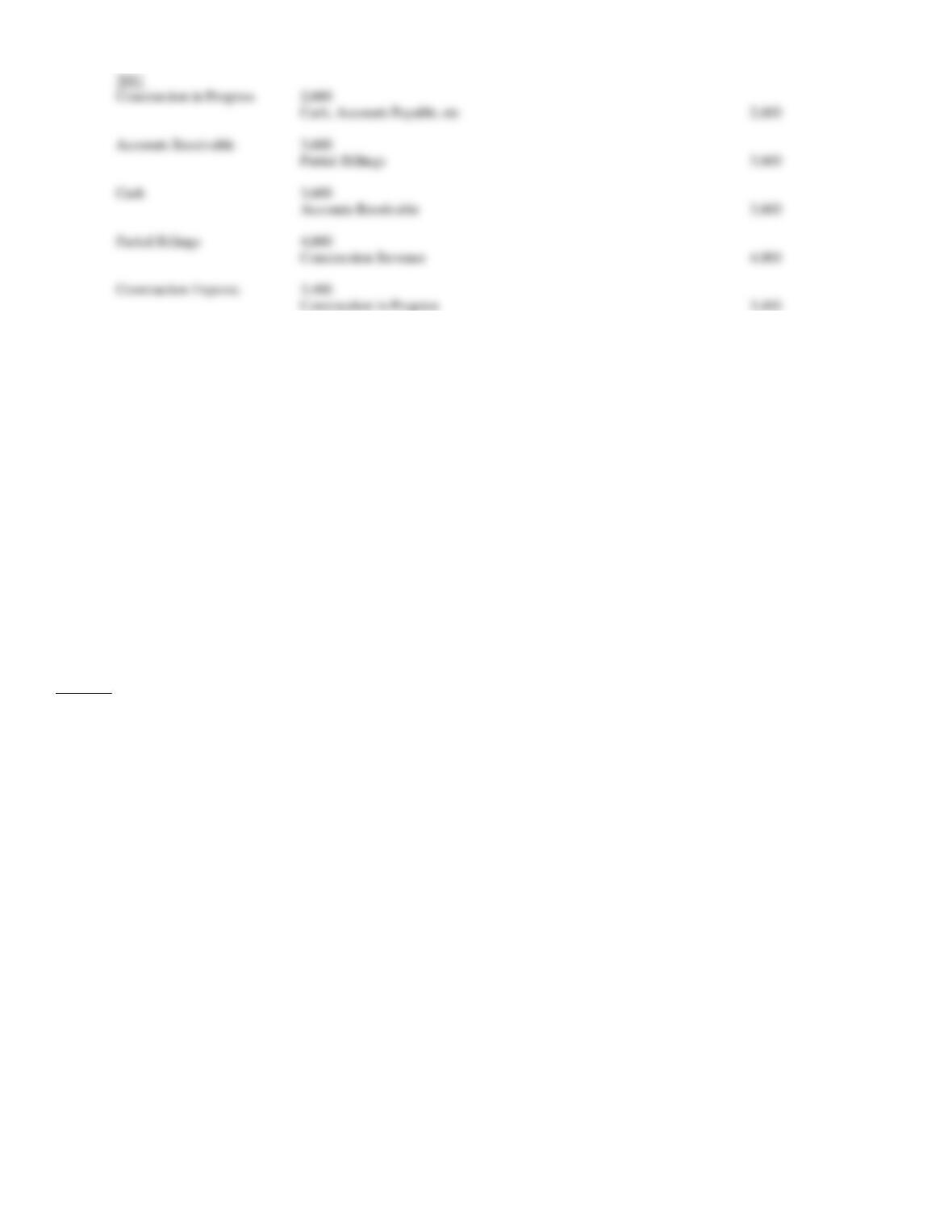
Entries
Construction in Progress
56,000
Materials, Accounts Payable, etc
56,000
Accounts Receivable
100,000
Cash
100,000
Accounts Receivable
100,000
Construction Expense
56,000
Construction in Progress
24,000
Construction Revenue
80,000
Partial Billings
160,000
Construction in Progress
160,000
Required:
a.
Assuming the percentage-of-completion method was in use, show how Construction in Progress would be disclosed on the balance
sheet at December 31, 2010.
b.
Assuming the percentage-of-completion method was in use, prepare all 2011 entries.
c.
Assume that the completed-contract method was in use and that the project was completed in 2012, during which time additional
construction costs of $220,000 were incurred and the remaining $210,000 was billed. Present just the two project completion revenue
and expense recognition entries.
68. Tallahassee Builders, Inc. signed a contract to build a certain project for $4,000. In 2010, $800 of cost was
incurred and $400 was billed to the customer and collected. At the end of 2010, it was estimated that it would
take $2,400 to complete the project. In 2011, actual additional costs to complete the project amounted to $2,600.
The remainder of the contract price was billed in 2011 and collected.
Required:
Prepare all journal entries for both years assuming the use of the:
a.
Percentage-of-completion method.
b.
Completed-contract method.
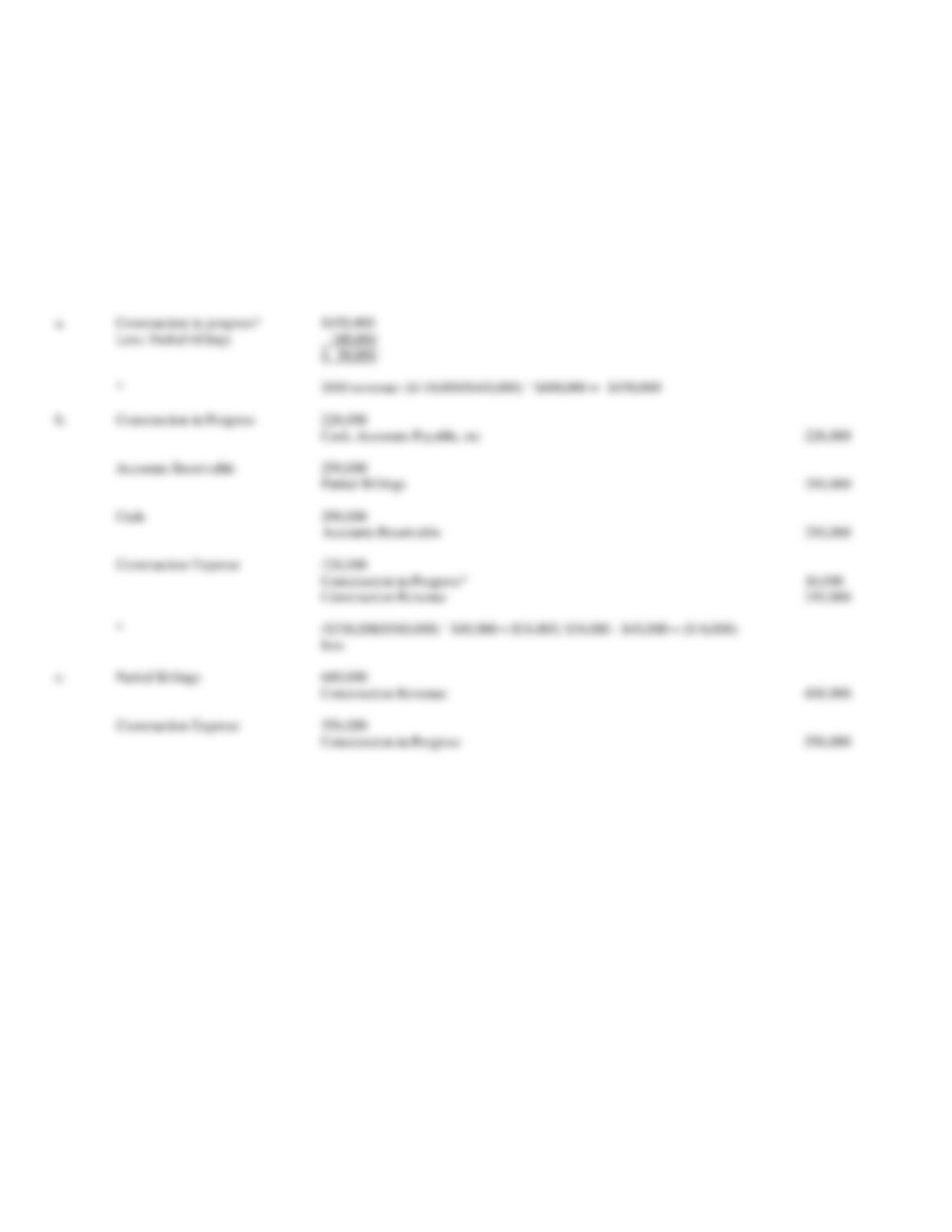
a.
Construction in progress*
$150,000
Less: Partial billings
100,000
*
2010 revenue: ($110,000/$440,000) ´ $600,000 = $150,000
Cash, Accounts Payable, etc
226,000
Accounts Receivable
290,000
Cash
290,000
Accounts Receivable
290,000
Construction Expense
226,000
Construction in Progress*
16,000
Construction Revenue
210,000
*
($336,000/$560,000) ´ $40,000 = $24,000; $24,000 – $40,000 = ($16,000)
Construction Revenue
600,000
Construction Expense
556,000
69. Lake City, Inc. sold 800 contracts at $400 each. Each contract permitted the buyer to use a tin pincher 16
times and a glass finisher 20 times. Cost information follows:
Initial direct costs
$8,000
Annual indirect costs
5,000
Direct cost per service use:
Tin pincher
4
Glass finisher
60
In the first year, the tin pincher was used 4,500 times and the glass finisher was used 4,800 times.
Required:
Fill in the lines below.
First Year
Revenue
(a) ___________
Less:
Initial direct costs
(b) ___________
Additional direct costs
(c) ___________
Indirect costs
(d) ___________
2011
Construction in Progress
2,600
Cash, Accounts Payable, etc
2,600
Accounts Receivable
3,600
Partial Billings
3,600
Cash
3,600
Accounts Receivable
3,600
Partial Billings
4,000
Construction Revenue
4,000
Construction Expense
3,400
Construction in Progress
3,400
70. Gainesville Gym sold 300 contracts at $230 each. Each contract permitted the buyer to use a tanning bed 12
times and a whirlpool 16 times. Cost information follows:
Initial direct costs
$1,000
Annual indirect costs
600
Direct cost per service use:
Tanning bed
7
Whirlpool
3
In the first year, customers used the tanning bed 2,160 times and the whirlpool 900 times.
Required:
Compute the amount of revenue that should be recognized in the first year.
Total direct costs:
300 ´ 12 ´ $7 =
$25,200
300 ´ 16 ´ $3 =
14,400
$39,600
Direct costs, first year:
2,160 ´ $7 =
$15,120
900 ´ $3 =
2,700
$17,820
($17,820/$39,600) ´ 300 ´ $230 =
$ 31,050
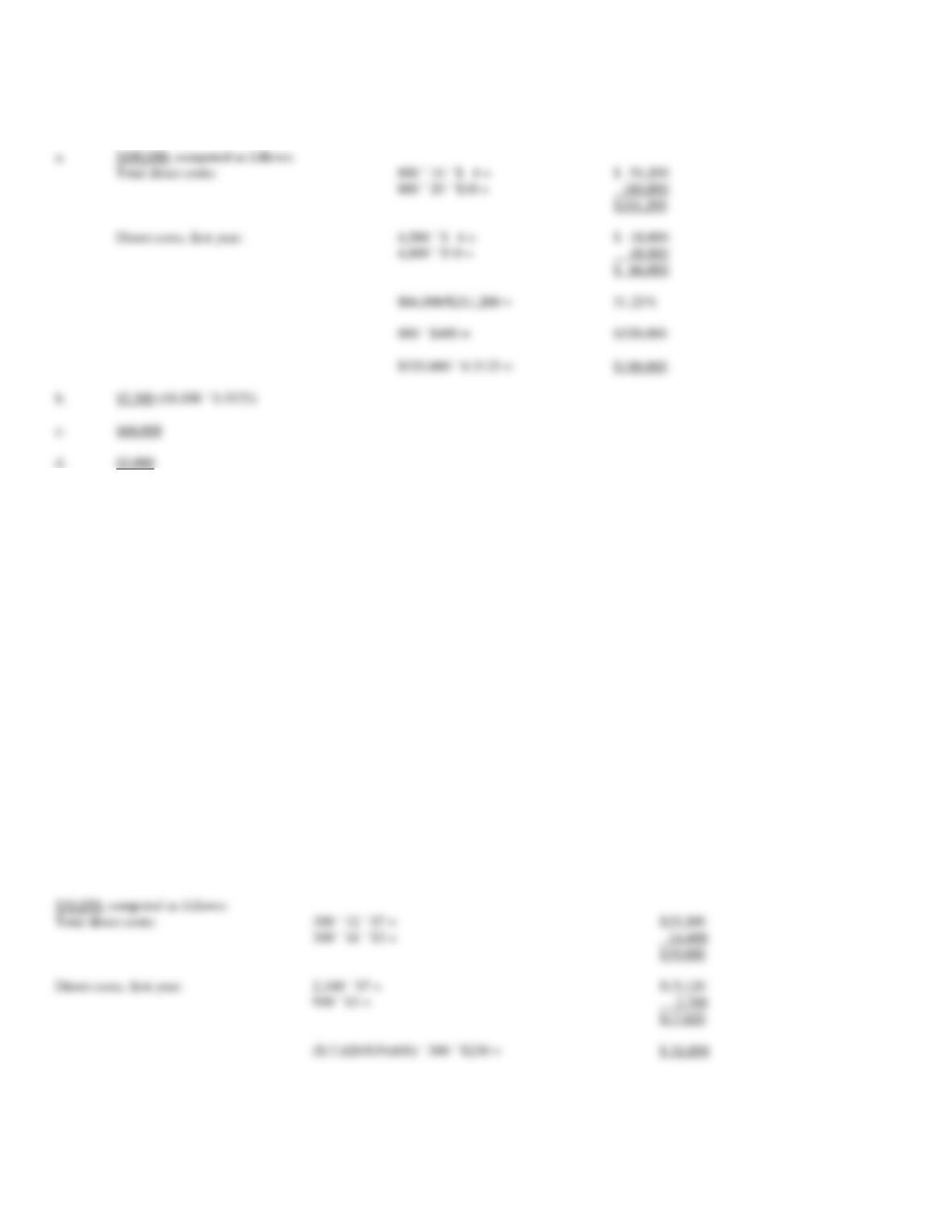
$100,000, computed as follows:
Total direct costs:
800 ´ 16 ´ $ 4 =
$ 51,200
800 ´ 20 ´ $10 =
160,000
$211,200
Direct costs, first year:
4,500 ´ $ 4 =
$ 18,000
4,800 ´ $10 =
48,000
$ 66,000
$66,000/$211,200 =
31.25%
800 ´ $400 =
$320,000
$320,000 ´ 0.3125 =
$100,000
$2,500 ($8,000 ´ 0.3125)
$66,000
$5,000
71. Homestead Corporation incurred the following activity during its first two years of operations:
2010
2011
Total credit sales
$750,000
$900,000
Installment sales*
300,000
450,000
Total cost of sales
500,000
540,000
Installment cost of sales**
165,000
270,000
Cash receipts on installment sales:
2010 sales
75,000
105,000
2011 sales
-0-
120,000
*
Included in total credit sales.
**
Included in total cost of sales.
Required:
Determine the following items for both 2010 and 2011:
a.
Gross profit realized on installment sales.
b.
Total gross profit.
c.
Net amount for installment accounts receivable shown on the balance sheet.
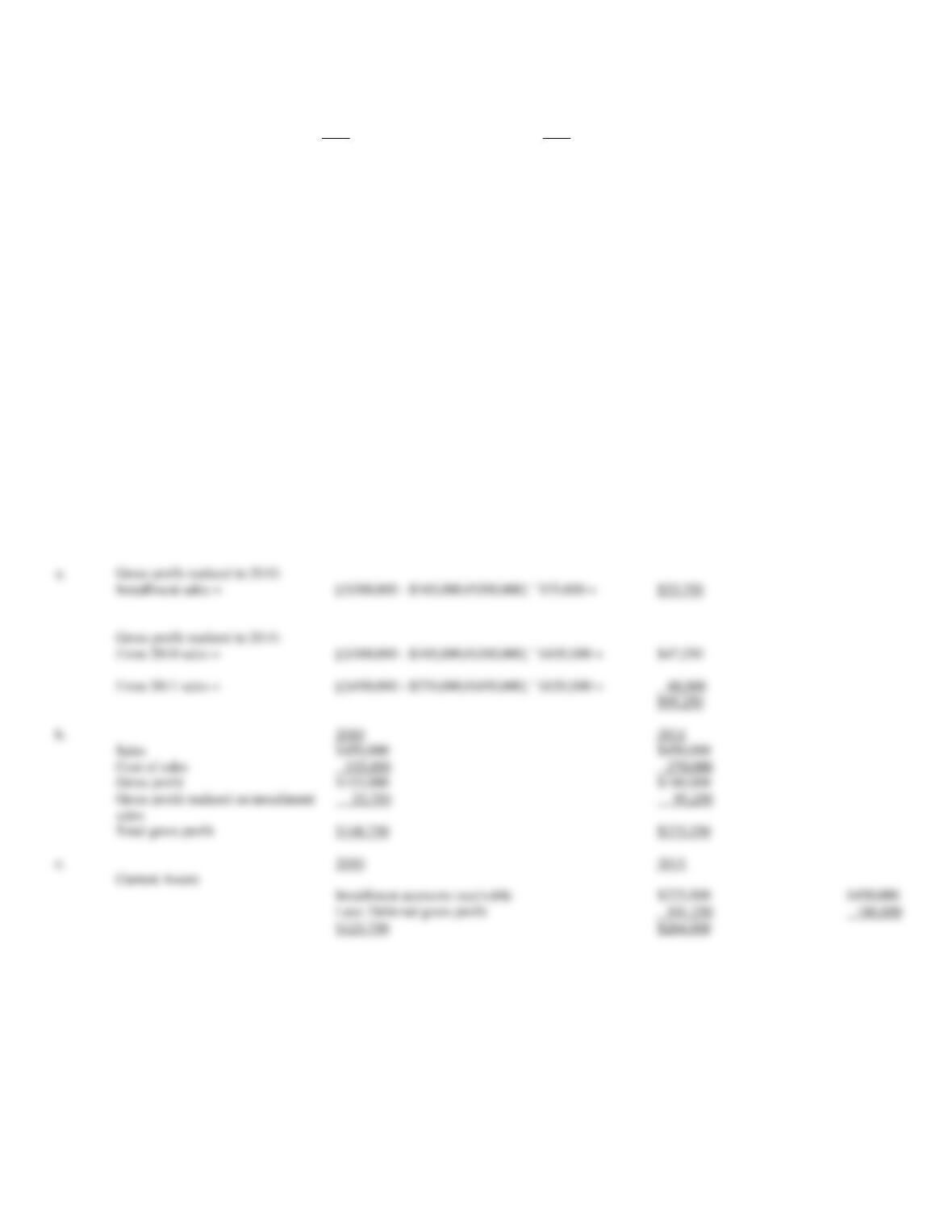
Gross profit realized in 2010:
Installment sales =
[($300,000 – $165,000)/$300,000] ´ $75,000 =
$33,750
Gross profit realized in 2011:
From 2010 sales =
[($300,000 – $165,000)/$300,000] ´ $105,000 =
$47,250
From 2011 sales =
[($450,000 – $270,000)/$450,000] ´ $120,000 =
48,000
$95,250
b.
2010
2011
Sales
$450,000
$450,000
Cost of sales
335,000
270,000
Gross profit
$115,000
$180,000
Total gross profit
$148,750
$275,250
c.
2010
2011
Current Assets
Installment accounts receivable
$225,000
Less: Deferred gross profit
101,250
186,000
$123,750
$264,000
72. Destin Company sold an asset for $450,000 during 2010, its first year of operations. The asset cost Destin
$300,000, and the sale was recorded using the cost recovery method. Cash collections were as follows:
$100,000 in 2010; $200,000 in 2011; and $150,000 in 2012.
Required:
a.
Prepare all journal entries connected with the sale for all three years.
b.
Show how the net amount of the accounts receivable would be disclosed on the 2011 balance sheet.
73. Ocala Company sold items only on the installment plan in 2010 and 2011. Additional information follows:
2010
2011
Sales
$108,000
$144,000
Cost of goods sold
88,560
103,680
Cash receipts on installment method sales
2010 sales
36,000
54,000
2011 sales
-0-
45,000
a.
2010
Accounts Receivable
450,000
Deferred Gross Profit
150,000
Asset
300,000
Cash
100,000
Accounts Receivable
100,000
2011
Cash
200,000
Accounts Receivable
200,000
2012
Cash
150,000
Accounts Receivable
150,000
Deferred Gross Profit
150,000
Gross Profit Realized on Cost Recovery
Transactions
150,000
b.
Accounts receivable
$150,000
Less: Deferred gross profit
(150,000)
$ -0-
Required:
Prepare the December 31, 2010 and 2011, adjusting entries to recognize the gross profit realized on installment sales.
74. Ft. Myers Co. began business on January 1, 2010. The company uses the installment method. Additional
information follows:
2010
2011
Installment sales
$160,000
$184,000
Cost of installment sales
136,000
158,240
General and administrative expenses
20,000
8,400
Cash receipts on installment method sales
2010 sales
40,000
89,600
2011 sales
—
36,800
December 31, 2010
Deferred Gross Profit, 2010*
6,480
December 31, 2011
Deferred Gross Profit, 2010*
9,720
Deferred Gross Profit, 2011**
12,600
Gross Profit Realized on Installment Plan
22,320
*
18% ´ $54,000 = $9,720
Required:
Compute the balance of Deferred Gross Profit at December 31, 2011.
75. Marco, Inc. repossessed an item in 2010 with a gross profit of 15%. The fair value of the repossessed item
was $3,600. The amount still unpaid was $5,000.
Required:
Prepare the journal entry to record the repossession of this item.
Repossessed Inventory
3,600
Deferred Gross Profit (0.15 ´ $5,000)
750
Allowance for Doubtful Installment Accounts Receivable
650
76. On January 1, 2010, Panama City Realty sold land for $2,000 that had originally cost $1,600. A 5% down
payment was received. Further cash collections were as follows:
2011
$ 600
2012
1,200
2013
100
Gross profit percentages:
2010: $136,000/$160,000 = 85%; 100% – 85% = 15%
2011: $158,240/$184,000 = 86%; 100% – 86% = 14%
To deferred gross profit:
2010: $160,000 – $136,000 =
$24,000
2011: $184,000 – $158,240 =
25,760
$49,760
Gross profit realized:
0.15 ´ $40,000 =
$ 6,000
0.15 ´ $89,600 =
13,440
$24,592
Required:
a.
Compute the amount of realized profit for the
year indicated under each method shown below:
Method
Year
Profit Realized
Full accrual
2011
___________
Installment
2012
___________
Cost recovery
2013
___________
b.
If the deposit method had been in use in 2010,
prepare the journal entry to record the receipt of
the down payment.
77. Palm Beach Products Co., a consignee, received inventory items on consignment. The cost of these goods
was $2,000. Palm Beach paid reimbursable advertising costs of $250. The goods were sold for $3,700, and
Palm Beach earned a 20% commission on the sales price. Palm Beach paid the consignor the amount due.
Required:
Prepare journal entries to record the information above.
Cash
Cash
3,700
3,700
Commissions Earned (.20 ´ $3,700)
Consignment-in (-$250 + $3,700 – $740)
2,710
Method
Year
Profit Realized
Full accrual
2011
Installment
2012
Cost recovery
2013
All profit recognized in 2010
($1,200/$2,000) ´ $400 = $240
Cash
Deposit from Purchaser
78. Palatka, Inc. sold a franchise that required an initial franchise fee of $16,000. A 20% down payment was
required, and the balance was covered by the issuance of a 6% note, payable by the franchisee in ten equal
annual installments. The collectibility of the note was reasonably assured.
Required:
Prepare the appropriate journal entry to record this franchise fee if:
a.
The refund period had expired but all material services had not been substantially performed by the franchisor.
b.
The refund period had expired and the franchisor had performed all material services for the franchisee.
c.
The refund period had expired, the down payment represents payment for material services performed, and material services remain to
be performed.
79. Your friend, a college marketing major, has started a marketing research consulting firm. He has already
started working for his first client. When setting up his accounting system he wants to fully understand the
theoretical issues associated with recording revenue. What do you advise?
a.
Cash
3,200
Notes Receivable
12,800
Unearned Franchise Fees
16,000
b.
Cash
3,200
Notes Receivable
12,800
Franchise Revenue
16,000
c.
Cash
3,200
Franchise Revenue
3,200
80. A new construction company owner comes to you for advice on how to account for the first long-term
construction project his company has been awarded. He is under the impression that he can use either the
completed-contract or the percentage-of-completion methods in all circumstances.
Required:
Explain to your client when each method is required.
81. You are conducting a seminar for health spa accountants on how to determine net income for long-term
service contracts using the proportional performance method.
Required:
a.
Describe the different ways revenue can be recognized on long-term service contracts using proportional performance.
b.
Discuss how the different types of long-term service contract costs are recognized as expenses.
Reasonably dependable estimates can be made of the extent of progress toward completion, contract revenues, and contract costs.
The buyer can be expected to satisfy its obligations under the contract.
The contractor can be expected to perform its contractual obligations.
82. A client in the retail industry has come to you for an explanation. The client’s company offers installment
sales contracts to some of its customers, and the client believes that the installment method of revenue
recognition must be the only way to account for such contracts.
Required:
Explain the difference between installment sales contracts and the installment method of revenue recognition.
83. A client in the software industry comes to you for an explanation of how to recognize revenue from the sale
of software. The company does not provide any services related to the software, but has agreements to deliver
software.
Required:
Explain how the presence or absence of significant production, modification, or customization affects revenue
recognition for agreements to deliver software.
84. IFRS provide guidance that differs from GAAP regarding the procedures to use in construction contracts’
future costs estimates. Discuss how the treatments differ.