116) Beasley Crossing prepares its financial statements in accordance with International
Financial Reporting Standards (IFRS). The company issued shares of the company’s Class B
stock. Beasley Crossing should report the stock in the company’s statement of financial position:
A) among liabilities unless the shares are mandatorily redeemable.
B) among liabilities if the shares are mandatorily redeemable or redeemable at the option of the
shareholder.
C) as equity unless the shares are mandatorily redeemable.
D) as equity unless the shares are redeemable at the option of the issuer.
117) The typical rights of preferred shares usually include:
A) the right to vote.
B) a preference to a predesignated amount of dividends, that is, a stated dollar amount per share
or percent of par per share.
C) a preference over common shareholders and lenders in the distribution of assets in the event
the corporation is dissolved.
D) the “preemptive right” to maintain one’s percentage share of ownership when new shares are
issued.
118) The statement of shareholders’ equity reports the transactions that cause changes in its
shareholders’ equity account balances. It shows the beginning and ending balances in primary
shareholders’ equity accounts and any changes that occur during the years reported. Typical
reasons for changes include each of the following except:
A) the sale of additional shares of stock.
B) the issuance of bonds.
C) net income.
D) declaration of dividends.
119) Red Inc. issues shares of stock with a par amount of $1 per share in exchange for a
machine. In accounting for the transaction:
A) If fair values of the stock and machine are unavailable, the stock should be recorded at its par
amount.
B) The stock is recorded at its par amount unless the fair value of the machine is readily
available.
C) Both the stock and machine are recorded at the fair value of the stock or the fair value of the
machine, whichever is more clearly determinable.
D) The machine should not be depreciated because the stock has no term to maturity.
120) Retained earnings might be reduced by each of the following except:
A) stock split not effected in the form of a stock dividend.
B) property dividend.
C) treasury stock.
D) cash dividend.
121) In 2018, Brock Lee Vegetables, issued $1 par value common stock for $30 per share. No
other common stock transactions occurred until March 31, 2020, when Brock Lee acquired
some of the issued shares for $25 per share and retired them. Which of the following statements
is true for this acquisition and retirement?
A) 2020 net income is decreased.
B) 2020 net income is increased.
C) Additional paid-in capital is increased.
D) Retained earnings is increased.
122) C. Worthy Ships initially issued 300,000 shares of $1 par stock for $1,500,000 in 2018. In
2020, the company repurchased 30,000 shares for $300,000. In 2021, 15,000 of the repurchased
shares were resold for $240,000. In its balance sheet dated December 31, 2021, C. Worthy’s
treasury stock account shows a balance of:
A) $ 0
B) $ 60,000
C) $150,000
D) $300,000
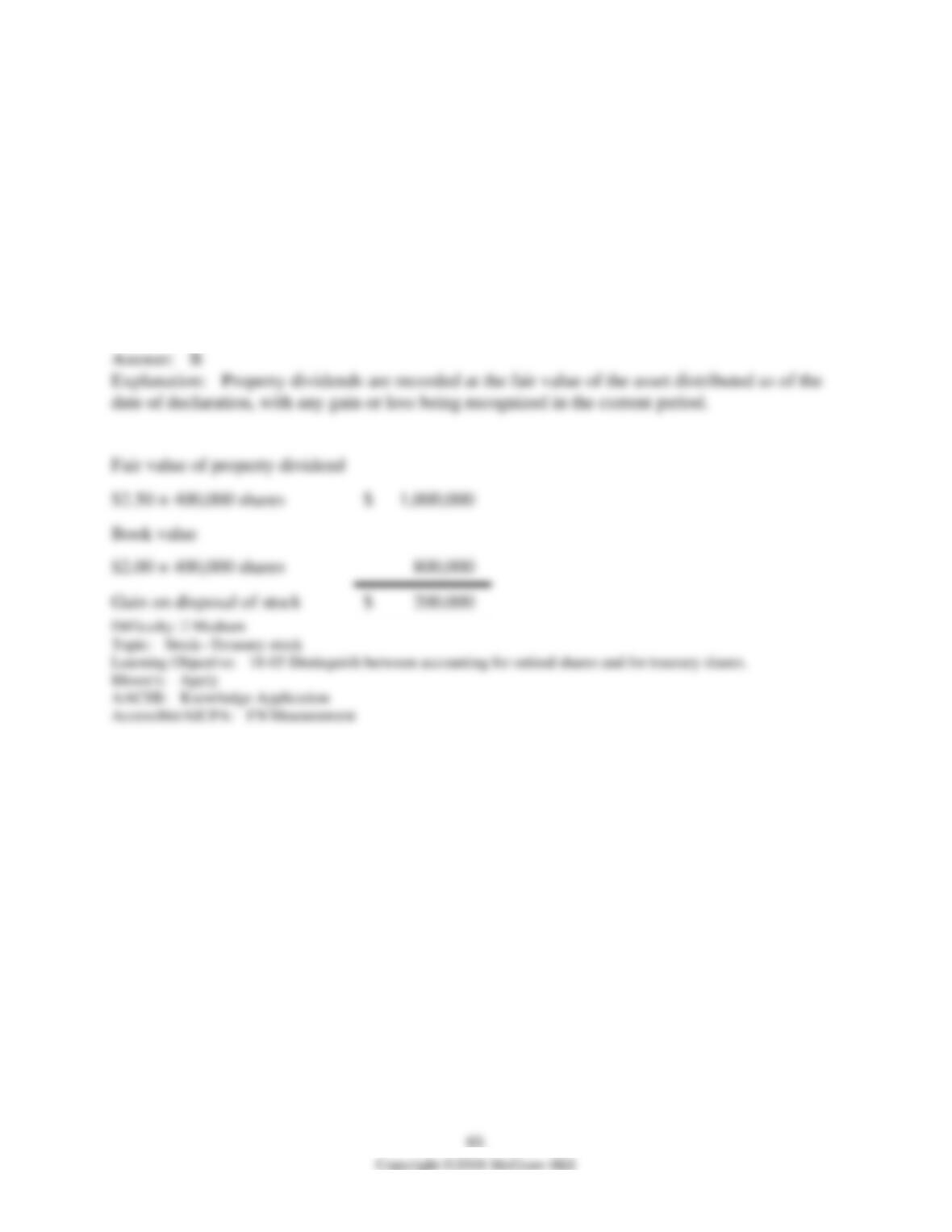
123) On June 27, 2018, Cara Van Travel distributed to its common shareholders 400,000
outstanding common shares of its investment in Constance Noring Pillows. The book value on
Van’s books of Noring’s $1 par common stock was $2 per share. Immediately after the
distribution, the market price of Noring’s stock was $2.50 per share. In its income statement for
the year ended June 30, 2020, what amount should Noring report as gain on disposal of the stock
(ignore taxes)?
A) $0
B) $200,000
C) $800,000
D) $1,000,000
124) Dan Druff Shampoo has 1,000,000 shares of common stock authorized with a par value of
$1 per share, of which 500,000 shares are outstanding. When the market value was $9 per share,
Druff issued a stock dividend by which for each ten shares held, one share was issued as a stock
dividend. The par per share did not change. What entry did Druff record for this transaction?
A)
Retained earnings
50,000
Common stock
50,000
B)
Paid-in capital—excess of par
50,000
Common stock
50,000
C)
Retained earnings
450,000
Common stock
50,000
Paid-in capital—excess of par
400,000
D)
Paid-in capital—excess of par
450,000
Common stock
50,000
Retained earnings
400,000
125) When a company issues a stock dividend of any size, which of the following would be
affected?
A) Earnings per share.
B) Total stockholders’ equity.
C) Total liabilities.
D) Total assets.
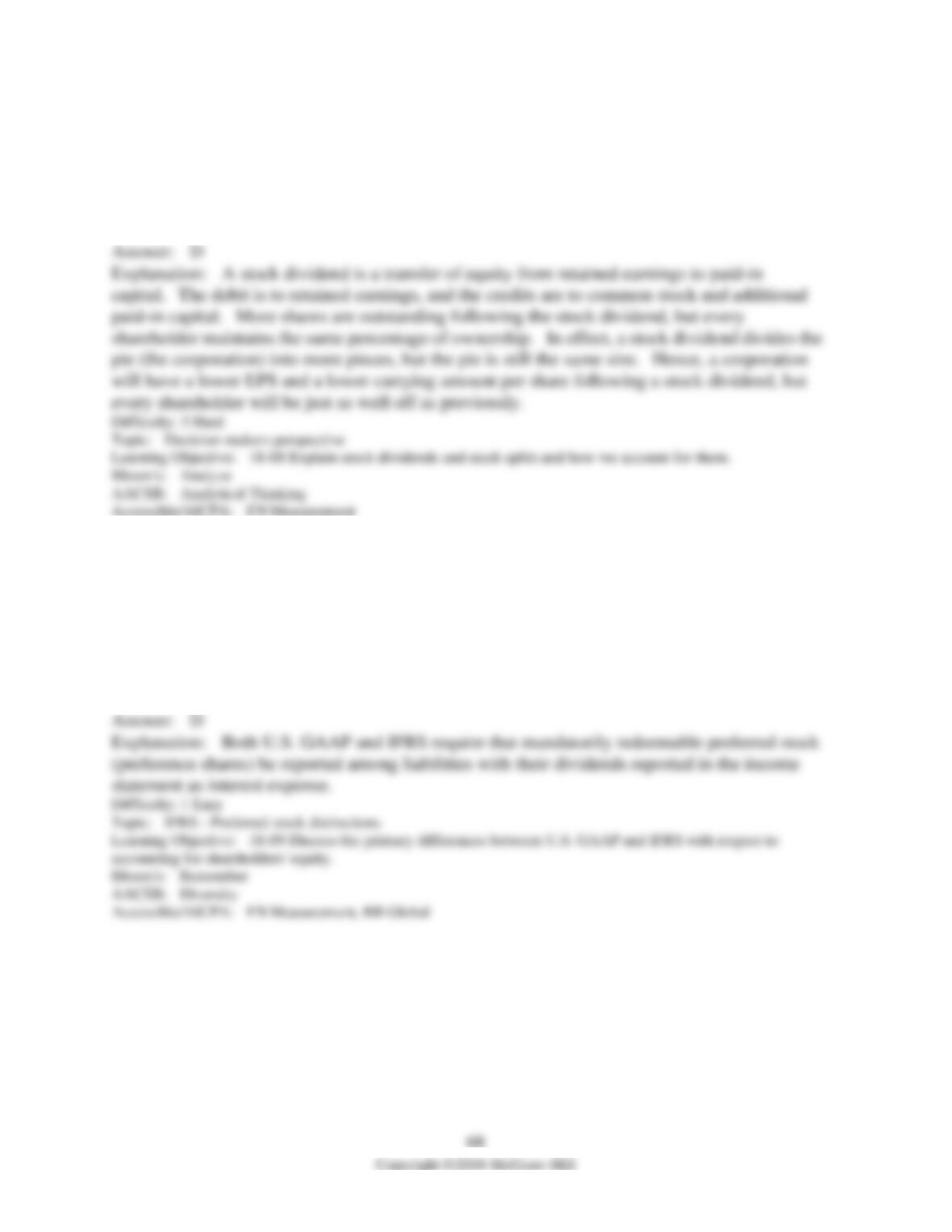
126) Doug Graves Cemetery had 50,000 shares of common stock issued and outstanding at
January 1, 2018. During 2018, Graves took the following actions:
June
1
Declared a 2-for-1 stock split, when the fair value of the stock was
$25 per share.
October
15
Declared a $0.40 per share cash dividend.
In Graves’s statement of shareholders’ equity for 2018, what amount should Graves report as
dividends?
A) $20,000
B) $40,000
C) $60,000
D) $90,000
Jan. 1 Shares issued and outstanding
June 1 2-for-1 stock split
×
June 1 Shares issued and outstanding
100,000
Oct. 15 Cash dividend declared (per share)
×
$
Dividends for the year
$
127) A stock split:
A) increases the debt to equity ratio.
B) decreases the debt to equity ratio.
C) decreases the size of the firm.
D) decreases future earnings per share.
128) Mandatorily redeemable preferred stock (mandatorily redeemable preference shares) is
reported among liabilities with related dividends reported in the income statement as interest
expense using:
A) IFRS.
B) U.S. GAAP.
C) Neither U.S. GAAP nor IFRS.
D) Both U.S. GAAP and IFRS.
129) Net income and other comprehensive income can be reported in a single statement of
comprehensive income using:
A) IFRS.
B) U.S. GAAP.
C) Neither U.S. GAAP nor IFRS.
D) Both U.S. GAAP and IFRS.
Listed below are five terms followed by a list of phrases that describe or characterize each of the
terms. Match each phrase with the correct term.
A) A debit balance for retained earnings.
B) A stock split in the form of a stock dividend.
C) Follows retained earnings in a balance sheet.
D) Associated with retiring stock.
E) A feature that could increase the dividend yield on preferred stock.
130) Participating
131) Paid-in capital–share repurchase
132) Deficit
133) Accumulated other comprehensive income
134) Large stock dividend
Listed below are five terms followed by a list of phrases that describe or characterize each of the
terms. Match each phrase with the correct term.
A) May be increased when net income increases.
B) A feature of preferred stock.
C) May be reduced when shares are retired.
D) Designed to increase the market value of stock.
E) Reduces the net proceeds from selling shares.
135) Cumulative
136) Share issue cost
137) Earnings-price ratio
138) Retained earnings
139) Reverse stock split
Listed below are five terms followed by a list of phrases that describe or characterize each of the
terms. Match each phrase with the correct term.
A) Similar to an S corporation, but no limit on number of owners.
B) Net income as a percentage of average book value.
C) Paid-in capital and/or retained earnings affected when sold.
D) Preferred practice is to disclose in the notes to the financial statements.
E) Used in evaluating stock performance.
140) Treasury stock
141) Restriction of retained earnings
142) Return on shareholders’ equity
143) Earnings-price ratio
144) Limited liability company
145) Use I = Increase, D = Decrease, or N = No effect, to indicate the effect on retained earnings
for each of the listed transactions.
____
Declaration of a property dividend.
____
Net income for the year.
____
Purchase of treasury stock at a cost greater than the original issue price.
____
Purchase of treasury stock at a cost less than the original issue price.
____
Issue common stock.
____
Resale of treasury stock.
Declaration of a property dividend.
Net income for the year.
Purchase of treasury stock at a cost greater than the original issue price.
Purchase of treasury stock at a cost less than the original issue price.
Issue common stock.
Resale of treasury stock.
146) Use I = Increase, D = Decrease, or N = No effect, to indicate the effect on retained earnings
for each of the listed transactions.
___
A net loss for the year.
___
A stock split effected in the form of a stock dividend.
___
A stock split in which the par per share is reduced (but not effected in the
form of a stock dividend).
___
Declaration of a 5% stock dividend.
___
Declaration of a cash dividend.
___
Issue stock for noncash assets.
___
Payment of previously declared cash dividend.
___
Retirement of common stock at a cost greater than the original issue price.
___
Retirement of common stock at a cost less than the original issue price.
___
Resale of treasury stock for less than book value.
A net loss for the year.
A stock split effected in the form of a stock dividend.
A stock split in which the par per share is reduced (but not effected in the
form of a stock dividend).
Declaration of a 5% stock dividend.
Declaration of a cash dividend.
Issue stock for noncash assets.
Payment of previously declared cash dividend.
Retirement of common stock at a cost greater than the original issue price.
Retirement of common stock at a cost less than the original issue price.
Resale of treasury stock for less than book value.
147) Use I = Increase, D = Decrease, or N = No effect, to indicate the effect on retained earnings
for each of the listed transactions.
____
Preferred stock
____
Investment revaluation reserve
____
Liabilities listed after Equity in the balance sheet (statement of financial
position)
____
Accumulated other comprehensive income
____
Asset revaluation reserve
____
Share premium
____
Equity listed after Liabilities in the balance sheet (statement of financial
position)
____
Share premium
____
Net gains (losses) on investments–AOCI
____
Paid-in capital–excess of par
____
Ordinary shares
____
Preference shares
____
Common stock
U
Preferred stock
I
Investment revaluation reserve
U
Accumulated other comprehensive income
I
Asset revaluation reserve
I
Share premium
U
Equity listed after Liabilities in the balance sheet (statement of financial
position)
I
Share premium
U
Net gains (losses) on investments–AOCI
U
Paid-in capital–excess of par
I
Ordinary shares
I
Preference shares
U
Common stock
148) Use I = Increase, D = Decrease, or N = No effect, to indicate the effect on retained earnings
for each of the listed transactions.
____
Declaration of a property dividend.
____
Net income for the year.
____
Purchase of treasury stock at a cost greater than the original issue price.
____
Purchase of treasury stock at a cost less than the original issue price.
____
Issue common stock.
____
Resale of treasury stock for less than cost, assuming no previous treasury
stock sales.
____
Resale of treasury stock for more than cost.
Declaration of a property dividend.
Net income for the year.
Purchase of treasury stock at a cost greater than the original issue price.
Purchase of treasury stock at a cost less than the original issue price.
Issue common stock.
Resale of treasury stock for less than cost, assuming no previous treasury
stock sales.
Resale of treasury stock for more than cost.
149) Use I = Increase, D = Decrease, or N = No effect, to indicate the effect on retained earnings
for each of the listed transactions.
____
A net loss for the year.
____
A stock split effected in the form of a stock dividend.
____
A stock split in which the par per share is reduced (but not effected in the
form of a stock dividend).
____
Declaration of a 5% stock dividend.
____
Declaration of a cash dividend.
____
Issue stock for noncash assets.
____
Payment of previously declared cash dividend.
____
Retirement of common stock at a cost greater than the original issue price.
____
Retirement of common stock at a cost less than the original issue price.
____
Resale of treasury stock for less than book value assuming no previous
treasury stock sales.
D
A net loss for the year.
D
A stock split effected in the form of a stock dividend.
N
A stock split in which the par per share is reduced (but not effected in the
form of a stock dividend).
D
Declaration of a 5% stock dividend.
D
Declaration of a cash dividend.
N
Issue stock for noncash assets.
N
Payment of previously declared cash dividend.
D
Retirement of common stock at a cost greater than the original issue price.
N
Retirement of common stock at a cost less than the original issue price.
D
Resale of treasury stock for less than book value assuming no previous
treasury stock sales.
80
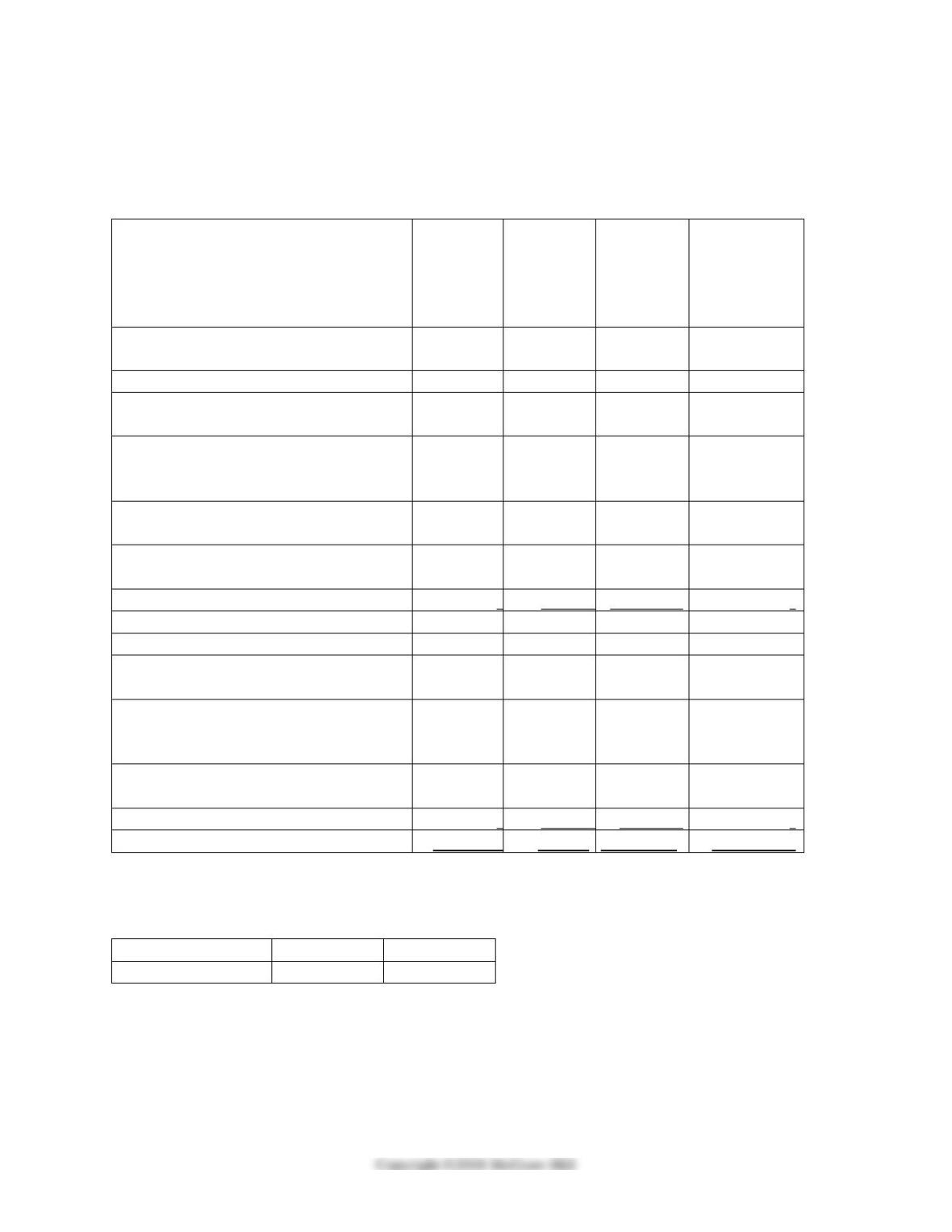
150) The following information comes from the 2018 Annual Report to stockholders of
Composition Inc. (in thousands):
From the Statement of Changes in Shareholders’ Equity:
Capital
in
Excess of
Par
Treasury
Shares
Treasury
Stock
Amount
Retained
Earnings
BALANCES AT December 31, 2016
$ 0
(30,561)
$(524,321)
$1,673,382
Net earnings
–
–
–
242,941
Sales of common stock under option
plans
(5,181)
377
10,738
–
Cash dividends declared on common
stock:
$.5375 per share
–
–
–
(68,952)
Compensation under employee
incentive plans
(1,802)
395
9,408
–
Treasury shares exchanged for
Acquisitions
139,209
20,449
318,293
–
Purchase of shares for treasury
–
(6,668)
(122,906)
–
BALANCES AT December 31, 2017
132,226
(16,008)
(308,788)
1,847,371
Net earnings
–
–
–
81,965
Sales of common stock under option
plans
(3,538)
279
7,095
–
Cash dividends declared on common
stock:
$.5475 per share
–
–
–
(72,903)
Compensation under employee
incentive plans
(196)
366
8,271
–
Purchase of shares for treasury
–
(2,933)
(48,678)
–
BALANCES AT December 31, 2018
$128,492
(18,296)
$(342,100)
$1,856,433
From the Statement of Cash Flows:
Cash flows from financing activities:
2018
2017
Dividends paid
72,244
66,932
What was the average exercise price per share of stock issued under option plans in 2018?