
Name:
Class:
Date:
chapter 18
Indicate whether the statement is true or false.
1. Indirect labor would be included in factory overhead.
a.
True
b.
False
2. Prime costs consist of factory overhead and direct labor.
a.
True
b.
False
3. Prime costs consist of direct materials, indirect materials, and direct labor.
a.
True
b.
False
4. Planning is the process of developing the company’s objectives or goals and translating these objectives into courses of
action.
a.
True
b.
False
5. A performance report that identifies the amount of employee downtime is a financial accounting report.
a.
True
b.
False
6. Controlling deals with choosing goals and deciding how to achieve them.
a.
True
b.
False
7. A staff department or unit is one that provides services, assistance, and advice to the departments with line or other staff
responsibilities.
a.
True
b.
False
8. Managerial accounting reports must be prepared according to generally accepted accounting principles.
a.
True
b.
False
9. Direct labor costs are included in the conversion costs of a product.
a.
True
b.
False
10. A cost object indicates how costs are related or identified.
a.
True
b.
False
11. Conversion costs consist of product costs and period costs.
a.
True

Name:
Class:
Date:
chapter 18
b.
False
12. Period costs include direct materials and direct labor.
a.
True
b.
False
13. Materials and labor costs that are not directly traced to the finished product are classified as factory overhead.
a.
True
b.
False
14. The cost of a material that is an integral part of the finished product is classified as factory overhead cost.
a.
True
b.
False
15. If the cost of materials is not a significant portion of the total product cost, the materials may be classified as part of
factory overhead cost.
a.
True
b.
False
16. A cost is a payment of cash for the purpose of generating revenues.
a.
True
b.
False
17. A report analyzing the dollar savings of purchasing new equipment to speed up the production process is a managerial
accounting report.
a.
True
b.
False
18. Period (nonmanufacturing) costs are classified into two categories: selling and administrative.
a.
True
b.
False
19. Product costs include direct labor and advertising expense.
a.
True
b.
False
20. Cost of oil used to lubricate factory machinery and equipment is an example of a direct materials cost.
a.
True
b.
False
21. An example of an eco-efficiency measure would be cost savings generated by recycling.
a.
True
b.
False
22. Direct costs are specifically traced to a cost object.
a.
True

Name:
Class:
Date:
chapter 18
b.
False
23. The payment of dividends is an example of a cost.
a.
True
b.
False
24. Factory overhead includes all manufacturing costs except direct materials and direct labor.
a.
True
b.
False
25. In most business organizations, the chief management accountant is called the controller.
a.
True
b.
False
26. Managerial accounting provides useful information to managers on product costs.
a.
True
b.
False
27. Costs other than direct materials and direct labor incurred in the manufacturing process are classified as factory
overhead.
a.
True
b.
False
28. Period costs are operating costs that are expensed in the period in which the goods are sold.
a.
True
b.
False
29. Since there are few rules to restrict how an organization chooses to arrange its own internal data for decision making,
managerial accounting provides ample opportunity for creativity and change.
a.
True
b.
False
30. Labor costs that are directly traceable to the product are part of factory overhead.
a.
True
b.
False
31. A diagram of the operating structure of an organization is called an organization chart.
a.
True
b.
False
32. The cost of a manufactured product generally consists of direct materials cost, direct labor cost, and factory overhead
cost.
a.
True
b.
False
33. If the cost of employee wages is not a significant portion of the total product cost, the wages are classified as direct

Name:
Class:
Date:
chapter 18
materials cost.
a.
True
b.
False
34. A report analyzing how many products need to be sold to cover operating costs is not typically a managerial
accounting report.
a.
True
b.
False
35. Product costs are not expensed until the product is sold.
a.
True
b.
False
36. The cost of wages paid to employees directly involved in converting materials to finished product is classified as
direct labor cost.
a.
True
b.
False
37. Period costs can be found on both the balance sheet and the income statement.
a.
True
b.
False
38. For a construction contractor, the wages of carpenters would be classified as factory overhead cost.
a.
True
b.
False
39. The Sustainability Accounting Standards Board (SASB) standards are required, just as GAAP standards are required.
a.
True
b.
False
40. Conversion costs are the combination of direct labor, direct material, and factory overhead costs.
a.
True
b.
False
41. Prime costs are the combination of direct labor costs and factory overhead costs.
a.
True
b.
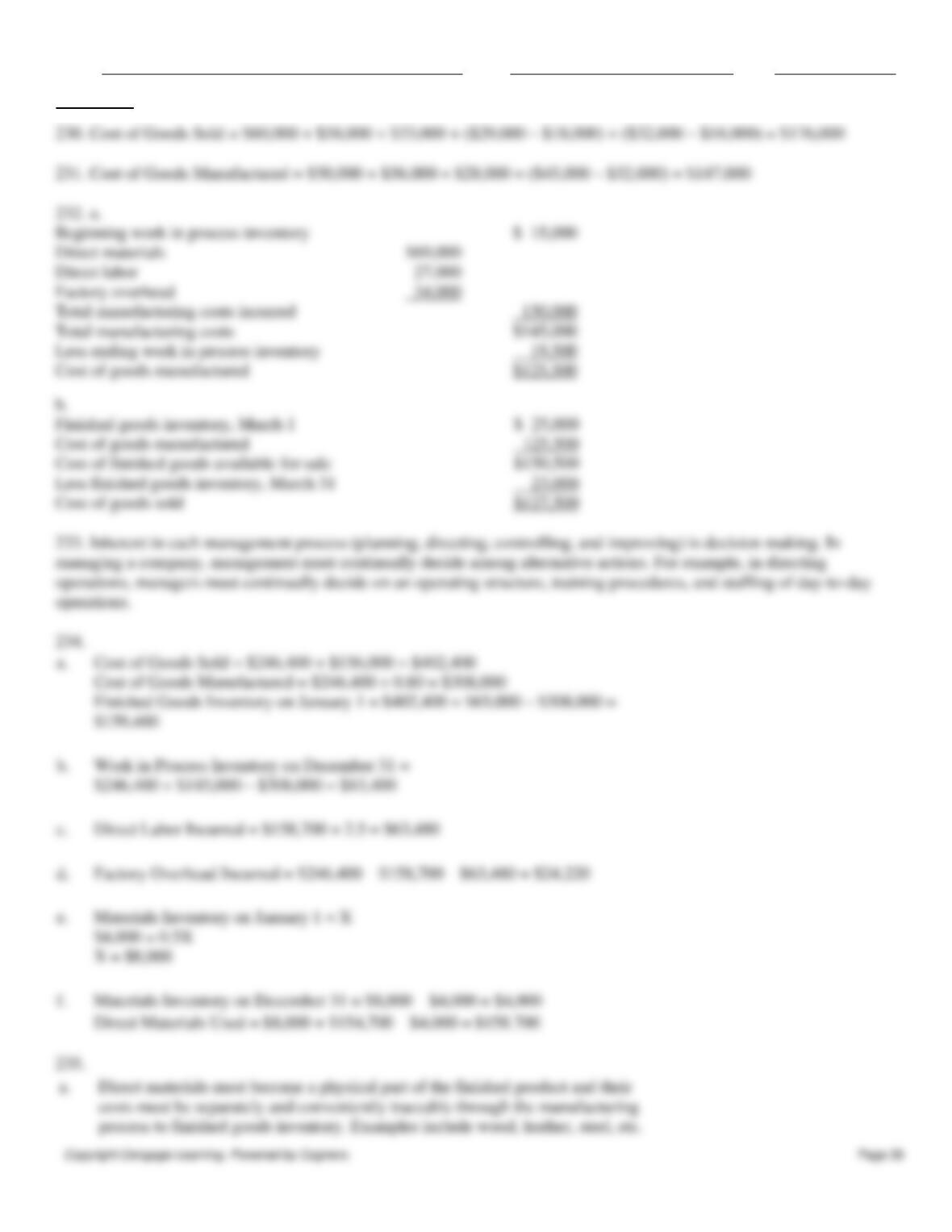
False
42. The controller’s staff consists of management accountants responsible for systems and procedures, general accounting,
budgets, taxes, and cost accounting.
a.
True
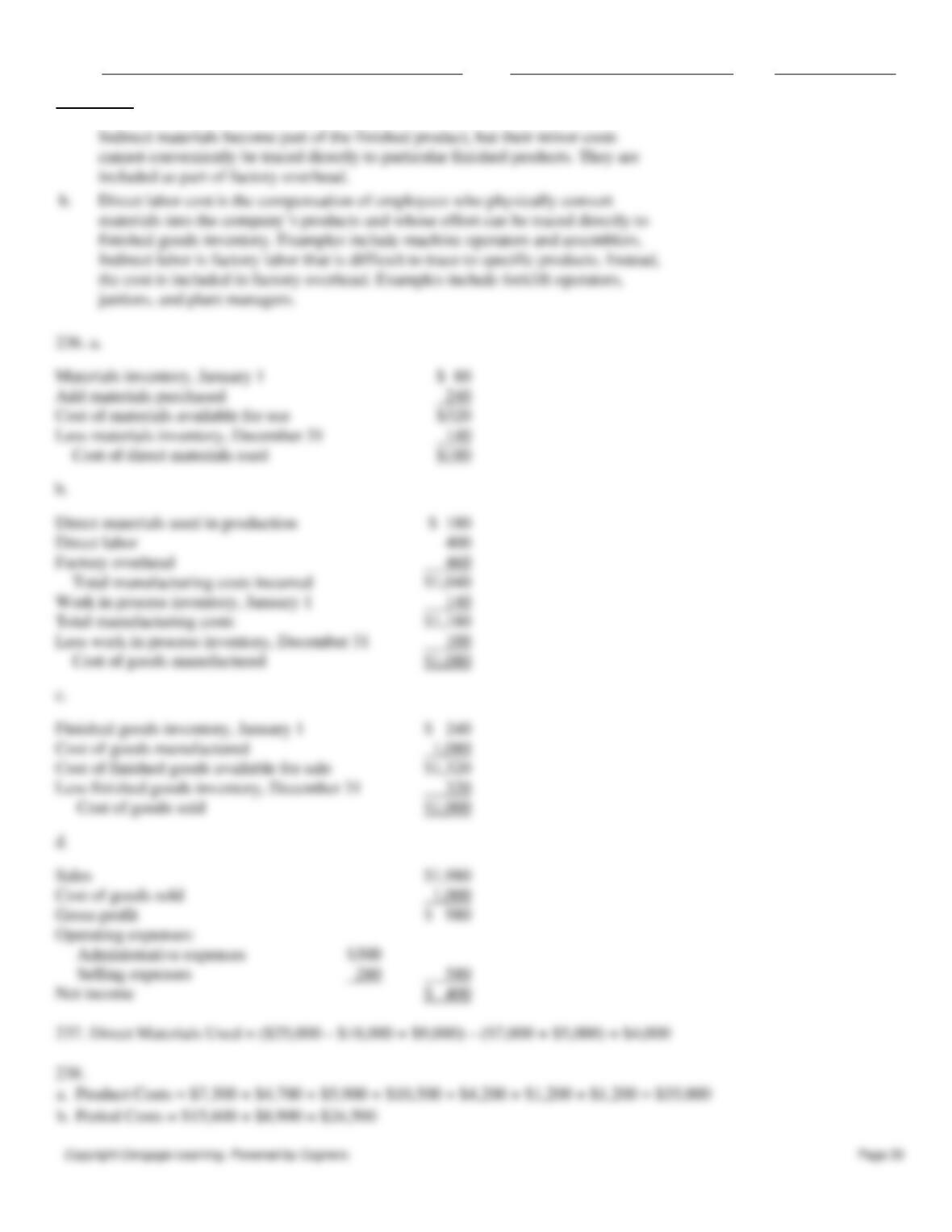
b.
False
43. Factory overhead is an example of a product cost.
a.
True
b.
False

Name:
Class:
Date:
chapter 18
44. Prime costs are the combination of direct materials and direct labor costs.
a.
True
b.
False
45. A staff department has no direct authority over a line department.
a.
True
b.
False
46. In most business organizations, the chief accountant is called the treasurer.
a.
True
b.
False
47. Manufacturers use machinery and labor to convert direct materials into finished products.
a.
True
b.
False
48. Indirect costs are specifically traced to a cost object.
a.
True
b.
False
49. Conversion cost is the combination of direct labor cost and factory overhead cost.
a.
True
b.
False
50. For an automotive repair shop, the wages of mechanics would be classified as direct labor cost.
a.
True
b.
False
51. On the balance sheet for a manufacturing business, inventories are categorized as materials, work in process, and
finished goods.
a.
True
b.
False
52. Managerial accounting information includes both historical and estimated data.
a.
True
b.
False
53. Conversion cost is the combination of direct materials cost and factory overhead cost.
a.
True
b.
False
54. Managers use managerial accounting information to evaluate performance of a company’s operation.
a.
True
b.
False

Name:
Class:
Date:
chapter 18
55. Planning is the process of monitoring operating results and comparing actual results with the expected results.
a.
True
b.
False
56. Only the value of the inventory that is sold will appear on the income statement.
a.
True
b.
False
57. Goods that are part way through the manufacturing process, but not yet complete, are referred to as materials
inventory.
a.
True
b.
False
58. Managerial accounting reports must be useful to the user of the information.
a.
True
b.
False
59. Operating expenses are product costs and are expensed when the product is sold.
a.
True
b.
False
60. Sustainability practice focuses on short-term solutions to sustain company profits.
a.
True
b.
False
61. The vice presidents of production and sales and the controller hold line positions in most large organizations.
a.
True
b.
False
62. Depreciation on factory plant and equipment is an example of factory overhead cost.
a.
True
b.
False
63. Managerial accounting information is for external as well as internal stakeholders.
a.
True
b.
False
64. Indirect labor and indirect materials would be part of factory overhead.
a.
True
b.
False
65. Factory overhead cost is sometimes referred to as factory burden.
a.
True
b.
False
66. Managerial accounting uses only past data in reports to aid management in the decision-making process.

Name:
Class:
Date:
chapter 18
a.
True
b.
False
67. The statement of cost of goods manufactured is an extension of the income statement for a manufacturing company.
a.
True
b.
False
68. Materials and labor costs that are not directly traced to the finished product are classified as cost of goods sold.
a.
True
b.
False
69. Controlling is the process of monitoring operating results and comparing actual results with the expected results.
a.
True
b.
False
70. The plant manager’s salary in a manufacturing business would be considered an indirect cost.
a.
True
b.
False
Indicate the answer choice that best completes the statement or answers the question.
71. The controller’s staff often consists of several management accountants. All of the following would most likely be on
the controller’s staff except
a.
general accountants
b.
budget analysts
c.
investments and shareholder relations managers
d.
cost accountants
72. Direct labor and direct materials are
a.
product costs and expensed when the goods are sold
b.
product costs and expensed when incurred
c.
period costs and expensed when incurred
d.
period costs and expensed when the goods are sold
73. Which of the following is most associated with financial accounting?
a.
can have both objective and subjective information
b.
can be prepared periodically, or as needed
c.
prepared in accordance with GAAP
d.
can be prepared for the entity or segment
74. Goods that are partially completed by a manufacturer are
a.
merchandise inventory
b.
work in process inventory
c.
finished goods inventory
d.
materials inventory

Name:
Class:
Date:
chapter 18
75. Which of the following costs are conversion costs?
a.
direct labor cost and factory overhead cost
b.
direct materials cost and direct labor cost
c.
factory overhead cost
d.
direct materials cost and factory overhead cost
Use the information provided for Jensen Company to answer the questions that follow.
Jensen Company
Direct materials used
$345,000
Direct labor incurred
250,000
Factory overhead incurred
400,000
Operating expenses
175,000
76. Jensen Company’s period costs are
a.
$345,000
b.
$250,000
c.
$400,000
d.
$175,000
77. Rent expense on a factory building would be treated as a
a.
period cost
b.
product cost
c.
direct cost
d.
direct materials cost
78. Replacing light fixtures with energy-efficient lighting is an example of which eco-efficiency measure?
a.
material use efficiency
b.
energy efficiency
c.
waste efficiency
d.
fuel efficiency
79. Prime costs are
a.
direct materials and factory overhead
b.
direct materials and direct labor
c.
direct labor and factory overhead
d.
period costs and factory overhead
80. Work in process inventory on December 31 is $42,000. Work in process inventory decreased by 40% during the year.
Total manufacturing costs incurred amount to $260,000. What is the cost of goods manufactured?
a.
$232,000
b.
$302,000
c.
$288,000
d.
$190,000

Name:
Class:
Date:
chapter 18
81. Which of the following is an example of direct labor cost for a cell phone manufacturer?
a.
cost of oil lubricants for factory machinery
b.
cost of wages of assembly worker
c.
salary of plant supervisor
d.
cost of phone components
82. At the beginning of the current year, Grant Company’s work in process inventory account had a balance of $30,000.
During the year, $68,000 of direct materials were used in production, and $66,000 of direct labor costs were incurred.
Factory overhead for the year amounted to $90,000. Cost of goods manufactured is $230,000. The balance in Work in
Process Inventory on December 31 is
a.
$24,000
b.
$44,000
c.
$66,000
d.
$36,000
83. Conversion costs are
a.
direct materials and direct labor
b.
direct materials and factory overhead
c.
factory overhead and direct labor
d.
direct materials and indirect labor
84. Smith Company reports the following information:
Cost of goods manufactured
$68,250
Direct materials used
27,000
Direct labor incurred
25,000
Work in process inventory, January 1
11,000
Factory overhead is 75% of the cost of direct labor. Work in process inventory on December 31 is
a.
$16,250
b.
$8,500
c.
$18,750
d.
$13,500
85. Work in process inventory increased by $20,000 during the current year. Cost of goods manufactured was $180,000.
Total manufacturing costs incurred are
a.
$198,000
b.
$160,000
c.
$189,000
d.
$200,000
86. The following information is taken from the financial records of Gunner Manufacturing:
Cost of materials used
$45,000
Direct labor costs
48,000
Factory overhead
39,000
Work in process, beginning
18,000

Name:
Class:
Date:
chapter 18
Work in process, ending
28,000
What is the cost of goods manufactured?
a.
$178,000
b.
$132,000
c.
$122,000
d.
$142,000
87. Finished goods inventory is reported on the
a.
income statement as a period cost
b.
balance sheet as a long-term asset
c.
balance sheet as a current asset
d.
income statement as revenue
88. Product costs
a.
appear only on the balance sheet
b.
appear only on the income statement
c.
are expensed as costs are incurred for direct labor, direct material, and factory overhead
d.
appear on both the income statement and balance sheet
89. Another term for factory overhead is
a.
surplus
b.
period cost
c.
supervisory cost
d.
factory burden
90. Which of the following is not true regarding direct materials for a bakery?
a.
Flour and sugar would probably be direct materials.
b.
Eggs would probably be a direct material.
c.
Oil to lubricate factory machines would not be a direct material.
d.
Paper cupcake liners, that become part of the product, must be accounted for as direct materials.
91. Which of the following is an example of a factory overhead cost?
a.
repair and maintenance cost on an administrative building
b.
factory heating and lighting cost
c.
insurance premiums on salespersons’ automobiles
d.
president’s salary
92. A product cost is
a.
expensed in the period in which it is manufactured
b.
shown with current liabilities on the balance sheet
c.
shown with operating expenses on the income statement
d.
expensed in the period the product is sold
93. All of the following would be reported on the balance sheet as a current asset except

Name:
Class:
Date:
chapter 18
a.
factory overhead
b.
materials inventory
c.
finished goods inventory
d.
work in process inventory
94. What term is used to describe the process of monitoring operating results and comparing actual results with the
expected results?
a.
improving
b.
controlling
c.
directing
d.
planning
95. All of the following are product costs except
a.
direct materials
b.
sales and administrative expenses
c.
direct labor
d.
factory overhead
96. Costs on the income statement for both a merchandiser and a manufacturer would be
a.
operating expenses
b.
direct materials
c.
direct labor incurred
d.
cost of goods manufactured
97. What term is used to describe the process of developing the organization’s objectives and translating those into
courses of action?
a.
supervising
b.
planning
c.
improving
d.
decision making
Use the information provided for Darwin Company to answer the questions that follow.
Darwin Company
Sales
$76,500
Direct materials used
7,300
Depreciation on factory equipment
4,700
Indirect labor
5,900
Direct labor
10,500
Factory rent
4,200
Factory utilities
1,200
Sales salaries expense
15,600
Office salaries expense
8,900
Indirect materials
1,200
98. Darwin Company’s period costs are
a.
$24,500

Name:
Class:
Date:
chapter 18
104. Factory overhead includes
b.
$30,300
c.
$29,200
d.
$35,000
99. Given the following data:
Cost of materials used
$45,000
Direct labor costs
48,000
Factory overhead
39,000
Work in process, beginning
28,000
Work in process, ending
18,000
Finished goods, beginning
28,000
Finished goods, ending
18,000
What is the cost of goods sold?
a.
$152,000
b.
$142,000
c.
$10,000
d.
$128,000
100. Cost of goods manufactured is equal to
a.
total manufacturing costs plus ending materials inventory less beginning materials inventory
b.
cost of goods sold plus beginning work in process inventory less ending work in process inventory
c.
total manufacturing costs plus ending work in process inventory less beginning work in process inventory
d.
total manufacturing costs plus beginning work in process inventory less ending work in process inventory
101. A company manufactured 50,000 units of a product at a cost of $450,000. It sold 45,000 units at $15 each. The gross
profit is
a.
$750,000
b.
$240,000
c.
$600,000
d.
$270,000
102. Who are the individuals charged with the responsibility for directing the day-to-day operations of a business?
a.
investors
b.
managers
c.
shareholders
d.
customers
103. Period costs include
a.
current assets on the balance sheet
b.
current liabilities on the balance sheet
c.
operating costs that are shown on the income statement when products are sold
d.
operating costs that are shown on the income statement in the period in which they are incurred

Name:
Class:
Date:
chapter 18
a.
factory rent and direct labor
b.
direct materials and direct labor
c.
indirect materials and direct materials
d.
indirect labor and indirect materials
105. Which of the following is an example of direct materials cost for an automobile manufacturer?
a.
cost of oil lubricants for factory machinery
b.
cost of wages of assembly worker
c.
salary of production supervisor
d.
cost of interior upholstery
106. Insurance expense incurred on a factory building would be treated as a
a.
direct cost
b.
period cost
c.
product cost
d.
selling cost
107. Managers use managerial accounting information for all of the following except to
a.
evaluate the company’s stock performance
b.
analyze the performance of a company’s operations
c.
support long-term planning decisions
d.
determine the cost of manufacturing a product
108. Which of the following may not be a factory overhead cost?
a.
materials used directly in the manufacturing process of the product
b.
insurance on factory equipment
c.
salaries of production supervisors
d.
property tax on factory building
109. Which of the following would least likely be considered a managerial accounting report?
a.
a report to analyze potential efficiencies and savings for the purchase of new production equipment
b.
a schedule of total manufacturing costs incurred
c.
a statement of cost of goods manufactured
d.
a statement of stockholders’ equity
110. If the cost of a material is a small portion of total production cost, it may be classified as part of
a.
direct labor cost
b.
selling and administrative costs
c.
miscellaneous costs
d.
factory overhead cost
111. Which of the following items would not be classified as part of factory overhead?
a.
direct labor used
b.
amortization of manufacturing patents

Name:
Class:
Date:
chapter 18
c.
production supervisors’ salaries
d.
factory supplies used
112. The cost of goods sold for Michaels Manufacturing in the current year was $233,000. The January 1 finished goods
inventory balance was $31,600, and the December 31 finished goods inventory balance was $24,200. Cost of goods
manufactured during the period was
a.
$233,000
b.
$225,600
c.
$288,800
d.
$240,400
113. Which of the following is not an example of a sustainable business activity?
a.
use of wind turbines to generate energy
b.
crop rotation
c.
expanded public transportation systems
d.
reduction of employee idle time
114. Which of the following statements is false?
a.
There is no overlap between financial and managerial accounting.
b.
Managerial accounting sometimes relies on past information.
c.
Managerial accounting does not need to conform to GAAP.
d.
Financial accounting must conform to GAAP.
115. The cost of wages paid to employees directly involved in the manufacturing process in converting materials into
finished products is classified as a
a.
factory overhead cost
b.
direct labor cost
c.
miscellaneous cost
d.
direct materials cost
116. Which of the following is part of factory overhead cost?
a.
sales commissions
b.
depreciation of factory equipment and machines
c.
depreciation of salesperson’s vehicle
d.
direct materials used
117. A company used $35,000 of direct materials, incurred $73,000 in direct labor cost, and had $114,000 in factory
overhead costs during the period. If beginning and ending work in process inventories were $28,000 and $32,000,
respectively, the cost of goods manufactured was
a.
$218,000
b.
$226,000
c.
$190,000
d.
$222,000
118. The primary goal of managerial accounting is to provide information to

Name:
Class:
Date:
chapter 18
a.
investors
b.
creditors
c.
management
d.
external auditors
119. Which of the following are reported on the income statement as part of cost of goods?
a.
administrative expenses
b.
period costs
c.
cost of goods manufactured
d.
operating expenses
120. What is the primary criterion for the preparation of managerial accounting reports?
a.
relevance of the reports
b.
manager needs
c.
timing of the reports
d.
cost of the reports
121. A plant manager’s salary is a(n)
a.
direct cost and an indirect cost
b.
direct cost
c.
indirect cost
d.
period cost
122. Which of the following are basic phases of the management process?
a.
supervising and directing
b.
decision making and supervising
c.
organizing and directing
d.
planning and controlling
123. The cost of a manufactured product generally consists of which of the following costs?
a.
direct materials cost and factory overhead cost only
b.
direct labor cost and factory overhead cost only
c.
direct labor cost, direct materials cost, and factory overhead cost
d.
direct materials cost and direct labor cost only
124. Compute conversion costs given the following data: direct materials, $347,500; direct labor, $196,300; factory
overhead, $187,900; and selling expenses, $45,290.
a.
$543,800
b.
$187,900
c.
$731,700
d.
$384,200
125. Managerial accounting reports are
a.
prepared according to GAAP

Name:
Class:
Date:
chapter 18
Office salaries expense
8,900
b.
prepared according to management needs
c.
prepared periodically only
d.
related to the entire business entity only
126. A company sells goods for $150,000 that cost $54,000 to manufacture. Which of the following statements is true?
a.
The company will recognize sales on the balance sheet of $150,000.
b.
The company will recognize $96,000 gross profit on the balance sheet.
c.
The company will decrease finished goods by $54,000.
d.
The company will increase finished goods by $54,000.
127. Accounting designed to meet the needs of decision makers inside the business is
a.
general accounting
b.
financial accounting
c.
managerial accounting
d.
external accounting
128. Given the following data:
Work in process, beginning
$14,000
Work in process, ending
20,000
Direct labor costs
4,000
Cost of goods manufactured
8,000
Factory overhead
8,000
Direct materials used is
a.
$2,000
b.
$4,000
c.
$8,000
d.
$14,000
129. Which of the following is most associated with managerial accounting?
a.
must follow GAAP
b.
may rely on estimates and forecasts
c.
is prepared for users outside the organization
d.
always reports on the entire entity
Use the information provided for Darwin Company to answer the questions that follow.
Darwin Company
Sales
$76,500
Direct materials used
7,300
Depreciation on factory equipment
4,700
Indirect labor
5,900
Direct labor
10,500
Factory rent
4,200
Factory utilities
1,200
Sales salaries expense
15,600

Name:
Class:
Date:
chapter 18
Indirect materials
1,200
130. Darwin Company’s product costs are
a.
$24,500
b.
$30,300
c.
$29,200
d.
$35,000
131. Which of the following will not be found on the balance sheet of a manufacturing company?
a.
cost of goods sold
b.
materials
c.
work in process
d.
finished goods
132. Beginning work in process is equal to
a.
cost of goods manufactured plus ending work in process minus manufacturing costs incurred during the
current period
b.
cost of goods manufactured minus ending work in process plus manufacturing costs incurred during the
current period
c.
ending work in process plus manufacturing costs incurred during the current period
d.
manufacturing costs incurred during the current period minus ending work in process
133. Materials must have which two qualities in order to be classified as direct materials?
a.
They must be classified as both prime costs and conversion costs.
b.
They must be introduced into the process in both work in process inventories and finished goods inventories.
c.
They must be an integral part of the finished product, but can be an insignificant portion of the total product
cost.
d.
They must be an integral part of the finished product and a significant portion of the total product cost.
134. Which of the following accounts will not be found on the statement of cost of goods manufactured?
a.
Factory Overhead
b.
Work in Process
c.
Purchases
d.
Cost of Goods Sold
135. Which of the following manufacturing costs is an indirect cost of producing a product?
a.
oil lubricants used for factory machinery
b.
commissions for sales personnel
c.
hourly wages of an assembly worker
d.
memory chips for a microcomputer manufacturer
Use the information provided for Jensen Company to answer the questions that follow.
Jensen Company
Direct materials used
$345,000
Direct labor incurred
250,000

Name:
Class:
Date:
chapter 18
d.
chief executive officer
Factory overhead incurred
400,000
Operating expenses
175,000
136. Jensen Company’s product costs are
a.
$995,000
b.
$920,000
c.
$825,000
d.
$770,000
137. Given the following data:
Beginning raw materials inventory
$30,000
Materials purchased
65,000
Ending raw materials inventory
40,000
What is the amount of raw materials used?
a.
$5,000
b.
$55,000
c.
$75,000
d.
$30,000
138. Cost of goods sold for a manufacturer equals cost of goods manufactured plus
a.
beginning work in process inventory less ending work in process inventory
b.
ending work in process inventory less beginning work in process inventory
c.
beginning finished goods inventory less ending finished goods inventory
d.
ending finished goods inventory less beginning finished goods inventory
139. Work in process inventory on December 31 of the current year is $44,000. Work in process inventory increased by
60% during the year. Cost of goods manufactured amounts to $275,000. What are the total manufacturing costs incurred
in the current year?
a.
$291,500
b.
$302,000
c.
$275,750
d.
$233,750
140. Cost of goods manufactured during the year is $240,000, and work in process inventory on December 31 is $50,000.
Work in process inventory during the year decreased by 60%. Total manufacturing costs incurred are
a.
$190,000
b.
$165,000
c.
$290,000
d.
$315,000
141. In most business organizations, the chief management accountant is called the
a.
chief accounting officer
b.
controller
c.
chairman of the board

Name:
Class:
Date:
chapter 18
142. Managerial accountants could prepare all of the following reports except a(n)
a.
performance report identifying amounts of scrap
b.
control report comparing direct material usage over time
c.
sales report targeting monthly sales and potential bonuses
d.
annual report for external regulators such as the SEC
143. All of the following are examples of indirect labor except
a.
maintenance personnel
b.
janitorial personnel
c.
machine operators
d.
plant managers
144. An example of a period cost is
a.
advertising expense
b.
indirect materials
c.
depreciation on factory equipment
d.
property taxes on plant facilities
145. What is the purpose of the statement of cost of goods manufactured?
a.
to determine the ending materials inventory
b.
to determine the ending work in process inventory
c.
to determine the amount transferred to finished goods
d.
All of these choices
146. Indirect labor and indirect materials are classified as
a.
factory overhead and product costs
b.
factory overhead and period costs
c.
operating costs and period costs
d.
operating costs and product costs
147. All of the following employees hold line positions except
a.
vice president of production
b.
vice president of finance
c.
manager of equipment
d.
vice president of sales
148. Which of the following is true of preparing managerial accounting reports?
a.
Managerial accounting reports are prepared according to GAAP.
b.
Managerial accounting reports must contain objective data only.
c.
Managerial accounting reports may be prepared at fixed intervals or on an as-needed basis.
d.
Managerial accounting reports are prepared for external users and company management.
149. Indirect costs incurred in a manufacturing environment that are not traced directly to a product are treated as

Name:
Class:
Date:
chapter 18
a.
period costs and expensed when incurred
b.
product costs and expensed when the goods are sold
c.
product costs and expensed when incurred
d.
period costs and expensed when the goods are sold
150. Purchases on the income statement of a retail business is comparable to _____ on the income statement of a
manufacturing business.
a.
finished goods
b.
cost of merchandise available
c.
cost of goods manufactured
d.
work in process
151. What term refers to the cost of changing direct materials into a finished manufactured product?
a.
factory overhead cost
b.
period cost
c.
conversion cost
d.
direct labor cost
152. Which of the following is not a prime cost?
a.
plant janitor’s wages
b.
direct labor wages
c.
machine operator wages
d.
assembly line wages
153. Which of the following is not a characteristic of useful managerial accounting reports?
a.
accurate
b.
adhere to GAAP
c.
historical and estimated data
d.
prepared as needed
154. Costs other than direct materials cost and direct labor cost incurred in the manufacturing process are classified as
a.
factory overhead costs
b.
miscellaneous expenses
c.
product costs
d.
period costs
155. All of the following could be considered a direct material except
a.
steel
b.
fabric
c.
glue
d.
lumber
156. In order to be useful to managers, managerial accounting reports should possess all of the following characteristics
except
a.
provide objective measures of past operations and subjective estimates about future decisions

Name:
Class:
Date:
chapter 18
b.
be prepared in accordance with generally accepted accounting principles
c.
be provided at any time management needs information
d.
be prepared to report information for any unit of the business to support decision making
Match each of the following items for Green Company, a lawn mower manufacturer, to the type of manufacturing cost (a–
c) it represents.
a.
Direct materials
b.
Direct labor
c.
Factory overhead
157. Wheels
158. Depreciation on worker’s tools
159. Wages of assemblers
160. Grease for wheel axles
Match each of the following items for Cupcake Company to the type(s) of cost (a–d) it represents. Each type may be used
more than once.
a.
Prime cost
b.
Conversion cost
c.
Both prime and conversion costs
d.
Neither prime nor conversion cost
161. Salesperson commissions
162. Factory rent
163. Depreciation expense—factory
164. Frosting
165. Baker’s wages
166. Depreciation expense—office
167. Cupcake mix
168. Sprinkles for decoration (indirect material)
Match each of the following items to the type of cost (a–c) it represents.
a.
Direct cost
b.
Indirect cost
c.
Neither direct nor indirect cost
169. Labor for machine maintenance

Name:
Class:
Date:
chapter 18
170. Factory equipment depreciation
171. Materials not traced to specific products
172. Office equipment depreciation
173. Materials traced to specific products
174. Insurance expired on administrative facilities
175. Product assembly labor incurred
176. Administrative office salaries
177. Salespersons’ salaries
178. Utilities on factory building
179. Utilities on administrative facilities
Match each of the following items for Bartel Corporation, a manufacturer of bar stools, to the type of cost (a or b) it
represents.
a.
Direct cost
b.
Indirect cost
180. The production labor wages for the bar stool assemblers
181. The factory supervisor’s salary for the bar stool factory
182. Lubricants used on the bar stool manufacturing equipment
183. Manufacturing costs for wood and steel used in the bar stools
184. Nails and screws used in the production of the bar stools
Match each of the following items for a bakery to the type of cost (a–d) it represents. Each type may be used more than
once.
a.
Direct materials
b.
Direct labor
c.
Factory overhead
d.
Nonmanufacturing cost
185. Salesperson commissions
186. Factory rent
187. Depreciation expense—factory
188. Frosting

Name:
Class:
Date:
chapter 18
189. Baker’s wages
190. Depreciation expense—office
191. Cupcake mix
192. Sprinkles for decoration (indirect material)
Match each description to the appropriate term (a–d). Each cost type may be used more than once.
a.
Direct materials
b.
Selling and administrative expense
c.
Factory overhead
d.
Direct labor
193. Rent expense on factory building
194. Sales supplies used
195. Factory supplies used
196. Indirect materials used
197. Wages of assembly line personnel
198. Cost of primary material used to make product
199. Depreciation on office equipment
200. Rent on office facilities
201. Insurance expired on factory equipment
202. Utilities incurred in the office
203. Advertising expense
Match each of the following items to the type of cost (a or b) it represents
a.
Product cost
b.
Period cost
204. Tires for the bicycles
205. Electricity costs to run the factory
206. Selling costs for the period
207. Delivery costs to take the bicycles to stores
208. Accountant salaries

Name:
Class:
Date:
chapter 18
Match each of the following descriptions to the phase of the management process (a–e) it describes.
a.
Planning
b.
Directing
c.
Controlling
d.
Improving
e.
Decision making
209. Used by managers for continuous improvement
210. Managers must continually choose among alternative actions
211. Used by management to develop the organization’s objectives and goals
212. Monitoring the operating results of implemented plans and comparing actual results to expected results
213. Process by which managers run day-to-day operations
Match each of the following items for Mostess Company, a cake factory, to the type of cost (a or b) it represents.
a.
Product cost
b.
Period cost
214. Frosting
215. Baker’s wages
216. Advertising fees
217. Delivery expense
Match each of the following items to the type of cost (a or b) it most typically represents.
a.
Product cost
b.
Period cost
218. Direct materials used
219. Factory utilities
220. Salespersons’ commissions
221. Salary of plant manager
222. Indirect materials used
223. Depreciation on store equipment
224. Indirect labor incurred
225. Advertising expense

Name:
Class:
Date:
chapter 18
226. Direct labor incurred
227. Factory machinery repairs and maintenance
228. Depreciation on factory machinery
229. Plant insurance expired
230. Keeton Company has the following data:
Cost of materials used
$60,000
Direct labor costs
58,000
Factory overhead
33,000
Work in process inventory, beginning
29,000
Work in process inventory, ending
18,000
Finished goods inventory, beginning
32,000
Finished goods inventory, ending
18,000
Determine the cost of goods sold.
231. Laramie Technologies has the following data:
Work in process inventory, beginning
$45,000
Work in process inventory, ending
32,000
Direct labor costs
56,000
Cost of materials used
50,000
Factory overhead
28,000
Determine the cost of goods manufactured.
232. Zoe Corporation has the following information for the month of March:
Cost of materials used in production
$69,000
Direct labor
27,000
Factory overhead
34,000
Work in process inventory, March 1
15,000
Work in process inventory, March 31
19,500
Finished goods inventory, March 1
25,000
Finished goods inventory, March 31
23,000
Determine the (a) cost of goods manufactured and (b) cost of goods sold.
233. What is decision making? Who is responsible for decision making in a managerial situation?
234. The following information is available for Carter Corporation:
• Materials inventory decreased $4,000.
• Materials inventory on December 31 was 50% of materials inventory on January 1.
• Beginning work in process inventory was $145,000.
• Ending finished goods inventory was $65,000.
• Purchases of direct materials were $154,700.

Name:
Class:
Date:
chapter 18
• Direct materials used were 2.5 times the cost of direct labor.
• Total manufacturing costs incurred were $246,400, 80% of cost of goods manufactured and $156,000 less
than cost of goods sold.
Compute:
a.
Finished goods inventory on January 1
b.
Work in process inventory on December 31
c.
Direct labor incurred
d.
Factory overhead incurred
e.
Materials inventory on January 1
f.
Direct materials used
235. Differentiate between:
a.
Direct materials versus indirect materials
b.
Direct labor versus indirect labor
236. The following data (in thousands of dollars) have been taken from the accounting records of Rayburn Corporation for
the current year:
Sales
$1,980
Selling expenses
280
Factory overhead
460
Direct labor
400
Administrative expenses
300
Direct materials purchased during year
240
Finished goods inventory, January 1
240
Finished goods inventory, December 31
320
Materials inventory, January 1
80
Materials inventory, December 31
140
Work in process inventory, January 1
140
Work in process inventory, December 31
100
Determine:
a.
Cost of the direct materials used in production during the year
b.
Cost of goods manufactured for the year
c.
Cost of goods sold for the year
d.
Net income for the year
Present all computations and final answers in thousands of dollars.
237. Watson Company has the following data:
Work in process inventory, beginning
$18,000
Work in process inventory, ending
25,000
Direct labor costs
5,000
Cost of goods manufactured
9,000
Factory overhead
7,000
Determine the amount of direct materials used.
238. Putney Company reports the following information:

Name:
Class:
Date:
chapter 18
Sales
$76,500
Cost of direct materials used in production
7,300
Depreciation on factory equipment
4,700
Indirect labor
5,900
Direct labor
10,500
Factory rent
4,200
Factory utilities
1,200
Sales salaries expense
15,600
Office salaries expense
8,900
Indirect materials
1,200
Compute:
a.
Product costs
b.
Period costs
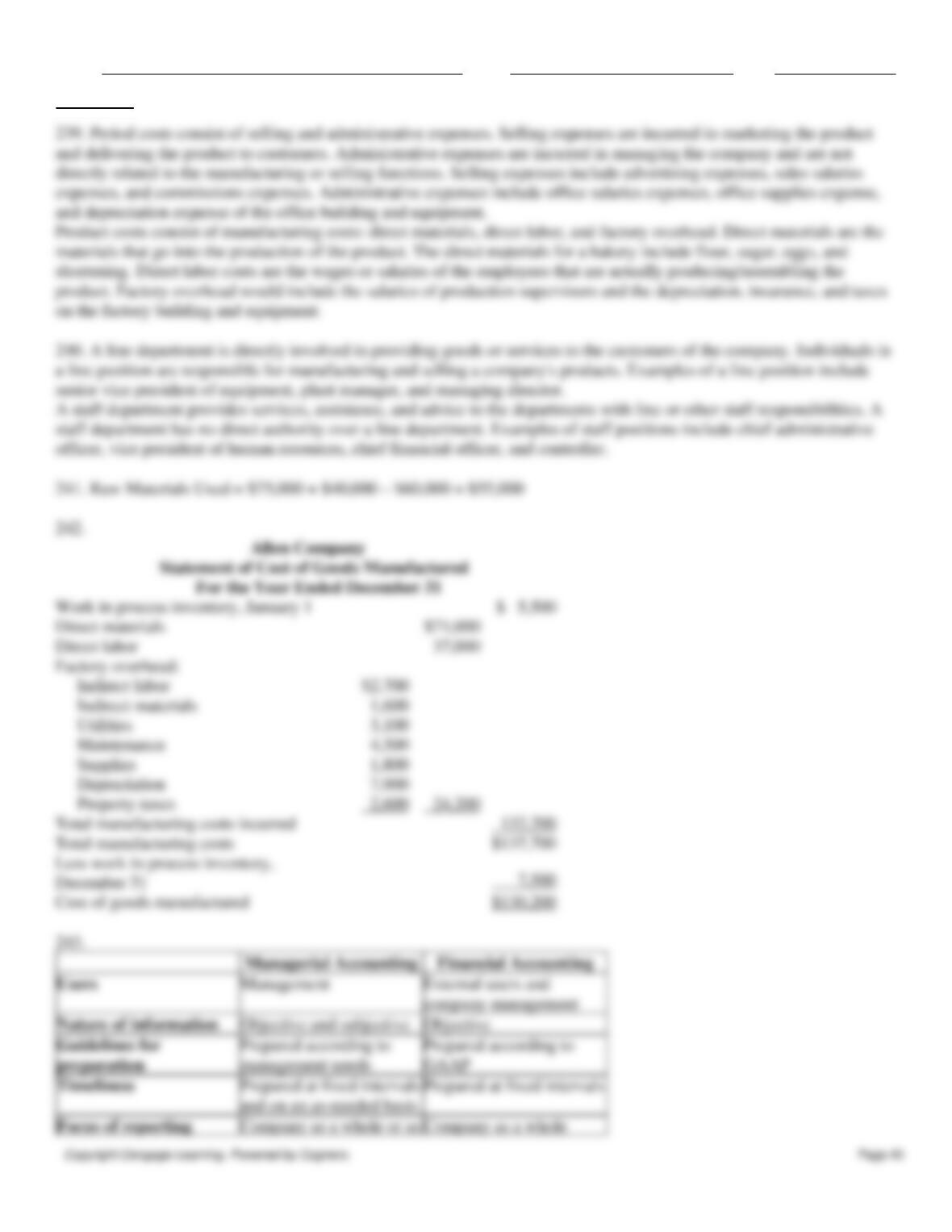
239. Differentiate between period and product costs, including examples of each type of cost.
240. Differentiate between a line department and a staff department.
241. Magnus Industries has the following data:
Beginning raw materials inventory
$75,000
Materials purchased
40,000
Ending raw materials inventory
60,000
Determine the cost of raw materials used.
242. Allen Company used $71,000 of direct materials and incurred $37,000 of direct labor costs during the current year.
Indirect labor amounted to $2,700, while indirect materials used totaled $1,600. Other operating costs pertaining to the
factory included utilities of $3,100, maintenance of $4,500, supplies of $1,800, depreciation of $7,900, and property taxes
of $2,600. There was no beginning or ending finished goods inventory, but work in process inventory began the year with
a $5,500 balance and ended the year with a $7,500 balance.
Prepare a statement of cost of goods manufactured for Allen Company for the year ended December 31.
243. Differentiate between financial and managerial accounting, addressing such issues as users, nature of information,
guidelines for preparation, timeliness, and focus of reporting.
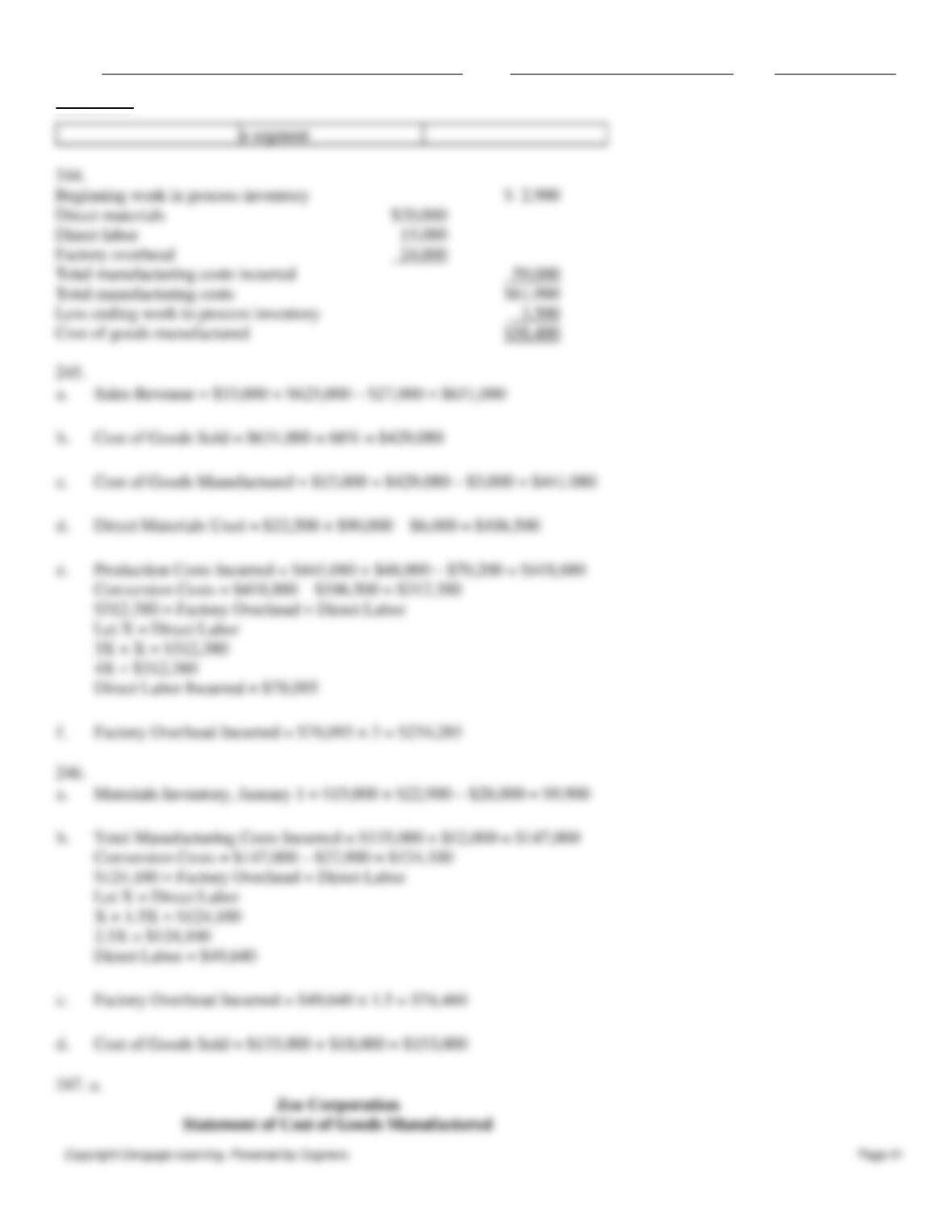
244. Sienna Company has the following information for January:
Cost of materials used in production
$20,000
Direct labor
15,000
Factory overhead
24,000
Work in process inventory, January 1
2,900
Work in process inventory, January 31
3,500
Determine the cost of goods manufactured.
245. Davis Manufacturing Company had the following data for a recent year:
January 1
December 31
Accounts receivable
$27,000
$33,000
Materials inventory
22,500
6,000

Name:
Class:
Date:
chapter 18
Work in process inventory
70,200
48,000
Finished goods inventory
3,000
15,000
Collections on account were $625,000.
Cost of goods sold was 68% of sales.
Direct materials purchased amounted to $90,000.
Factory overhead was 300% of the cost of direct labor.
Compute:
a.
Sales revenue (all sales were on account)
b.
Cost of goods sold
c.
Cost of goods manufactured
d.
Direct materials used
e.
Direct labor incurred
f.
Factory overhead incurred
246. Taylor Industries had a fire, and some of its accounting records were destroyed. Available information is as follows
for the year ended December 31:
Materials inventory, December 31
$ 15,000
Direct materials purchased
28,000
Direct materials used
22,900
Cost of goods manufactured
135,000
Additional information:
Factory overhead is 150% of direct labor cost.
Finished goods inventory decreased by $18,000 during the year.
Work in process inventory increased by $12,000 during the year.
Determine:
a.
Materials inventory, January 1
b.
Direct labor incurred
c.
Factory overhead incurred
d.
Cost of goods sold
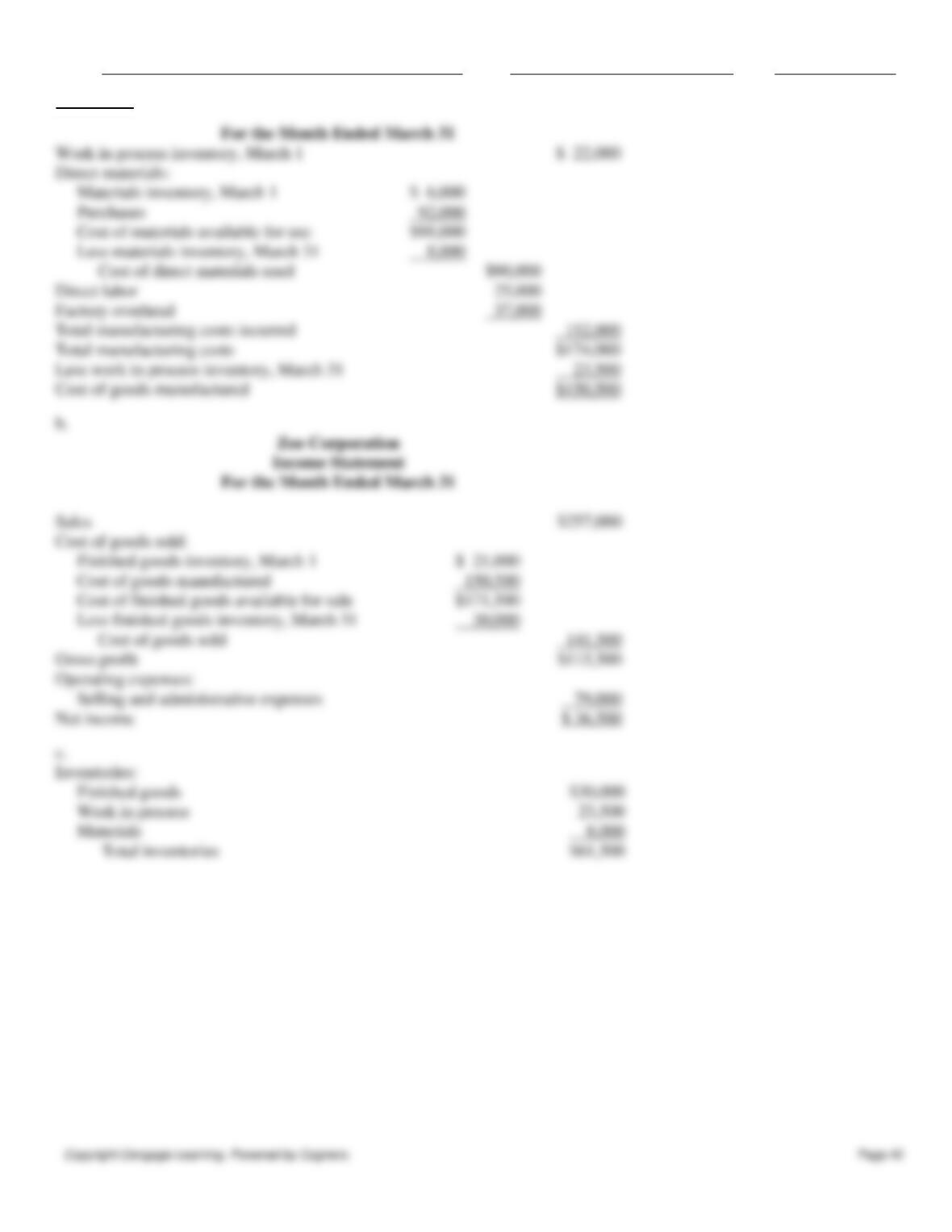
247. Zoe Corporation has the following information for the month of March:
Purchases
$ 92,000
Materials inventory, March 1
6,000
Materials inventory, March 31
8,000
Direct labor
25,000
Factory overhead
37,000
Work in process inventory, March 1
22,000
Work in process inventory, March 31
23,500
Finished goods inventory, March 1
21,000
Finished goods inventory, March 31
30,000
Sales
257,000
Selling and administrative expenses
79,000
Prepare (a) a schedule of cost of goods manufactured, (b) an income statement for the month ended March 31, and (c) the
Inventories section of the balance sheet.

Name:
Class:
Date:
chapter 18
Answer Key

Name:
Class:
Date:
chapter 18

Name:
Class:
Date:
chapter 18
Name:
Class:
Date:
chapter 18
Name:
Class:
Date:
chapter 18
Name:
Class:
Date:
chapter 18
Name:
Class:
Date:
chapter 18
Name:
Class:
Date:
chapter 18
Name:
Class:
Date:
chapter 18
Name:
Class:
Date:
chapter 18
Name:
Class:
Date:
chapter 18
Name:
Class:
Date:
chapter 18
Name:
Class:
Date:
chapter 18
Name:
Class:
Date:
chapter 18