28) Ariel Company sells preferred stock at par value, and records a:
A) debit to Cash and a credit to Common Stock.
B) debit to Preferred Stock and a credit to Cash.
C) debit to Cash and a credit to Preferred Stock.
D) debit to Cash, credit to Preferred Stock and a credit to Paid in Capital in Excess of Par Value-Preferred
Stock.
29) Korgen Company sells common stock at par value, and records a:
A) debit to Common Stock and a credit to Cash.
B) debit to Equipment and a credit to Common Stock.
C) debit to Cash and a credit to Common Stock.
D) debit to Cash, credit to Common Stock and a credit to Paid in Capital in Excess of Par Value-Common
Stock.
30) Bannon Corporation has 100 shares of $47 par, 7% cumulative preferred stock and 2,900 shares of 17
par common stock. Bannon paid $19,000 in cash dividends including one-year dividends in arrears to
preferred stockholders. Common stockholders will receive: (Round any intermediate calculations to the
nearest cent, and your final answer to the nearest dollar.)
A) $0.
B) $658.
C) $329.
D) $18,342.
31) Cannes Corporation has 120 shares of $107, 7% cumulative nonparticipating preferred stock and 1,200
shares of $16 par value common stock outstanding. The company paid $11,000 cash dividends including
one-year dividends in arrears to preferred stockholders. Preferred stockholders received: (Round any
intermediate calculations to the nearest cent, and your final answer to the nearest dollar.)
A) $899.
B) $11,000.
C) $10,101.
D) $1,798.
32) To calculate dividends on par-value preferred stock:
A) multiply the number of shares issued times rate.
B) multiply rate times par-value per share.
C) multiply number of shares outstanding times rate times par-value.
D) None of these answers is correct.
33) When a company distributes some of their profits to shareholders, it is in the form of:
A) cumulative stock.
B) reduced taxes.
C) dividends.
D) bonds.
34) Common Stock is an asset.
35) A company can exchange stock for noncash assets.
36) A company issues no-par value with no stated value stock. Therefore, the company has a minimum
legal capital amount.
37) Number of preferred shares times market value per share times dividend rate is the formula used to
determine the dividends to be paid.
38) Almont Corporation is authorized to issue 2,000 shares of common stock. Record the journal entry for
each of the following independent situations. Assume Almont issues 1,000 shares at $14 on August 31.
a) Common stock has a $11 per share par value.
b) Common stock has no par value and no stated amount.
c) Common stock is no-par stock with a stated value of $7 per share.
39) Journalize the following independent transactions:
a) Casey Company sells 300 shares of $20 par-value common stock at $20.
b) Jacob Corporation sells 100 shares of $20 par-value common stock at $30.
c) Moss Inc. sells 40 shares of no-par common stock with a $20 stated value for $30 per share.
40) Birch Company issued 200 shares of common stock with a par value of $10 per share in exchange for
equipment with a fair market value of $4,000. Record the journal entry for the stock issuance.
41) Morton Corporation issued 350 shares of its $6 par value stock to an attorney. The shares are in full
settlement for $8,000 of legal services to help set up the company. Prepare the journal entry for the stock
issuance.
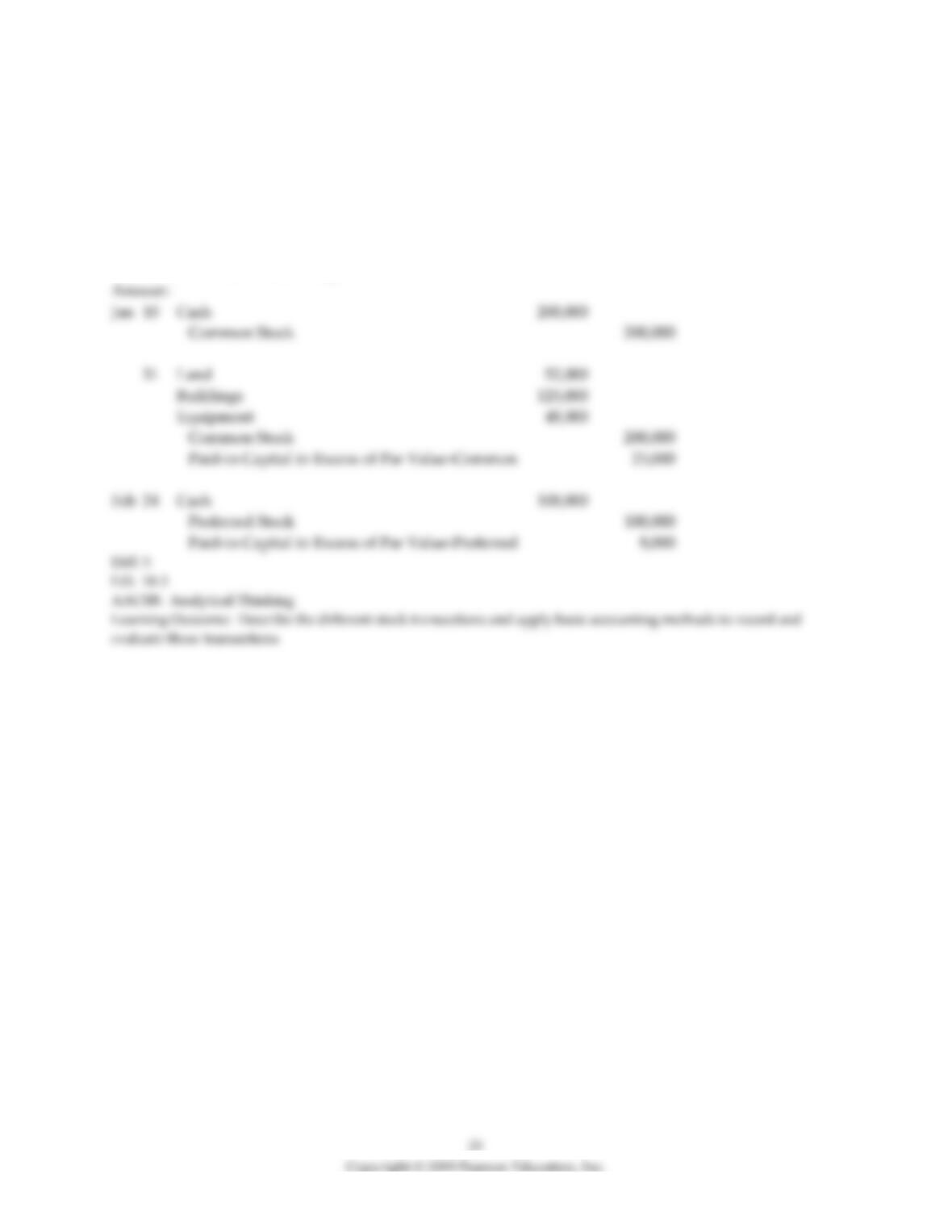
42) R. Red formed a corporation with an authorization of 20,000 shares of $50 par, 6% non-cumulative
preferred stock and 100,000 shares of $10 par common stock. The following selected transactions were
completed during the first year of operations. Journalize the transactions omitting explanations.
Jan 10 Issued 20,000 shares of common stock at par for cash.
31 Issued 20,000 shares of common stock in exchange for land, buildings, and
equipment with fair market prices of $52,000, $125,000, and $48,000, respectively.
Feb 24 Issued 2,000 shares of preferred stock at $54 for cash.
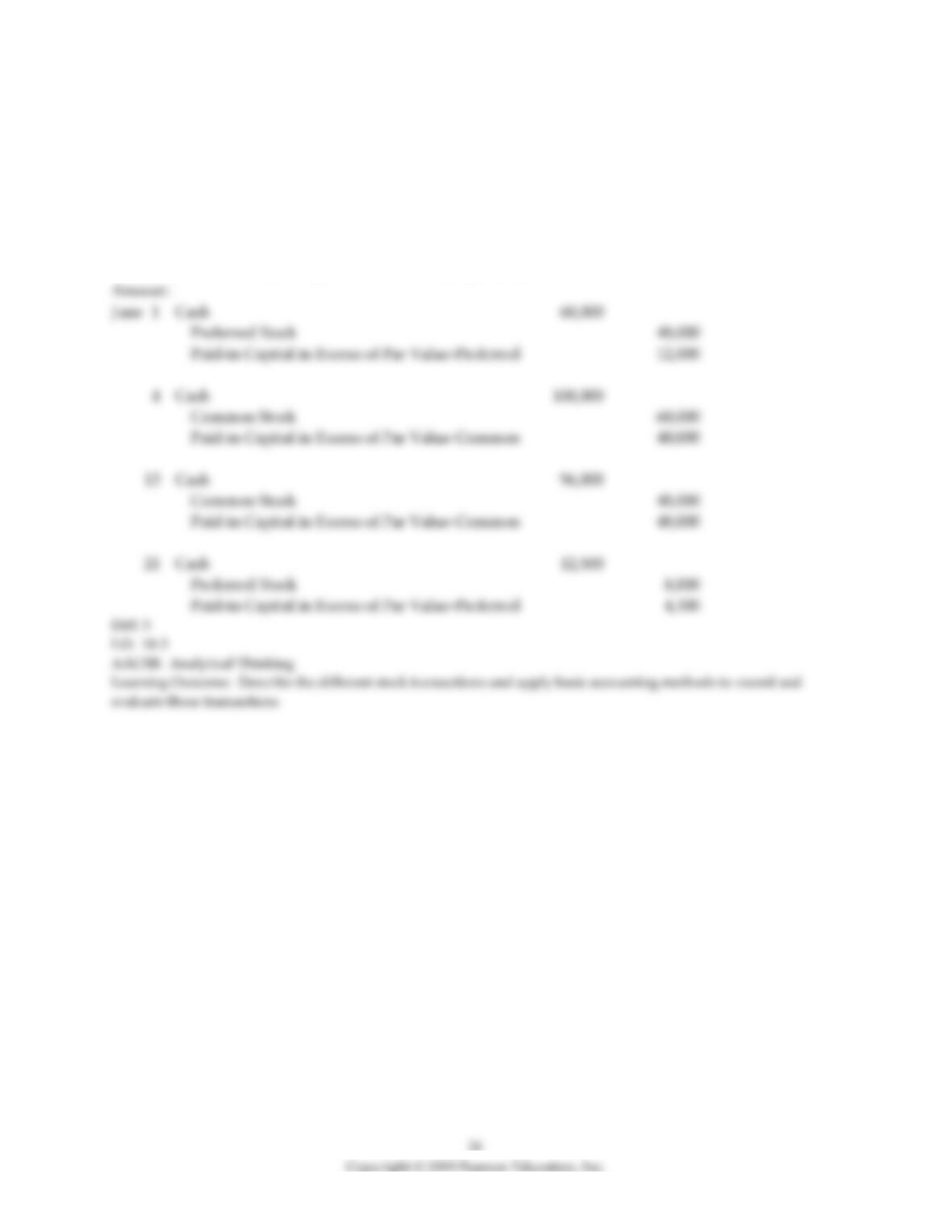
43) Elsinore Corporation has been issued a charter by the state of New Hampshire. This charter gives
Elsinore the authority to issue 10,000 shares of $16 par value preferred stock and 100,000 shares of $6 par
value common stock. Journalize the entries listed below.
June 1 Issued 3,000 shares of preferred stock at $20 per share.
4 Issued 10,000 shares of common stock at $10 per share.
13 Issued 8,000 shares of common stock at $12 per share.
21 Issued 500 shares of preferred stock at $25 per share.
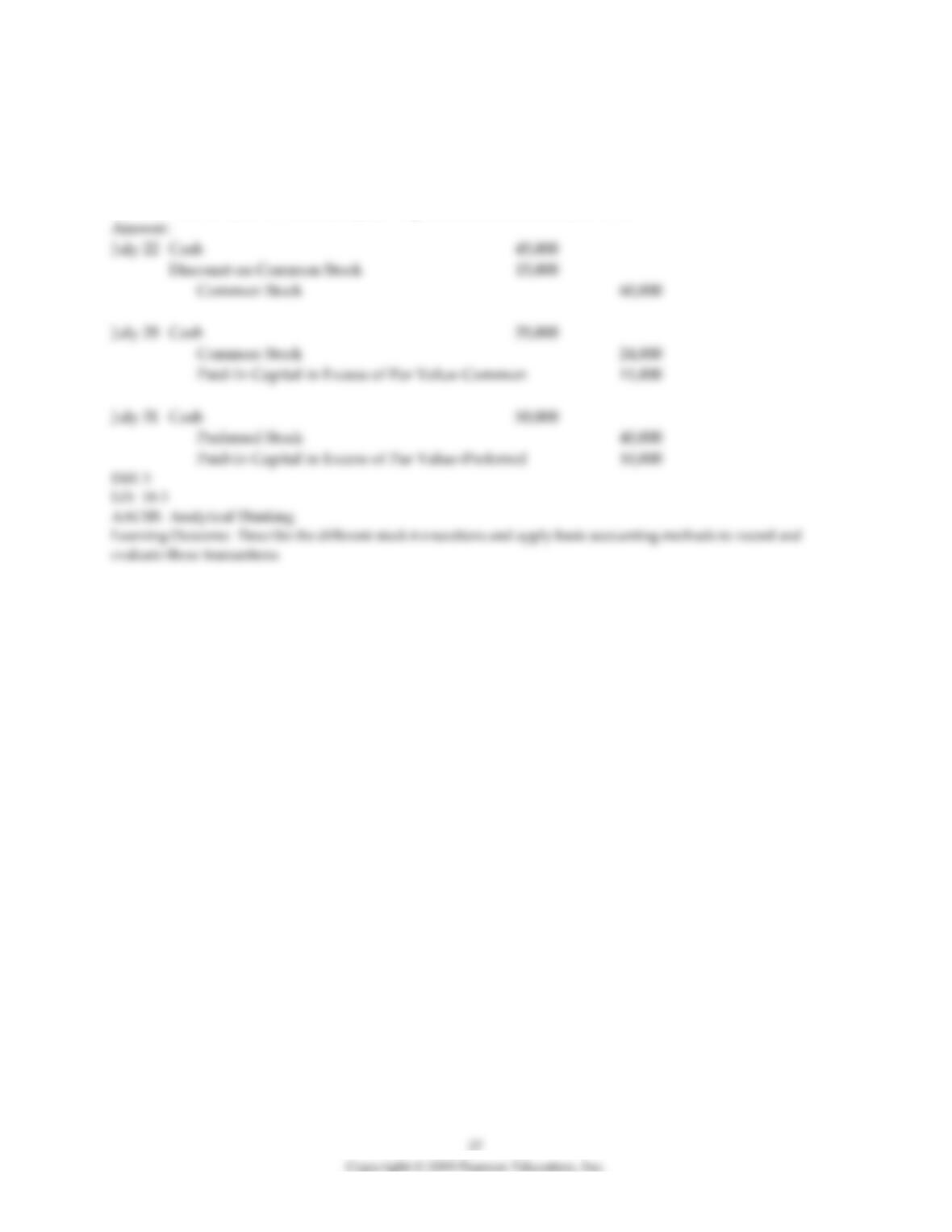
44) Journalize the following stock transactions for Rick Corporation.
July 22 Issued 10,000 shares of $6 par common stock for $45,000 cash.
28 Issued 6,000 shares of $4 par common stock for $35,000 cash.
31 Issued 4,000 shares of $10 par, 7% preferred stock for $50,000 cash.
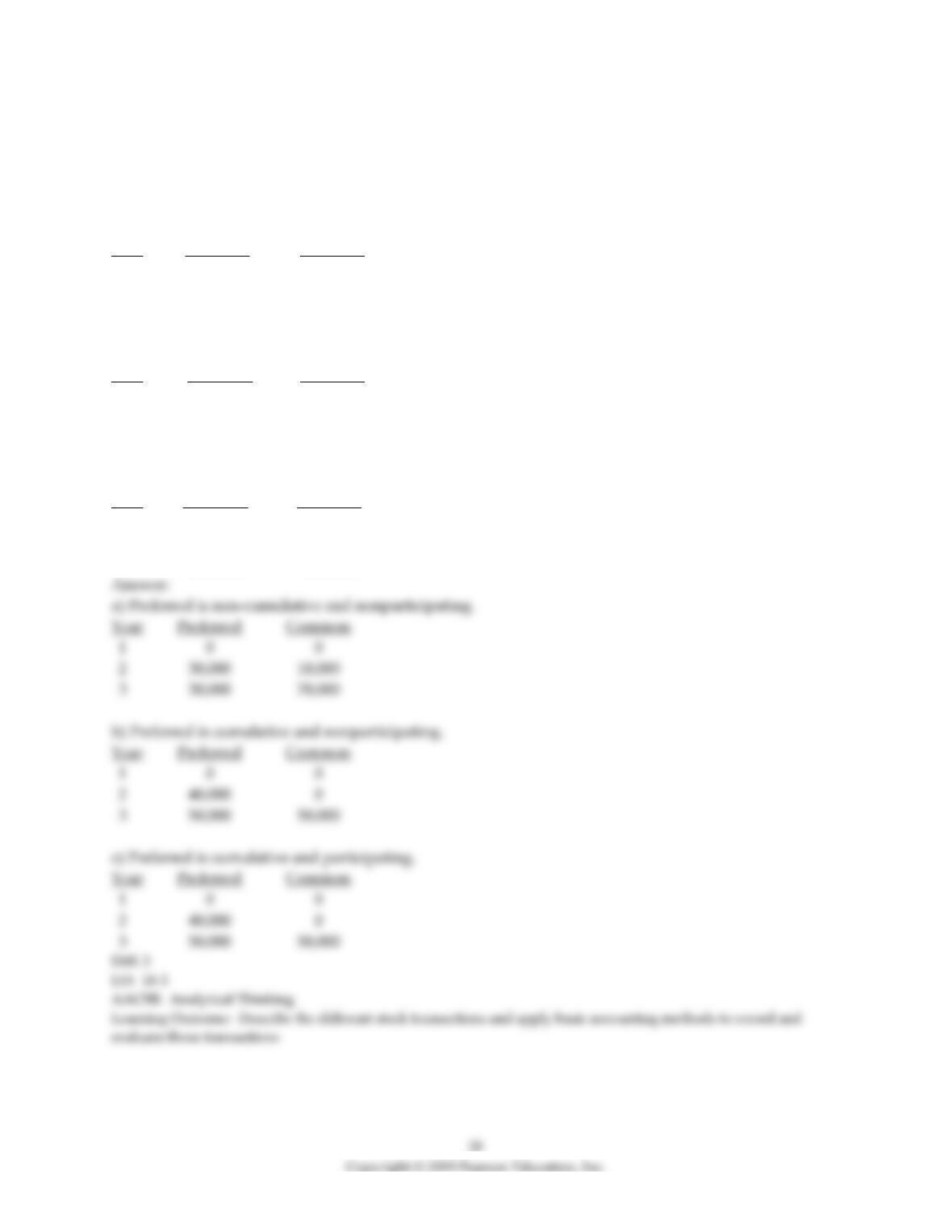
45) Jane Kathryn has 30,000 shares outstanding of $10 par value, 10% preferred stock and 100,000 shares
outstanding $5 par value common stock. In the first 3 years of operations, the company paid dividends in
Year 1, $0; Year 2, $40,000; Year 3, $100,000. Calculate the dividend paid to preferred and common
stockholders under the following independent situations:
a) Preferred is non-cumulative and nonparticipating.
Year Preferred Common
1 ________ ________
2 ________ ________
3 ________ ________
b) Preferred is cumulative and nonparticipating.
Year Preferred Common
1 ________ ________
2 ________ ________
3 ________ ________
c) Preferred is cumulative and participating.
Year Preferred Common
1 ________ ________
2 ________ ________
3 ________ ________
46) Jane Kathryn has 15,000 shares outstanding of $15 par value, 5% preferred stock and 100,000 shares
outstanding $10 par value common stock. In the first 3 years of operations, the company paid dividends
in Year 1, $0; Year 2, $10,000; Year 3, $20,000. Calculate the dividend paid to preferred and common
stockholders under the following independent situations:
a) Preferred is non-cumulative and nonparticipating.
Year Preferred Common
1 ________ ________
2 ________ ________
3 ________ ________
b) Preferred is cumulative and nonparticipating.
Year Preferred Common
1 ________ ________
2 ________ ________
3 ________ ________
47) Colder Industries has 30,000 shares of $10 par common stock and 8,500 shares of $50 par, 6%
preferred stock outstanding. Total dividends available are $80,000. Compute the dividends to be
distributed to preferred and common stockholders under the following condition.
The preferred stock is nonparticipating and non-cumulative with no dividends distributed last year.
48) Colder Industries has 30,000 shares of $10 par common stock and 8,500 shares of $50 par, 6%
preferred stock outstanding. Total dividends available are $80,000. Compute the dividends to be
distributed to preferred and common stockholders under the following condition.
The preferred stock is nonparticipating and cumulative with no dividends distributed last year.
49) Alpha-Omega Industries has 30,000 shares of $12 par common stock and 15,000 shares of $50 par, 5%
preferred stock outstanding. Total dividends available are $162,000. Compute the dividends to be
distributed to preferred and common stockholders under the following condition.
The preferred stock is participating and non-cumulative with no dividends distributed last year.
50) Alpha-Omega Industries has 30,000 shares of $12 par common stock and 15,000 shares of $50 par, 5%
preferred stock outstanding. Total dividends available are $162,000. Compute the dividends to be
distributed to preferred and common stockholders under the following condition.
The preferred stock is participating and cumulative with no dividends distributed last year.
51) Prepare the journal entries for Blitz Industries:
Aug 10 Issued 12,000 shares of $12 par value common stock for $150,000
Aug 20 Issued 6,000 shares of 8%, $25 par value preferred stock for $200,000
52) Prepare the journal entries for Blitz Industries:
April 6 Issued 9,000 shares of $112 par value common stock for $1150,000
April 15 Issued 54,000 shares of 58%, $1525 par value preferred stock for $13200,000
April 23 Issued 5,000 shares of $5 par common stock for $20,000 cash.
53) Sold common stock at a price above the par value.
Debit ________ Credit ________ & ________
54) Exchanged preferred stock for a building when the stock was selling at a premium.
Debit ________ Credit ________ & ________
55) Sold common stock at a price equal to the par value.
Debit ________ Credit ________
56) Exchanged common stock for a building and land when the stock was selling at a discount.
Debit ________ & ________ & ________ Credit ________
57) Sold preferred stock at a price above the par value.
Debit ________ Credit ________ & ________
58) Exchanged common stock for services of corporation organizers (valued above par).
Debit ________ Credit ________ & ________
59) Exchanged common stock for services of corporation organizers (valued at par).
Debit ________ Credit ________
60) Sold common stock at a price less than the par value.
Debit ________ & ________ Credit ________
18.4 Learning Objective 18-4
1) The journal entry for the receipt of a cash payment on common stock subscriptions would include:
A) debiting Subscriptions Receivable-Common Stock; crediting Common Stock.
B) debiting Common Stock; crediting Subscriptions Receivable-Common Stock.
C) debiting Cash; crediting Subscriptions Receivable-Common Stock.
D) debiting Cash; crediting Common Stock Subscribed.
2) Elegant Corporation received subscriptions for 100 shares of its $105 par value common stock for $124
per share. The entry to record the receipt of the subscriptions would include a:
A) debit to Common Stock Subscribed for $10,500.
B) debit to Subscriptions Receivable-Common Stock for $10,500.
C) credit to Paid-in Capital in Excess of Par Value-Common for $1,900.
D) credit to Common Stock to be Outstanding $12,400.
3) Tory Company received the first installment of $2,400 on a common stock subscription. The entry to
record the collection would include a:
A) debit to Subscriptions Receivable-Common Stock for $2,400.
B) credit to Common Stock Subscribed for $2,400.
C) credit to Common Stock for $2,400.
D) credit to Subscriptions Receivable-Common Stock for $2,400.
4) The account that is a current asset on balance sheet representing the amount due on stock subscriptions
is:
A) Common Stock Subscribed.
B) Preferred Stock Subscribed.
C) Stock Subscription.
D) Subscriptions Receivable-Common Stock.
5) The journal entry to record the final installment from a common stock subscription is:
A) a debit Cash and a credit to Paid in Capital in Excess of Par Value-Common Stock.
B) a debit to Subscriptions Receivable-Common Stock and a credit to Cash.
C) a debit to Cash and a credit to Subscriptions Receivable–Common Stock.
D) a debit to Common Stock Subscribed and a credit to Cash.
6) Common Stock Subscribed is:
A) shown as an equity account below Issued Common Stock.
B) a contra-asset account.
C) a receivables account.
D) shown on the income statement as a revenue.
7) In the stockholders’ equity section of a balance sheet:
A) common stock is listed before preferred stock.
B) common stock is listed after preferred stock.
C) common stock is listed after retained earnings.
D) common stock is not listed.
8) The source of capital approach:
A) prepares Paid-In Capital by listing the legal section first.
B) prepares Paid-In Capital by listing classes of stockholder sources of capital.
C) records stock at par value.
D) None of the above are correct.
9) Journalize the transactions for the stock subscription plan for Poplar Company. On April 1, Poplar
received subscriptions for 250 shares of $20 par value common stock at $26 per share. The buyer will pay
two equal installments on May 1 and July 1. Assume all payments are made as scheduled and the
company issues the stock after the July 1 collection.
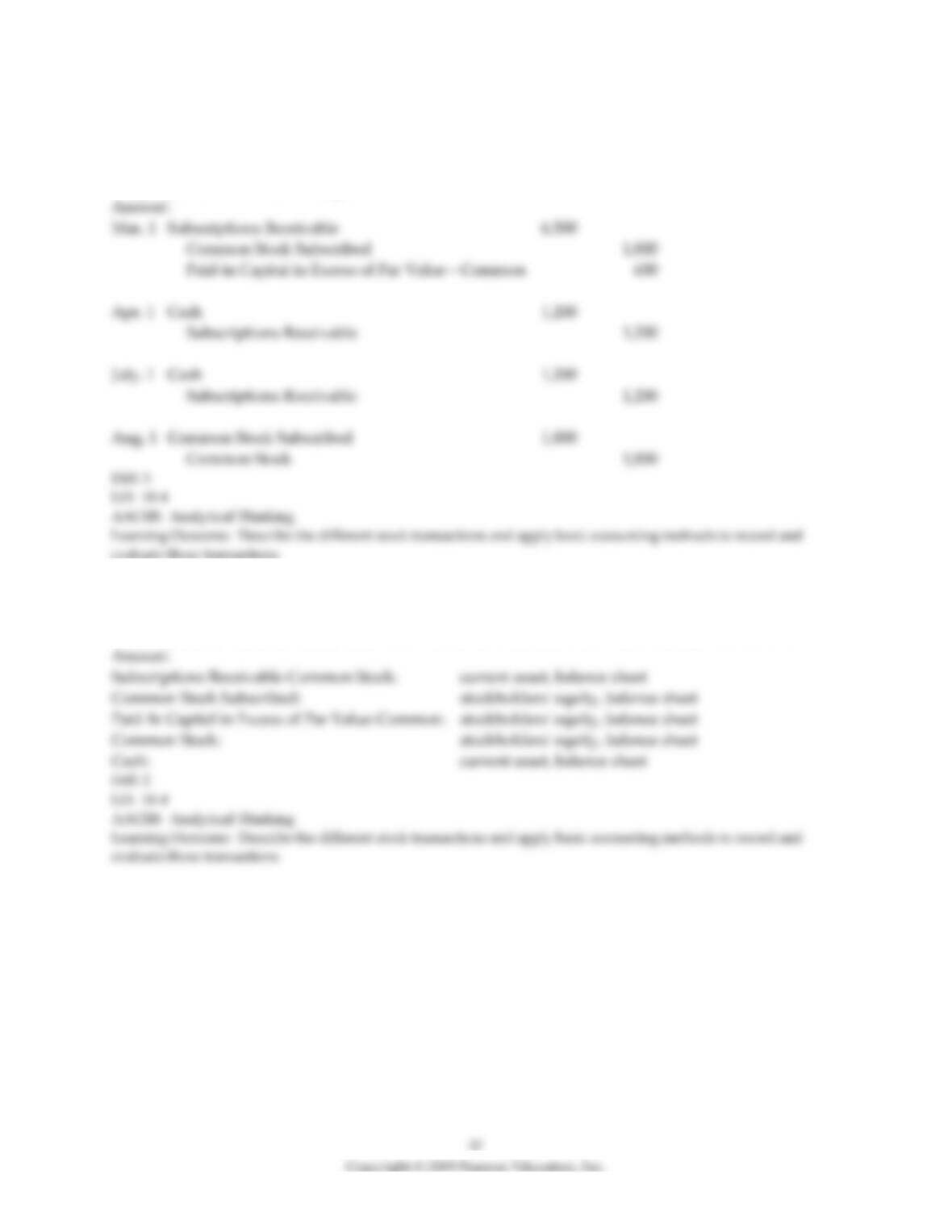
10) Journalize the transactions for the stock subscription plan for Oro Company. On March 1, Oro
received subscriptions for 120 shares of $15 par value common stock at $20 per share. The buyer will pay
two equal installments on April 1 and July 1. Assume all payments are made as scheduled and the
company issues the stock on August 1.
11) Identify the account types used in recording transactions related to a stock subscription plan:
Subscriptions Receivable-Common Stock; Common Stock Subscribed, Paid-In Capital in Excess of Par
Value-Common, Common Stock, Cash. Also list the financial statement where the accounts are found.
12) Describe a stock subscription plan.
Using the following accounts:
[1] Subscription receivable-common stock
[2] Cash
[3] Machinery
[4] Building
[5] Land
[6] Organization costs
[7] Preferred stock
[8] Common stock
[9] Paid in capital in excess of par value – common
[10] Paid in capital in excess of par value – preferred
[11] Common stock subscribed
[12] Discount on common stock
[13] Organization Expense
Indicate the account(s) to be debited and credited to record the following transaction.
13) Sold common stock at a price above par accepting a subscription.
Debit ________ Credit ________ & ________
14) Received first installment on common stock subscription.
Debit ________ Credit ________

15) Issued fully paid common stock.
Debit ________ Credit ________