134) For each of the following jobs, identify a possible nonfinancial performance measure.
(a) Computer help desk worker at your university.
(b) Dental hygienist.
(c) Airline gate agent.
(d) City bus driver.
135) What is a business model?
136) Explain how producing more units than can be sold can increase operating income. Would
this be an issue in a service company or is it only an issue in a manufacturing environment?
Could a company employ this strategy indefinitely to show continuous increases in profits?
137) Describe the four common perspectives that are used in the balanced scorecard.
80
138) Sam Almasi, the CEO of Almasi Technologies Inc. (ATI), a biotechnology firm had
recently returned from a conference on modern cost management and performance measurement
methods where he was exposed to target costing, value-chain analysis, balanced scorecard,
activity-based management, and other ideas.
ATI is a five-year old company operating in a growing, but competitive market. It develops and
produces a number of different enzymes for use by research scientists and pharmaceutical
companies. Its main competitors are also small to medium-sized firms just like ATI. The key to
growth in this industry is the ability to develop new products in a short time. Gail Stevenson, the
vice-president (VP) for research & development (R&D), has noticed that some of ATI’s new
developments did not perform well because of the delays in their introduction into the market.
Stevenson is very keen on hiring the best scientists and ensuring that they stay current in their
fields because knowledge is the key competitive weapon in the biotechnology industry.
Bob Phillips, the controller of ATI, had another concern. He has been noticing that the new
products were not only delayed but their actual development costs were usually higher than
budgeted. One of his goals was to see that the new products were profitable for the company.
Linda Joseph, the production manager, had a different concern of her own. Based on her
observation, the production of the new enzymes was taking longer. Her feeling was that the
products spent too much time in the quality control (QC) department. Barry Laker, the manager
of the QC department, argued that the new enzymes lacked the rigorous specifications that are
demanded in the marketplace. Consequently, the QC department has to perform additional tests
to get to the root cause of the problems.
Almasi had heard complaints from all quarters, and decided to convene a meeting of all the
department heads.
Almasi: Good afternoon, everyone. I am troubled that despite hiring a number of talented
scientists, we are unable to compete effectively in the marketplace. Many of the recent entrants
in the game seem to be beating us easily.
Stevenson: Sam, the key to our growth is rapid introduction of new products. Although my
scientists are developing new enzymes in record times, they seem to be getting held up in
manufacturing, and especially, the QC department.
Laker: Sam, I think I can pinpoint the root cause of the problem. I agree that our scientists are
developing new enzymes in record times, but they do not seem to be paying any attention to
standards. It looks like my department will have to provide training to them regarding quality
control matters.
Stevenson: With due respect, I do not think there is more to know about QC standards. It looks
like the QC department wants more attention and is therefore creating all this unnecessary fuss.
Joseph: I think I will agree with Barry that there are problems at the R&D side. My production
scientists are also complaining that adequate specifications have not been developed; they have
to constantly phone their R&D counterparts for clarifications.
81
Stevenson: I do not believe that the production problems can be attributed to R&D. I have
personally screened each and every scientist during the hiring process.
Phillips: I don’t think we will make much progress as a company if we keep pointing fingers at
one another. We all must realize that all problems, regardless of their origin, finally affect the
bottom-line of our company. Unless we set aside our differences and work together as a team, we
will be unable to compete with our rivals. Some of our competitors follow best practices, which
we must try to emulate.
Almasi: I agree with Bob. We must all look for solutions. I recently attended a conference where
noted speakers talked about the value-chain of a company, interrelationships between functions,
and the balanced scorecard. In fact, some speakers suggested that companies must stop
discussing in terms of individual functions or departments; instead they must talk in terms of
processes and understand linkages among all the processes that exist in an organization. I believe
there are a number of ideas that we could adopt. I will leave the conference proceedings in the
library, and suggest that we all read about these different topics. How about getting together after
six weeks and discussing a plan of action? Thank you and see you all after six weeks.
Required:
Assume the role of a consultant preparing a report for ATI. Discuss the following aspects in your
report:
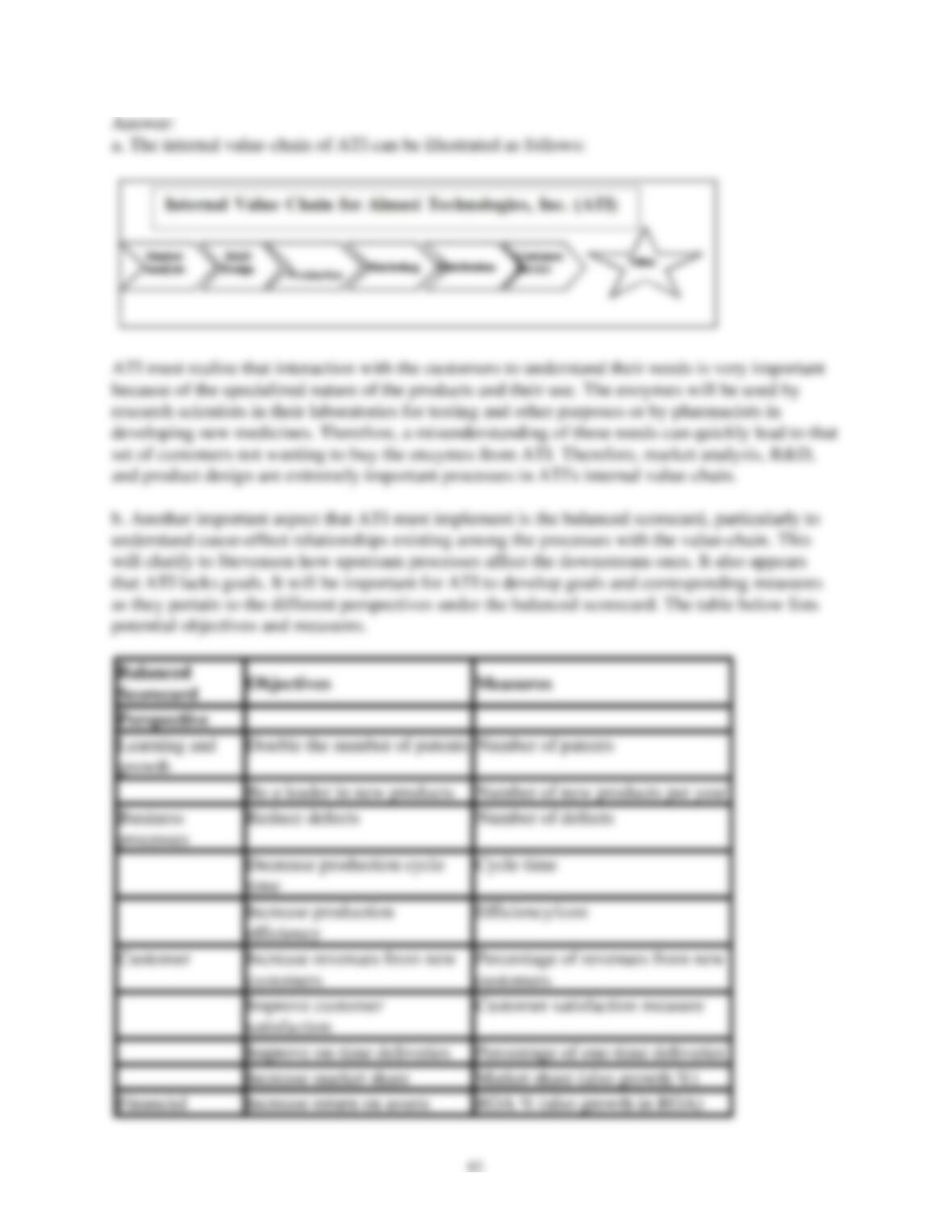
a. The internal value-chain of ATI.
b. The balanced scorecard. Identify the goals of the company under each perspective of the
scorecard and cause-effect relationships, and develop potential measures that could be used.
c. How the inter-departmental differences can be eliminated.

84
139) Granite Manufacturing produces high-end furniture products for the luxury hotel industry.
Granite has succeeded through excellence in design, careful attention to quality in manufacturing
and in customer service, and through continuous product innovation. The manufacturing process
at Granite begins with a close consultation with each customer so that the finished product
exactly meets the customer’s specifications. This commonly means unique designs, special
fabrics, and high levels of manufacturing quality. In addition, Granite believes that a key
competitive edge it has over other competitors is that it has an outstanding design staff that is
able to work with customers to come up with product designs that go beyond the customer’s
expectations.
Required:
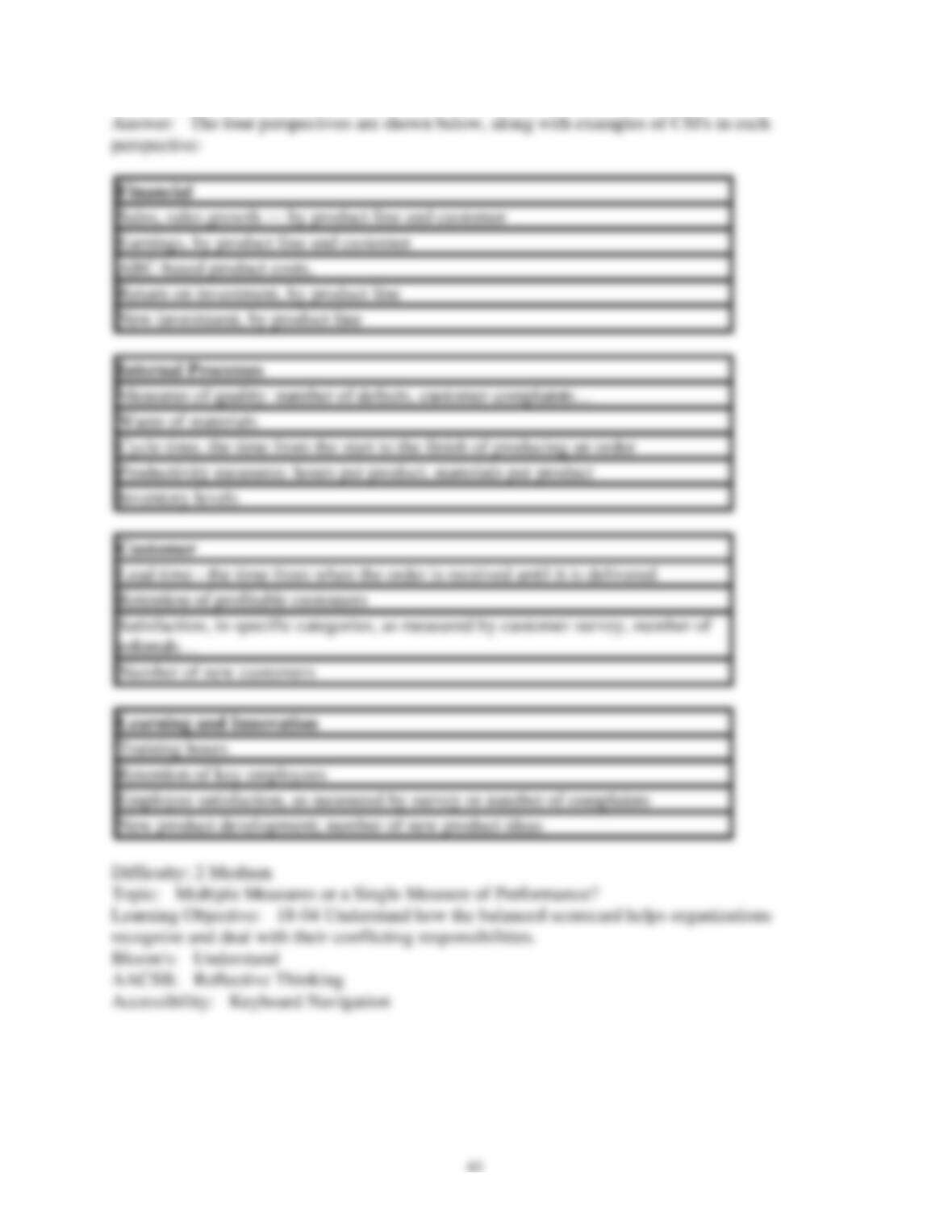
Present a balanced scorecard for Granite Manufacturing with 3-4 perspectives and 3-4
quantitative critical success factors (CSFs) in each perspective.
140) Jackie Horner started Glad Rags to combine fashion and sustainability. The original
production of sandals made from recycled plastic has expanded to a complete line of casual
footwear. Current sales total over $2 million. Jackie hired the firm’s first controller early this
year, and has asked him to detail suggestions for ways to increase profits. Thomas Roberts, the
new controller, has compiled a list of recommended changes that focus on quality improvements.
Glad Rags’ customers expect high quality at a low price, a “value” product. So, the company
must simultaneously watch costs and quality. After receiving his list of suggestions, Jackie calls
Thomas to her office and says, “I don’t see how improving quality can increase productivity. In
fact, it seems to me that efforts to improve quality will slow down production and decrease
productivity.”
Required:
Using specific examples, help Thomas explain to Jackie why efforts to improve quality can also
boost productivity. How does productivity play a role in the firm’s strategy and competitive
environment?
141) What is the difference between continuous improvement and benchmarking?
142) Dr. Hal Trotter is the director of the Wellness House, a residential center for recovering
alcoholics. A typical patient spends 3-4 weeks in an intensive program of rehabilitation. The
Wellness House has a staff of 45, including 12 certified therapists, to serve an average patient
load of 15. Dr. Trotter is attempting to develop some productivity measures for the center, but is
not aware of the limitations of productivity measurement in not-for-profit organizations. You
have been called in as a consultant to help develop appropriate productivity measures.
Required:
(a) Identify any major differences/limitations you face in developing performance measures for
the Wellness House.
(b) Recommend two or three overall measures of productivity that are appropriate for the
Wellness House as a not-for-profit organization.
89
143) Divisional managers of Crusing Incorporated have been expressing growing dissatisfaction
with the current methods used to measure divisional performance. Divisional operations are
evaluated every quarter by comparison with the static budget prepared during the prior year.
Divisional managers claim that many factors are completely out of their control but are included
in this comparison. This results in an unfair and misleading performance evaluation. The
managers have been particularly critical of the process used to establish standards and budgets.
The annual budget, stated by quarters, is prepared six months prior to the beginning of the
operating year. Pressure by top management to reflect increased earnings has often caused
divisional managers to overstate revenues and/or understate expenses. In addition, once the
budget had been established, divisions were required to “live with the budget.” Frequently,
external factors such as the state of the economy, changes in consumer preferences, and actions
of competitors have not been adequately recognized in the budget parameters that top
management supplied to the divisions. The credibility of the performance review is curtailed
when the budget cannot be adjusted to incorporate these changes. Top management, recognizing
the current problems, has agreed to establish a committee to review the situation and to make
recommendations for a new performance evaluation system. The committee consists of each
division manager, the Corporate Controller, and the Executive Vice President who serves as the
chairman. At the first meeting, one division manager outlined an Achievement of Objectives
System (AOS). In this performance evaluation system, divisional managers would be evaluated
according to three criteria:
(1) Doing better than last year – Various measures would be compared to the same measures of
the prior year.
(2) Planning realistically – Actual performance for the current year would be compared to
realistic plans and/or goals.
(3) Managing current assets – Various measures would be used to evaluate the divisional
management’s achievements and reactions to changing business and economic conditions.
A division manager believed this system would overcome many of the inconsistencies of the
current system because divisions could be evaluated from three different viewpoints. In addition,
managers would have the opportunity to show how they would react and account for changes in
uncontrollable external factors. A second division manager was also in favor of the proposed
AOS. However, he cautioned that the success of a new performance evaluation system would be
limited unless it had the complete support of top management. Further, this support should be
visible within all divisions. He believed that the committee should recommend some procedures
which would enhance the motivational and competitive spirit of the divisions.
Required:
a. Explain whether or not the proposed AOS would be an improvement over the measure of
divisional performance now used by Crusing Incorporated.
b. Develop specific performance measures for each of the three criteria in the proposed AOS
which could be used to evaluate divisional managers.
c. Discuss the motivational and behavioral aspects of the proposed performance system. Also,
recommend specific programs which could be instituted to promote morale and give incentives
to divisional management.
144) Companies are continuously seeking ways to improve quality of production and reduce
costs. One of the areas is to work with suppliers to improve the quality and reliability of parts
and products shipped. In an article entitled “In Defense of Activity-Based Cost Management,”
Robert S. Kaplan says:
An ABC model can play a major role in improving supplier relationships as well. These
relationships must be a vital part of any quality and cycle-time improvement program. A key
insight is to use ABC to distinguish between low-price and low-cost suppliers. Traditional cost
accounting, with its emphasis on purchase price variances, encourages purchasing people to
continually scan the population of potential suppliers to obtain low price quotations. Most
companies have learned, the hard way, that many of their low-price suppliers are actually
extremely high-cost suppliers. (Source: Management Accounting: November, 1992)
Required:
(a) Explain what Kaplan means by “many of their low-price suppliers are actually extremely
high-cost suppliers.”
(b) What general prevention and appraisal activities can be used to improve the quality and
reliability of parts and products shipped from suppliers?
145) What is productivity, and what are the differences between partial productivity measures
and total factor productivity?
146) Explain how nonfinancial performance measures for customer satisfaction may differ from
functional performance measures.
147) Why is worker involvement important to an organization’s success?
148) At some manufacturing companies, line employees are allowed to stop the line or halt
production if they think there is a problem occurring. In other words, if units begin to be
processed that are outside of specifications.
Required:
Discuss the advantages and disadvantage of this employee empowerment policy.