111) The Everton Manufacturing Company collected the following information (in days):
April
May
June
Transporting product
2.0
3.0
2.0
Processing product
5.0
7.0
7.0
Inspecting product
0.5
0.8
1.0
Storing product
2.0
3.0
4.0
Required:
a. Calculate the manufacturing cycle efficiency for April, May, and June.
b. Calculate the processing time required for June so that the manufacturing cycle efficiency is
equal to the most efficient of the previous two months.
112) The Altoona Manufacturing Company collected the following information (in days) for
July, August, and September:
July
August
September
Transporting product
2.0
3.0
2.0
Processing product
5.0
7.0
7.0
Inspecting product
0.5
0.8
1.0
Storing product
1.0
3.0
4.0
Required:
a. Calculate the manufacturing cycle efficiency for July, August, and September.
b. Assume October’s processing time will be the same as September. If Altoona’s target for
manufacturing cycle efficiency is 65%, what will be October’s target for manufacturing cycle
time?
113) The Gantry Company collected the following information (in days) for October, November,
and December:
October
November
December
Transporting product
1.0
2.0
3.0
Processing product
6.0
6.0
7.0
Inspecting product
2.0
1.0
0.8
Storing product
4.0
2.0
3.0
Required:
a. Calculate the manufacturing cycle efficiency for October, November, and December.
b. Assume January’s processing time will be the same as December. If Gantry’s target for
manufacturing cycle efficiency is 60%, what will be January’s target for non-processing times?
114) Marion Forging Co. has provided the following information for last year:
Tons of metal input
14,000
Labor hours
5,000
Overhead costs
$
125,000
Tons of forging produced
10,000
Required:
Calculate the partial productivity for:
a. Metal.
b. Labor.
115) Marion Forging Co. has provided the following information for last year:
Tons of metal input
14,000
@
$10/ton
Labor hours
5,000
@
$30/hour
Overhead costs
$
125,000
Tons of forging produced
10,000
@
selling price of $60/ton
Required:
Calculate the total factor productivity measure.
116) Pantipazole Products Co. has provided the following information for last year:
Material costs
$
150,000
Labor hours
$
45,000
Overhead costs
$
117,000
Tons of forging produced
8,000
@
selling price of $45/each
Required:
Calculate the total factor productivity measure.
117) Shuster Metalworks Co. has provided the following information for last year:
Pounds of metal input
21,000
Labor hours
8,000
Overhead costs
$
165,000
Pounds of output produced
12,000
Required:
Calculate the partial productivity for:
a. Metal.
b. Labor.
118) Shuster Metalworks Co. has provided the following information for last year:
Pounds of metal input
21,000
@
$12/pound
Labor hours
8,000
@
$25/hour
Overhead costs
$
165,000
Pounds of output produced
12,000
@
selling price of $70/pound
Required:
Calculate the total factor productivity measure.
119) Cummings Co. has provided the following information for last year:
Material costs
$
225,000
Labor costs
$
70,000
Overhead costs
$
175,000
Product produced
9,000
@
selling price of $60/each
Required:
Calculate the total factor productivity measure.
120) Maeve Co. has provided the following information for last year:
Pounds of input
35,000
Labor hours
8,000
Overhead costs
$
142,000
Units of output produced
15,000
Required:
Calculate the partial productivity for:
a. Metal.
b. Labor.
121) Colbyville Co. has provided the following information for last year:
Pounds of input
35,000
@
$17/pound
Labor hours
8,000
@
$26/hour
Overhead costs
$
142,000
Units of output produced
15,000
@
selling price of $85/unit
Required:
Calculate the total factor productivity measure.
122) Beach Co. has provided the following information for last year:
Material costs
$
160,000
Labor costs
$
62,000
Overhead costs
$
171,000
Product produced
11,000
@
selling price of $52/each
Required:
Calculate the total factor productivity measure.
123) Melbourne, Inc. has provided the following information for last year:
Pounds of input
42,000
@
$18/pound
Labor hours
11,000
@
$24/hour
Overhead costs
$
187,000
Units of output produced
33,000
@
selling price of $85/unit
Required:
Calculate the partial productivity for:
a. Metal.
b. Labor.
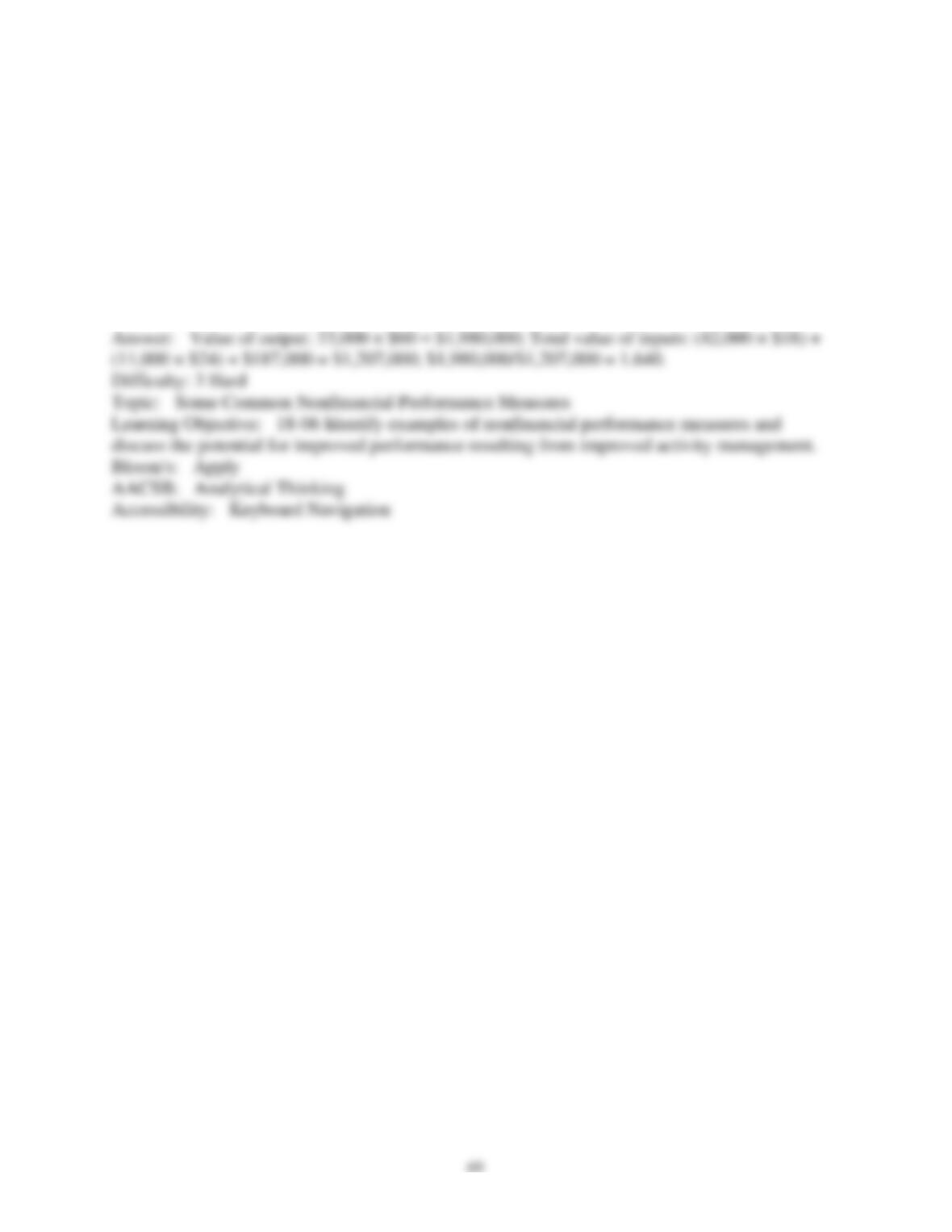
124) Melbourne Inc., has provided the following information for last year:
Pounds of input
42,000
@
$18/pound
Labor hours
11,000
@
$24/hour
Overhead costs
$
187,000
Units of output produced
33,000
@
selling price of $60/unit
Required:
Calculate the total factor productivity measure.
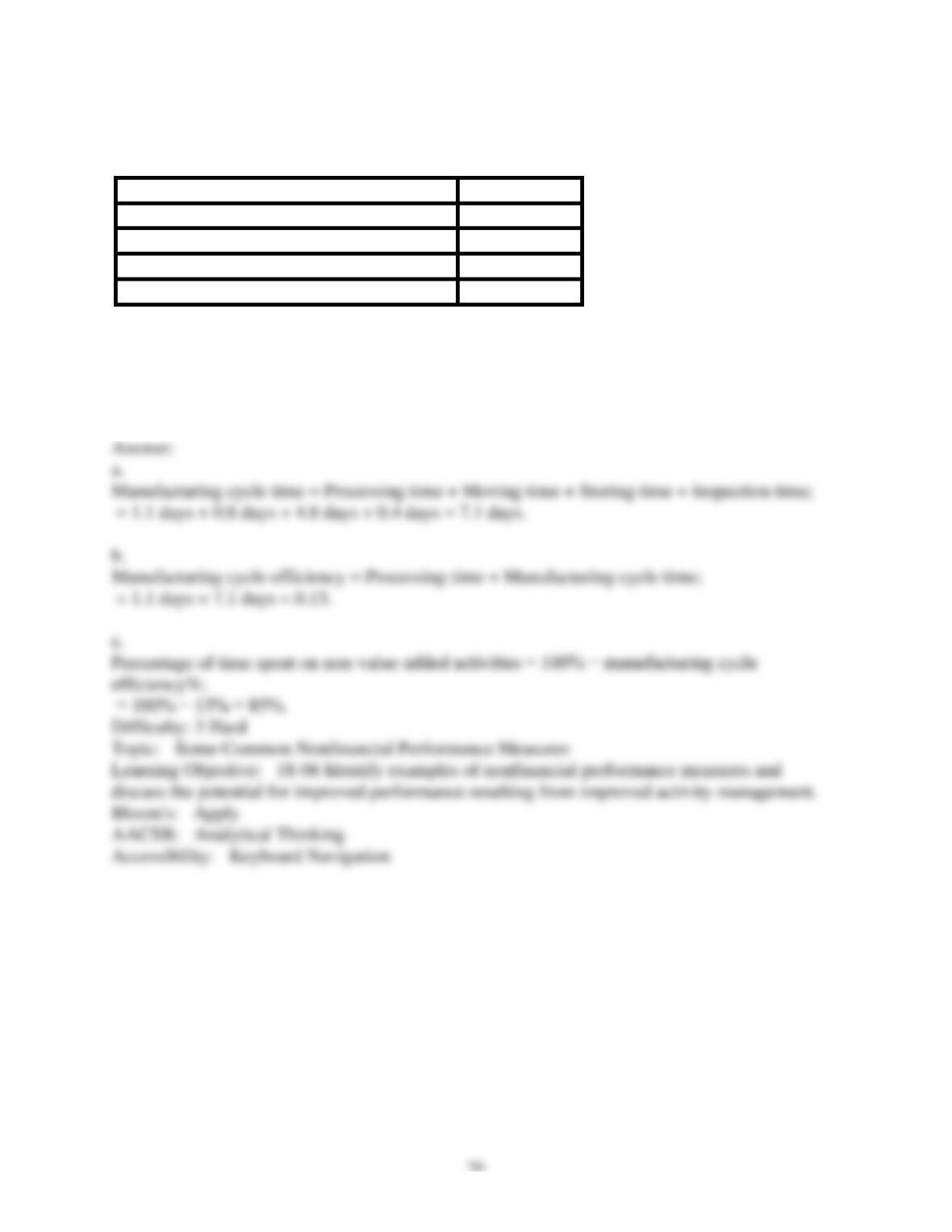
125) Indiatlantic Corporation’s management keeps track of the time it takes to process orders.
During the most recent month, the following average times were recorded per order:
Hours
Processing Time
1.1
Inspection Time
0.4
Moving Time
0.8
Storing Time
4.8
Required:
a. Compute the manufacturing cycle time.
b. Compute the manufacturing cycle efficiency.
c. What percentage of the production time is spent in non-value-added activities?
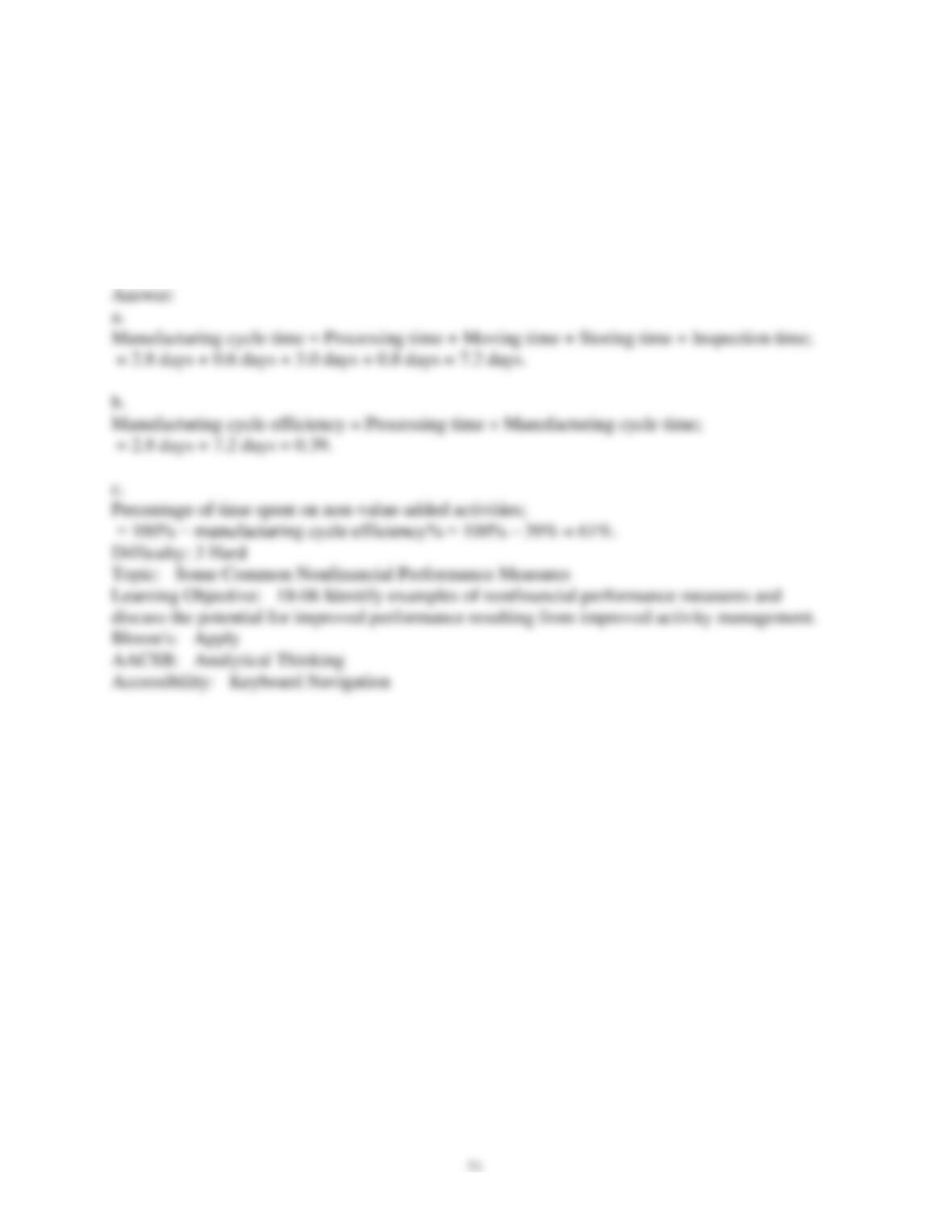
126) During the most recent month at Harrison Corporation, storing time was 3.0 days,
inspection time was 0.8 days, processing time was 2.8 days, and moving time was 0.6 days.
Required:
a. Compute the manufacturing cycle time.
b. Compute the manufacturing cycle efficiency.
c. What percentage of the production time is spent in non-value-added activities?
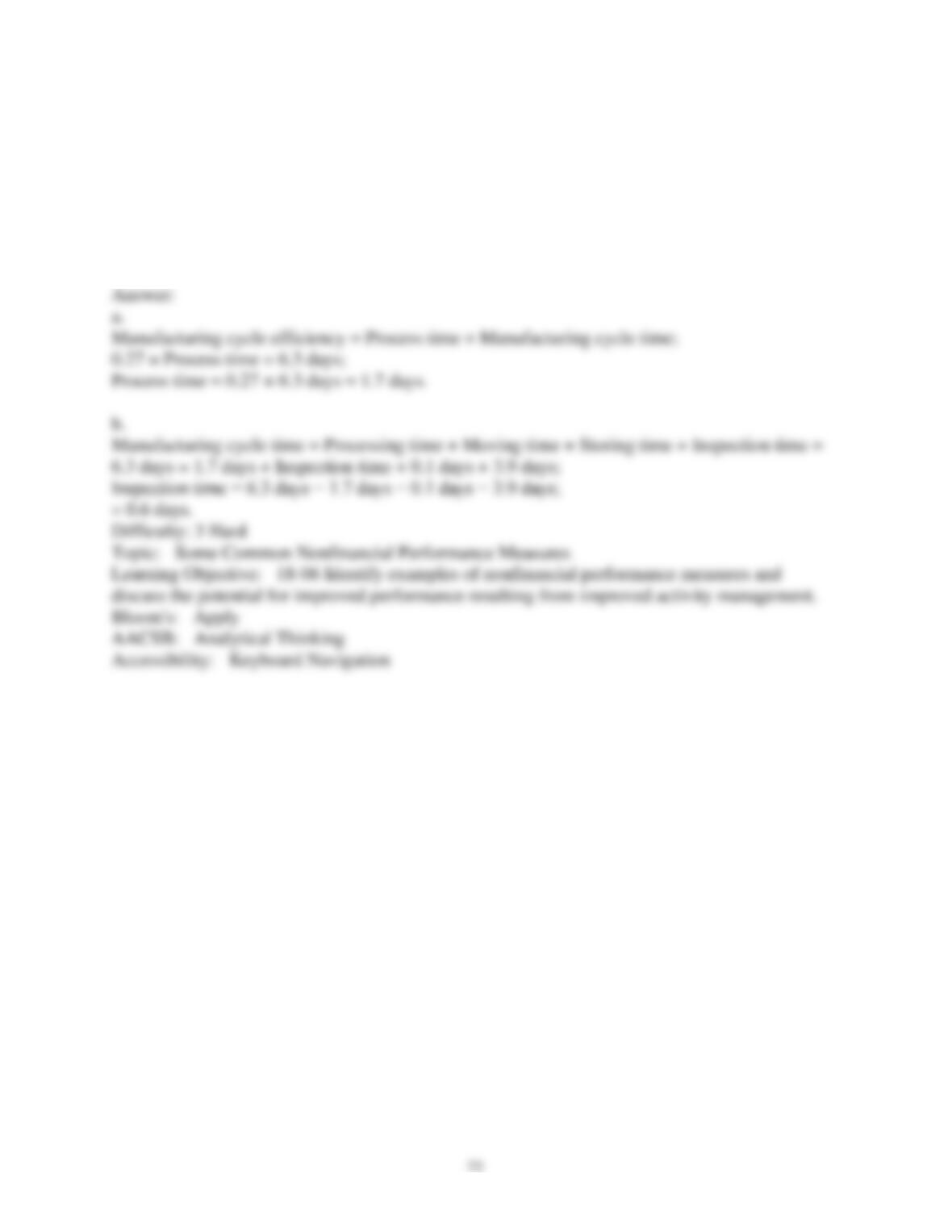
127) Michael Corporation’s management reports that its average manufacturing cycle time is 6.3
days, its manufacturing cycle efficiency is 0.27, its average move time is 0.1 day, and its average
storage time is 3.9 days.
Required:
a. What is the process time?
b. What is the inspection time?
128) Karin Corporation keeps track of the time required to fill orders. The times required for a
particular order appear below:
Hours
Processing Time
0.6
Inspection Time
0.3
Moving Time
2.1
Storing Time
8.4
Required:
a. Determine the manufacturing cycle time. Show your work.
b. Determine the manufacturing cycle efficiency. Show your work.
129) Consider the following management activities:
∙ Choose the organization’s long-term strategy.
∙ Plan and organize the use of resources into efficient operations.
∙ Implement plans and organizational change.
∙ Measure and report results.
∙ Define the organization’s scale and scope of operations.
Required:
a. Identify the sequence in which the decisions must be carried out. Why is it important to carry
out these activities sequentially?
b. How can an effective cost management system support the above activities?
130) Consider a local coffee shop, a Starbucks store, and a retail gas station that offers fresh
coffee in its convenience stores.
Required:
Characterize these stores according to the Porter strategy framework.
131) Studebaker Corporation, one of the earliest auto manufacturers, prospered in the late 1940s
and into the 1950s. Its advertising after World War II emphasized quality of design and
production. The corporation also used the stability of its work force in its advertisements, often
featuring pictures of father and son working side by side in its factories.
Required:
a. From just this brief description of Studebaker Corporation, which type of competitive
strategy—cost leadership or differentiation—would you guess Studebaker was using? Explain
your choice.
b. Given your answer in Part (a), speculate on what market factors might have caused the
corporation to go into bankruptcy and cease production in the mid-1960s.
132) Describe the difference between a company’s mission statement and its business-level
strategy.
133) Levi Strauss and Co., maker of Levi’s familiar 501 and 505 brands of jeans, also makes a
“Signature” brand that was introduced several years ago for discount retailers such as Walmart.
Levi’s strategy with the new jeans was to sell a competitively priced pair. The jeans were to be
about one-half the price of the familiar 501 and 505 jeans. To get costs down Levi would:
∙ Use cheaper fabrics and materials.
∙ Shun costly mass-market advertising.
∙ Strictly limit the number of fits, styles, and colors.
The Signature brand had a good first year of sales; assume that results for the second year and
later are not yet in.
Required:
a. Assess the new strategy at Levi. What do you think are the potential benefits and risks?
b. How will the firm’s value chain and balanced scorecard change as a result of the new strategy?