18) What is value engineering?
A) Reevaluating market strategies to create a more valuable product
B) Estimating the value added of the engineering processes
C) Reevaluating production activities to reduce costs
D) Estimating the value of the end product
19) Ganges Company makes bulk burlap by the ton. Currently, their manufacturing cost is $215 per unit, and their
non-manufacturing cost is $40 per unit. The going market price of the product is $300. Ganges uses
the target price and target cost methodology. If they desire to make a profit of 20% on the price, what must they
do?
A) Increase the advertising costs by $15 per unit.
B) Reduce the price they charge by $15 per unit.
C) Reduce the full-product cost by $60 per unit.
D) Reduce the full-product cost by $15 per unit.
20) Which of the following describes full-product cost?
A) All production costs plus all non-manufacturing costs
B) All production costs
C) Direct materials plus direct labor cost
D) Manufacturing overhead plus non-manufacturing cost
21) Bakersfield Manufacturing produces agricultural tools including a hand tiller. Their current full-product cost for
a hand tiller is $20. Bakersfield wishes to make a 15% profit on the selling price. Bakersfield uses a target pricing
strategy. The current competitive market price for this product is $22. What does Bakersfield have to do to achieve
their profit objective?
A) Reduce full-product cost by $1.30.
B) Reduce full-product cost by $3.00.
C) Reduce full-product cost by $2.70.
D) Reduce full-product cost by $11.25.
22) Bakersfield Manufacturing produces agricultural tools including a hand tiller. Their current full-product cost for
a hand tiller is $20. Bakersfield wishes to make a 15% profit on the selling price. Bakersfield uses a target pricing
strategy. The current competitive market price for this product is $22.00. What would be the most appropriate
response to this situation?
A) Employ cost plus pricing.
B) Carry out value engineering study.
C) Expand production facilities.
D) Strengthen internal controls.
23) Arnold Company produces handheld calculators, and their manufacturing cost is currently $5.80 per unit. The
company also has non-manufacturing costs of $1.20 per unit. Arnold employs target pricing strategy, and the
current market price is $8.00 per unit. If Arnold wishes to price their product at a 25% markup over full-product
cost, what must they do?
A) Price the product at $8.75 per unit.
B) Reduce full-product cost by $0.20.
C) Reduce full-product cost by $0.60.
D) Reduce the non-manufacturing cost by 25%.
24) Torreya Company produces gaskets for the automotive industry. Current production cost is $4.50 per carton of
100. There is a highly competitive market for the product, and Torreya currently uses a target pricing approach.
Currently, equivalent products are selling for $5.90 per carton. Torreya wishes to earn a minimum of a 30% markup
over cost. What would be their most appropriate response?
A) To raise the price to $5.95 per carton
B) To change over to cost plus pricing
C) To mark the price down to $5.80 per carton
D) To stop producing this product because they cannot earn the required amount of profit
25) Appalachee Company produces gaskets for the automotive industry. Current production cost is $3.50 per gross.
There is a highly competitive market for the product, and Appalachee currently uses a target pricing approach.
Currently, equivalent products are selling for $4.75 per gross. Apalachee wishes to earn a minimum of a 40%
markup over cost. What would be their most appropriate response? (Please round all amounts to the nearest cent.)
A) Reduce production cost by $0.11 per gross.
B) Reduce production cost by $0.05 per gross.
C) Increase price to $4.90 per gross.
D) Increase price to $4.85.
26) Leon Production produces steel rivets for the shipbuilding business. Leon uses the target pricing approach. The
company’s objective is to achieve gross profit equal to 25% of selling price. Other data are shown below:
Current production cost $112 per carton
Current market price $130 per carton
What must the company do to achieve their profit goal? (Please round all amounts to the nearest cent.)
A) Reduce production cost from $112 to $110.00.
B) Reduce production cost from $112 to $97.50.
C) Reduce production cost from $112 to $101.25.
D) Reduce production cost from $112 to $99.00.
27) Martin Manufacturers produces 3 models of industrial hammers. Martin uses the target pricing approach. The
company’s objective is to achieve gross profit equal to 40% of selling price. Other data are shown below:
Current production cost $42.50 per unit
Current market price $60.00 per unit
What must the company do to achieve their profit goal? (Please round all amounts to the nearest cent.)
A) Reduce production cost by $6.50 per unit.
B) Increase price by $0.50 per unit.
C) Reduce production cost by $4.20 per unit.
D) Increase price by $6.50.
28) Nemesis Company manufactures water skis. Nemesis pursues a target pricing strategy. Please review the data
below:
Current market price $180 per pair
Current manufacturing cost $110 per pair
Current non-manufacturing cost $25 per pair
Desired profit 30% of price
Which of the following represents the full-product cost?
A) $143
B) $180
C) $110
D) $135
29) Nemesis Company manufactures water skis. Nemesis pursues a target pricing strategy. Please review the data
below:
Current market price $180 per pair
Current manufacturing cost $110 per pair
Current non-manufacturing cost $25 per pair
Desired profit 30% of price
Which of the following represents the target price?
A) $143
B) $180
C) $110
D) $135
30) Nemesis Company manufactures water skis. Nemesis pursues a target pricing strategy. Please review the data
below:
Current market price $180 per pair
Current manufacturing cost $110 per pair
Current non-manufacturing cost $25 per pair
Desired profit 30% of price
Which of the following represents the target cost?
A) $126
B) $180
C) $110
D) $135
31) Nemesis Company manufactures water skis. Nemesis pursues a target pricing strategy. Please review the data
below:
Current market price $180 per pair
Current manufacturing cost $110 per pair
Current non-manufacturing cost $25 per pair
Desired profit 30% of price
Which of the following would be the desired cost reduction? (Please round all amounts to nearest cent.)
A) $12.50
B) $16.00
C) $11.00
D) $9.00
32) A-1 Sports Vehicles Manufacturing produces a specialty racing bicycle. There is stiff foreign competition, and
the company is forced to pursue target pricing. The competitive market price of the bicycle is $2,000. Currently the
manufacturing cost for this product at A-1 is $1,550 and the associated non-manufacturing costs are $270. A-1’s
owners insist on achieving a profit of 12% of sales price. What amount is the target price? (Please round all
amounts to the nearest whole dollar.)
A) $1,820
B) $1,550
C) $2,000
D) $1,760
33) A-1 Sports Vehicles Manufacturing produces a specialty racing bicycle. There is stiff foreign competition, and
the company is forced to pursue target pricing. The competitive market price of the bicycle is $2,000. Currently the
manufacturing cost for this product at A-1 is $1,550 and the associated non-manufacturing costs are $270. A-1’s
owners insist on achieving a profit of 12% of sales price. What amount is the target cost? (Please round all amounts
to the nearest whole dollar.)
A) $1,820
B) $1,550
C) $2,000
D) $1,760
34) A-1 Sports Vehicles Manufacturing produces a specialty racing bicycle. There is stiff foreign competition, and
the company is forced to pursue target pricing. The competitive market price of the bicycle is $2,000. Currently the
manufacturing cost for this product at A-1 is $1,550 and the associated non-manufacturing costs are $270. A-1’s
owners insist on achieving a profit of 12% of sales price. What amount is the full-product cost? (Please round all
amounts to the nearest whole dollar.)
A) $1,820
B) $1,550
C) $2,000
D) $1,760
35) A-1 Sports Vehicles Manufacturing produces a specialty racing bicycle. There is stiff foreign competition, and
the company is forced to pursue target pricing. The competitive market price of the bicycle is $2,000. Currently the
manufacturing cost for this product at A-1 is $1,550 and the associated non-manufacturing costs are $270. A-1’s
owners insist on achieving a profit of 12% of sales price. How much is the desired cost reduction? (Please round all
amounts to the nearest whole dollar.)
A) $60
B) $50
C) $40
D) $0
36) Clark Manufacturing makes blank CDs; it is a very competitive market and the company follows a target pricing
strategy. Currently the market price for a unit of product (one unit equals a package of 100 CDs) is $18.00. Clark’s
production costs are shown below:
Direct materials $5.00 per unit
Direct labor $2.90 per unit
Indirect production costs $6.42 per unit
Non-manufacturing costs $3.20 per unit
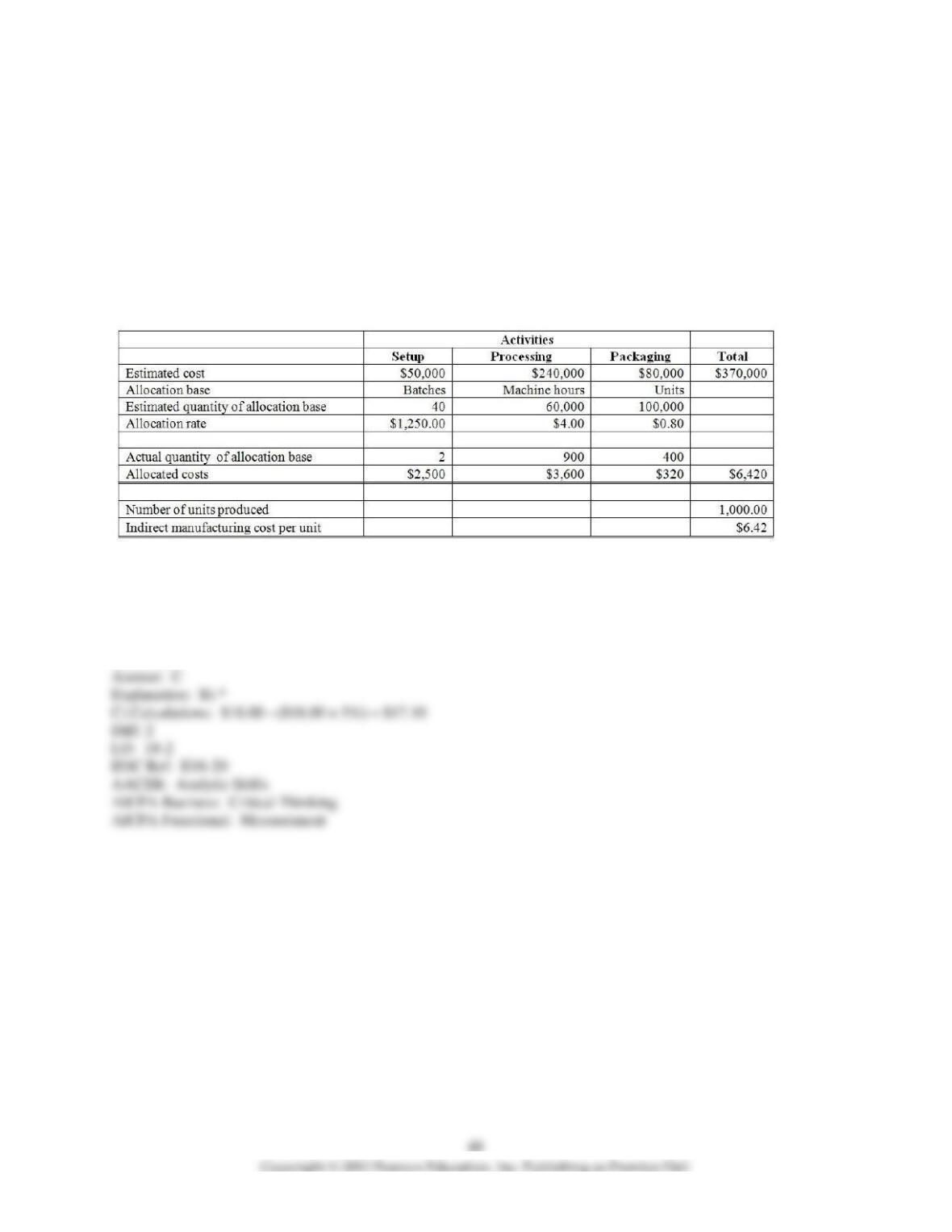
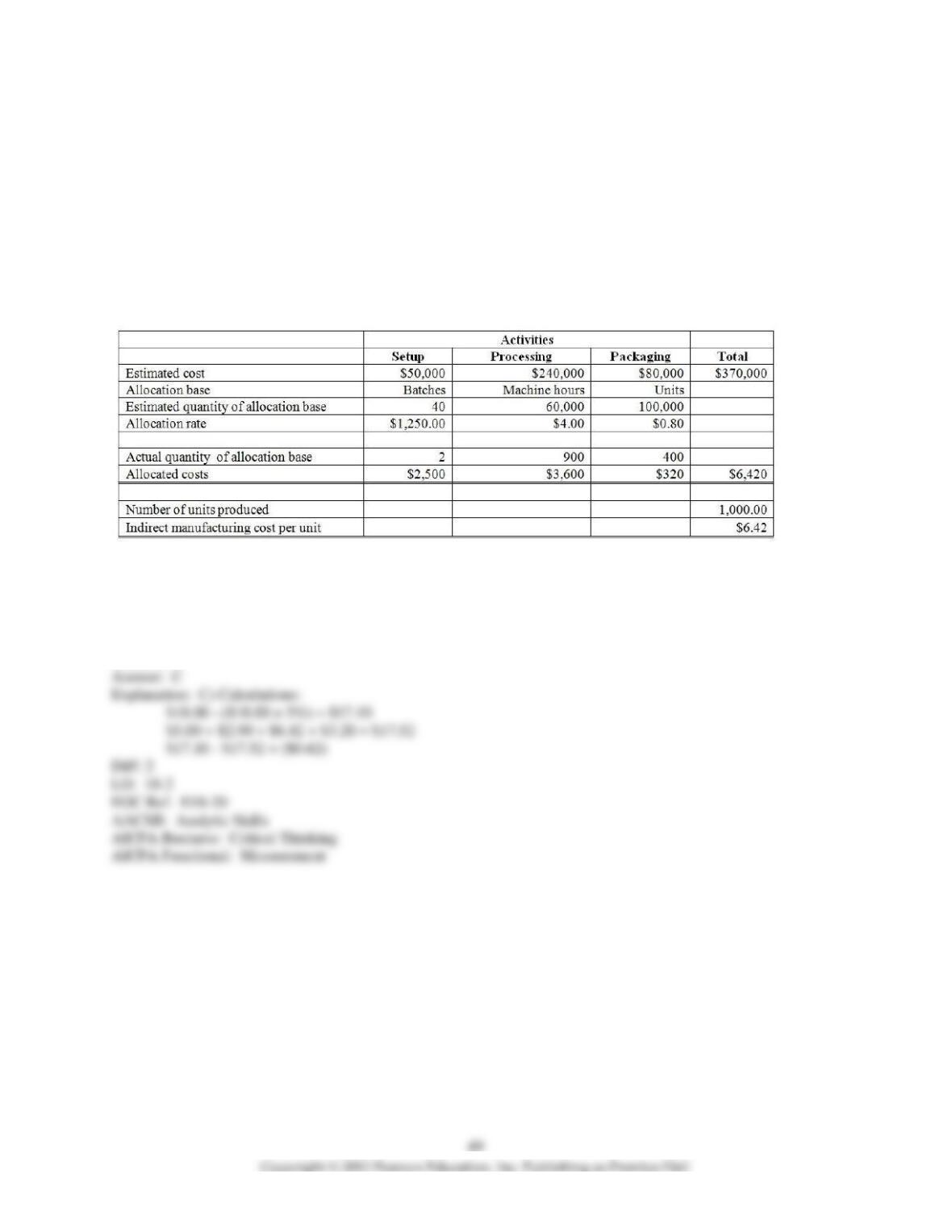
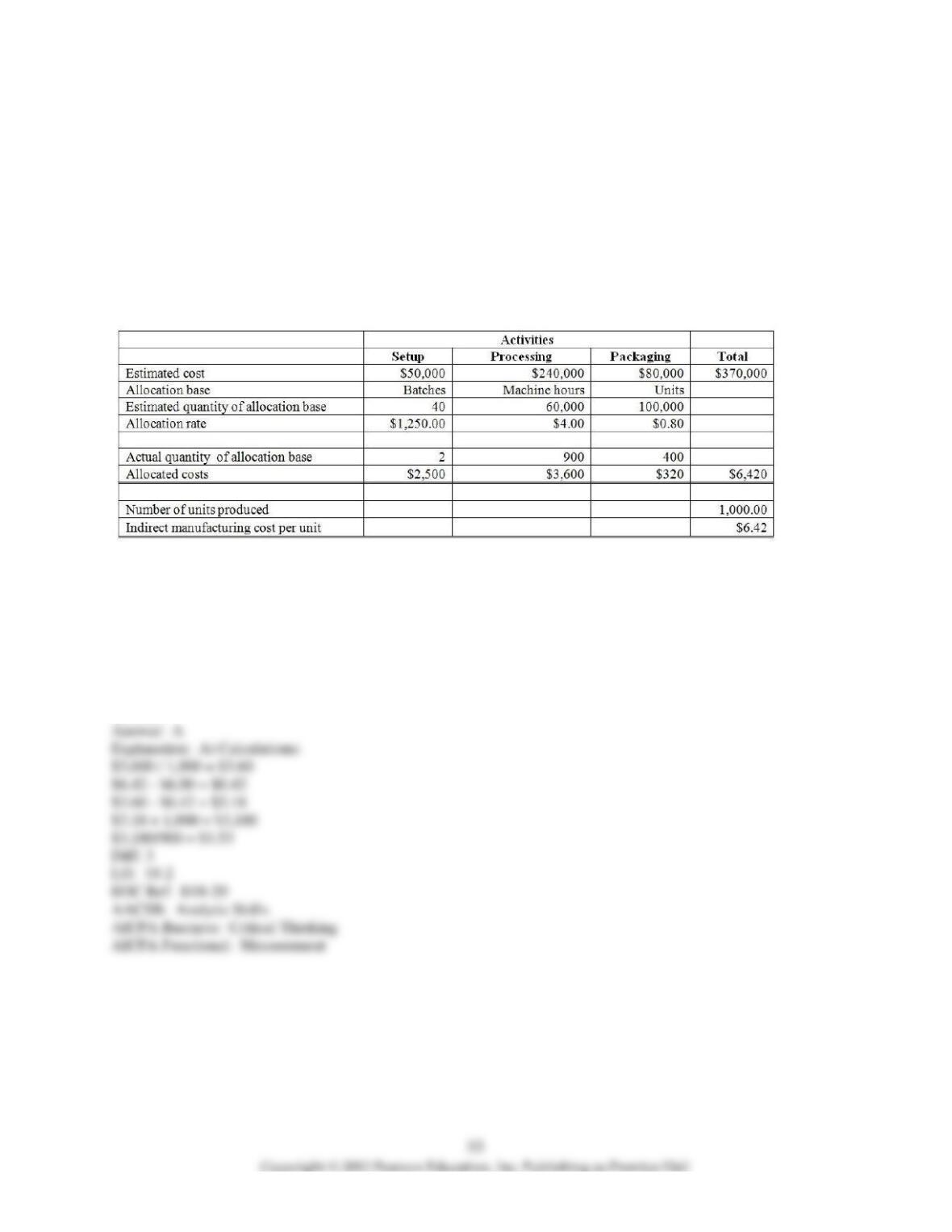
Clark uses activity-based costing for its indirect production costs and provides the following information about this
particular product:
The company’s objective is to earn 5% profit on the sales price of the product. Based on the above data, what is the
company’s target cost per unit?
A) $18.40
B) $14.32
C) $17.10
D) $17.52
37) Clark Manufacturing makes blank CDs; it is a very competitive market and the company follows a target pricing
strategy. Currently the market price for a unit of product (one unit equals a package of 100 CDs) is $18.00. Clark’s
production costs are shown below:
Direct materials $5.00 per unit
Direct labor $2.90 per unit
Indirect production costs $6.42 per unit
Non-manufacturing costs $3.20 per unit
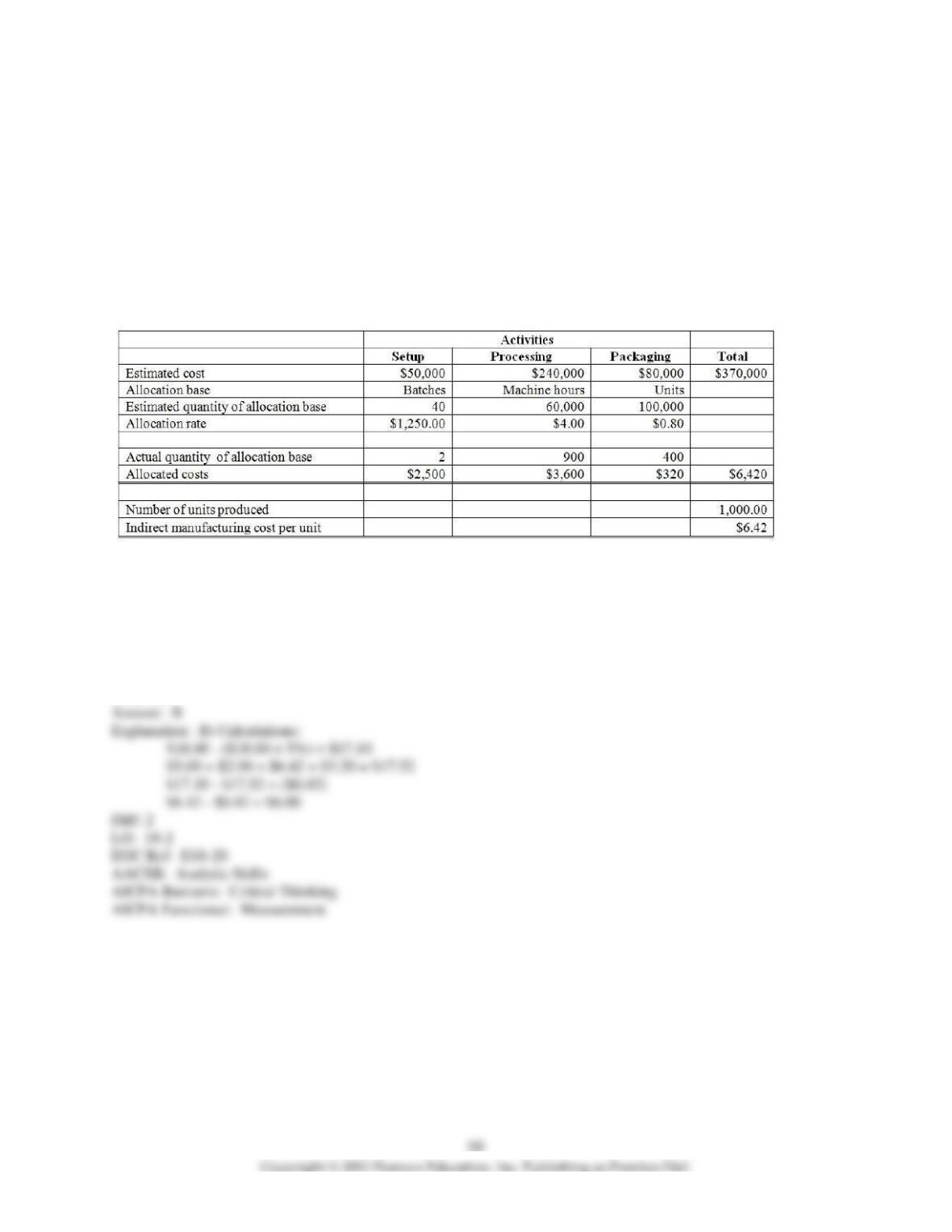
Clark uses activity-based costing for its indirect production costs and provides the following information about this
particular product:
The company’s objective is to earn 5% profit on the sales price of the product. Based on the above data, how much
cost reduction does the company need to achieve its objective?
A) $0.90
B) $0.34
C) $0.42
D) $0.62
38) Clark Manufacturing makes blank CDs; it is a very competitive market and the company follows a target pricing
strategy. Currently the market price for a unit of product (one unit equals a package of 100 CDs) is $18.00. Clark‘s
production costs are shown below:
Direct materials $5.00 per unit
Direct labor $2.90 per unit
Indirect production costs $6.42 per unit
Non-manufacturing costs $3.20 per unit
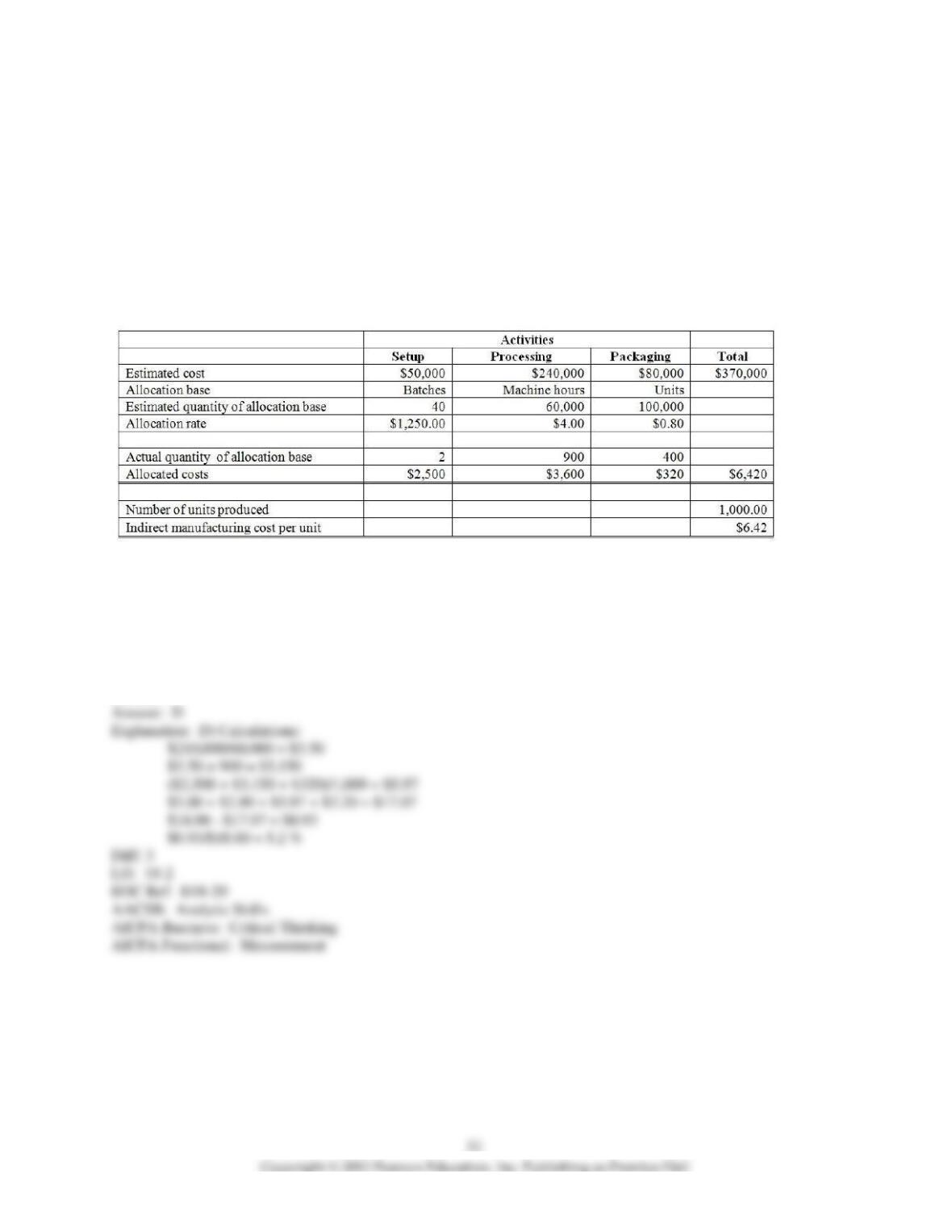
Clark uses activity-based costing for its indirect production costs and provides the following information about this
particular product:
The company’s objective is to earn 5% profit on the sales price of the product. Clark carried out a value engineering
study and decided that they could make the processing activity more efficient and save costs. In order to achieve
their profit objective for this product, they need to reduce the indirect cost per unit from $6.42 down to what
amount?
A) $6.10
B) $6.00
C) $5.80
D) $5.62
39) Clark Manufacturing makes blank CDs; it is a very competitive market and the company follows a target pricing
strategy. Currently the market price for a unit of product (one unit equals a package of 100 CDs) is $18.00. Clark’s
production costs are shown below:
Direct materials $5.00 per unit
Direct labor $2.90 per unit
Indirect production costs $6.42 per unit
Non-manufacturing costs $3.20 per unit
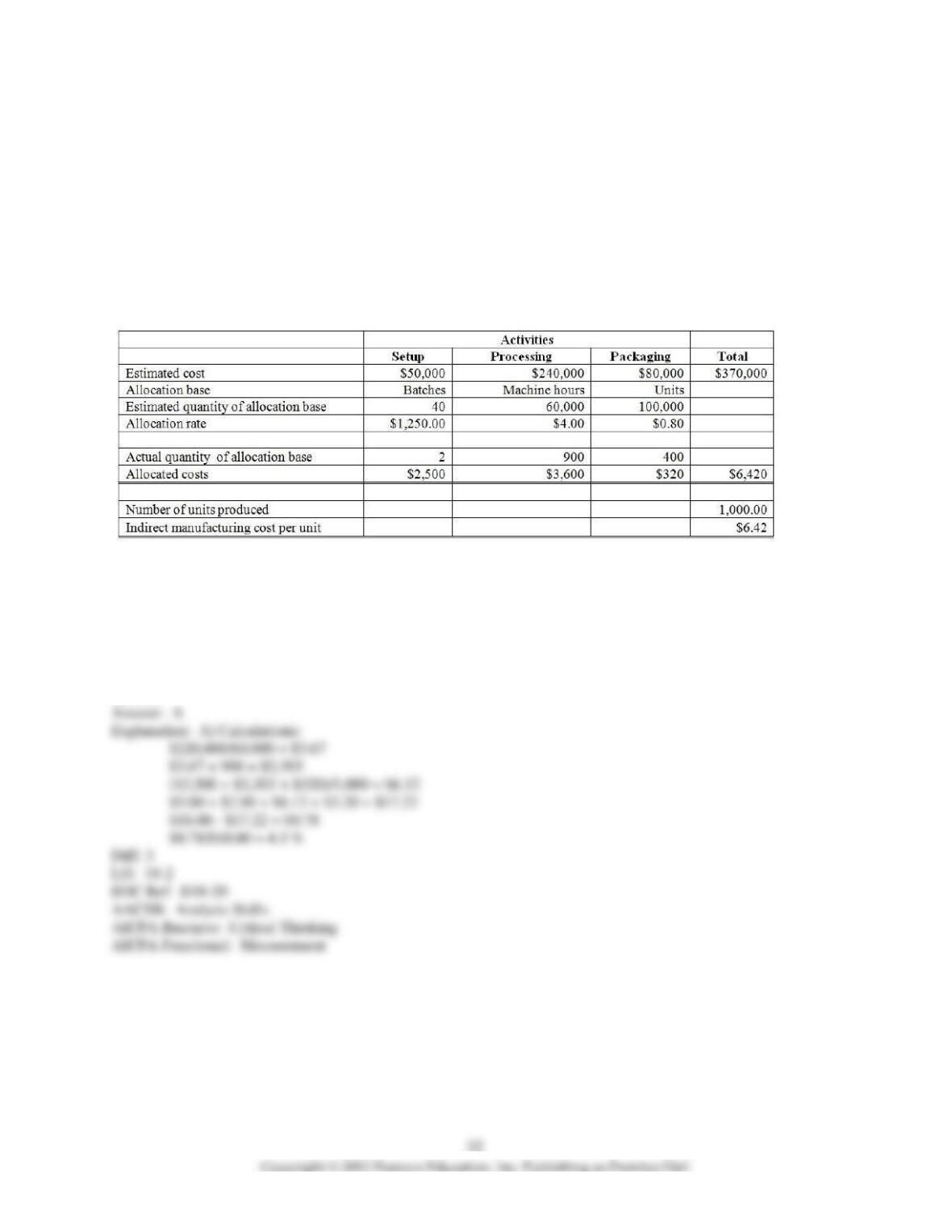
Clark uses activity-based costing for its indirect production costs and provides the following information about this
particular product:
The company’s objective is to earn 5% profit on the sales price of the product. Clark carried out a value engineering
study and decided that they could make the processing activity more efficient and save costs. If they reduce the total
processing activity cost down to $210,000, what will their profit percentage be? (Please round to the nearest tenth of
a percent.)
A) 4.8%
B) 4.9%
C) 5.9%
D) 5.2%
40) Clark Manufacturing makes blank CDs; it is a very competitive market and the company follows a target pricing
strategy. Currently the market price for a unit of product (one unit equals a package of 100 CDs) is $18.00. Clark’s
production costs are shown below:
Direct materials $5.00 per unit
Direct labor $2.90 per unit
Indirect production costs $6.42 per unit
Non-manufacturing costs $3.20 per unit
Clark uses activity-based costing for its indirect production costs and provides the following information about this
particular product:
The company’s objective is to earn 5% profit on the sales price of the product. Clark carried out a value engineering
study and decided that they could make the processing activity more efficient and save costs. If they reduce the total
processing activity cost by $20,000, what will their profit percentage be? (Please round to the nearest tenth of a
percent.)
A) 4.3%
B) 4.9%
C) 5.9%
D) 5.2%
41) Clark Manufacturing makes blank CDs; it is a very competitive market and the company follows a target pricing
strategy. Currently the market price for a unit of product (one unit equals a package of 100 CDs) is $18.00. Clark’s
production costs are shown below:
Direct materials $5.00 per unit
Direct labor $2.90 per unit
Indirect production costs $6.42 per unit
Non-manufacturing costs $3.20 per unit
Clark uses activity-based costing for its indirect production costs and provides the following information about this
particular product:
The company’s objective is to earn 5% profit on the sales price of the product. Clark carried out a value engineering
study and decided that they could make the processing activity more efficient and save costs. They have determined
that if they can reduce the activity rate for the processing activity down low enough, they can hit their profit
objective. What activity rate would be needed to achieve the 5% objective they seek? (Please round to nearest
cent.)
A) $3.53
B) $3.18
C) $3.21
D) $4.09
Learning Objective 18-3
1) Just-in–time methodology depends on maintaining higher inventory levels to ensure that the manufacturing
process isn’t interrupted by supply shortages.
2) Just-in–time production systems are organized into independent work cells that have all the resources needed to
complete the manufacturing process.
3) The traditional manufacturing process focuses on small batches of production, whereas the just–in-time
methodology focuses on large batches of products being produced in a sequence of departments or activities.
4) Just-in–time systems are based on a “demand-pull system” where customer demand triggers the production
process.
5) Just-in–time production gains economic advantage by purchasing inventory in large batches in order to get
volume discounts and achieve lower manufacturing costs.
6) For just–in-time systems, it is essential that manufacturers develop relationships with suppliers that are very
reliable, and that can guarantee quick deliveries of materials in small quantities.
7) Just-in–time production systems have a great deal of flexibility, and can easily tolerate small interruptions of
supplies, and occasional defective materials.
8) Just-in–time systems allow manufacturers to save money on storing, insuring, and financing inventories, by
maintaining lower levels of inventory.
9) Which of the following pertains to a just-in-time production system?
A) It will have more inventory accounts to track production costs.
B) It will produce goods in smaller batches than a traditional production system.
C) It will require higher inventory levels.
D) It will require longer setup times than a traditional production system.
10) Which of the following pertains to a just–in-time production system?
A) An individual does fewer tasks than under a traditional system.
B) Materials and Work in process are combined into a single account.
C) Units are produced in larger batches than under a traditional system.
D) Direct labor costs are recorded in their own separate account.
11) Which of the following is CORRECT about a just–in-time production system?
A) Customer orders drive the production process.
B) Goods are produced ahead of time to protect against running out of inventory.
C) Materials are purchased in large quantities.
D) Inventory levels are maintained at high levels.
12) Which of the following pertains to a just-in-time production system?
A) Direct materials and work in process are combined into a conversion inventory account.
B) Direct materials and work in process are combined into a raw and in process inventory account.
C) Work in process and conversion costs are combined into a raw and in process inventory account.
D) Direct materials and conversion costs are combined into a raw and in process inventory account.
13) All of the following accounts would be used in a backflush costing system EXCEPT:
A) work in process inventory.
B) finished goods inventory.
C) raw and in process inventory.
D) conversion costs.
14) In a just–in-time costing system, the entry to record direct material purchases on account would include which of
the following?
A) Debit to raw and in process inventory
B) Credit to cash
C) Debit to materials inventory
D) Credit to raw and in process inventory
15) In a just–in-time costing system, the entry to record the standard cost of finished goods completed would include
which of the following?
A) Debit to finished goods inventory
B) Debit to conversion costs
C) Debit to cost of goods sold
D) Credit to sales
16) In a just–in-time costing system, the entry to record the sale of a manufactured product would include which of
the following?
A) Debit to cost of goods sold
B) Debit to finished goods inventory
C) Credit to raw and in process inventory
D) Credit to conversion costs
17) In a just–in-time costing system, any remaining balance in the conversion costs account at the end of an
accounting period is usually cleared to which account?
A) Raw and in process inventory
B) Cost of goods sold
C) Work in process inventory
D) Finished goods inventory
18) Which of the following is NOT a characteristic of just-in-time production?
A) “Demand-pull” system to initiate production
B) Small, self-contained work cells
C) Ultra-reliable suppliers
D) Surplus stocks maintained to protect against supply interruption
19) Johnson Production Company uses just–in-time production and accounting methods. On June 1, Johnson
purchased $4,000 of raw materials on account. Which of the following journal entries correctly records this
transaction?
A) Debit accounts payable for $4,000, credit Raw and in-process inventory for $4,000.
B) Debit $4,000 to Materials inventory, credit $4,000 to Accounts payable.
C) Debit $4,000 to Work in process inventory, credit $4,000 to Accounts payable.
D) Debit $4,000 to Raw and in-process inventory, credit $4,000 to Accounts payable.
20) Johnson Production Company uses just–in-time production and accounting methods. On June 1, Johnson paid
direct labor costs of $5,000 in cash. Which of the following journal entries correctly records this transaction?
A) Debit $5,000 to Cash, credit $5,000 to Conversion costs.
B) Debit $5,000 to Conversion costs, credit $5,000 to Cash.
C) Debit $5,000 to Manufacturing overhead, credit $5,000 to Cash.
D) Debit $5,000 to Raw and in-process inventory, credit $5,000 to Cash.
21) Johnson Production Company uses just–in-time production and accounting methods. On June 1, Johnson paid
$6,000 for factory repair and maintenance costs in cash. Which of the following journal entries correctly records this
transaction?
A) Debit $6,000 to Cash, credit $6,000 to Manufacturing overhead.
B) Debit $6,000 to Raw and in-process inventory, credit $6,000 to Cash.
C) Debit $6,000 to Conversion costs, credit $6,000 to Cash.
D) Debit $6,000 to Manufacturing overhead, credit $6,000 to Cash.
22) Johnson Production Company uses just–in-time production and accounting methods. On June 1, Johnson
completed 400 units of product and moved the products to finished goods. Each unit included $8.00 of direct
materials cost and $2.00 of conversion costs. Which of the following journal entries correctly records this
transaction?
A) Debit $4,000 to Finished goods, credit $4,000 to Raw and in-process inventory.
B) Debit $4,000 to Finished goods, credit $3,200 to Raw and in-process, credit $800 to Conversion costs.
C) Debit $3,200 to Conversion costs, debit $800 to Materials inventory, credit $4,000 to Finished goods.
D) Debit $4,000 to Cost of goods sold, credit $3,200 to Materials inventory, credit $800 to Conversion costs.
23) Johnson Production Company uses just–in-time production and accounting methods. On June 1, Johnson sold
200 units of product for $12.00 per unit. Each unit included $8.00 of direct materials cost and $2.00 of conversion
costs. Johnson recorded the revenues of $2,400 in one entry, and then recorded the cost of goods sold in a second
entry. Which of the following correctly records the cost of goods sold?
A) Debit $2,000 to Cost of goods sold, credit $2,000 to Finished goods inventory.
B) Debit $2,000 to Finished goods, credit $1,600 to Raw and in-process, credit $400 to Conversion costs.
C) Debit $1,600 to Conversion costs, debit $400 to Materials inventory, credit $2,000 to Cost of goods sold.
D) Debit $2,000 to Cost of goods sold, credit $2,000 to Raw and in-process inventory.