43) Orlando Avionics makes three types of radios for small aircraft-model A, model B, and model C. The
manufacturing operations are mechanized and there is no direct labor. Manufacturing overhead costs are significant,
and Orlando has adopted an activity-based costing system. Direct materials costs per unit for each model are as
follows:
Model A $28
Model B $32
Model C $40
Orlando has three activities-assembly, materials management, and testing. The cost driver for assembly is machine
hours. The cost driver for materials management is number of parts, and the cost driver for testing is the number of
units of product. Total costs and production volumes for the year 2012 were estimated as follows:
Total cost
Total units
Assembly
$780,000
120,000
Machine hours
Materials management
$120,000
80,000
Parts
Testing
$22,500
5,000
Units
The Model A radio requires 12 parts to construct, and also requires 16 machine hours of processing. What is the
manufacturing cost to make one unit of Model A?
A) $150.00
B) $132.00
C) $126.50
D) $154.50
44) Orlando Avionics makes three types of radios for small aircraft-model A, model B, and model C. The
manufacturing operations are mechanized and there is no direct labor. Manufacturing overhead costs are significant,
and Orlando has adopted an activity-based costing system. Direct materials costs per unit for each model are as
follows:
Model A $28
Model B $32
Model C $40
Orlando has three activities-assembly, materials management, and testing. The cost driver for assembly is machine
hours. The cost driver for materials management is number of parts, and the cost driver for testing is the number of
units of product. Total costs and production volumes for the year 2012 were estimated as follows:
Total cost
Total units
Assembly
$780,000
120,000
Machine hours
Materials management
$120,000
80,000
Parts
Testing
$22,500
5,000
Units
The Model B radio requires 15 parts to construct, and also requires 18 machine hours of processing. What is the
manufacturing cost to make one unit of Model B?
A) $150.00
B) $176.00
C) $126.50
D) $144.00
45) Orlando Avionics makes three types of radios for small aircraft-model A, model B, and model C. The
manufacturing operations are mechanized and there is no direct labor. Manufacturing overhead costs are significant,
and Orlando has adopted an activity-based costing system. Direct materials costs per unit for each model are as
follows:
Model A $28
Model B $32
Model C $40
Orlando has three activities-assembly, materials management, and testing. The cost driver for assembly is machine
hours. The cost driver for materials management is number of parts, and the cost driver for testing is the number of
units of product. Total costs and production volumes for the year 2012 were estimated as follows:
Total cost
Total units
Assembly
$780,000
120,000
Machine hours
Materials management
$120,000
80,000
Parts
Testing
$22,500
5,000
Units
The Model C radio requires 19 parts to construct, and also requires 20.5 machine hours of processing. What is the
manufacturing cost to make one unit of Model C?
A) $206.25
B) $176.00
C) $126.50
D) $166.25
46) Formosa Steel Products makes steel building materials for export, and uses an activity-based costing system to
account for the indirect manufacturing costs of its various products. Indirect costs for the whole factory are broken
down into three activities-casting, materials handling, and milling. The cost driver for casting is machine hours; the
cost driver for material handling is kilograms, and the cost driver for milling is direct labor hours. Activity costs
and volumes for the year were estimated as follows:
Activity
Cost
Volume
Casting
$2,000,000
800,000.00
Machine hours
Material Handling
$400,000
500,000.00
Kilograms
Milling
$1,120,000
140,000.00
Direct labor hours
One product is steel reinforcement rods, sold by the metric ton. Engineering reports show that one metric ton of steel
reinforcement rods requires $100 of direct materials cost plus $50 of direct labor cost. Producing one metric ton of
steel rods also requires 24 machine hours for casting, weighs 1,000 kilograms, and requires 15 direct labor hours.
What is the activity rate for the casting activity?
A) $0.40 per machine hour
B) $4.40 per machine hour
C) $2.50 per machine hour
D) $1.25 per machine hour
47) Formosa Steel Products makes steel building materials for export, and uses an activity-based costing system to
account for the indirect manufacturing costs of its various products. Indirect costs for the whole factory are broken
down into three activities-casting, materials handling, and milling. The cost driver for casting is machine hours; the
cost driver for material handling is kilograms, and the cost driver for milling is direct labor hours. Activity costs
and volumes for the year were estimated as follows:
Activity
Cost
Volume
Casting
$2,000,000
800,000.00
Machine hours
Material Handling
$400,000
500,000.00
Kilograms
Milling
$1,120,000
140,000.00
Direct labor hours
One product is steel reinforcement rods, sold by the metric ton. Engineering reports show that one metric ton of steel
reinforcement rods requires $100 of direct materials cost plus $50 of direct labor cost. Producing one metric ton of
steel rods also requires 24 machine hours for casting, weighs 1,000 kilograms, and requires 15 direct labor hours.
What is the activity rate for the material handling activity?
A) $1.25 per kg
B) $4.40 per kg
C) $2.50 per kg
D) $0.80 per kg
48) Formosa Steel Products makes steel building materials for export, and uses an activity-based costing system to
account for the indirect manufacturing costs of its various products. Indirect costs for the whole factory are broken
down into three activities-casting, materials handling, and milling. The cost driver for casting is machine hours; the
cost driver for material handling is kilograms, and the cost driver for milling is direct labor hours. Activity costs
and volumes for the year were estimated as follows:
Activity
Cost
Volume
Casting
$2,000,000
800,000.00
Machine hours
Material Handling
$400,000
500,000.00
Kilograms
Milling
$1,120,000
140,000.00
Direct labor hours
One product is steel reinforcement rods, sold by the metric ton. Engineering reports show that one metric ton of steel
reinforcement rods requires $100 of direct materials cost plus $50 of direct labor cost. Producing one metric ton of
steel rods also requires 24 machine hours for casting, weighs 1,000 kilograms, and requires 15 direct labor hours.
A) $8.00 per direct labor hr
B) $4.40 per direct labor hr
C) $0.13 per direct labor hr
D) $0.80 per direct labor hr
49) Formosa Steel Products makes steel building materials for export, and uses an activity-based costing system to
account for the indirect manufacturing costs of its various products. Indirect costs for the whole factory are broken
down into three activities-casting, materials handling, and milling. The cost driver for casting is machine hours; the
cost driver for material handling is kilograms, and the cost driver for milling is direct labor hours. Activity costs
and volumes for the year were estimated as follows:
Activity
Cost
Volume
Casting
$2,000,000
800,000.00
Machine hours
Material Handling
$400,000
500,000.00
Kilograms
Milling
$1,120,000
140,000.00
Direct labor hours
One product is steel reinforcement rods, sold by the metric ton. Engineering reports show that one metric ton of steel
reinforcement rods requires $100 of direct materials cost plus $50 of direct labor cost. Producing one metric ton of
steel rods also requires 24 machine hours for casting, weighs 1,000 kilograms, and requires 15 direct labor hours.
What is the full manufacturing cost for one metric ton of steel reinforcement rods? (Please round to the nearest
whole dollar.)
A) $1,130
B) $980
C) $1,030
D) $975
50) An activity-based costing system improves the allocation of which of the following manufacturing costs?
A) Indirect manufacturing costs
B) Direct labor
C) Direct materials
D) Sales commissions
51) Which of the following would NOT be considered an activity for the purposes of an activity-based costing
system?
A) Materials handling
B) Machine processing
C) Direct materials cost
D) Packaging
52) Which of the following would most likely be treated as an activity in an activity-based costing system?
A) Direct labor cost
B) Machine processing
C) Direct materials cost
D) Sales revenues
53) Ace Plastics produces many different kinds of products all in one manufacturing facility. They have identified
four activities for their costing system:
Materials management — allocated by number of purchase orders
Chemical processing — allocated on metric tons
Molding — allocated on direct labor hours
Packaging — allocated by number of units produced
The activity rates are as follows:
Materials management
$12.00
Per purchase order
Chemical processing
$7.50
Per metric ton
Molding
$24.00
Per direct labor hour
Packaging
$0.10
Per unit
Ace received an order for 3,000 plastic toys. The engineering design shows that the order will require $540 of direct
material cost in total, $90 of direct labor cost, will require 4 purchase orders, will use 2 metric tons of chemical base,
will need 8 direct labor hours, and will produce 3.000 units of product. What will the full production cost of the
order be?
A) $630
B) $645
C) $1,095
D) $1,185
54) Ace Plastics produces many different kinds of products all in one manufacturing facility. They have identified
four activities for their costing system:
Materials management — allocated by number of purchase orders
Chemical processing — allocated on metric tons
Molding — allocated on direct labor hours
Packaging — allocated by number of units produced
The activity rates are as follows:
terials management
$12.00
Per purchase order
Chemical processing
$7.50
Per metric ton
Molding
$24.00
Per direct labor hour
Packaging
$0.10
Per unit
Ace received an order for 3,000 plastic toys. The engineering design shows that the order will require $540 of direct
material cost in total, $90 of direct labor cost, will require 4 purchase orders, will use 2 metric tons of chemical base,
will need 8 direct labor hours, and will produce 3.000 units of product. How much is the manufacturing cost for one
unit of product? (Please round to the nearest tenth of a cent.)
A) $0.630
B) $0.365
C) $0.395
D) $0.185
30
55) AAA Metal Bearings produces two sizes of metal bearings (sold by the crate)-standard and heavy. The standard
bearings require $200 of direct materials per unit (per crate) and the heavy bearings require $245 of direct materials
per unit. The operation is mechanized and there is no direct labor. Previously AAA used a single plant-wide
allocation rate for manufacturing overhead, which was $1.55 per machine hour. Based on the single rate, gross
profit data were as follows:
Per unit
Standard
Heavy
Direct materials cost
$200.00
$245.00
Direct labor cost
$0.00
$0.00
Manuf overhead cost
$124.00
$93.00
Total manuf cost
$324.00
$338.00
Price per unit
$350.00
$370.00
Gross profit per unit
$26.00
$32.00
Although the data showed that the heavy bearings were more profitable than the standard bearings, the plant
manager knew that the heavy bearings required much more processing in the metal fabrication phase than the
standard bearings, and that this factor was not adequately reflected in the single allocation rate. He suspected that it
was distorting the profit data. He suggested adopting an activity-based costing approach.
Working together, the engineers and accountants identified the following three manufacturing activities, and broke
down the annual overhead costs as shown:
Activities:
Estimated Cost
Metal fabrication
$420,000
Machine processing
$152,000
Packaging
$17,000
$589,000
Engineers believed that metal fabrication costs should be allocated by weight, and estimated that the plant processed
12,000 kilos of metal per year. Machine processing costs were correlated to machine hours, and the engineers
estimated a total of 380,000 machine hours for the year. Packaging costs were the same for both types of products,
and so they could be allocated simply by the number of units produced. The production plan provided for 4,000
units of standard and 1,000 units of heavy bearings to be produced during the year. Additional data on a per unit
basis are as follows:
Standard
Heavy
Kilos per unit
2.00
4.00
Machine hours per unit
80.00
60.00
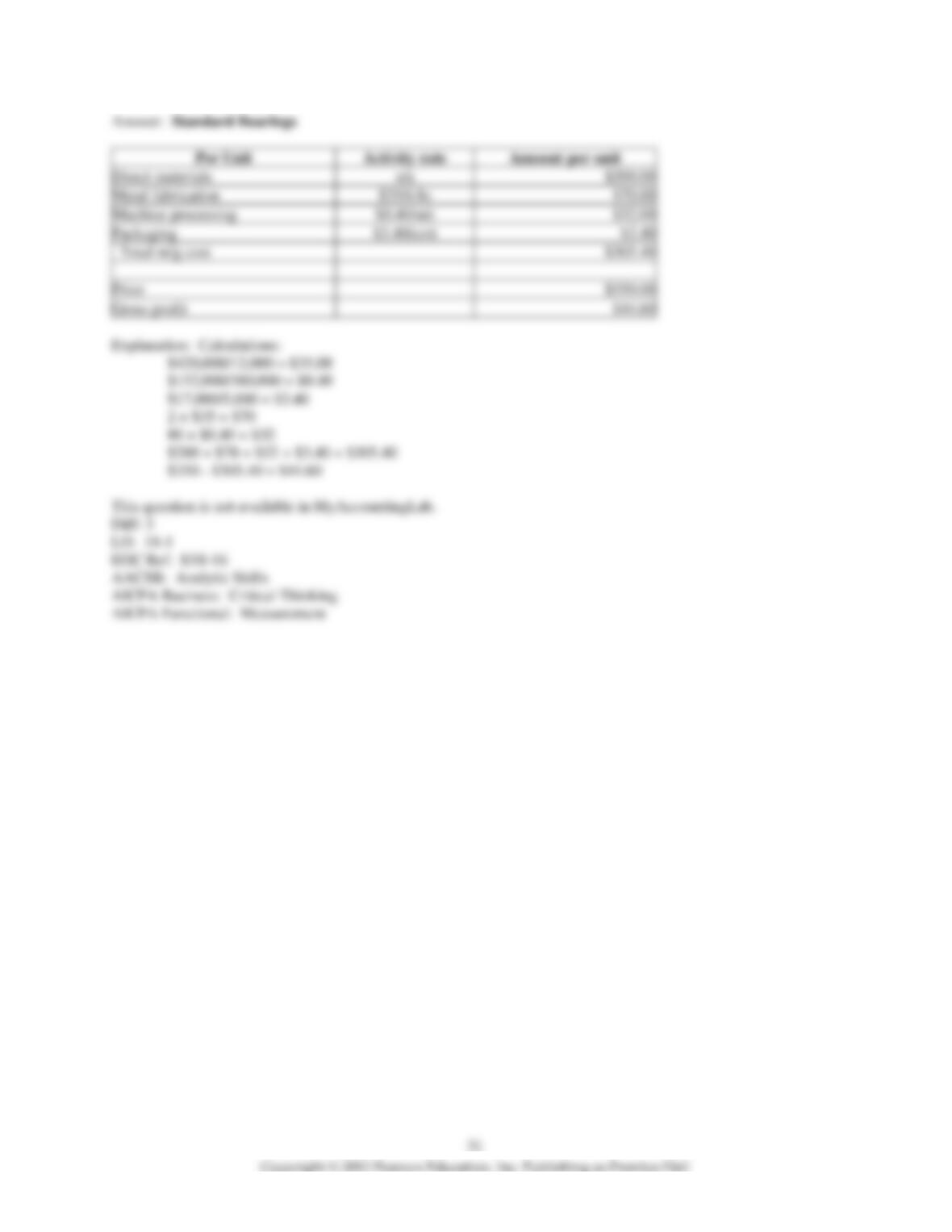
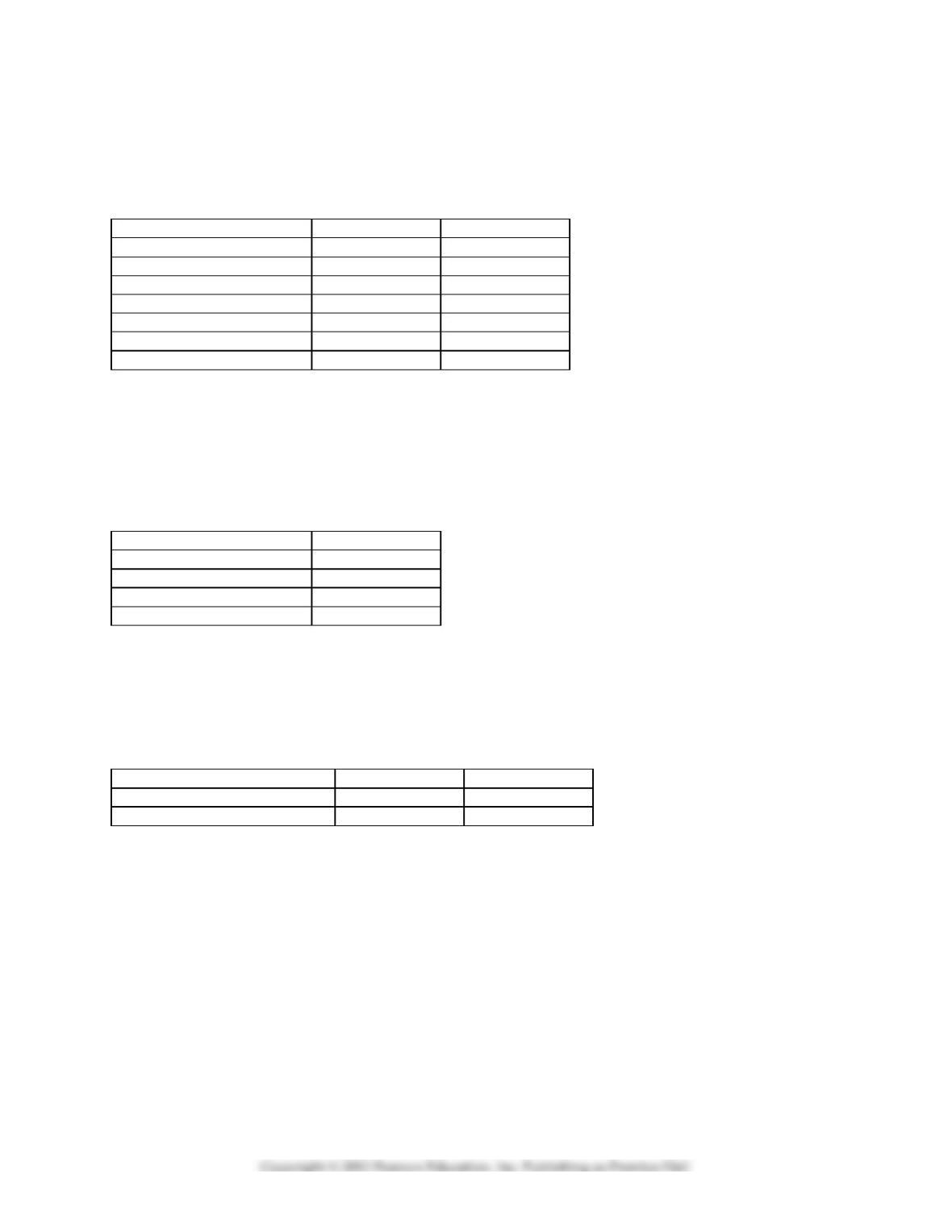
Using the data above, please calculate activity rates. Then, following the ABC methodology, calculate the
production cost and gross profit for one unit of standard bearings, using the format below:
Standard Bearings
Per Unit
Activity rate
Amount per unit
Direct materials
Metal fabrication
Machine processing
Packaging
Total mfg cost
Price
Gross profit
32
56) AAA Metal Bearings produces two sizes of metal bearings (sold by the crate)-standard and heavy. The standard
bearings require $200 of direct materials per unit (per crate) and the heavy bearings require $245 of direct materials
per unit. The operation is mechanized and there is no direct labor. Previously AAA used a single plantwide
allocation rate for manufacturing overhead, which was $1.55 per machine hour. Based on the single rate, gross
profit data were as follows:
Per unit
Standard
Heavy
Direct materials cost
$200.00
$245.00
Direct labor cost
$0.00
$0.00
Manuf overhead cost
$124.00
$93.00
Total manuf cost
$324.00
$338.00
Price per unit
$350.00
$370.00
Gross profit per unit
$26.00
$32.00
Although the data showed that the heavy bearings were more profitable than the standard bearings, the plant
manager knew that the heavy bearings required much more processing in the metal fabrication phase than the
standard bearings, and that this factor was not adequately reflected in the single allocation rate. He suspected that it
was distorting the profit data. He suggested adopting an activity based costing approach.
Working together, the engineers and accountants identified the following three manufacturing activities, and broke
down the annual overhead costs as shown:
Activities:
Estimated Cost
Metal fabrication
$420,000
Machine processing
$152,000
Packaging
$17,000
$589,000
Engineers believed that metal fabrication costs should be allocated by weight, and estimated that the plant processed
12,000 kilos of metal per year. Machine processing costs were correlated to machine hours, and the engineers
estimated a total of 380,000 machine hours for the year. Packaging costs were the same for both types of products,
and so they could be allocated simply by the number of units produced. The production plan provided for 4,000
units of standard and 1,000 units of heavy bearings to be produced during the year. Additional data on a per unit
basis are as follows:
Standard
Heavy
Kilos per unit
2.00
4.00
Machine hours per unit
80.00
60.00
Using the data above, please calculate activity rates. Then, following the ABC methodology, calculate the
production cost and gross profit for one unit of heavy bearings, using the format below:
Standard Bearings
Per Unit
Activity rate
Amount per unit
Direct materials
Metal fabrication
Machine processing
Packaging
Total mfg cost
Price
Gross profit (loss)
Heavy Bearings
Per unit
Activity rate
Amount per unit
Direct materials
n/a
Metal fabrication
$35/kilo
Machine processing
$0.40/mh
$24.00
Packaging
$3.40
Total mfg cost
Price
Gross profit/(loss)
34
57) AAA Metal Bearings produces two sizes of metal bearings (sold by the crate)-standard and heavy. The standard
bearings require $200 of direct materials per unit (per crate) and the heavy bearings require $245 of direct materials
per unit. The operation is mechanized and there is no direct labor. Previously AAA used a single plantwide
allocation rate for manufacturing overhead, which was $1.55 per machine hour. Based on the single rate, gross
profit data were as follows:
Per unit
Standard
Heavy
Direct materials cost
$200.00
$245.00
Direct labor cost
$0.00
$0.00
Manuf overhead cost
$124.00
$93.00
Total manuf cost
$324.00
$338.00
Price per unit
$350.00
$370.00
Gross profit per unit
$26.00
$32.00
Although the data showed that the heavy bearings were more profitable than the standard bearings, the plant
manager knew that the heavy bearings required much more processing in the metal fabrication phase than the
standard bearings, and that this factor was not adequately reflected in the single allocation rate. He suspected that it
was distorting the profit data. He suggested adopting an activity-based costing approach.
Working together, the engineers and accountants identified the following three manufacturing activities, and broke
down the annual overhead costs as shown:
Activities:
Estimated Cost
Metal fab
$420,000
Machine processing
$152,000
Packaging
$17,000
$589,000
Engineers believed that metal fabrication costs should be allocated by weight, and estimated that the plant processed
12,000 kilos of metal per year. Machine processing costs were correlated to machine hours, and the engineers
estimated a total of 380,000 machine hours for the year. Packaging costs were the same for both types of products,
and so they could be allocated simply by the number of units produced. The production plan provided for 4,000
units of standard and 1,000 units of heavy bearings to be produced during the year. Additional data on a per unit
basis are as follows:
Standard
Heavy
Kilos per unit
2.00
4.00
Machine hours per unit
80.00
60.00
Using the data above, please calculate activity rates. Then, following the ABC methodology, calculate the
production cost and gross profit for both product types, using the format below:
Per Unit
Standard
Heavy
Direct materials
Metal fabrication
Machine processing
Packaging
Total mfg cost
Price
Gross profit
Per Unit
Standard
Heavy
Metal fabrication
$70.00
Machine processing
$32.00
$24.00
Packaging
$3.40
$3.40
Total mfg cost
Price
Gross profit
$44.60
Learning Objective 18-2
1) Activity-based costing systems and traditional costing systems will produce the same results for product cost and
profitability, although they use different methods of calculation.
2) Target cost is the price that customers are willing to pay and target price is the desired cost to produce the
product.
3) Traditional costing systems can distort unit manufacturing costs and product profitability when many products are
produced and the various products have significantly different production processes.
4) Target costing starts with the price that customers are willing to pay and then subtracts the company’s desired
profit to determine the desired full-product cost.
5) Activity-based management can be used to make business decisions about cost cutting.
6) Value engineering requires the collaboration of marketing, engineering and accounting personnel to achieve the
optimum results.
7) Full-product cost includes both manufacturing and non-manufacturing costs.
8) Full-product cost includes all manufacturing costs plus selling expenses, but does not include administrative
expenses.
9) Business managers can use activity-based costing data to assist them in pricing and product mix decisions, and in
cost management.
10) Target pricing is based on the cost to produce a product, plus a profit mark–up.
11) Morley Manufacturing is considering the manufacture of a new product. Morley was hoping to sell the
product for $168 per unit and estimated the total cost per unit to be $120. Morley conducted market research and
found out that the market is only willing to pay $154 for the new product. Using the target costing approach, what
does the total per unit cost of the new product have to be if Morley wants to achieve the same amount of profit as
originally planned?
A) $110
B) $106
C) $109
D) $100
12) Madrid Manufacturing is considering the manufacture of a new product. Madrid was hoping to sell the product
for $504 per unit and estimated the total cost per unit to be $360. Madrid conducted market research and found out
that the market is only willing to pay $462 for the new product. Using the target costing approach, how much will
Madrid have to reduce the production cost in order to achieve the same amount of gross profit as originally planned?
A) $47
B) $31
C) $30
D) $42
13) Equival Company wishes to sell truck axles to car manufacturers. The current market price of the axles is $400,
and Equival knows it must accept the market price. The company wishes to make a profit equal to 20% of the price.
Using target costing, Equival will have to design the production process to meet this requirement. What is the
desired target cost per axle?
A) $320
B) $480
C) $420
D) $380
14) Percival Company wishes to sell wooden beams to home builders. The current market price of the beams is
$950, and Percival knows it must accept the market price. The company wishes to make a profit equal to 16% of the
price. Using target costing, the company will have to design the production process to meet this requirement. What
is the desired target cost per beam?
A) $798
B) $1,062
C) $152
D) $800
15) Equival Company wishes to sell truck axles to car manufacturers. The current market price of the axles is $400,
and Equival knows it must accept the market price. Currently, it costs the company $330 to produce each axle. The
company wishes to make a profit equal to 20% of the price. Which of the following strategies should Equival adopt
to achieve its objective?
A) Raise the price to $410.
B) Reduce its production costs by $10 per unit.
C) Increase the production costs by $20 per unit.
D) Use advertising to increase the volume of sales.
16) Percival Company wishes to sell wooden beams to home builders. The current market price of the beams is
$950, and Percival knows it must accept the market price. Currently, the beams cost Percival $809 to produce. The
company wishes to make a profit equal to 16% of the price. Which of the following strategies would help Percival
accomplish their objective?
A) Increase the production cost by $22 per unit.
B) Increase the volume of sales.
C) Increase the sales price to $961.
D) Reduce production costs by $11 per unit.
17) Lisbon Manufacturing is considering the manufacture of a new product. Lisbon was hoping to sell the product
for $588 per unit and estimated the total cost per unit to be $420. Lisbon conducted market research and found out
that the market is only willing to pay $539 for the new product. Using the target costing approach, what does the
total per unit cost of the new product have to be if Lisbon wants to achieve a 40% markup on total cost?
A) $215.60
B) $385.00
C) $257.60
D) $420.00