49) Which of the following is not included in manufacturing cycle time?
A) Inspection time.
B) Storing time.
C) Moving time.
D) Marketing time.
50) Mountainburg Corporation keeps track of the time required to fill orders. The times recorded
for a particular order appear below:
Hours
Processing Time
1.2
Inspection Time
0.3
Moving Time
3.8
Storing Time
4.2
The manufacturing cycle time was:
A) 5.3 hours.
B) 20.7 hours.
C) 15.4 hours.
D) 9.5 hours.
51) Travis Corporation keeps track of the time required to fill orders. The times recorded for a
particular order appear below:
Hours
Processing Time
0.7
Inspection Time
0.3
Moving Time
2.9
Storing Time
8.7
The manufacturing cycle efficiency was closest to:
A) 0.73.
B) 0.06.
C) 0.15.
D) 0.02.
52) Steinwand Corporation keeps track of the time required to fill orders. Data concerning a
particular order appear below:
Hours
Processing Time
1.9
Inspection Time
0.2
Moving Time
2.8
Storing Time
7.2
The manufacturing cycle time was:
A) 20.3 hours.
B) 25.2 hours.
C) 4.9 hours.
D) 12.1 hours.
53) Steinwand Corporation keeps track of the time required to fill orders. Data concerning a
particular order appear below:
Hours
Processing Time
1.9
Inspection Time
0.2
Moving Time
2.8
Storing Time
7.2
The manufacturing cycle efficiency was closest to:
A) 0.24.
B) 0.16.
C) 0.92.
D) 0.08.
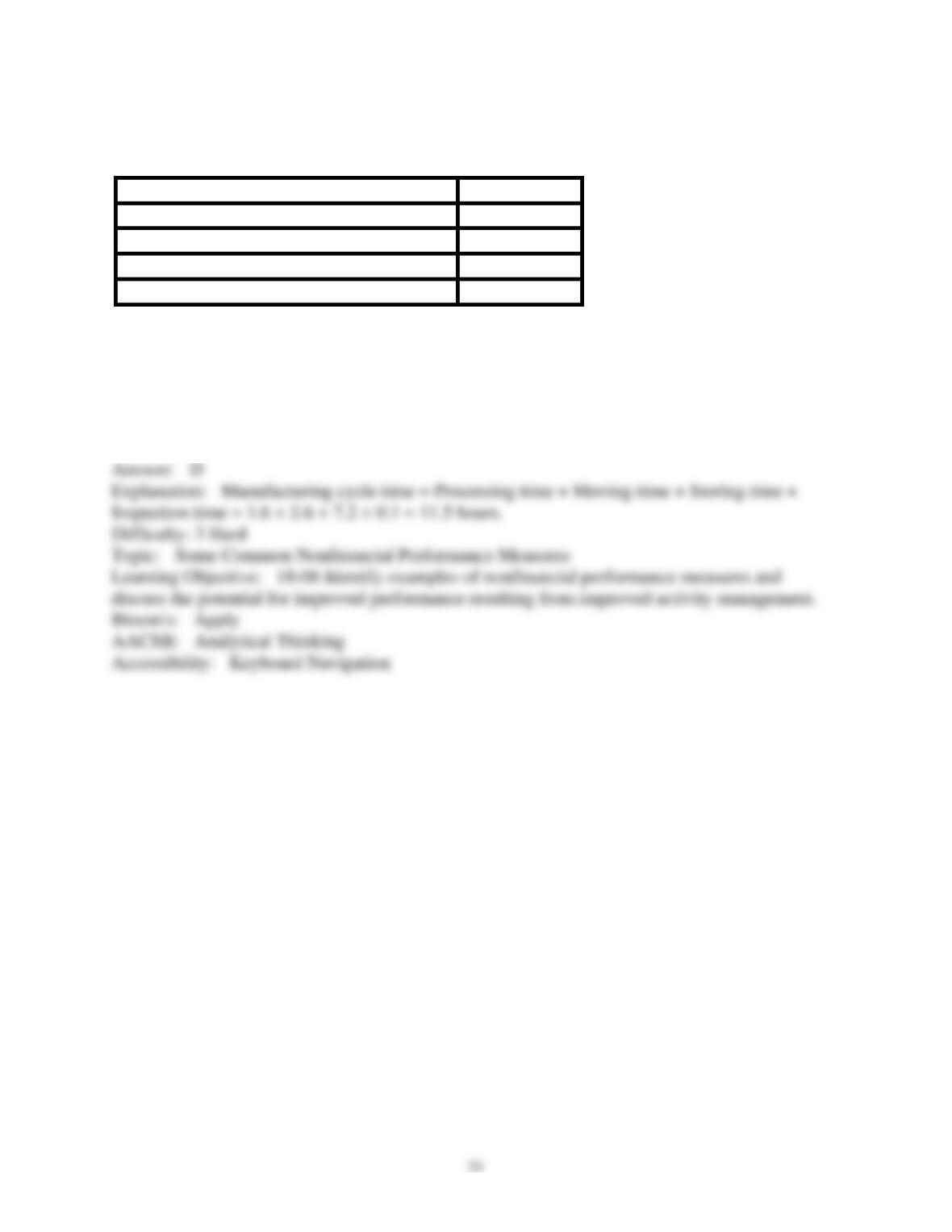
54) Morgenstern Corporation keeps track of the time required to fill orders. The times recorded
for a particular order appear below:
Hours
Processing Time
1.6
Inspection Time
0.1
Moving Time
2.6
Storing Time
7.2
The manufacturing cycle time was:
A) 4.3 hours.
B) 31.6 hours.
C) 27.3 hours.
D) 11.5 hours.
26
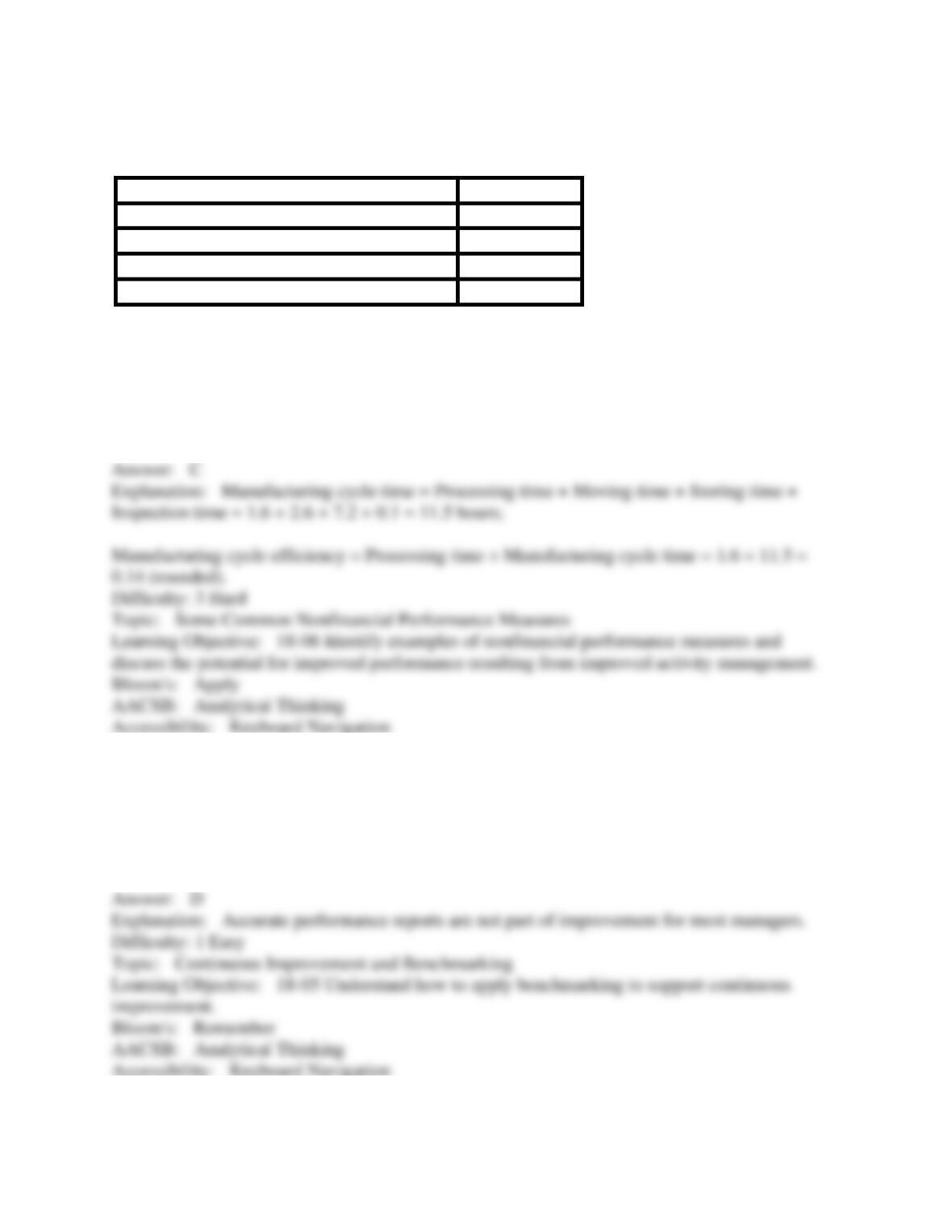
55) Morgenstern Corporation keeps track of the time required to fill orders. The times recorded
for a particular order appear below:
Hours
Processing Time
1.6
Inspection Time
0.1
Moving Time
2.6
Storing Time
7.2
The manufacturing cycle efficiency was closest to:
A) 0.05.
B) 0.57.
C) 0.14.
D) 0.16.
56) Which of the following items is not part of the continuous improvement philosophy?
A) Eliminate activities that are nonvalue-added.
B) Improve the efficiency of activities that are value-added.
C) Use benchmarking to identify activities that need improvement.
D) Provide bonus incentives to managers for accurate performance reports.
57) Benchmarks are used to evaluate the performance of an activity or operation relative to other
organizations or other parts of one’s own organization. Which of the following is not a guideline
for using benchmarks to evaluate performance?
A) Benchmarks should only be used for nonfinancial measures.
B) Do not benchmark everything at the best-in-the-business level.
C) Benchmark only best-in-the-business activities that are important.
D) Use internal benchmarks for less important activities or operations.
58) Which of the following statements is(are) false?
(A) Internal, regional, and local benchmarks should be used for the most important processes and
activities in an organization.
(B) In general, the use of multiple measures to evaluate performance is better than the use of a
single performance measure.
A) Only A is false.
B) Only B is false.
C) Both of these are false.
D) Neither of these is false.
59) Which of the following is typically not considered an objective of quality control?
A) Reduce costs associated with customer complaints.
B) Reduce costs of honoring product or service warranty.
C) Increase customer satisfaction with product or service.
D) Increase the number of deliveries made when promised.
60) Functional performance measures differ from customer satisfaction performance measures in
that they are used primarily to evaluate:
A) internal processes.
B) external processes.
C) benchmark processes.
D) continuous improvement processes.
61) Manufacturing cycle efficiency is computed by dividing process time by:
A) moving time + storage time.
B) storage time + inspection time.
C) moving time + storage time + inspection time.
D) process time + moving time + storage time + inspection time.
62) Which of the following statements is(are) true regarding performance measures?
(A) In general, objective performance measures are better than subjective performance measures.
(B) In general, the use of multiple performance measures is better than the use of single
performance measures.
A) Only A is true.
B) Only B is true.
C) Both of these are true.
D) Neither of these is true.
63) An objective performance measure is one where:
A) different people will agree as to the appropriateness of a measure.
B) different people will agree as to the method to calculate the measure.
C) different managers will calculate a measure differently.
D) different managers will view the facts and come to different conclusion.
64) A subjective performance measure is one where:
A) different people will agree as to the appropriateness of a measure.
B) different people will agree as to the method to calculate the measure.
C) different managers will calculate a measure the same.
D) different managers will view the facts and come to different conclusions.
65) Which of the following is not a mistake often made when measuring nonfinancial
performance?
A) Using subjective rather than objective measures.
B) Not linking measure to strategy.
C) Not validating links between activities and strategies.
D) Not setting appropriate performance targets.
66) Which of the following performance measures would be used to evaluate the personnel
department performance?
A) Number of product recalls.
B) Percentage of late deliveries.
C) Number of requests for transfers.
D) Length of time to fill vacant positions.
67) Partial productivity measures are most closely related to what type of variances?
A) Price variances.
B) Sales mix variances.
C) Efficiency variances.
D) Production volume variances.
68) Total factor productivity:
A) is a ratio of the value of output to the value of all key inputs.
B) is the same thing as the production volume variance.
C) focuses on an individual input.
D) includes materials and labor but not overhead.
69) If a manager wants to assess performance relative to the industry, it is best to use:
A) partial productivity measures.
B) production volume variances.
C) sales price variances.
D) total factor productivity.
70) Partial productivity:
A) is a ratio of the value of output to the value of all key inputs.
B) is the same thing as the production volume variance.
C) focuses on an individual input.
D) includes materials and labor but not overhead.
71) Which of the following is not a partial productivity measure?
A) tons output/tons of material used.
B) sales value/total cost.
C) gallons output/direct labor hour.
D) units produced/machine hour.
72) Which of the following is a total factor productivity measure?
A) Tons output/tons of material used.
B) Units produced/machine hour.
C) Sales value/total cost.
D) Gallons output/direct labor hour.
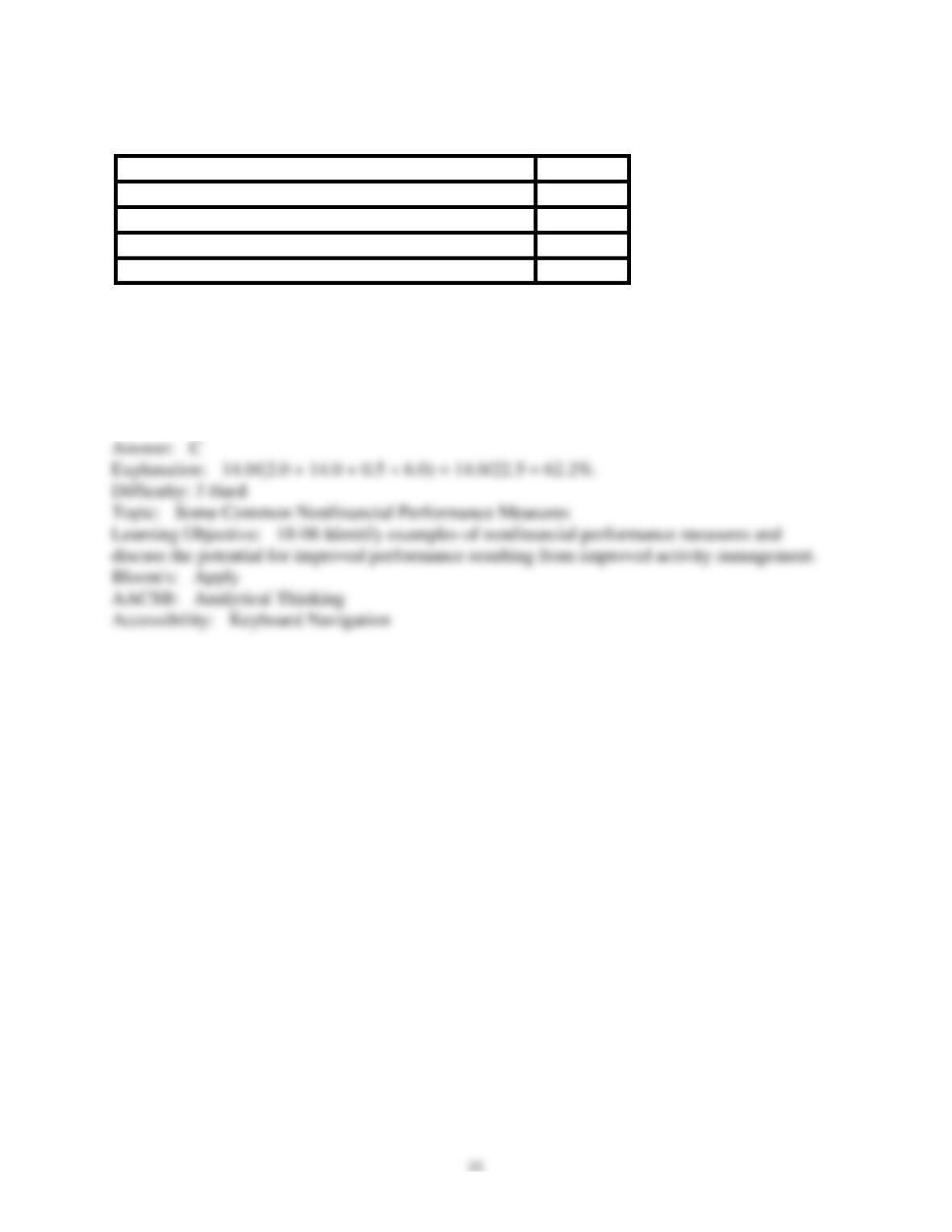
73) The Otero Manufacturing Company collected the following information (in days):
April
Transporting product
2.0
Processing product
14.0
Inspecting product
0.5
Storing product
6.0
What is the manufacturing cycle efficiency?
A) 87.5%.
B) 63.6%.
C) 62.2%.
D) 42.9%.
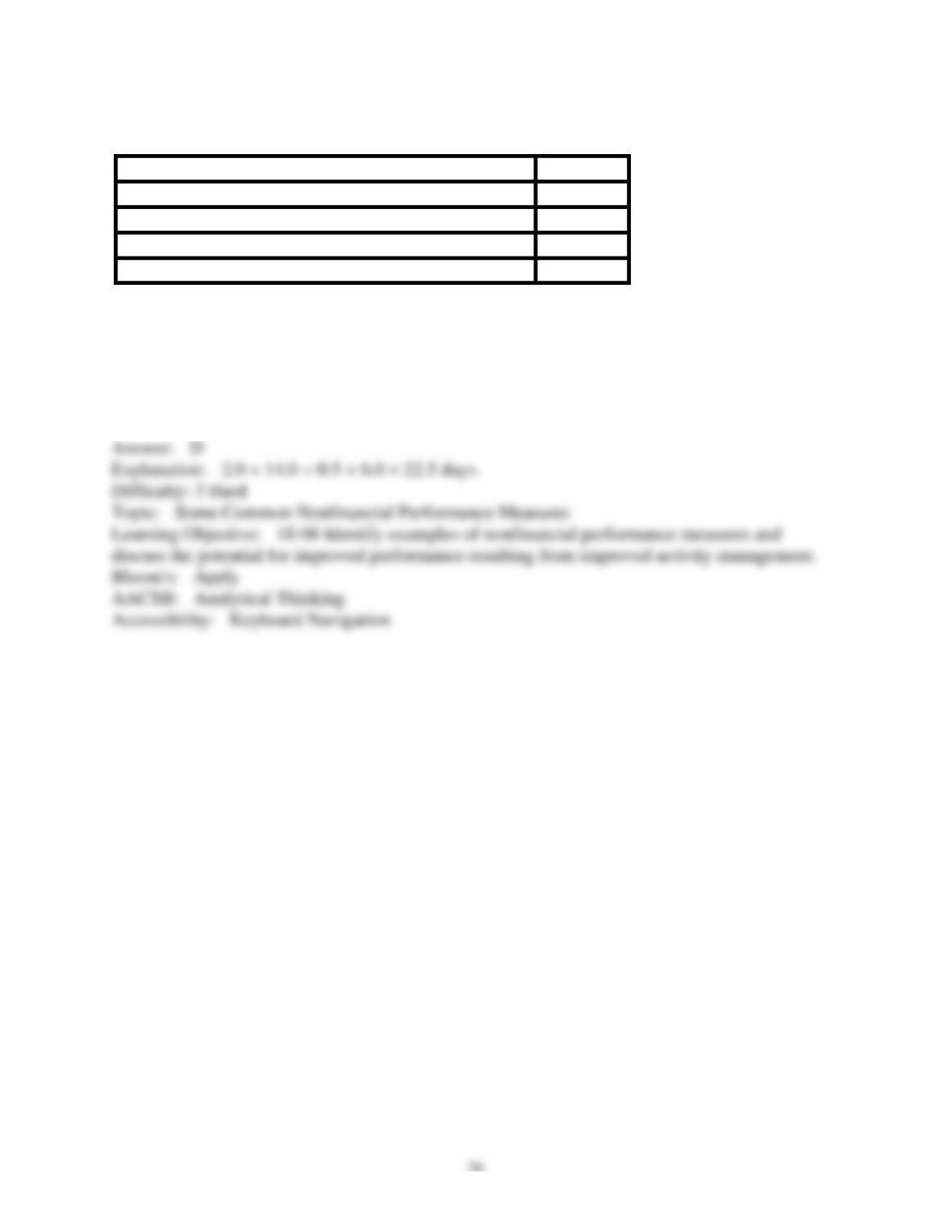
74) The Otero Manufacturing Company collected the following information (in days):
April
Transporting product
2.0
Processing product
14.0
Inspecting product
0.5
Storing product
6.0
What is the manufacturing cycle time?
A) 14.0 days.
B) 16.0 days.
C) 22.0 days.
D) 22.5 days.
75) The Malcolm Company collected the following information (in days):
Manufacturing product
20.0
Storing product
8.0
Transporting product
2.0
Inspecting product
1.0
What is the manufacturing cycle efficiency?
A) 28.6%.
B) 64.5%.
C) 71.4%.
D) 90.9%.
76) The Malcolm Company collected the following information (in days):
Manufacturing product
20.0
Storing product
8.0
Transporting product
2.0
Inspecting product
1.0
What is the manufacturing cycle time?
A) 10 days.
B) 31 days.
C) 28 days.
D) 22 days.
77) The Majors Company collected the following information (in days):
Inspecting product
4
Transporting product
6
Storing product
15
Manufacturing product
40
What is the manufacturing cycle efficiency?
A) 61.5%.
B) 72.7%.
C) 87.0%.
D) 27.3%.
78) The Majors Company collected the following information (in days):
Inspecting product
4
Transporting product
6
Storing product
15
Manufacturing product
40
What is the manufacturing cycle time?
A) 21 days.
B) 65 days.
C) 55 days.
D) 46 days.
79) The Falisari Company collected the following information (in days):
Inspecting product
4
Transporting product
14
Storing product
20
Manufacturing product
65
What is the manufacturing cycle efficiency?
A) 100.0%.
B) 82.2%.
C) 63.1%.
D) 76.5%.
80) The Falisari Company collected the following information (in days):
Inspecting product
4
Transporting product
14
Storing product
20
Manufacturing product
65
What is the manufacturing cycle time?
A) 65 days.
B) 34 days.
C) 103 days.
D) 85 days.