Accounting, 9e (Horngren)
Chapter 18 Activity-Based Costing and Other Cost Management Tools
Learning Objective 18-1
1) With increased competition, managers need more accurate estimates of product costs to set prices and to identify
the most profitable products.
2) Activity-based costing focuses on a single predetermined overhead rate for cost analysis.
3) The main difference between activity-based costing and traditional costing systems is that activity-based
costing uses a separate allocation rate for each activity.
4) Companies that use activity-based costing do NOT need to trace direct materials and direct labor to products as is
done in traditional costing systems.
5) Two main benefits of activity-based costing are more accurate product cost information and more detailed
information on costs of activities and the drivers of these costs.
6) The first step in the activity-based costing system is to identify each activity and its total indirect cost.
7) Activity-based management refers to using activity-based cost information to make decisions that increase profits
while satisfying customers’ needs.
8) Activity-based costing systems combine many various elements of overhead into a single cost pool.
9) Sleep Tight Company manufactures pillows using an activity–based costing system. The following information is
provided for the month of June:
Activity
Estimated Indirect
Activity Costs
Allocation Base
Estimated Quantity of
Allocation Base
Materials
handling
$3,150
Number of parts
4,200 parts
Assembling
$13,860
Number of parts
4,200 parts
Packaging
$2,730
Number of pillows
1,050 pillows
Each pillow consists of 4 parts and the total direct materials cost per pillow is $3.50. There is no direct labor. If
Sleep Tight sells pillows for $21.00, they will earn a gross profit of $1.30 per pillow.
10) Activity-based costing creates more precise matching of indirect costs with products.
11) An activity-based costing system would be of less value to a business making a single product than it would be
for a company with multiple products.
12) A traditional costing system employs multiple allocation rates, but an activity-based costing system uses only
one single allocation rate.
13) An activity-based costing system can be a significant competitive advantage for a business which does bidding
for manufacturing work.
14) The following four steps are necessary in order to use an activity–based costing system:
1. Compute the allocation rate for each activity.
2. Identify activities and estimate their total costs.
3. Identify the cost driver for each activity and then estimate the quantity of each driver’s allocation base.
4. Allocate the indirect costs to the cost object.
In what order are these steps performed?
A) 1,2,3,4
B) 3,1,2,4
C) 2,3,1,4
D) 2,1,3,4
15) JC Manufacturing produces products that use a variety of components. Which of the following cost drivers
would be the MOST applicable for assigning material handling costs to the finished products?
A) Direct labor hours
B) Direct labor cost
C) Number of units produced
D) Number of components used
16) Which of the following is MOST likely to be the cost driver for the packaging and shipping activity?
A) Number of components
B) Number of orders
C) Hours of testing
D) Number of setups
17) Which of the following statements is CORRECT regarding activity-based costing systems?
A) They have separate indirect cost allocation rates for each activity.
B) They are not as accurate or precise as traditional costing systems.
C) They accumulate overhead costs by processing departments.
D) They are less complex and, therefore, less costly than traditional systems.
18) What is the last step in developing an activity-based costing system?
A) Estimate the total quantity of the cost driver.
B) Estimate the total indirect costs of each activity.
C) Identify the activities.
D) Allocate costs to the cost object.
19) Brannon Company manufactures ceiling fans and uses an activity-based costing system. Each ceiling fan
consists of 20 separate parts totaling $95 in direct materials and requires 2.5 hours of machine time to produce.
Additional information follows:
Activity
Allocation Base
Cost Allocation Rate
Materials handling
Number of parts
$.08
Machining
Machine hours
$7.20
Assembling
Number of parts
$.35
Packaging
Number of finished units
$2.70
What is the cost of materials handling per ceiling fan?
A) $1.60
B) $7.20
C) $6.00
D) $5.00
20) Brannon Company manufactures ceiling fans and uses an activity-based costing system. Each ceiling fan
consists of 20 separate parts totaling $95 in direct materials, and requires 2.5 hours of machine time to produce.
Additional information follows:
Activity
Allocation Base
Cost Allocation Rate
Materials handling
Number of parts
$.08
Machining
Machine hours
$7.20
Assembling
Number of parts
$.35
Packaging
Number of finished units
$2.70
What is the cost of machining per ceiling fan?
A) $18.00
B) $180.00
C) $30.00
D) $144.00
21) Brannon Company manufactures ceiling fans and uses an activity-based costing system. Each ceiling fan
consists of 20 separate parts totaling $95 in direct materials, and requires 2.5 hours of machine time to produce.
Additional information follows:
Activity
Allocation Base
Cost Allocation Rate
Materials handling
Number of parts
$.08
Machining
Machine hours
$7.20
Assembling
Number of parts
$.35
Packaging
Number of finished units
$2.70
What is the cost of assembling per ceiling fan?
A) $87.50
B) $7.00
C) $7.50
D) $35.00
22) Brannon Company manufactures ceiling fans and uses an activity-based costing system. Each ceiling fan
consists of 20 separate parts totaling $95 in direct materials, and requires 2.5 hours of machine time to produce.
There are no direct labor costs. Additional information follows:
Activity
Allocation Base
Cost Allocation Rate
Materials handling
Number of parts
$.08
Machining
Machine hours
$7.20
Assembling
Number of parts
$.35
Packaging
Number of finished units
$2.70
What is the total manufacturing cost per ceiling fan?
A) $125.75
B) $121.13
C) $115.32
D) $124.30
23) Kenney Company uses activity-based costing to account for its manufacturing process. Kenney Company
produces tires and each tire has $.50 of direct materials, includes 20 parts and requires 2 hours of machine time.
There is no direct labor. Additional information follows:
Activity
Allocation Base
Cost Allocation Rate
Materials handling
Number of parts
$.16
Machining
Machine hours
$14.40
Assembling
Number of parts
$.70
Packaging
Number of finished units
$5.40
What is the cost of materials handling per tire?
A) $5.60
B) $16.00
C) $1.60
D) $3.20
24) Kenney Company uses activity-based costing to account for its manufacturing process. Kenney Company
produces tires, and each tire has $.50 of direct materials, includes 20 parts and requires 2 hours of machine time.
There is no direct labor. Additional information follows:
Activity
Allocation Base
Cost Allocation Rate
Materials handling
Number of parts
$.16
Machining
Machine hours
$14.40
Assembling
Number of parts
$.70
Packaging
Number of finished units
$5.40
What is the cost of machining per tire?
A) $28.80
B) $26.40
C) $25.80
D) $29.50
25) Kenney Company uses activity-based costing to account for its manufacturing process. Kenney Company
produces tires, and each tire has $.50 of direct materials, includes 20 parts and requires 2 hours of machine time.
There is no direct labor. Additional information follows:
Activity
Allocation Base
Cost Allocation Rate
Materials handling
Number of parts
$.16
Machining
Machine hours
$14.40
Assembling
Number of parts
$.70
Packaging
Number of finished units
$5.40
What is the cost of assembling per tire?
A) $15.40
B) $7.00
C) $14.00
D) $28.00
26) Alpha Company manufactures breadboxes and uses an activity-based costing system. The following information
is provided for the month of May:
Activity
Estimated Indirect
Activity Costs
Allocation Base
Estimated Quantity of
Allocation Base
Materials handling
$3,500
Number of parts
5,000 parts
Assembling
$12,000
Number of parts
5,000 parts
Packaging
$5,750
Number of bread boxes
1,250 bread boxes
Each breadbox consists of 4 parts, and the direct materials cost per breadbox is $7.00. What is the cost of materials
handling and assembling per breadbox?
A) $4.60
B) $17.00
C) $14.40
D) $12.40
27) Alpha Company manufactures breadboxes and uses an activity-based costing system. The following information
is provided for the month of May:
Activity
Estimated Indirect
Activity Costs
Allocation Base
Estimated Quantity of
Allocation Base
Materials handling
$3,500
Number of parts
5,000 parts
Assembling
$12,000
Number of parts
5,000 parts
Packaging
$5,750
Number of bread boxes
1,250 bread boxes
Each breadbox consists of 4 parts, and the direct materials cost per breadbox is $7.00. There is no direct labor.
What is the total manufacturing cost per breadbox?
A) $17.40
B) $24.00
C) $12.40
D) $26.00
28) Sleep Tight Company manufactures pillows using an activity-based costing system. The following information
is provided for the month of June:
Activity
Estimated Indirect
Activity Costs
Allocation Base
Estimated Quantity of
Allocation Base
Materials handling
$3,150
Number of parts
4,200 parts
Assembling
$13,860
Number of parts
4,200 parts
Packaging
$2,730
Number of pillows
1,050 pillows
Each pillow consists of 4 parts, and the total direct materials cost per pillow is $3.50.
What is the total cost of materials handling and assembling for each pillow?
A) $15.40
B) $16.20
C) $18.80
D) $13.20
29) Sleep Tight Company manufactures pillows using an activity-based costing system. The following information
is provided for the month of June:
Activity
Estimated Indirect
Activity Costs
Allocation Base
Estimated Quantity of
Allocation Base
Materials handling
$3,150
Number of parts
4,200 parts
Assembling
$13,860
Number of parts
4,200 parts
Packaging
$2,730
Number of pillows
1,050 pillows
Each pillow consists of 4 parts, and the total direct materials cost per pillow is $3.50.
What is the total cost of packaging per pillow?
A) $3.50
B) $7.00
C) $9.38
D) $2.60
30) Sleep Tight Company manufactures pillows using an activity-based costing system. The following information
is provided for the month of June:
Activity
Estimated Indirect
Activity Costs
Allocation Base
Estimated Quantity of
Allocation Base
Materials handling
$3,150
Number of parts
4,200 parts
Assembling
$13,860
Number of parts
4,200 parts
Packaging
$2,730
Number of pillows
1,050 pillows
Each pillow consists of 4 parts and the total direct materials cost per pillow is $3.50. There is no direct labor. What
is the total manufacturing cost per pillow?
A) $16.20
B) $22.30
C) $18.50
D) $26.50
31) Pitt Jones Company had the following activities, allocated costs, and allocation bases:
Activities
Allocated Costs
Allocation Base
Account inquiry (hours)
$60,000
2,000 hours
Account billing (lines)
$30,000
20,000 lines
Account verification (accounts)
$15,000
20,000 accounts
Correspondence (letters)
$10,000
1,000 letters
The above activities are carried out at two of their regional offices.
Northeast Office
Midwest Office
Account inquiry (hours)
100 hours
200 hours
Account billing (lines)
10,000 lines
7,000 lines
Account verification (accounts)
1,000 accounts
600 accounts
Correspondence (letters)
50 letters
100 letters
What is the cost per unit for the account inquiry activity?
A) $0.75
B) $30.00
C) $10.00
D) $1.50
32) Pitt Jones Company had the following activities, allocated costs, and allocation bases:
Activities
Allocated Costs
Allocation Base
Account inquiry (hours)
$60,000
2,000 hours
Account billing (lines)
$30,000
20,000 lines
Account verification (accounts)
$15,000
20,000 accounts
Correspondence (letters)
$10,000
1,000 letters
The above activities are carried out at two of their regional offices.
Northeast Office
Midwest Office
Account inquiry (hours)
100 hours
200 hours
Account billing (lines)
10,000 lines
7,000 lines
Account verification (accounts)
1,000 accounts
600 accounts
Correspondence (letters)
50 letters
100 letters
What is the cost per unit for the account billing activity?
A) $1.50
B) $30.00
C) $1.60
D) $1.43
33) Pitt Jones Company had the following activities, allocated costs, and allocation bases:
Activities
Allocated Costs
Allocation Base
Account inquiry (hours)
$60,000
2,000 hours
Account billing (lines)
$30,000
20,000 lines
Account verification (accounts)
$15,000
20,000 accounts
Correspondence (letters)
$10,000
1,000 letters
The above activities are carried out at two of their regional offices.
Northeast Office
Midwest Office
Account inquiry (hours)
100 hours
200 hours
Account billing (lines)
10,000 lines
7,000 lines
Account verification (accounts)
1,000 accounts
600 accounts
Correspondence (letters)
50 letters
100 letters
What is the cost per unit for the account verification activity?
A) $30.00
B) $0.50
C) $2.25
D) $0.75
34) Pitt Jones Company had the following activities, allocated costs, and allocation bases:
Activities
Allocated Costs
Allocation Base
Account inquiry (hours)
$60,000
2,000 hours
Account billing (lines)
$30,000
20,000 lines
Account verification (accounts)
$15,000
20,000 accounts
Correspondence (letters)
$10,000
1,000 letters
The above activities are carried out at two of their regional offices.
Northeast Office
Midwest Office
Account inquiry (hours)
100 hours
200 hours
Account billing (lines)
10,000 lines
7,000 lines
Account verification (accounts)
1,000 accounts
600 accounts
Correspondence (letters)
50 letters
100 letters
What is the cost per unit for the correspondence activity?
A) $10.00
B) $30.50
C) $25.00
D) $0.75
35) Pitt Jones Company had the following activities, allocated costs, and allocation bases:
Activities
Allocated Costs
Allocation Base
Account inquiry (hours)
$60,000
2,000 hours
Account billing (lines)
$30,000
20,000 lines
Account verification (accounts)
$15,000
20,000 accounts
Correspondence (letters)
$10,000
1,000 letters
The above activities are carried out at two of their regional offices.
Northeast Office
Midwest Office
Account inquiry (hours)
100 hours
200 hours
Account billing (lines)
10,000 lines
7,000 lines
Account verification (accounts)
1,000 accounts
600 accounts
Correspondence (letters)
50 letters
100 letters
How much of the account inquiry cost will be assigned to the Midwest Office?
A) $2,000
B) $6,500
C) $3,000
D) $6,000
36) Pitt Jones Company had the following activities, allocated costs, and allocation bases:
Activities
Allocated Costs
Allocation Base
Account inquiry (hours)
$60,000
2,000 hours
Account billing (lines)
$30,000
20,000 lines
Account verification (accounts)
$15,000
20,000 accounts
Correspondence (letters)
$10,000
1,000 letters
The above activities are carried out at two of their regional offices.
Northeast Office
Midwest Office
Account inquiry (hours)
100 hours
200 hours
Account billing (lines)
10,000 lines
7,000 lines
Account verification (accounts)
1,000 accounts
600 accounts
Correspondence (letters)
50 letters
100 letters
How much of the correspondence cost will be assigned to the Northeast Office?
A) $500
B) $1,200
C) $2,500
D) $800
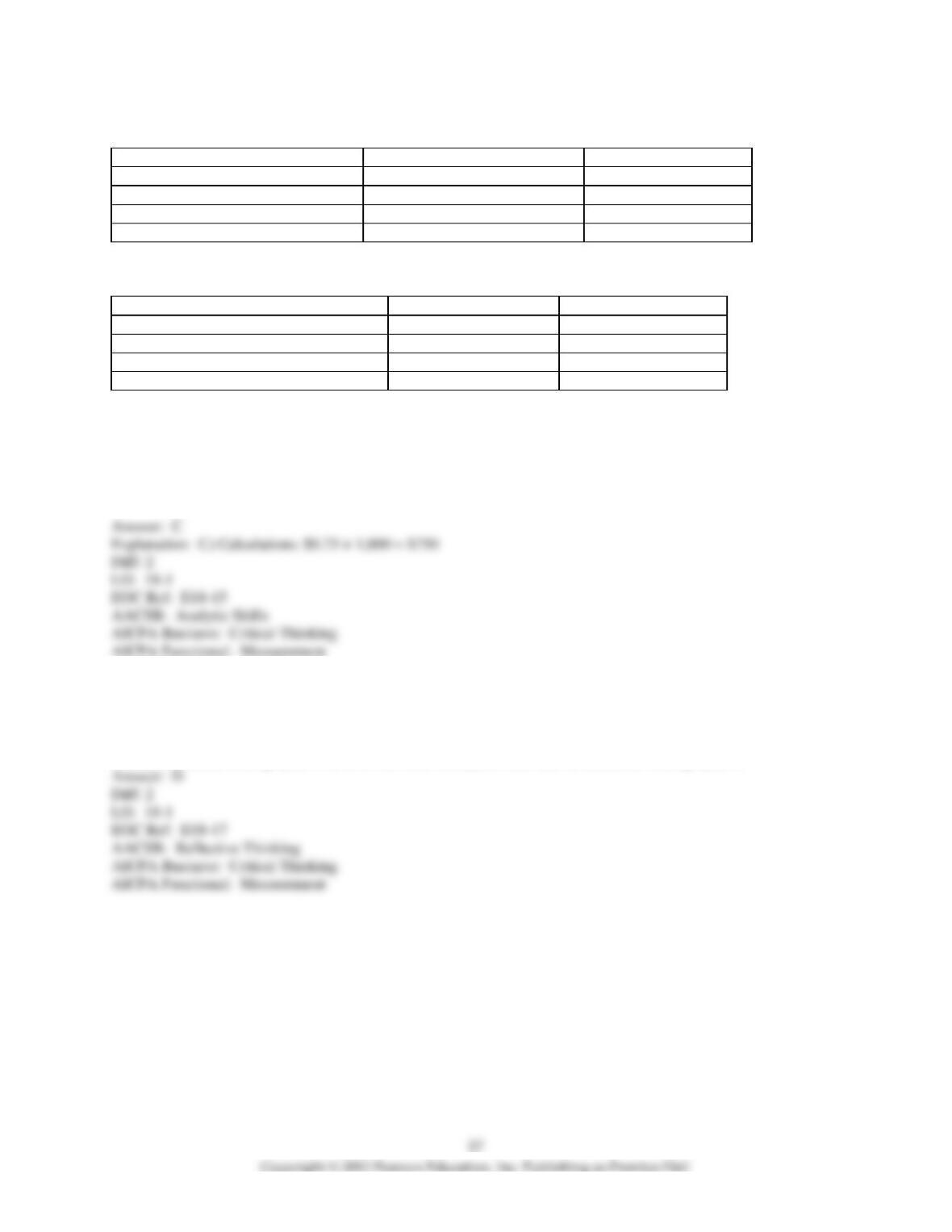
37) Pitt Jones Company had the following activities, allocated costs, and allocation bases:
Activities
Allocated Costs
Allocation Base
Account inquiry (hours)
$60,000
2,000 hours
Account billing (lines)
$30,000
20,000 lines
Account verification (accounts)
$15,000
20,000 accounts
Correspondence (letters)
$10,000
1,000 letters
The above activities are carried out at two of their regional offices:
Northeast Office
Midwest Office
Account inquiry (hours)
100 hours
200 hours
Account billing (lines)
10,000 lines
7,000 lines
Account verification (accounts)
1,000 accounts
600 accounts
Correspondence (letters)
50 letters
100 letters
How much of the account verification costs will be assigned to the Northeast Office?
A) $800
B) $2,500
C) $750
D) $1,500
38) Which of the following statements is FALSE?
A) Many traditional costing systems can distort product costs and profitability.
B) Activity-based costing systems tend to be more costly than traditional costing systems.
C) Many traditional costing systems tend to combine various costs into a single cost pool.
D) Activity-based costing systems tend to use fewer cost pools than does a traditional costing system.
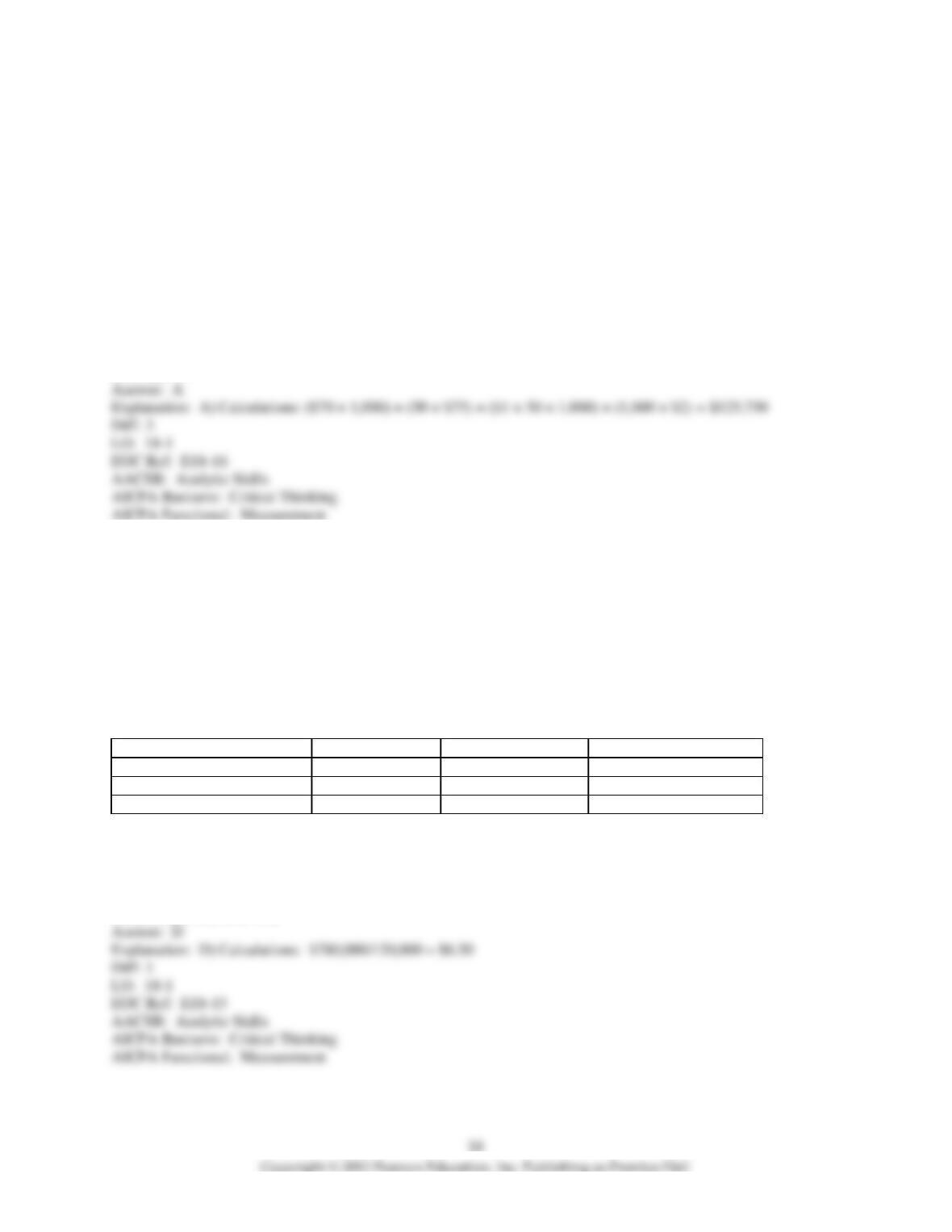
39) Quality Stereo Company has provided the following information regarding its activity-based costing system:
• Purchasing department costs are allocated based on purchase orders and the cost allocation rate is $75 per
purchase order.
• Assembly department costs are allocated based on the number of parts used and the cost allocation rate is $1.00
per part.
• Packaging department costs are allocated based on the number of units produced and the allocation rate is $2.00
per unit produced.
Each stereo produced has 50 parts, and the direct materials cost per unit is $70. There are no direct labor costs.
Quality Stereo has an order for 1,000 stereos which will require 50 purchase orders in all. What is the total cost of
the 1,000 stereos?
A) $125,750
B) $55,750
C) $123,750
D) $122,000
40) Orlando Avionics makes three types of radios for small aircraft-model A, model B, and model C. The
manufacturing operations are mechanized and there is no direct labor. Manufacturing overhead costs are significant,
and Orlando has adopted an activity-based costing system. Direct materials costs per unit for each model are as
follows:
Model A $28
Model B $32
Model C $40
Orlando has three activities-assembly, materials management, and testing. The cost driver for assembly is machine
hours. The cost driver for materials management is number of parts, and the cost driver for testing is the number of
units of product. Total costs and production volumes for the year 2012 were estimated as follows:
Total cost
Total units
Assembly
$780,000
120,000
Machine hours
Materials management
$120,000
80,000
Parts
Testing
$22,500
5,000
Units
What is the allocation rate for the Assembly activity? (Please round to the nearest cent.)
A) $7.69 per machine hour
B) $0.60 per machine hour
C) $0.15 per machine hour
D) $6.50 per machine hour
41) Orlando Avionics makes three types of radios for small aircraft-model A, model B, and model C. The
manufacturing operations are mechanized and there is no direct labor. Manufacturing overhead costs are significant,
and Orlando has adopted an activity-based costing system. Direct materials costs per unit for each model are as
follows:
Model A $28
Model B $32
Model C $40
Orlando has three activities-assembly, materials management, and testing. The cost driver for assembly is machine
hours. The cost driver for materials management is number of parts, and the cost driver for testing is the number of
units of product. Total costs and production volumes for the year 2012 were estimated as follows:
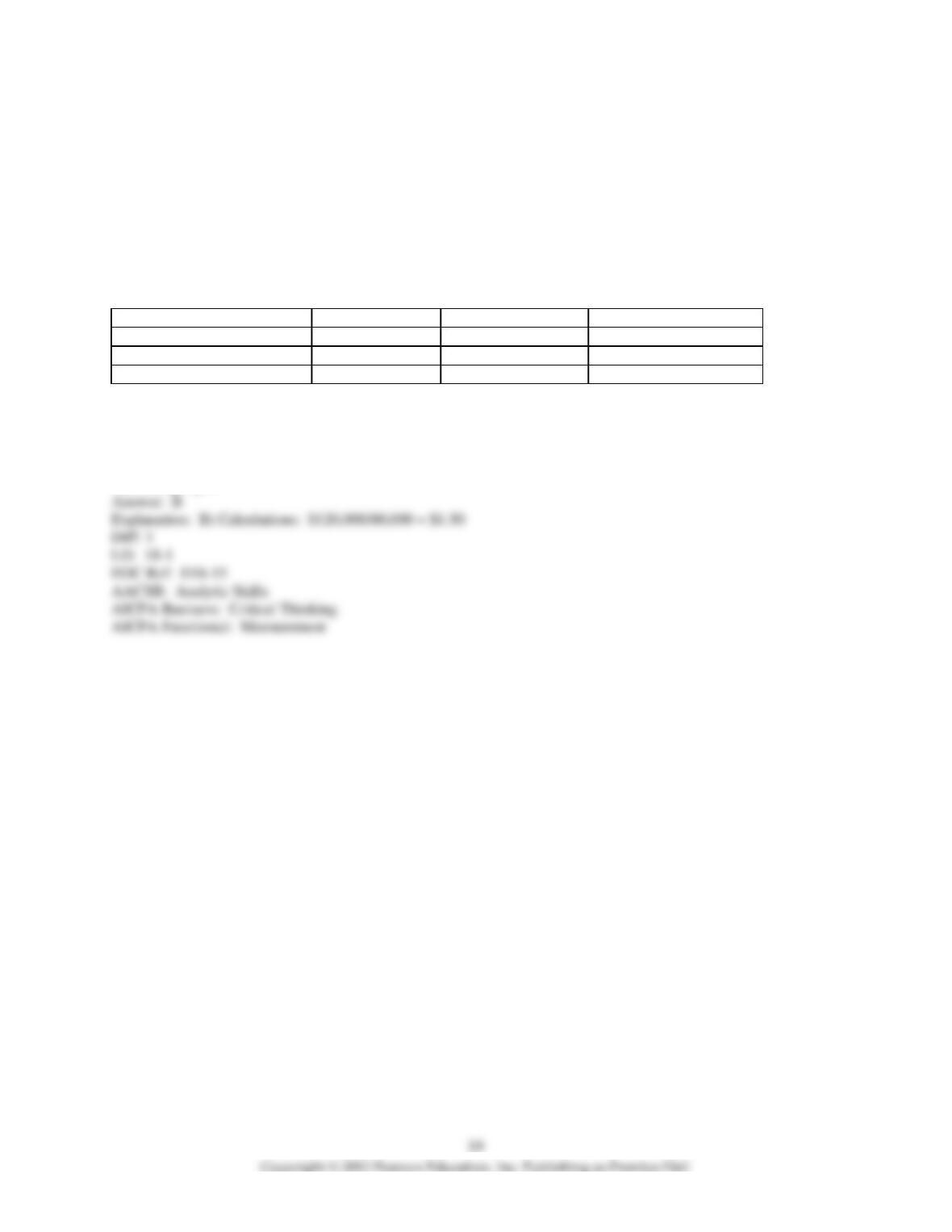
Total cost
Total units
Assembly
$780,000
120,000
Machine hours
Materials management
$120,000
80,000
Parts
Testing
$22,500
5,000
Units
What is the allocation rate for the materials management activity? (Please round to the nearest cent.)
A) $0.67 per part
B) $1.50 per part
C) $0.15 per part
D) $6.00 per part
42) Orlando Avionics makes three types of radios for small aircraft-model A, model B, and model C. The
manufacturing operations are mechanized and there is no direct labor. Manufacturing overhead costs are significant,
and Orlando has adopted an activity-based costing system. Direct materials costs per unit for each model are as
follows:
Model A $28
Model B $32
Model C $40
Orlando has three activities-assembly, materials management, and testing. The cost driver for assembly is machine
hours. The cost driver for materials management is number of parts, and the cost driver for testing is the number of
units of product. Total costs and production volumes for the year 2012 were estimated as follows:
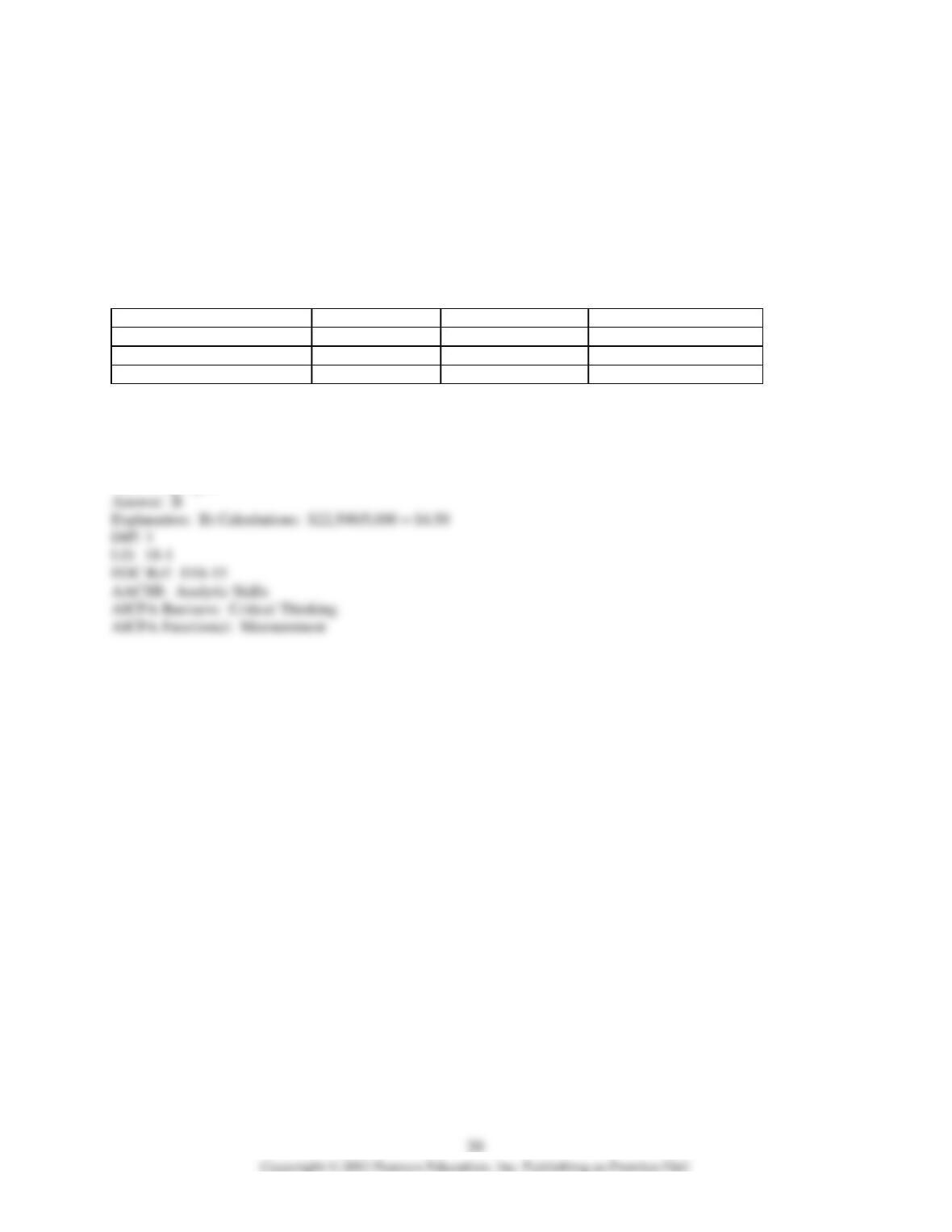
Total cost
Total units
Assembly
$780,000
120,000
Machine hours
Materials management
$120,000
80,000
Parts
Testing
$22,500
5,000
Units
What is the allocation rate for the testing activity? (Please round to the nearest cent.)
A) $0.67 per unit
B) $4.50 per unit
C) $0.22 per part
D) $1.50 per part