Chapter 17—Earnings Per Share and Retained Earnings Key
1. Which one of the following indicators is intended to show the potential impacts of possible future events on a
corporation’s performance?
2. Which one of the following indicators is a company prohibited from reporting?
3. When calculating earnings per share, dividends declared on noncumulative preferred stock, but not paid,
should be
4. Reporting basic earnings per share is required for which type of corporate capital structure?
5. A simple capital structure consists of
6. Basic earnings per share is computed as
7. Which of the following items would be included in a basic earnings per share calculation?
8. Which of the following items would not be included in a basic earnings per share calculation?
9. On January 1, 2010, Walters Corporation had 24,000 shares of common stock outstanding. On April 1, it
reacquired 2,400 shares; on July 1, it issued 10,800 shares; on October 1, it issued another 9,600 shares; and on
December 1, it reacquired 600 shares. The weighted average number of common shares outstanding for 2010
was
10. On January 1, 2010, Brennen Corporation had 20,000 shares of common shares outstanding. During the
year, it sold another 2,600 shares on July 1 and reacquired 600 shares on November 1. The corporation earned
$337,600 net income. The company also has 15,000 shares of $10 par value, 6%, cumulative preferred stock on
which no dividends have been declared for the last two years. The basic earnings per share for the year is

11. On January 1, 2010, Kuper Corporation had 12,000 shares of common stock outstanding. Kuper reacquired
1,000 shares on May 1, and issued another 5,000 shares on September 1. The company also has 10,000 shares
of $20 par, 10%, noncumulative preferred stock outstanding on which no dividends have been declared during
the last two years. The company had a $45,360 loss for the year. The earnings per share for the year is
12. On January 1, a corporation had 10,380 shares of common stock outstanding. On August 1, it sold an
additional 6,000 shares. During the year, dividends of $4,800 and $56,000 were declared and paid on the
common and preferred stock, respectively. Net income for the year was $240,000. The basic earnings per share
for the year was
13. On January 1, 2010, a corporation had 10,380 shares of common stock outstanding, and on June 1, it
reacquired 6,000 shares. Despite a net loss for the year of $180,000, the company declared and paid cash
dividends of $24,000 and $28,000 on common and preferred stock, respectively. The earnings per share for
2010 was
14. On January 1, 2010, Libby Corporation had 18,000 shares of common stock outstanding, and reacquired
2,000 shares on July 1. The company earned net income of $110,800 and paid a cash dividend on its preferred
stock of $36,000. The earnings per share for the year was
15. On January 1, 2010, Smith Company had 21,000 shares of common stock outstanding and issued an
additional 4,500 shares on May 1. The company declared and paid a cash dividend of $30,000 and earned
$330,000 net income. The earnings per share for the year was
16. Common shares outstanding are increased as a result of a stock dividend or stock split. For purposes of
calculating the earnings per share, when is the stock dividend or stock split considered to have occurred?
17. On January 1, a corporation had 20,000 shares of common stock outstanding. An additional 4,000 shares
were issued on July 1, and on November 1, the company declared a 3-for-1 stock split. The denominator in the
earnings per share calculation would be
18. On January 1, a corporation had 60,000 shares of common stock outstanding. On March 1, the company
reacquired 12,000 shares, and it declared a 10% stock dividend on October 1. The denominator in the earnings
per share calculation would be
19. On January 1, a corporation had 50,000 shares of common stock outstanding. On April 1, the company
declared a 20% stock dividend, and on August 1, the company had a 3-for-1 stock split. On December 1, the
company issued an additional 6,000 shares. The denominator in the earnings per share calculation would be
20. For which one of the following components is earnings per share information required to be presented on
the income statement?
21. Which one of the following statements concerning earnings per share amounts is true?
22. Reporting diluted earnings per share is required for which type of corporate capital structure?
23. When a corporation has a loss from continuing operations, the basic earnings per share is
24. When a corporation has contingently issuable common stock for which the conditions have not been met for
issuance, the shares are included in
25. The potential dilutive effect of the exercise of stock options or warrants will affect which of the following
when calculating diluted earnings per share?
26. Which statement best reflects the issues associated with the computation of diluted earnings per share?
27. Dual presentation of the basic and diluted earnings per share amounts is
28. In calculating earnings per share, a company uses the treasury stock method when
29. Smock Corporation had 30,000 shares of common stock outstanding during the year. In addition, there were
compensatory stock options to purchase 3,000 shares of common stock at $20 a share outstanding the entire
year. The average market price for the common stock during the year was $36 a share. The unrecognized
compensation cost (net of tax) relating to these options was $4 a share. The denominator to compute the diluted
earnings per share is
30. Under the treasury stock method, the number of shares of common stock assumed to be reacquired is
determined by using the
31. The assumed conversion of convertible debt and preferred stock in diluted earnings per share calculations
affects
32. Under the if-converted method, the impact of various convertible securities on the diluted earnings per share
calculation are ranked from
33. Given the following convertible securities, determine the appropriate ranking to determine their impact on
diluted earnings per share calculations:
(1)
10% convertible preferred stock with dividends of $6,000 declared during the year and shares convertible into 2,500 common shares
(2)
6% convertible bonds with interest expense (net of taxes) of $7,000 and convertible into 3,500 common shares
(3)
8% convertible bonds with interest expense (net of taxes) of $4,000 and convertible into 1,600 common shares
34. In the determination of the diluted earnings per share, convertible securities are
35. Interest expense on convertible bonds that are dilutive is included in the numerator of the diluted earnings
per share calculation at an amount equal to

36. The term deficit in financial accounting means
37. How will a company’s working capital and net income be affected by the recording of a cash dividend on
the declaration date? (Assume the dividend is paid on a later date.)
Working Capital
Net Income
I.
decrease
decrease
II.
decrease
no effect
III.
no effect
no effect
IV.
no effect
decrease
38. How will a company’s working capital and current ratio be affected by the recording of a cash dividend on
the declaration date? (Assume the dividend is paid on a later date.)
Working Capital
Current Ratio
I.
decrease
decrease
II.
decrease
no effect
III.
no effect
no effect
IV.
no effect
decrease
39. How will a company’s working capital and total stockholders’ equity be affected by the recording of the
declaration of a stock dividend? (Assume the stock dividend is distributed at a later date.)
Working Capital
Total Stockholders’ Equity
I.
decrease
decrease
II.
decrease
no effect
III.
no effect
no effect
IV.
no effect
decrease

40. How will a company’s retained earnings and total stockholders’ equity be affected by the recording of the
declaration of a stock dividend? (Assume the stock dividend is distributed at a later date.)
Retained Earnings
Total Stockholders’ Equity
I.
decrease
decrease
II.
decrease
no effect
III.
no effect
no effect
IV.
no effect
decrease
41. All of the following types of dividends will result in an increase in liabilities as a result of recording the
declaration of a dividend except a (Assume the dividends are paid or distributed on a later date.)
42. During 2010, Omni Corp. had net income of $300,000. Included in net income was after-tax interest
expense of $20,000 on convertible bonds. The $200,000 face value of convertible bonds can be converted into
common stock at the rate of 200 shares per $1,000 bond. Prior to the conversion, there were 400,000 shares of
common stock outstanding. The fully diluted earnings per share is
43. During 2010, Pesty Co. had net income of $200,000 including after-tax interest expense of $30,000 on
convertible bonds. The $300,000 face value of convertible bonds can be converted into common stock at the
rate of 300 shares per $1,000 bond. Prior to the conversion, there were 400,000 shares of common stock
outstanding. The fully diluted earnings per share is
44. Aster Corp. has $1,000,000, 6%, nonconvertible bonds due in 2015 and $1,500,000, 3%, convertible bonds
due in 2012. The basic earnings per share is $1.25 and the diluted earnings per share is $1.18. Based upon this
information, Aster must disclose
45. The Carol Company has issued 10%, fully participating, cumulative preferred stock with a total par value of
$600,000 and common stock with a total par value of $900,000. No dividends are in arrears. How much cash
will be paid to the preferred stockholders and the common stockholders, respectively, if cash dividends of
$141,000 are distributed?
46. The Farmer Company has issued 10%, fully participating, cumulative preferred stock with a total par value
of $300,000 and common stock with a total par value of $900,000. Dividends for one previous year are in
arrears. How much cash will be paid to the preferred stockholders and the common stockholders, respectively,
if cash dividends of $222,000 are distributed at the end of the current year?
47. The Stamp Company has issued 10%, partially participating, cumulative preferred stock with a total par
value of $200,000 and common stock with a total par value of $800,000. The preferred stock participates up to
15% of its par value. No dividends are in arrears. How much cash will be paid to the preferred stockholders and
the common stockholders, respectively, if cash dividends of $160,000 are distributed?
48. Which statement best represents the relationship between date of declaration, date of record and ex-dividend
date, and date of payment, for a cash dividend.
49. On November 1, 2010, the Metal Construction Company declared a property dividend payable in the form
of bonds held for long-term investment purposes. The bonds will be distributed to the common stockholders on
December 15, 2010. The bonds to be distributed to the common stockholders originally cost Metal $210,000.
Fair value of the bonds on various dates is as follows:
December 31, 2009
$220,000
November 1, 2010
225,000
December 15, 2010
230,000
Which one of the following amounts should be used to record the appropriate credit to Property Dividends Payable?
50. On October 1, 2010, Black Company declared a property dividend payable in the form of marketable equity
securities classified as “available for sale” for financial accounting purposes. The marketable equity securities
will be distributed to the common stockholders on December 1, 2010. The investment in equity securities
originally cost Black $410,000 on August 1, 2010. The investment’s fair value on various dates is as follows:
October 1, 2010
$430,000
December 1, 2010
435,000
December 31, 2010
440,000

The amount credited to Realized Gain on Disposal of Investments resulting from this dividend transaction should be
51. How will a company’s total current liabilities and total stockholders’ equity be affected by the declaration of
a stock dividend? (Assume the stock dividend is distributed at a later date.)
Total
Total
Current Liabilities
Stockholders’ Equity
I.
increase
decrease
II.
increase
no effect
III.
no effect
decrease
IV.
no effect
no effect
52. Exhibit 17-1
The Zoeller Corporation’s stockholders’ equity accounts have the following balances as of December 31, 2010:
Common stock, $10 par (30,000 shares issued
and outstanding)
$ 300,000
Additional paid-in capital
2,000,000
Retained earnings
5,700,000
Total stockholders’ equity
$8,000,000
Refer to Exhibit 17-1. On January 2, 2011, the board of directors of Zoeller declared a 30% stock dividend to be distributed on January 31, 2011.
The market price per share of Zoeller’s common stock was $30 on January 2 and $32 on January 31. As a result of this stock dividend, the retained
earnings account should be decreased by
53. Exhibit 17-1
The Zoeller Corporation’s stockholders’ equity accounts have the following balances as of December 31, 2010:
Common stock, $10 par (30,000 shares issued
and outstanding)
$ 300,000
Additional paid-in capital
2,000,000
Retained earnings
5,700,000
Total stockholders’ equity
$8,000,000

Refer to Exhibit 17-1. On January 2, 2011, the board of directors of Zoeller declared a 5% stock dividend to be distributed on January 31, 2011. The
market price per share of Zoeller’s common stock was $30 on January 2 and $32 on January 31. As a result of this stock dividend, the retained
earnings account should be decreased by
54. The Martin Company’s stockholders’ equity accounts have the following balances as of December 31, 2010:
Common stock, $20 par (25,000 shares issued of which
2,000 are being held as treasury stock)
$ 500,000
Additional paid-in capital
750,000
Retained earnings
2,250,000
$3,500,000
Less: Treasury stock (2,000 shares at cost)
(120,000)
Total stockholders’ equity
$3,380,000
On January 2, 2011, the board of directors of Martin declared a 10% stock dividend to be distributed on February 15, 2011. The market price of
Martin Company’s common stock was $65 per share on January 2, 2011. On the date of declaration, the retained earnings account should be
decreased by
55. A dividend that represents a return of capital rather than a distribution of retained earnings is called a
56. When a company is determining its dividend policy, the company must adhere to legal requirements. The
legal requirements are determined by the
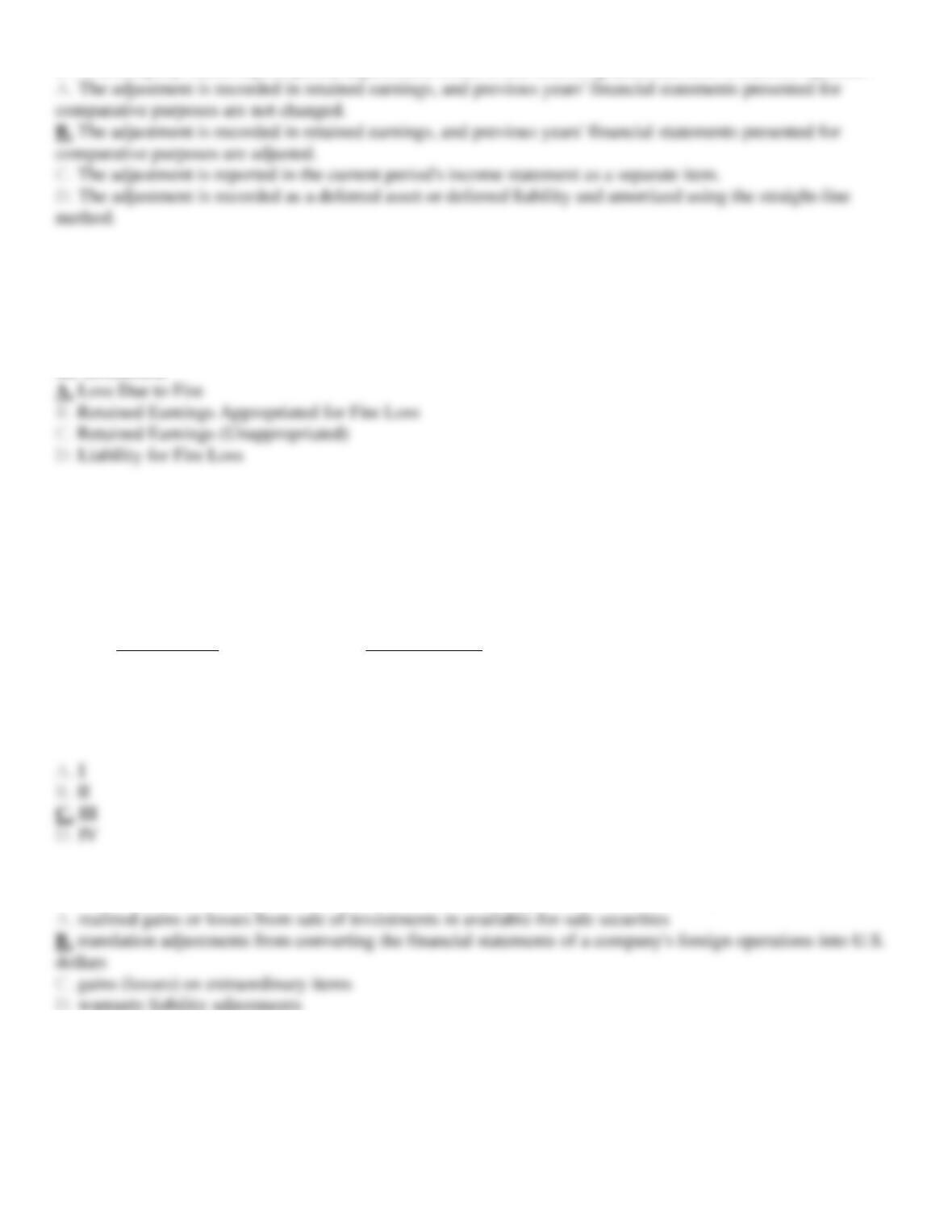
57. If a company makes a prior period adjustment, which of the following describes how it must be reported?
58. The Logan Company does not carry fire insurance for any of its factories. Instead, the company appropriates
retained earnings each year for an amount equal to the estimated annual insurance premiums. During the current
year, one of its factories is destroyed by fire. Logan should debit which one of the following accounts to record
the destruction
59. If a corporation appropriates retained earnings for treasury stock transactions, the appropriation will affect
total amounts for retained earnings and stockholders’ equity as
Total
Total
Retained Earnings
Stockholders’ Equity
I.
decrease
decrease
II.
decrease
no effect
III.
no effect
no effect
IV.
no effect
decrease
60. Which of the following could be a component of other comprehensive income (loss)?
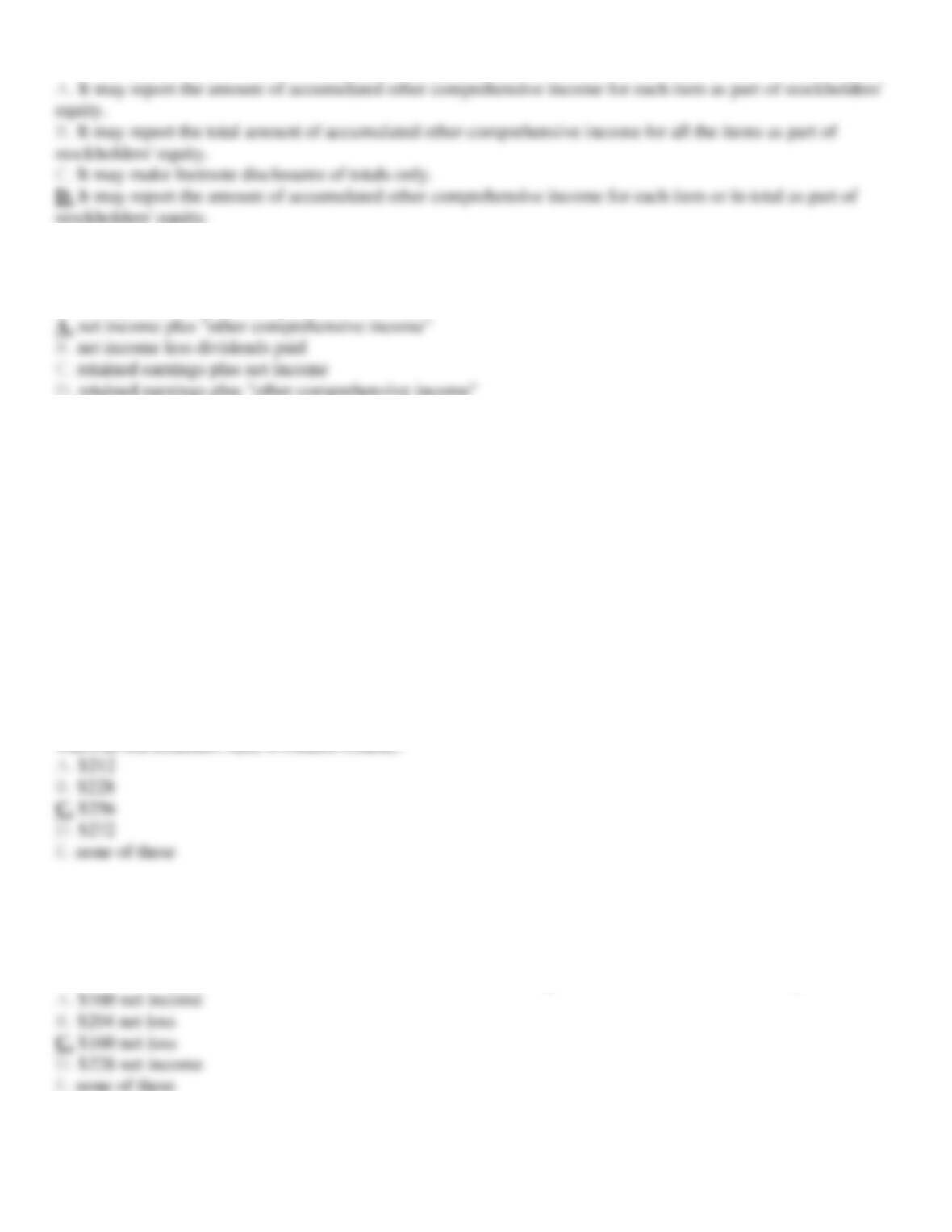
61. How may a corporation report its types of comprehensive income?
62. Comprehensive income represents
63. The following information is provided for the Columbus Company:
Deferred compensation payable-stock appreciation rights
$ 10
Bonds payable
120
Additional paid-in capital on common stock
20
Donated capital
16
Treasury stock (at cost)
8
Common stock, $1 par
100
Common stock option warrants
40
Unrealized increase in value of available for sale securities
28
Additional paid-in capital from treasury stock
3
Retained earnings
57
What is the total stockholders’ equity of Columbus Company?
64. On January 1, Roberts reported total stockholders’ equity of $1,300. During the year, $50 of dividends were
declared and paid, donated land with a donor book value of $14 and a current fair value of $38 was received,
additional common stock was issued for $300, and treasury stock was acquired for $22. The reported total
stockholders’ equity at December 31 was $1,406. What was the reported net income or loss for the year?
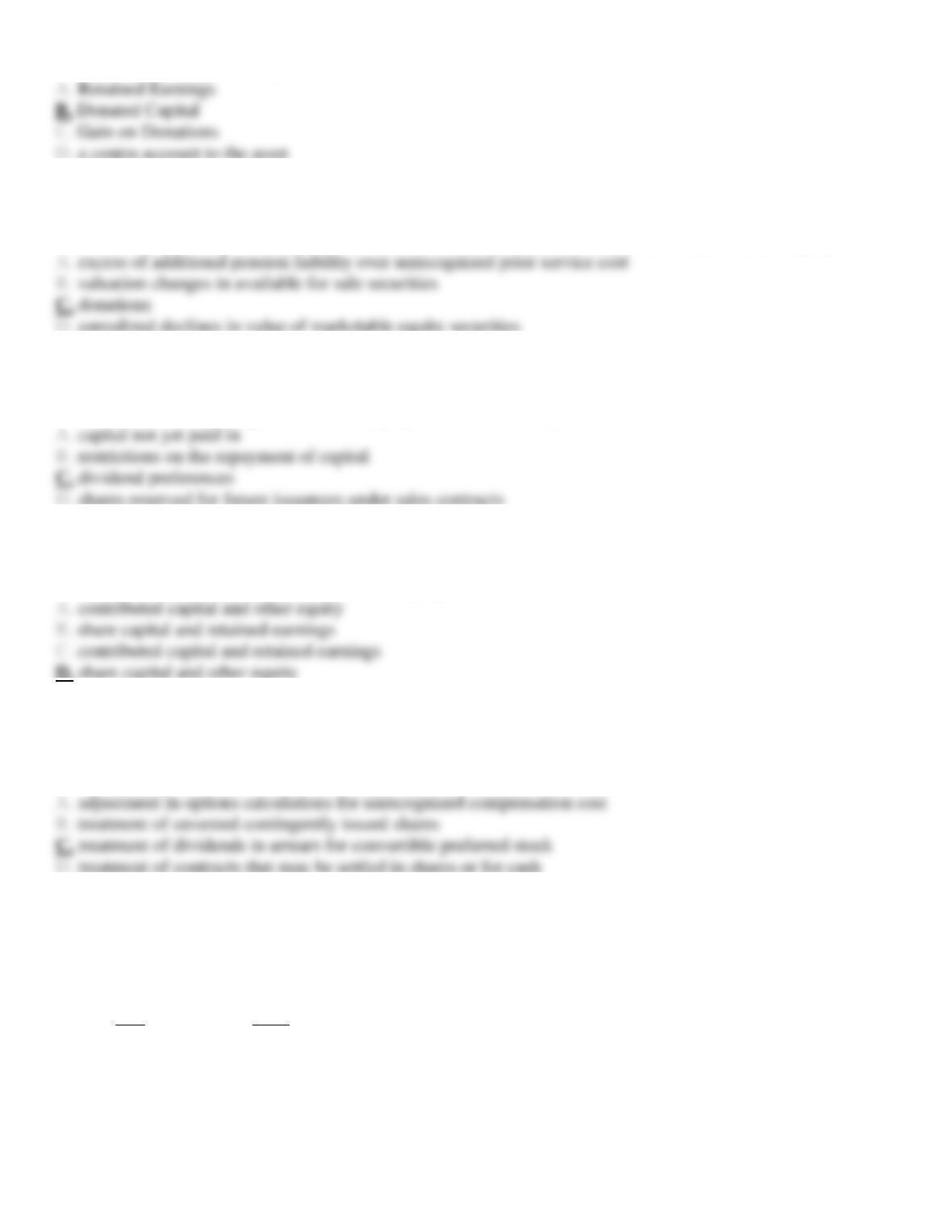
65. When recording the receipt of donated assets, the credit could be to
66. Which one of the following would least likely result in a negative component of stockholders’ equity?
67. Which of the following stockholders’ equity disclosures are required under both GAAP and IFRS?
68. The two defined sections of stockholders’ equity under IFRS are
69. Differences exist between IFRS and GAAP in the reporting of EPS. Which of the following areas is not an
area of difference?
70. Specific EPS disclosure is regularly reported for extraordinary items under
IFRS
GAAP
I.
yes
no
II.
no
yes
III.
yes
yes
IV.
no
no