
College Accounting, 14e (Slater)
Chapter 17 Partnership
17.1 Learning Objective 17-1
1) Many associations, which include two or more persons that create a medical center or law firm could
organize a:
A) sole proprietorship.
B) corporation.
C) partnership.
D) Both B and C are correct.
2) The accounting procedures are the same for sole proprietorships as for partnerships with the exception
of:
A) the asset section includes more than one cash account.
B) the liability section.
C) the revenue section.
D) the capital section has separate capital sections for each partner.
3) Articles of partnership:
A) are required to form a partnership by federal law.
B) are a formal written agreement that states the partners’ relationship.
C) may be an oral agreement.
D) Both B and C are correct.
4) Dissolution of a partnership can occur under the limited life characteristic if a partner:
A) dies.
B) becomes incapacitated.
C) goes bankrupt.
D) All of the above are correct.
5) The characteristic that means the actions of one partner are binding on all other partners is known as:
A) mutual agency.
B) exclusive agency.
C) unlimited life.
D) limited liability.
6) The characteristic that means if a partnership is unable to pay its obligations all general partners are
individually liable is known as:
A) limited life.
B) unlimited liability.
C) limited liability.
D) mutual agreement.
7) A partner that is personally liable for all of the debts of the partnership is known as:
A) a limited partner.
B) a general partner.
C) a mutual partner.
D) None of these answers is correct.
8) Which of the following is true of a partnership?
A) Actions of one partner are not binding on all the other partners.
B) Each partner is individually liable for partnership debts.
C) All of the owners always share income and losses equally.
D) Both A and B are correct.
9) Bob and Sam formed a partnership. Bob invested $19,000, cash; Sam invested $8,000 cash and
equipment with a fair value of $6,000. The proper entry to record this is to:
A) debit Cash $27,000; debit Equipment $6,000; credit Capital $33,000.
B) debit Cash $27,000; debit Equipment $6,000; credit Accounts Payable $33,000.
C) debit Cash $27,000; debit Equipment $6,000; credit Bob’s Capital $19,000; and credit Sam’s Capital
$14,000.
D) debit Cash $27,000; credit Bob’s Capital $19,000; and credit Sam’s Capital $8,000.
10) Tricia and Jennifer formed a partnership. Tricia invested $16,000 cash; Jennifer invested $12,000 cash,
equipment with a fair value of $15,000, and $5,000 accounts payable. The proper entry to record this is:
A) debit Cash $28,000; debit Equipment $15,000; credit Accounts Payable $5,000; credit Tricia’s Capital
$16,000; and credit Jennifer’s Capital $22,000.
B) debit Cash $28,000; debit Equipment $10,000; debit Accounts Payable $5,000; credit Tricia’s Capital
$21,500; and credit Jennifer’s Capital $21,500.
C) debit Cash $28,000; debit Equipment $15,000; credit Tricia’s Capital $21,500; and credit Jennifer’s
Capital $21,500.
D) debit Cash $23,000; debit Equipment $15,000; credit Tricia’s Capital $16,000; and credit Jennifer’s
Capital $22,000.
11) Partner A invested furniture that was recorded at a value above the fair market value. This error
would cause:
A) the period’s net income to be overstated.
B) the period’s end capital to be understated.
C) the period’s end assets to be overstated.
D) the period’s end assets to be understated.
12) In comparison with the proprietorship form of business organization, forming a partnership offers
which of the following advantages?
A) Limited life
B) Legal liability of each partner for all of the debts
C) Combination of ability and experience of the partners
D) Simple transfer of interest in the partnership to outsiders
13) When two proprietors decide to combine their businesses and form a partnership, GAAP usually
requires that noncash assets be taken over at their:
A) residual value on the date of the formation of the partnership.
B) book value on the date of the partnership.
C) fair market value on the date of the partnership.
D) historical cost on the date of the partnership.
14) Which of the following is NOT generally written into the articles of partnership agreement?
A) How new partners are admitted
B) How accounting records will be maintained
C) The marital status of each partner
D) All are written into the agreement.

15) Since all partners are bound together in the agreement and each act on the behalf of the partnership,
________ has been established.
A) limited life
B) limited risk
C) mutual agency
D) unlimited liability
16) Partner C invested equipment in the partnership that has a market value exceeding book value; the
equipment was recorded at its book value. This error would cause:
A) future period’s net income to be understated.
B) future period’s net income to be overstated.
C) this period’s end assets to be overstated.
D) None of these is correct.
17) All assets held by a partnership are:
A) co-owned by all partners.
B) owned by the partner(s) who purchased the assets.
C) owned by the partners based on investment percentage.
D) owned by the partnership.
18) Jane’s investment in a new partnership includes $4,000 cash and equipment at a fair value of $10,000.
The new partnership is assuming $2,200 of Jane’s accounts payable. The partnership entry should be to:
A) debit Jane, Capital $11,800; debit Accounts Payable $2,200; credit Cash $4,000; credit Equipment
$10,000.
B) debit Cash $4,000; debit Equipment $10,000; credit Jane, Capital $14,000.
C) debit Cash $4,000; debit Equipment $10,000; credit Accounts Payable $2,200; credit Jane, Capital
$11,800.
D) debit Jane, Investment $14,000; credit Capital $14,000.

19) Nathan Long is entering into a partnership with Terri. Nathan is investing $4,000 cash and equipment
currently on Nathan’s books at $16,000 and accumulated depreciation of $4,000. The equipment has a fair
market value of $10,000. The entry to record Nathan’s investment should be to:
A) debit Cash $4,000; debit Equipment $16,000; credit Accumulated Depreciation $4,000; credit Long,
Capital $16,000.
B) debit Cash $4,000; debit Equipment $10,000; credit Accumulated Depreciation $4,000; credit Long,
Capital $10,000.
C) debit Long, Capital $12,000; debit Accumulated Depreciation $4,000; credit Cash $4,000; credit
Equipment $12,000.
D) debit Cash $4,000; debit Equipment $10,000; credit Long, Capital $14,000.
20) A partnership can be formed with an oral agreement.
21) The Uniform Partnership Act defines a partnership as “an association of two or more persons to carry
on as co-owners of a business for profit.”
22) A partnership is defined by the Generally Accepted Accounting Principles.
23) Mutual agency means that the act of a single partner is binding on all the other partners.
24) If Sam invests $11,000 cash in a partnership, Cash is debited and Sam, Capital is credited, $11,000.
Given the following accounts:
[1] Cash
[2] Accounts receivable
[3] Allowance for doubtful accounts
[4] Merchandise inventory
[5] Store supplies
[6] Store equipment
[7] Accumulated depreciation
[8] Notes payable
[9] Accounts payable
[10] John Partner’s, Capital
[11] Joy Partner’s, Capital
[12] John Partner’s, withdrawals
[13] Joy Partner’s, withdrawals
[14] Income summary
[15] Service revenue
[16] Gain on realization
[17] Loss on realization
Indicate the account(s) to be debited and credited to record the following transactions.
25) John partner invested cash in the business.
Debit ________ Credit ________
26) John accepted Joy into the partnership with an investment of cash, inventory, and store equipment,
including accumulated depreciation.
Debit ________ & ________ & ________ Credit ________ & ________
27) The business paid an account.
Debit ________ Credit ________
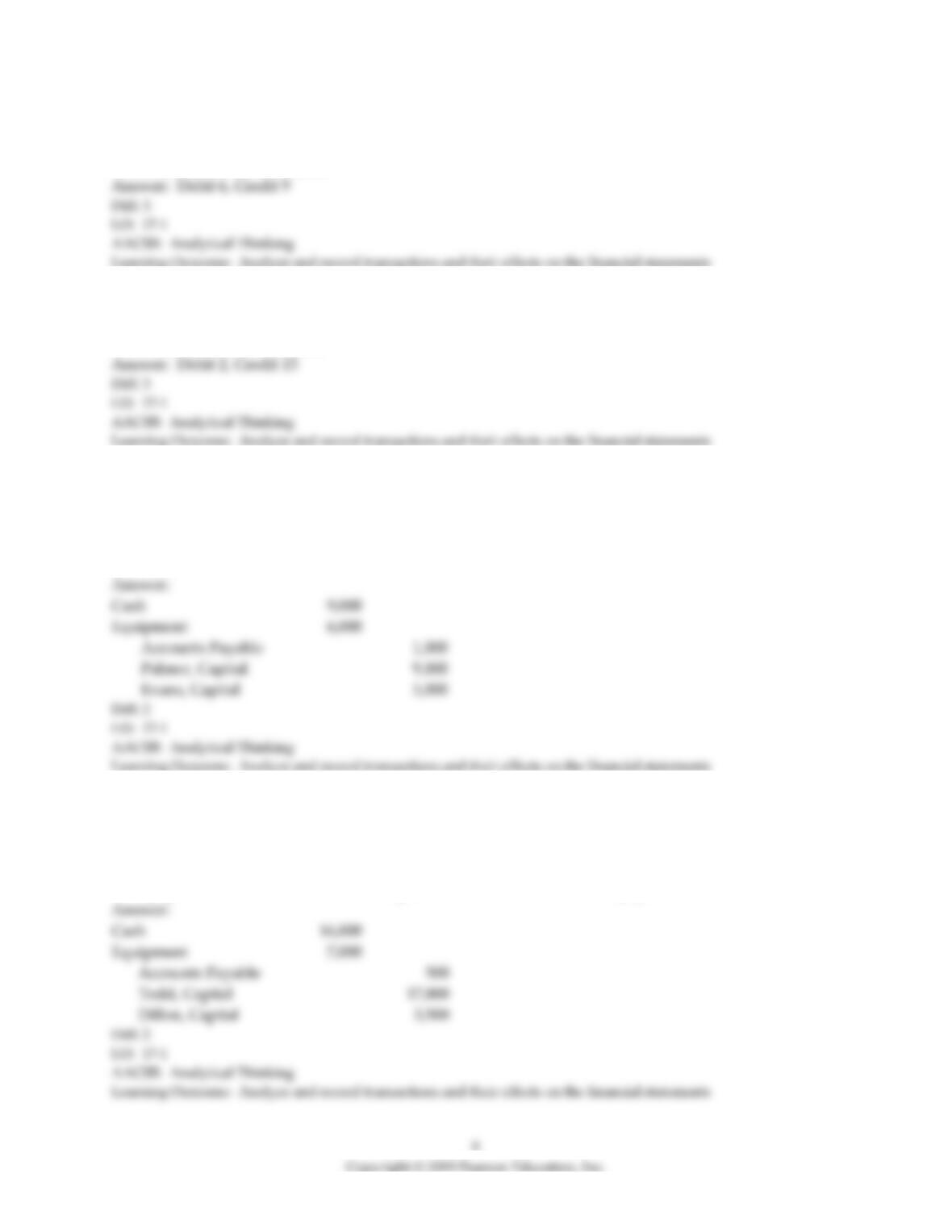
28) The business bought store equipment on account.
Debit ________ Credit ________
29) The business provided services on credit.
Debit ________ Credit ________
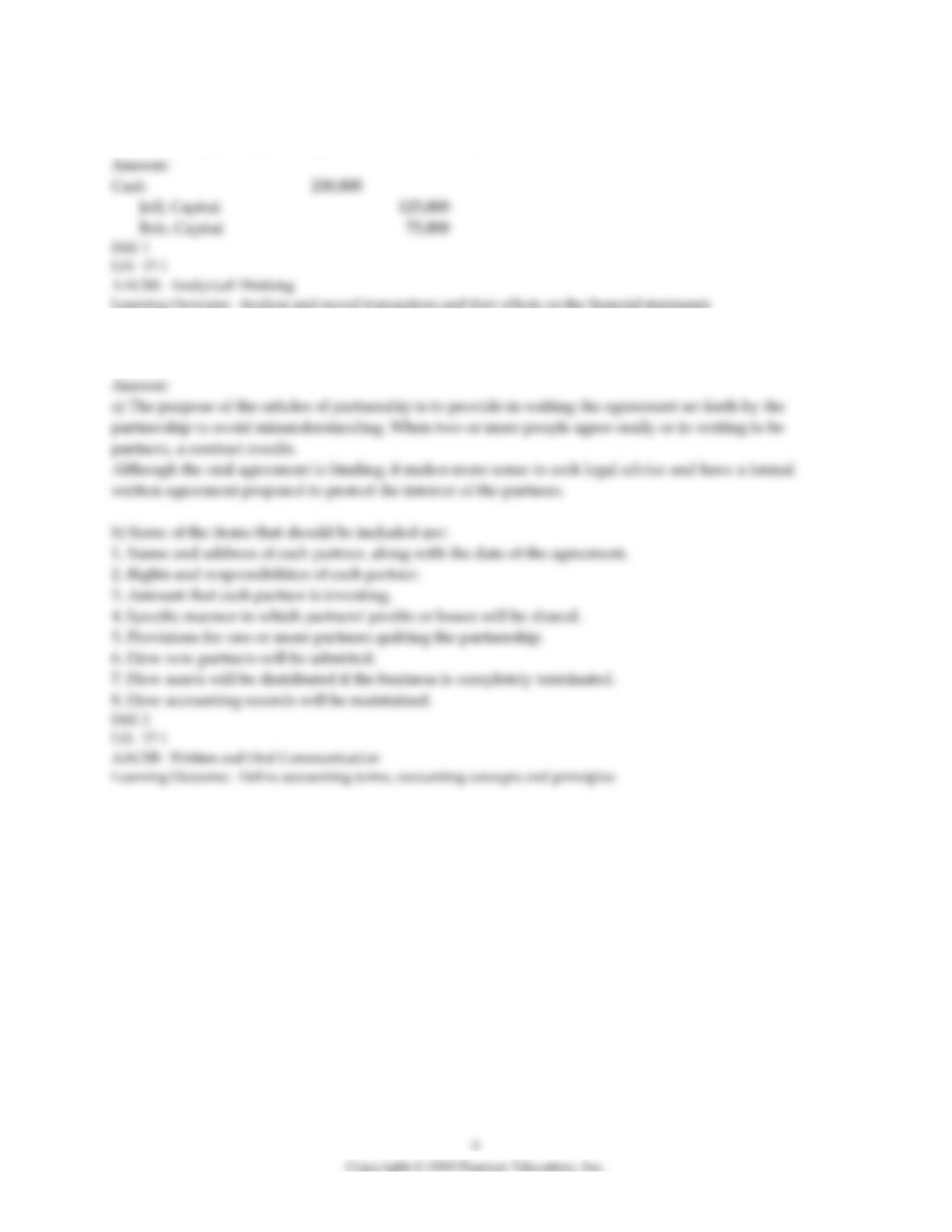
30) Prepare the journal entry to record the partners’ investment in the company.
Palmer invests $3,000 cash and equipment on his books at $6,000 with accumulated depreciation of $500.
The fair market value of the equipment is $6,000. Evans is investing $6,000 cash and $1,000 accounts
payable.
31) Prepare the journal entry to record the partners’ investment in the company.
Todd and Dillon combine their two businesses and enter into a partnership. Todd invests $10,000 cash
and equipment on his books at $8,000 with accumulated depreciation of $3,000. The fair market value of
the equipment is $7,000. Dillon is investing $6,000 cash and $500 accounts payable.
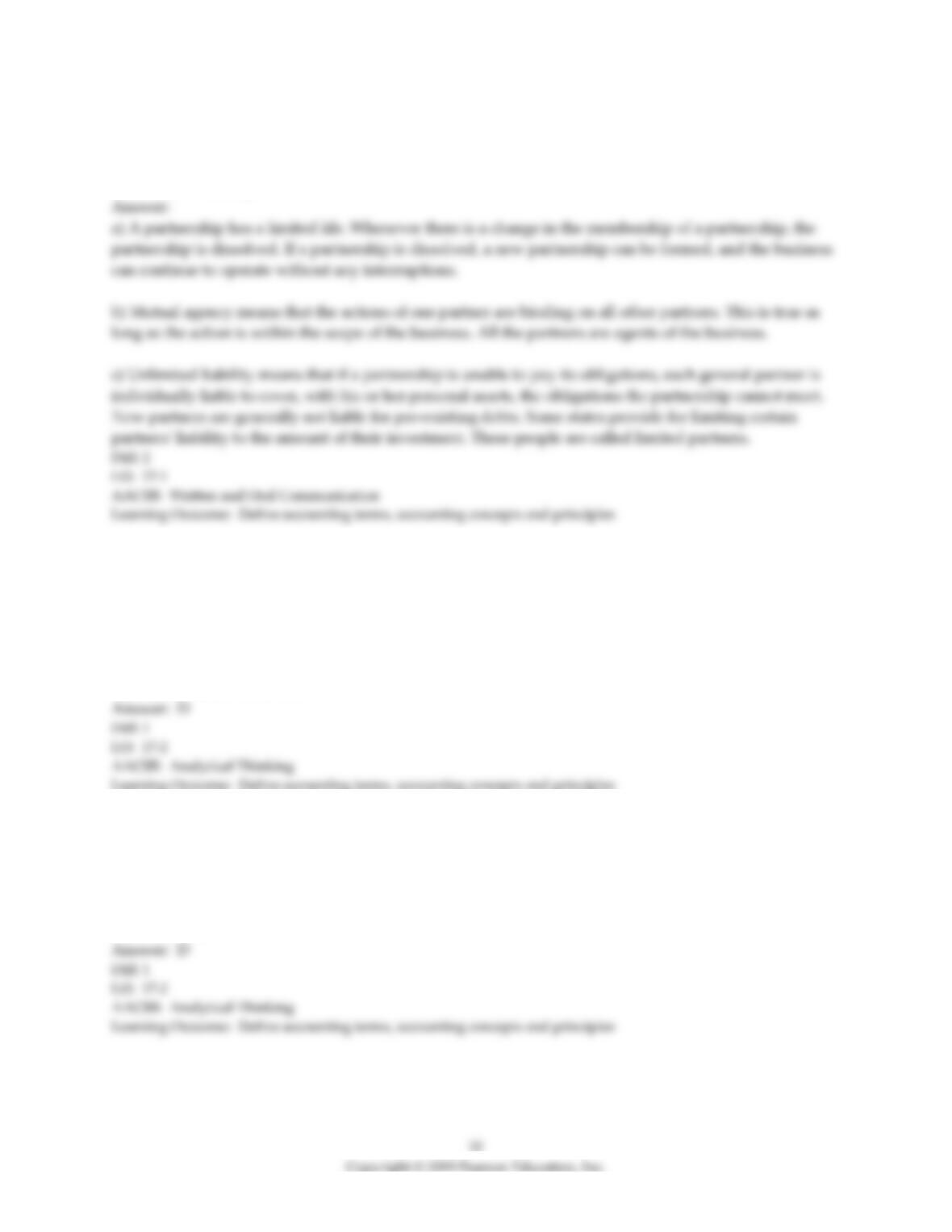
32) Jeff and Bob agreed on October 1, 201x to enter into a partnership. Jeff contributes $125,000 and Bob
contributes $75,000. Journalize their initial investments.
33) Discuss (a) the purpose of the articles of partnership, and (b) indicate the items that should be
included.
34) Discuss the following characteristics of partnerships:
a) Limited life
b) Mutual agency
c) Unlimited liability
17.2 Learning Objective 17-2
1) A method of dividing net income or loss between the partners is known as a(n):
A) salary allowance.
B) interest allowance.
C) payroll allowance.
D) Both A and B are correct.
2) Which method of allocation of profits and losses is based on a percent of initial investment of the
partners?
A) Salary allowance
B) Salary expense
C) Profit and loss ratio
D) Interest allowance
3) The agreed-upon ratio for dividing earnings or losses of a partnership is called:
A) interest allowance.
B) salary allowance.
C) profit and loss ratio.
D) profit and loss allowance.
4) Sherry and Jim entered into a partnership agreement. However, the agreement did not state how
income and losses would be divided. The law states that income will be divided:
A) equally.
B) according to investments.
C) according to abilities.
D) None of these answers is correct.
5) Apply the interest allowance method; each partner earns interest on their capital investment at a rate of
10%. Compute Julie and Jennifer’s share of net income if Julie invested $52,000 and Jennifer invested
$38,000. The remainder after distribution on interest on capital is to be divided equally. Net income was
$12,000.
A) Julie $5,200; Jennifer $3,800
B) Julie $6,700; Jennifer $5,300
C) Julie $6,000; Jennifer $6,000
D) None of these answers is correct.

6) What is the closing entry to allocate net income of $48,000 to Sara, Ellen, and Mary? Respective capital
balances are $50,000, $81,000, and $24,000. No agreement was made for division of income. (Round any
intermediate calculations to two decimal places, and your final answers to the nearest dollar.)
A) Debit Income Summary $48,000; credit Sara, Capital $16,000; credit Ellen, Capital $16,000; credit Mary,
Capital $16,000
B) Debit Income Summary $48,000; credit Sara, Capital $15,484; credit Ellen, Capital $25,084; credit Mary,
Capital $7,432
C) Debit Salary Expense $48,000; credit Salaries Payable $48,000
D) Net income cannot be allocated.
7) What is the closing entry to allocate net income $210,000 to Eric, Von, and Derek? Their respective
capital balances are $69,000, $69,000, and $92,000. Net income is shared in a ratio of their capital balances.
A) Debit Income Summary $210,000; credit Eric, Capital $63,000; credit Von, Capital $63,000; credit Derek,
Capital $84,000
B) Debit Income Summary $210,000; credit Eric, Capital $70,000; credit Von, Capital $70,000; credit Derek,
Capital $70,000
C) Debit Salary Expense $210,000; credit Salaries Payable $210,000
D) Net income cannot be allocated.
8) The journal entry to close net income to the partners is to:
A) debit Income Summary; credit the capital accounts.
B) debit the capital accounts; credit Income Summary.
C) debit the capital accounts; credit Net Loss.
D) debit Net Loss; credit the capital accounts.

9) The original investment balances of partners Bridget and Emily are $9,000 and $19,000, respectively.
Bridget and Emily work full time in the business. The business earned net income of $20,000 for the
period. The partners have agreed to share earnings based upon the percentage of original investment.
Bridget’s share of the net income is: (Round any intermediate calculations to two decimal places, and
your final answer to the nearest dollar.)
A) $9,474.
B) $10,000.
C) $6,400.
D) indeterminable.
10) The net income earned by the Brian, Bill, and Bob partnership is $24,000. Their respective average
capital balances are $28,000, $28,000, and $56,000. What is the closing entry to allocate the net income if no
agreement was made for division of income?
A) Debit Income Summary $24,000; credit Brian, Capital $8,000; credit Bill, Capital $8,000; credit Bob,
Capital $8,000
B) Debit Income Summary $24,000; credit Brian, Capital $6,000; credit Bill, Capital $6,000; credit Bob,
Capital $12,000
C) Debit Brian, Capital $8,000; debit Bill, Capital $8,000; debit Bob, Capital $8,000; credit Income
Summary $24,000
D) Not enough information given to allocate
11) Allison and Josh are partners in a business. Allison’s capital is $120,000 and Josh’s capital is $120,000.
Profits for the year are $80,000. They agree to share profits and losses as follows:
Allison Josh
Salaries $20,000 $41,000
Interest on capital 10% 10%
Remaining profits and losses 3/5 2/5
Allison’s share of the profits before paying salaries and interest on capital is: (Round any intermediate
calculations to two decimal places, and your final answer to the nearest dollar.)
A) $48,000.
B) $70,500.
C) $40,000.
D) $11,400.

12) Alice and James are partners in a business. Alice’s capital is $130,000 and James’s capital is $170,000.
Profits for the year are $130,000. They agree to share profits and losses as follows:
Alice James
Salaries $20,000 $43,000
Interest on capital 10% 10%
Remaining profits and losses 50% 50%
James’s share of the profit is:
A) $52,000.
B) $65,000.
C) 39,000.
D) None of the above
13) Applying the interest allowance method, compute Taylor and Timmy’s share of net income if Taylor
invested $370,000 and Timmy invested $780,000 at a 6% interest rate, for each partner with the remainder
to be divided equally. Net income was $90,000.
A) Taylor, $28,957; Timmy, $61,043
B) Taylor, $45,000; Timmy, $45,000
C) Taylor, $32,700; Timmy, $57,300
D) None of these answers is correct.
14) The basis on which profits and losses are shared is governed by:
A) the SEC.
B) the IRS.
C) the partnership agreement.
D) the partners and must be shared equally.
15) The different partners are taxed on:
A) the gross revenue of the partnership.
B) the amount they withdraw from the partnership.
C) the total amount of the net profit of the partnership.
D) the partners’ share of the net profit of the partnership.
16) The two types of allowances that may be considered before the division of profits and losses are:
A) interest and salary allowances.
B) interest and bonus allowances.
C) salary and bonus allowances.
D) bonus and liquidation allowances.
17) The income/loss agreement was ignored when closing the income summary and all income was
distributed evenly. This error would cause:
A) the total partners’ equity to be overstated.
B) the total partners’ equity to be understated.
C) the total partners‘ equity to be unaffected.
D) the ending assets to be overstated.
18) Applying the ratio based on investment method, compute Tom and Troy’s share of net income if Tom
invested $300,000 and Troy invested $500,000. Net income was $130,000. (Round any intermediate
calculations to two decimal places, and your final answers to the nearest dollar.)
A) Tom, $80,000; Troy, $50,000
B) Tom, $65,000; Troy, $65,000
C) Tom, $49,400; Troy, $81,900
D) None of these answers is correct.

19) Partner B invested inventory using the retail selling price for valuation. Some of the inventory is
unsold at period end. This error would cause:
A) the period’s net income to be overstated.
B) the period’s net income to be understated.
C) the ending assets to be overstated.
D) Both B and C are correct.
20) Applying the profit and loss ratio method, compute Taylor and Timmy’s share of net income if Taylor
invested $200,000 and Timmy invested $800,000 and the profit and loss ratio is 3:2. Net income was
$70,000.
A) Taylor, $14,000; Timmy, $56,000
B) Taylor, $35,000; Timmy, $35,000
C) Taylor, $42,000; Timmy, $28,000
D) None of these answers is correct.
21) Kim and John formed a partnership in 2015. John invested $140,000 and Kim invested $90,000. The
partnership had $100,000 in income during 2017. There is no agreement as to how income is divided. Kim
and John’s share is:
A) Kim gets $100,000 and John gets $90,000.
B) Kim gets $90,000 and John gets $100,000.
C) Kim gets $50,000 and John gets $50,000.
D) some other division.
22) Partners Brian, Josh, and Chad have capital balances of $11,000, $12,000, and $86,000, respectively.
The losses for the year are $14,000. What will Josh’s capital balance be if the three partners share profits
and losses at a 2:2:6 ratio for Brian, Josh, and Chad, respectively?
A) $9,200 debit balance
B) $8,200 debit balance
C) $2,800 debit balance
D) $9,200 credit balance
23) Partners Brian, Josh, and Chad have average capital balances of $11,000, $10,000, and $90,000,
respectively. Net income for the year is $20,000. Salary allowances are $19,000 for Brian and $8,000 for
Josh. Chad gets 10% interest on his capital balance with the remainder being divided at a 1:1:2 ratio for
Brian, Josh, and Chad, respectively. What is Brian’s capital balance after distributing the net income?
(Assume no change in capital balances during the year.)
A) $26,000 credit balance
B) $5,000 debit balance
C) $16,000 debit balance
D) $11,000 debit balance
24) Partners Jessica and Jill receive salary allowances of $8,000 and $17,000, respectively. They share
income and losses in a 3:1 ratio for Jessica and Jill, respectively. If the partnership suffers a $23,000 loss,
by how much would Jessica’s capital decrease?
A) $17,250
B) $9,250
C) $15,000
D) $28,000
25) Jan and Ben are partners, with beginning capital balances of $70,000 and $62,000 respectively. During
the year, Jan withdrew $12,000 and Ben withdrew $23,000. The year’s net income of $48,000 was
distributed $19,000 to Jan and $29,000 to Ben. Calculate the ending balances in the capital accounts.
A) Jan, $58,000; Ben, $39,000
B) Jan, $77,000; Ben, $68,000
C) Jan, $90,000; Ben, $90,000
D) Jan, $70,000; Ben, $62,000

26) A cash withdrawal of a partner was recorded the same as paying payroll. This error would cause:
A) the period’s net income to be understated.
B) the period’s net income to be overstated.
C) the period end assets to be overstated.
D) the period end assets to be understated.
27) A statement of partner’s equity is the same as a statement of owner’s equity except:
A) there is a capital account for each partner.
B) net income is assigned to one partner.
C) no additional investment by partners is shown on the statement.
D) There is no difference in the statements.
28) Partnerships are subject to federal income tax.
29) The statement of partners’ equity reveals each partner’s ownership percentage of the firm’s capital.
30) Partners are required to report their share of partnership earnings on their personal tax return.
31) After calculating salary and interest allowances, it is necessary to determine whether net income will
cover these expenses.

32) The profit or loss is required to be divided equally between the partners if otherwise not stated.
33) A loss occurs when net income is not large enough to cover salary and interest allowances for the
partners.
34) An interest allowance is based on a partner’s individual investment of capital.
35) A profit and loss ratio must be based on capital contributions.
36) An interest allowance is based on the beginning capital balance of each partner.