114) Oregon Co.’s employees are eligible for retirement with benefits at the end of the year in
which both age 60 is attained and they have completed 35 years of service. The benefits provide
15 years reimbursement for health care services of $20,000 annually, beginning one year from
the date of retirement.
Ralph Young was hired at the beginning of 1977 by Oregon after turning age 22 and is expected
to retire at the end of 2020 (age 60). The discount rate is 4%. The plan is unfunded.
The PV of an ordinary annuity of $1 where n = 15 and i = 4% is 11.11839.
The PV of $1 where n = 2 and i = 4% is 0.92456.
With respect to Ralph, what is the service cost to be included in Oregon’s 2018 postretirement
benefit expense, rounded to the nearest dollar?
A) $3,544.
B) $6,365.
C) $20,000.
D) $5,272.
115) Oregon Co.’s employees are eligible for retirement with benefits at the end of the year in
which both age 60 is attained and they have completed 35 years of service. The benefits provide
15 years reimbursement for health care services of $20,000 annually, beginning one year from
the date of retirement.
Ralph Young was hired at the beginning of 1977 by Oregon after turning age 22 and is expected
to retire at the end of 2020 (age 60). The discount rate is 4%. The plan is unfunded.
The PV of an ordinary annuity of $1 where n = 15 and i = 4% is 11.11839.
The PV of $1 where n = 2 and i = 4% is 0.92456.
With respect to Ralph, what is the interest cost to be included in Oregon’s 2019 postretirement
benefit expense, rounded to the nearest dollar?
A) $7,802.
B) $7,877.
C) $8,766.
D) None of these answer choices is correct.
116) Assume the actuary estimates the net cost of providing health care benefits to a particular
employee during his retirement years to have a present value of $60,000. If the benefits relate to
an estimated 25 years of service and five of those years have been completed:
A) The EPBO would be $12,000.
B) The EPBO would be $8,400.
C) The APBO would be $8,400.
D) The APBO would be $12,000.
117) The EPBO for a particular employee on January 1, 2018, was $30,000. The APBO at the
beginning of the year was $6,000. The appropriate discount rate for this postretirement plan is
5%. The employee is expected to serve the company for a total of 25 years with 5 of those years
already served as of January 1, 2018. What is the APBO at December 31, 2018?
A) $6,300.
B) $7,200.
C) $7,500.
D) $7,560.
118) The EPBO for a particular employee on January 1, 2018, was $150,000. The APBO at the
beginning of the year was $30,000. The appropriate discount rate for this postretirement plan is
5%. The employee is expected to serve the company for a total of 25 years with 5 of those years
already served as of January 1, 2018. What is the APBO at December 31, 2018?
A) $37,800.
B) $42,800.
C) $31,500.
D) $30,000.
119) At December 31, 2017, Mallory, Inc., reported in its balance sheet a net loss of $12 million
related to its postretirement benefit plan. The actuary for Mallory at the end of 2018 increased
her estimate of future health care costs. Mallory’s entry to record the effect of this change will
include:
A) A debit to Loss-OCI and a credit to APBO.
B) A debit to APBO and a credit to Loss-OCI.
C) A debit to Postretirement benefit expense and a credit to APBO.
D) A debit to Postretirement benefit expense and a credit to Loss-OCI.
120) The net postretirement benefit liability (APBO minus plan assets) is increased by:
A) Service cost.
B) Expected return on plan assets.
C) Amortization of net gain.
D) Cash contributions to plan assets.
121) In a postretirement health care plan, prior service cost is attributed to the service of active
employees from the date of the amendment to:
A) The partial eligibility date.
B) The retirement date.
C) The full eligibility date.
D) The date of death.
122) Recording the expense for postretirement benefits will not:
A) Increase the APBO.
B) Increase the postretirement benefit assets.
C) Decrease the prior service cost.
D) Increase the net loss-AOCI.
123) The following data are for Guava Company’s retiree health care plan for the current
calendar year.
Number of employees covered
5
Years employed as of January 1
4
(each)
Attribution period
20
years
EPBO, January 1
$
60,000
EPBO, December 31
$
63,600
Interest rate
6
%
Funding and plan assets
None
What is the interest cost to be included in the current year’s postretirement benefit expense?
A) $3,600.
B) $720.
C) $768.
D) $4,000.
124) The following data are for Guava Company’s retiree health care plan for the current
calendar year.
Number of employees covered
5
Years employed as of January 1
4
(each)
Attribution period
20
years
EPBO, January 1
$
60,000
EPBO, December 31
$
63,600
Interest rate
6
%
Funding and plan assets
None
What is the service cost to be included in the current year’s postretirement benefit expense?
A) $3,000.
B) $3,180.
C) $3,200.
D) $4,000.
125) The following data are for Guava Company’s retiree health care plan for the current
calendar year.
Number of employees covered
5
Years employed as of January 1
4
(each)
Attribution period
20
years
EPBO, January 1
$
60,000
EPBO, December 31
$
63,600
Interest rate
6
%
Funding and plan assets
None
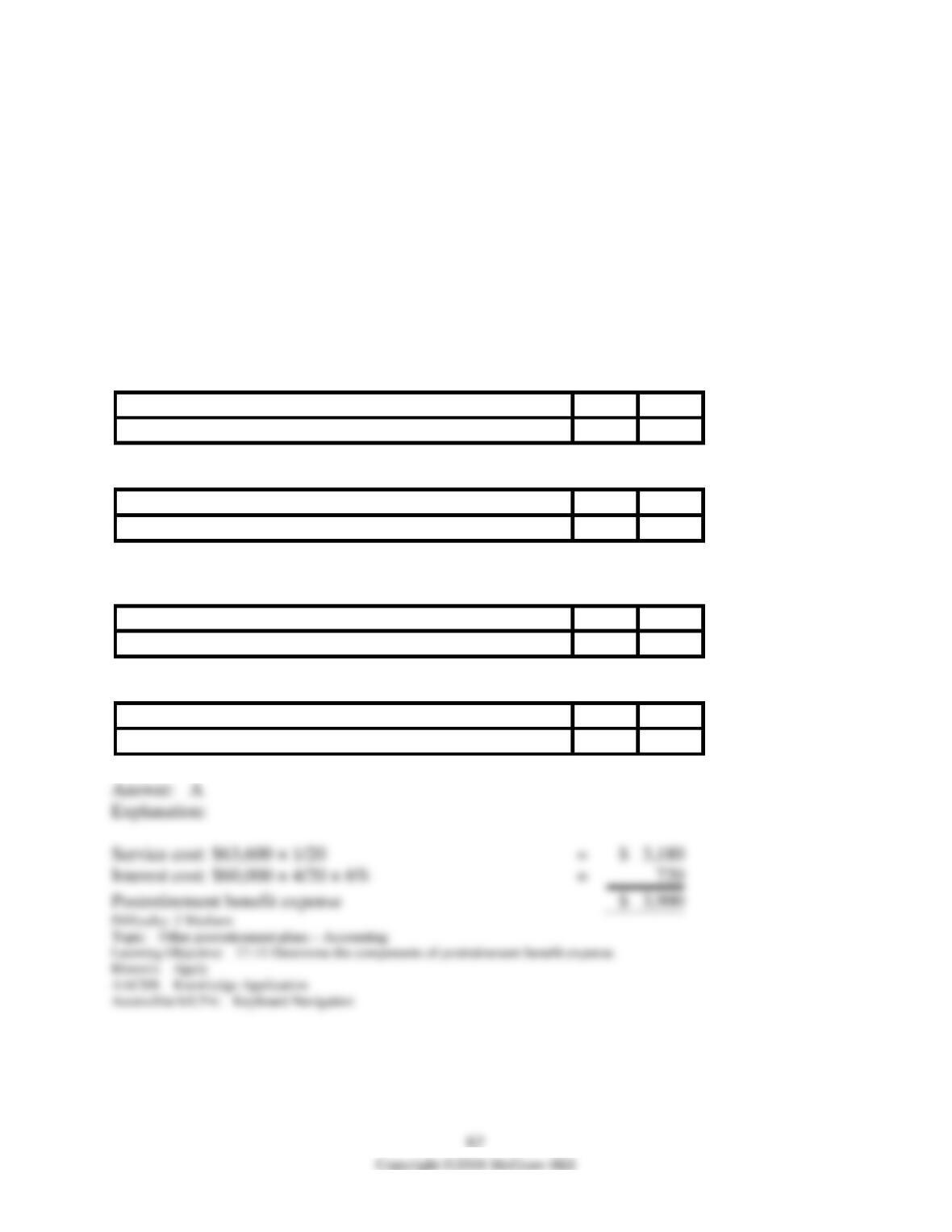
What is the correct entry to record postretirement benefit expense for the current year?
A)
Postretirement benefit expense
3,900
APBO
3,900
B)
Postretirement benefit expense
3,900
Cash
3,900
C)
Postretirement benefit expense
4,000
APBO
4,000
D)
Postretirement benefit expense
7,600
APBO
7,600
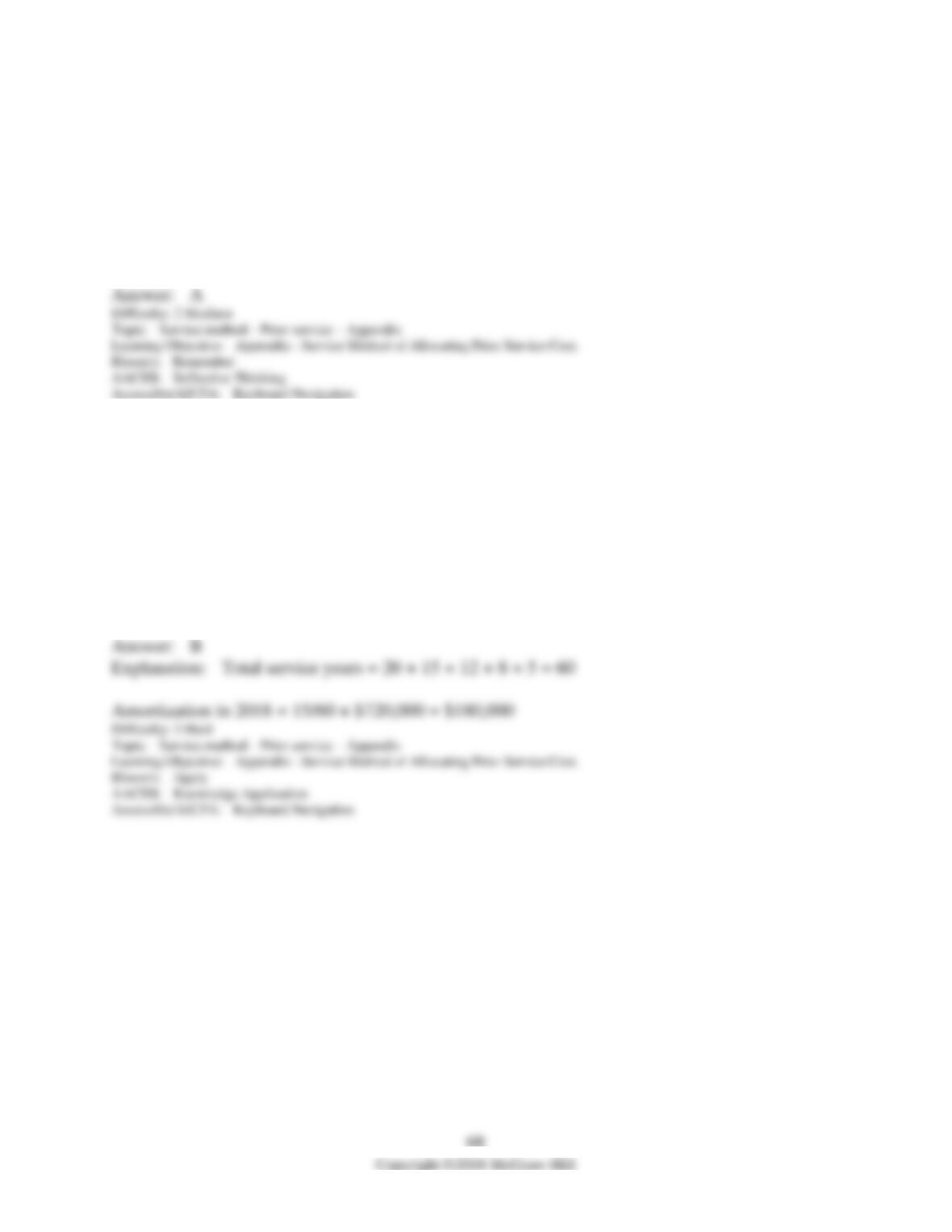
Service cost: $63,600 × 1/20
=
Interest cost: $60,000 × 4/20 × 6%
=
Postretirement benefit expense
126) When the service method is used for amortizing prior service costs, the amount recognized
each year is:
A) In proportion to the fraction of the total remaining service years worked during the year.
B) A constant amount or fixed amount.
C) Prior service cost divided by the average remaining service life of the active employee group.
D) Prior service cost divided by the average estimated retirement age of the currently enrolled
employee group.
127) On January 1, 2017, WOW amended its defined benefit pension plan. The amount of prior
service costs caused by this action was $720,000. WOW uses the service method for amortizing
prior service costs. The following service years were provided by the company actuary: 2017,
20; 2018, 15;2019, 12;2020, 8; and 2021, 5. Twenty employees benefit from this amendment. In
2018, the amortization amount would be:
A) $12,000.
B) $180,000.
C) $144,000.
D) $300,000.
128) Persoff Industries International has a defined benefit pension plan. The company revised its
estimate of future salary levels causing its defined benefit obligation to increase by $16 million.
Also, Persoff’s $25 million actual return on plan assets exceeded the 5% high-grade corporate
bond rate times the $440 million plan assets. Persoff prepares its financial statements in
accordance with International Financial Reporting Standards (IFRS). The company will:
A) Record a $3 million decrease in its plan assets.
B) Record a $16 million gain-OCI.
C) Change an amount in the equity section of the balance sheet to be subsequently amortized to
pension expense.
D) Change an amount in the equity section of the balance sheet that will never be amortized to
pension expense.
129) Under IFRS, components of other comprehensive income:
A) Can be reported as part of a single statement of comprehensive income.
B) Are not permitted to be reported.
C) Must be reported in a separate statement of comprehensive income.
D) Can be reported as part of a statement of shareholders’ equity.
130) Revenue and expense items and components of other comprehensive income can be
reported in a single statement of comprehensive income using:
A) U.S. GAAP.
B) IFRS.
C) Both U.S. GAAP and IFRS.
D) Neither U.S. GAAP nor IFRS.
131) Revenue and expense items and components of other comprehensive income can be
reported in the statement of shareholders’ equity using:
A) U.S. GAAP.
B) IFRS.
C) Both U.S. GAAP and IFRS.
D) Neither U.S. GAAP nor IFRS.
132) Actuarial gains and losses are reported as OCI as they occur using:
A) U.S. GAAP.
B) IFRS.
C) Both U.S. GAAP and IFRS.
D) Neither U.S. GAAP nor IFRS.
133) Prior service cost is included among OCI items in the statement of comprehensive income
and thus subsequently becomes part of AOCI where it is amortized over the average remaining
service period using
A) U.S. GAAP.
B) IFRS.
C) Both U.S. GAAP and IFRS.
D) Neither U.S. GAAP nor IFRS.
134) Prior service cost is expensed immediately using:
A) U.S. GAAP.
B) IFRS.
C) Both U.S. GAAP and IFRS.
D) Neither U.S. GAAP nor IFRS.
135) Generic Company sponsors an unfunded postretirement plan providing healthcare
benefits. The following information relates to the current year’s activity of Generic’s
postretirement benefit plan:
Postretirement benefit expense
$
150
million
Service cost
120
million
Amortization of net gain–AOCI
10
million
Prior service cost–AOCI
none
Retiree benefits paid (end of year)
30
million
The interest cost for the year is:
A) $20 million
B) $40 million
C) $30 million
D) $50 million
136) In a defined benefit pension plan, the journal entry to record pension expense will not
include:
A) a debit to service cost
B) a credit to projected benefit obligation
C) a debit to amortization of prior service cost
D) a debit to plan assets
137) In a defined benefit pension plan, the journal entry to record benefits paid to retired
employees will include:
A) a debit to projected benefit obligation
B) a debit to plan assets
C) a credit to retiree benefits
D) a credit to cash
138) In a defined benefit pension plan, the journal entry to record the employer’s annual cash
contribution to plan assets:
A) reduces the employer’s obligation to pay benefits
B) includes a credit to plan assets
C) might reduce next period’s pension expense
D) includes a debit to cash
139) In a defined benefit pension plan, gains and losses (either from changing assumptions
regarding the PBO or from the return on assets being higher or lower than expected) are:
A) deferred and not immediately included in pension expense and net income
B) included in pension expense and net income
C) included in pension expense but not net income
D) included in net income but not in pension expense
140) Which of the following is not true with regard to pension plans?
A) Pension plans are arrangements designed to provide income to individuals during their
retirement years.
B) A defined contribution pension plan creates a liability for the employer.
C) A pension fund (plan assets) is established by the employer for a defined benefit pension plan.
D) Pension expense is reported for a defined benefit pension plan.
141) A 401k plan:
A) is a type of defined contribution pension plan.
B) is a type of defined benefit pension plan.
C) creates a liability for the employer.
D) creates a liability for the employee.
142) Service cost with regard to pension plans:
A) increases pension expense and reduces the return on plan assets.
B) increases the projected benefit obligation and increases pension expense.
C) increases the projected benefit obligation and reduces plan assets.
D) increases pension expense and reduces plan assets.
143) The balance of the plan assets can change due to:
A) periodic service cost, accrued interest, revised estimates, plan amendments, and the payment
of benefits.
B) investment returns, employer contributions, and the payment of benefits.
C) periodic service cost, accrued interest, revised estimates, employer contributions, and the
payment of benefits.
D) periodic service cost, employer contributions, and the payment of benefits.
144) The projected benefit obligation:
A) contains periodic service cost, accrued interest, revised estimates, plan amendments, and the
payment of benefits.
B) is the pension benefit obligation that is not contingent upon an employee’s continuing service.
C) is the discounted present value of retirement benefits calculated by applying the pension
formula with no attempt to forecast what salaries will be when the formula actually is applied.
D) is the present value of retirement benefits calculated by applying the pension formula in
which the actuary includes projected salaries in the pension formula.
145) Blue Company has a plan whereby it pays for health care insurance for all employees after
they retire. Red Company has a defined benefit pension plan for its employees. With respect to
these plans, which of the following statements is not true?
A) Red Company’s obligation tends to increase in a more steady pattern than that of Blue
Company.
B) Red Company’s accounting for its obligation is similar to that of Blue Company.
C) Red Company’s obligation is less difficult to estimate than that of Blue Company.
D) Red Company is less likely to fund its obligation than is Blue Company.
146) Harvey Hotels has provided a defined benefit pension plan for its employees for several
years. At the end of the most recent year, the following information was available with regard to
the plan: service cost: $6.2 million, expected return on plan assets: $1.2 million, actual return on
plan assets: $1 million, interest cost: $1.4 million, payments to retired employees: $2 million,
and amortization of prior service cost (created when the pension plan was amended causing a
drop in the projected benefit obligation): $1.1 million. What amount should Harvey Hotels report
as pension expense in its income statement for the year?
A) $1.4 million
B) $7.5 million
C) $7.7 million
D) $8.7 million
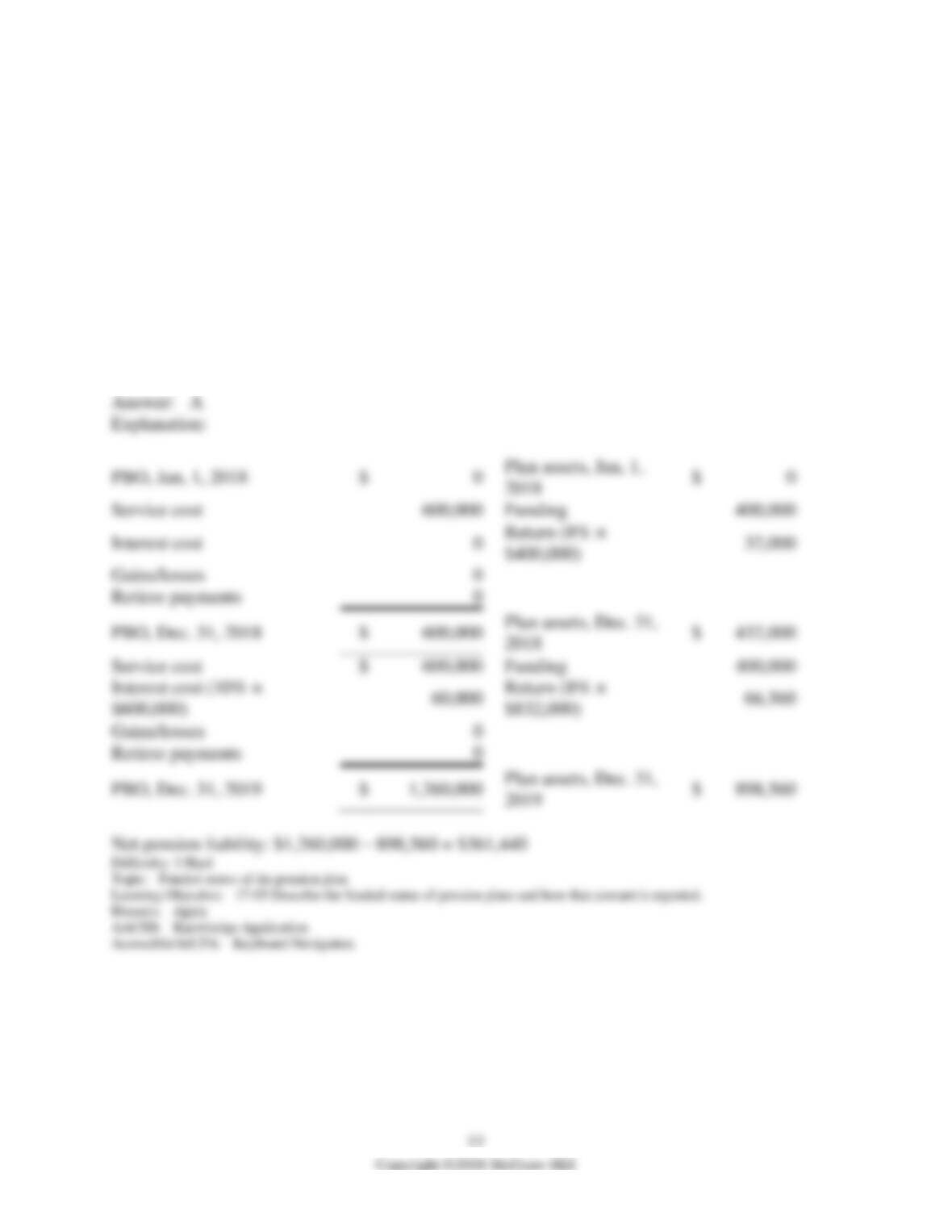
147) On January 1, 2018,Gillock Climbing Academy instituted a defined benefit pension plan for
its employees. The annual service cost for each year of 2018 and 2019 was $600,000. The
interest rate used to determine the projected benefit obligation is 10%. Both the actual and the
expected return on plan assets are 8% for both years. Gillock funded the plan in the amount of
$400,000 each January 1, beginning on January 1, 2018.
What pension liability should Gillock report in its balance sheet for the year ended December 31,
2019?
A) $361,440
B) $393,440
C) $421,440
D) $481,440
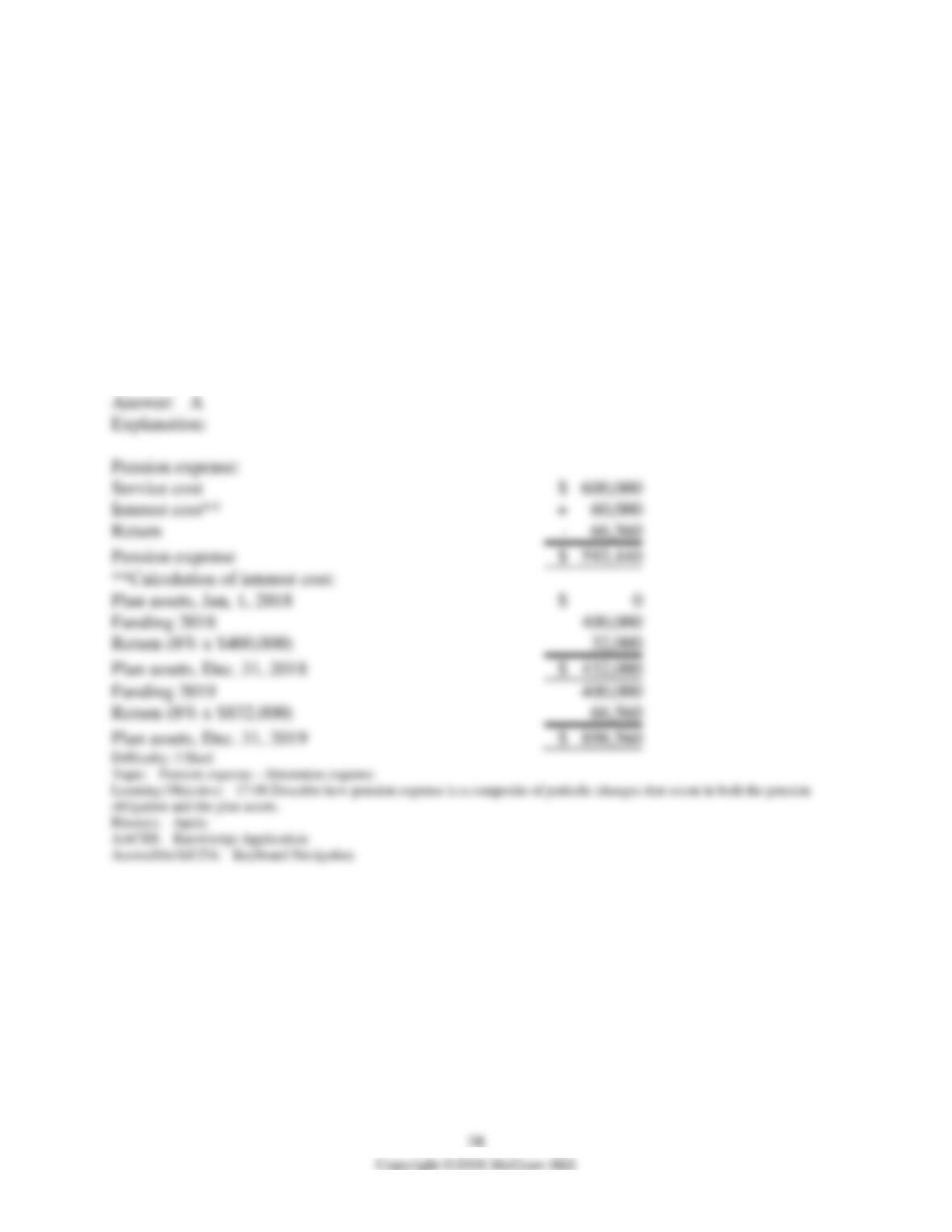
148) On January 1, 2018, Gillock Climbing Academy instituted a defined benefit pension plan
for its employees. The annual service cost for each year of 2018 and 2019 was $600,000. The
interest rate used to determine the projected benefit obligation is 10%. Both the actual and the
expected return on plan assets are 8% for both years. Gillock funded the plan in the amount of
$400,000 each January 1, beginning on January 1, 2018.
What amount of pension expense should Gillock report in its income statement for the year
ended December 31, 2019?
A) $593,440.
B) $600,000.
C) $628,000.
D) $726,560.
149) On January 1, 2018,Gillock Climbing Academy instituted a defined benefit pension plan for
its employees. The annual service cost for each year of 2018 and 2019 was $600,000. The
interest rate used to determine the projected benefit obligation is 10%. Both the actual and the
expected return on plan assets are 8% for both years. Gillock funded the plan in the amount of
$400,000 each January 1, beginning on January 1, 2018.
An employer reports a pension loss when:
A) a change in an assumption causes the projected benefit obligation to be less than expected.
B) the return on plan assets is lower than expected.
C) retiree benefits paid out are more than expected.
D) the accumulated benefit obligation is less than expected.
150) On January 1, 2018,Gillock Climbing Academy instituted a defined benefit pension plan for
its employees. The annual service cost for each year of 2018 and 2019 was $600,000. The
interest rate used to determine the projected benefit obligation is 10%. Both the actual and the
expected return on plan assets are 8% for both years. Gillock funded the plan in the amount of
$400,000 each January 1, beginning on January 1, 2018.
An employer reports the components of pension expense outside the subtotal of income from
operations with the exception of:
A) service cost.
B) interest cost.
C) actual return on plan assets.
D) expected return on plan assets.
151) On January 1, 2018,Gillock Climbing Academy instituted a defined benefit pension plan for
its employees. The annual service cost for each year of 2018 and 2019 was $600,000. The
interest rate used to determine the projected benefit obligation is 10%. Both the actual and the
expected return on plan assets are 8% for both years. Gillock funded the plan in the amount of
$400,000 each January 1, beginning on January 1, 2018.
In the income statement, companies report the service cost component of pension expense:
A) as part of total compensation costs.
B) as part of total service cost that includes past service cost.
C) as part of non-operating income.
D) separate from the other components and outside the subtotal of income from operations.