Test Bank for Intermediate Accounting, Seventeenth Edition
17 – 36
Solution 17-117
BE. 17-118—Investments in debt securities.
Presented below are unrelated cases involving investments in debt securities.
Case I. The fair value of the trading securities at the end of last year was 30% below original
cost, and this was properly reflected in the accounts. At the end of the current year, the fair value
has increased to 20% above cost.
Case II. The fair value of an available–for-sale security has declined to less than forty percent of
the original cost. The decline in value is considered to be other than temporary.
Case III. A debt security, whose fair value is now less than cost, is classified as trading but is
reclassified as available-for–sale.
Instructions
Indicate the accounting required for each case separately.
Investments
17 – 37
EXERCISES
Ex. 17-119—Investment in equity securities.
Agee Corporation acquired a 35% interest in Trent Company on January 1, 2021, for $750,000.
At that time, Trent had 1,000,000 shares of its $1 par common stock issued and outstanding.
During 2021, Trent paid cash dividends of $240,000 and thereafter declared and issued a 5%
common stock dividend when the fair value was $2 per share. Trent‘s net income for 2021 was
$540,000. What is the balance in Agee’s equity investment account at the end of 2021?
Ex. 17-120—Fair value and equity methods. (Essay)
Compare the fair value and equity methods of accounting for investments in stocks subsequent to
acquisition.
Ex. 17-121—Fair value and equity methods.
Fill in the dollar changes caused in the Investment account and Dividend Revenue or Investment
Revenue account by each of the following transactions, assuming Crane Company uses (a) the
fair value method and (b) the equity method for accounting for its investments in Hudson
Company.
(a) Fair Value Method (b) Equity Method
Investment Dividend Investment Investment
Transaction Account Revenue Account Revenue
———————————————————————————————————————————
1. At the beginning of Year 1, Crane bought
30% of Hudson’s common stock at its
book value. Total book value of all
Hudson’s common stock was $800,000
on this date.
———————————————————————————————————————————
Test Bank for Intermediate Accounting, Seventeenth Edition
17 – 38
Ex. 17-121 (cont.)
2. During Year 1, Hudson reported $60,000
of net income and paid $30,000 of
dividends.
———————————————————————————————————————————
3. During Year 2, Hudson reported $30,000
of net income and paid $20,000 of
dividends.
———————————————————————————————————————————
4. During Year 3, Hudson reported a net
loss of $10,000 and paid $4,000 of
dividends.
———————————————————————————————————————————
5. Indicate the Year 3 ending balance in the
Investment account, and cumulative totals
for Years 1, 2, and 3 for dividend revenue
and investment revenue.
———————————————————————————————————————————
Ex. 17-122—Comprehensive income calculation.
The following information is available for Irwin Company for 2018:
Net Income $120,000
Realized gain on sale of available–for-sale debt securities 15,000
Unrealized holding gain arising during the period on
available-for-sale debt securities 34,000
Reclassification adjustment for gains included in net
income 8,000
Investments
17 – 39
Ex. 17-122 (cont.)
Instructions
(1) Determine other comprehensive income for 2021.
(2) Compute comprehensive income for 2021.
*Ex. 17-123—Fair value hedge.
On January 2, 2021, Tylor Company issued a 4-year, $800,000 note at 6% fixed interest, interest
payable semiannually. Tylor now wants to change the note to a variable rate note. As a result, on
January 2, 2021, Tylor Company enters into an interest rate swap where it agrees to receive 6%
fixed and pay LIBOR of 5.6% for the first 6 months on $800,000. At each 6-month period, the
variable interest rate will be reset. The variable rate is reset to 6.6% on June 30, 2021.
Instructions
(a) Compute the net interest expense to be reported for this note and related swap transaction
as of June 30, 2021.
(b) Compute the net interest expense to be reported for this note and related swap transaction
as of December 31, 2021.
Test Bank for Intermediate Accounting, Seventeenth Edition
17 – 40
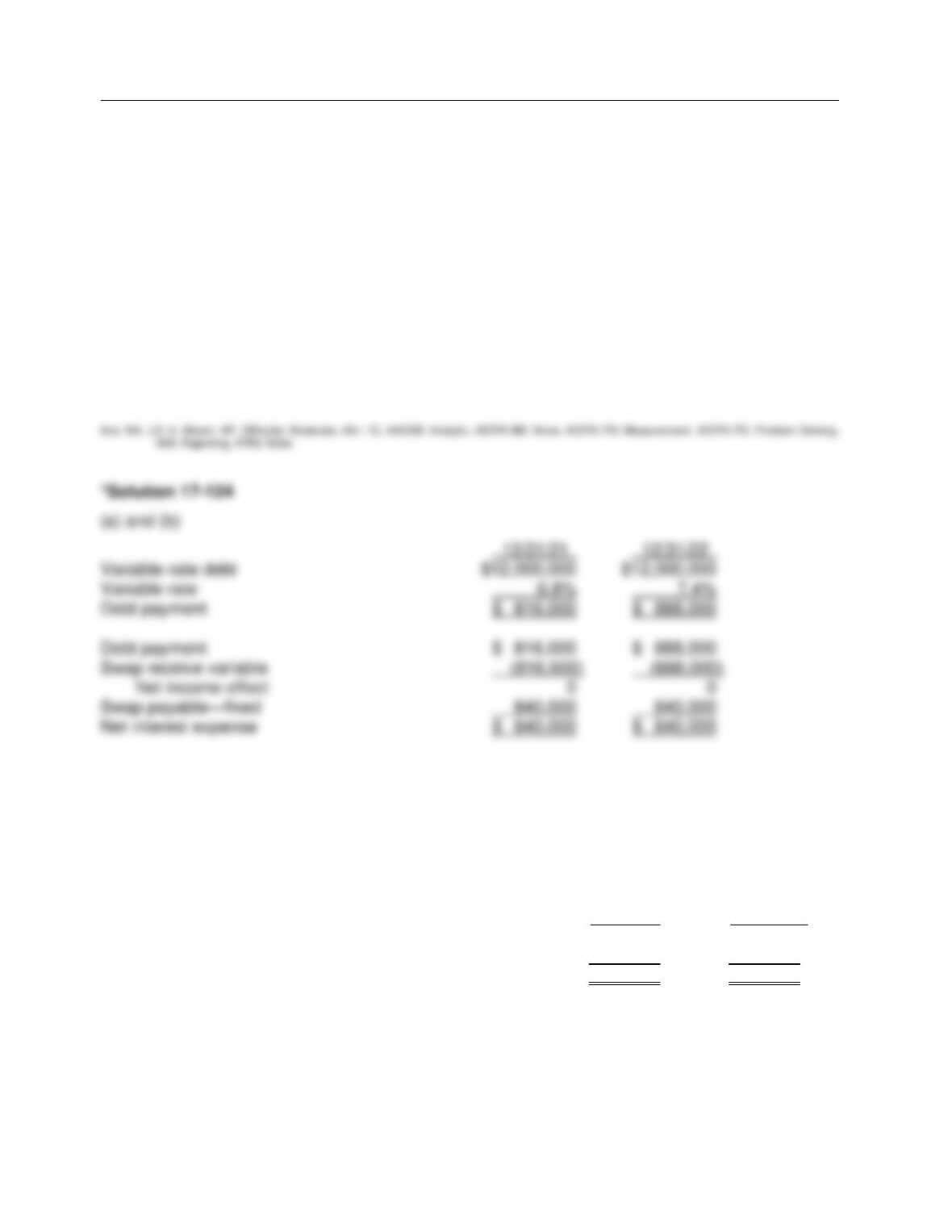
*Ex. 17-124—Cash flow hedge.
On January 2, 2021, Sloan Company issued a 5-year, $12,000,000 note at LIBOR with interest
paid annually. The variable rate is reset at the end of each year. The LIBOR rate for the first year
is 6.8%.
Sloan Company decides it prefers fixed-rate financing and wants to lock in a rate of 7%. As a
result, Sloan enters into an interest rate swap to pay 7% fixed and receive LIBOR based on $12
million. The variable rate is reset to 7.4% on January 2, 2022.
Instructions
(a) Compute the net interest expense to be reported for this note and related swap transactions
as of December 31, 2021.
(b) Compute the net interest expense to be reported for this note and related swap transactions
as of December 31, 2022.
PROBLEMS
Pr. 17-125—Trading equity securities.
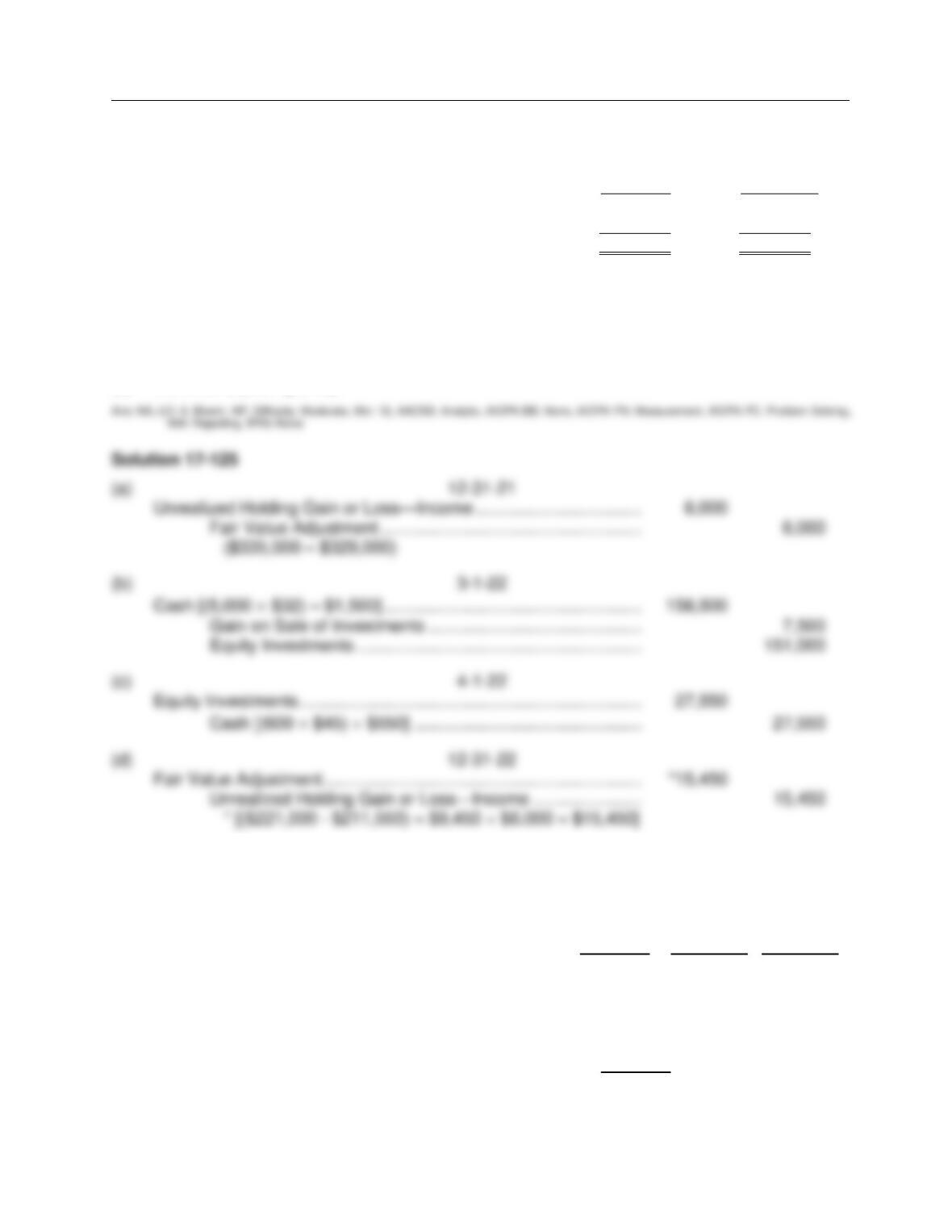
Korman Company has the following securities in its portfolio of equity securities on December 31,
2021:
Cost Fair Value
5,000 shares of Thomas Corp., Common $151,000 $139,000
10,000 shares of Gant, Common 184,000 190,000
$335,000 $329,000
All of the securities had been purchased in 2021. In 2022, Korman completed the following
securities transactions:
March 1 Sold 5,000 shares of Thomas Corp., Common @ $32 less fees of $1,500.
April 1 Bought 600 shares of Werth Stores, Common @ $45 plus fees of $550.
Investments
17 – 41
Pr. 17-125 (cont.)
The Korman Company portfolio of equity securities appeared as follows on December 31, 2022:
Cost Fair Value
10,000 shares of Gant, Common $184,000 $195,500
600 shares of Werth Stores, Common 27,550 25,500
$211,550 $221,000
Instructions
Prepare the general journal entries for Korman Company for:
(a) the 2021 adjusting entry.
(b) the sale of the Thomas Corp. stock.
(c) the purchase of the Werth Stores’ stock.
(d) the 2022 adjusting entry.
Pr. 17-126—Equity investments.
Perez Company began operations in 2020. Since then, it has reported the following gains and
losses for its equity investments in on the income statement:
2020 2021 2022
Gains (losses) from sale of securities $ 15,000 $(20,000) $ 14,000
Unrealized holding losses on valuation of securities (30,000) — (15,000)
Unrealized holding gain on valuation of securities — 10,000 —
At January 1, 2023, Perez owned the following securities:
Cost
BKD Common (15,000 shares @ $30) $450,000
LRF Preferred (2,000 shares @ $105) 210,000
Test Bank for Intermediate Accounting, Seventeenth Edition
17 – 42
Pr. 17-126 (cont.)
During 2023, the following events occurred:
1. Sold 5,000 shares of BKD for $170,000.
2. Acquired 1,000 shares of Horton Common for $40 per share. Brokerage commissions totaled
$1,000.
At 12/31/23, the fair values for Perez‘s investments were:
BKD Common, $28 per share
LRF Preferred, $110 per share
Horton Common, $45 per share
Instructions
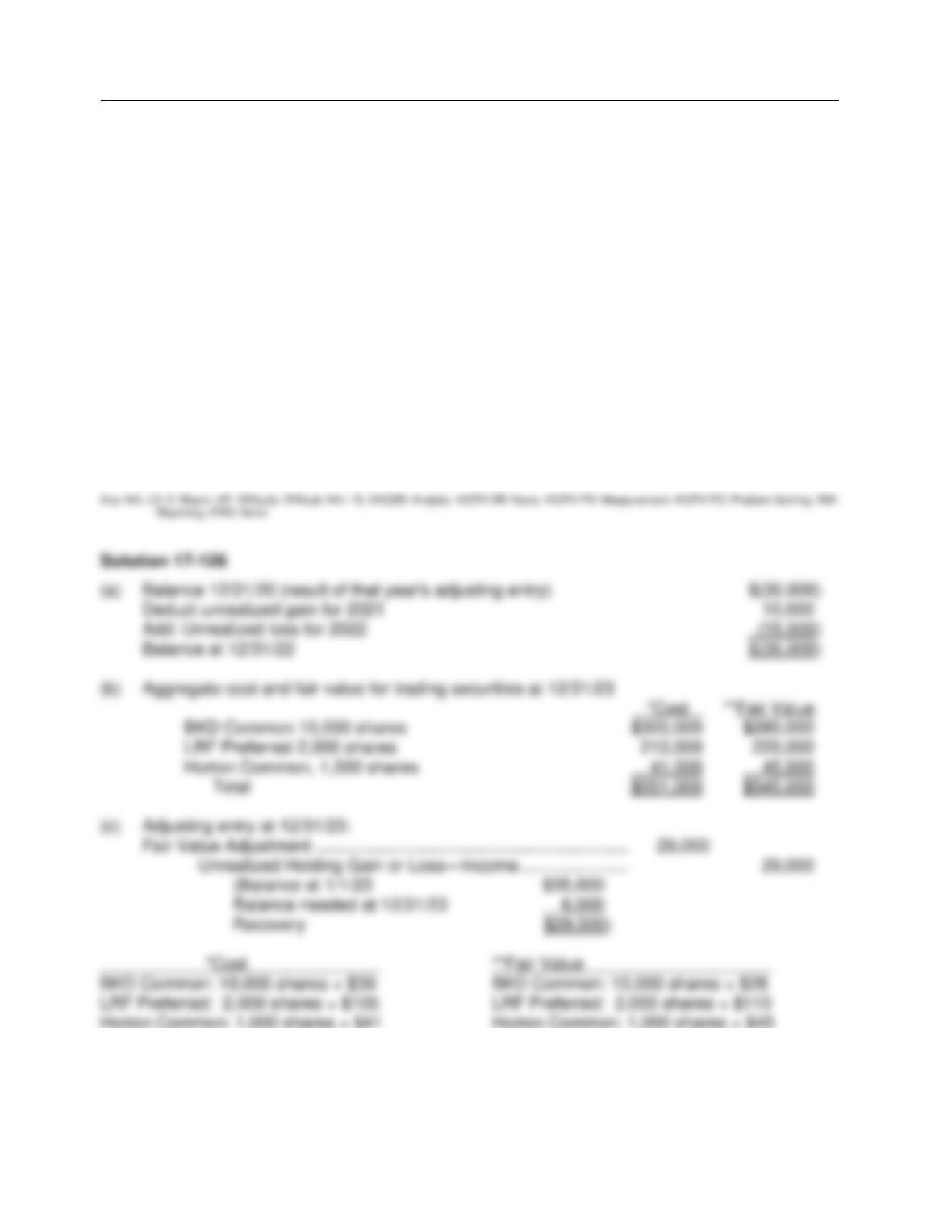
(a) Prepare a schedule which shows the balance in the Fair Value Adjustment account at
December 31, 2022 (after the adjusting entry for 2022 is made).
(b) Prepare a schedule which shows the aggregate cost and fair values for Perez’s securities
portfolio at 12/31/23.
(c) Prepare the necessary adjusting entry based upon your analysis in (b) above.
Investments
17 – 43
Pr. 17-127—Equity securities.
During the course of your examination of the financial statements of Doppler Corporation for the
year ended December 31, 2021, you found a new account, “Investments.” Your examination
revealed that during 2021, Doppler began a program of investments, and all investment-related
transactions were entered in this account. Your analysis of this account for 2021 follows:
Doppler Corporation
Analysis of Investments Account
For the Year Ended December 31, 2021
Date—2021 Debit Credit
(a)
Harmon Company Common Stock
Feb. 14 Purchased 4,000 shares @ $66 per share. $264,000
July 26 Received 400 shares of Harmon Company common stock
as a stock dividend. (Memorandum entry in general ledger.)
Sept. 28 Sold the 400 shares of Harmon Company common stock
received July 26 @ $70 per share. $28,000
(b)
Debit Credit
Taber Inc., Common Stock
Apr. 30 Purchased 20,000 shares @ $40 per share. $800,000
Oct. 28 Received dividend of $1 per share. $20,000
Additional information:
1. The fair value for each security as of the 2021 date of each transaction follow:
Security Feb. 14 Apr. 30 July 26 Sept. 28 Dec. 31
Harmon Company $66 $74 $70 $76
Taber Inc. $40 33
Doppler Corp. 25 28 30 33 35
2. All of the investments of Doppler are nominal in respect to percentage of ownership (5% or
less).
Instructions
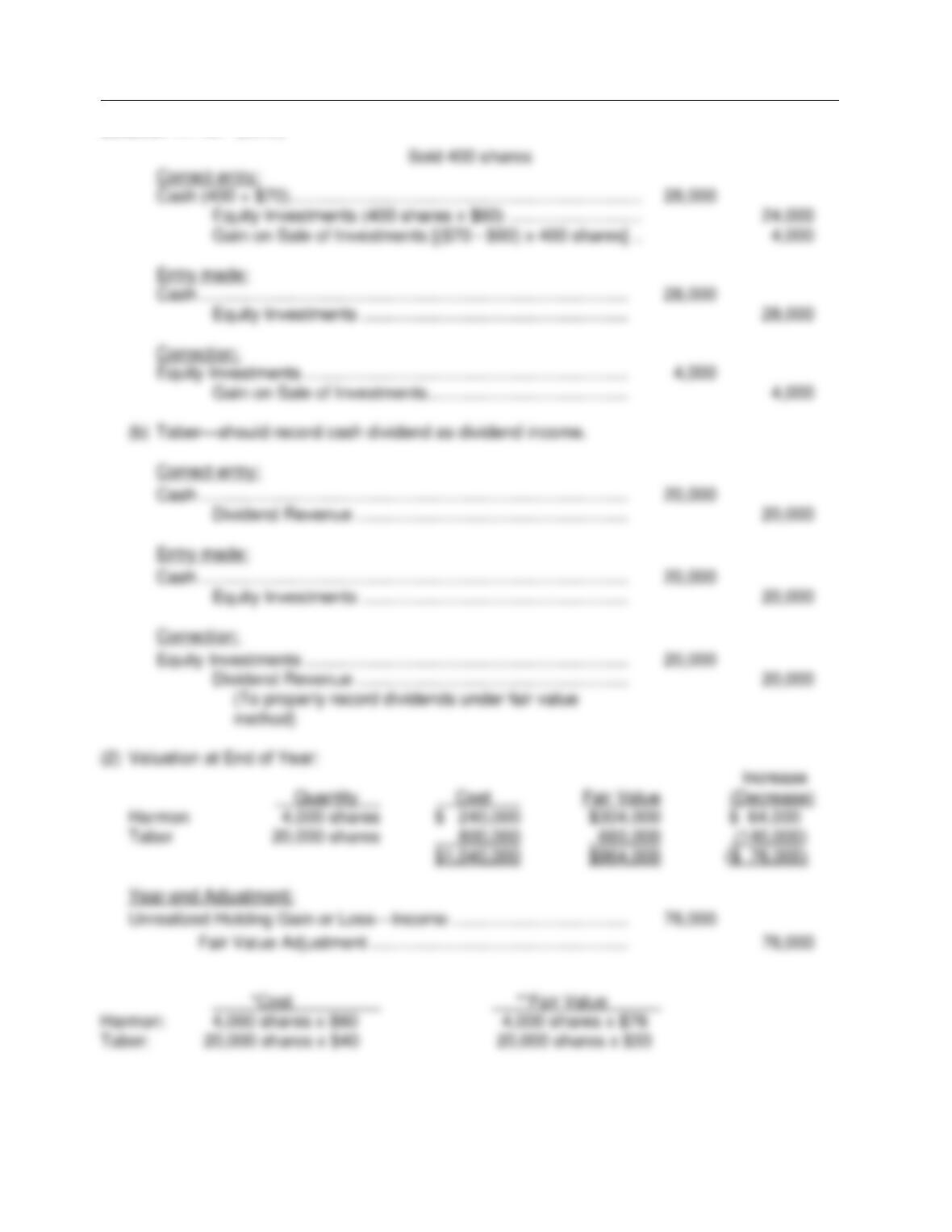
(1) Prepare any necessary correcting journal entries related to investments (a) and (b).
(2) Prepare the entry, if necessary, to record the proper valuation of the equity security portfolio
as of December 31, 2021.
Test Bank for Intermediate Accounting, Seventeenth Edition
17 – 44
Solution 17-127 (cont.)
Investments
17 – 45
*Pr. 17-128—Derivative financial instrument.
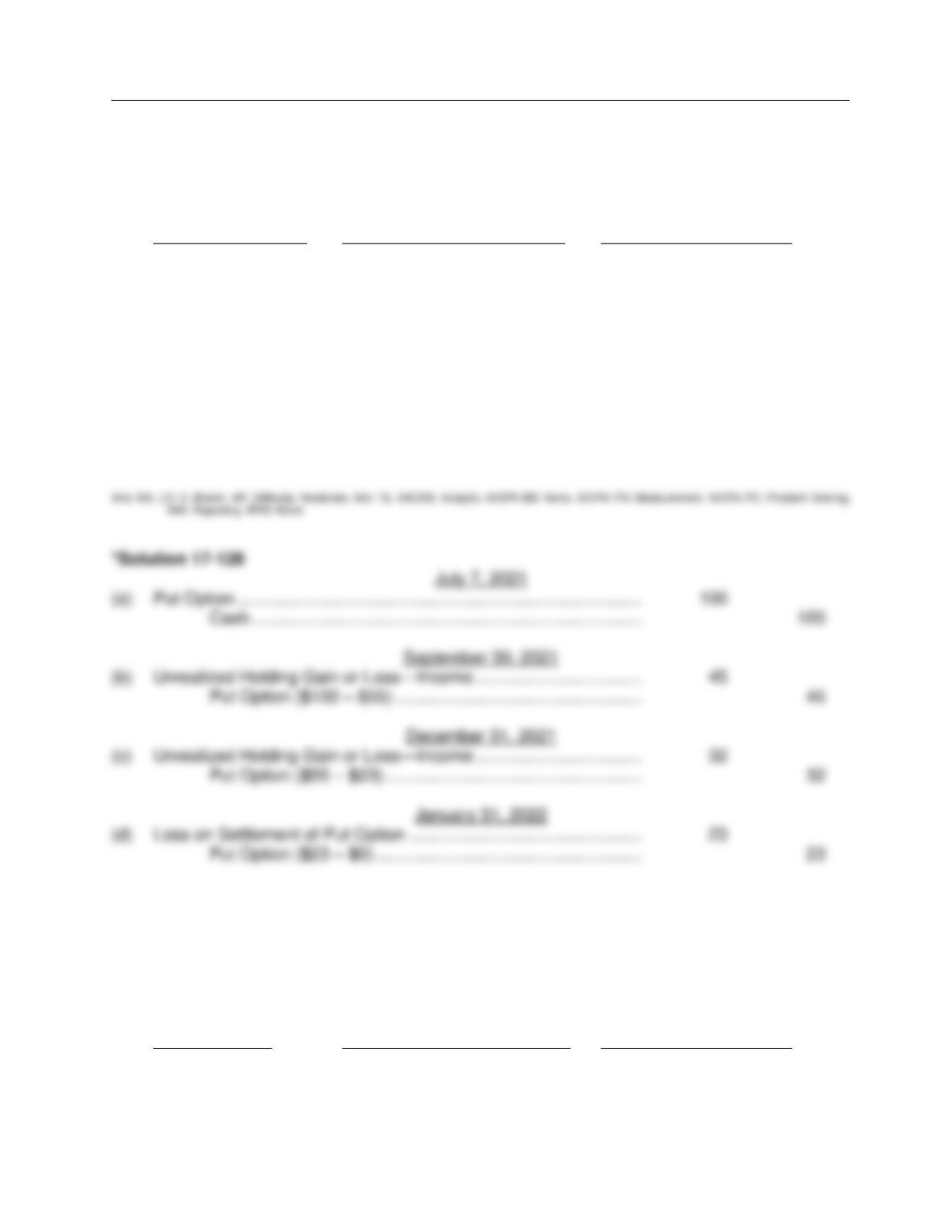
Hummel Company purchased a put option on Olney common shares on July 7, 2021, for $100.
The put option is for 200 shares, and the strike price is $30. The option expires on January 31,
2022. The following data are available with respect to the put option:
Date Market Price of Olney Shares Time Value of Put Option
September 30, 2021 $32 per share $55
December 31, 2021 $31 per share 23
January 31, 2022 $33 per share 0
Instructions
Prepare the journal entries for Hummel Company for the following dates:
(a) July 7, 2021—Investment in put option on Olney shares.
(b) September 30, 2021— Hummel prepares financial statements.
(c) December 31, 2021— Hummel prepares financial statements.
(d) January 31, 2022—Put option expires.
*Pr. 17-129—Derivative financial instrument.
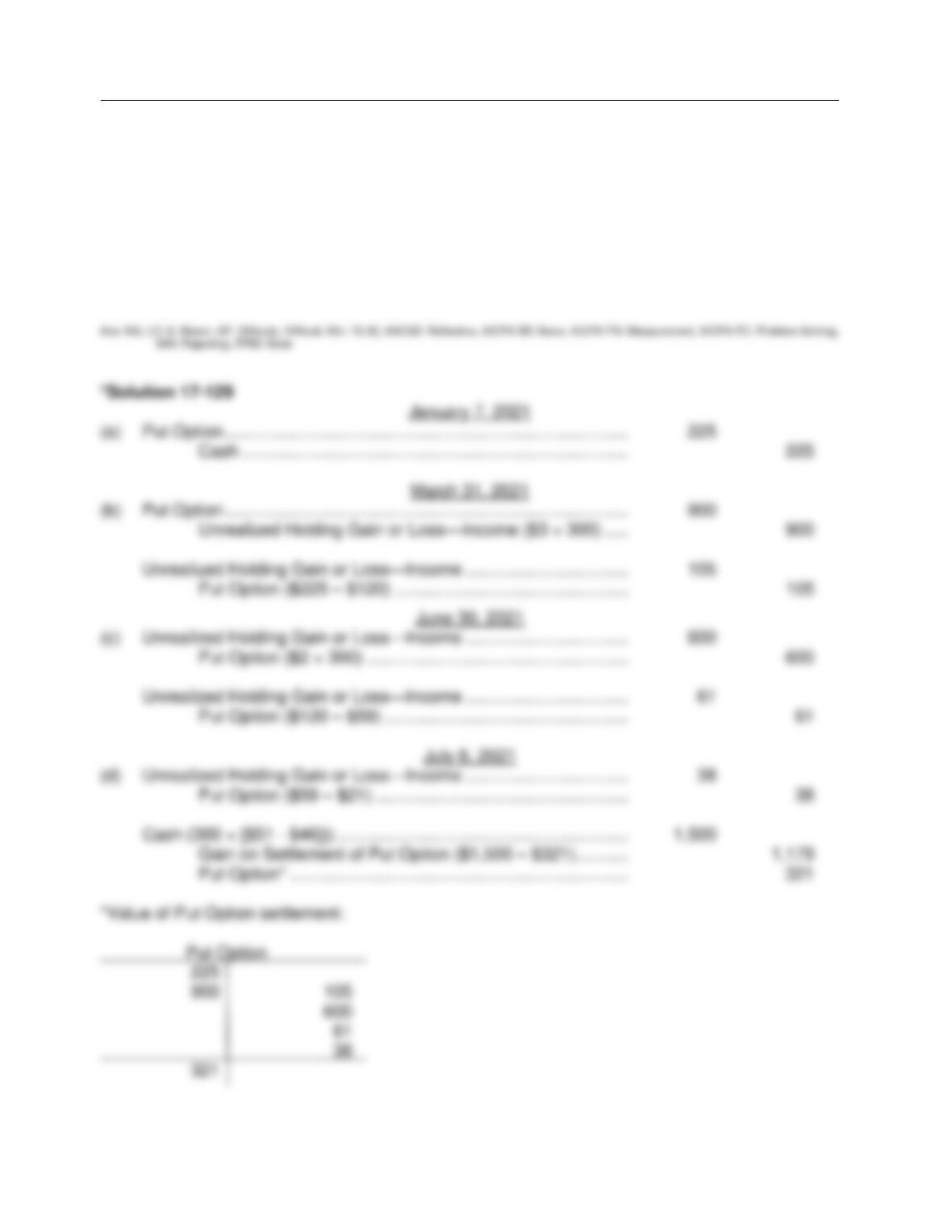
Welch Company purchased a put option on Reese common shares on January 7, 2021, for $225.
The put option is for 300 shares, and the strike price is $51. The option expires on July 6, 2021.
The following data are available with respect to the put option:
Date Market Price of Reese Shares Time Value of Put Option
March 31, 2021 $48 per share $120
June 30, 2021 $50 per share 59
July 6, 2021 $46 per share 21
Test Bank for Intermediate Accounting, Seventeenth Edition
17 – 46
*Pr. 17-129 (cont.)
Instructions
Prepare the journal entries for Welch Company for the following dates:
(a) January 7, 2021—Investment in put option on Reese shares.
(b) March 31, 2021— Welch prepares financial statements.
(c) June 30, 2021— Welch prepares financial statements.
(d) July 6, 2021— Welch settles the put option on the Reese shares.
Investments
17 – 47
IFRS QUESTIONS
True/False
1. IFRS requires that gains and losses on non-trading equity securities be reported as part of
other comprehensive income.
2. Under IFRS, impairment charges related to held-for-collection debt securities may be
reversed.
3. Both GAAP and IFRS classify debt investments as trading, available–for-sale, and held-to–
maturity.
4. IFRS requires that Company A consolidate Company B when it controls and owns more than
50% of Company B.
5. Under IFRS, both the investor and the investee should follow the same accounting practices,
requiring adjustments be made to the investor’s books in order to prepare financial
information.
Answers to True/False
Multiple Choice
6. Match the approach and location where gains and losses from non-trading securities are
reported:
Location where gains/
Approach losses reported
a. GAAP Equity
b. IFRS Equity
c. GAAP Comprehensive income
d. IFRS Comprehensive income
Test Bank for Intermediate Accounting, Seventeenth Edition
17 – 48
Use the following information for questions 7 and 8
Rushia Company has a non-trading investment in the 10%, 10-year bonds of Pear Company. The
investment’s carrying value is $3,200,000 at December 31, 2020. On January 9, 2021, Rushia
learns that Pear Company has lost its primary manufacturing facility in an uninsured fire. As a
result, Rushia determines that the investment is impaired and now has a fair value of $2,300,000.
In June, 2022, Pear Company has succeeded in rebuilding its manufacturing facility, and its
prospects have improved as a result.
7. If Rushia Company determines that the fair value of the investment is now $3,900,000 and
is using GAAP for its external financial reporting, which of the following is true?
a. Rushia is prohibited from recording the recovery in value of the impaired investment.
b. Rushia may record a recovery of $900,000.
c. Rushia may record a recovery of $700,000.
d. Rushia may record a recovery of $1,600,000.
8. If Rushia Company determines that the fair value of the investment is now $2,900,000 and
is using IFRS for its external financial reporting, which of the following is true?
a. Rushia is prohibited from recording the recovery in value of the impaired investment.
b. Rushia may record a recovery of $600,000.
c. Rushia may record a recovery of $900,000.
d. Rushia may record a recovery, but is limited to 80% of the value of the recovery.
Answers to multiple choice
Short Answer:
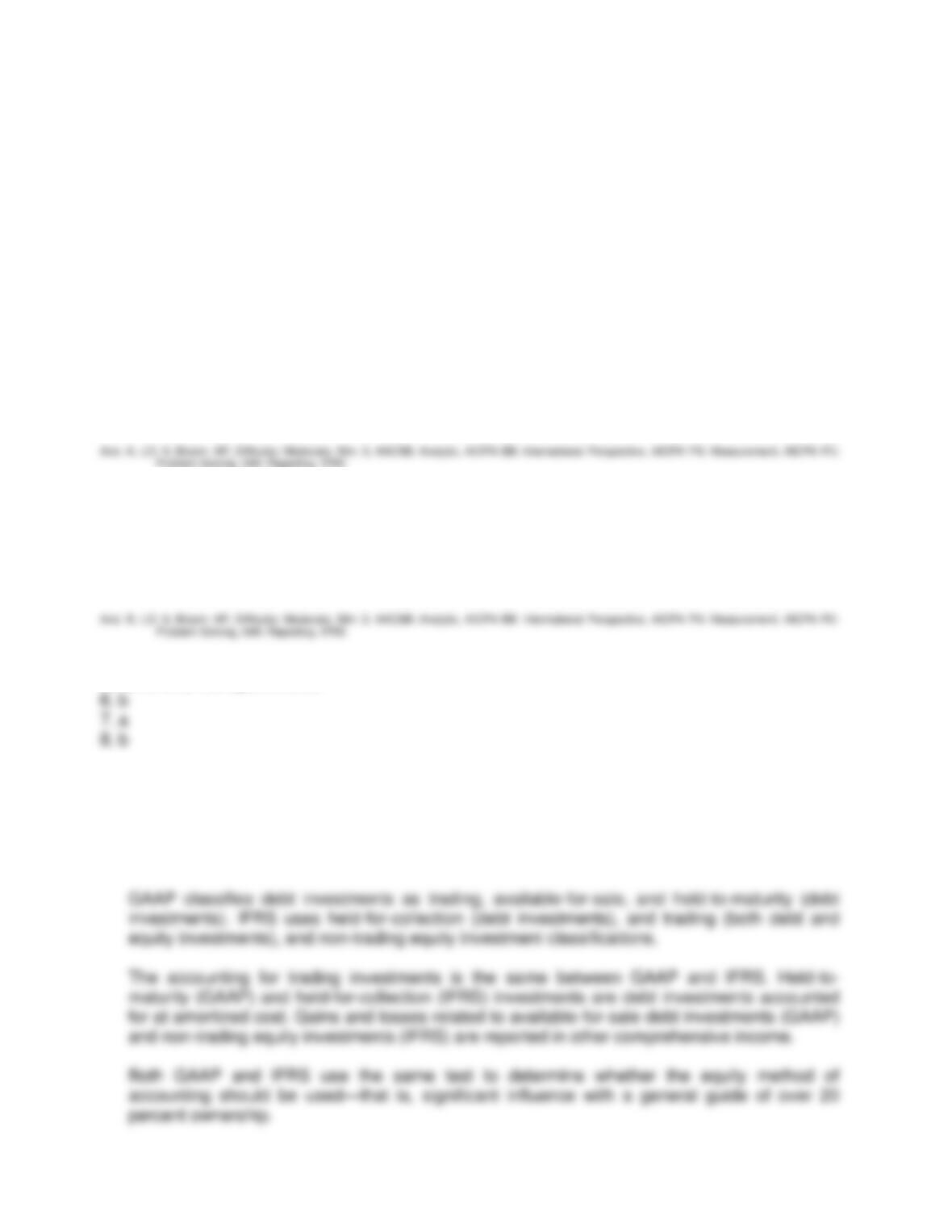
9. Briefly describe some of the similarities and differences between GAAP and IFRS with
respect to the accounting for investments.
Investments
17 – 49
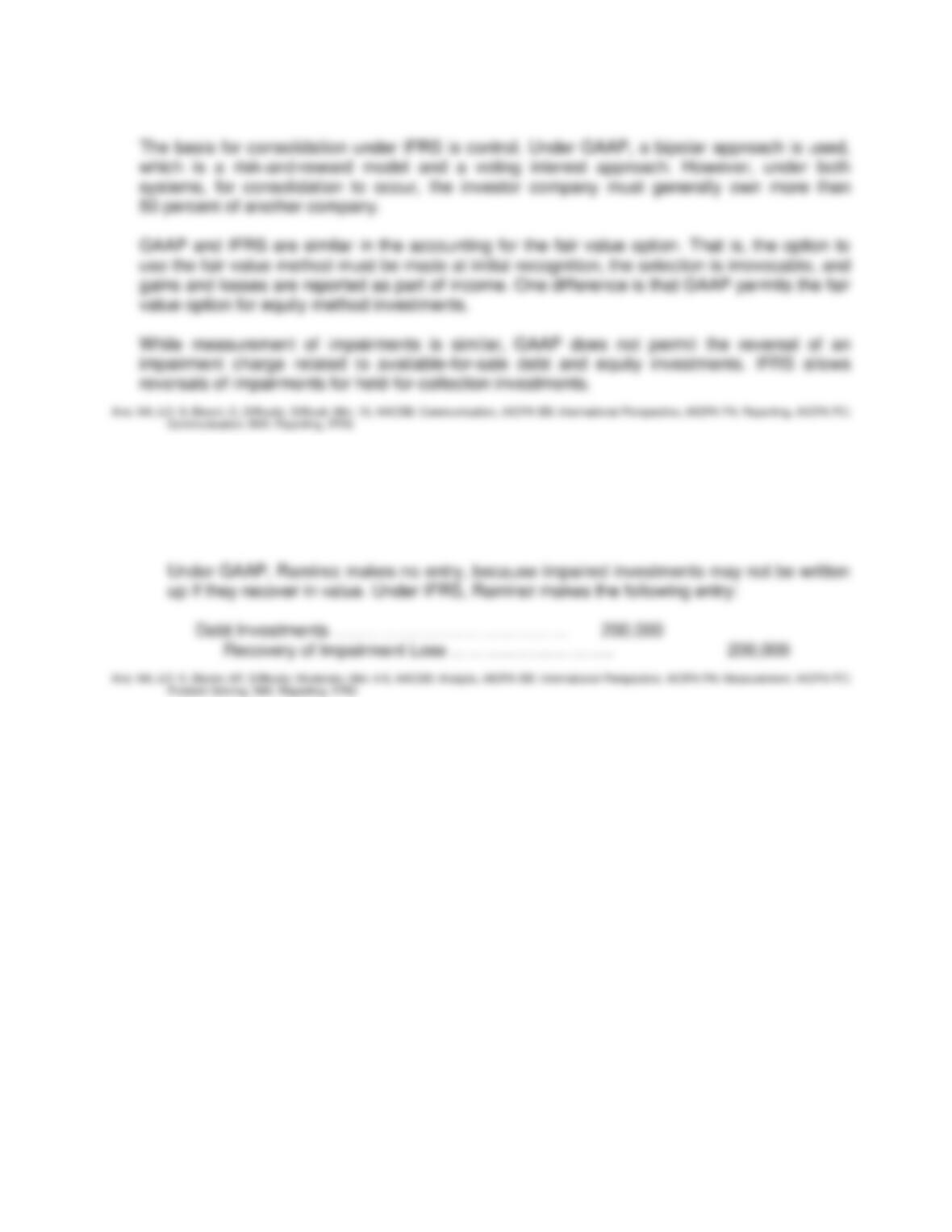
10. Ramirez Company has a held-for-collection investment in the 6%, 20-year bonds of Soto
Company. The investment was originally purchased for $1,200,000 in 2017. Early in 2020,
Ramirez recorded an impairment of $200,000 on the Soto investment, due to Soto’s
financial distress. In 2021, Soto returned to profitability and the Soto investment was no
longer impaired. What entry does Ramirez make in 2021 under (a) GAAP and (b) IFRS?