80) At December 31, 2017, Mongo, Inc., reported in its balance sheet a net loss of $3 million
related to its pension plan. The actuary for Mongo at the end of 2018 increased her estimate of
future salary levels. Mongo’s entry to record the effect of this change will include:
A) A debit to loss-OCI and a credit to PBO.
B) A debit to PBO and a credit to loss-OCI.
C) A debit to pension expense and a credit to PBO.
D) A debit to pension expense and a credit to loss-OCI.
81) JL Health Services reported a net loss-AOCI in last year’s balance sheet. This year, the
company revised its estimate of future salary levels causing its PBO estimate to decline by $24.
Also, the $48 million actual return on plan assets was less than the $54 million expected return.
As a result:
A) The statement of comprehensive income will report a $6 million gain and a $24 million loss.
B) The net pension liability will increase by $18 million.
C) Accumulated other comprehensive income will increase by $18 million.
D) The net pension liability will decrease by $24 million.
82) Amortizing a net loss for pensions will:
A) Increase retained earnings and increase accumulated other comprehensive income.
B) Decrease retained earnings and decrease accumulated other comprehensive income.
C) Increase retained earnings and decrease accumulated other comprehensive income.
D) Decrease retained earnings and increase accumulated other comprehensive income.
83) Amortizing a net gain for pensions and other postretirement benefit plans will:
A) Increase retained earnings and increase accumulated other comprehensive income.
B) Decrease retained earnings and decrease accumulated other comprehensive income.
C) Increase retained earnings and decrease accumulated other comprehensive income.
D) Decrease retained earnings and increase accumulated other comprehensive income.
84) Amortizing prior service cost for pensions and other postretirement benefit plans will:
A) Decrease retained earnings.
B) Increase assets.
C) Decrease assets.
D) Decrease shareholders’ equity.
85) The key elements of a defined benefit pension plan include all of the following except:
A) The pension expense.
B) The plan assets.
C) Amortized future benefits.
D) The employer’s obligation.
86) The net pension liability (PBO minus plan assets) is increased by:
A) Service cost.
B) Expected return on plan assets.
C) Amortization of prior service cost.
D) Cash contributions to plan assets.
87) The net pension liability (PBO minus plan assets) is decreased by:
A) Service cost.
B) Expected return on plan assets.
C) Amortization of net gain-AOCI.
D) Prior service cost.
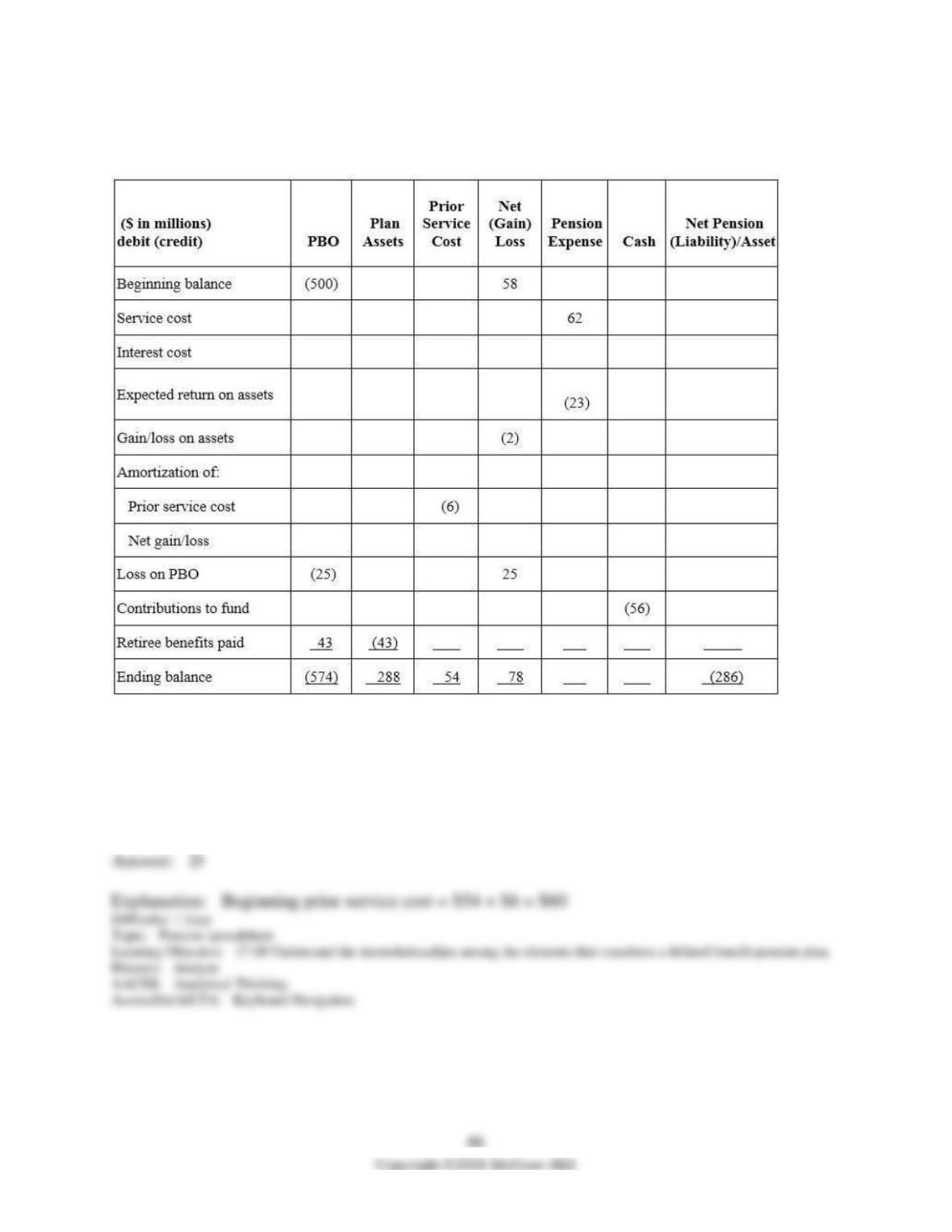
88) The following incomplete (columns have missing amounts) pension spreadsheet is for Old
Tucson Corporation (OTC).
What was the prior service cost at the beginning of the year?
A) $48 millions.
B) $54 millions.
C) $56 millions.
D) $60 millions.
47
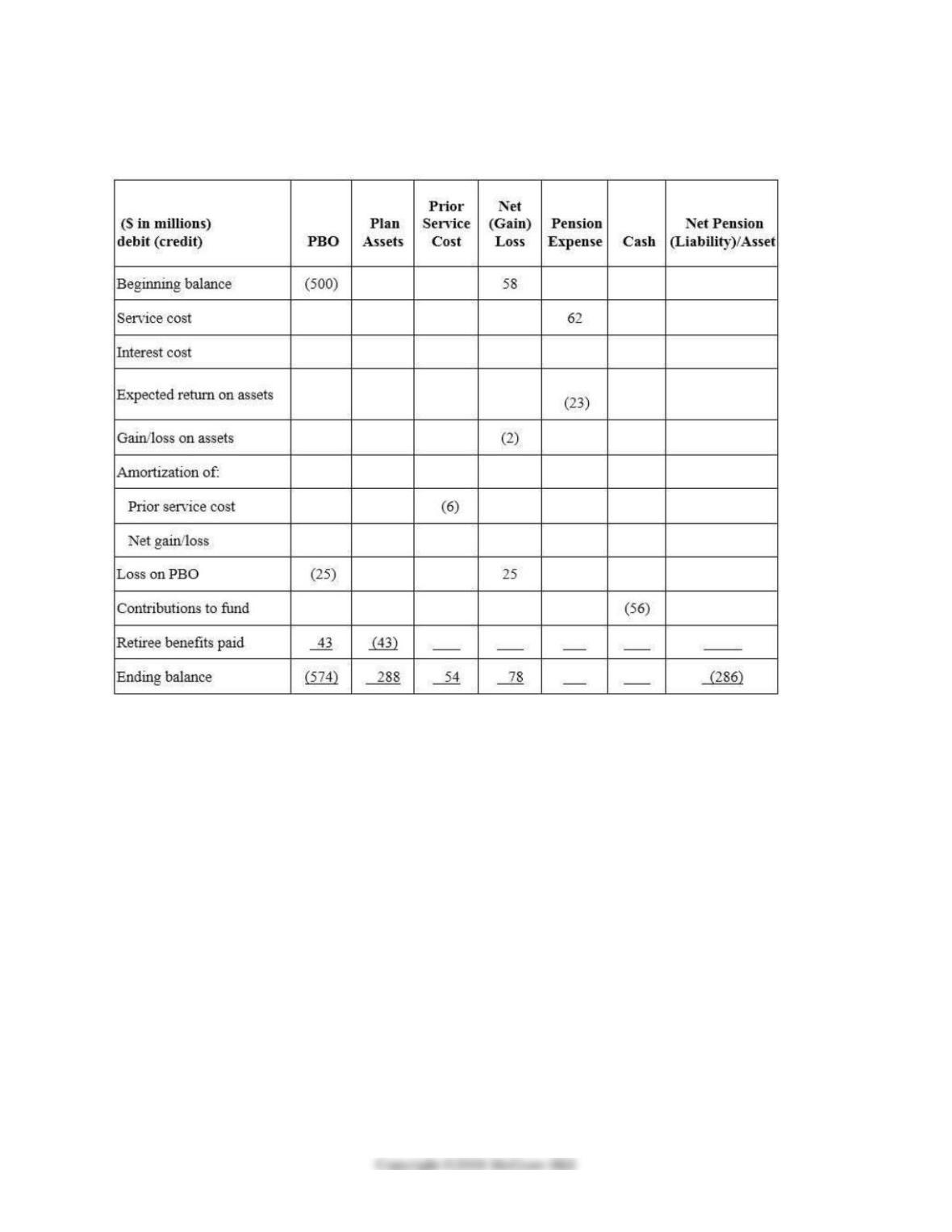
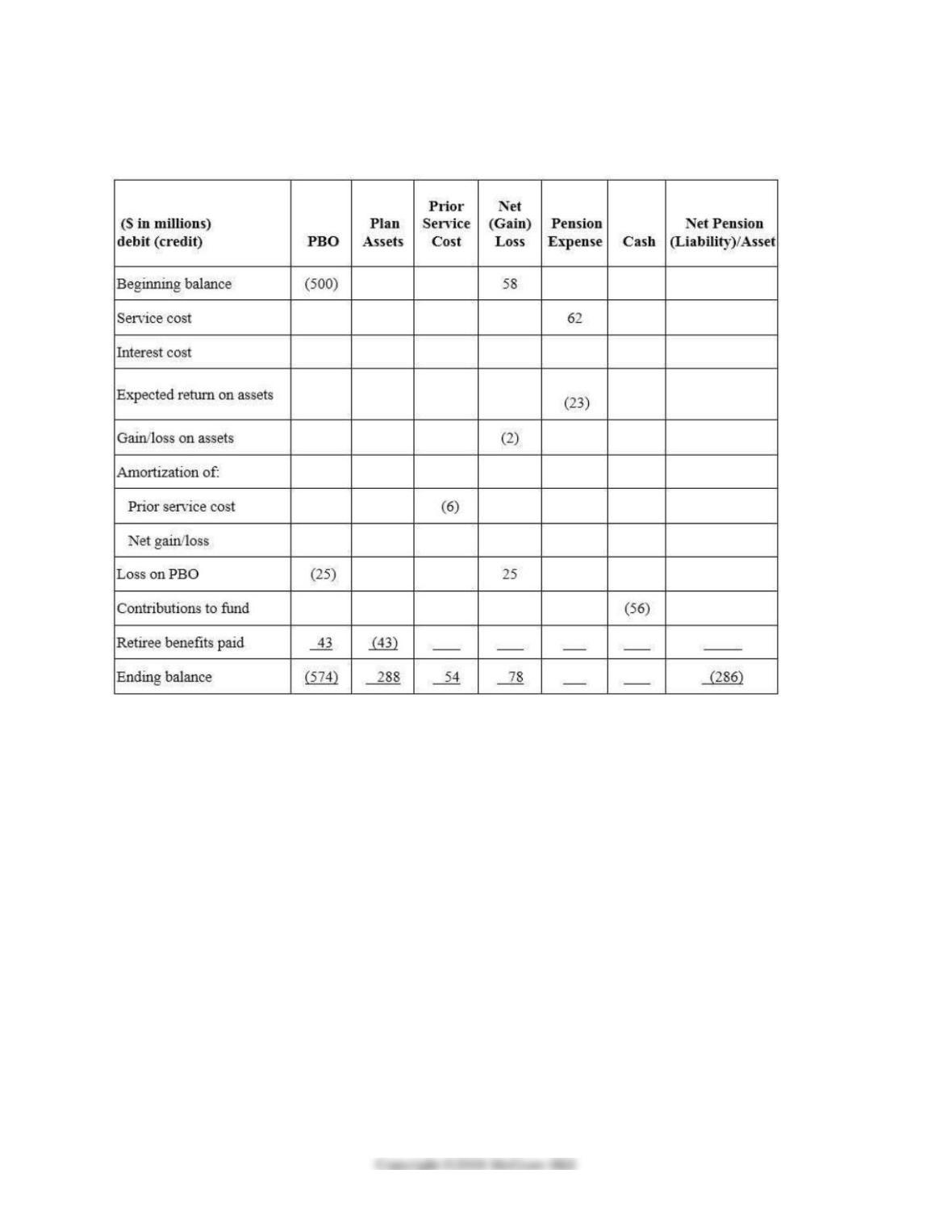
89) The following incomplete (columns have missing amounts) pension spreadsheet is for Old
Tucson Corporation (OTC).
What is OTC’s pension expense for the year?
A) $78 millions.
B) $72 millions.
C) $66 millions.
D) $18 millions.
49
90) The following incomplete (columns have missing amounts) pension spreadsheet is for Old
Tucson Corporation (OTC).
What was the balance of the net pension asset/liability reported in the balance sheet at the end of
the previous year?
A) Net pension asset of $250 millions.
B) Net pension asset of $442 millions.
C) Net pension liability of $250 millions.
D) Net pension liability of $442 millions.
91) Prior to 1993, postretirement benefits other than pensions generally were accounted for on
the:
A) Accrual basis.
B) Cash basis.
C) Modified accrual basis.
D) Hybrid basis.
92) According to generally accepted accounting principles, accounting for postretirement
benefits other than pensions must adhere to the:
A) Accrual basis of accounting.
B) Cash basis of accounting.
C) Modified accrual basis.
D) Modified cash basis.
93) Accounting for postretirement health care benefits is similar, in most respects, to accounting
for:
A) Payroll taxes.
B) Health insurance costs for current employees.
C) Pension benefits.
D) Sick pay and vacation pay.
94) Eligibility for postretirement health care benefits usually is based on the employee‘s:
A) Job title.
B) Number of years in the profession.
C) Number of years in the current position.
D) Age and/or years of service.
95) Eligibility requirements and the nature of benefits for postretirement health care plans
usually are specified in the:
A) Written plan.
B) Informal plan.
C) Substantive plan.
D) Severance plan.
96) Which of the following is not included among the assumptions needed to estimate
postretirement health care benefits?
A) Employee turnover.
B) Expected retirement age of plan participants.
C) Life expectancy of plan participants.
D) Return on plan assets.
97) Which one of the following assumptions is needed to estimate both postretirement health
care benefits and pension benefits?
A) Per capita claims cost.
B) Expected cost trend rate.
C) Benefits provided by other governmental or private plans.
D) Employee turnover.
98) The estimated medical costs are expected to be $7,500 during an employee’s retirement. The
retiree is expected to pay 30% of the cost and Medicare is expected to pay 50% of the cost. What
is the company’s estimated net cost of benefits?
A) $5,250.
B) $7,500.
C) $1,500.
D) $3,750.
99) With pensions, service cost reflects additional benefits employees earn from an additional
year’s service. The service cost for retiree health care plans is:
A) An allocation to the current year of a portion of an estimated fixed total cost.
B) An allocation to the current year of a portion of an existing liability.
C) An amount earned by a defined benefit formula.
D) The amount paid to retired employees.
100) Pension benefits and postretirement health benefits typically are similar in their:
A) Application of present value concepts.
B) Vesting policies.
C) Coverage for eligible dependents.
D) Relationship between cost of coverage and length of service.
101) A company’s total obligation for postretirement benefits is measured by the:
A) APBO.
B) HMOP.
C) HOBO.
D) EPBO.
102) The process of assigning the cost of postretirement benefits to the years during which those
benefits are assumed to be earned by employees is called:
A) Restitution.
B) Retribution.
C) Attribution.
D) Assignation.
103) The attribution period for postretirement benefits spans each year of service from the
employee’s date of hire to the employee’s date of:
A) Full eligibility.
B) Death.
C) Retirement.
D) Termination.
104) The attribution period for postretirement health care plans does not include:
A) The first five years of service.
B) The year of hire.
C) The employee probation period.
D) The years of service beyond the full eligibility date.
105) If no estimates are changed and there is no net loss or gain or prior service cost, which of
the following amounts related to an unfunded postretirement benefit plan will not increase with
each additional year of service before the full eligibility date?
A) Other comprehensive income.
B) Postretirement benefit expense.
C) APBO.
D) EPBO.
106) The postretirement benefit obligation is the:
A) Future value of the estimated benefits during retirement.
B) Present value of the estimated benefits during retirement.
C) Fair value of the estimated benefits during retirement.
D) Actual value of estimated benefits during retirement.
107) The APBO increases each year by the:
A) Interest accrued on the APBO and the portion of the EPBO attributed to that year.
B) Interest accrued on the EPBO and the portion of the EPBO attributed to that year.
C) Interest accrued on the APBO and the portion of the APBO attributed to that year.
D) Interest accrued on the EPBO and the portion of the APBO attributed to that year.
108) The attribution approach required by GAAP for postretirement health care plans is to
assign:
A) An equal fraction of the EPBO to each year the employee is on the company payroll.
B) An equal fraction of the APBO to each year the employee is on the company payroll.
C) An equal fraction of the APBO to each year of service from the employee’s hire date to the
employee’s full eligibility date.
D) An equal fraction of the EPBO to each year of service from the employee’s hire date to the
employee’s full eligibility date.
109) The amount of cash paid annually for unfunded postretirement health benefit plans,
assuming they are not independently insured, usually is equal to:
A) The amount required by the actuarial formula.
B) The present value of future benefits.
C) The amount necessary to cover future benefits.
D) The amount necessary to pay the current year’s health care cost.
110) A company’s postretirement health care benefit plan had an APBO of $265,000 on January
1, 2018. During 2018, retiree benefits paid were $40,000. The discount rate for the plan for this
year was 10%. Service cost for 2018 was $80,000. Plan assets (fair value) increased during the
year by $45,000. The amount of the APBO at December 31, 2018, was:
A) $225,000.
B) $305,000.
C) $331,500.
D) $371,500.
111) Oregon Co.’s employees are eligible for retirement with benefits at the end of the year in
which both age 60 is attained and they have completed 35 years of service. The benefits provide
15 years reimbursement for health care services of $20,000 annually, beginning one year from
the date of retirement.
Ralph Young was hired at the beginning of 1977 by Oregon after turning age 22 and is expected
to retire at the end of 2020 (age 60). The discount rate is 4%. The plan is unfunded.
The PV of an ordinary annuity of $1 where n = 15 and i = 4% is 11.11839.
The PV of $1 where n = 2 and i = 4% is 0.92456.
What is the present value of Ralph’s net benefits as of his expected retirement date, rounded to
the nearest dollar?
A) $166,580.
B) $222,368.
C) $300,000.
D) None of these answer choices is correct.
112) Oregon Co.’s employees are eligible for retirement with benefits at the end of the year in
which both age 60 is attained and they have completed 35 years of service. The benefits provide
15 years reimbursement for health care services of $20,000 annually, beginning one year from
the date of retirement.
Ralph Young was hired at the beginning of 1977 by Oregon after turning age 22 and is expected
to retire at the end of 2020 (age 60). The discount rate is 4%. The plan is unfunded.
The PV of an ordinary annuity of $1 where n = 15 and i = 4% is 11.11839.
The PV of $1 where n = 2 and i = 4% is 0.92456.
With respect to Ralph, what is Oregon’s expected postretirement benefit obligation (EPBO) at
the end of 2018, rounded to the nearest dollar?
A) $137,045.
B) $205,593.
C) $246,810.
D) $768,000.
113) Oregon Co.’s employees are eligible for retirement with benefits at the end of the year in
which both age 60 is attained and they have completed 35 years of service. The benefits provide
15 years reimbursement for health care services of $20,000 annually, beginning one year from
the date of retirement.
Ralph Young was hired at the beginning of 1977 by Oregon after turning age 22 and is expected
to retire at the end of 2020 (age 60). The discount rate is 4%. The plan is unfunded.
The PV of an ordinary annuity of $1 where n = 15 and i = 4% is 11.11839.
The PV of $1 where n = 2 and i = 4% is 0.92456.
With respect to Ralph, what is Oregon’s accumulated postretirement benefit obligation (APBO)
at the end of 2018, rounded to the nearest dollar?
A) $130,544.
B) $205,593.
C) $195,050.
D) None of these answer choices are correct