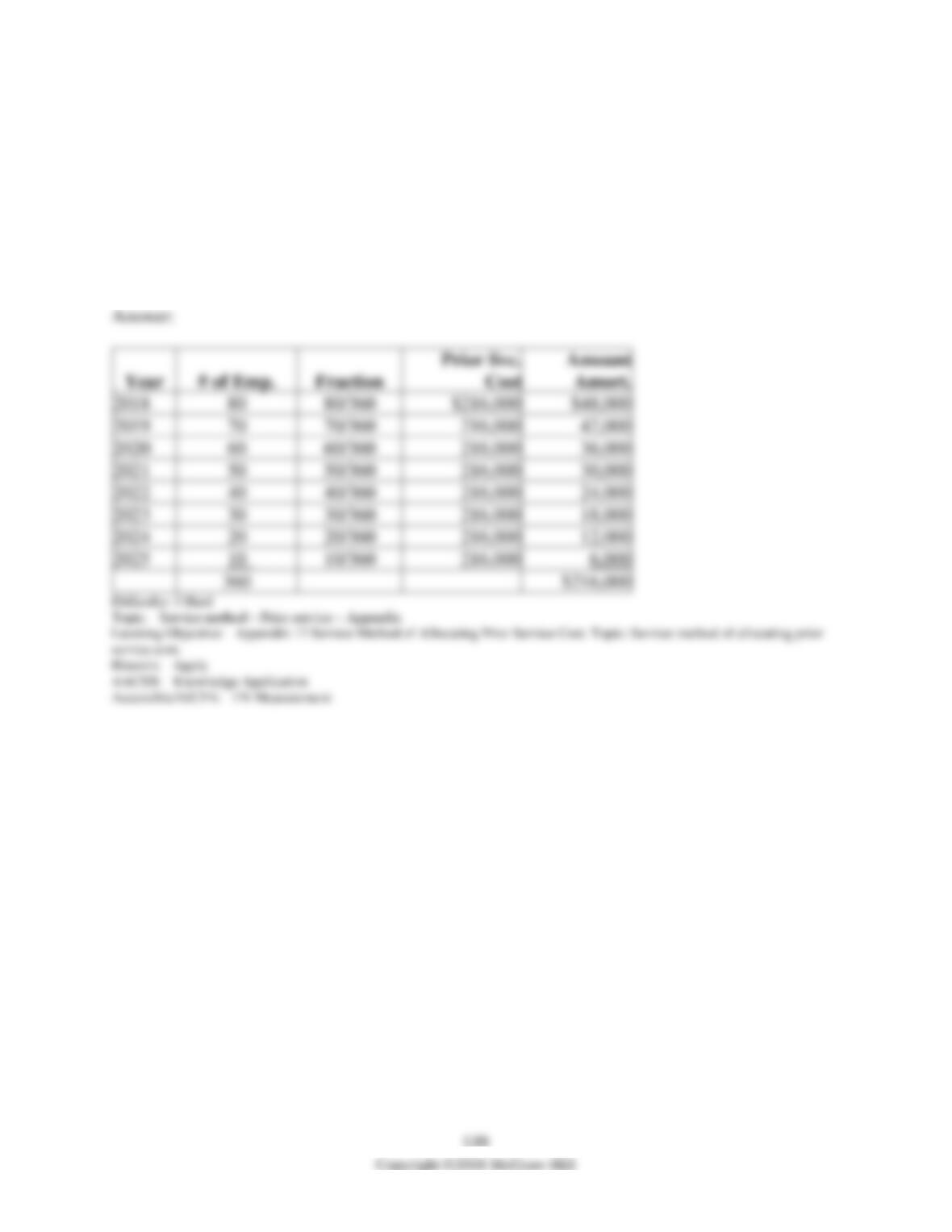
229) Rodeo Corporation amended its defined benefit pension plan on January 31, 2018, to
increase retirement benefits earned with each service year. The actuary estimated the prior
service cost to be $216,000. Rodeo’s 80 present employees are expected to retire at the rate of
about 10 each year at the end of each of the next eight years beginning on December 31, 2018.
Required:
Using the service method, calculate the amount of prior service cost to be amortized to pension
expense in each of the next eight years.

140
230) Dharma Initiative, Inc, has a defined benefit pension plan. Characteristics of the plan during
2018 are as follows:
($ in 000s)
PBO balance, January 1
$960
Plan assets balance, January 1
600
Service cost
150
Interest cost
90
Gain from change in actuarial assumption
44
Benefits paid
(72)
Actual return on plan assets
40
Contributions 2018
120
The expected long-term rate of return on plan assets was 8%. There were no AOCI balances
related to pensions on January 1, 2018, but at the end of 2018, the company amended the pension
formula creating a prior service cost of $24 million.
Required:
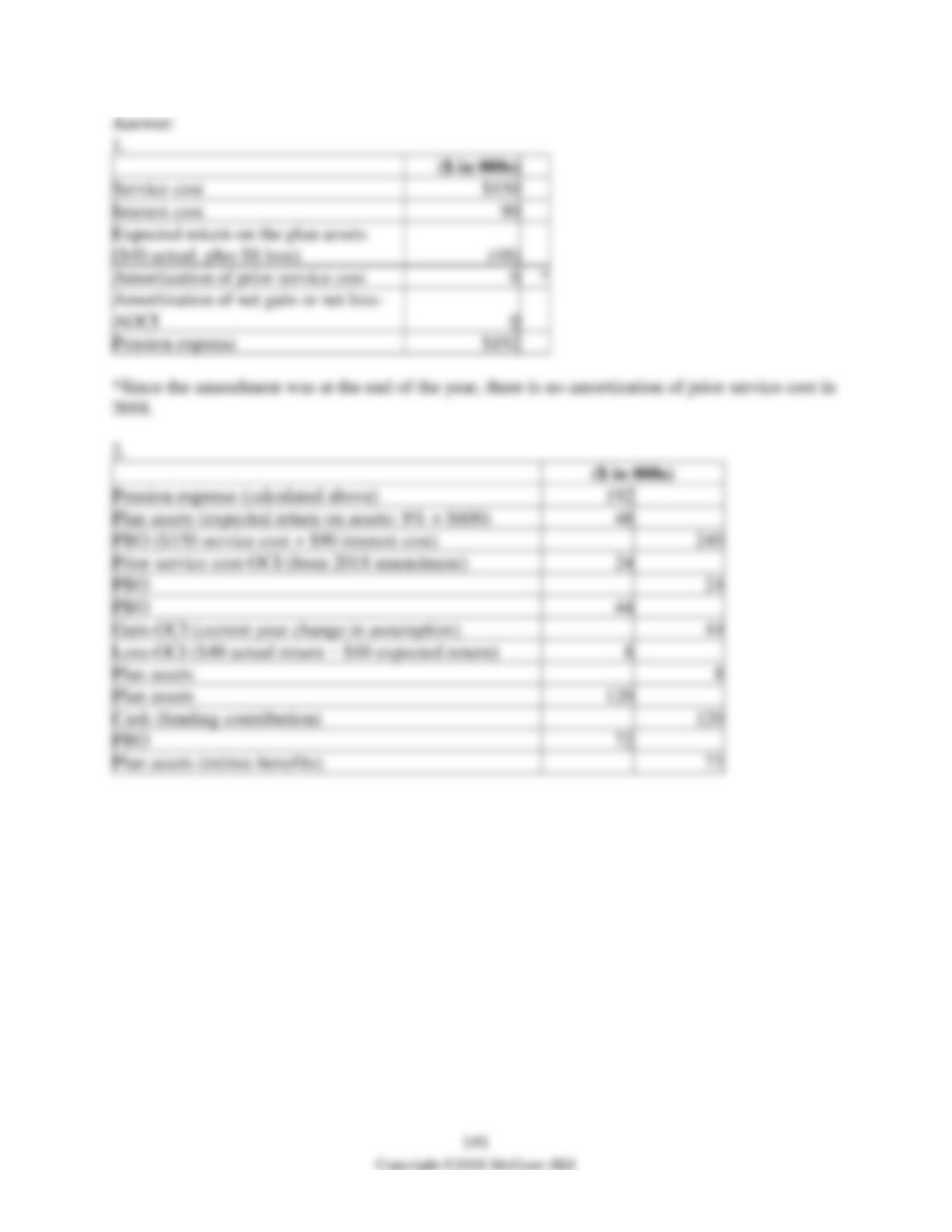
1. Calculate the pension expense for 2018.
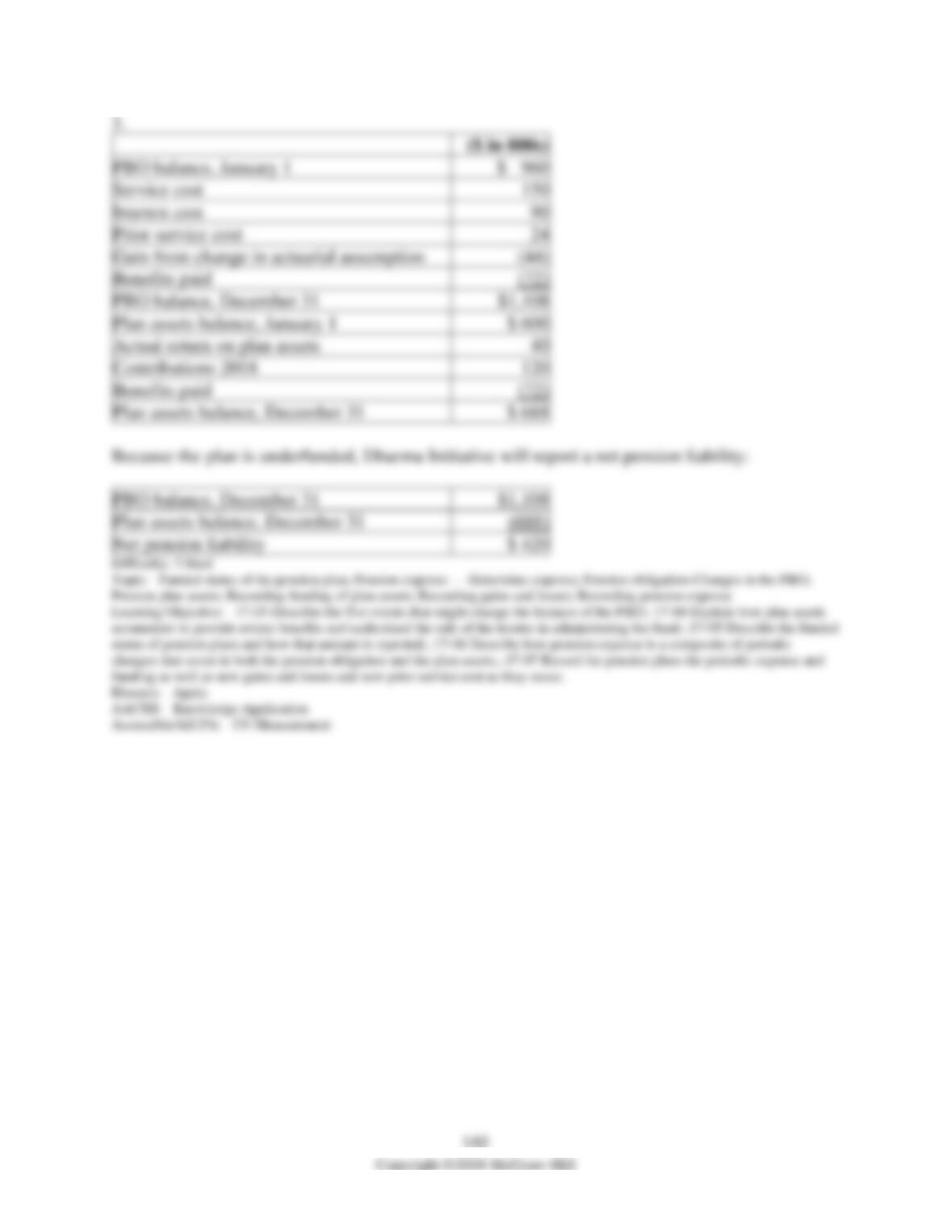
2. Prepare the journal entry to record pension expense, gains or losses, past service cost, funding,
and payment of benefits for 2018.
3. What amount will Dharma Initiative report in its 2018 balance sheet as a net pension asset or
net pension liability?

143
231) Dharma Initiative, Inc., has a defined benefit pension plan. Characteristics of the plan
during 2018 are as follows:
($ in 000s)
DBO balance, January 1
$960
Plan assets balance, January 1
600
Service cost
150
Interest cost (10%)
96
Gain from change in actuarial assumption
44
Benefits paid
(72)
Actual return on plan assets
40
Contributions 2018
120
The expected long-term rate of return on plan assets was 8%. There were no AOCI balances
related to pensions on January 1, 2018, but at the end of 2018, the company amended the pension
formula creating a prior service cost of $24 million. Dharma Initiative prepares its financial
statements according to International Financial Reporting Standards (IFRS).
Required:
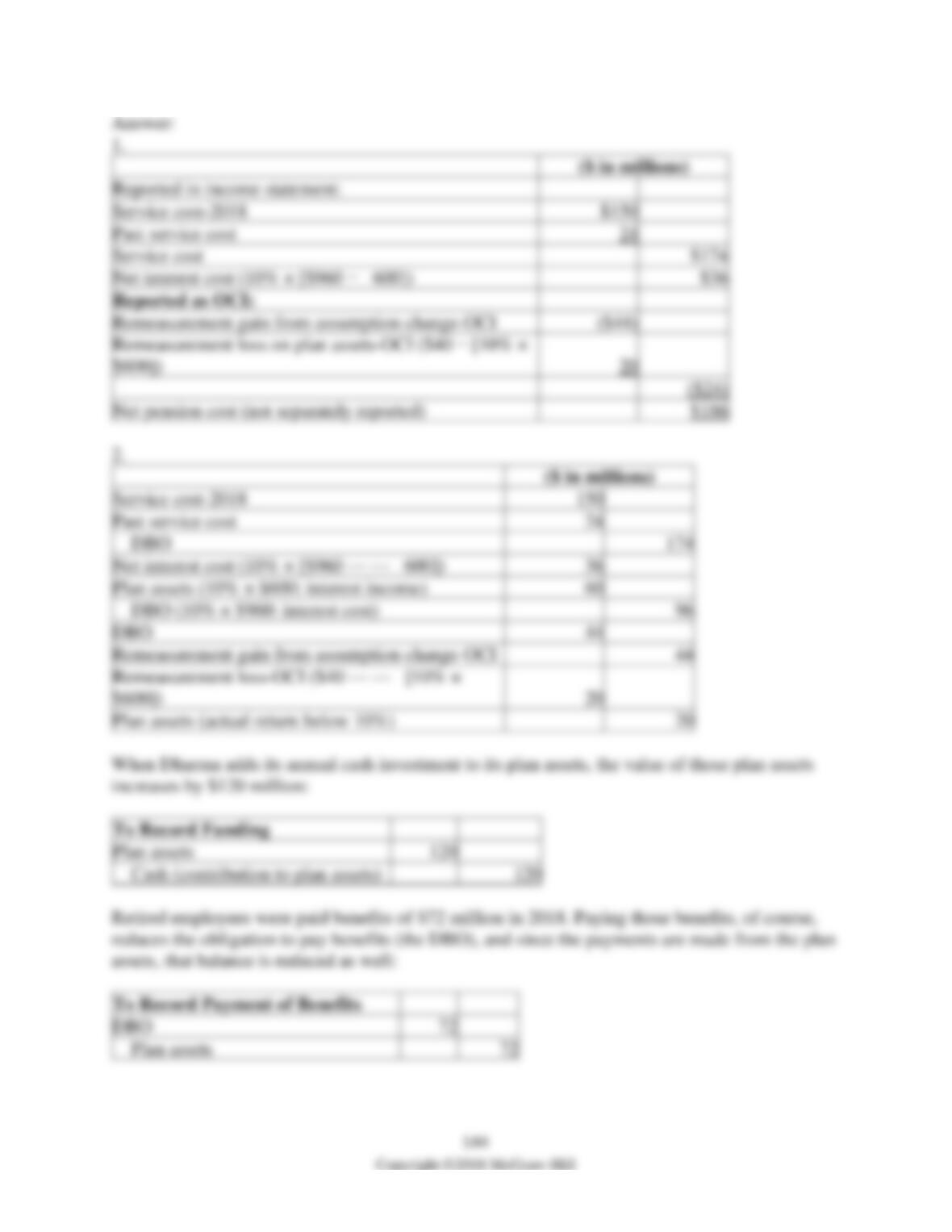
1. Calculate the pension expense for 2018.
2. Prepare the journal entry to record pension expense, gains or losses, past service cost, funding,
and payment of benefits for 2018.
3. What amount will Dharma Initiative report in its 2018 balance sheet as a net pension asset or
net pension liability?
232) Differentiate between a defined contribution pension plan and a defined benefit pension
plan.
233) Discuss the key quantitative elements of accounting for a defined benefit pension plan.
234) Differentiate between the projected benefit obligation, the accumulated benefit obligation,
and the vested benefit obligation.
235) Pension plans typically require some minimum period of employment before benefits vest.
What is the 1974 federal law governing vesting (as well as other aspects of pensions)? What are
the vesting rules?
236) What is the theoretical and practical trade-off when measuring the pension liability using
the projected benefit obligation compared to the accumulated benefit obligation?
237) DeAngelo Yards, Inc., calculated pension expense for its underfunded pension plan as
follows:
($ in millions)
Service cost
$448
Interest cost
300
Expected return on the plan assets ($200 actual, less $20 gain)
(180)
Amortization of prior service cost
16
Amortization of net loss
4
Pension expense
$588
Required:
Which elements of DeAngelo’s balance sheet are affected by the components of pension
expense? What are the specific changes in these accounts?
238) Discuss income smoothing as the term relates to pension plans.
239) What are the possible components of pension expense? Which of these elements would
exist in every defined benefit plan?When would the remaining elements arise?
Use the following to answer the question(s) below:
In its 2018 annual report to shareholders, JDS Corporation disclosed the following information
about its pension plan:
($ in millions)
2018
2017
PROJECTED BENEFIT
OBLIGATION
Beginning balance
$120.0
$102.2
Service cost
4.1
5.5
Interest cost
7.0
6.5
Benefits paid
(2.6)
(4.4)
Actuarial loss
6.6
11.4
Ending balance
$135.1
$121.2
The increase in the underfunded projected benefit obligation was primarily attributable to a
reduction in the assumed discount rate. This was combined with the effect of increases in
benefits under the terms of the plan in excess of current inflation rates. The net result was
reflected as a reduction in accumulated other comprehensive income.
240) Explain how the loss is reported in the financial statements (other than the balance sheet).
241) Why did the loss result in a reduction in accumulated other comprehensive income?
242) Discuss the accounting for postretirement benefits prior to 1993 and under current GAAP.
What are the key differences?
243) Prepare a list of how retiree health benefits differ from pension benefits with respect to
accounting, funding, regulation, and employee benefits.
244) The components of postretirement benefit expense are similar to the components of pension
expense. How does the service cost component differ between the two expenses?
245) What is different about the expected postretirement benefit obligation and the accumulated
postretirement benefit obligation?
246) What are the five components of postretirement benefit expense?
247) In its 2018 annual report to shareholders, Livey Companies Inc. (LCI) disclosed the
following information regarding its postemployment benefit plans:
The Company and certain of its affiliates sponsor postemployment benefit plans covering
substantially all salaried and certain hourly employees. The cost of these plans is charged to
expense over the working life of the covered employees. Net postemployment costs consisted of
the following for the years ended December 31, 2018, 2017, and 2016:
($ in millions)
2018
2017
2016
Service cost
$34
$26
$24
Amortization of net loss
8
6
2
Other expense
−
−
161
Net postemployment costs
$42
$32
$187
The company instituted workforce reduction programs in its North American food operations in
2016. These actions resulted in incremental postemployment costs, which are shown as other
expense above.
Required:
Describe the three components in the net postemployment costs disclosed by LCI.
248) Open Arms Industries has a noncontributory, defined benefit pension plan. During 2018,
changing economic conditions caused the actuary to increase the assumed rate of salary
progression.
Required:
1. Does the change create a gain or does it create a loss for Open Arms? Why?
2. Assuming the magnitude of the change is $7 million. Prepare the appropriate journal entry to
record any 2018 gain or loss. (Ignore income taxes.) If Open Arms prepares its financial
statements according to U.S. GAAP, how will the company report the gain or loss?
3. Would your response to question 2 differ if Open Arms prepares its financial statements
according to International Financial Reporting Standards (IFRS)?
249) The income statement of Starboard Industries includes $12 million for the amortization of a
loss resulting from the company’s actuary changing an estimate used in calculating the obligation
for the pension plan. Does Starboard Industries prepare its financial statements according to U.S.
GAAP or IFRS?
250) How do U.S. GAAP and IFRS differ with regard to reporting prior service costs?
251) Describe how employers report the components of pension expense in the company’s
financial statements.