Investments
17 – 21
76. On November 1, 2021, Horton Company purchased Lopez, Inc., 10-year, 9%, bonds with
a face value of $800,000, for $720,000. An additional $24,000 was paid for the accrued
interest. Interest is payable semiannually on January 1 and July 1. The bonds mature on
July 1, 2028. Horton uses the straight-line method of amortization. Ignoring income taxes,
the amount reported in Horton’s 2021 income statement as a result of Horton’s available–
for-sale investment in Lopez was
a. $14,000.
b. $13,333.
c. $12,000.
d. $10,667.
77. On October 1, 2021, Menke Company purchased to hold to maturity, 500, $1,000, 9%
bonds for $520,000. An additional $15,000 was paid for accrued interest. Interest is paid
semiannually on December 1 and June 1 and the bonds mature on December 1, 2025.
Menke uses straight-line amortization. Ignoring income taxes, the amount reported in
Menke’s 2021 income statement from this investment should be
a. $11,250.
b. $10,050.
c. $12,450.
d. $13,650.
78. At the end of 2021, Hauke Company purchased 6,000, $1,000, 9% bonds. The carrying
value of the bonds at December 31, 2018 was $5,880,000. The bonds mature on March 1,
2026, and pay interest on March 1 and September 1. Hauke sells 3,000 bonds on
September 1, 2022, for $2,964,000, after the interest has been received. Hauke uses
straight-line amortization. The gain on the sale is
a. $0.
b. $14,400.
c. $24,000.
d. $33,600.
Use the following information for 79 and 80.
On January 3, 2020, Moss Company acquires $500,000 of Adam Company’s 10-year, 10%
bonds at a price of $532,090 to yield 9%. Interest is payable each December 31. The bonds are
classified as held-to-maturity.
79. Assuming that Moss Company uses the effective-interest method, what is the amount of
interest revenue that would be recognized in 2021 related to these bonds?
a. $50,000
b. $53,208
c. $47,890
d. $47,698
Test Bank for Intermediate Accounting, Seventeenth Edition
17 – 22
80. Assuming that Moss Company uses the straight-line method, what is the amount of
premium amortization that would be recognized in 2022 related to these bonds?
a. $3,209
b. $2,110
c. $2,300
d. $2,510
Questions 81 and 82 are based on the following information:
Richman Company purchased $1,200,000 of 8%, 5-year bonds from Carlin, Inc. on January 1,
2021, with interest payable on July 1 and January 1. The bonds sold for $1,249,896 at an
effective interest rate of 7%. Using the effective interest method, Richman Company decreased
the Available-for-Sale Debt Securities account for the Carlin, Inc. bonds on July 1, 2021 and
December 31, 2021 by the amortized premiums of $4,248 and $4,392, respectively.
81. At December 31, 2021, the fair value of the Carlin, Inc. bonds was $1,272,000. What
should Richman Company report as other comprehensive income and as a separate
component of stockholders’ equity?
a. $0
b. $8,640
c. $22,104
d. $30,744
82. At February 1, 2022, Richman Company sold the Carlin bonds for $1,236,000. After
accruing for interest, the carrying value of the Carlin bonds on February 1, 2022 was
$1,240,500. Assuming Richman Company has a portfolio of available-for-sale debt
investments, what should Richman Company report as a gain (or loss) on the bonds?
a. $0.
b. ($4,500).
c. ($26,244).
d. ($35,244).
83. During 2021 Logic Company purchased 10,000 shares of Midi, Inc. for $30 per share.
During the year Logic Company sold 2,500 shares of Midi, Inc. for $35 per share. At
December 31, 2021 the market price of Midi, Inc.’s stock was $28 per share. What is the
total amount of gain/(loss) that Logic Company will report in its income statement for the
year ended December 31, 2021 related to its investment in Midi, Inc. stock?
a. ($20,000)
b. $12,500
c. ($7,500)
d. ($2,500)
Investments
17 – 23
84. Instrument Corporation has the following investment which was held throughout 2021–
2022:
Fair Value
Cost 12/31/21 12/31/22
Equity investment $900,000 $1,200,000 $1,140,000
What amount of gain or loss would Instrument Corporation report in its income statement
for the year ended December 31, 2022 related to its investment?
a. $60,000 gain.
b. $60,000 loss.
c. $300,000 gain.
d. $240,000 gain.
85. At December 31, 2021, Atlanta Company has an equity portfolio valued at $160,000. Its
cost was $132,000. If the Securities Fair Value Adjustment has a debit balance of $8,000,
which of the following journal entries is required at December 31, 2021?
a. Fair Value Adjustment 28,000
Unrealized Holding Gain or Loss–Income 28,000
b. Fair Value Adjustment 20,000
Unrealized Holding Gain or Loss–Income 20,000
c. Unrealized Holding Gain or Loss–Income 28,000
Fair Value Adjustment 28,000
d. Unrealized Holding Gain or Loss–Income 20,000
Fair Value Adjustment 20,000
86. Kramer Company’s equity securities portfolio which is appropriately included in current
assets is as follows:
December 31, 2021
Fair Unrealized
Cost Value Gain (Loss)
Catlett Corp. $260,000 $215,000 $(45,000)
Lyman, Inc. 245,000 265,000 20,000
$505,000 $480,000 $(25,000)
Ignoring income taxes, what amount should be reported as a charge against income in
Kramer’s 2021 income statement if 2021 is Kramer’s first year of operation?
a. $0.
b. $20,000 gain.
c. $25,000 loss.
d. $45,000 loss.
Test Bank for Intermediate Accounting, Seventeenth Edition
17 – 24
87. On its December 31, 2020, balance sheet, Trump Company reported its investment in
equity securities, which had cost $600,000, at fair value of $560,000. At December 31,
2021, the fair value of the securities was $585,000. What should Trump report on its 2021
income statement as a result of the increase in fair value of the investments in 2021?
a. $0.
b. Unrealized loss of $15,000.
c. Realized gain of $25,000.
d. Unrealized gain of $25,000.
88. During 2020, Woods Company purchased 80,000 shares of Holmes Corporation common
stock for $1,260,000 as an equity investment. The fair value of these shares was
$1,200,000 at December 31, 2020. Woods sold all of the Holmes stock for $17 per share
on December 3, 2021, incurring $56,000 in brokerage commissions. Woods Company
should report a realized gain on the sale of stock in 2021 of
a. $44,000.
b. $100,000.
c. $104,000.
d. $160,000.
Use the following information for questions 89 and 90.
On its December 31, 2020 balance sheet, Calhoun Company appropriately reported a $10,000
debit balance in its Fair Value Adjustment account. There was no change during 2021 in the
composition of Calhoun’s portfolio of debt investments held as available-for-sale debt securities.
The following information pertains to that portfolio:
Security Cost Fair value at 12/31/21
X $130,000 $160,000
Y 100,000 90,000
Z 175,000 125,000
$405,000 $375,000
89. What amount of unrealized loss on these debt securities should be included in Calhoun’s
stockholders’ equity section of the balance sheet at December 31, 2021?
a. $40,000.
b. $30,000.
c. $20,000.
d. $0.
90. The amount of unrealized loss to appear as a component of comprehensive income for
the year ending December 31, 2021 is
a. $40,000.
b. $30,000.
c. $20,000.
d. $0.
Investments
17 – 25
91. On January 2, 2021 Pod Company purchased 25% of the outstanding common stock of
Jobs, Inc. and subsequently used the equity method to account for the investment. During
2021 Jobs, Inc. reported net income of $1,260,000 and distributed dividends of $540,000.
The ending balance in the Investment in Pod Company account at December 31, 2021
was $960,000 after applying the equity method during 2021. What was the purchase price
Pod Company paid for its investment in Jobs, Inc?
a. $510,000
b. $780,000
c. $1,140,000
d. $1,410,000
92. Ziegler Corporation purchased 25,000 shares of common stock of the Sherman
Corporation for $40 per share on January 2, 2020. Sherman Corporation had 100,000
shares of common stock outstanding during 2021, paid cash dividends of $150,000 during
2021, and reported net income of $500,000 for 2021. Ziegler Corporation should report
revenue from investment for 2021 in the amount of
a. $37,500.
b. $87,500.
c. $125,000.
d. $137,500.
Use the following information for questions 93 and 94.
Harrison Company owns 20,000 of the 50,000 outstanding shares of Taylor, Inc. common stock.
During 2021, Taylor earns $1,200,000 and pays cash dividends of $960,000.
93. If the beginning balance in the investment account was $750,000, the balance at
December 31, 2021 should be
a. $1,230,000.
b. $990,000.
c. $846,000.
d. $750,000.
94. Harrison should report investment revenue for 2021 of
a. $480,000.
b. $384,000.
c. $96,000.
d. $0.
Test Bank for Intermediate Accounting, Seventeenth Edition
17 – 26
Use the following information for questions 95 through 98.
The summarized balance sheets of Goebel Company and Dobbs Company as of December 31,
2021 are as follows:
Goebel Company
Balance Sheet
December 31, 2021
Assets $2,400,000
Liabilities $ 300,000
Capital stock 1,200,000
Retained earnings 900,000
Total equities $2,400,000
Dobbs Company
Balance Sheet
December 31, 2021
Assets $1,800,000
Liabilities $410,000
Capital stock 1,150,000
Retained earnings 240,000
Total equities $1,800,000
95. If Goebel Company acquired a 20% interest in Dobbs Company on December 31, 2021
for $350,000 and the fair value method of accounting for the investment were used, the
amount of the debit to Equity Investments (Dobbs) would have been
a. $278,000.
b. $230,000.
c. $350,000.
d. $360,000.
96. If Goebel Company acquired a 30% interest in Dobbs Company on December 31, 2021
for $430,000 and the equity method of accounting for the investment were used, the
amount of the debit to Equity Investments (Dobbs) would have been
a. $540,000.
b. $430,000.
c. $345,000.
d. $417,000.
97. If Goebel Company acquired a 20% interest in Dobbs Company on December 31, 2021
for $290,000 and during 2022 Dobbs Company had net income of $150,000 and paid a
cash dividend of $60,000, applying the fair value method would give a debit balance in the
Equity Investments (Dobbs) account at the end of 2022 of
a. $230,000.
b. $290,000.
c. $320,000.
d. $308,000.
Investments
17 – 27
98. If Goebel Company acquired a 30% interest in Dobbs Company on December 31, 2021
for $440,000 and during 2022 Dobbs Company had net income of $150,000 and paid a
cash dividend of $60,000, applying the equity method would give a debit balance in the
Equity Investments (Dobbs) account at the end of 2022 of
a. $440,000.
b. $467,000.
c. $485,000.
d. $422,000.
Use the following information for questions 99 and 100.
Blanco Company purchased 200 of the 1,000 outstanding shares of Darby Company’s common
stock for $600,000 on January 2, 2021. During 2021, Darby Company declared dividends of
$100,000 and reported earnings for the year of $400,000.
99. If Blanco Company used the fair value method of accounting for its investment in Darby
Company, its Equity Investments (Darby) account on December 31, 2021 should be
a. $580,000.
b. $660,000.
c. $600,000.
d. $680,000.
100. If Blanco Company uses the equity method of accounting for its investment in Darby
Company, its Equity Investments (Darby) account at December 31, 2021 should be
a. $580,000.
b. $600,000.
c. $660,000.
d. $680,000.
Use the following information for questions 101 and 102.
Brown Corporation earns $720,000 and pays cash dividends of $240,000 during 2021. Dexter
Corporation owns 3,000 of the 10,000 outstanding shares of Brown.
101. What amount should Dexter show in the investment account at December 31, 2021 if the
beginning of the year balance in the account was $960,000?
a. $1,176,000.
b. $960,000.
c. $1,104,000.
d. $1,440,000.
Test Bank for Intermediate Accounting, Seventeenth Edition
17 – 28
102. How much investment income should Dexter report in 2021?
a. $240,000.
b. $216,000.
c. $144,000.
d. $720,000.
103. Myers Company acquired a 60% interest in Gannon Corporation on December 31, 2020
for $1,775,000. During 2021, Gannon had net income of $1,000,000 and paid cash
dividends of $250,000. At December 31, 2021, the balance in the investment account
should be
a. $1,775,000.
b. $2,375,000.
c. $2,225,000.
d. $2,525,000.
Reporting, IFRS: None
Use the following information for questions 104 and 105.
Tracy Company owns 4,000 of the 10,000 outstanding shares of Penn Corporation common
stock. During 2021, Penn earns $450,000 and pays cash dividends of $150,000.
104. If the beginning balance in the investment account was $900,000, the balance at
December 31, 2021 should be
a. $900,000.
b. $1,020,000.
c. $1,080,000.
d. $1,200,000.
105. Tracy should report investment revenue for 2021 of
a. $60,000.
b. $120,000.
c. $150,000.
d. $180,000.
106. The following information relates to Windom Company for 2021:
Realized gain on sale of available-for-sale debt securities $45,000
Unrealized holding gains arising during the period on
available-for-sale debt securities 90,000
Reclassification adjustment for gains included in net income 30,000
Windom’s 2021 comprehensive income is
a. $75,000.
b. $105,000.
c. $135,000.
d. $165,000.
Investments
17 – 29
Multiple Choice Answers—Computational
MULTIPLE CHOICE—CPA Adapted
107. On October 1, 2020, Wenn Company purchased 800 of the $1,000 face value, 8% bonds
of Loy, Inc., for $936,000, including accrued interest of $16,000. The bonds, which mature
on January 1, 2027, pay interest semiannually on January 1 and July 1. Wenn used the
straight-line method of amortization and appropriately recorded the bonds as available-for–
sale. On Wenn‘s December 31, 2021 balance sheet, the carrying value of the bonds is
a. $920,000.
b. $912,000.
c. $908,800.
d. $896,000.
108. Valet Corporation began operations in 2021. An analysis of Valet’s debt securities
portfolio acquired in 2021 shows the following totals at December 31, 2021 for trading and
available-for–sale debt securities:
Trading Available-for-Sale
Securities Securities
Aggregate cost $180,000 $220,000
Aggregate fair value 160,000 190,000
What amount should Valet report in its 2021 income statement for unrealized holding
loss?
a. $50,000.
b. $10,000.
c. $30,000.
d. $20,000.

Test Bank for Intermediate Accounting, Seventeenth Edition
17 – 30
109. At December 31, 2021, Jeter Corporation had the following debt securities that were
purchased during 2021, its first year of operation:
Fair Unrealized
Cost Value Gain (Loss)
Trading Securities:
Security A $ 85,000 $ 65,000 $(20,000)
B 15,000 20,000 5,000
Totals $100,000 $ 85,000 $(15,000)
Available-for-Sale Securities:
Security Y $ 70,000 $ 80,000 $ 10,000
Z 85,000 55,000 (30,000)
Totals $155,000 $135,000 $(20,000)
All market declines are considered temporary. Fair value adjustments at December 31,
2021 should be established with a corresponding charge against
Income Stockholders’ Equity
a. $40,000 $ 0
b. $25,000 $30,000
c. $15,000 $20,000
d. $15,000 $ 0
110. On December 29, 2022, James Company sold a debt security that had been purchased
on January 4, 2021. James owned no other debt securities. An unrealized holding loss
was reported in the 2021 income statement. A realized gain was reported in the 2022
income statement. Was the debt security classified as available–for-sale and did its 2021
market price decline exceed its 2022 market price recovery?
2021 Market Price
Decline Exceeded 2022
Available-for-Sale Market Price Recovery
a. Yes Yes
b. Yes No
c. No Yes
d. No No
Use the following information for questions 111 through 113.
Rich, Inc. acquired 30% of Doane Corporation‘s voting stock on January 1, 2021 for $1,000,000.
During 2021, Doane earned $400,000 and paid dividends of $250,000. Rich’s 30% interest in
Doane gives Rich the ability to exercise significant influence over Doane’s operating and financial
policies. During 2022, Doane earned $500,000 and paid cash dividends of $150,000 on April 1
and $150,000 on October 1. On July 1, 2022, Rich sold half of its stock in Doane for $660,000
cash.
Investments
17 – 31
111. Before income taxes, what amount should Rich include in its 2021 income statement as a
result of the investment?
a. $400,000.
b. $250,000.
c. $120,000.
d. $75,000.
112. The carrying amount of this investment in Rich’s December 31, 2021 balance sheet
should be
a. $1,000,000.
b. $1,045,000.
c. $1,120,000.
d. $1,150,000.
113. What should the gain be on sale of this investment in Rich’s 2022 income statement?
a. $160,000.
b. $137,500.
c. $122,500.
d. $100,000.
114. On January 1, 2021, Reston Company purchased 25% of Ace Corporation’s common
stock; no goodwill resulted from the purchase. Reston appropriately carries this
investment at equity and the balance in Reston’s investment account was $1,170,000 at
December 31, 2021. Ace reported net income of $700,000 for the year ended December
31, 2021, and paid cash dividends on common stock totaling $280,000 during 2021. How
much did Reston pay for its 25% interest in Ace?
a. $1,065,000.
b. $1,240,000.
c. $1,275,000.
d. $1,415,000.
Test Bank for Intermediate Accounting, Seventeenth Edition
17 – 32
115. On December 31, 2020, Patel Company purchased debt securities as trading securities.
Pertinent data are as follows:
Fair Value
Security Cost At 12/31/21
A $132,000 $119,000
B 172,000 186,000
C 288,000 263,000
On December 31, 2021, Patel transferred its investment in security C from trading to
available-for-sale because Patel intends to retain security C as a long-term investment.
What total amount of gain or loss on its securities should be included in Patel’s income
statement for the year ended December 31, 2021?
a. $1,000 gain.
b. $24,000 loss.
c. $25,000 loss.
d. $38,000 loss.
Multiple Choice Answers—CPA Adapted
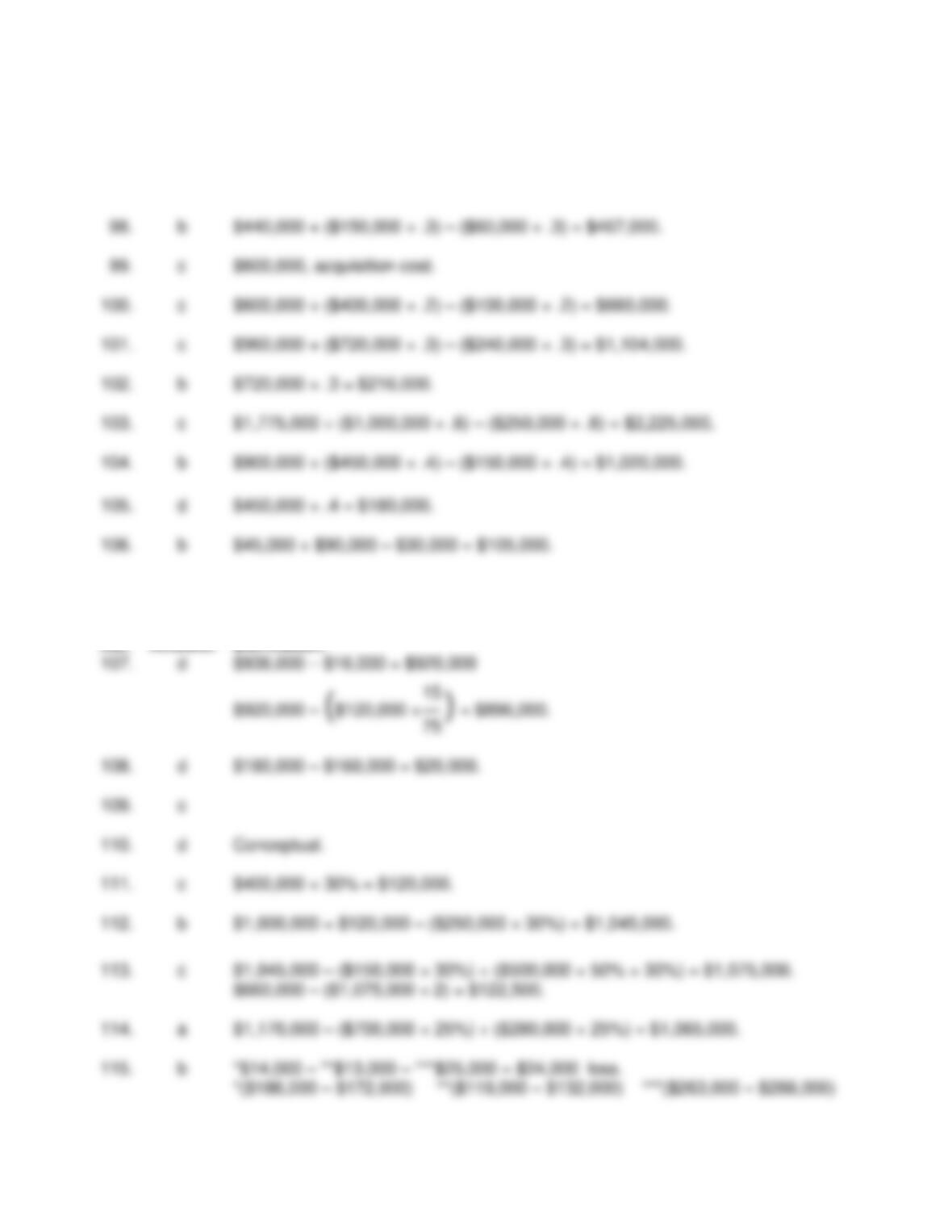
DERIVATIONS — Computational
Investments
17 – 33
DERIVATIONS — Computational (cont.)
No. Answer Derivation
Test Bank for Intermediate Accounting, Seventeenth Edition
17 – 34
DERIVATIONS — Computational (cont.)
No. Answer Derivation
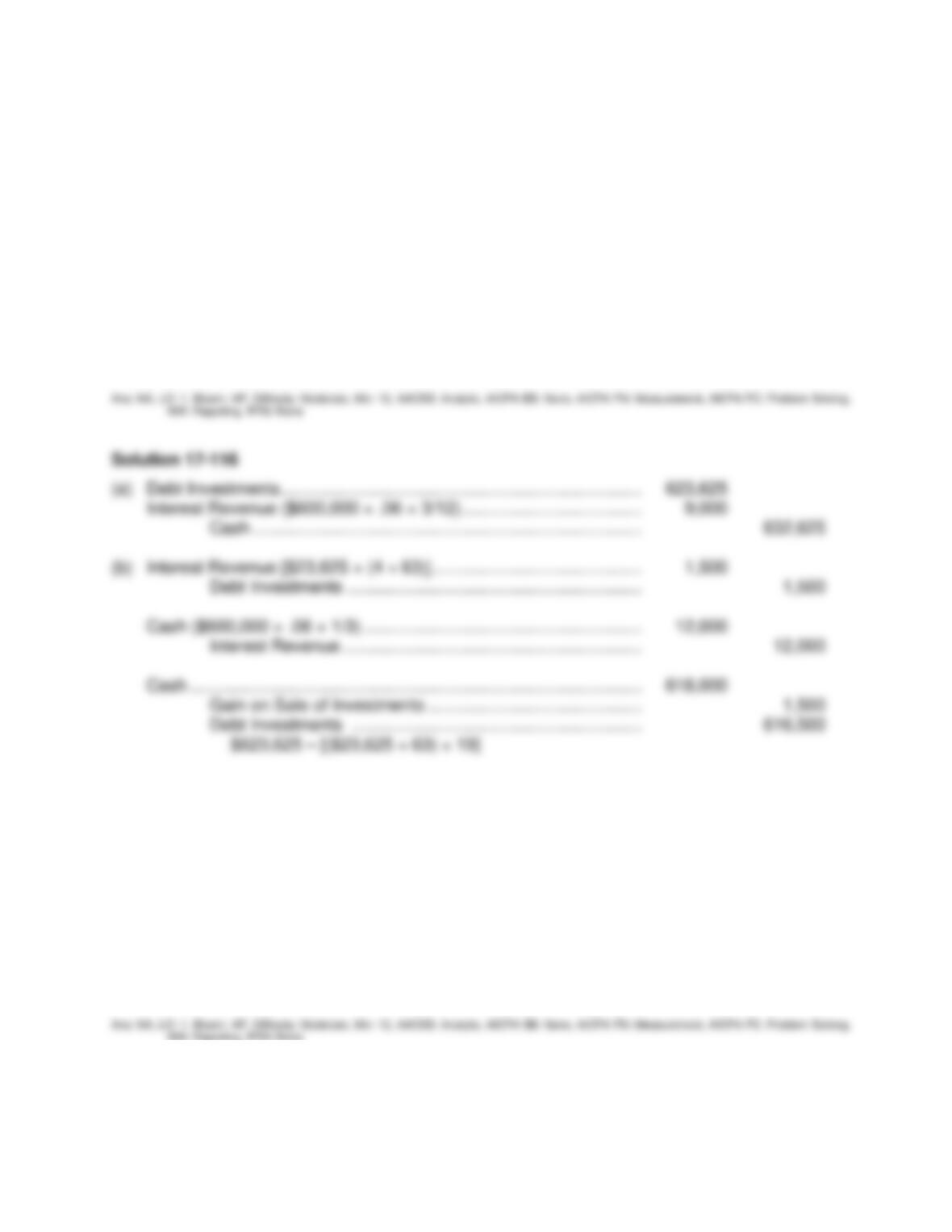
DERIVATIONS — CPA Adapted
No. Answer Derivation
Investments
17 – 35
BRIEF EXERCISES
BE. 17–116—Investment in debt securities at premium.
On April 1, 2021, West Company purchased $600,000 of 6% bonds for $623,625 plus accrued
interest as an available-for-sale security. Interest is paid on July 1 and January 1 and the bonds
mature on July 1, 2026.
Instructions
(a) Prepare the journal entry on April 1, 2021.
(b) The bonds are sold on November 1, 2022 at 103 plus accrued interest. Amortization was
recorded when interest was received by the straight-line method (by months and round to the
nearest dollar). Prepare all entries required to properly record the sale.
BE. 17–117—Investment in debt securities at a discount.
On May 1, 2021, Kirmer Corporation purchased $1,500,000 of 12% bonds, interest payable on
January 1 and July 1, for $1,406,500 plus accrued interest. The bonds mature on January 1,
2027. Amortization is recorded when interest is received by the straight-line method (by months
and round to the nearest dollar). (Assume bonds are available for sale.)
Instructions
(a) Prepare the entry for May 1, 2021.
(b) The bonds are sold on August 1, 2022 for $1,412,500 plus accrued interest. Prepare all
entries required to properly record the sale.