134) A company has two products: A and B. It uses activity-based costing and has prepared the
following analysis showing budgeted cost and activity for each of its three activity cost pools:
Budgeted Activity
Activity Cost Pool
Budgeted Cost
Product A
Product B
Activity 1
$
87,000
3,000
2,800
Activity 2
$
62,000
4,500
5,500
Activity 3
$
93,000
2,500
5,250
Annual production and sales level of Product A is 34,300 units, and the annual production and
sales level of Product B is 69,550 units. What is the approximate overhead cost per unit of
Product A under activity-based costing?
A) $3.00
B) $2.00
C) $10.28
D) $15.00
E) $2.33
135) A company has two products: A1 and B2. It uses activity-based costing and has prepared
the following analysis showing budgeted cost and activity for each of its three activity cost
pools:
Budgeted Activity
Activity Cost Pool
Budgeted Cost
Product A1
Product B2
Activity 1
$
48,000
1,200
4,800
Activity 2
$
63,000
2,240
4,760
Activity 3
$
80,000
7,200
800
Annual production and sales level of Product A1 is 8,480 units, and the annual production and
sales level of Product B2 is 22,310 units. What is the approximate overhead cost per unit of
Product A1 under activity-based costing?
A) $8.00
B) $9.00
C) $10.00
D) $12.00
E) $4.00
136) A company has two products: A1 and B2. It uses activity-based costing and has prepared
the following analysis showing budgeted cost and activity for each of its three activity cost
pools:
Budgeted Activity
Activity Cost Pool
Budgeted Cost
Product A1
Product B2
Activity 1
$
48,000
1,200
4,800
Activity 2
$
63,000
2,240
4,760
Activity 3
$
80,000
7,200
800
Annual production and sales level of Product A1 is 8,480 units, and the annual production and
sales level of Product B2 is 22,310 units. What is the approximate overhead cost per unit of
Product B2 under activity-based costing?
A) $8.00
B) $9.00
C) $10.00
D) $12.00
E) $4.00
[The following information applies to the questions displayed below.]
Assume that a pet food manufacturer is considering adding two types of pet food to its existing
product line. Research had determined that good demand exists for dog food in 40-pound bags
and cat food in 0.5 pound cans.
The company identified the following partial list of activities, costs, and activity drivers expected
for the next year:
Activity
Expected Costs
Cost Driver
Material handling
$
105,000
Number of batches made
Storage costs
$
820,000
Weight of finished product
Dog Food
Cat Food
Production volume
100,000
units
200,000
units
Batches made
200
batches
150
batches
137) What are the overhead rates used to apply material handling (MH) and storage costs (SC)
using activity-based costing?
A) MH $300/batch; SC $2.73/unit.
B) MH $300/batch; SC $.20/lb.
C) MH $525/batch; SC $.205/unit.
D) MH $700/batch; SC $.205/lb.
E) MH $700/batch; SC $8.20/lb.
138) How much overhead cost will be assigned to each product line using activity-based costing
(ABC)?
A) Dog food: $462,500; cat food: $462,500.
B) Dog food: $860,000; cat food: $65,000.
C) Dog food: $60,000; cat food: $45,000.
D) Dog food: $800,000; cat food: $20,000.
E) Dog food: $320; cat food: $320.
139) How much overhead cost will be assigned to each unit of product using activity-based
costing (ABC)?
A) Dog food: $4.62; cat food: $4.62.
B) Dog food: $2.64; cat food: $2.64.
C) Dog food: $8.60; cat food: $0.33.
D) Dog food: $0.26; cat food: $8.60.
E) Dog food: $0.12; cat food: $3.85.
[The following information applies to the questions displayed below.]
Assume that the Oregon Ice Cream Company is considering the costs of two of their product
lines—ice cream sandwiches and dessert bars. The company identified the following partial list
of activities, costs, and activity drivers expected for the next year.
Activity
Expected Costs
Cost Driver
Extrusion costs
$
637,500
Number batches made
Packaging costs
$
44,000
Number of units made
Ice Cream Sandwiches
Dessert Bars
Production volume
350,000
units
200,000
units
Batches made
400
batches
350
batches
140) How much overhead cost will be assigned to the ice cream sandwich product line using
activity-based costing (ABC)?
A) $340,000
B) $368,000
C) $28,000
D) $850.08
E) $433,682
141) How much overhead cost will be assigned to the dessert bar product line using activity-
based costing (ABC)?
A) $340,750
B) $247,818
C) $16,000
D) $297,500
E) $313,500
142) A company identified the following partial list of activities, costs, and activity drivers
expected for the next year:
Activity
Expected Costs
Cost Driver
Extrusion costs
$
83,600
Number batches made
Handling costs
$
8,800
Number of orders filled
Packaging costs
$
40,500
Number of units made
Product A
Product B
Production volume
750,000
units
600,000
units
Batches made
200
batches
750
batches
Orders filled
75
200
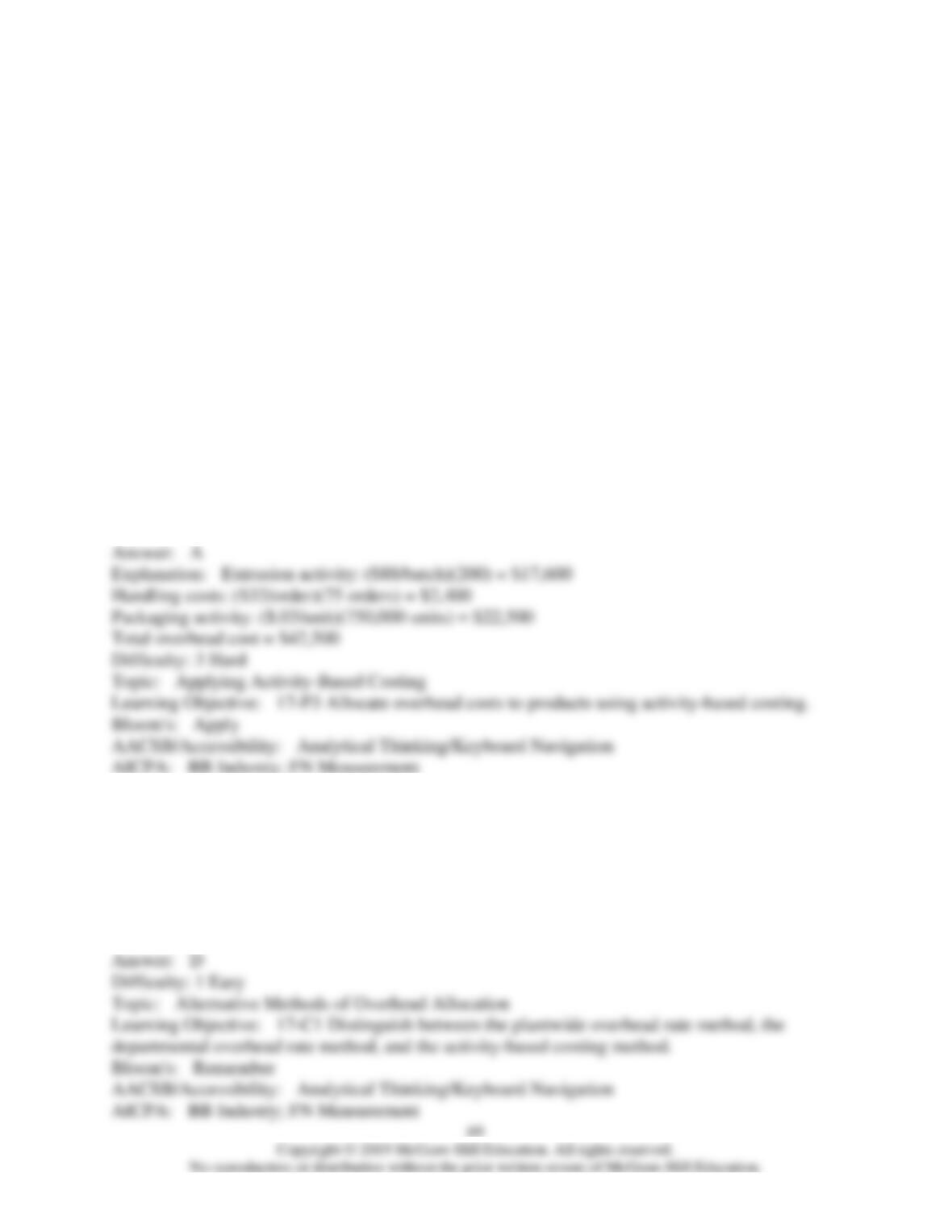
Calculate activity rates for each of the three activities using activity-based costing (ABC).
A) Extrusion: $304 per batch; handling: $32 per unit; packaging: $0.03 per unit.
B) Extrusion: $88 per batch; handling: $32 per order; packaging: $0.03 per unit.
C) Extrusion: $88 per order; handling: $32 per unit; packaging: $0.03 per batch.
D) Extrusion: $418 per batch; handling: $117.33 per order; packaging: $0.054 per unit.
E) Extrusion: $118.13 per batch; handling: $44 per order; packaging: $0.0675 per unit.
143) A company identified the following partial list of activities, costs, and activity drivers
expected for the next year:
Activity
Expected Costs
Cost Driver
Extrusion costs
$
83,600
Number batches made
Handling costs
$
8,800
Number of orders filled
Packaging costs
$
40,500
Number of units made
Product A
Product B
Production volume
750,000
units
600,000
units
Batches made
200
batches
750
batches
Orders filled
75
200
How much overhead in total will be assigned to the Product A line using activity-based costing?
A) $42,500.
B) $132,900.
C) $90,400.
D) $66,000.
E) $66,450.
144) Which of the following would not be considered a product cost?
A) Direct material costs.
B) Factory supervisor’s salary.
C) Direct labor costs.
D) Budget accountant’s salary.
E) Manufacturing overhead costs.
145) Which of the following costing systems is more accurate for overhead cost allocation and
most likely to allow managers the ability to make better pricing decisions?
A) Departmental overhead allocation rates.
B) Plantwide overhead rate.
C) Activity-based costing.
D) Traditional costing system.
E) Direct costing.
146) Which of the following statements is true of activity-based costing?
A) ABC ignores the allocation of storage costs.
B) An activity cost pool collects costs related to the same activity.
C) ABC is more likely to result in big differences from a traditional costing system if the
business makes only one product rather than multiple products.
D) Activities are the cost objects of the second stage of ABC.
E) ABC uses a single overhead rate.
147) ABC assumes all costs in a ________ can be grouped together because they all impact the
activity.
A) cost pool.
B) department.
C) time period.
D) organization.
E) product line.
148) Put the following ABC implementation steps in order ________.
A Use the activity overhead rates to assign overhead costs to cost objects.
B Compute the allocation rates.
C Trace overhead costs to cost pools.
D Identify the activities and the overhead costs they cause.
A) DACB
B) DBCA
C) BADC
D) CDAB
E) DCBA
149) ________ is considered while choosing a cost allocation base for activity costs in ABC
costing.
A) The marketing strategy of the products being produced
B) The product sales price
C) The availability of reliable data and metrics
D) The number of employees in direct labor
E) The number of departments
150) Would the following activities at a manufacturer of shampoo be best classified as unit-level,
batch-level, product-level, or facility level activities?
Researching new formulas Shipping orders to stores
A) Batch Batch
B) Unit Unit
C) Product Batch
D) Product Unit
E) Facility Product
151) All of the following are examples of facility-level costs except:
A) Costs of cleaning the workplace.
B) Costs of custodial work.
C) Costs of personnel support.
D) Costs of receiving shipments.
E) Costs of providing electricity.
152) ________ costs support the company as a whole.
A) Batch-level
B) Product-level
C) Unit-level
D) Facility-level
E) Activity
153) Which of the following is a disadvantage of the departmental overhead rate method?
A) It may fail to accurately assign many overhead costs that are not driven by production
volume.
B) Allows each department to have its own overhead rate.
C) Allows each department to have its own allocation base.
D) The departmental overhead rate is usually more accurate in overhead allocations than the
plantwide overhead rate.
E) The departmental overhead rate is consistent with GAAP and can be used for external
reporting.
154) The use of departmental overhead rates will generally result in:
A) The use of a single cost allocation base.
B) The use of a single overhead cost pool for the factory.
C) The use of a separate cost allocation base for each department in the factory.
D) The use of a separate cost allocation base for each activity in the factory.
E) The use of a separate cost allocation base for each month.
155) ABC systems ________.
A) usually will undercost complicated or complex products
B) will limit cost drivers to units of output
C) highlight the different levels of activities
D) will allocate costs based on volume
E) comply with GAAP
156) ABC costing might lead to:
A) increasing the sales price of low-volume products.
B) increasing the sales price of high-volume products.
C) increasing low-volume products that appear to be profitable.
D) decreasing high-volume products that appear to be unprofitable.
E) increasing materials cost.
157) West Company estimates that overhead costs for the next year will be $5,240,000 for
indirect labor and $550,000 for factory utilities. The company uses machine hours as its
overhead allocation base. If 150,000 machine hours are planned for this next year, what is the
company’s plantwide overhead rate?
A) $0.0259 per machine hour.
B) $34.93 per machine hour.
C) $38.60 per machine hour.
D) $3.67 per machine hour.
E) $0.2727 per machine hour.
158) The following data relates to Mangini Company’s estimated amounts for next year.
Estimated:
Department 1
Department 2
Manufacturing overhead costs
$320,000
$400,000
Direct labor hours
65,000
DLH
75,000
DLH
Machine hours
2,000
MH
2,500
MH
What is the company’s plantwide overhead rate if machine hours are the allocation base? (Round
your answer to two decimal places.)
A) $200.00 per MH
B) $150.00 per MH
C) $160.00 per MH
D) $31.11 per MH
E) $5.14 per MH
[The following information applies to the questions displayed below.]
Tasty Bakery produces donuts which go through two operations, mixing and baking, before they
are ready to be packaged. Next year’s expected costs and activities are shown below.
Mixing
Baking
Direct labor hours
300,000
DLH
70,000
DLH
Machine hours
1,000,000
MH
800,000
MH
Overhead costs
$500,000
$400,000
159) Compute Tasty’s departmental overhead rate for the mixing department based on direct
labor hours.
A) $1.50 per DLH.
B) $5.00 per DLH.
C) $0.75 per DLH.
D) $0.60 per DLH.
E) $1.67 per DLH.
160) Compute Tasty’s departmental overhead rate for the mixing department based on machine
hours.
A) $1.50 per MH.
B) $3.33 per MH.
C) $0.60 per MH.
D) $0.50 per MH.
E) $2.00 per MH.
161) When calculating the departmental overhead rate, the numerator should be?
A) The total estimated departmental overhead cost.
B) The total amount of departmental allocation base.
C) The total plantwide budgeted overhead cost.
D) The actual quantity of the departmental allocation base used by the job.
E) The actual department direct labor hours.
162) Cleveland Choppers manufactures two types of motorcycles, a Base and a Loaded model.
The following activity and costs have been gathered:
Product
Number of
Components
Number of
Setups
Number of
Direct Labor Hrs
Base
15
20
700
Loaded
25
40
600
Overhead costs
$
27,000
$
22,500
The number of components and number of setups are chosen as activity-cost drivers for
overhead. Assuming an ABC costing system is being used, what is the total overhead cost
assigned to the Base model?
A) $15,450.
B) $21,375.
C) $13,500.
D) $17,625.
E) $15,625.
163) Cleveland Choppers manufactures two types of motorcycles, a Base and a Loaded model.
The following activity and costs have been gathered:
Product
Number of
Components
Number of
Setups
Number of
Direct Labor Hrs
Base
15
20
700
Loaded
25
40
600
Overhead costs
$
27,000
$
22,500
The number of components and number of setups are chosen as activity-cost drivers for
overhead. Assuming an ABC costing system is being used, what is the total overhead cost
assigned to the Loaded model?
A) $31,875.
B) $36,000.
C) $28,125.
D) $34,050.
E) $31,125.
164) Match each of the following terms a through j with the appropriate definitions 1 through 10.
(a) Cost object
(b) Activity
(c) Facility-level activities
(d) Activity-based costing
(e) Batch level activities
(f) Activity-based management
(g) Pool rate
(h) Activity cost driver
(i) Value-added activities
(j) Cost pool
_____ (1) Actions which add value to a product.
_____ (2) Actions which cause costs to be incurred.
_____ (3) A collection of costs that are related to the same or similar activity.
_____ (4) An outgrowth of ABC that uses the link between activities and costs.
_____ (5) The target of a cost assignment.
_____ (6) Activities performed only on groups of units.
_____ (7) Factor that drives cost.
_____ (8) An allocation rate used to assign overhead costs to cost objects.
_____ (9) A cost allocation method that focuses on activities performed.
_____(10) Activities performed to sustain facility capacity as a whole.