CHAPTER 17
INVESTMENTS
IFRS questions are available at the end of this chapter.
TRUE-FALSE—Conceptual
Answer No. Description
T *20. Disclosure of fair value information.
MULTIPLE CHOICE—Conceptual
Answer No. Description
Test Bank for Intermediate Accounting, Seventeenth Edition
17 – 2
MULTIPLE CHOICE—Conceptual (cont.)
Answer No. Description
MULTIPLE CHOICE—Computational
Investments
17 – 3
MULTIPLE CHOICE—Computational (cont.)
Answer No. Description
MULTIPLE CHOICE—CPA Adapted
Answer No. Description

Test Bank for Intermediate Accounting, Seventeenth Edition
17 – 4
BRIEF EXERCISES
Item Description
BE17-116 Investment in debt securities at a premium.
BE17-117 Investment in debt securities at a discount.
BE17-118 Investments in debt securities (essay).
EXERCISES
Item Description
E17-119 Investment in equity securities.
E17-120 Fair value and equity methods (essay).
E17-121 Fair value and equity methods.
E17-122 Comprehensive income calculation.
*E17-123 Fair value hedge.
*E17-124 Cash flow hedge.
PROBLEMS
Item Description
P17-125 Equity securities.
P17-126 Equity securities.
P17-127 Equity securities.
*P17-128 Derivative financial instrument.
*P17-129 Derivative financial instrument.

Investments
17 – 5
CHAPTER LEARNING OBJECTIVES
1. Describe the accounting for investments in debt securities.
2. Describe the accounting for investments in equity securities.
3. Explain the equity and consolidation methods of accounting.
4. Evaluate other major issues related to investments in debt and equity securities.
*5. Describe the uses of and accounting for derivatives.
*6. Explain the accounting for hedges.
*7. Identify special reporting issues related to derivative financial instruments that cause
unique accounting problems.
*8. Describe the required fair value disclosures.
9. Compare the accounting for investments under GAAP and IFRS.

Test Bank for Intermediate Accounting, Seventeenth Edition
17 – 6
SUMMARY OF QUESTIONS BY LEARNING OBJECTIVES AND BLOOM’S TAXONOMY
Item
LO
BT
Item
LO
BT
Item
LO
BT
Item
LO
BT
Item
LO
BT
TRUE-FALSE STATEMENTS
1.
1
K
5.
1
K
9.
2
K
13.
3
K
17.
4
K
2.
1
K
6.
1
K
10.
3
K
14.
3
K
18.
4
K
3.
1
K
7.
1
K
11.
3
K
15.
4
K
19.
4
K
4.
1
K
8.
2
K
12.
3
C
16.
4
K
20.
8
C
MULTIPLE CHOICE QUESTIONS
21.
1
K
41.
1
C
61.
5
K
81.
1
AP
101.
3
AP
22.
1
K
42.
1
C
62.
5
K
82.
1
AP
102.
3
AP
23.
1
K
43.
2
K
63.
5
C
83.
2
AP
103.
3
AP
24.
1
K
44.
3
AN
64.
6
K
84.
2
AP
104.
3
AP
25.
1
C
45.
3
C
65.
6
K
85.
2
AP
105.
3
AP
26.
1
K
46.
3
C
66.
7
K
86.
2
AP
106.
4
AP
27.
1
K
47.
3
K
67.
1
AP
87.
2
AP
107.
1
AP
28.
1
C
48.
3
C
68.
1
AP
88.
2
AP
108.
1
AP
29.
2
K
49.
3
K
69.
1
AP
89.
1
AP
109.
1
AP
30.
1
K
50.
3
C
70.
1
AP
90.
1
AP
110.
1
AN
31.
1
K
51.
4
C
71.
1
AP
91.
3
AP
111.
3
AP
32.
1
AP
52.
4
K
72.
1
AP
92.
3
AP
112.
3
AP
33.
1
K
53.
4
K
73.
1
AP
93.
3
AP
113.
3
AP
34.
1
K
54.
4
K
74.
1
AP
94.
3
AP
114.
3
AN
35.
1
K
55.
4
K
75.
1
AP
95.
3
AP
115.
4
AP
36.
1
AP
56.
4
C
76.
1
AP
96.
3
AP
37.
1
K
57.
4
C
77.
1
AP
97.
3
AP
38.
1
C
58.
4
K
78.
1
AP
98.
3
AP
39.
1
K
59.
4
K
79.
1
AP
99.
3
AP
40.
1
C
60.
5
K
80.
1
AP
100.
3
AP
BRIEF EXERCISES
116.
1
AP
117.
1
AP
118.
1, 4
AN
EXERCISES
119.
3
AP
121.
3
AN
123.
6
AP
120.
3
AN
122.
3
AP
124.
6
AP
PROBLEMS
125.
4
AP
126.
2
AP
127.
2
AN
128.
5
AP
129.
6
AP

Investments
17 – 7
TRUE-FALSE—Conceptual
1. Debt securities include corporate bonds and convertible debt, but not U.S. government
securities.
2. Trading securities are securities bought and held primarily for sale in the near term to
generate income on short-term price differences.
3. Unrealized holding gains and losses are recognized in net income for available-for-sale
debt securities.
4. To classify a debt security as held-to-maturity, the company need only to have the positive
intent to hold the security to maturity.
5. Companies do not report changes in the fair value of available-for-sale debt securities as
income until the security is sold.
6. The Fair Value Adjustment account has a normal credit balance.
7. Companies report trading securities at fair value, with unrealized holding gains and losses
reported in net income.
8. Equity security holdings between 20 and 50 percent indicates that the investor has a
controlling interest over the investee.
9. The Unrealized Holding Gain/Loss—Income account for equity securities is reported as a
part of other comprehensive income.
10. Significant influence over an investee may be indicated by material intercompany trans–
actions and interchange of managerial personnel.
11. The accounting profession has concluded that an investment of 50 percent or more of the
voting stock of an investee should lead to a presumption of only significant influence over
an investee.
Test Bank for Intermediate Accounting, Seventeenth Edition
17 – 8
12. All cash dividends received by an investor from the investee decrease the investment’s
carrying value under the equity method.
13. Under the fair value method, the investor reports as revenue its share of the net income
reported by the investee.
14. A controlling interest occurs when one corporation acquires a voting interest of more than
50 percent in another corporation.
15. Companies may not use the fair value option for investments that follow the equity method
of accounting.
16. Changes in the fair value of a company’s available-for-sale debt instruments are included
as part of earnings in any given period.
17. If a decline in a security’s value is judged to be temporary, a company needs to write
down the cost basis of the individual security to a new cost basis.
18. A reclassification adjustment is necessary when a company reports realized gains/losses
as part of net income but also shows unrealized gains/losses as part of other
comprehensive income.
19. If a company transfers held–to-maturity securities to available-for-sale securities, the
unrealized gain or loss is recognized in income.
*20. One requirement related to fair value disclosure is that both the cost and the fair value of
all instruments be reported in the notes to the financial statements.
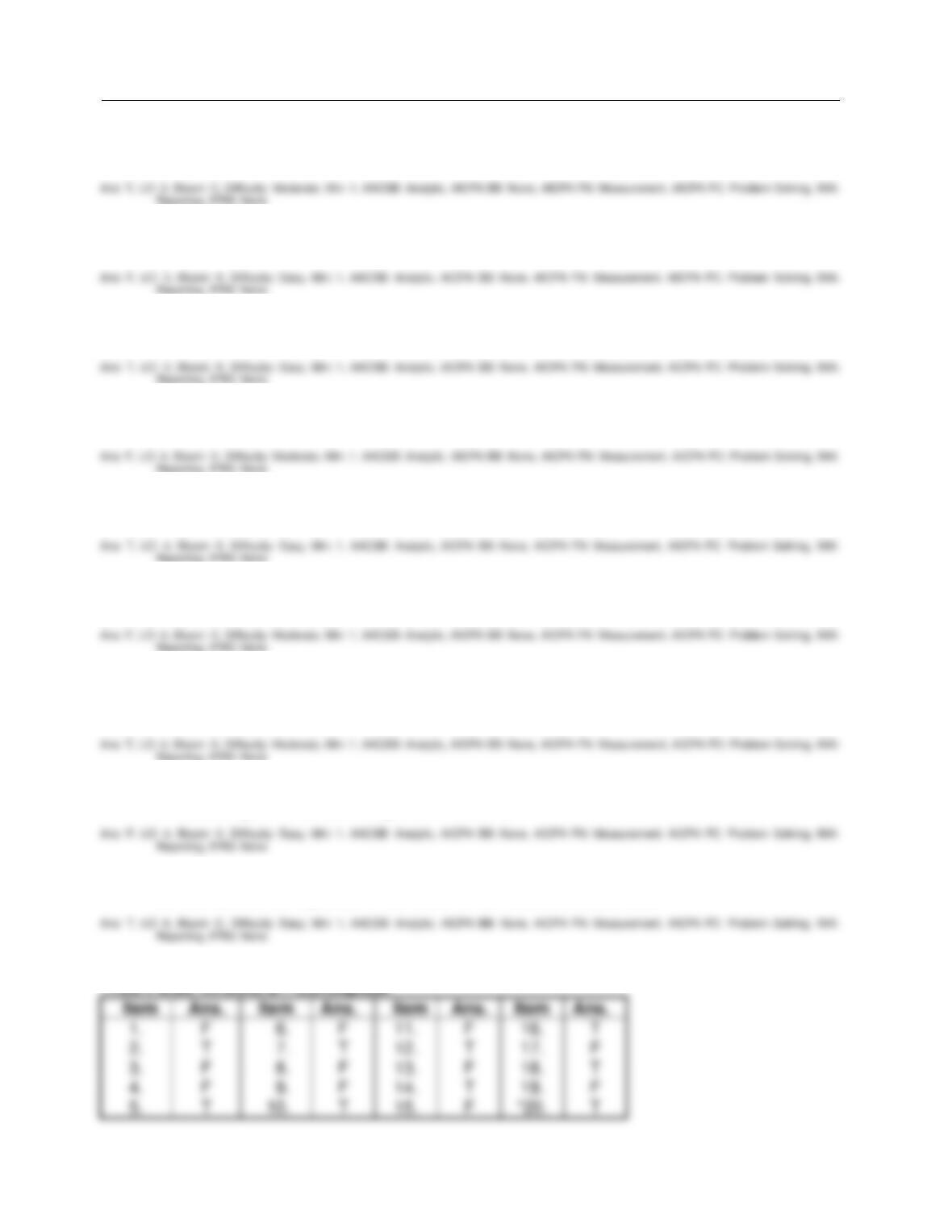
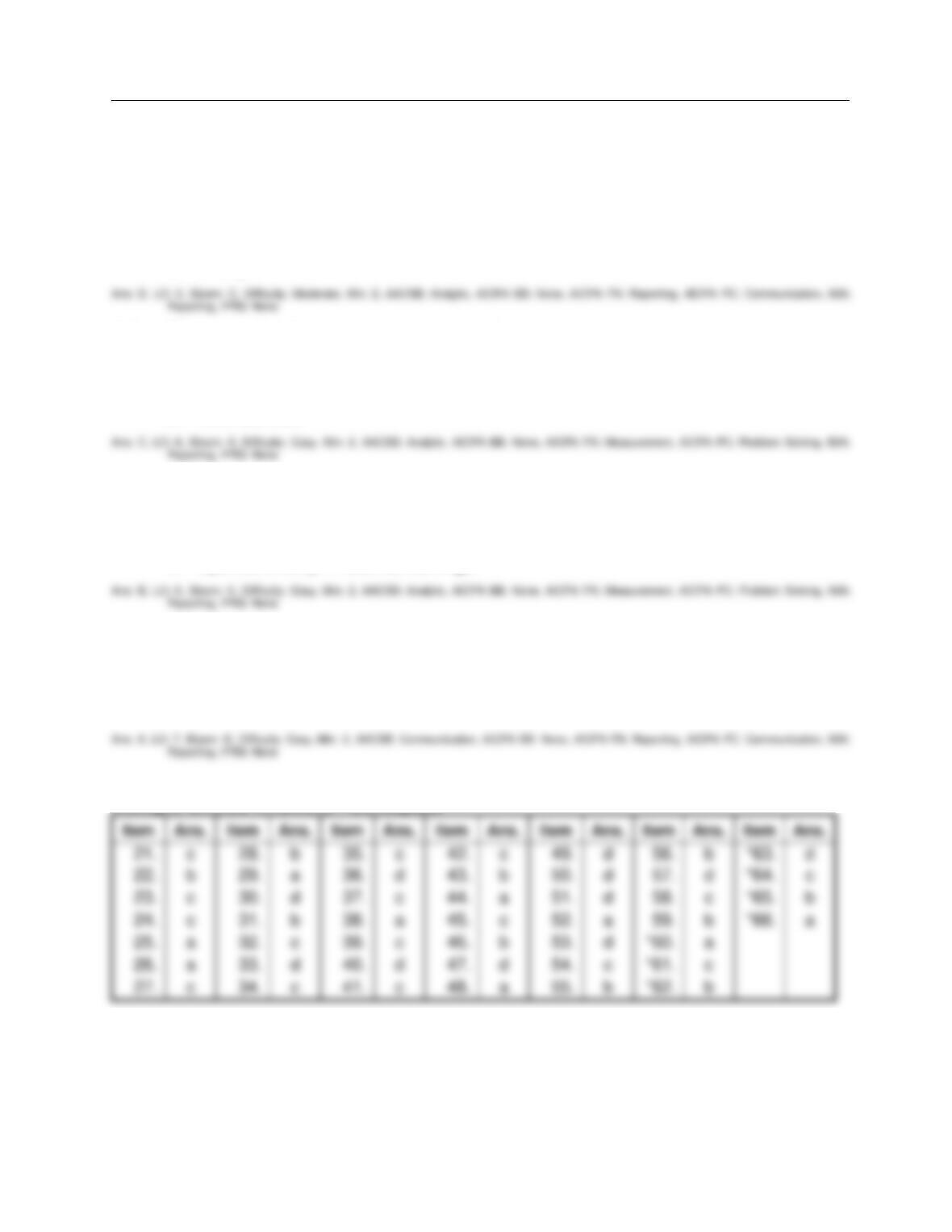
True-False Answers—Conceptual

Investments
17 – 9
MULTIPLE CHOICE—Conceptual
21. Which of the following is not a debt security?
a. Convertible bonds
b. Commercial paper
c. Loans receivable
d. All of these are debt securities.
22. A correct valuation for debt securities is
a. available-for-sale at amortized cost.
b. held–to-maturity at amortized cost.
c. held–to-maturity at fair value.
d. None of these answers are correct.
23. Securities which could be classified as held–to-maturity are
a. redeemable preferred stock.
b. warrants.
c. municipal bonds.
d. treasury stock.
24. Unrealized holding gains or losses which are recognized in income are from debt
securities classified as
a. held–to-maturity.
b. available-for-sale.
c. trading.
d. None of these answers are correct.
P25. When an investor’s accounting period ends on a date that does not coincide with an
interest receipt date for bonds held as an investment, the investor must
a. make an adjusting entry to debit Interest Receivable and to credit Interest Revenue for
the amount of interest accrued since the last interest receipt date.
b. notify the issuer and request that a special payment be made for the appropriate
portion of the interest period.
c. make an adjusting entry to debit Interest Receivable and to credit Interest Revenue for
the total amount of interest to be received at the next interest receipt date.
d. do nothing special and ignore the fact that the accounting period does not coincide
with the bond’s interest period.

Test Bank for Intermediate Accounting, Seventeenth Edition
17 – 10
S26. Debt securities that are accounted for at amortized cost, not fair value, are
a. held–to-maturity debt securities.
b. trading debt securities.
c. available-for–sale debt securities.
d. never-sell debt securities.
S27. Debt securities acquired by a corporation which are accounted for by recognizing
unrealized holding gains or losses that are included as other comprehensive income and
as a separate component of stockholders’ equity are
a. held–to-maturity debt securities.
b. trading debt securities.
c. available–for-sale debt securities.
d. never-sell debt securities.
S28. Use of the effective-interest method in amortizing bond premiums and discounts results in
a. a greater amount of interest income over the life of the bond issue than would result
from use of the straight-line method.
b. a varying amount being recorded as interest income from period to period.
c. a variable rate of return on the book value of the investment.
d. a smaller amount of interest income over the life of the bond issue than would result
from use of the straight-line method.
S29. Equity securities acquired by a corporation which are accounted for by recognizing
unrealized holding gains or losses are
a. securities where a company has holdings of less than 20%.
b. securities where a company has holdings of more than 20%.
c securities where a company has holdings of between 20% and 50%.
d. securities where a company has holdings of more than 50%.
30. A requirement for a security to be classified as held–to-maturity is
a. ability to hold the security to maturity.
b. positive intent.
c. the security must be a debt security.
d. All of these are required.
31. Held-to-maturity securities are reported at
a. acquisition cost.
b. amortized cost.
c. acquisition cost plus interest.
d. fair value.

Investments
17 – 11
32. Watt Company purchased $300,000 of bonds for $315,000. If Watt intends to hold the
securities to maturity, the entry to record the investment includes
a. a debit to Debt Investments at $300,000.
b. a credit to Premium on Debt Investments of $15,000.
c. a debit to Debt Investments at $315,000.
d. None of these choices are correct.
33. Which of the following is not correct in regard to trading securities?
a. They are held with the intention of selling them in a short period of time.
b. Unrealized holding gains and losses are reported as part of net income.
c. Any discount or premium is amortized.
d. All of these choices are correct.
34. In accounting for investments in debt securities,
a. a discount is reported separately.
b. a premium is reported separately.
c. any discount or premium is amortized.
d. None of these answers are correct.
35. Investments in debt securities are generally recorded at
a. cost including accrued interest.
b. maturity value.
c. cost including brokerage and other fees.
d. maturity value with a separate discount or premium account.
36. Jordan Company purchased ten-year, 10% bonds that pay interest semiannually. The
bonds are sold to yield 8%. One step in calculating the issue price of the bonds is to
multiply the principal by the table value for
a. 10 periods and 10% from the present value of 1 table.
b. 10 periods and 8% from the present value of 1 table.
c. 20 periods and 5% from the present value of 1 table.
d. 20 periods and 4% from the present value of 1 table.
37. Investments in debt securities should be recorded on the date of acquisition at
a. lower of cost or market.
b. fair value.
c. fair value plus brokerage fees and other costs incidental to the purchase.
d. face value plus brokerage fees and other costs incidental to the purchase.

Test Bank for Intermediate Accounting, Seventeenth Edition
17 – 12
38. An available-for-sale debt security is purchased at a discount. The entry to record the
amortization of the discount includes a
a. debit to Debt Investments.
b. debit to the discount account.
c. debit to Interest Revenue.
d. None of these answers are correct.
39. GAAP specifies that, regarding the amortization of a premium or discount on a debt
security, the
a. effective-interest method of allocation must be used.
b. straight-line method of allocation must be used.
c. effective-interest method of allocation should be used but other methods can be
applied if there is no material difference in the results obtained.
d. par value method must be used and therefore no allocation is necessary.
40. Which of the following is correct about the effective-interest method of amortization?
a. The effective-interest method applied to investments in debt securities is different from
that applied to bonds payable.
b. Amortization of a discount decreases from period to period.
c. Amortization of a premium decreases from period to period.
d. It must be used to amortize a discount or premium unless some other method yields a
similar result.
41. When investments in debt securities are sold between interest payment dates, preferably
the
a. securities account should include accrued interest.
b. accrued interest is credited to Interest Expense.
c. accrued interest is credited to Interest Revenue.
d. accrued interest is debited to Interest Receivable.
42. Which of the following is not generally correct about recording a sale of a debt security
before maturity date?
a. Accrued interest will be received by the seller even though it is not an interest
payment date.
b. An entry must be made to amortize a discount to the date of sale.
c. The entry to amortize a premium to the date of sale includes a credit to the Premium
on Debt Investments.
d. A gain or loss on the sale is reported as an other revenue or expense.

Investments
17 – 13
S43. When a company has acquired a “passive interest” in another corporation, the acquiring
company should account for the investment
a. by using the equity method.
b. by using the fair value method.
c. by using the effective interest method.
d. by consolidation.
S44. Santo Corporation declares and distributes a cash dividend that is a result of current
earnings. How will the receipt of those dividends affect the investment account of the
investor under each of the following accounting methods?
Fair Value Method Equity Method
a. No Effect Decrease
b. Increase Decrease
c. No Effect No Effect
d. Decrease No Effect
P45. An investor has a long-term investment in stocks. Regular cash dividends received by the
investor are recorded as
Fair Value Method Equity Method
a. Income Income
b. A reduction of the investment A reduction of the investment
c. Income A reduction of the investment
d. A reduction of the investment Income
46. When a company holds between 20% and 50% of the outstanding stock of an investee,
which of the following statements applies?
a. The investor should always use the equity method to account for its investment.
b. The investor should use the equity method to account for its investment unless circum-
stances indicate that it is unable to exercise “significant influence” over the investee.
c. The investor must use the fair value method unless it can clearly demonstrate the
ability to exercise “significant influence” over the investee.
d. The investor should always use the fair value method to account for its investment.
47. If the parent company owns 90% of the subsidiary company’s outstanding common stock,
the company should generally account for the income of the subsidiary under the
a. cost method.
b. fair value method.
c. divesture method.
d. equity method.

Test Bank for Intermediate Accounting, Seventeenth Edition
17 – 14
48. Koehn Corporation accounts for its investment in the common stock of Sells Company
under the equity method. Koehn Corporation should ordinarily record a cash dividend
received from Sells as
a. a reduction of the carrying value of the investment.
b. additional paid-in capital.
c. an addition to the carrying value of the investment.
d. dividend income.
49. Under the equity method of accounting for investments, an investor recognizes its share
of the earnings in the period in which the
a. investor sells the investment.
b. investee declares a dividend.
c. investee pays a dividend.
d. earnings are reported by the investee in its financial statements.
50. Judd, Inc., owns 35% of Cosby Corporation. During the calendar year 2021, Cosby had
net earnings of $300,000 and paid dividends of $30,000. Judd mistakenly recorded these
transactions using the fair value method rather than the equity method of accounting.
What effect would this have on the investment account, net income, and retained
earnings, respectively?
a. Understate, overstate, overstate
b. Overstate, understate, understate
c. Overstate, overstate, overstate
d. Understate, understate, understate
51. Dublin Company holds a 30% stake in Club Company which was purchased in 2021 at a
cost of $3,000,000. After applying the equity method, the Investment in Club Company
account has a balance of $3,040,000. At December 31, 2021 the fair value of the
investment is $3,120,000. Which of the following values is acceptable for Dublin to use in
its balance sheet at December 31, 2021?
I. $3,000,000
II. $3,040,000
III. $3,120,000
a. I, II, or III.
b. I or II only.
c. II only.
d. II or III only.
52. The fair value option allows a company to
a. report most financial instruments at fair value at any point of time.
b. record income when the fair value of its bonds increases.
c. value its own liabilities at fair value.
d. All of these choices are true of the fair value option.

Investments
17 – 15
53. Impairments are
a. based on discounted cash flows for securities.
b. recognized as a realized loss if the impairment is judged to be temporary.
c. based on fair value for available-for-sale investments and on negotiated values for
held–to-maturity investments.
d. evaluated using the CECL model similar to receivables.
54. A reclassification adjustment is reported in the
a. income statement as an Other revenue or expense.
b. stockholders’ equity section of the balance sheet.
c. statement of comprehensive income as other comprehensive income.
d. statement of stockholders’ equity.
55. When an investment in a held-to-maturity security is transferred to an available–for-sale
debt security, the carrying value assigned to the available-for-sale debt security should be
a. its original cost.
b. its fair value at the date of the transfer.
c. the lower of its original cost or its fair value at the date of the transfer.
d. the higher of its original cost or its fair value at the date of the transfer.
56. When an investment in an available-for-sale debt security is transferred to trading
because the company anticipates selling the security in the near future, the carrying value
assigned to the investment upon entering it in the trading portfolio should be
a. its original cost.
b. its fair value at the date of the transfer.
c. the higher of its original cost or its fair value at the date of the transfer.
d. the lower of its original cost or its fair value at the date of the transfer.
P57. A debt security is transferred from one category to another. Generally acceptable
accounting principles require that for this particular reclassification (1) the security be
transferred at fair value at the date of transfer, and (2) the unrealized gain or loss at the
date of transfer currently carried as a separate component of stockholders’ equity be
amortized over the remaining life of the security. What type of transfer is being described?
a. Transfer from trading to available–for-sale
b. Transfer from available-for-sale to trading
c. Transfer from held–to-maturity to available-for-sale
d. Transfer from available-for-sale to held–to-maturity

Test Bank for Intermediate Accounting, Seventeenth Edition
17 – 16
58. “Gains trading” involves
a. moving securities whose value has decreased since acquisition from available–for-sale
to held-to-maturity in order to avoid reporting losses.
b. reporting investment securities at fair value but liabilities at amortized cost.
c. selling securities whose value has increased since acquisition (winners) while holding
those whose value has decreased since acquisition (losers).
d. All of the above are considered methods of “gains trading” or “cherry picking.”
59. Transfers between categories
a. result in companies omitting recognition of fair value in the year of the transfer.
b. are accounted for at fair value for all transfers.
c. are considered unrealized and unrecognized if transferred out of held–to-maturity into
trading.
d. will always result in an impact on net income.
*60. Companies that attempt to exploit inefficiencies in various derivative markets by
attempting to lock in profits by simultaneously entering into transactions in two or more
markets are called
a. arbitrageurs.
b. gamblers.
c. hedgers.
d. speculators.
*61. All of the following statements regarding accounting for derivatives are correct except that
a. they should be recognized in the financial statements as assets and liabilities.
b. they should be reported at fair value.
c. gains and losses resulting from speculation should be deferred.
d. gains and losses resulting from hedge transactions are reported in different ways,
depending upon the type of hedge.
*62. All of the following are characteristics of a derivative financial instrument except the
instrument
a. has one or more underlyings and an identified payment provision.
b. requires a large investment at the inception of the contract.
c. requires or permits net settlement.
d. All of these are characteristics of derivatives.
Investments
17 – 17
*63. Which of the following are considered equity securities?
I. Convertible debt.
II. Redeemable preferred stock.
III. Call or put options.
a. I and II only.
b. I and III only.
c. II only.
d. III only.
*64. The accounting for fair value hedges records the derivative at its
a. amortized cost.
b. carrying value.
c. fair value.
d. historical cost.
*65. Gains or losses on cash flow hedges are
a. ignored completely.
b. recorded in equity, as part of other comprehensive income.
c. reported directly in net income.
d. reported directly in retained earnings.
*66. An option to convert a convertible bond into shares of common stock is a(n)
a. embedded derivative.
b. host security.
c. hybrid security.
d. fair value hedge.
Multiple Choice Answers—Conceptual

Test Bank for Intermediate Accounting, Seventeenth Edition
17 – 18
MULTIPLE CHOICE—Computational
67. On August 1, 2021, Dambro Company acquired 1,200, $1,000, 9% bonds at 97 plus
accrued interest. The bonds were dated May 1, 2018, and mature on April 30, 2027, with
interest paid each October 31 and April 30. The bonds will be added to Dambro’s
available-for-sale portfolio. The preferred entry to record the purchase of the bonds on
August 1, 2021 is
a. Debt Investments ……………………………………………………….. 1,191,000
Cash ………………………………………………………………. 1,191,000
b. Debt Investments ……………………………………………………….. 1,164,000
Interest Receivable …………………………………………………….. 27,000
Cash ………………………………………………………………. 1,191,000
c. Debt Investments ……………………………………………………….. 1,164,000
Interest Revenue ……………………………………………………….. 27,000
Cash ………………………………………………………………. 1,191,000
d. Debt Investments ……………………………………………………….. 1,200,000
Interest Revenue ……………………………………………………….. 27,000
Discount on Debt Investments …………………………... 36,000
Cash ……………………………………………………………… 1,191,000
68. Kern Company purchased bonds with a face amount of $1,000,000 between interest
payment dates. Kern purchased the bonds at 102, paid brokerage costs of $15,000, and
paid accrued interest for three months of $25,000. The amount to record as the cost of
this long-term investment in bonds is
a. $1,060,000.
b. $1,035,000.
c. $1,020,000.
d. $1,000,000.
Use the following information for questions 69 and 70.
Patton Company purchased $1,500,000 of 10% bonds of Scott Company on January 1, 2021,
paying $1,410,375. The bonds mature January 1, 2031; interest is payable each July 1 and
January 1. The discount of $89,625 provides an effective yield of 11%. Patton Company uses the
effective-interest method and plans to hold these bonds to maturity.
69. On July 1, 2021, Patton Company should increase its Debt Investments account for the
Scott Company bonds by
a. $8,970.
b. $5,140.
c. $4,485.
d. $2,571.

Investments
17 – 19
70. For the year ended December 31, 2021, Patton Company should report interest revenue
from the Scott Company bonds of:
a. $158,970.
b. $155,283.
c. $155,130.
d. $150,000.
Use the following information for questions 71 and 72.
Landis Company purchased $3,000,000 of 8%, 5-year bonds from Ritter, Inc. on January 1, 2021,
with interest payable on July 1 and January 1. The bonds sold for $3,124,740 at an effective
interest rate of 7%. Using the effective-interest method, Landis Company decreased the
Available–for-Sale Debt Securities account for the Ritter, Inc. bonds on July 1, 2021 and
December 31, 2021 by the amortized premiums of $10,620 and $10,980, respectively.
71. At December 31, 2021, the fair value of the Ritter, Inc. bonds was $3,180,000. What
should Landis Company report as other comprehensive income and as a separate
component of stockholders’ equity?
a. $76,860.
b. $55,260.
c. $21,600.
d. No entry should be made.
72. At April 1, 2022, Landis Company sold the Ritter bonds for $3,090,000. After accruing for
interest, the carrying value of the Ritter bonds on April 1, 2022 was $3,097,440. Assuming
Landis Company has a portfolio of Available-for-Sale Debt Securities, what should Landis
Company report as a gain or loss on the bonds?
a. ($88,110).
b. ($65,610).
c. ($7,440).
d. $ 0.

Test Bank for Intermediate Accounting, Seventeenth Edition
17 – 20
73. On August 1, 2021, Fowler Company acquired $500,000 face value 10% bonds of Kasnic
Corporation at 104 plus accrued interest. The bonds were dated May 1, 2021, and mature
on April 30, 2026, with interest payable each October 31 and April 30. The bonds will be
held to maturity. What entry should Fowler make to record the purchase of the bonds on
August 1, 2021?
a. Debt Investments ……………………………………………………….. 520,000
Interest Revenue ……………………………………………………….. 12,500
Cash ………………………………………………………………. 532,500
b. Debt Investments ……………………………………………………….. 532,500
Cash ………………………………………………………………. 532,500
c. Debt Investments ……………………………………………………….. 532,500
Interest Revenue ……………………………………………… 12,500
Cash ………………………………………………………………. 520,000
d. Debt Investments ……………………………………………………….. 500,000
Premium on Bonds …………………………………………………….. 32,500
Cash ………………………………………………………………. 532,500
74. On October 1, 2021, Renfro Company purchased to hold to maturity, 4,000, $1,000, 9%
bonds for $3,960,000 which includes $60,000 accrued interest. The bonds, which mature
on February 1, 2030, pay interest semiannually on February 1 and August 1. Renfro uses
the straight–line method of amortization. The bonds should be reported in the December
31, 2021 balance sheet at a carrying value of
a. $3,900,000.
b. $3,903,000.
c. $3,960,000.
d. $3,961,750.
75. On November 1, 2021, Howell Company purchased 1,000 of the $1,000 face value, 9%
bonds of Ramsey, Incorporated, for $1,052,500, which includes accrued interest of
$15,000. The bonds, which mature on January 1, 2026, pay interest semiannually on
March 1 and September 1. Assuming that Howell uses the straight-line method of
amortization and that the bonds are appropriately classified as available–for-sale, the net
carrying value of the bonds should be shown on Howell’s December 31, 2021, balance
sheet at
a. $1,000,000.
b. $1,037,500.
c. $1,036,000.
d. $1,052,500.