
71. Monster, Inc. determined the following information concerning its common stock during 2010:
January 1
10,500 shares outstanding
March 1
Issued a 2-for-1 stock split
July 1
Issued 1,000 additional shares
October 1
Reacquired 2,000 shares
Required:
What should Monster, Inc. use as the denominator for its basic earnings per share calculation for 2010?
Jan. 1 – Feb. 28
10,500 shares ´ 2 ´ 2/12
= 3,500
Mar. 1 – June 30
21,000 shares ´ 4/12
= 7,000
July 1 – Sept. 30
22,000 shares ´ 3/12
= 5,500
Oct. 1 – Dec. 31
20,000 shares ´ 3/12
= 5,000
72. Warren, Inc. determined the following information concerning its common stock during 2010:
January 1
40,000 shares outstanding
April 1
Issued a 10% stock dividend
July 1
Issued an additional 1,900 shares
October 1
Issued a 2-for-1 stock split
December 1
Reacquired 3,000 shares
Required:
What should Warren, Inc. use as the denominator for its basic earnings per share calculation for 2010?
Jan. 1 – Mar. 31
40,000 ´ 1.10 ´ 2 ´ 3/12
= 22,000
Apr. 1 – June 30
44,000 ´ 2 ´ 3/12
= 22,000
July 1 – Sept. 30
45,900 ´ 2 ´ 3/12
= 22,950
Oct. 1 – Nov. 30
91,800 ´ 2/12
= 15,300
Dec. 1 – Dec. 31
88,800 ´ 1/12
= 7,400
73. On January 1, 2010, Cain Co. had 20,000 shares of common stock outstanding. On April 1, 2010 it had a
15% stock dividend. On October 1, 2011 it had a 4:1 stock split.
Required:
a.
Determine the weighted average common stock outstanding used in the basic earnings per share computation at 12/31/2010.
b.
Determine the weighted average common stock outstanding used in the basic earnings per share computation at 12/31/2011.
c.
Cain will be issuing comparative financial statements for 2010 and 2011. What number of shares should be used in the earnings per
share computation for 2010 and 2011? Why?
74. Eric, Inc. began 2011 with 25,000 common shares outstanding and issued a 20% stock dividend on August
1. The company issued 6,000 shares on December 1. Eric also has 8,000 shares of 8%, $20 par, cumulative
preferred stock outstanding on which no dividends have been paid during either 2010 or 2011. Net income for
2011 was $165,060.
Required:
Compute Eric, Inc.’s basic earnings per share for 2011.
Numerator
= Net Income – Preferred Stock
= $165,060 – (8,000 ´ $20 ´ .08)
= $165,060 – $12,800
Denominator:
Jan. 1 – July 31:
25,000 ´ 1.20 ´ 7/12
= 17,500
Dec. 1 – Dec. 31:
36,000 ´ 1/12
= 3,000
Weighted average number of
30,500
a.
23,000 (20,000 ´ 1.15 ´ 9/12 + 23,000 ´ 3/12)
b.
92,000 (23,000 from above ´ 4)
c.
92,000
75. Murray Co. had 60,000 common shares outstanding on January 1, 2010. The company sold an additional
4,500 shares on March 1, issued a 3-for-1 stock split on September 1, and reacquired 3,600 shares on December
1. The company also declared, but has not paid, a dividend on its 10,000 shares of 5%, $10 par, noncumulative
preferred stock. The net loss for the year was $33,190.
Required:
Compute Murray Co.’s basic earnings per share for 2010.
76. Maui Corporation had 50,000 shares of common stock outstanding during 2010 with the following
characteristics:
Par value per share
$10
Average market value per share
50
Market value per share on 12/31/2010
60
The company also has compensatory stock options to purchase 5,000 shares of common stock at $40 a share during the year. The unrecognized
compensation cost (net of tax) related to these stock options is $5 per share. Net income for the year was $60,600.
Required:
Compute the basic and diluted earnings per share for Maui Corporation.
Basic Earnings per Share
= Net Income/Weighted Average Common Shares
Outstanding
= $60,600/50,000
Shares assumed issued from options
5,000
Proceeds/Avg. Market Price = [5,000 shares ´ ($40 + 5)]/$50
4,500
Numerator
= ($33,190) – (10,000 ´ .05 ´ $10)
= ($33,190) – $5,000
= ($38,190)
Denominator:
Jan. 1 – Feb. 28:
60,000 ´ 3 ´ 2/12
= 30,000
Mar. 1 – Aug. 30:
64,500 ´ 3 ´ 6/12
= 96,750
Sept. 1 – Nov. 30:
193,500 ´ 3/12
= 48,375
77. During 2010, Sanchez, Inc. had the following convertible securities outstanding:
A.
$220,000 of 10%, $100 par, convertible preferred stock. Each share is convertible into 5 shares of common stock.
B.
$200,000 of 9.5% convertible bonds. Each $1,000 bond is convertible into 45 shares of common stock.
C.
$100,000 of 8% convertible bonds. Each $1,000 bond is convertible into 32 shares of common stock.
D.
$150,000 of 11%, $100 par, convertible preferred stock. Each share is convertible into 5 shares of common stock.
Sanchez, Inc. has an income tax rate of 40%.
Required:
a.
Prepare a schedule that lists the impact of the assumed conversion of each convertible security on diluted earnings per share.
b.
Prepare a ranking of the order in which the securities would be included in the diluted earnings per share calculations.
78. Going Green, Inc. had 18,000 shares of common stock outstanding on January 1. An additional 6,000 shares
were issued on May 1. The company also had 1,000 shares of 5.5%, $100 par, convertible preferred stock
outstanding during the year. Each share is convertible into 8 shares of common stock. Net income for the year
was $82,500.
Required:
Compute the appropriate earnings per share amount(s) that would appear on the Going Green’s income
statement.
Denominator:
Jan 1 – Apr. 30:
18,000 ´ (4/12)
= 6,000
May 1 – Dec. 31:
24,000 ´ (8/12)
= 16,000
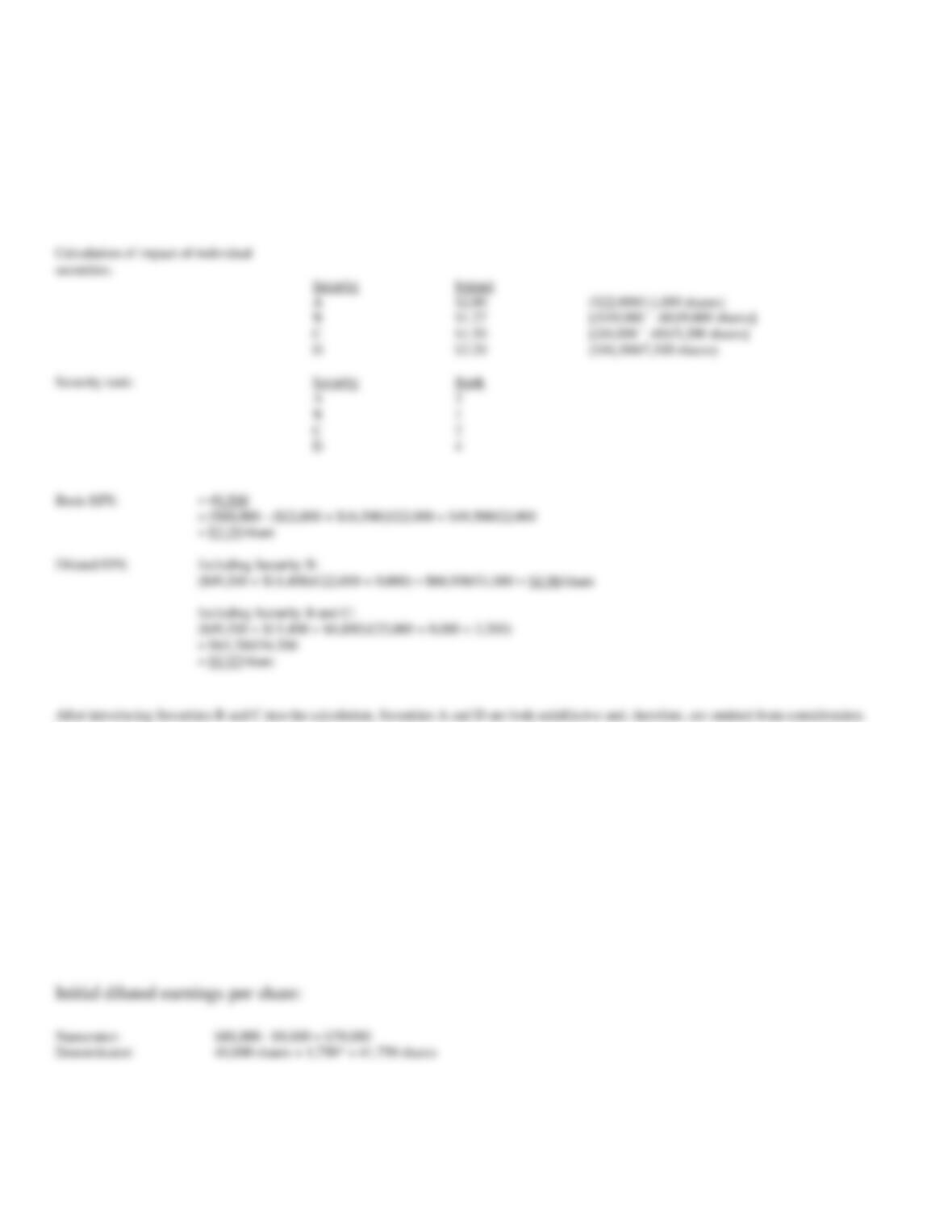
Security
Impact
A
$2.00
$22,000/11,000 shares
B
$1.27
($19,000 ´ .60)/9,000 shares
C
$1.50
($8,000 ´ .60)/3,200 shares
D
$2.20
$16,500/67,500 shares
Security
Rank
A
3
B
1
C
2
D
4
79. Dave Company had 30,000 shares of common stock outstanding on January 1 and issued an additional
9,000 on August 1 of 2010. The company also has $100,000 of 8% convertible bonds outstanding during the
year. Each $1,000 bond is convertible into 5 shares of common stock. Dave had after-tax net income for the
year of $160,000, and the tax rate was 30%.
Required:
Compute the appropriate earnings per share amount(s) to be reported on Dave Company’s 2010 income
statement, and explain your answer.
Numerator:
$160,000
Denominator:
Jan. 1 – July 31:
30,000 ´ 7/12
= $17,500
Aug. 1 – Dec. 31:
39,000 ´ 5/12
= 16,250
Numerator:
$160,000 + [($100,000 ´ .08) ´ (1 – .30)] = $165,600
Denominator:
33,750 shares + (100 ´ 5 shares) = 34,250 shares
80. During 2010, Sanchez, Inc. had the following convertible securities outstanding:
A.
$220,000 of 10%, $100 par, cumulative preferred stock. Each share is convertible into 5 shares of common stock.
B.
$200,000 of 9.5% convertible bonds. Each $1,000 bond is convertible into 45 shares of common stock.
C.
$100,000 of 8% convertible bonds. Each $1,000 bond is convertible into 32 shares of common stock.
D.
$150,000 of 10%, $100 par, cumulative preferred stock. Each share is convertible into 5 shares of common stock.
Numerator:
$82,500
Denominator:
22,000 shares + (1,000 ´ 8) = 30,000 shares
Sanchez, Inc. has an income tax rate of 40%. Its reported net income for 2010 was $88,000, and it had 22,000 shares of common stock outstanding all
year.
Required:
Calculate basic and diluted earnings per share for Sanchez.
81. Rhonda Company had 40,000 shares of common stock outstanding during 2010 and compensatory stock
options to purchase 5,000 shares of common stock at $10 a share plus a $3 a share unrecognized compensation
cost (net of tax). The average market price is $20 a share. The company also had 7% convertible preferred stock
on which dividends of $9,000 were declared. Each preferred share is convertible into 6,000 common shares.
Rhonda’s after-tax net income was $88,000, and the tax rate was 40%.
Required:
Compute 2010 diluted earnings per share for Rhonda Company.
82. As of December 31, 2010, the Rau Corporation has 10,000 shares of 10% preferred stock issued and
outstanding with a total par value of $250,000. In addition, as of this date, Rau has 75,000 shares of common
stock issued and outstanding with a total par value of $750,000. Dividends for 2009 and 2010 have not been
paid. As of December 31, 2010, the Rau Corporation declared total cash dividends of $290,000 to be paid to
both the preferred stockholders and the common stockholders.
Required:
How much cash will be distributed to both the preferred stockholders and the common stockholders,
respectively, on December 31, 2010, under each of the following independent situations?
a.
The preferred stock is noncumulative and nonparticipating.
b.
The preferred stock is cumulative and nonparticipating.
c.
The preferred stock is cumulative and fully participating.
d.
The preferred stock is cumulative and partially participating up to 15% of its par value.
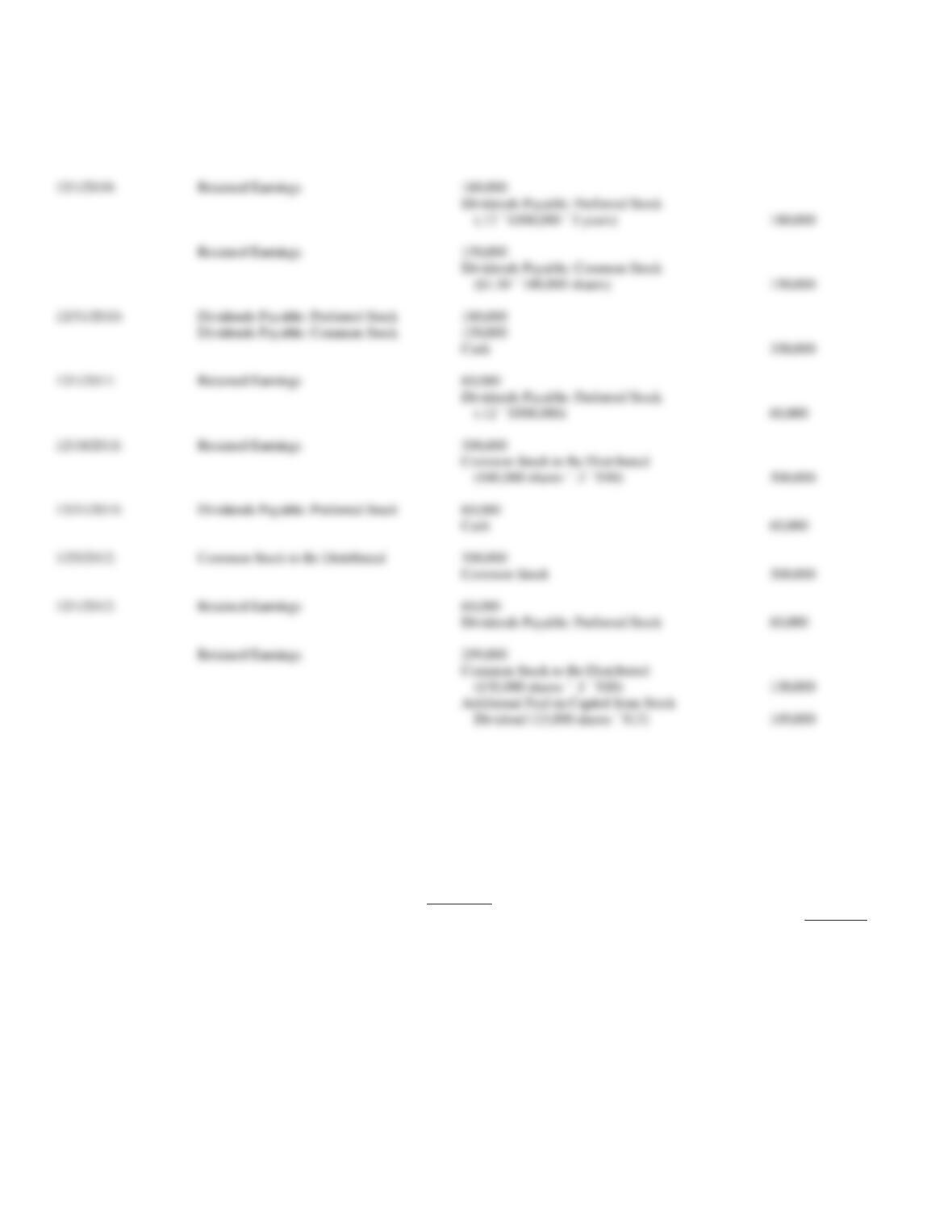
a.
Preferred stockholders (10% ´ $250,000)
$ 25,000
Common stockholders ($290,000 – $25,000)
265,000
Preferred stockholders ($25,000 ´ 3 years)
$ 75,000
Common stockholders ($290,000 – $75,000)
215,000
c.
Preferred stockholders:
$25,000 ´ 3 years
$ 75,000
$250,000/$1,000,000 ´ $140,000
35,000
$110,000
Common stockholders:
$750,000 ´ .1
$ 75,000
$750,000/$1,000,000 ´ $140,000
105,000
$180,000
d.
Preferred stockholders:
$25,000 ´ 3 years
$ 75,000
.05 ´ $250,000
12,500
$ 87,500
Common stockholders:
$750,000 ´ .1
$ 75,000
*
Assumed shares issued
5,000
Less: assumed shares reacquired
3,250
[5,000 ´ ($10 + 3)]/$20
Increase in shares
1,750
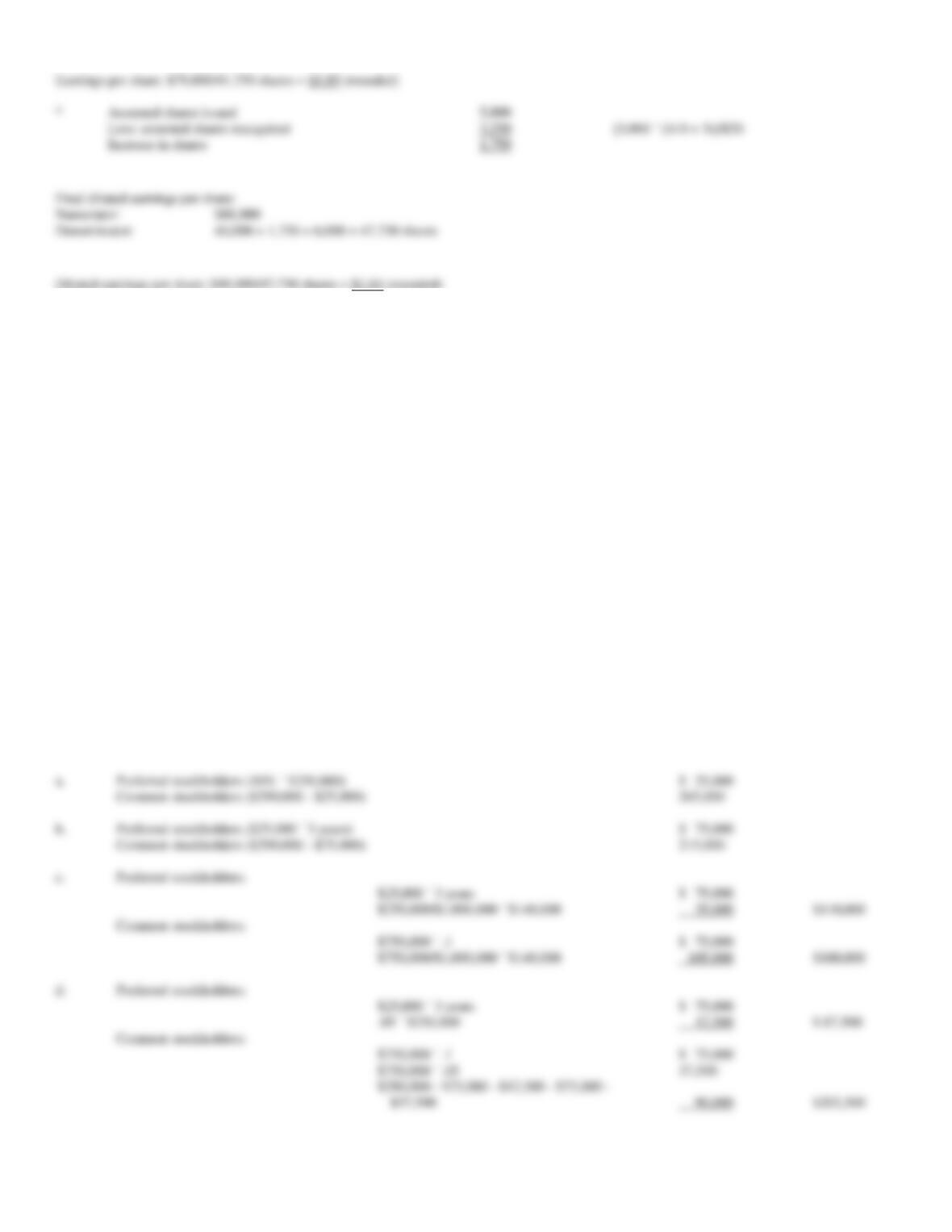
Numerator:
$88,000
Denominator:
40,000 + 1,750 + 6,000 = 47,750 shares

83. The Comfort Corporation’s stockholders’ equity accounts have the following balances as of January 1, 2010:
12% preferred stock, cumulative, $50 par
(10,000 shares issued and outstanding)
$ 500,000
Common stock, $10 par (100,000 shares issued and outstanding)
1,000,000
Additional paid-in capital: common
1,000,000
Retained earnings
3,750,000
Total stockholders’ equity
$6,250,000
Comfort engaged in the following dividend transactions during 2010, 2011, and 2012:
2010:
Dividends are in arrears for 2008 and 2009. On December 1, 2010, the annual cash dividend plus the dividends in arrears were
declared on the preferred stock. In addition, a $1.50 per share dividend was declared on the common stock. The dividends were
paid on December 31, 2010.
2011:
On December 1, 2011, the annual cash dividend on the preferred stock was declared. The dividend was paid on December 31,
2011.
On December 10, a 30% stock dividend was declared on the common stock, distributable on January 25, 2012. The market price
per share for the common stock on December 10, 2011, was $28.
2012:
On January 25, 2012, the stock dividend declared on December 10, 2011, was issued.
On December 1, the annual cash dividend on the preferred stock was declared; it is payable on January 15, 2013.
In addition, on December 1, a 10% stock dividend was declared on the common stock, distributable on January 20, 2013. The
market price per share for the common stock on December 1, 2012, was $23.
No other stock transactions took place during 2010, 2011, or 2012.
Required:
Prepare the entries to record the dividend transactions for 2010, 2011, and 2012. (Do not record any transactions for 2013.)
84. The Naomi Corporation’s stockholders’ equity accounts have the following balances as of January 1, 2010:
Common stock, $10 par (60,000 shares issued and outstanding)
$ 600,000
Additional paid-in capital: common
1,500,000
Retained earnings
1,200,000
Total stockholders’ equity
$3,300,000
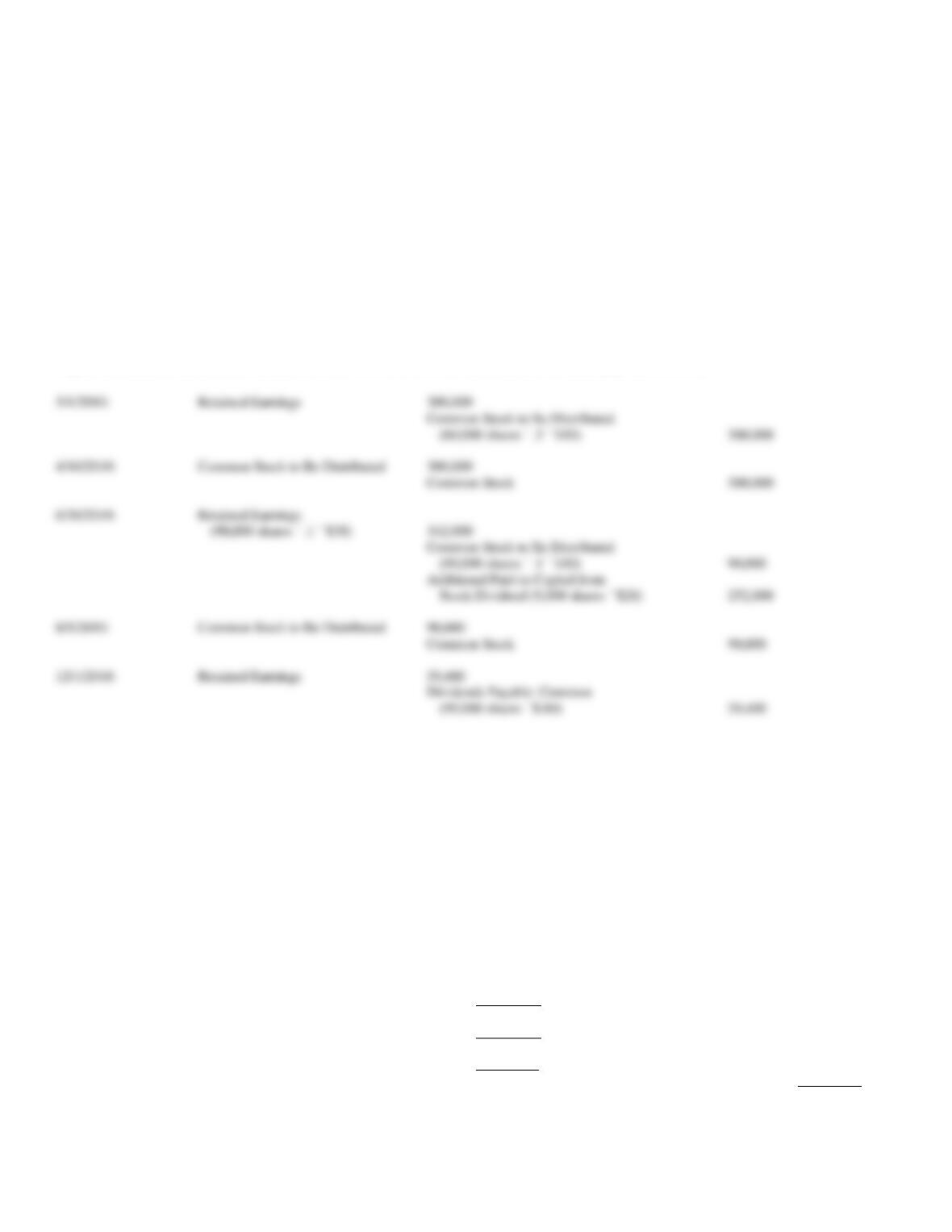
12/1/2010:
Retained Earnings
180,000
Dividends Payable: Preferred Stock
(.12 ´ $500,000 ´ 3 years)
180,000
Retained Earnings
150,000
Dividends Payable: Common Stock
($1.50 ´ 100,000 shares)
150,000
Dividends Payable: Preferred Stock
180,000
Dividends Payable: Common Stock
150,000
Cash
330,000
12/1/2011:
Retained Earnings
60,000
Dividends Payable: Preferred Stock
(.12 ´ $500,000)
60,000
Retained Earnings
300,000
Common Stock to Be Distributed
(100,000 shares ´ .3 ´ $10)
300,000
Dividends Payable: Preferred Stock
60,000
Cash
60,000
1/25/2012:
Common Stock to Be Distributed
300,000
Common Stock
300,000
12/1/2012:
Retained Earnings
60,000
Dividends Payable: Preferred Stock
60,000
Retained Earnings
299,000
Common Stock to Be Distributed
(130,000 shares ´ .1 ´ $10)
130,000
Additional Paid-in Capital from Stock
Dividend (13,000 shares ´ $13)
169,000
Naomi engaged in the following dividend transactions during 2010:
March 1:
Declared a 50% stock dividend on the common stock, distributable on April 10. The market price per share for the
common stock was $35 on March 1.
April 10:
Distributed the stock dividend declared on March 1.
June 30:
Declared a 10% stock dividend on the common stock, distributable on August 5. The market price for the common stock
was $38 per share on June 30.
August 5:
Distributed the stock dividend declared on June 30.
December 1:
A $.60 per share cash dividend was declared on the common stock, payable on January 20, 2011.
Required:
Prepare the entries to record the dividend transactions for 2010. (Do not record the cash dividend payment in 2011.)
85. Following is the stockholders’ equity section of Liu Corporation’s balance sheet on December 31, 2009.
STOCKHOLDERS’ EQUITY
Contributed capital:
Preferred stock, 9%, $100 par (8,000 shares authorized, 4,000 shares
issued and outstanding)
$ 400,000
Common stock, $5 par (50,000 shares authorized, 30,000 shares issued
and outstanding)
150,000
Common stock subscribed, $5 par (3,000 shares at a subscription price
of $34 per share)
15,000
Additional paid-in capital on preferred stock
64,000
Additional paid-in capital on common stock
350,000
Total contributed capital
$ 979,000
Retained earnings
440,000
Total contributed capital and retained earnings
$1,419,000
Less: Treasury stock (500 shares of common at $22 per share)
(11,000)
Total stockholders’ equity
$1,408,000
3/1/2010:
Retained Earnings
300,000
Common Stock to Be Distributed
(60,000 shares ´ .5 ´ $10)
300,000
4/10/2010:
Common Stock to Be Distributed
300,000
Common Stock
300,000
6/30/2010:
Retained Earnings
(90,000 shares ´ .1 ´ $38)
342,000
Common Stock to Be Distributed
(90,000 shares ´ .1 ´ $10)
90,000
Additional Paid-in Capital from
Stock Dividend (9,000 shares ´ $28)
252,000
8/5/2010:
Common Stock to Be Distributed
90,000
12/1/2010:
Retained Earnings
59,400
Dividends Payable: Common
(99,000 shares ´ $.60)
59,400

During 2010, the following transactions occurred:
·
2,000 shares of common stock were issued for cash at $25 per share.
·
750 shares of preferred stock were issued for cash at $124 per share.
·
400 shares of treasury stock were reissued for cash at $25 per share.
·
The final payments on the subscribed common stock were received, and 3,000 shares of common stock were issued.
·
On July 1, 2010, Liu purchased equity securities for $50,000 and classified them as available for sale. The fair value of these securities
was $60,000 on December 31, 2010.
·
Net income for 2010 was $228,000 and total dividends paid were $81,000.
Required:
Prepare in good form a statement of changes in stockholders’ equity for Liu Corporation for the year ended December 31, 2010.
LIU CORPORATION
Statement of Changes in Stockholder’s
Equity
For Year Ended December 31, 2010
Preferred Stock
Common Stock
>
Shares
Par
Shares
Par
>
Explanation
Issued
Value
Issued
Value
Subscribed
>
Balances 1/1/2010
4,000
$400,000
30,000
$150,000
$ 15,000
>
Issued for cash
>
(common)
2,000
10,000
>
Issued for cash
>
(preferred)
750
75,000
>
Reissued treasury
>
stock
>
Issued subscribed
>
Stock
3,000
15,000
(15,000)
>
Unrealized increase
>
in value of available-
>
for-sale securities
>
>
Net income
>
Cash dividends
>
Balances 12/31/2010
4,750
$475,000
35,000
$175,000
0
>
<
Accum.
<
Additional
Paid-in Capital
Other
Treasury
<
Preferred
Common
Treasury
Retained
Compr.
Stock
<
Stock
Stock
Stock
Earnings
Income
(cost)
<
Balances 1/1/2010
$64,000
$350,000
$ 0
$440,000
$ 0
($11,000)
<
Issued for cash
<
(common)
40,000
<
Issued for cash
<
(preferred)
18,000
<
Reissued treasury
<
stock
1,200
8,800
<
Issued subscribed
<
stock
<
Unrealized increase
<
in value of avail-
<
able-for-sale
<
Cash dividends
(81,000)
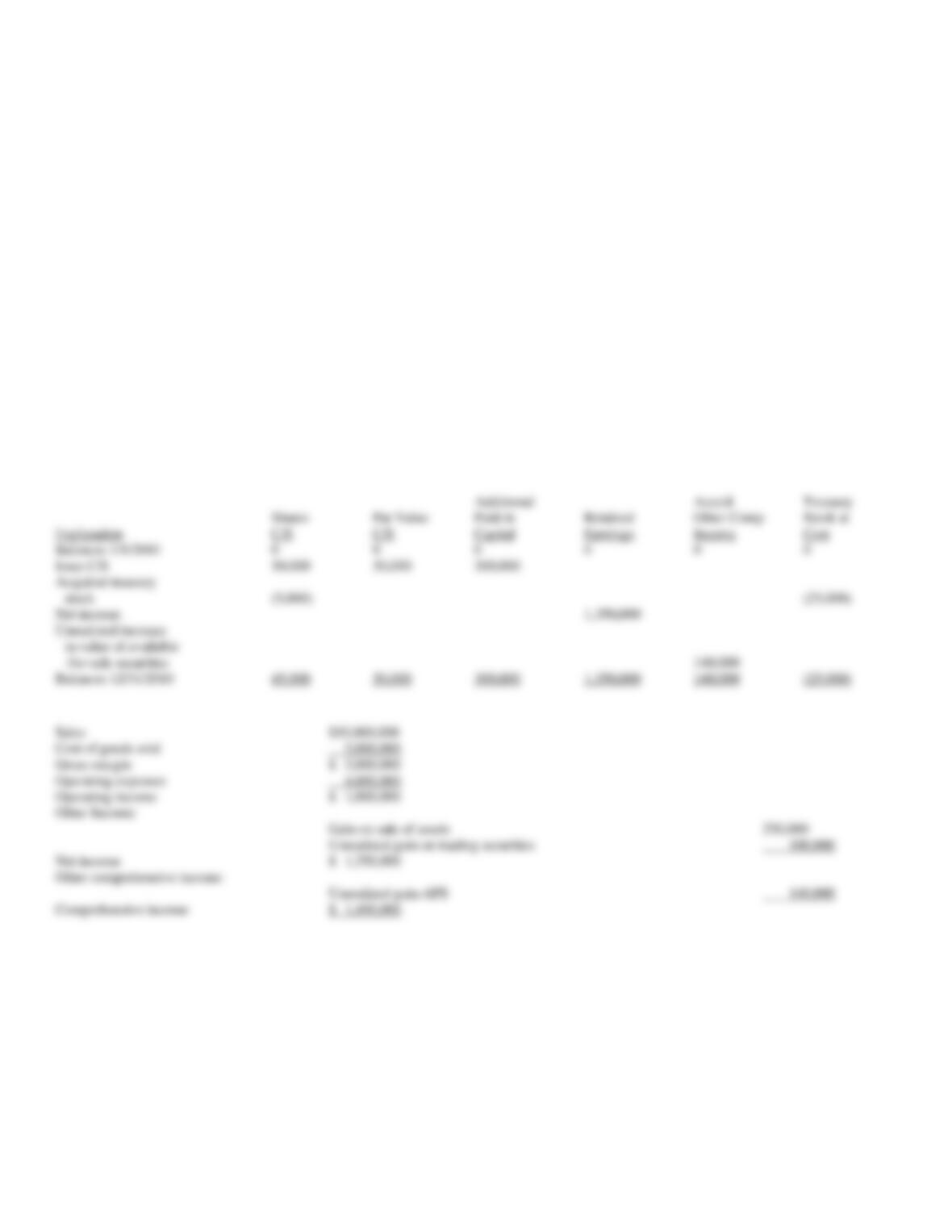
86. Rutledge was organized at the beginning of 2010. It had the following income items for the year ended
December 31, 2010:
Sales
$10,000,000
Gain on sale of assets
250,000
Unrealized gain available for sale securities
140,000
Unrealized gain on trading securities
100,000
Cost of goods sold
5,000,000
Operating expenses
4,000,000
As a new company, Rutledge issued 50,000 shares of $1 par common stock for $350,000. On July 5, 2010, Rutledge reacquired 5,000 shares of its
own stock for $25,000.
Required:
Prepare the December 31, 2010 statement of changes in stockholders’ equity.
Additional
Accu’d
Treasury
Shares
Par Value
Retained
Other Comp
Stock at
Explanation
C/S
C/S
Capital
Earnings
Income
Cost
Balances 1/1/2010
0
0
0
0
Issue C/S
50,000
50,000
300,000
Acquired treasury
stock
(5,000)
(25,000)
Net income
1,350,000
Unrealized increase
in value of available
-for-sale securities
140,000
Balances 12/31/2010
45,000
50,000
300,000
1,350,000
140,000
(25,000)
Sales
$10,000,000
Cost of goods sold
5,000,000
Gross margin
$ 5,000,000
Operating expenses
4,000,000
Operating income
$ 1,000,000
Other Income:
Gain on sale of assets
250,000
Unrealized gain on trading securities
100,000
Net income
$ 1,350,000
Other comprehensive income:
Unrealized gain-AFS
140,000
Comprehensive income
$ 1,490,000
87. Below is information for A Company and B Company at the end of 2010. The items for both companies are
the same; however, A Company uses the cost method to account for treasury stock while B Company uses the
par value method.
A Company
B Company
Common stock:
Authorized number of shares
75,000
75,000
Issued number of shares
20,000
20,000
Treasury shares
500
500
Cost of treasury shares
$ 4,200
$ 4,200
Par value
$ 10
$ 10
Additional paid-in capital on common stock
$ 32,000
$ 31,200
Additional paid-in capital from treasury stock
$ 1,600
Retained earnings
$125,300
$125,300
Required:
Prepare the stockholders’ equity section of the balance sheet for each company.
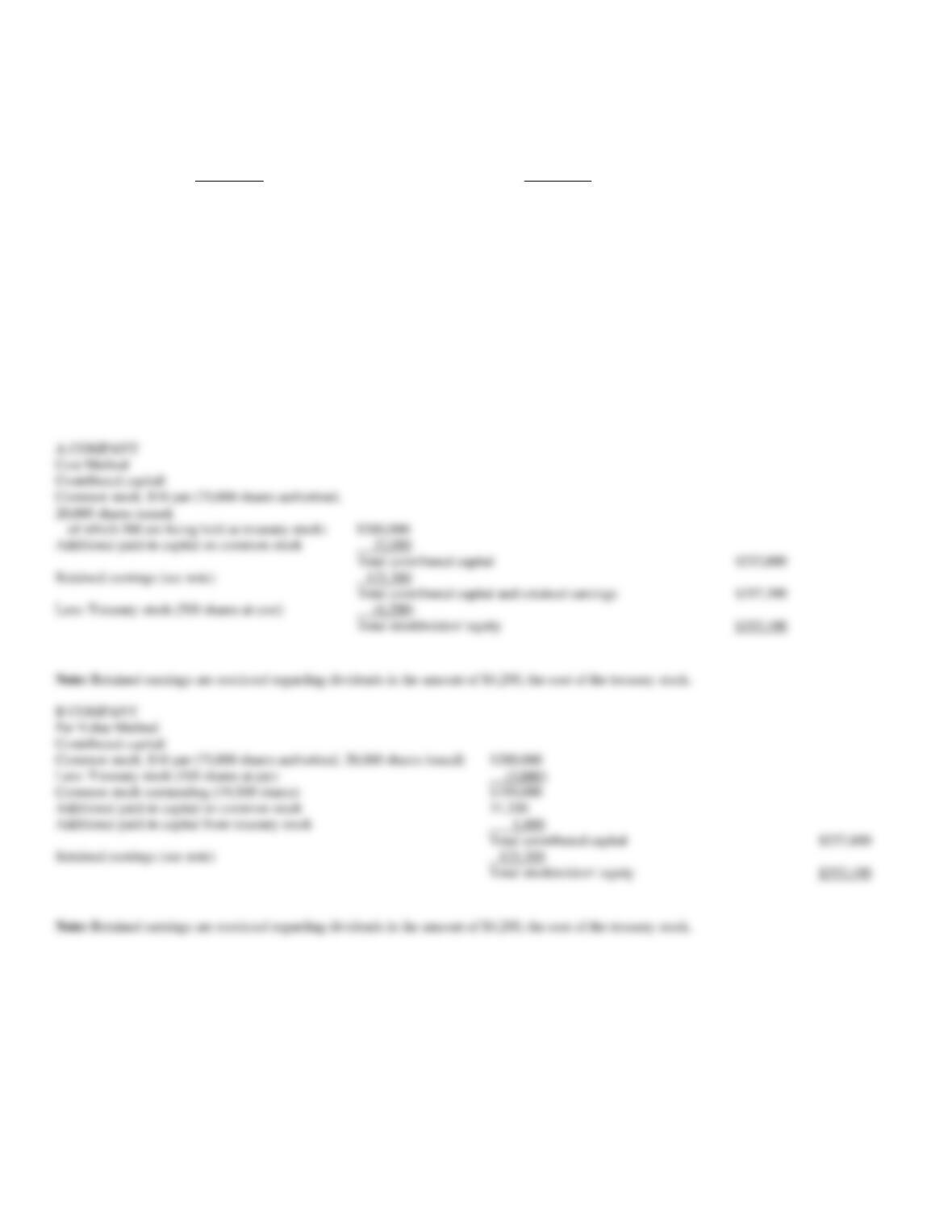
Contributed capital:
of which 500 are being held as treasury stock)
$200,000
Additional paid-in capital on common stock
32,000
Total contributed capital
$232,000
Retained earnings (see note)
125,300
Total contributed capital and retained earnings
$357,300
Less: Treasury stock (500 shares at cost)
(4,200)
Total stockholders’ equity
$353,100
Contributed capital:
Common stock, $10 par (75,000 shares authorized, 20,000 shares issued)
$200,000
Less: Treasury stock (500 shares at par)
(5,000)
Common stock outstanding (19,500 shares)
$195,000
Additional paid-in capital on common stock
31,200
Additional paid-in capital from treasury stock
1,600
Total contributed capital
Retained earnings (see note)
125,300
Total stockholders’ equity
88. When the basic and diluted earnings per share amounts are disclosed on the income statement, additional
disclosures are made in the footnotes.
Required:
Describe the information contained in the footnotes concerning the basic and diluted earnings per share.
89. Corporations with complex capital structures are required to report both the basic and diluted earnings per
share amounts. In order to compute the diluted earnings per share, potential common shares must be considered.
Required:
List the sequence of steps necessary to include potential common shares in the diluted earnings per share
calculation.
90. When computing diluted earnings per share, a company may use the if converted method or the treasury
stock method.
Required:
Describe when and why a company would use each method.
91. The board of directors of the Sound Design Corporation is trying to establish the dividends policy for 2010
for the company. The board has asked you, the vice president of finance, to attend the meeting in order to get
your input. You were asked to discuss and evaluate stock dividends from the perspective of both (1) the
stockholders, and (2) the issuing corporation’s viewpoint.
Required:
a.
Theoretically, from a stockholder’s viewpoint, stock dividends have several disadvantages. Discuss the disadvantages associated with
stock dividends from the stockholder’s perspective.
b.
Discuss the advantages associated with a stock dividend from the issuing corporation’s viewpoint.
c.
For financial accounting purposes, explain how the cost of a stock dividend is measured at the date of declaration.
decrease because of the increase in the number of shares.
future for cash dividends.
specific number of shares is used to measure the value of the stock dividend.
92. Corporations are required to report accumulated other comprehensive income (or loss) in stockholders’
equity.
Required:
If a corporation has more than one type of other comprehensive income, how may it report these types in its
stockholders’ equity?
93. IFRS and GAAP are similar in regard to computing earnings per share components. However, the
calculation of the impact from the exercise of options differs.
Required:
a.
Describe the difference in treatment of unrecognized compensation cost relating to options in the calculation of EPS.
b.
Explain why the IFRS approach will systematically result in lower reported diluted EPS.
early. IFRS makes no adjustment for unrecognized compensation cost.