165) Identify each of the following activities as unit level (U), batch level (B), product level (P),
or facility level (F) to indicate the way each is incurred with respect to production.
_____ (1) Providing electricity
_____ (2) Sampling product quality
_____ (3) Cutting parts
_____ (4) Receiving shipments
_____ (5) Organizing production
_____ (6) Printing checks
_____ (7) Providing personnel support
_____ (8) Calibrating machines
_____ (9) Cleaning workplace
_____ (10) Assembling components
166) Direct labor, direct materials, and manufacturing overhead are all product costs. Why is
overhead more difficult to account for than either direct labor or direct materials?
167) Name and briefly describe three overhead rate methods.
168) Explain cost flows for the plantwide overhead rate method.
169) Explain cost flows for the departmental overhead rate method.
170) Explain cost flows for activity-based costing.
171) What is the basic principle underlying activity-based costing?
172) How does ABC differ from using multiple departmental rates?
173) What are the major advantages of using a plantwide overhead rate?
174) Explain some of the disadvantages of the departmental overhead rate method.
175) Why is overhead allocation under ABC usually more accurate than either the plantwide
overhead allocation method or the departmental overhead allocation method?
176) Identify and explain the four control levels associated with activity-based costing.
177) A company estimates that overhead costs for the next year will be $7,200,000 for indirect
labor, $400,000 for factory utilities, and $43,000 for depreciation on factory machinery. The
company uses direct labor hours as its overhead allocation base. If 955,375 direct labor hours are
planned for this next year, what is the company’s plantwide overhead rate?
178) A company estimates that overhead costs for the next year will be $3,600,000 for indirect
labor, $200,000 for factory utilities, and $21,500 for depreciation on factory machinery. The
company uses machine hours as its overhead allocation base. If 764,300 machine hours are
planned for this next year, what is the company’s plantwide overhead rate?
179) A company has two products: A and B. It uses a plantwide overhead allocation method
based on activity 2 and has prepared the following analysis showing budgeted costs and
activities. Use this information to compute (a) the company’s plantwide overhead rate and (b) the
amount of overhead allocated to Product A.
Activity Cost Pool
Budgeted
Overhead Cost
Budgeted Activity
Product A
Product B
Total
Activity 1
$160,000
400
1,600
2,000
Activity 2
$110,000
2,000
1,000
3,000
Activity 3
$180,000
1,200
10,800
12,000
Total budgeted overhead
$450,000
180) A company has two products: A and B. It uses activity-based costing and has prepared the
following analysis showing budgeted costs and activities. Use this information to compute (a) the
company’s overhead rates for each of the three activities and (b) the amount of overhead
allocated to Product A.
Activity Cost Pool
Budgeted
Overhead Cost
Budgeted Activity
Product A
Product B
Total
Activity 1
$160,000
400
1,600
2,000
Activity 2
$110,000
2,000
1,000
3,000
Activity 3
$180,000
1,200
10,800
12,000
Total budgeted overhead
$450,000
181) A company has two products: AA and BB. It uses a plantwide overhead allocation method
based on activity 33 and has prepared the following analysis showing budgeted costs and
activities. Use this information to compute the company’s plantwide overhead rate.
Activity Cost Pool
Budgeted
Overhead Cost
Budgeted Activity
Product AA
Product BB
Total
Activity 11
$40,000
100
400
500
Activity 22
$55,000
500
250
750
Activity 33
$90,000
300
1,700
2,000
Total budgeted overhead
$185,000
182) A company expects next year’s overhead costs to be $400,000. During this time, the
company also expects to produce 1,000,000 units, have 200,000 direct labor hours, and 800,000
machine hours.
Make the following independent calculations.
a. Compute a plantwide overhead rate using units of production as the allocation base.
b. Compute a plantwide overhead rate using direct labor hours as the allocation base.
c. Compute a plantwide overhead rate using machine hours as the allocation base.
183) Superior Products Manufacturing identified the following data in its two production
departments.
Assembly
Finishing
Manufacturing overhead costs
$225,000
$420,000
Direct labor hours worked
6,600 DLH
9,000 DLH
Machine hours used
2,400 MH
5,200 MH
Make the following independent calculations (Round to two decimals).
a. Compute a plantwide overhead rate using machine hours as the allocation base.
b. Compute a plantwide overhead rate using direct labor hours as the allocation base.
184) Superior Products Manufacturing identified the following data in its two production
departments:
Assembly
Finishing
Manufacturing overhead costs
$225,000
$420,000
Direct labor hours worked
6,600 DLH
10,000 DLH
Machine hours used
2,400 MH
5,200 MH
Compute departmental overhead rates assuming the Assembly rate is based on machine hours
and the Finishing rate is based on direct labor hours.
185) Fischer Company identified the following activities, costs, and activity drivers:
Activity
Expected Costs
Expected Activity
Handling parts
$425,000
25,000 parts in stock
Inspecting product
$390,000
940 batches
Processing purchase orders
$220,000
440 orders
Designing packaging
$230,000
5 models
a. Compute a plantwide overhead rate assuming the company assigns overhead based on 70,000
budgeted direct labor hours (Round to two decimals).
b. Compute separate rates for each of the four activities using the activity-based costing.
186) Assume New Belgium Brewing Company manufactures and distributes three types of beer
and that estimated per unit product costs and related information for the next year are shown in
the following table:
Blue Paddle
Somersault
Cocoa Mole Ale
Cost data per unit:
Direct materials
$100,000
$500,000
$750,000
Direct labor
$3,600
$4,800
$6,000
Overhead
$12,000
$16,000
$20,000
Total product cost per unit
$115,600
$520,800
$776,000
Machine hours per unit
30 MH
40 MH
50 MH
Number of units produced per year
30 units
20 units
10 units
a. If New Belgium Brewing Company uses a plantwide overhead rate based on machine hours,
what is the total product cost per unit of Cocoa Mole Ale?
b. Blue Paddle is a traditional brew made in large quantities with long production runs.
Somersault is a seasonal beer made in small batches. Cocoa Mole Ale is a specialty beer also
made in small batches. Which of the overhead allocation methods studied in this chapter would
you recommend that New Belgium Brewing Company use and why?
187) Time Bender Company makes watches and clocks. The following estimated data are
available for the company’s next fiscal year:
Total direct labor costs: $1,700,000
Total setup costs: $190,000
Watches
Clocks
Expected production
800,000
100,000
Direct labor hours needed
68,000 DLH
17,000 DLH
Machine setups needed
1,000 setups
1,000 setups
Determine the setup cost per unit for the watches and the clocks if setup costs are assigned using
a plantwide overhead rate based on direct labor hours. (Round to two decimal places.)
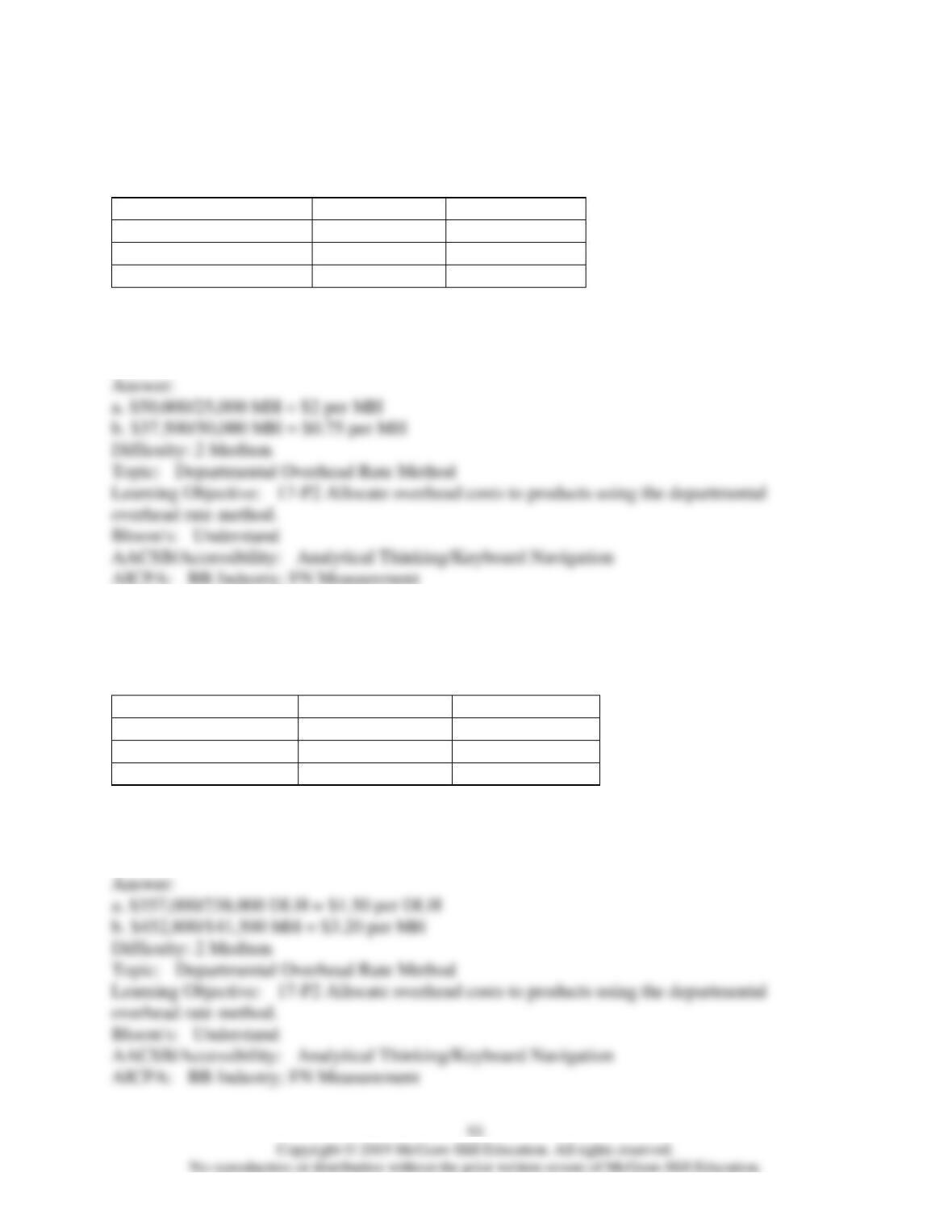
188) Base Runner, Inc. manufactures baseball bats that go through two operations, cutting and
sanding, before they are complete. Expected costs and activities for the two departments are
shown in the following table:
Cutting
Sanding
Direct labor hours
50,000 DLH
5,000 DLH
Machine hours
25,000 MH
50,000 MH
Overhead costs
$50,000
$37,500
a. Compute a departmental overhead rate for the cutting department based on machine hours.
b. Compute a departmental overhead rate for the sanding department based on machine hours.
189) Blast Rocket Company manufactures candy-coated popcorn treats that go through two
operations, popping and baking, before they are complete. Expected costs and activities for the
two departments are shown in the following table:
Popping
Baking
Direct labor hours
238,000 DLH
50,000 DLH
Machine hours
25,000 MH
141,500 MH
Overhead costs
$357,000
$452,800
a. Compute a departmental overhead rate for the popping department based on direct labor hours.
b. Compute a departmental overhead rate for the baking department based on machine hours.
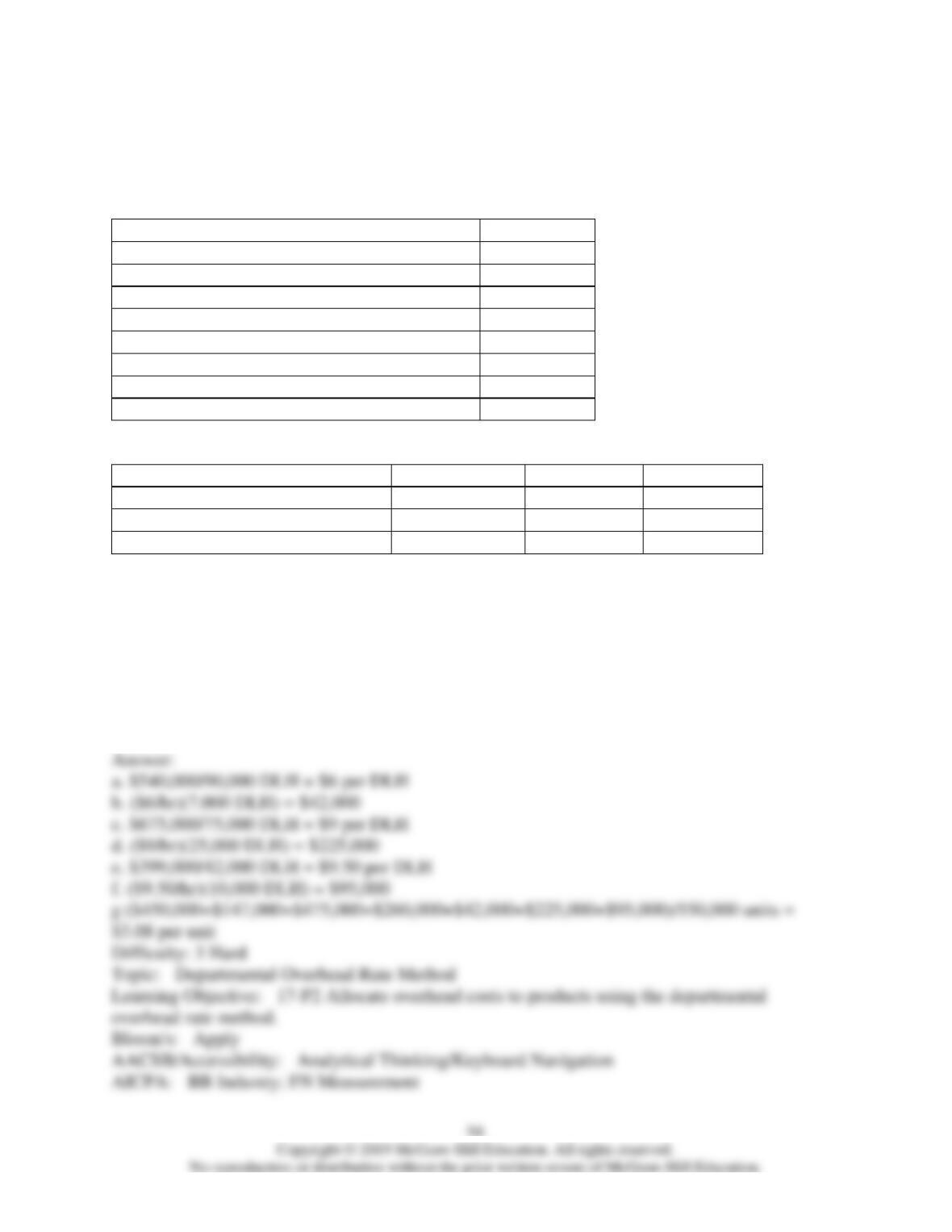
190) Freeze Frame, Inc. produces cameras that require three processes, A, B, and C, to complete.
Digital camera model #789 is the best-selling of all the many types of cameras produced.
Information related to the 550,000 units of digital camera model #789 produced annually is
shown below.
Direct materials
$450,000
Direct labor
Department A (7,000 DLH x $21 per DLH)
$147,000
Department B (25,000 DLH x $19 per DLH)
$475,000
Department C (10,000 DLH x $26 per DLH)
$260,000
Machine Hours
Department A
42,000 MH
Department B
23,000 MH
Department C
38,000 MH
Freeze Frame’s total expected overhead costs and related overhead data are shown below:
Department A
Department B
Department C
Direct labor hours
90,000 DLH
75,000 DLH
42,000 DLH
Machine hours
67,500 MH
135,000 MH
53,200 MH
Manufacturing overhead costs
$540,000
$675,000
$399,000
a. Compute a departmental overhead rate for department A based on direct labor hours.
b. How much overhead is associated with model 789 from department A?
c. Compute a departmental overhead rate for department B based on direct labor hours.
d. How much overhead is associated with model 789 from department B?
e. Compute a departmental overhead rate for department C based on direct labor hours.
f. How much overhead is associated with model 789 from department C?
g. What is the per unit cost of the 550,000 units of model 789?
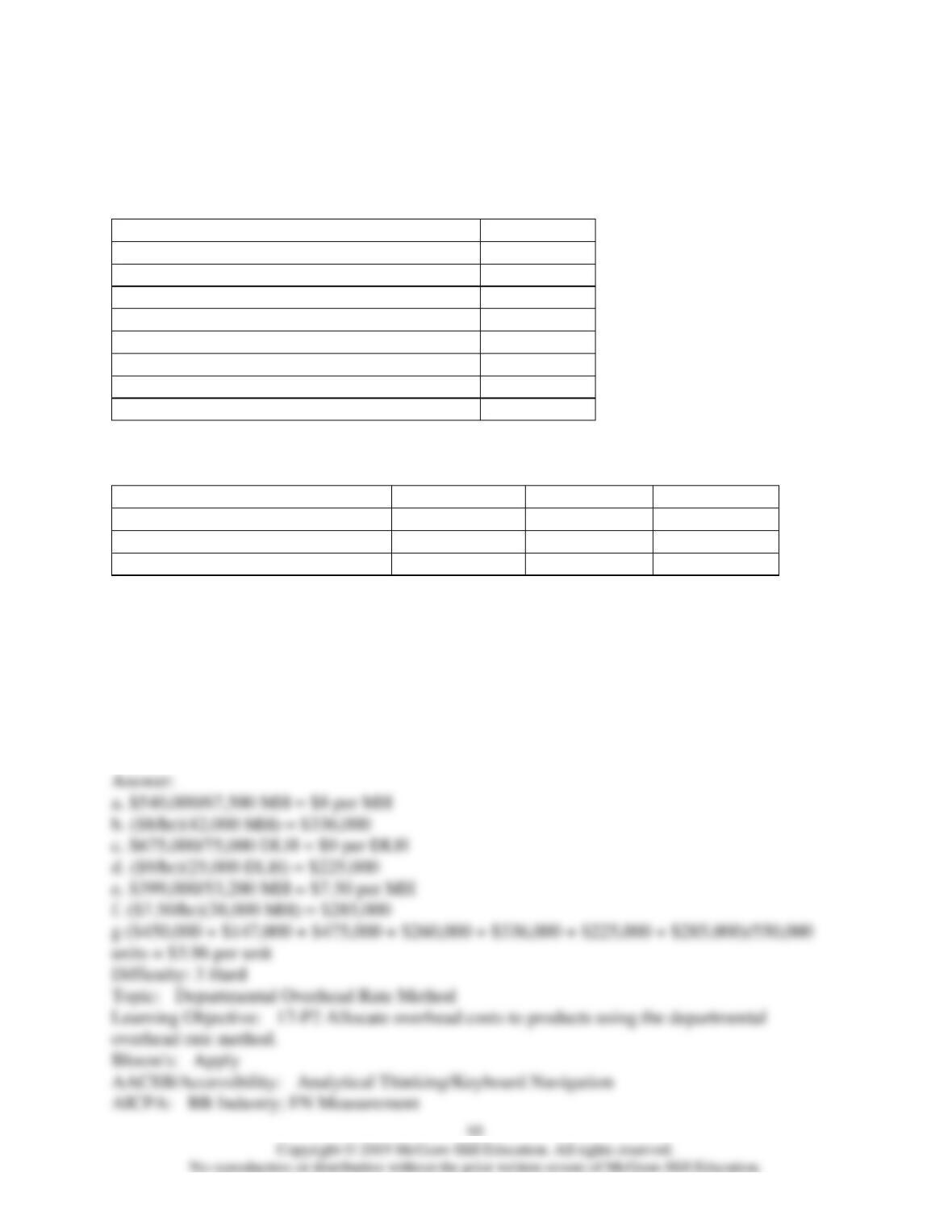
191) Freeze Frame, Inc. produces cameras that require three processes, A, B, and C, to complete.
Digital camera model #789 is the best-selling of all the many types of cameras produced.
Information related to the 550,000 units of digital camera model #789 produced annually is
shown below:
Direct materials
$450,000
Direct Labor
Department A (7,000 DLH x $21 per DLH)
$147,000
Department B (25,000 DLH x $19 per DLH)
$475,000
Department C (10,000 DLH x $26 per DLH)
$260,000
Machine Hours
Department A
42,000 MH
Department B
23,000 MH
Department C
38,000 MH
Freeze Frame’s total expected overhead costs and related overhead data are shown in the
following table:
Department A
Department B
Department C
Direct labor hours
90,000 DLH
75,000 DLH
42,000 DLH
Machine hours
67,500 MH
135,000 MH
53,200 MH
Manufacturing overhead costs
$540,000
$675,000
$399,000
a. Compute a departmental overhead rate for department A based on machine hours.
b. How much overhead is associated with model 789 from department A?
c. Compute a departmental overhead rate for department B based on direct labor hours.
d. How much overhead is associated with model 789 from department B?
e. Compute a departmental overhead rate for department C based on machine hours.
f. How much overhead is associated with model 789 from department C?
g What is the per unit cost of the 550,000 units of model 789?
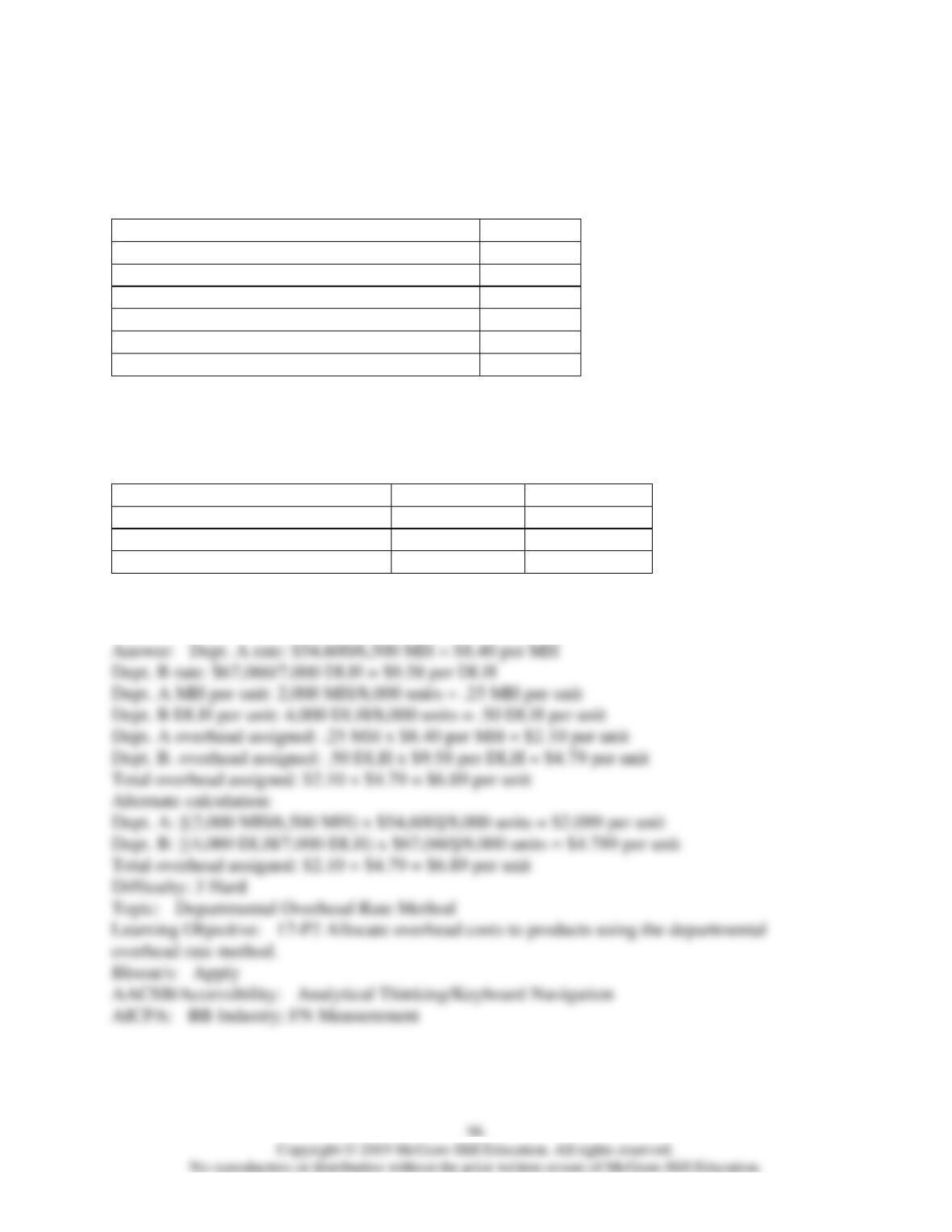
192) Outer Limits, Inc. produces fencing units which require two processes, A and B, to
complete. The best-selling type of fence is made of PVC. Information related to the 8,000 units
of pvc fencing produced annually is shown below.
Direct materials
$450,000
Direct labor
Department A (5,000 DLH x $23 per DLH)
$115,000
Department B (4,000 DLH x $25 per DLH)
$100,000
Machine hours
Department A
2,000 MH
Department B
3,000 MH
Outer Limits’ total expected overhead costs and related overhead data are shown below. The
company uses departmental overhead rates based on machine hours in department A and direct
labor hours in department B.
Department A
Department B
Direct labor hours
9,000 DLH
7,000 DLH
Machine hours
6,500 MH
13,000 MH
Manufacturing overhead costs
$54,600
$67,060
Determine the total amount of overhead assigned to each unit of PVC fencing.
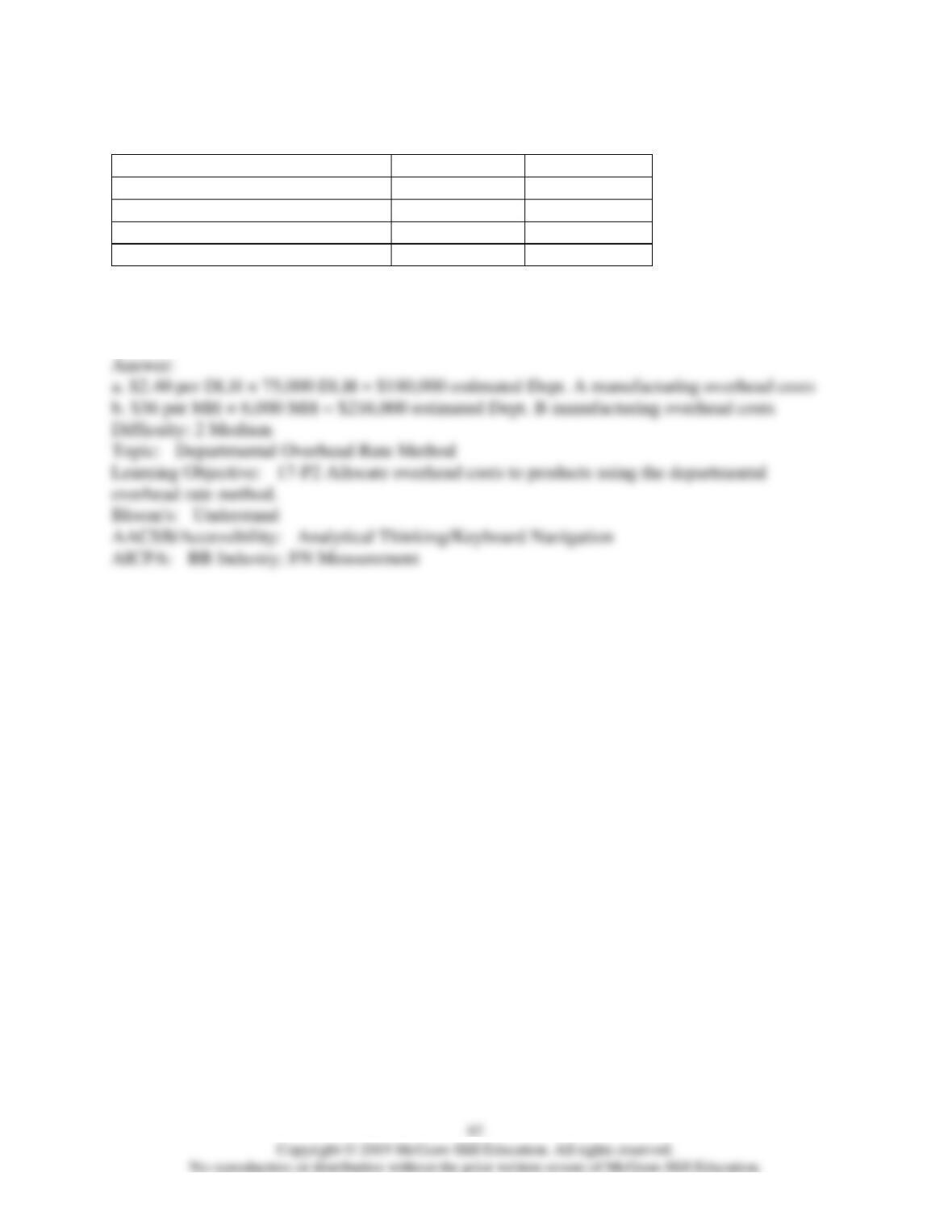
193) A company’s total expected overhead costs and related overhead data are shown below.
Department A
Department B
Direct labor hours
75,000 DLH
30,000 DLH
Machine hours
3,000 MH
6,000 MH
Manufacturing overhead costs
?
?
Departmental overhead rate
$2.40 per DLH
$36 per MH
a. Compute estimated manufacturing overhead costs for Department A.
b. Compute estimated manufacturing overhead costs for Department B.
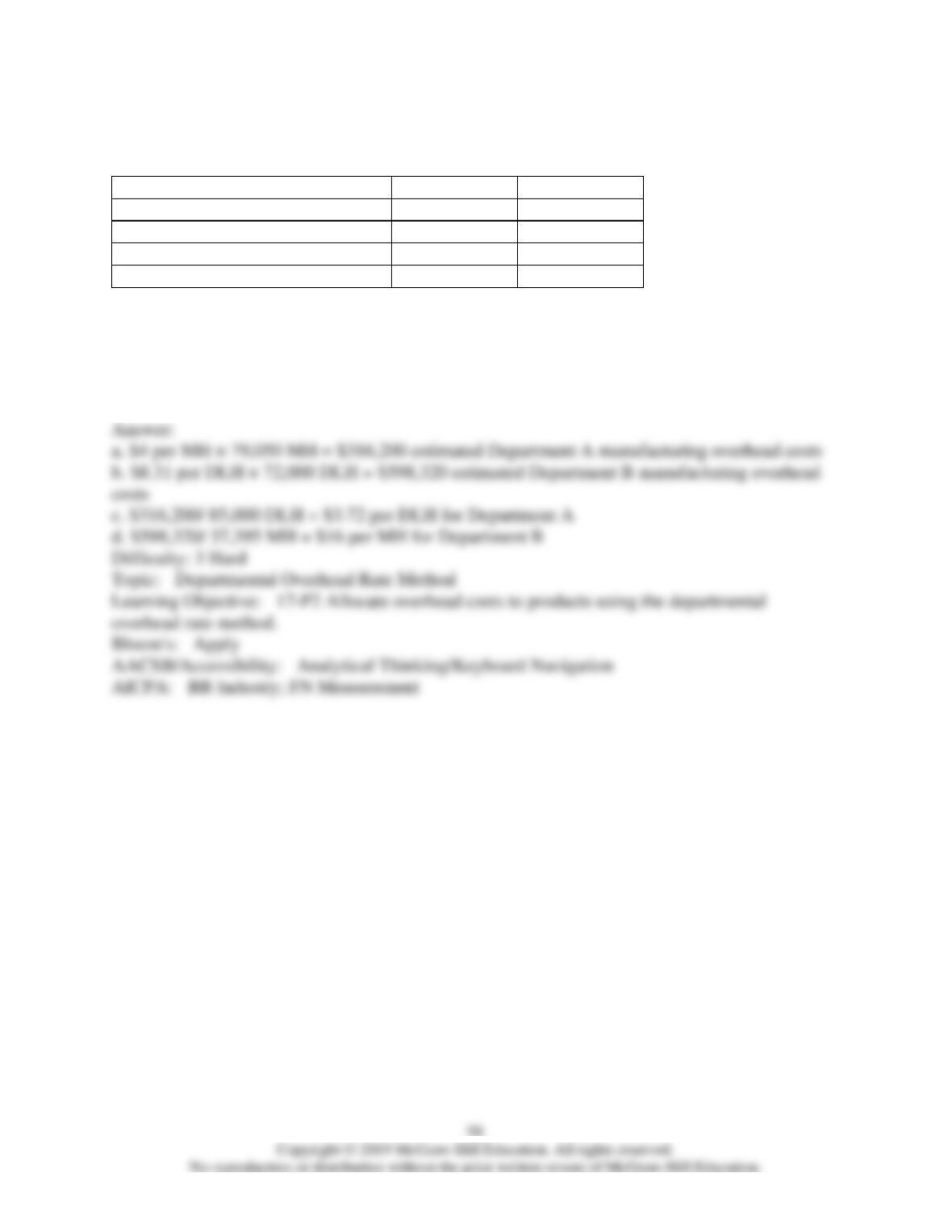
194) A company’s total expected overhead costs and related overhead data are shown in the
following table:
Department A
Department B
Direct labor hours
85,000 DLH
72,000 DLH
Machine hours
79,050 MH
37,395 MH
Manufacturing overhead costs
?
?
Departmental overhead rate
$4 per MH
$8.31 per DLH
a. Compute estimated manufacturing overhead costs for Department A.
b. Compute estimated manufacturing overhead costs for Department B.
c. Compute the departmental overhead rate based on direct labor hours for Department A.
d. Compute the departmental overhead rate based on machine hours for Department B.