52) When accounting for pensions, delayed recognition of gains and losses in earnings achieves:
A) Income averaging.
B) Expense averaging.
C) Income optimization.
D) Income smoothing.
53) Which of the following is not a potential component of pension expense?
A) Return on plan assets.
B) Prior service cost.
C) Retiree benefits paid.
D) Gains and losses.
54) A net gain or loss affects the pension expense only if it exceeds an amount equal to what
percentage of the PBO or plan assets, whichever is higher?
A) 5%.
B) 10%.
C) 15%.
D) 20%.
55) Pension gains related to plan assets occur when:
A) The return on plan assets is higher than expected.
B) The vested benefit obligation is less than expected.
C) Retiree benefits paid out are less than expected.
D) The accumulated benefit obligation is more than expected.
56) The amortization of a net gain has what effect on pension expense?
A) Decreases it.
B) Has no effect on it.
C) Increases it (but only by the amount over 10% of the PBO).
D) Increases it (regardless of the amount).
57) Assume that at the beginning of the current year, a company has a net gain-AOCI of
$25,000,000. At the same time, assume the PBO and the plan assets are $200,000,000 and
$150,000,000, respectively. The average remaining service period for the employees expected to
receive benefits is 10 years. What is the amount of amortization to pension expense for the year?
A) $3,000,000.
B) $500,000.
C) $2,500,000.
D) $1,500,000.
58) Assume that at the beginning of the current year, a company has a net gain-AOCI of
$60,000,000. At the same time, assume the PBO and the plan assets are $300,000,000 and
$450,000,000, respectively. The average remaining service period for the employees expected to
receive benefits is 10 years. What is the amount of amortization to pension expense for the year?
A) $6,000,000.
B) $15,000,000.
C) $1,500,000.
D) $7,500,000.
59) Amortizing prior service cost for pension plans will:
A) Decrease assets.
B) Increase liabilities.
C) Increase shareholders’ equity.
D) Decrease retained earnings.
60) Scallion Company received the following reports of its defined benefit pension plan for the
current calendar year:
PBO
Plan assets
Balance, January 1
$
400,000
Balance, January 1
$
250,000
Service cost
195,000
Actual return
30,000
Interest cost
32,000
Annual contribution
110,000
Benefits paid
(80,000
)
Benefits paid
(80,000
)
Balance, December 31
$
547,000
Balance, December 31
$
310,000
The long-term expected rate of return on plan assets is 10%. Assuming no other data are
relevant, what is the pension expense for the year?
A) $197,000.
B) $227,000.
C) $172,000.
D) $202,000.
Service cost
$
195,000
Interest cost
32,000
Expected return on plan assets
)
Pension expense
$
202,000
61) Fox Company received the following reports of its defined benefit pension plan for the
current calendar year:
PBO
Plan assets
Balance, January 1
$
600,000
Balance, January 1
$
500,000
Service cost
360,000
Actual return
50,000
Interest cost
64,000
Annual contribution
220,000
Benefits paid
(90,000
)
Benefits paid
(90,000
)
Balance, December 31
$
934,000
Balance, December 31
$
680,000
The long-term expected rate of return on plan assets is 8%. Assuming no other data are relevant,
what is the pension expense for the year?
A) $360,000.
B) $424,000.
C) $374,000.
D) $384,000.
Service cost
$
360,000
Interest cost
64,000
Expected return on plan assets
)
Pension expense
$
384,000
62) The following information is related to the defined benefit pension plan of Dreamworld
Company for the year:
Service cost
$
60,000
Contributions to pension plan
110,000
Benefits paid to retirees
150,000
Plan assets (fair value), January 1
640,000
Plan assets (fair value), December 31
750,000
Actual return on plan assets
150,000
PBO, January 1
900,000
PBO, December 31
960,000
Discount rate
10
%
Long-term expected return on plan assets
9
%
Assuming no other relevant data exist, what is the pension expense for the year?
A) $190,000.
B) $92,400.
C) $60,000.
D) $170,000.
Service cost
60,000
Interest cost ($900,000 × 10%)
90,000
Expected return on plan assets ($640,000 × 9%)
)
Pension expense
92,400
63) The following information is related to the defined benefit pension plan of Simpson
Company for the year:
Service cost
$
90,000
Contributions to pension plan
140,000
Benefits paid to retirees
110,000
Plan assets (fair value), January 1
540,000
Plan assets (fair value), December 31
650,000
Actual return on plan assets
80,000
PBO, January 1
800,000
PBO, December 31
870,000
Discount rate
10
%
Long-term expected return on plan assets
9
%
Assuming no other relevant data exist, what is the pension expense for the year?
A) $90,000.
B) $230,600.
C) $121,400.
D) $154,000.
Service cost
$
90,000
Interest cost ($800,000 × 10%)
80,000
Expected return on plan assets ($540,000 × 9%)
)
Pension expense
$
121,400
64) Colombo Enterprises has a defined benefit pension plan. At the end of the reporting year, the
following data were available: beginning PBO, $75,000; service cost, $14,000; interest cost,
$6,000; benefits paid for the year, $9,000; ending PBO, $89,000; and the expected return on plan
assets, $10,000. There were no other pension-related costs. The journal entry to record the annual
pension costs will include a debit to pension expense for:
A) $20,000.
B) $15,000.
C) $12,000.
D) $10,000.
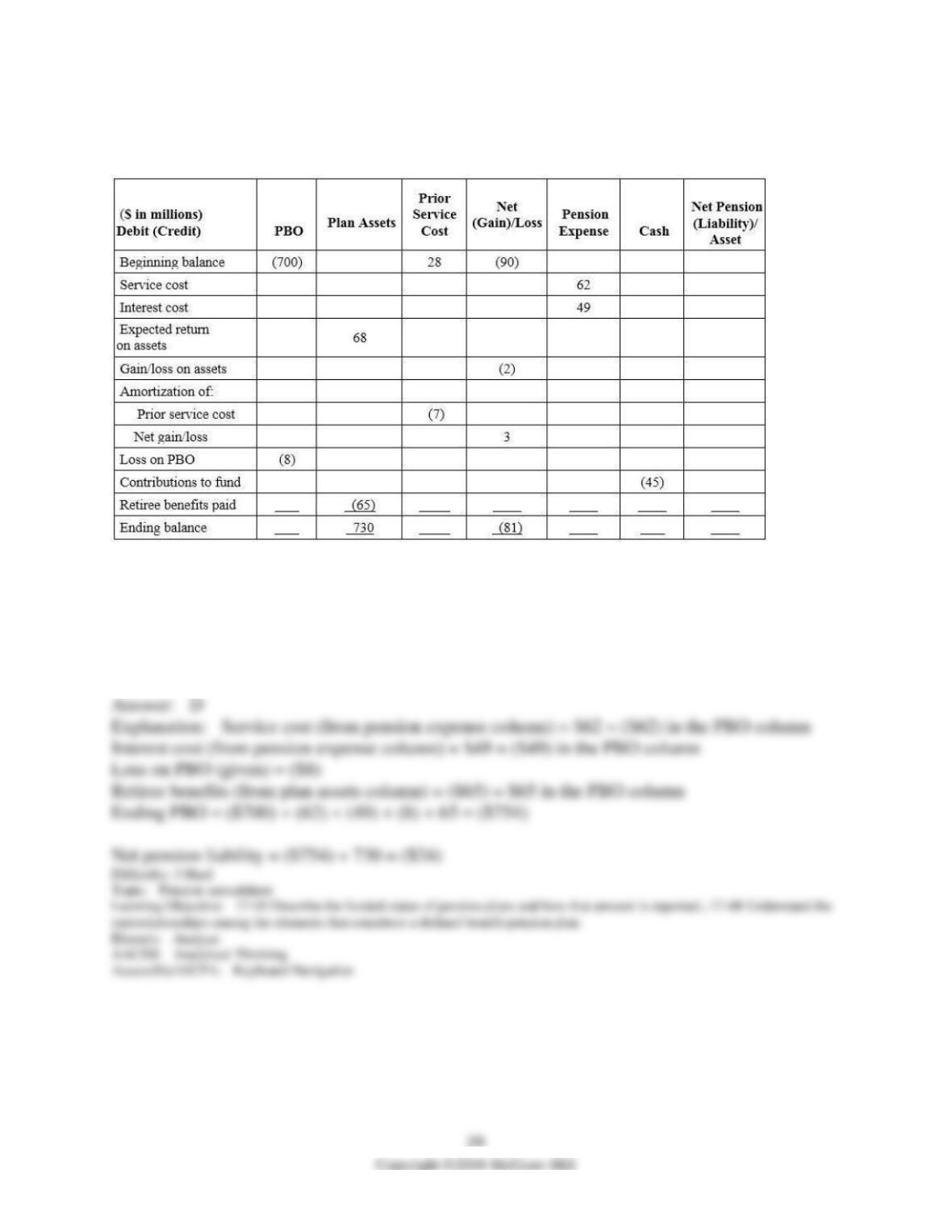
65) The following incomplete (columns have missing amounts) pension spreadsheet is for the
current year for First Republic Corporation (FRC).
What was the net pension asset/liability reported in the balance sheet at the end of the year?
A) Net pension asset of $50.
B) Net pension asset of $24.
C) Net pension liability of $50.
D) Net pension liability of $24.
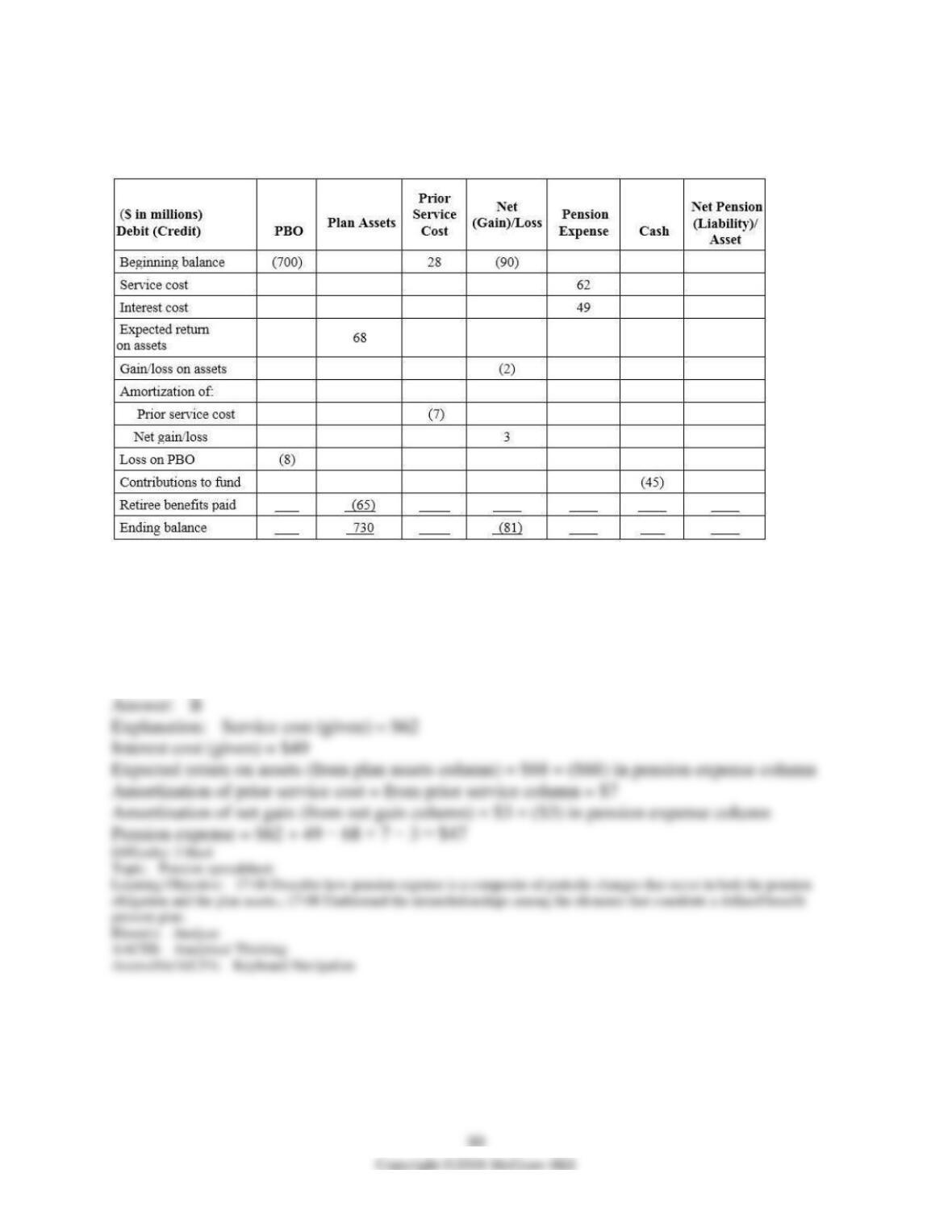
66) The following incomplete (columns have missing amounts) pension spreadsheet is for the
current year for First Republic Corporation (FRC).
What was FRC’s pension expense for the year?
A) $44.
B) $47.
C) $49.
D) $107.
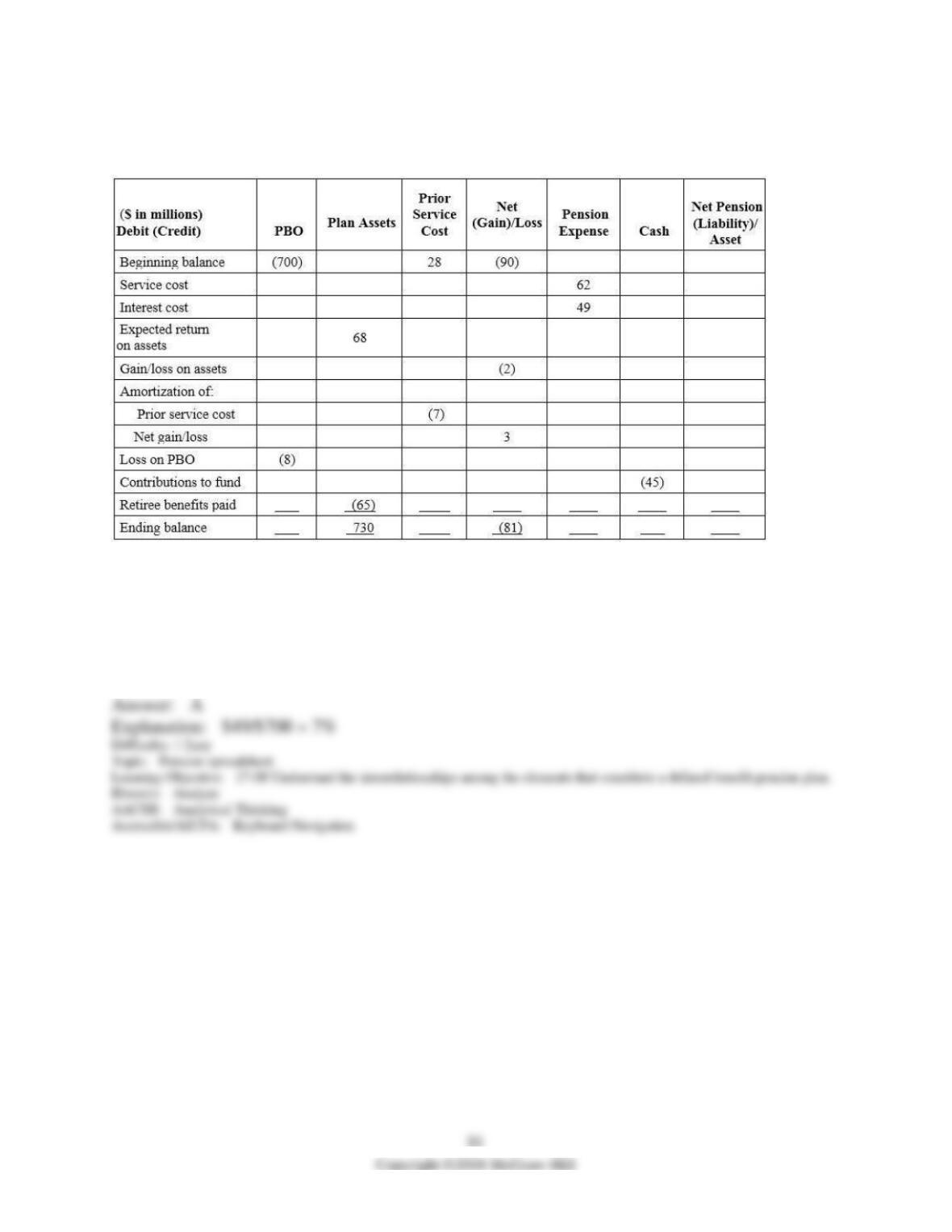
67) The following incomplete (columns have missing amounts) pension spreadsheet is for the
current year for First Republic Corporation (FRC).
What was the actuary’s interest (discount) rate?
A) 7%.
B) 8%.
C) 9%.
D) 10%.
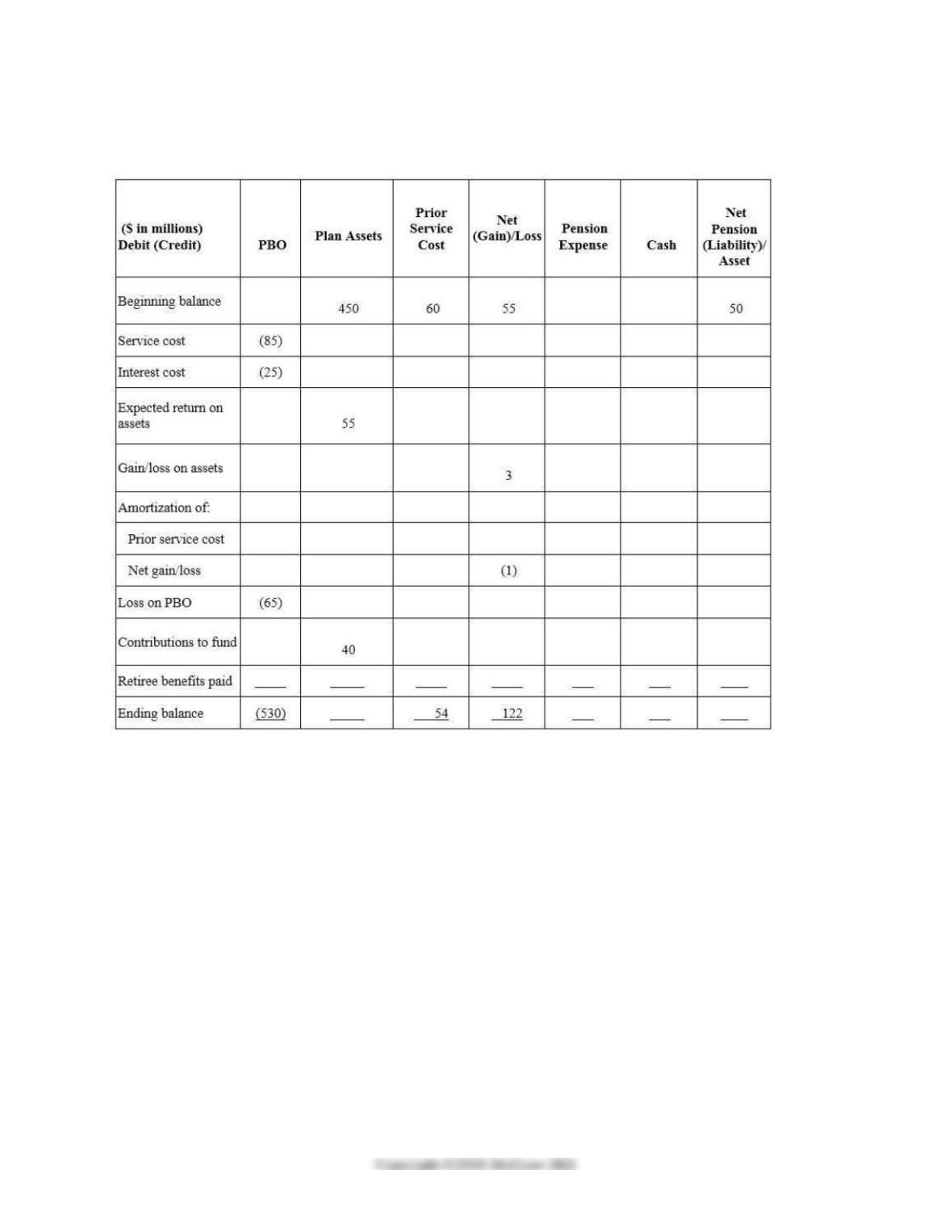
32
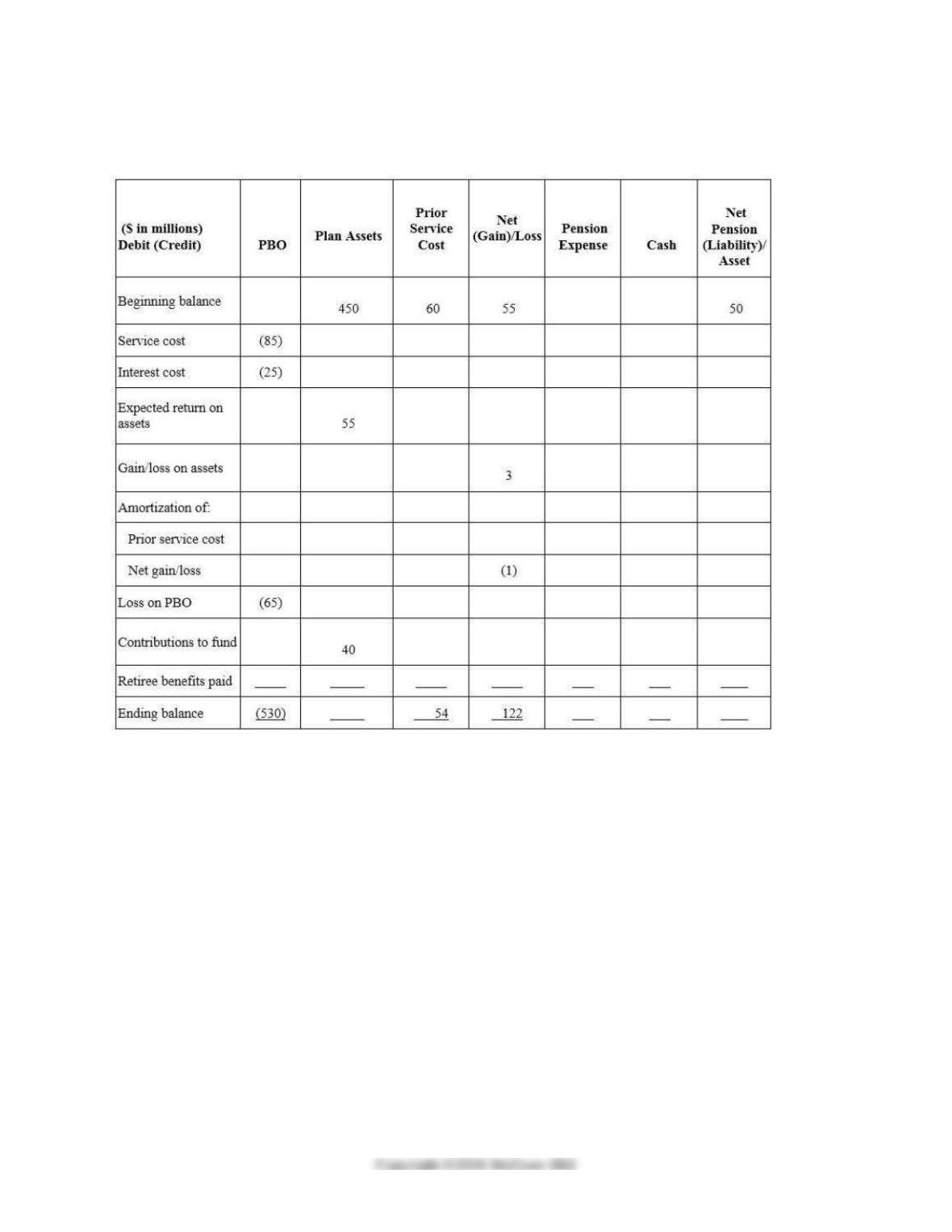
68) The following refers to the pension spreadsheet (columns have missing amounts) for the
current year for Pancho Villa Enterprises (PVE).
What was PVE’s pension expense for the year?
A) $250.
B) $50.
C) $68.
D) $62.
34
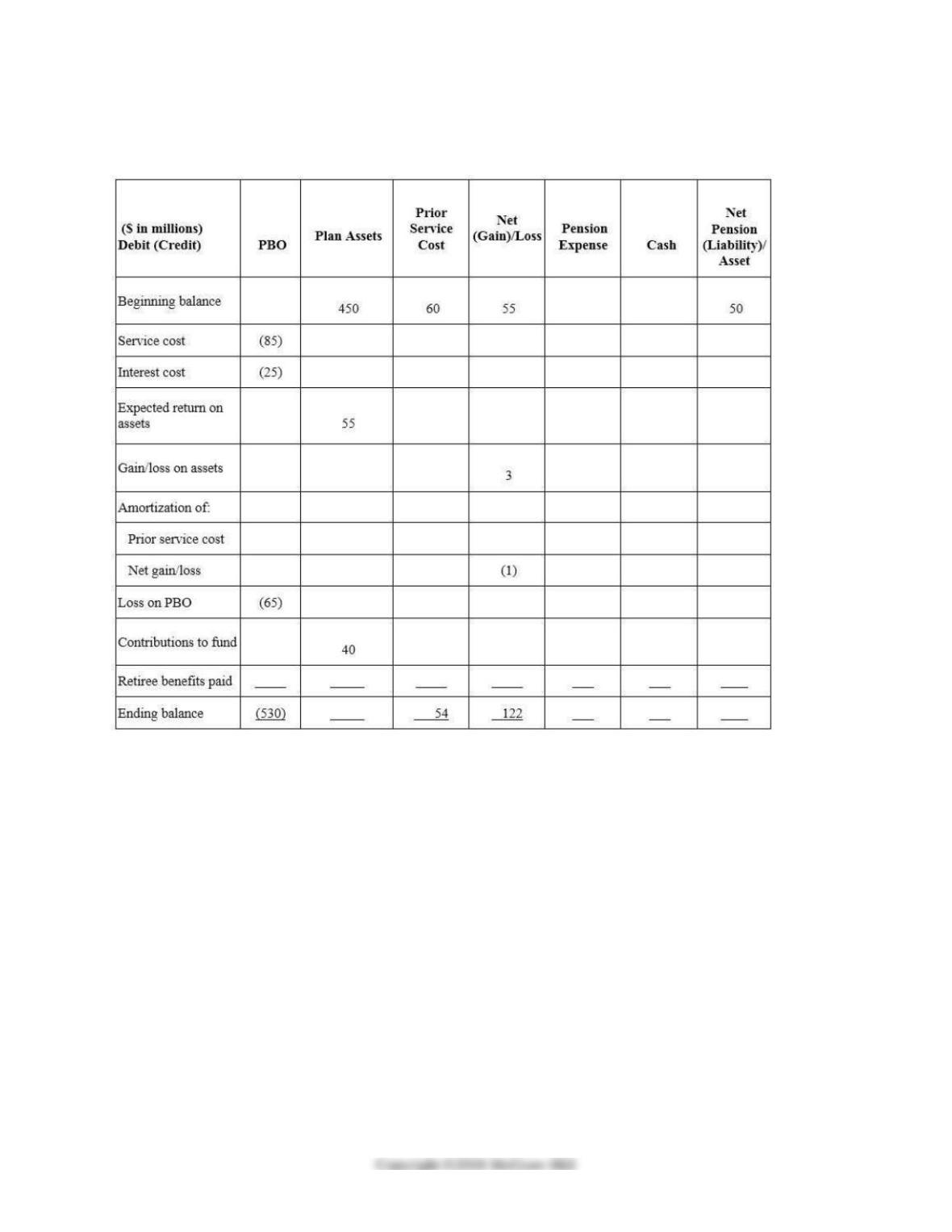
69) The following refers to the pension spreadsheet (columns have missing amounts) for the
current year for Pancho Villa Enterprises (PVE).
What was the PBO at the beginning of the year?
A) $160.
B) $400.
C) $500.
D) $610.
36
70) The following refers to the pension spreadsheet (columns have missing amounts) for the
current year for Pancho Villa Enterprises (PVE).
What were the retiree benefits paid?
A) $45.
B) $50.
C) $55.
D) $60.
71) Which of the following is a correct statement concerning the reporting of the pension plan on
the face of the employer’s balance sheet?
A) Only the plan assets are separately reported.
B) Only the PBO is separately reported.
C) Both the PBO and the plan assets are separately reported.
D) Neither the PBO nor the plan assets is separately reported.
72) Recording pension expense would usually:
A) Increase the PBO.
B) Increase current assets.
C) Increase the prior service cost-AOCI.
D) Increase the net loss-AOCI.
73) Accumulated other comprehensive income:
A) Is a liability.
B) Might include prior service cost.
C) Includes accumulated pension expense.
D) Is reported in the income statement.
74) A statement of comprehensive income does not include:
A) Net income.
B) Losses from the return on assets exceeding expectations.
C) Losses from changes in estimates regarding the PBO.
D) Prior service cost.
75) Amortizing prior service cost for pension plans will:
A) Increase retained earnings and increase accumulated other comprehensive income.
B) Decrease retained earnings and decrease accumulated other comprehensive income.
C) Increase retained earnings and decrease accumulated other comprehensive income.
D) Decrease retained earnings and increase accumulated other comprehensive income.
76) A statement of comprehensive income does not include:
A) Gains from the return on pension assets exceeding expectations.
B) Gains and losses on unsold held-to-maturity securities.
C) Losses from the return on pension assets falling short of expectations.
D) Prior service cost.
77) Gains and losses can occur with pension plans when:
A) Either the PBO or the return on plan assets turns out to be different than expected.
B) Either the ABO or the return on plan assets turns out to be different than expected.
C) Either the PBO, the ABO, or the return on plan assets turns out to be different than expected.
D) Either the PBO or the ABO turns out to be different than expected.
78) A gain from changing an estimate regarding the obligation for pension plans will:
A) Increase assets.
B) Increase liabilities.
C) Decrease shareholders’ equity.
D) Increase shareholders’ equity.
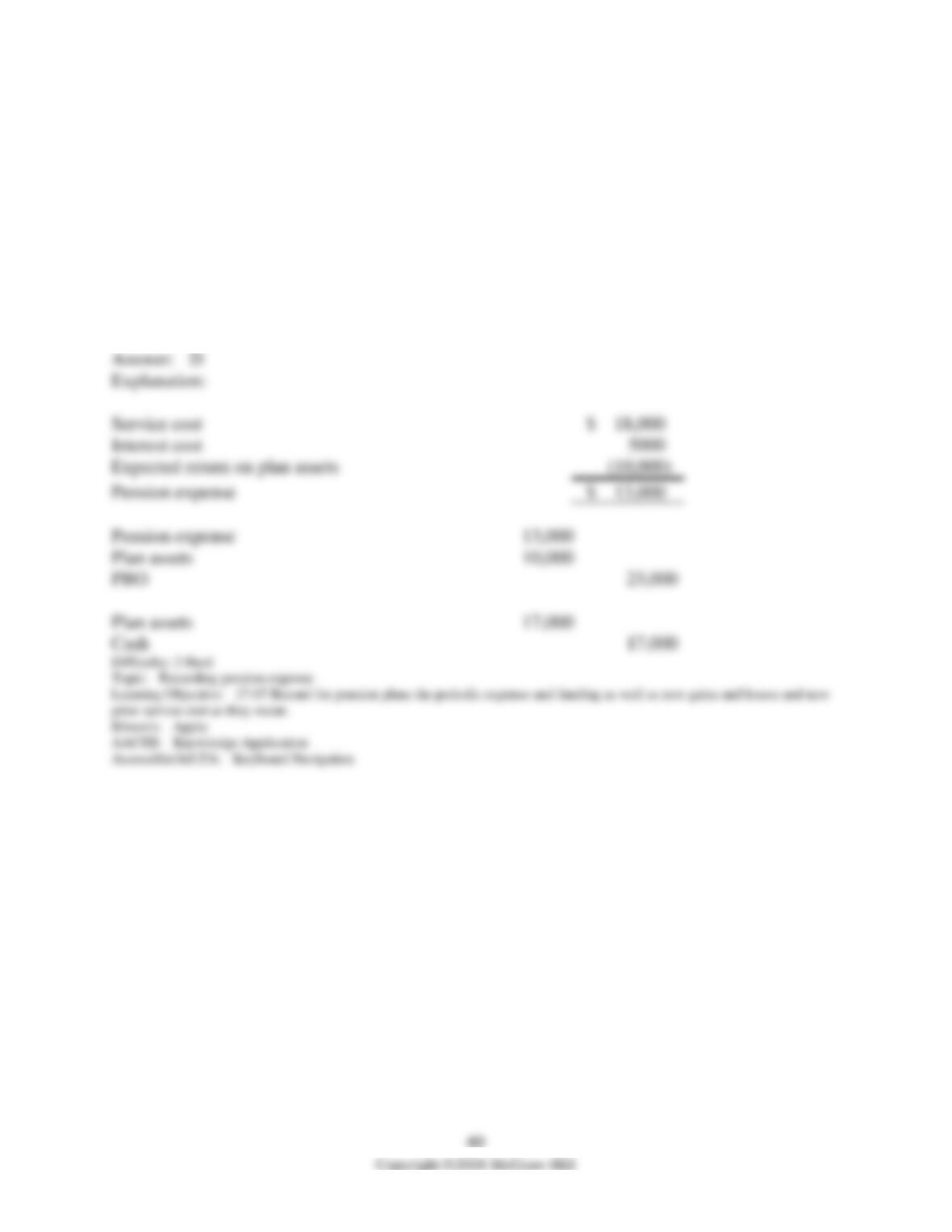
79) Castillo Company has a defined benefit pension plan. At the end of the reporting year, the
following data were available: beginning PBO, $75,000; service cost, $18,000; interest cost,
$5,000; benefits paid for the year, $9,000; ending PBO, $89,000; the expected return on plan
assets, $10,000; and cash deposited with pension trustee, $17,000. There were no other pension-
related costs. The journal entry to record the annual pension costs will include a credit to the
PBO for:
A) $13,000.
B) $17,000.
C) $18,000.
D) $23,000.