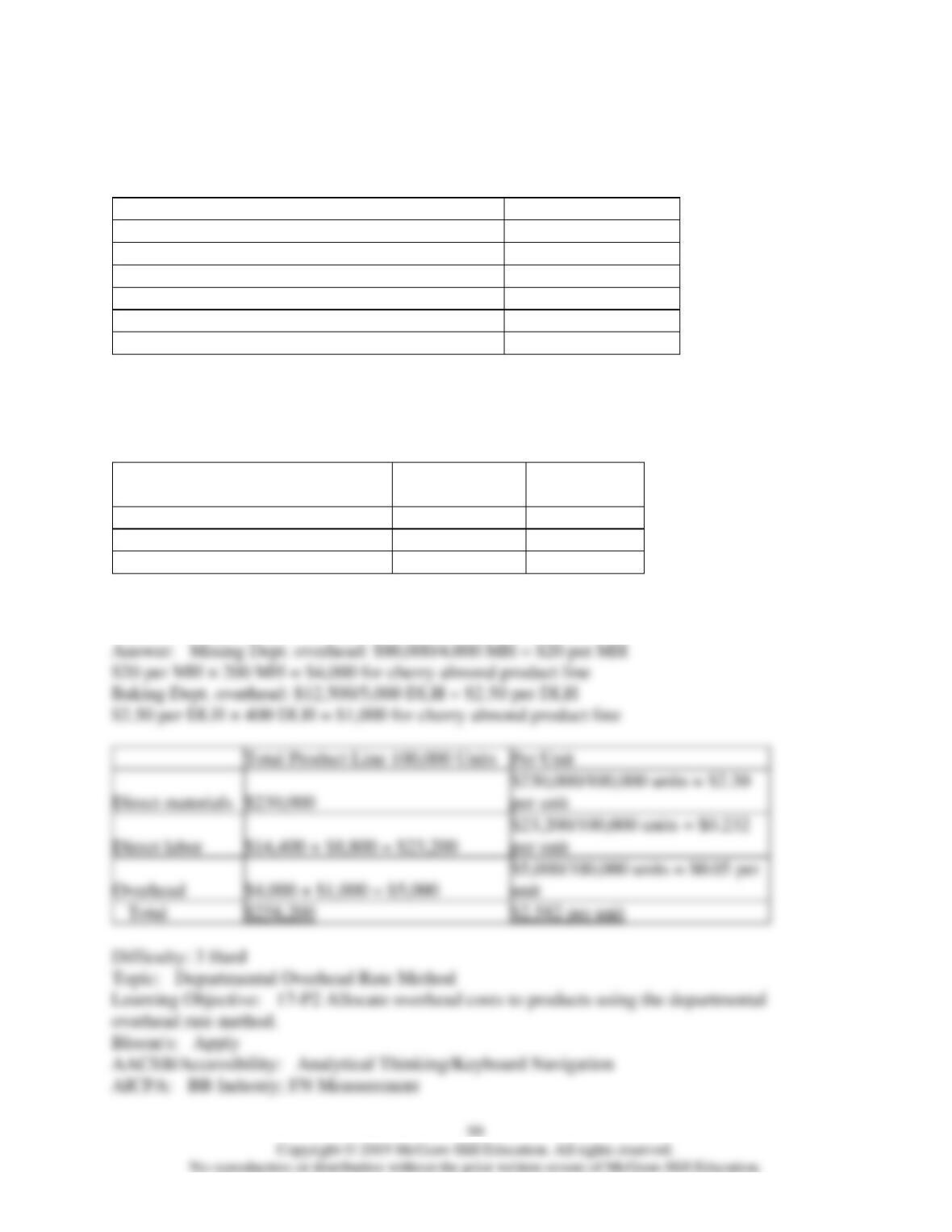
195) Rising Sun, Inc. produces granola that requires two processes, mixing and baking, to
complete. The best-selling type of granola is cherry almond delight. Information related to the
100,000 units of cherry almond delight produced annually is shown in the following table:
Direct materials
$230,000
Direct labor
Mixing Department (600 DLH x $24 per DLH)
$14,400
Baking Department (400 DLH x $22 per DLH)
$8,800
Machine hours
Mixing Department
200 MH
Baking Department
300 MH
Rising Sun’s total expected overhead costs and related overhead data are shown below. The
company uses departmental overhead rates based on machine hours in the mixing department
and direct labor hours in the baking department.
Mixing
Department
Baking
Department
Direct labor hours
11,000 DLH
5,000 DLH
Machine hours
4,000 MH
3,000 MH
Manufacturing overhead costs
$80,000
$12,500
Determine the total product cost of this product line and each unit of cherry almond delight.
Total Product Line 100,000 Units
Per Unit
Direct materials
$230,000
$230,000/100,000 units = $2.30
per unit
Direct labor
$14,400 + $8,800 = $23,200
$23,200/100,000 units = $0.232
per unit
Overhead
$4,000 + $1,000 = $5,000
$5,000/100,000 units = $0.05 per
unit
Total
$258,200
$2.582 per unit
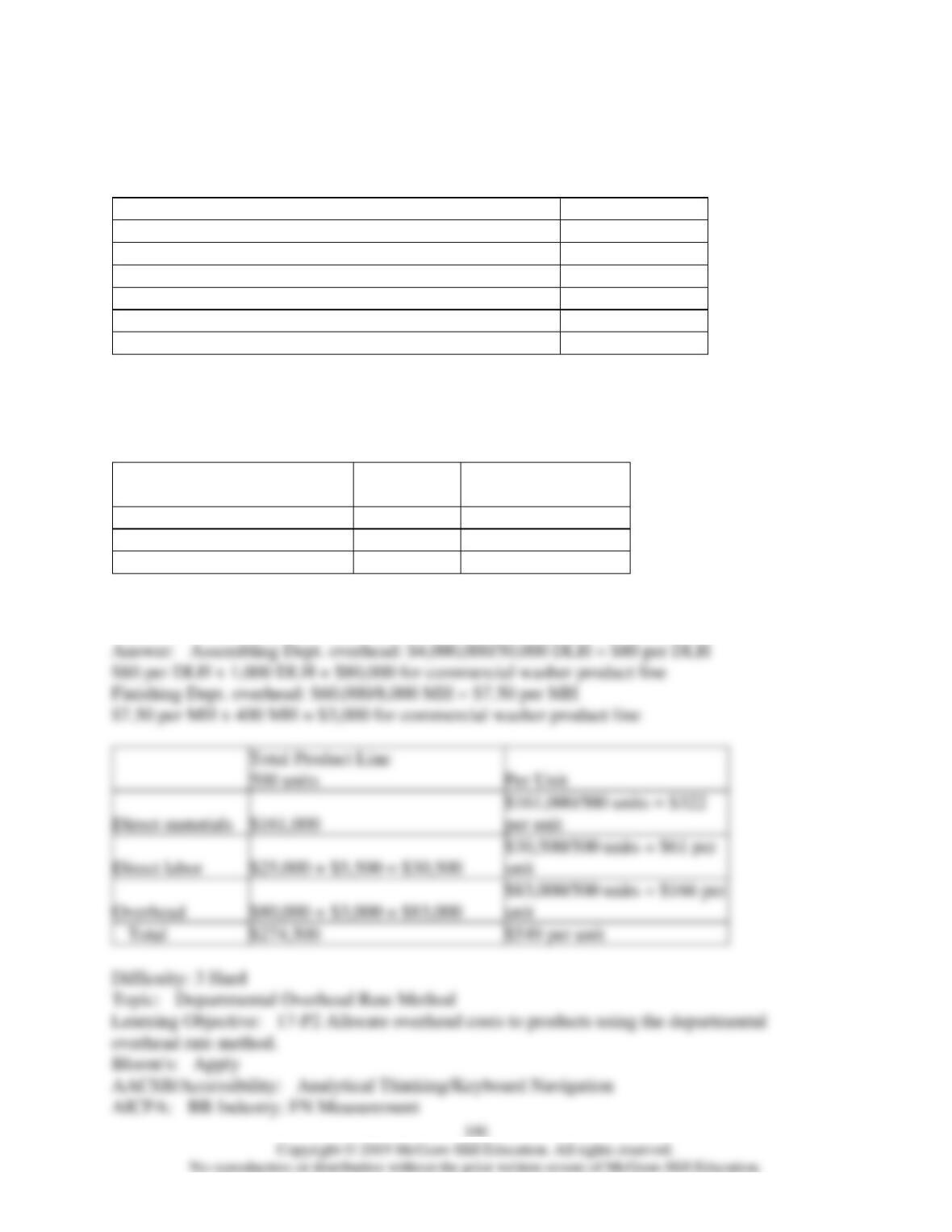
196) Slosh, Inc. produces washing machines that require two processes, assembling and
finishing, to complete. The company’s bestselling machine is the commercial washer.
Information related to the 500 commercial washers produced annually is shown below.
Direct materials
$161,000
Direct labor
Assembling Department (1,000 DLH x $25 per DLH)
$25,000
Finishing Department (250 DLH x $22 per DLH)
$5,500
Machine hours
Assembling Department
1,500 MH
Finishing Department
400 MH
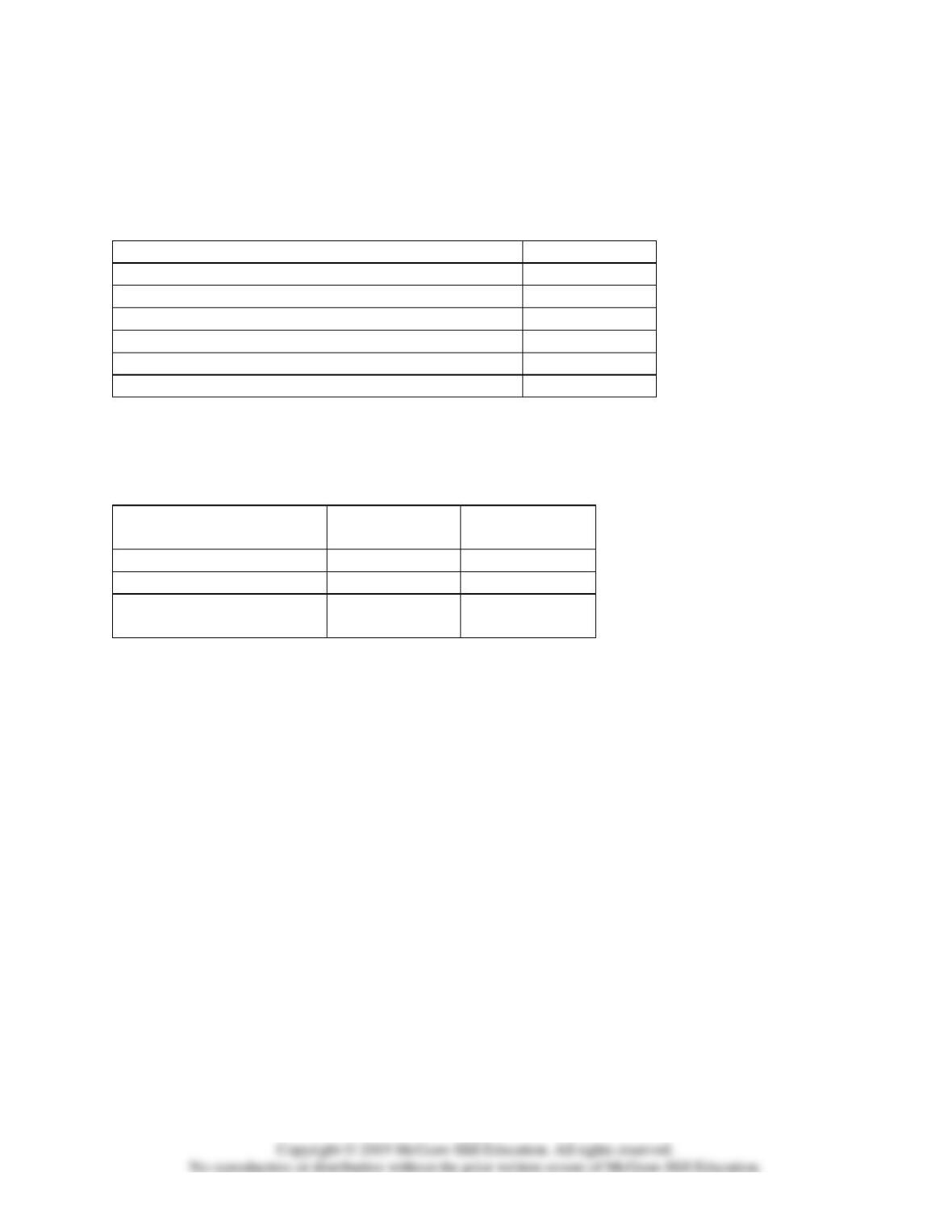
Slosh’s total expected overhead costs and related overhead data are shown below. The company
uses departmental overhead rates based on direct labor hours in the Assembling Department and
machine hours in the Finishing Department.
Assembling
Department
Finishing
Department
Direct labor hours
50,000 DLH
275,000 DLH
Machine hours
37,500 MH
8,000 MH
Manufacturing overhead costs
$4,000,000
$60,000
Determine the total product cost of this product line and each individual commercial washer.
Total Product Line
500 units
Per Unit
Direct materials
$161,000
$161,000/500 units = $322
per unit
Direct labor
$25,000 + $5,500 = $30,500
$30,500/500 units = $61 per
unit
Overhead
$80,000 + $3,000 = $83,000
$83,000/500 units = $166 per
unit
Total
$274,500
$549 per unit
101
197) Lemon Yellow Company produces children’s clothing that requires two processes, cutting
and sewing, to complete. The company is concerned about one product, a hooded jacket, which
hasn’t been selling as well as it had in past years. Information related to the 20,000 jackets
produced annually is shown in the following table:
Direct materials
$26,000
Direct labor
Cutting Department (200 DLH x $20 per DLH)
$4,000
Sewing Department (2,000 DLH x $22 per DLH)
$44,000
Machine hours
Cutting Department
160 MH
Sewing Department
1,500 MH
Lemon Yellow’s total expected overhead costs and related overhead data are shown below. The
company uses departmental overhead rates based on direct labor hours in the Cutting Department
and machine hours in the Sewing Department.
Cutting
Department
Sewing
Department
Direct labor hours
16,000 DLH
175,000 DLH
Machine hours
3,200 MH
30,000 MH
Manufacturing overhead
costs
$480,000
$240,000
Assume this jacket currently sells for $10. How much profit does the company make per jacket?
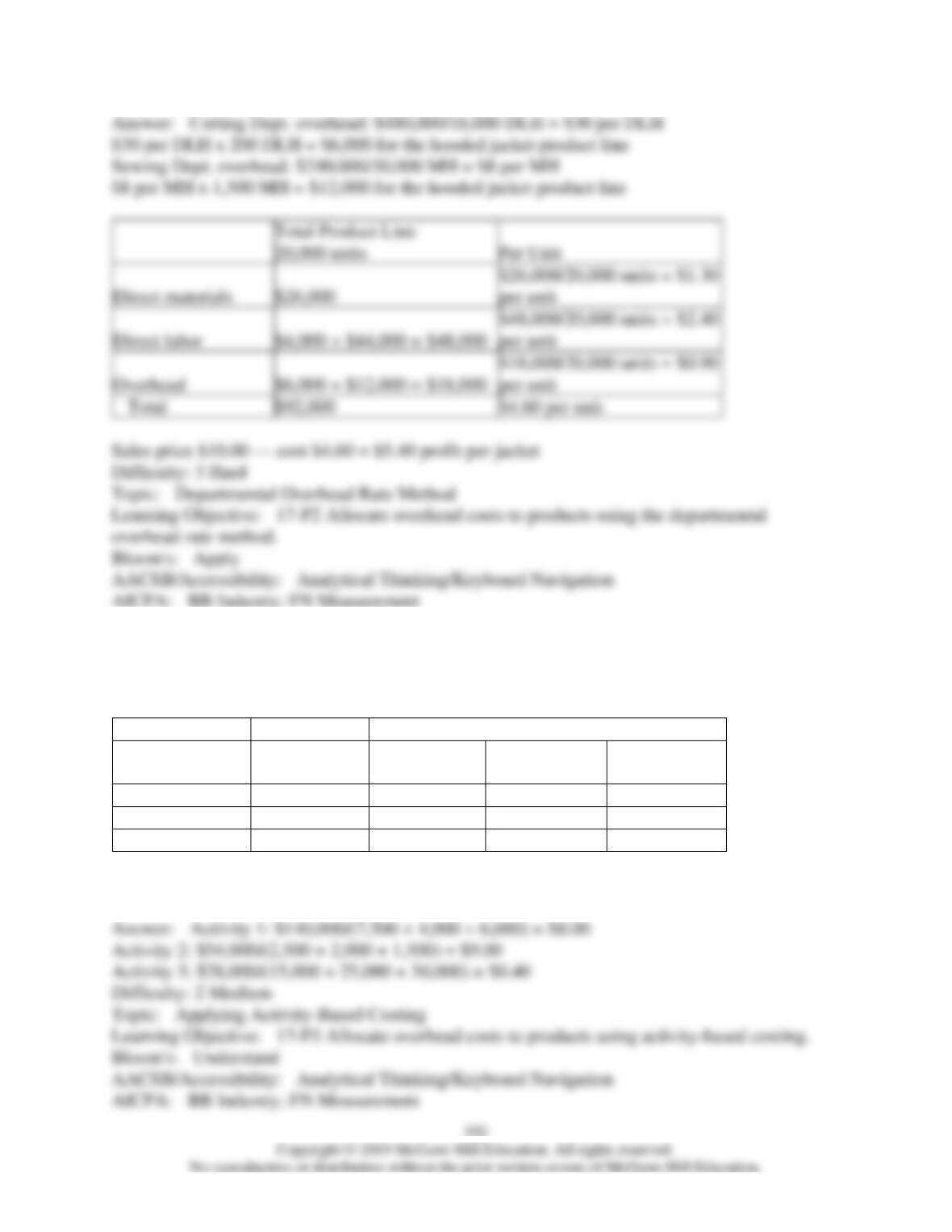
Total Product Line
20,000 units
Per Unit
Direct materials
$26,000
$26,000/20,000 units = $1.30
per unit
Direct labor
$4,000 + $44,000 = $48,000
$48,000/20,000 units = $2.40
per unit
Overhead
$6,000 + $12,000 = $18,000
$18,000/20,000 units = $0.90
per unit
$92,000
$4.60 per unit
198) A company uses activity-based costing to determine the costs of its three products: A, B,
and C. The budgeted cost and activity for each of the company’s three activity cost pools are
shown below.
Budgeted Activity
Activity Cost
Pool
Budgeted Cost
Product A
Product B
Product C
Activity 1
$140,000
7,500
4,000
6,000
Activity 2
$54,000
2,500
2,000
1,500
Activity 3
$28,000
15,000
25,000
30,000
Compute the company’s activity rates under activity-based costing for each of the three activities.
199) A company uses activity-based costing to determine the costs of its three products: A, B,
and C. The budgeted cost and activity for each of the company’s three activity cost pools are
shown in the following table:
Budgeted Activity
Activity Cost
Pool
Budgeted Cost
Product A
Product B
Product C
Activity 1
$425,000
1,700
680
1,870
Activity 2
$144,900
1,890
1,575
2,835
Activity 3
$85,000
2,400
1,000
1,600
Compute the company’s activity rates under activity-based costing for each of the three activities.
200) A company uses activity-based costing to determine the costs of its three products: A, B,
and C. The activity rates and activity levels for each of the company’s three activity cost pools
are shown below.
Budgeted Activity
Activity Cost
Pool
Activity Rate
Product A
Product B
Product C
Activity 1
$19
700
1,150
650
Activity 2
$27
2,400
2,100
1,500
Activity 3
$62
600
1,350
1,050
Compute the company’s budgeted cost for each of the three activities under activity-based
costing.
Activity
Cost Pool
Activity
Rate
Product
A
Product
B
Product
C
Total
Budgeted Cost (total
activity × activity rate)
Activity 1
$19
700
1,150
650
2,500
2,500 × $19 = $47,500
Activity 2
$27
2,400
2,100
1,500
6,000
6,000 × $27 = $162,000
Activity 3
$62
600
1,350
1,050
3,000
3,000 × $62 = $186,000
201) A company uses activity-based costing to determine the costs of its three products: A, B
and C. The activity rates and activity levels for each of the company’s three activity cost pools
are shown in the following table:
Budgeted Activity
Activity Cost
Pool
Activity Rate
Product A
Product B
Product C
Activity 1
$48
3,500
1,000
500
Activity 2
$51
300
2,100
600
Activity 3
$73
400
200
1,400
Compute the company’s budgeted overhead cost for each of the three products under activity-
based costing.
Cost
Pool
Activity
Rate
Product
A
Assigned
Product
B
Assigned
Product
C
Assigned
Activity
1
$48
3,500
$168,000
1,000
$48,000
500
$24,000
Activity
2
$51
300
$15,300
2,100
$107,100
600
$30,600
Activity
3
$73
400
$29,200
200
$14,600
1,400
$102,200
Total OH
cost
$212,500
$169,700
$156,800
202) A company has two products: X and Y. It uses activity-based costing and has prepared the
following analysis showing budgeted cost and activity for each of its three activity cost pools.
Budgeted Activity
Activity Cost
Pool
Budgeted Cost
Product X
Product Y
Activity 1
$3,600
25,200
46,800
Activity 2
$4,800
36,000
44,000
Activity 3
$6,300
43,200
46,800
Annual production and sales level of Product X is 161,100 units, and the annual production and
sales level of Product Y is 275,200 units.
a. Compute the approximate overhead cost per unit of Product X under activity-based costing.
b. Compute the approximate overhead cost per unit of Product Y under activity-based costing.
203) A company has two products: Big and Little. It uses activity-based costing and has prepared
the following analysis showing budgeted cost and activity for each of its three activity cost
pools:
Budgeted Activity
Activity Cost
Pool
Budgeted Cost
Big Product
Little Product
Activity 1
$72,000
1,200
2,800
Activity 2
$91,000
5,250
1,750
Activity 3
$88,000
3,200
4,800
Annual production and sales level of big product is 62,525 units, and the annual production and
sales level of little product is 251,900 units.
a. Compute the approximate overhead cost per unit of big product under activity-based costing.
b. Compute the approximate overhead cost per unit of little product under activity-based costing.
204) Bark Mode, Incorporated produces and distributes two types of security systems, Standard
and Deluxe. Budgeted cost and activity for each of its three activity cost pools are shown below.
The company plans to produce and sell 120,000 standard units and 80,000 deluxe units.
Budgeted Activity
Activity Cost Pool
Budgeted Cost
Standard
Deluxe
Packaging
$100,000
120,000 finished units
80,000 finished units
Material handling
$49,600
600,000 total parts
640,000 total parts
Production setups
$120,000
6 total setups
14 total setups
a. Compute the approximate overhead cost per unit of standard under activity-based costing.
b. Compute the approximate overhead cost per unit of deluxe under activity-based costing.
205) Sparks Company produces and distributes two types of garden sculptures, Plain and Fancy.
Budgeted cost and activity for each of its three activity cost pools are shown below. The
company plans to produce and sell 64,000 plain units and 49,150 fancy units.
Budgeted Activity
Activity Cost Pool
Budgeted Cost
Plain
Fancy
Packaging
$360,000
70,000 finished units
130,000 finished units
Material handling
$262,500
140,000 total parts
210,000 total parts
Production setups
$125,000
5 total setups
20 total setups
a. Compute the approximate overhead cost per unit of Plain under activity-based costing.
b. Compute the approximate overhead cost per unit of Fancy under activity-based costing.
206) Upside Down, Incorporated designs custom storage spaces to eliminate clutter in both
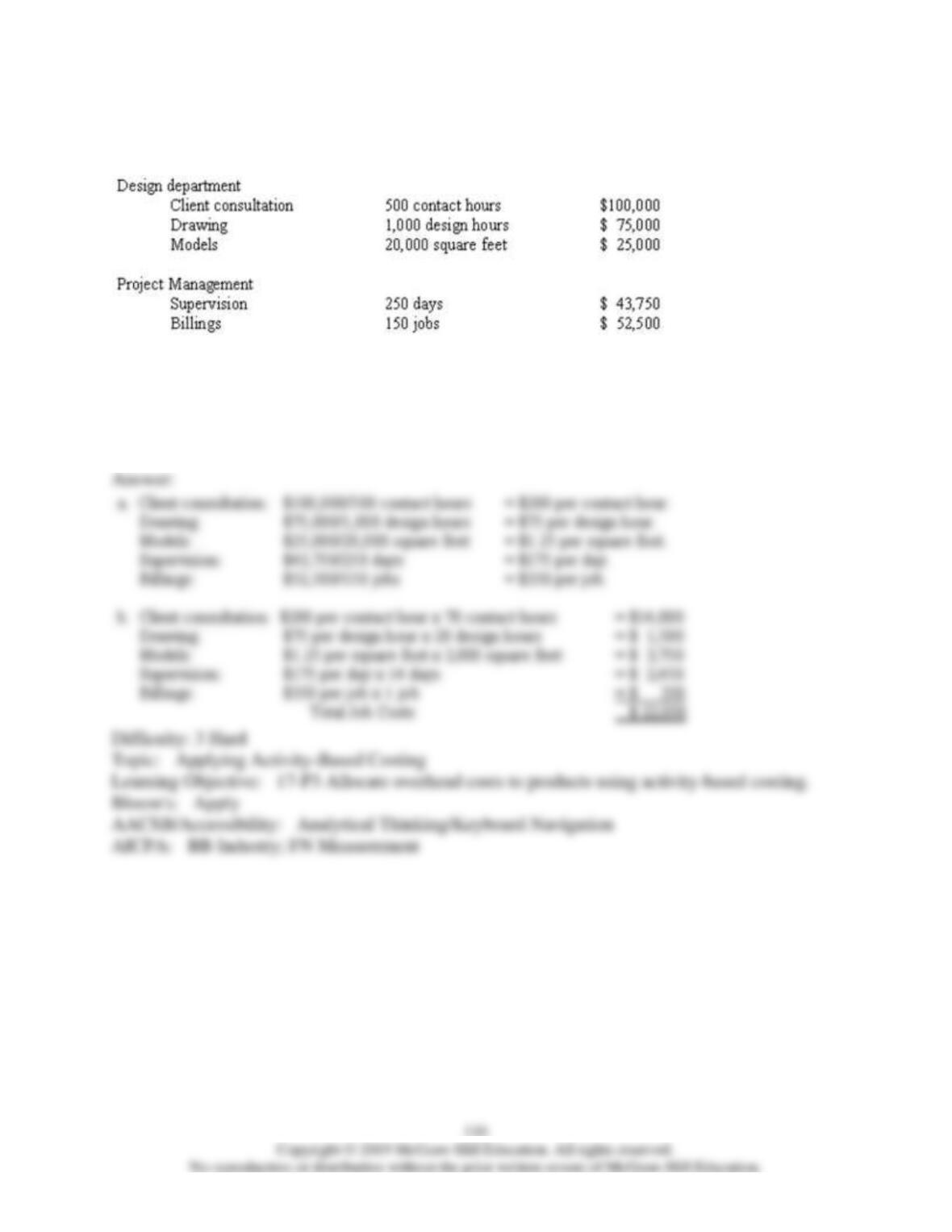
residential and business settings. The following data pertain to a recent reporting period:
Required
a. Use ABC to compute overhead rates for each activity.
b. Assign costs to a 3,000 square foot job that requires 70 contact hours, 20 design hours, and 14
days to complete.
207) Inside Out, Company designs custom showroom spaces in interior design marts across the
country. The following data pertain to a recent reporting period.
Design Department
Client consultation
750 contact hours
$127,500
Drawing
1,200 design hours
$96,000
Models
15,000 square feet
$21,000
Project Management
Supervision
225 days
$40,500
Billings
150 jobs
$54,000
Required
a. Use ABC to compute overhead rates for each activity.
b. Assign costs to a 3,000 square-foot job that requires 70 contact hours, 20 design hours, and 14
days to complete.
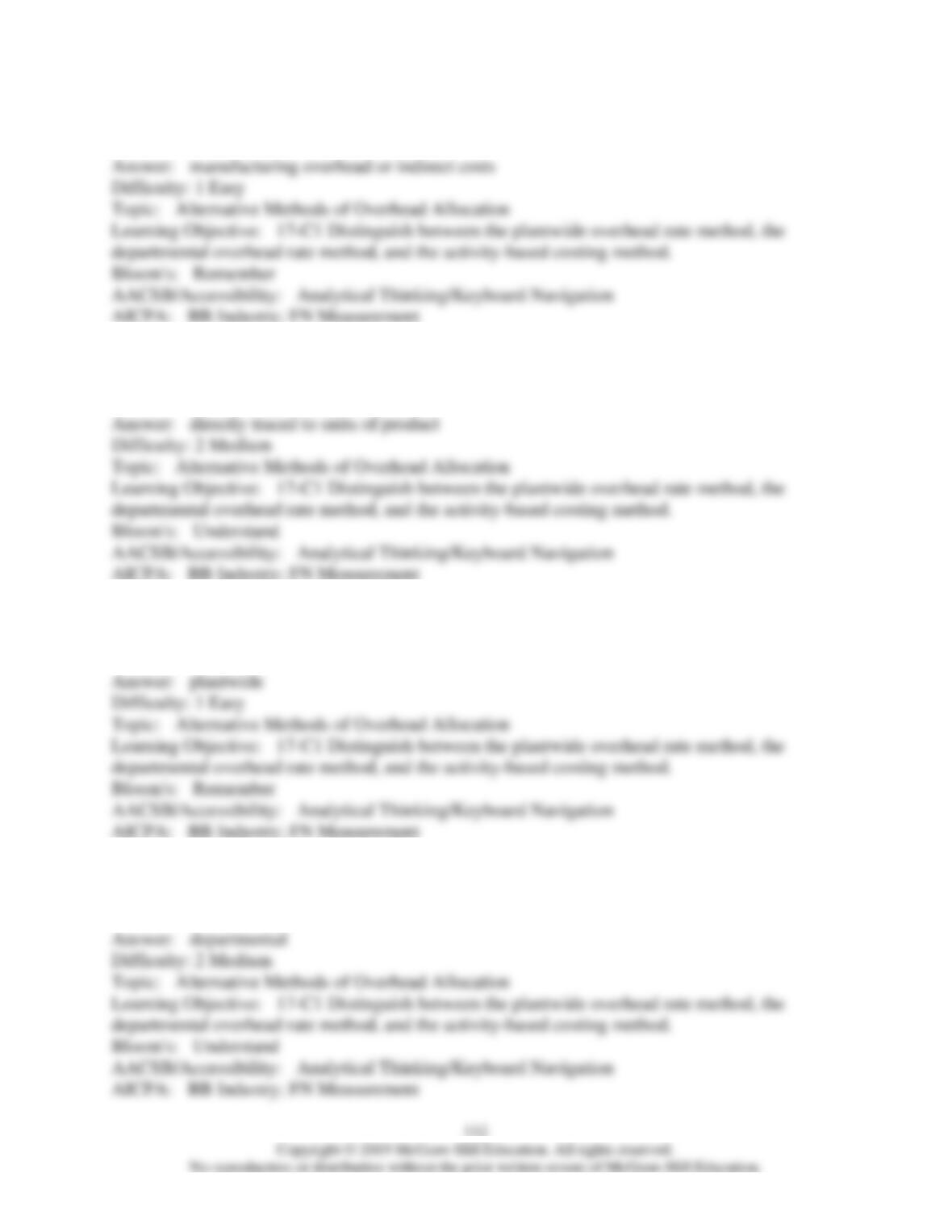
a. Client consultation
$127,500/750 contact hours
$170/contact hour
Drawing
$96,000/1,200 design hours
$80/design hour
Models
$21,000/15,000 sq. ft.
$1.40/sq. ft.
Supervision
$40,500/225 days
$180/day
Billings
$54,000/150 jobs
$360/job
b. Client consultation
($170/contact hour)(70 hrs)
= $11,900
Drawing
($80/design hour)(20 hrs)
= 1,600
Models
($1.40/sq. ft.)(3,000 sq ft)
= 4,200
Supervision
($180/day)(14 days)
= 2,520
Billings
($360/job)(1 job)
= 360
Total job cost
$20,580
208) Product costs consist of direct labor, direct materials, and ________.
209) Overhead costs cannot be ________ in the same way that direct materials and direct labor
can.
210) The ________ overhead rate method uses a single rate for allocating overhead costs to
products.
211) The ________ overhead rate method uses multiple volume-based measures to allocate
overhead costs to products.
212) ________ focuses on activities and the cost of carrying out activities.
213) The ________ is the target of the cost assignment.
214) The ________ overhead rate is calculated by dividing total budgeted overhead cost by a
chosen allocation base, such as direct labor hours.
215) The ________ overhead rate method uses a different overhead rate for each production
department.
216) The departmental overhead rate method allows each department to have its own overhead
rate and its own ________.
217) The premise of ABC is that it takes ________ to make products and provide services.
218) The ________ stage of ABC is to compute an activity rate for each cost pool and then use
this rate to allocate overhead costs to products.
219) A ________ is a collection of costs that are related to the same or similar activity.
220) The major advantages of using a single plantwide overhead rate are ________ and
________.
221) Allocated overhead ________ vary depending upon the allocation method used.
222) When products differ in batch size and complexity, they usually consume different amounts
of ________.
223) ________ is an outgrowth of ABC that draws on the link between activities and cost
incurrence for better management.