Given the following accounts:
[1] Cash
[2] Accounts receivable
[3] Allowance for doubtful accounts
[4] Merchandise inventory
[5] Store supplies
[6] Store equipment
[7] Accumulated depreciation
[8] Notes payable
[9] Accounts payable
[10] John Partner’s, Capital
[11] Joy Partner’s, Capital
[12] John Partner’s, withdrawals
[13] Joy Partner’s, withdrawals
[14] Income summary
[15] Service revenue
[16] Gain on realization
[17] Loss on realization
Indicate the account(s) to be debited and credited to record the following transactions.
37) Jim, a partner, withdrew cash from the business.
Debit ________ Credit ________
38) Closed the income summary to the partners’ accounts with a net income.
Debit ________ Credit ________ & ________
39) Closed the income summary, there is a net loss.
Debit ________ & ________ Credit ________
40) The partnership of Smith and Jones, who have average capital balances of $17,000 and $23,000,
respectively, earned $90,000 net income. Under each of the following independent situations, calculate
the distribution of the $90,000.
a) No agreement was established.
b) Share based on their average capital balances.
41) Jan and Bill have average capital balances of $35,000 and $20,000, respectively. The partners have
agreed to allow $20,000 salary allowances. The partners will share income and losses in a 1:2 ratio for Jan
and Bill, respectively. How much will each partner’s capital account change if net income is $130,000?
42) Jean and Joy are partners, with beginning capital balances of $100,000 and $70,000 respectively.
During the year, Jean withdrew $20,000 and Joy withdrew $15,000. The year’s net income of $40,000 was
distributed $15,000 to Jean and $25,000 to Joy. Prepare a statement of Partners’ equity.
17.3 Learning Objective 17-3
1) Jim wants to invest cash so that he will have a one-third interest in Tom and Steve’s company. The
capital balances are $12,000 Tom, $23,000 Steve. The admission of Jim would be to:
A) debit Cash $7,667; credit Jim, Capital $7,667.
B) debit Cash $11,667; credit Jim, Capital $11,667.
C) debit Cash $17,500; credit Jim, Capital $17,500.
D) debit Cash $24,000; credit Jim, Capital $24,000.
2) The Ben and Jill partnership agree to admit Fred with a one-third interest for $14,000. Ben and Jill’s
capital balances are $18,000, and $8,000, respectively, and they share profits and losses equally. The entry
to admit Fred would include:
A) debit Cash $14,000; credit Fred, Capital $14,000.
B) debit Cash $14,000; credit Ben, Capital $3,500; debit Jill, Capital $3,500; credit Fred, Capital $7,000.
C) debit Cash $26,000; credit Ben, Capital $13,000; credit Jill, Capital $13,000.
D) debit Cash $26,000; debit Ben, Capital $6,500; credit Jill, Capital $6,500; credit Fred, Capital $13,000.
3) Mary sold Jill her equity in the Mary and Jill partnership for $31,000. If both Mary and Jill had a $16,000
capital balance, the entry to record this transaction would be to:
A) debit Cash $31,000; credit Jill, Capital $31,000.
B) debit Mary, Capital $16,000; credit Jill, Capital $16,000.
C) debit Cash $16,000; credit Mary, Capital $16,000.
D) debit Jill, Capital $16,000; credit Mary, Capital $16,000.
4) When a partnership is worth more than the amounts recorded, an incoming partner may:
A) be required to pay a bonus to the other partners.
B) pay a smaller amount as an initial investment.
C) have to pay the same as other partners.
D) None of these answers is correct.
5) A bonus paid by an incoming partner to the old partners is shared:
A) equally.
B) by the salary method.
C) on the basis of profit and loss ratio.
D) by the interest method.
6) When recording a bonus to a new partner, the new partner will:
A) pay more than what the new partner’s capital account will reflect.
B) pay the same as the other partners’ capital accounts.
C) pay less than the new partner will receive in the capital account.
D) have no bonus recorded as a bonus cannot be paid to new partners.
7) A bonus is paid to the old partners when:
A) the old partner believes the business is worth less than the amounts recorded in the accounting
records.
B) the equity of a partnership is worth more than what is recorded in the accounting records.
C) the company’s earnings records are less than expected.
D) None of these answers is correct.
8) When a partner withdraws from a partnership, the partnership can:
A) audit the accounting records and adjust assets to fair market value.
B) credit the account of the partner that withdrew and debit Cash.
C) share any loss or profit from the historical value of assets.
D) None of the above answers is correct.
9) Carrie withdrew from the partnership of Carrie, Carl, and Van, and accepted $18,000 cash. Her capital
balance was $23,400 and the difference will be shared in a ratio of 2:1 for Carl and Van, respectively. The
entry would be to:
A) debit Cash $18,000; credit Van, Capital $18,000.
B) debit Van, Capital $23,400; credit Cash $23,400.
C) debit Carrie, Capital $23,400; credit Cash $18,000; credit Carl, Capital $3,600; credit Van, Capital $1,800.
D) debit Cash $23,400; debit Van, Capital $3,600; debit Carl, Capital $1,800; credit Carrie, Capital $28,800.
10) An investment by a new partner was debited to existing partners’ capital balances. This error would
cause:
A) the new partner’s capital account to be understated.
B) the period end partners’ equity to be understated.
C) the period end assets to be overstated.
D) None of these is correct.
11) A partnership admits a new partner. The new partner invests $75,000 in the business and receives a
credit of $90,000 to his capital account. The difference of $15,000 is called a(n):
A) admission fee.
B) partnership expense.
C) bonus.
D) illegal activity.
12) When a partner withdraws, the partnership may have an audit to adjust the assets to their:
A) historic cost.
B) depreciated value.
C) fair market value.
D) book value.
13) Carl, Brian, and Ann share profits and losses in a 2:1:1 ratio, respectively, in their partnership. The
assets are to be reduced $12,000 in value when Brian wishes to leave the partnership. If each partner had
a capital balance of $36,000 before Brian’s notification of withdrawal, what amount should Brian be
allowed to withdraw from the partnership?
A) $36,000
B) $33,000
C) $24,000
D) $39,000
14) Tom and Barb are partners who share profits and losses in the ratio of 6:4 for Tom and Barb,
respectively. Their capital balances are $47,000 and $32,000, respectively. If Jane is admitted to the
partnership for $28,000 for a one-fourth interest, her capital balance will be:
A) $35,667.
B) $15,000.
C) $28,000.
D) $26,750.
15) Allan and Rick are partners who share profits and losses in the ratio of 3:2 for Allan and Rick,
respectively. They have capital balances of $40,000 and $47,000, respectively. If Tammy invests $32,000 for
one-third interest, Tammy’s capital balance will be: (Round your answer to the nearest dollar.)
A) $39,667.
B) $29,000.
C) $32,000.
D) $23,800.

16) Nathan invests $2,800 for 10% interest in a partnership that has total capital of $20,000 after admitting
Nathan. Which of the following is true?
A) Nathan’s capital is $2,000.
B) The original partners received a bonus of $280.
C) Nathan received a bonus of $280.
D) The original partners‘ capital in the business was $22,800 before admitting Nathan.
17) Sue invests $10,000 for a one-fourth interest in a partnership in which the other partners have capital
totaling $22,000 before admitting Sue. After distribution of the bonus, Sue’s capital is:
A) $10,000.
B) $5,500.
C) $3,000.
D) $8,000.
18) Bill pays Steve $13,000 for his $9,000 interest in a partnership. On the partnership books:
A) Bill will have capital of $9,000.
B) Bill will have capital of $13,000.
C) Bill will have capital of $22,000.
D) None of these answers is correct.
19) Joan and Helen are partners who have agreed to allow Carol to purchase Helen’s share for a direct
payment of $36,000 to Helen. Joan and Helen’s previous capital balances were $10,000 and $17,000,
respectively. What will be the amount in Carol’s capital account?
A) $17,000
B) $10,000
C) $36,000
D) Some other number
20) Sol and Joe are partners sharing profits and losses in a 3:2 ratio for Sol and Joe, respectively. Their
capital balances are $17,000 and $19,000, respectively. The partners agree to admit Dan for $16,000 for a
25% interest in the partnership. Joe’s capital balance after admitting Dan is:
A) $17,000.
B) $20,800.
C) $19,160.
D) $3,000.
21) When a partnership is dissolved:
A) it is implied that the business cannot form a different ownership structure.
B) it is implied that the business cannot continue with a new group of partners.
C) it is implied that it must be dissolved with any change in partnership structure.
D) it is implied that the business will halt operations.
22) “Limited life” in a partnership agreement means:
A) a partnership is limited in the amount of debt it is liable for in the course of the business.
B) a partnership is limited to the amount of revenue it can earn.
C) a partnership may be dissolved if the location of the business has changed.
D) a partnership may be dissolved as the result of any change in the ownership.
23) Bernstein is brought into the partnership. His capital is equal to his net assets that he brings to the
partnership. He brings assets of $175,000 and liabilities of $32,000. His capital balance will be:
A) $32,000.
B) $175,000.
C) $207,000.
D) $143,000.
24) A partnership can be joined by:
A) investing into the business.
B) purchasing an equity interest in the business.
C) buying out one of the partners and taking over their interest (by mutual agreement).
D) All of the above are correct.
25) A partner may withdraw from a partnership and take assets valued at more than book equity if:
A) the remaining partners are not anxiously awaiting the partner’s retirement.
B) the partnership assets are overvalued.
C) the partnership assets are undervalued.
D) Both A and C are correct.
26) A new partner was admitted, but the assets weren’t revalued. A revaluation would have decreased
the equity of the partner and partnership. This error would cause:
A) the future periods’ net income to be understated.
B) the future periods’ net income to be overstated.
C) this period’s end assets to be understated.
D) the new partner’s capital to be overstated.
27) If the retiring partner’s interest is sold to one of the remaining partners, the retiring partner’s equity is
split equally between the remaining partners.
28) When the equity of a partnership is less than amounts recorded in the accounting records, an
incoming partner may have to pay a bonus.
Given the following accounts:
[1] Cash
[2] Accounts receivable
[3] Allowance for doubtful accounts
[4] Merchandise inventory
[5] Store supplies
[6] Store equipment
[7] Accumulated depreciation
[8] Notes payable
[9] Accounts payable
[10] John Partner’s, Capital
[11] Joy Partner’s, Capital
[12] John Partner’s, withdrawals
[13] Joy Partner’s, withdrawals
[14] Income summary
[15] Service revenue
[16] Gain on realization
[17] Loss on realization
Indicate the account(s) to be debited and credited to record the following transactions.
29) Closed Joy Partner’s withdrawals.
Debit ________ Credit ________
30) Ann and Bill’s partnership capital balances are $50,000 and $70,000, respectively. They share profits
and losses in a ratio of 1:3 for Ann and Bill, respectively. Robin is admitted to the partnership, invests
$65,000 for a 40% interest, and is awarded a bonus. Prepare the journal entry to admit Robin to the
partnership.
31) Jones and James’ partnership capital balances are $65,000 and $85,000, respectively. They share profits
and losses in a 1:3 ratio for Jones and James, respectively. Johnson is admitted to the partnership and
invests $55,000 for a one-fourth interest, with a bonus to the old partners. Prepare the journal entry to
admit Johnson to the partnership.
32) Sue and Jill, who have ending capital balances of $80,000 and $60,000 respectively, agree to admit two
new partners. Carlos will buy 1/2 of Sue’s interest for $20,000 and 1/4 of Jill’s interest for $25,000 directly
from the partners. Carmen will invest $40,000 for a $40,000 equity interest. Journalize the entry to admit
Carlos and Carmen.
17.4 Learning Objective 17-4
1) When a partnership is terminated, the assets are turned into cash and obligations are paid. This process
is called:
A) dissolution.
B) termination.
C) liquidation.
D) None of the above
2) The last step taken in liquidating a partnership is to:
A) sell the assets.
B) divide profits on assets with partners.
C) pay creditors.
D) distribute the remaining cash according to partners’ capital balances.
3) The sale of assets for liquidation purposes of a partnership is called:
A) a sheriff’s sale.
B) dissolution.
C) net liquidation.
D) realization.
4) Partners Randy and Mary each have $3,000 capital balances and share income and losses in a 2:1 ratio
for Randy and Mary, respectively. Cash equals $5,000, noncash assets total $13,000, and liabilities are
$5,000. If all the noncash assets are sold for $10,000, Mary’s capital account will: (Round your answer to
the nearest dollar.)
A) increase by $5,333.
B) decrease by $1,000.
C) decrease by $2,000.
D) increase by $2,667.
5) Partners Eric and Jeremy each have $7,000 capital balances and share income and losses in a 2:1 ratio
for Eric and Jeremy, respectively. Cash equals $3,000, noncash assets are $16,000, and liabilities are $5,000.
If all the noncash assets are sold for $2,000, and each partner is personally insolvent, Jeremy eventually
will receive cash of:
A) $0.
B) $6,000.
C) $4,667.
D) $12,000.
6) Partners Robert and Sally have $3,600 capital balances and share income and losses in a 2:1 ratio for
Robert and Sally, respectively. Cash equals $1,200, noncash assets are $12,000, and liabilities are $5,500. If
all the noncash assets are sold for $5,700, and each partner agrees to make up any capital deficits with
personal cash contributions, Sally eventually will receive cash of:
A) $0.
B) $1,200.
C) $1,500.
D) $2,100.
7) Which of the following is an incorrect step in the process of partnership liquidation?
A) Pay any liabilities
B) Sell the assets
C) Allocate gains and losses to partners
D) None of the above
8) A partnership can be terminated by which of the following?
A) Bankruptcy
B) Death of a partner
C) Agreement by partners
D) All of the above
9) The last entry to liquidate a partnership would probably include:
A) debit to Capital (for each partner); credit to Cash.
B) debit to Cash; debit or credit to Loss or Gain from Realization; credit to individual assets sold.
C) debit to individual assets sold; credit to Cash.
D) None of the above
10) When a partnership is liquidated, the journal entry to pay the claims of creditors would include:
A) a debit to partners’ equity accounts.
B) a debit to each individual creditor.
C) a credit to cash.
D) Both B and C
11) When a partnership is liquidated, the assets are sold and the cash realized is applied first to the:
A) claims of creditors.
B) partner with the largest investment.
C) partners’ equity accounts.
D) partners according to their ownership interests.
12) The last step in a partnership liquidation is to apply cash to creditor claims.
13) After all liabilities have been paid, the remaining assets are distributed based on equal share to
partners.
14) A Loss or Gain from Realization account is credited when the assets are sold at a loss during the
liquidation process.
15) When the assets are sold at a loss and one partner cannot make up the deficit, the other partners have
no liability to make up the deficit.
Given the following accounts:
[1] Cash
[2] Accounts receivable
[3] Allowance for doubtful accounts
[4] Merchandise inventory
[5] Store supplies
[6] Store equipment
[7] Accumulated depreciation
[8] Notes payable
[9] Accounts payable
[10] John Partner’s, Capital
[11] Joy Partner’s, Capital
[12] John Partner’s, withdrawals
[13] Joy Partner’s, withdrawals
[14] Income summary
[15] Service revenue
[16] Gain on realization
[17] Loss on realization
Indicate the account(s) to be debited and credited to record the following transactions.
16) During liquidation realized less than book value for the store equipment.
Debit ________ & ________ & ________ Credit ________
17) During liquidation realized more than book value for the merchandise inventory.
Debit ________ Credit ________ & ________
18) The partnership of Rick and Allan is being liquidated. All gains and losses are shared in a 3:5 ratio,
respectively. Before liquidation, their balance sheet balances are as follows:
Cash $10,000
Other Assets 8,000
Liabilities 4,000
Rick, Capital 7,000
Allan, Capital 7,000
If the Other Assets are sold for $10,000, how much will each partner receive upon liquidation?
19) The partnership of Brandon and Ryan is being liquidated. All gains and losses are shared in a 3:1
ratio, respectively. Before liquidation, their balance sheet balances are as follows:
Cash $10,000
Other Assets 7,000
Liabilities 3,000
Brandon, Capital 7,000
Ryan, Capital 7,000
a) If the Other Assets are sold for $10,000, how much capital will each partner receive have before paying
liabilities and distributing the remaining assets?
b) If the Other Assets are sold for $7,000, how much capital will each partner have before paying
liabilities and distributing remaining assets?
20) After several years of business, Abel, Barney, and Cole are liquidating. The following are post-closing
account balances.
Cash 18,000
Inventory 73,000
Other assets 137,000
Accounts Payable 61,000
Abel, Capital 50,000
Barney, Capital 50,000
Cole, Capital 87,000
Non-cash assets are sold for $270,000. Profits and losses are shared equally.
Record the sale of the noncash items.
21) After several years of business, Abel, Barney, and Cole are liquidating. The following are post-closing
account balances.
Cash 18,000
Inventory 73,000
Other assets 157,000
Accounts Payable 61,000
Abel, Capital 50,000
Barney, Capital 50,000
Cole, Capital 87,000
Non-cash assets are sold for $275,000. Profits and losses are shared equally.
Record the payment of the liabilities.
22) After several years of business, Abel, Barney, and Cole are liquidating. The following are post-closing
account balances.
Cash 18,000
Inventory 73,000
Other assets 157,000
Accounts Payable 61,000
Abel, Capital 50,000
Barney, Capital 50,000
Cole, Capital 87,000
Non-cash assets are sold for $305,000. Profits and losses are shared equally.
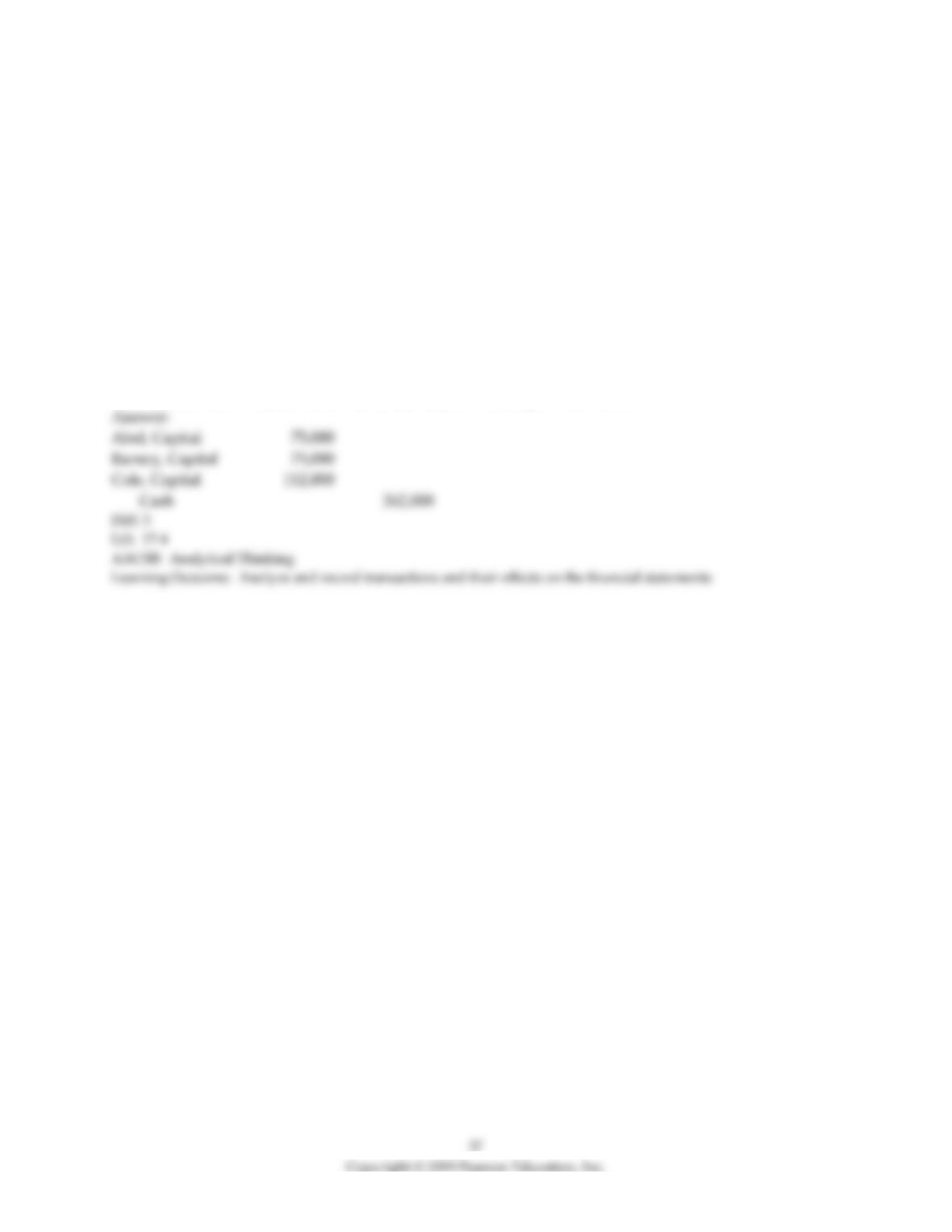
After all liabilities are paid, divide the remaining cash amongst the partners.