Intermediate Accounting, 9e (Spiceland)
Chapter 17 Pensions and Other Postretirement Benefits
1) The projected benefit obligation may be less reliable than the accumulated benefit obligation.
2) The amount of the vested benefit obligation is less than the projected benefit obligation and
more than the accumulated benefit obligation.
3) An upward revision of inflation and compensation trends would likely cause a gain in the
pension benefit obligation.
4) The difference between pension plan assets and the PBO is equal to the funded status of the
plan.
5) A net pension asset is the excess of the projected benefit obligation over the plan assets.
6) If a pension plan is underfunded, the company has a net loss-OCI.
7) Prior service cost is recognized as pension expense over a period of several years.
8) A net gain or net loss affects pension expense only if it exceeds 10% of the pension benefit
obligation or 10% of plan assets, whichever is lower.
9) Pension expense and funding amounts are both accounting decisions.
10) There almost always is a balance sheet liability for plans of postretirement benefits other
than pensions since very few of these plans are funded.
11) The expected postretirement benefit obligation (EPBO) is the discounted present value of the
total benefits expected to be paid by the employer to the plan participants.
12) Conceptually, the service method provides a better matching of costs and benefits in
amortizing prior service cost than does the straight-line method.
13) Which of the following is not a requirement for a qualified pension plan?
A) It cannot discriminate in favor of highly paid employees.
B) It must cover at least 80% of the employees.
C) It must be funded in advance of retirement.
D) Benefits must vest after a specified period of service, commonly five years.
14) Which of the following is not a characteristic of a qualified pension plan?
A) It can be limited to highly compensated salaried employees.
B) It must be funded in advance of retirement.
C) Benefits must vest after a specified period of service.
D) It must cover at least 70% of employees.
15) Which of the following is not usually part of the pension formula under a defined benefit
plan?
A) Age at retirement.
B) Number of years of service.
C) Seniority at time of retirement.
D) Compensation level.
16) Which of the following describes defined benefit pension plans?
A) They raise few accounting issues for employers.
B) Retirement benefits depend on how much money has accumulated in an individual’s account.
C) They are simple to construct.
D) Retirement benefits are based on the plan benefit formula.
17) Which of the following describes defined benefit pension plans?
A) The investment risk is borne by the employee.
B) The plans are simple and easy to construct.
C) The investment risk is borne by the employer.
D) Retirement benefits depend on the individual’s account balance.
18) Defined contribution pension plans that link the amount of contributions to company
performance are often called:
A) Incentive savings plans.
B) Thrift plans.
C) Savings plans.
D) None of these is correct.
19) The accounting for defined contribution pension plans is easy because each year:
A) The employer records pension expense equal to the amount paid out to retirees.
B) The employer records pension expense based on an amount provided by the actuary.
C) The employer records pension expense equal to the annual contribution.
D) The employer records pension expense based on the earnings of the plan assets.
20) Which of the following is not an uncertainty that complicates determining how much to set
aside each year to ensure that sufficient funds are available to provide the benefits promised
under a defined benefit plan?
A) Employee turnover.
B) Number of employees who retired last year.
C) Future inflation rates.
D) Future compensation levels.
21) To help assess the uncertainties that surround a defined benefit pension plan, corporations
frequently hire a(n):
A) CPA.
B) Attorney.
C) Investment analyst.
D) Actuary.
22) The employer has an obligation to provide future benefits for:
A) Defined benefit pension plans.
B) Defined contribution pension plans.
C) Defined benefit and defined contribution plans.
D) None of these answer choices are correct.
23) Which of the following statements typifies defined contribution plans?
A) Investment risk is borne by the corporation sponsoring the plan.
B) The plans are more complex than defined benefit plans.
C) Present value factors are used to determine the annual contributions to the plan.
D) The employer’s obligation is satisfied by making the periodic contribution to the plan.
24) The annual pension expense for what type of pension plan(s) is recorded by a journal entry
that includes a debit to pension expense and a credit to a noncurrent liability?
A) A defined benefit plan only.
B) A defined contribution plan only.
C) Both a defined benefit and a defined contribution plan.
D) This is not the correct entry.
25) Which of the following is not a way of measuring the pension obligation?
A) Accumulated benefit obligation.
B) Vested benefit obligation.
C) Retiree benefit obligation.
D) Projected benefit obligation.
26) The portion of the obligation that plan participants are entitled to receive regardless of their
continued employment is called the:
A) Vested benefit obligation.
B) Retiree benefit obligation.
C) Actual benefit obligation.
D) True benefit obligation.
27) ERISA made major changes in the requirements for pension plan:
A) Vesting.
B) Reporting.
C) Taxing.
D) Investing.
28) Compared to the ABO, the PBO usually is:
A) Less material.
B) Less representationally faithful.
C) Less relevant.
D) Less reliable.
29) Compared to the ABO, the PBO usually is:
A) Larger.
B) More reliable.
C) Less relevant.
D) More material.
30) Consider the following:
I. Present value of vested benefits at present pay levels.
II. Present value of nonvested benefits at present pay levels.
III. Present value of additional benefits related to projected pay increases.
Which of the above constitutes the accumulated benefit obligation?
A) I & II.
B) I, II, III.
C) II & III.
D) II only.
31) Consider the following:
I. Present value of vested benefits at present pay levels.
II. Present value of nonvested benefits at present pay levels.
III. Present value of additional benefits related to projected pay increases.
Which of the above constitutes the projected benefit obligation?
A) III only.
B) I, II.
C) I, II, III.
D) II only.
32) Consider the following:
I. Present value of vested benefits at present pay levels.
II. Present value of nonvested benefits at present pay levels.
III. Present value of additional benefits related to projected pay increases.
Which of the above constitutes the vested benefit obligation?
A) I & II.
B) I, II, III.
C) II.
D) I only.

33) Interest cost will:
A) Increase the PBO and increase pension expense.
B) Increase pension expense and reduce plan assets.
C) Increase the PBO and reduce plan assets.
D) Increase pension expense and reduce the return on plan assets.
34) The PBO is increased by:
A) An increase in the average life expectancy of employees.
B) Amortization of prior service cost.
C) An increase in the actuary’s assumed discount rate.
D) A return on plan assets that is lower than expected.
35) Payment of retirement benefits:
A) Increases the PBO.
B) Increases the ABO.
C) Reduces the GBO.
D) Reduces the PBO.
36) A company’s defined benefit pension plan had a PBO of $265,000 on January 1, 2018.
During 2018, pension benefits paid were $40,000. The discount rate for the plan for this year was
10%. Service cost for 2018 was $80,000. Plan assets (fair value) increased during the year by
$45,000. The amount of the PBO at December 31, 2018, was:
A) $225,000.
B) $305,000.
C) $331,500.
D) None of these answer choices are correct.
37) Mars Inc. has a defined benefit pension plan. On December 31 (the end of the fiscal year),
the company received the PBO report from the actuary. The following information was included
in the report: ending PBO, $110,000; benefits paid to retirees, $10,000; interest cost, $7,200. The
discount rate applied by the actuary was 8%. What was the beginning PBO?
A) $90,000.
B) $100,000.
C) $107,200.
D) $112,000.
38) Louie Company has a defined benefit pension plan. On December 31 (the end of the fiscal
year), the company received the PBO report from the actuary. The following information was
included in the report: ending PBO, $110,000; benefits paid to retirees, $10,000; interest cost,
$8,000. The discount rate applied by the actuary was 8%. What was the service cost for the year?
A) $2,000.
B) $12,000.
C) $18,000.
D) $92,000.
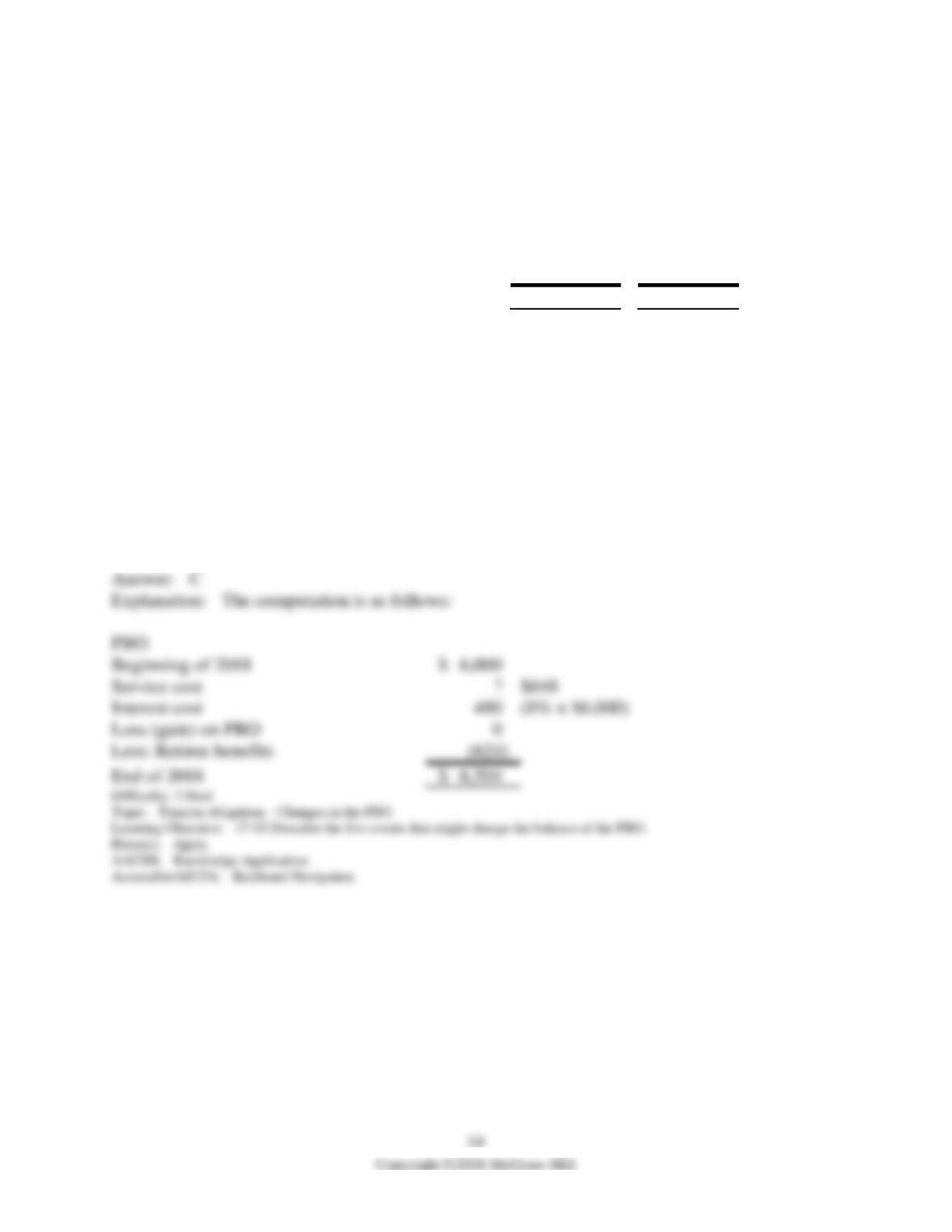
39) The following information pertains to Havana Corporation’s defined benefit pension plan:
($ in 000s)
2018
2019
Beginning
balances
Beginning
balances
Projected benefit obligation
$
(6,000
)
$
(6,504
)
Plan assets
5,760
6,336
Prior service cost-AOCI
600
552
Net loss-AOCI
720
786
At the end of 2018, Havana contributed $696 thousand to the pension fund and benefit payments
of $624 thousand were made to retirees. The expected rate of return on plan assets was 10%, and
the actuary’s discount rate is 8%. There were no changes in actuarial estimates and assumptions
regarding the PBO.
What is the 2018 service cost for Havana’s plan?
A) $276 thousand.
B) $528 thousand.
C) $648 thousand.
D) Cannot be determined from the given information.
Beginning of 2018
$
6,000
Service cost
$648
Interest cost
(8% × $6,000)
Loss (gain) on PBO
Less: Retiree benefits
)
End of 2018
$
6,504
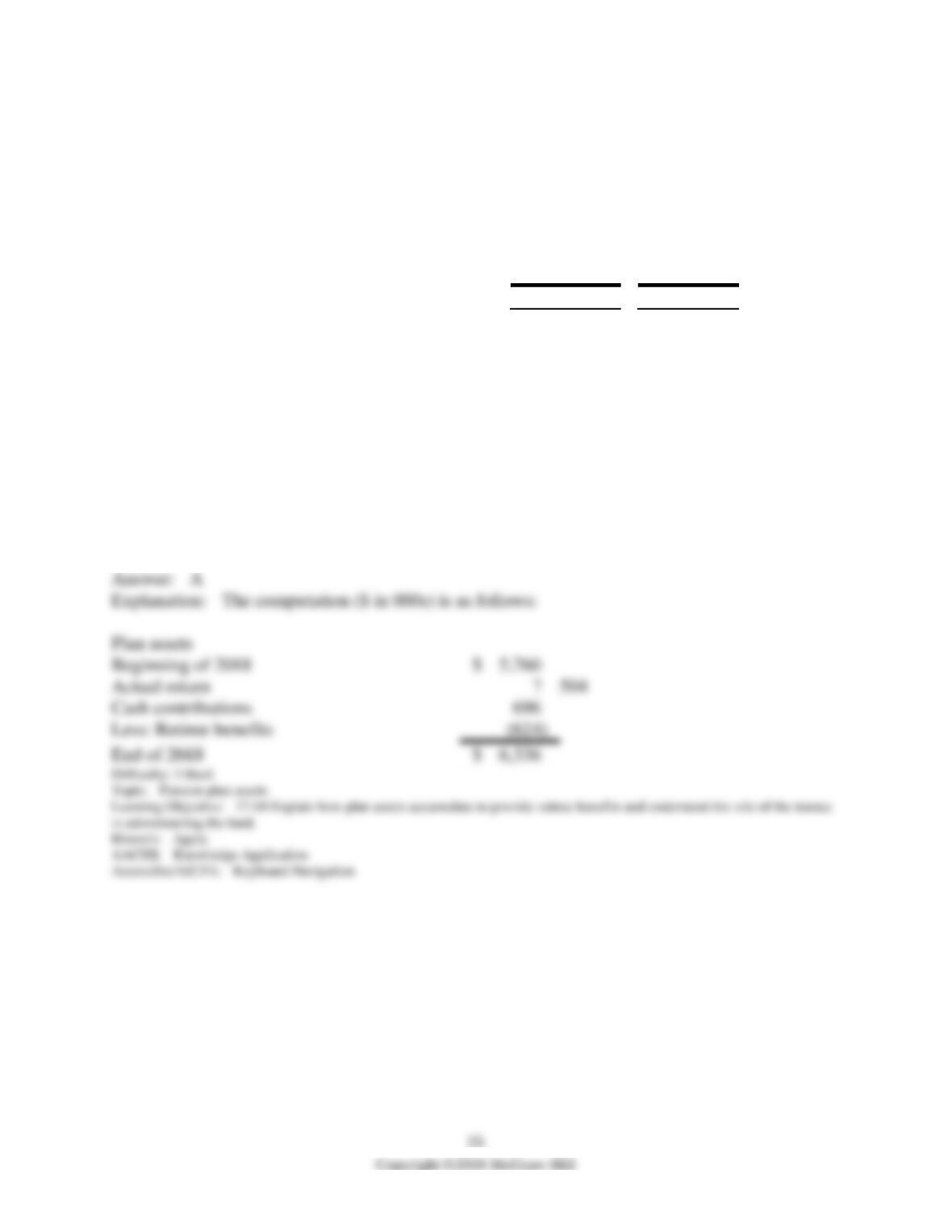
40) The following information pertains to Havana Corporation’s defined benefit pension plan:
($ in 000s)
2018
2019
Beginning
balances
Beginning
balances
Projected benefit obligation
$
(6,000
)
$
(6,504
)
Plan assets
5,760
6,336
Prior service cost-AOCI
600
552
Net loss-AOCI
720
786
At the end of 2018, Havana contributed $696 thousand to the pension fund and benefit payments
of $624 thousand were made to retirees. The expected rate of return on plan assets was 10%, and
the actuary’s discount rate is 8%. There were no changes in actuarial estimates and assumptions
regarding the PBO.
What is Havana’s 2018 actual return on plan assets?
A) $504 thousand.
B) $618 thousand.
C) $1,128 thousand.
D) None of these answer choices is correct.
Beginning of 2018
$
5,760
Actual return
504
Cash contributions
Less: Retiree benefits
)
End of 2018
$
6,336
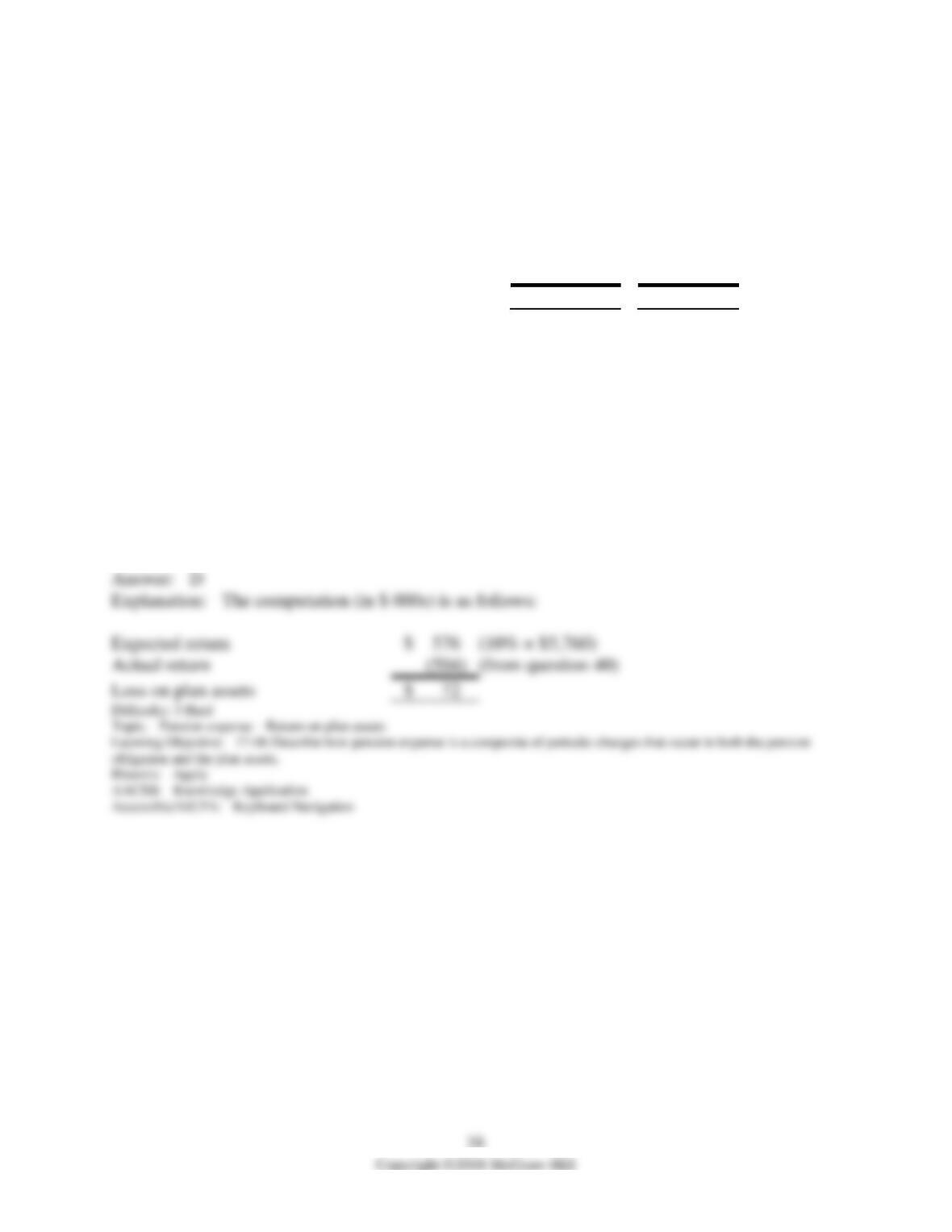
41) The following information pertains to Havana Corporation’s defined benefit pension plan:
($ in 000s)
2018
2019
Beginning
balances
Beginning
balances
Projected benefit obligation
$
(6,000
)
$
(6,504
)
Plan assets
5,760
6,336
Prior service cost-AOCI
600
552
Net loss-AOCI
720
786
At the end of 2018, Havana contributed $696 thousand to the pension fund and benefit payments
of $624 thousand were made to retirees. The expected rate of return on plan assets was 10%, and
the actuary’s discount rate is 8%. There were no changes in actuarial estimates and assumptions
regarding the PBO.
What is Havana’s 2018 gain or loss on plan assets?
A) $115.2 thousand.
B) $160.8 thousand.
C) $276 thousand.
D) None of these answer choices is correct.
Actual return
(504
)
(from question 40)
Loss on plan assets
$
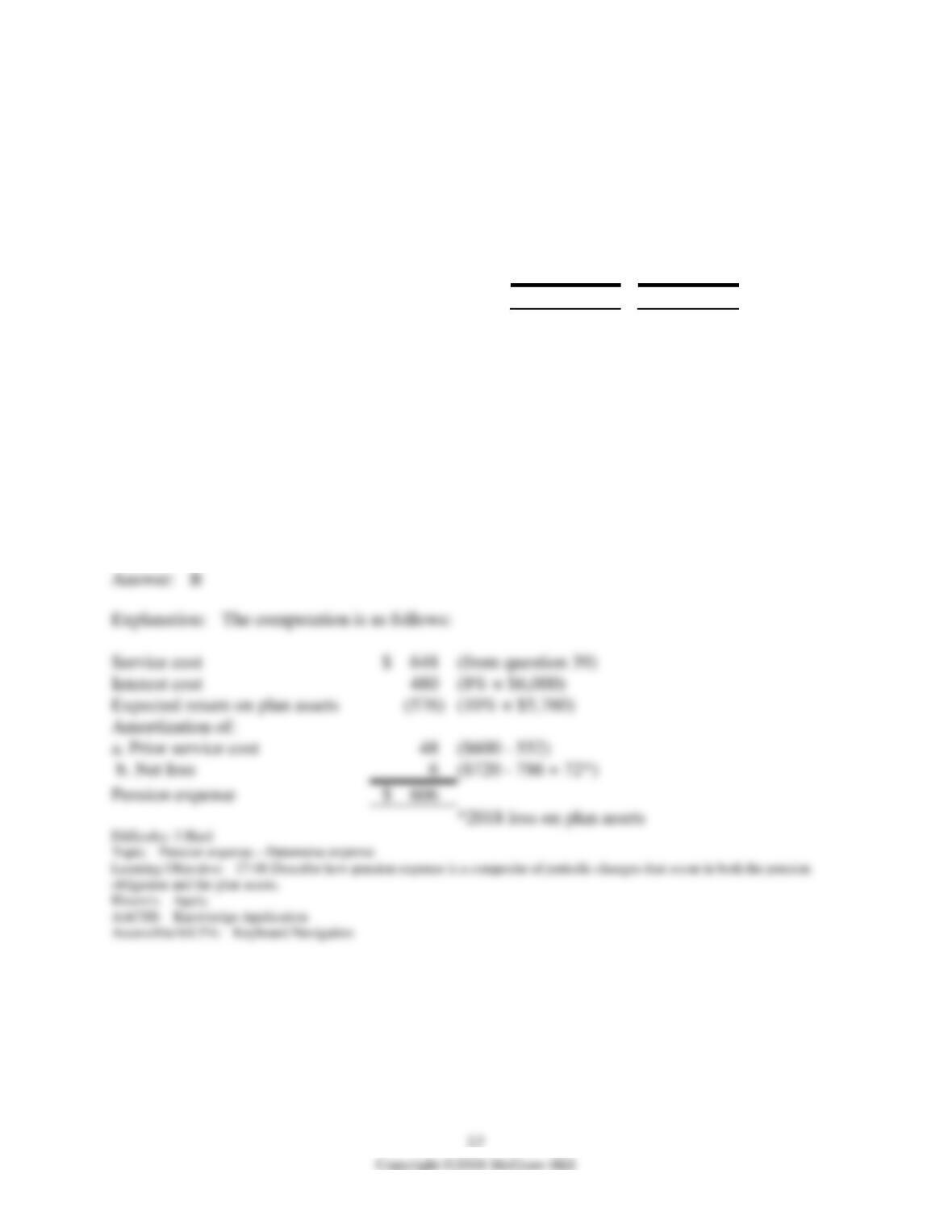
42) The following information pertains to Havana Corporation’s defined benefit pension plan:
($ in 000s)
2018
2019
Beginning
balances
Beginning
balances
Projected benefit obligation
$
(6,000
)
$
(6,504
)
Plan assets
5,760
6,336
Prior service cost-AOCI
600
552
Net loss-AOCI
720
786
At the end of 2018, Havana contributed $696 thousand to the pension fund and benefit payments
of $624 thousand were made to retirees. The expected rate of return on plan assets was 10%, and
the actuary’s discount rate is 8%. There were no changes in actuarial estimates and assumptions
regarding the PBO.
What is the 2018 pension expense for Havana’s plan?
A) $594 thousand.
B) $606 thousand.
C) $678 thousand.
D) None of these answer choices is correct.
Service cost
$
648
(from question 39)
Interest cost
480
(8% × $6,000)
Expected return on plan assets
(576
)
(10% × $5,760)
Amortization of:
a. Prior service cost
($600 – 552)
b. Net loss
($720 – 786 + 72*)
Pension expense
$
606
*2018 loss on plan assets
43) An underfunded pension plan means that the:
A) PBO is less than plan assets.
B) PBO exceeds plan assets.
C) ABO is less than plan assets.
D) ABO exceeds plan assets.
44) An overfunded pension plan means that the:
A) PBO is less than plan assets.
B) PBO exceeds plan assets.
C) ABO is less than plan assets.
D) ABO exceeds plan assets.
45) Data for 2018 were as follows: PBO, January 1, $240,000 and December 31, $270,000;
pension plan assets (fair value) January 1, $180,000, and December 31, $230,000. The projected
benefit obligation was underfunded at the end of 2018 by:
A) $30,000.
B) $60,000.
C) $20,000.
D) $40,000.
46) Pension expense is decreased by:
A) Amortization of prior service cost.
B) Amortization of net gain.
C) Benefits paid to retired employees.
D) Prior service cost.
47) Interest cost is calculated by multiplying the:
A) ABO by the expected return on the plan assets.
B) ABO by the discount rate.
C) PBO by the expected return on plan assets.
D) PBO by the discount rate.
48) The three components of pension expense that are present most often are:
A) Service cost, prior service cost, and gain on plan assets.
B) Service cost, interest cost, and gain from revisions in pension liability.
C) Service cost, contribution cost, and prior service cost.
D) Service cost, interest cost, and expected return on plan assets.
49) The pension expense includes periodic changes that occur:
A) In the PBO.
B) In the PBO and the plan assets.
C) In the plan assets.
D) In the PBO and the ABO.
50) Which of the following is true?
A) A projected benefits approach is used to determine the periodic pension expense.
B) An accumulated benefits approach is used to determine the periodic pension expense.
C) A vested benefits approach is used to determine the periodic pension expense.
D) The pension expense is unrelated to the pension obligation.
51) The component of pension expense that results from amending a pension plan to give
recognition to previous service of currently enrolled employees is the amortization of:
A) Prior service costs.
B) Amendment costs.
C) Retiree service costs.
D) Transition costs.