67) Activity-based costing often shifts overhead costs from large volume, standardized products
to low-volume, specialty products that consume disproportionate resources.
68) The final step of activity-based costing assigns overhead costs to pools rather than to
products.
69) Batch-level costs vary with the number of units produced.
70) Unit-level costs vary with the number of units produced.
71) Batch-level costs do not vary with the number of units produced.
72) Product-level costs do not vary with the number of units or batches produced.
73) Facility-level costs vary with the number of units or batches produced.
74) A quality-inspection cost is an example of unit-level costs.
75) Plantwide overhead rates typically do a better job of matching each department’s overhead
costs to the products using the department’s resources than do departmental overhead rates.
76) Two big benefits of ABC costing are a) more accurate product cost information and b) more
detailed information on costs and the drivers of those costs.
77) A method of assigning overhead costs to a product using a single overhead rate is:
A) Plantwide overhead rate method.
B) Cost pool overhead rate method.
C) Departmental overhead rate method.
D) Activity-based costing.
E) Overhead cost allocation method.
78) Which types of overhead allocation methods result in the use of more than one overhead rate
during the same time period?
A) Plantwide overhead rate method and departmental overhead rate method.
B) Cost pool overhead rate method and plantwide overhead rate method.
C) Departmental overhead rate method and activity-based costing.
D) Activity-based costing and plantwide overhead rate method.
E) Departmental overhead rate method and cost pool overhead rate method.
79) Which of the following would not be considered a product cost?
A) Direct labor costs.
B) Factory supervisor’s salary.
C) Factory line worker’s salary.
D) Cost accountant’s salary.
E) Manufacturing overhead costs.
80) Overhead costs:
A) Are directly related to production.
B) Can be traced to units of product in the same way that direct materials can.
C) Cannot be traced to units of product in the same way that direct labor can.
D) Are period costs.
E) Include only fixed costs.
81) The cost object of the plantwide overhead rate method is:
A) The unit of product.
B) The production departments of the company.
C) The production activities of the company.
D) Manufacturing cost pools.
E) The time period.
82) Which of the following statements is true with regard to the plantwide overhead rate
method?
A) The rate is determined using volume-related measures.
B) It is logical to use this method when overhead costs are not closely tied to volume-related
measures.
C) This method uses multiple overhead rates.
D) The rate is determined using measures that are not closely related to volume.
E) The method provides the most accurate means of allocating overhead costs.
83) The cost object(s) of the departmental overhead rate method is:
A) The time period.
B) The production departments of the company.
C) The production departments in the first stage and the unit of product in the second stage.
D) The unit of product in the first stage and the production departments in the second stage.
E) The production activities of the company.
84) Which of the following statements is true with regard to the departmental overhead rate
method?
A) It is logical to use this method when overhead resources are consumed by various products in
substantially the same way throughout multiple departments.
B) It is logical to use this method when overhead resources are consumed by various products in
substantially different ways throughout multiple departments.
C) Each department has the same rate for the same activity pool.
D) It requires one overhead cost pool and one rate.
E) It is the same as activity-based costing.
85) The cost object(s) of the activity-based costing method is(are):
A) The time period.
B) The production departments of the company.
C) The production activities of the company.
D) The production activities in the first stage and the unit of product in the second stage.
E) The unit of product in the first stage and the production activities in the second stage.
86) From an ABC perspective, what causes costs to be incurred?
A) Financial transactions.
B) The volume of units produced.
C) Debits and credits.
D) Management decisions.
E) Activities.
87) Which of the following statements is true with regard to activity-based costing rates?
A) The premise of ABC is that activities are what cause costs to be incurred.
B) ABC is another way to refer to a multiple departmental rate situation.
C) There one basic stage to ABC.
D) ABC is simpler and less expensive to implement than other traditional methods of allocating
overhead costs.
E) All cost drivers used to determine the rates will be unit-level drivers.
88) What is the reason for pooling costs?
A) To shift costs from low-volume to high-volume products.
B) It is a budgeting technique designed to accurately track fixed costs.
C) Determining a pool rate for all costs incurred by the same activity reduces the number of cost
assignments required.
D) This procedure helps to determine which costs are directly related to production volume.
E) It simplifies departmental overhead costing procedures.
89) Which of the following are advantages of using the plantwide overhead rate method?
A) The use of cost pools is considerably more accurate than other overhead allocations.
B) The necessary information is readily available.
C) It is more accurate than traditional overhead allocations.
D) Each department has its own overhead rate and its own allocation base.
E) It takes into account that when products differ in batch size and complexity, they usually
consume different amounts of overhead resources.
90) Which of the following companies would be best served by a plantwide overhead rate?
A) A company that manufactures many different products and whose operations are an equal mix
of labor and mechanized work.
B) A company that manufactures few products and whose operations are labor intensive.
C) A company that manufactures many different products and whose operations are highly
mechanized.
D) A company whose products use overhead resources in very different ways.
E) A company whose products differ in batch size and complexity and consume different
amounts of overhead resources.
91) Which of the following is true?
A) Overhead costs are often affected by many issues and are frequently too complex to be
explained by any one factor.
B) The departmental overhead rate is not usually based on measures closely related to production
volume.
C) The departmental overhead rate is most accurate in assigning overhead costs that are not
driven by production volume.
D) Allocated overhead costs will be the same no matter which allocation method is used.
E) When cost analysts are able to logically trace cost objects to costs, costing accuracy is
improved.
92) Which of the following is a disadvantage of the departmental overhead rate method?
A) The departmental overhead rate method assigns overhead on the basis of volume-related
measures.
B) The departmental overhead rate method is more refined than the plantwide overhead rate
method.
C) The departmental overhead rate method does not assign overhead on the basis of volume-
related measures.
D) The departmental overhead rate method is simpler and less costly to implement than the
plantwide rate method.
E) There are no disadvantages of the departmental overhead rate method.
93) Which of the following is not true?
A) The departmental overhead method assigns overhead on the basis of volume-related
measures.
B) The departmental overhead rate method is more refined than the plantwide overhead rate
method.
C) Overhead costing accuracy is improved by the use of multiple departmental rates rather than a
single overhead rate.
D) The departmental overhead rate method does not assign overhead on the basis of volume-
related measures.
E) The departmental overhead rate method is more costly to implement than the plantwide
overhead rate method.
94) What are three advantages of activity-based costing over traditional volume-based allocation
methods?
A) Ease of use, more accurate product costing, and more effective cost control.
B) Fewer allocation bases, ease of use, and a direct correlation to production volume.
C) More accurate product costing, more effective cost control, and better focus on the relevant
factors for decision making.
D) More accurate product costing, fewer cost objects, and a direct correlation to production
volume.
E) More accurate product costing, ease of use, less costly to implement.
95) What are the main advantages of volume-based allocation methods compared to activity-
based costing?
A) Volume-based methods are easier to use and less costly to implement and maintain.
B) Volume-based methods are more accurate and allowed by GAAP.
C) Volume-based methods are less accurate and easier to use.
D) Volume-based methods are harder to use and more costly to implement and maintain.
E) There are no advantages to using volume-based methods.
96) K Company estimates that overhead costs for the next year will be $2,900,000 for indirect
labor and $800,000 for factory utilities. The company uses direct labor hours as its overhead
allocation base. If 80,000 direct labor hours are planned for this next year, what is the company’s
plantwide overhead rate?
A) $0.02 per direct labor hour.
B) $46.25 per direct labor hour.
C) $36.25 per direct labor hour.
D) $10 per direct labor hour.
E) $0.10 per direct labor hour.
97) K Company estimates that overhead costs for the next year will be $2,900,000 for indirect
labor and $800,000 for factory utilities. The company uses direct labor hours as its overhead
allocation base. If 80,000 direct labor hours are planned for this next year, how much overhead
would be assigned to a product requiring 4 direct labor hours?
A) $46.25
B) $36.25
C) $185.00
D) $145.00
E) None of the choices
98) Peterson Company estimates that overhead costs for the next year will be $6,520,000 for
indirect labor and $550,000 for factory utilities. The company uses machine hours as its
overhead allocation base. If 140,000 machine hours are planned for this next year, what is the
company’s plantwide overhead rate? (Round your answer to two decimal places.)
A) $0.02 per machine hour.
B) $50.50 per machine hour.
C) $45.75 per machine hour.
D) $3.93 per machine hour.
E) $0.25 per machine hour.
99) A company estimates that overhead costs for the next year will be $8,320,000 for indirect
labor and $155,500 for factory utilities. The company uses machine hours as its overhead
allocation base. If 400,000 machine hours are planned for this next year, what is the company’s
plantwide overhead rate? (Round your answer to two decimal places.)
A) $0.05 per machine hour.
B) $21.19 per machine hour.
C) $20.80 per machine hour.
D) $0.39 per machine hour.
E) $2.57 per machine hour.
100) The following data relates to Spurrier Company’s estimated amounts for next year.
Estimated:
Department 1
Department 2
Manufacturing overhead costs
$
1,100,000
$
3,300,000
Direct labor hours
540,000
DLH
790,000
DLH
Machine hours
90,000
MH
24,000
MH
What is the company’s plantwide overhead rate if direct labor hours are the allocation base?
(Round your answer to two decimal places.)
A) $3.31 per direct labor hour.
B) $3.43 per direct labor hour.
C) $2.04 per direct labor hour.
D) $0.30 per direct labor hour.
E) $0.50 per direct labor hour.
101) The following data relates to Black-Out Company’s estimated amounts for next year.
Estimated:
Department 1
Department 2
Manufacturing overhead costs
$
300,000
$
400,000
Direct labor hours
60,000
DLH
80,000
DLH
Machine hours
1,000
MH
2,000
MH
What is the company’s plantwide overhead rate if machine hours are the allocation base? (Round
your answer to two decimal places.)
A) $233.33 per MH
B) $150.00 per MH
C) $100.00 per MH
D) $4.90 per MH
E) $5.00 per MH
102) The following data relates to Patterson Company’s estimated amounts for next year.
Estimated:
Department 1
Department 2
Manufacturing overhead costs
$
50,000
$
60,000
Direct labor hours
180,000
DLH
200,000
DLH
Machine hours
200,000
MH
400,000
MH
What is the company’s plantwide overhead rate if direct labor hours are the allocation base?
(Round your answer to two decimal places.)
A) $3.45 per DLH
B) $5.45 per DLH
C) $0.29 per DLH
D) $0.26 per DLH
E) $0.20 per DLH
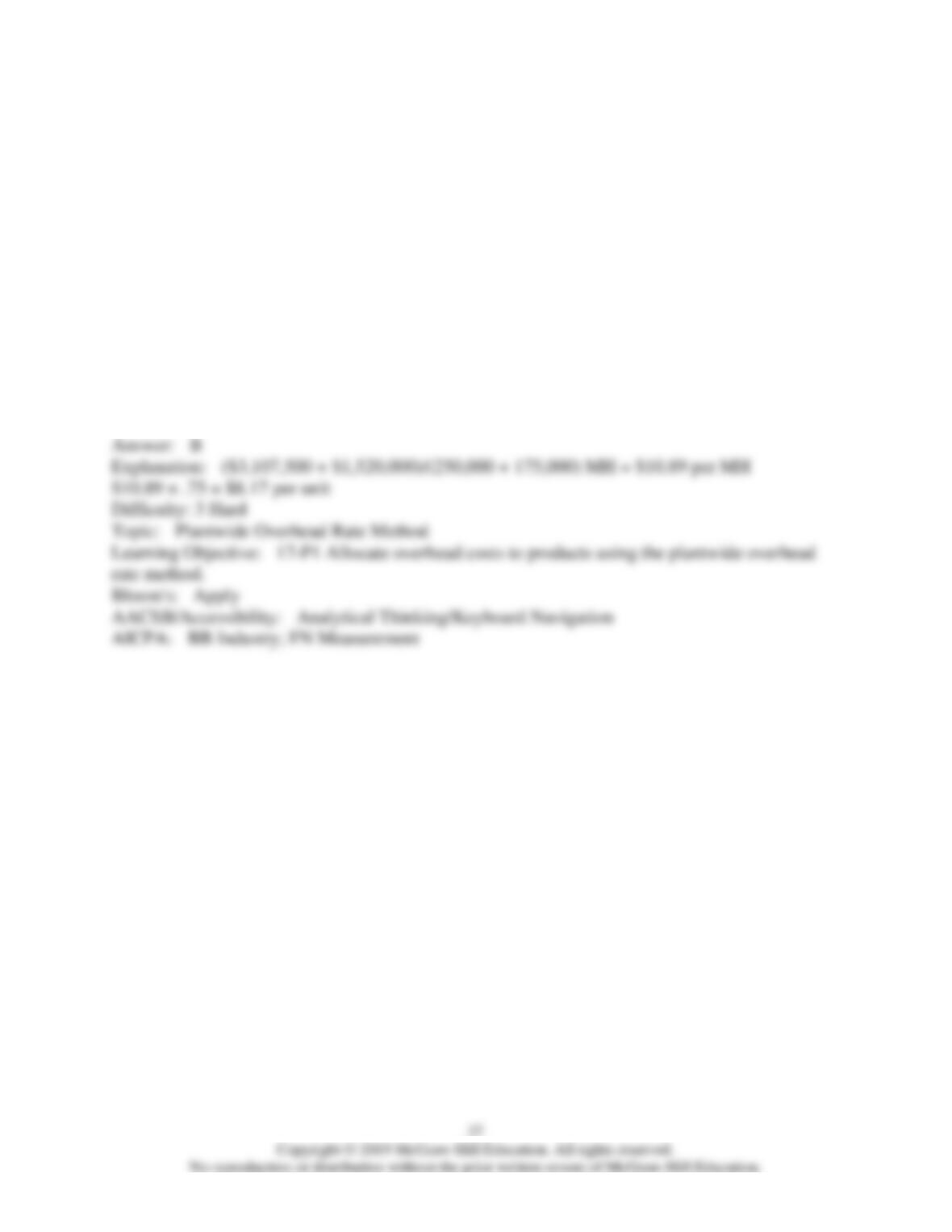
103) Lake Erie Company uses a plantwide overhead rate with machine hours as the allocation
base. Next year, 600,000 units are expected to be produced taking 0.75 machine hours each. How
much overhead will be assigned to each unit produced given the following estimated amounts?
Estimated:
Department 1
Department 2
Manufacturing overhead costs
$
3,107,500
$
1,520,000
Direct labor hours
150,000
DLH
250,000
DLH
Machine hours
250,000
MH
175,000
MH
A) $11.57 per unit
B) $8.17 per unit
C) $5.61 per unit
D) $12.43 per unit
E) $10.89 per unit
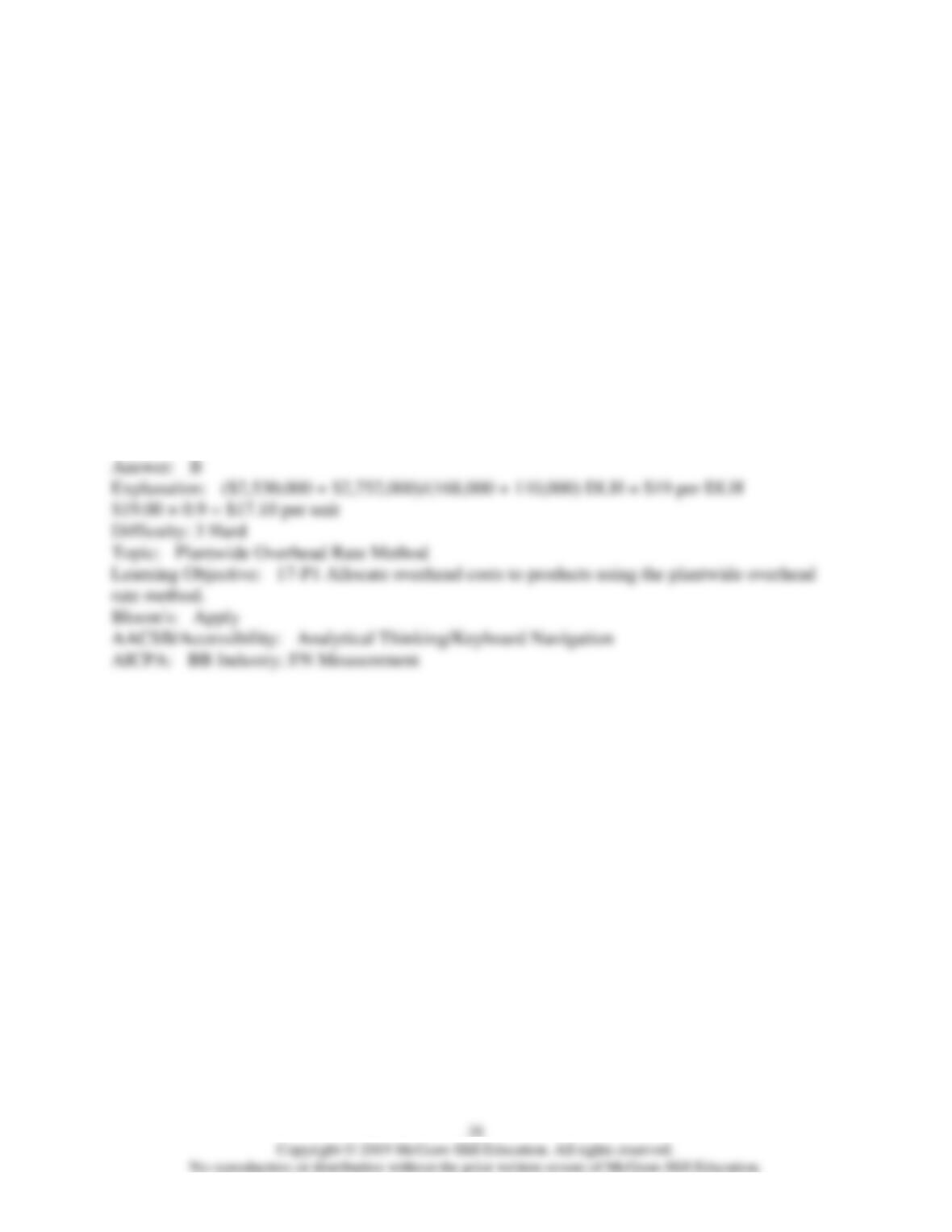
104) Red Raider Company uses a plantwide overhead rate with direct labor hours as the
allocation base. Next year, 400,000 units are expected to be produced requiring 0.9 direct-labor
hours each. How much overhead will be assigned to each unit produced given the following
estimated amounts?
Estimated:
Department 1
Department 2
Manufacturing overhead costs
$
2,530,000
$
2,752,000
Direct labor hours
168,000
DLH
110,000
DLH
Machine hours
30,000
MH
8,000
MH
A) $19.00 per unit
B) $17.10 per unit
C) $139.00 per unit
D) $125.10 per unit
E) None of the choices
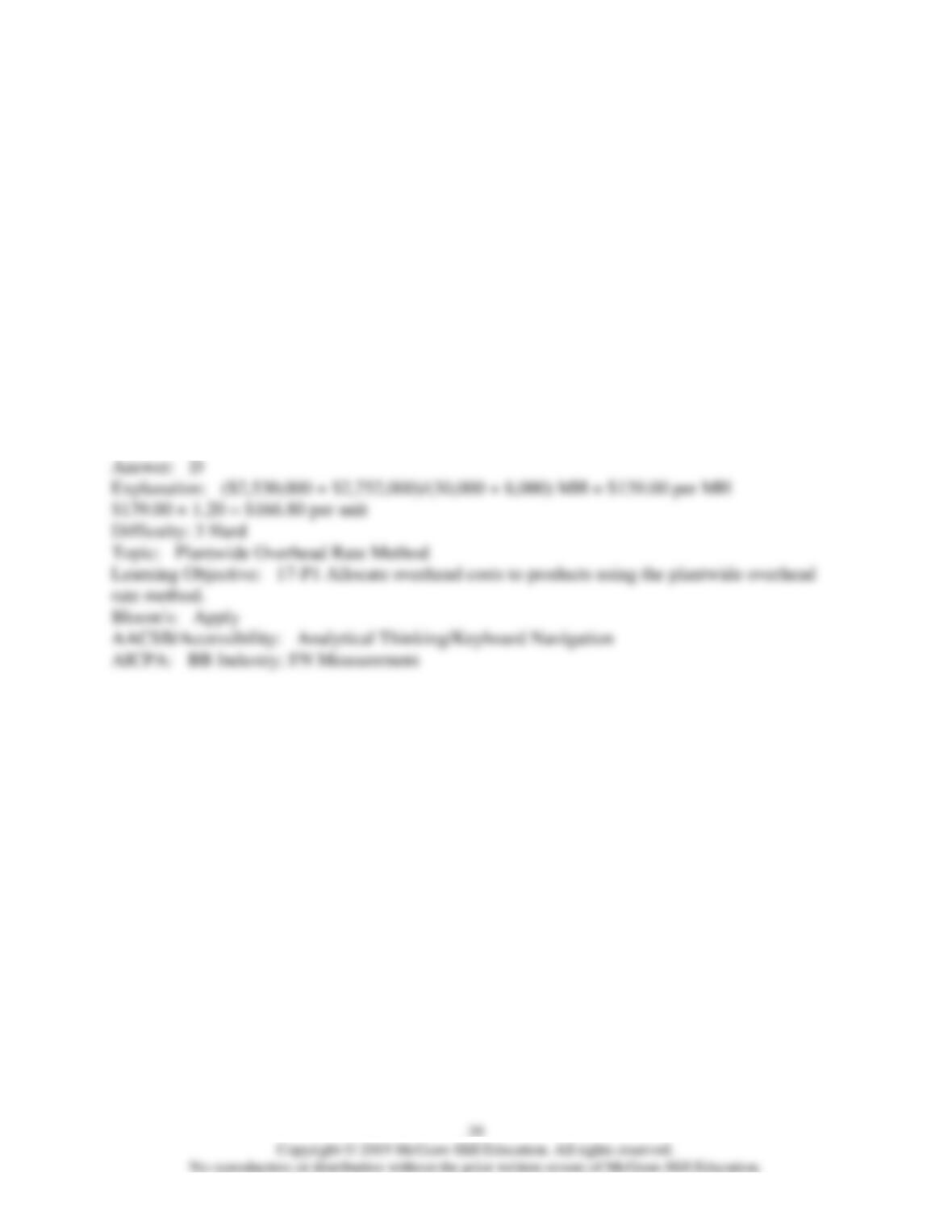
105) Red Raider Company uses a plantwide overhead rate with machine hours as the allocation
base. Next year, 400,000 units are expected to be produced requiring 1.2 machine hours each.
How much overhead will be assigned to each unit produced given the following estimated
amounts?
Estimated:
Department 1
Department 2
Manufacturing overhead costs
$
2,530,000
$
2,752,000
Direct labor hours
168,000
DLH
110,000
DLH
Machine hours
30,000
MH
8,000
MH
A) $19.00 per unit
B) $139.00 per unit
C) $22.68 per unit
D) $166.80 per unit
E) None of the choices
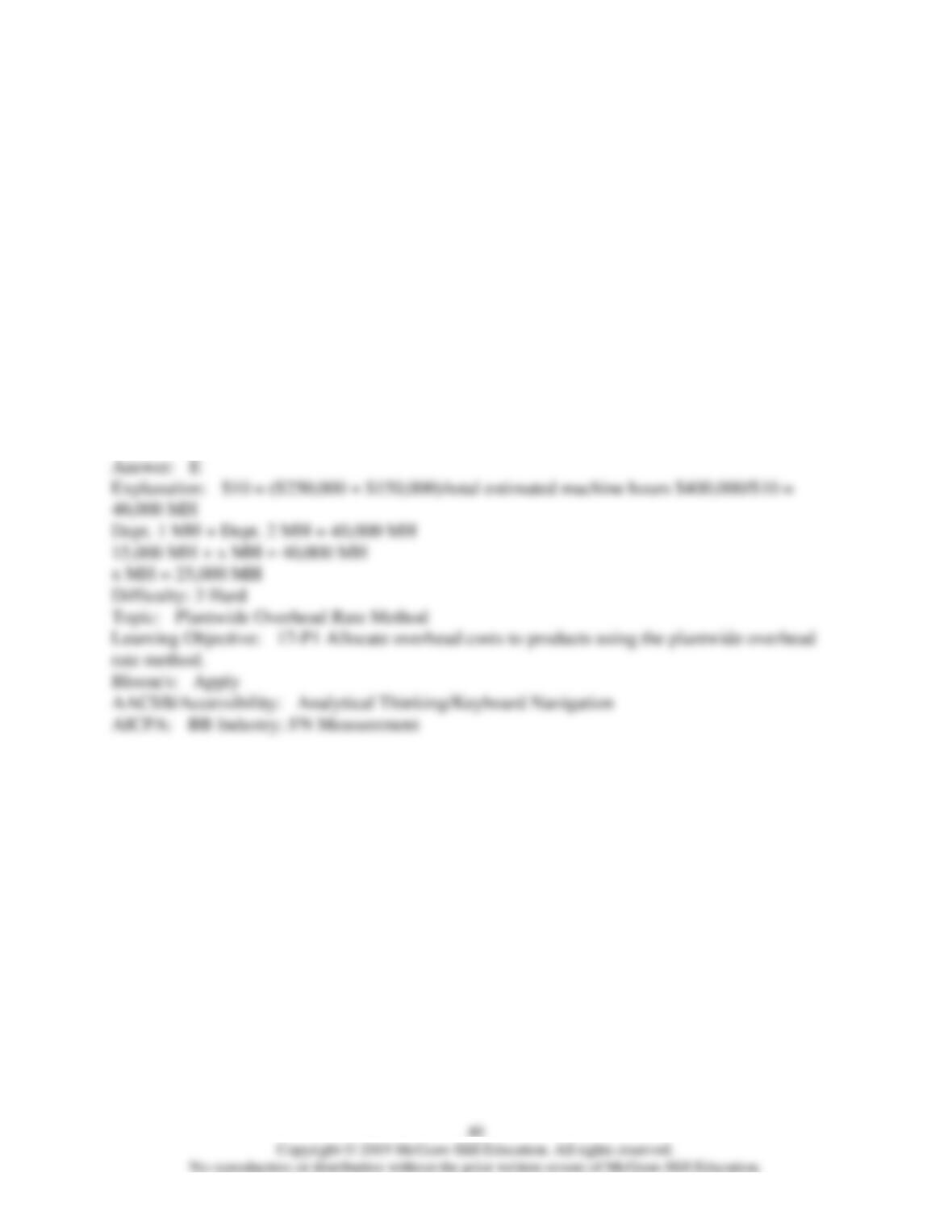
106) Western Company allocates $10 overhead to products based on the number of machine
hours used. The company uses a plantwide overhead rate with machine hours as the allocation
base. Given the amounts below, how many machine hours does the company expect in
department 2?
Estimated:
Department 1
Department 2
Manufacturing overhead costs
$
250,000
$
150,000
Direct labor hours
8,000
DLH
12,000
DLH
Machine hours
15,000
MH
?
MH
A) 33,000 MH
B) 137,500 MH
C) 82,500 MH
D) 88,000 MH
E) 25,000 MH