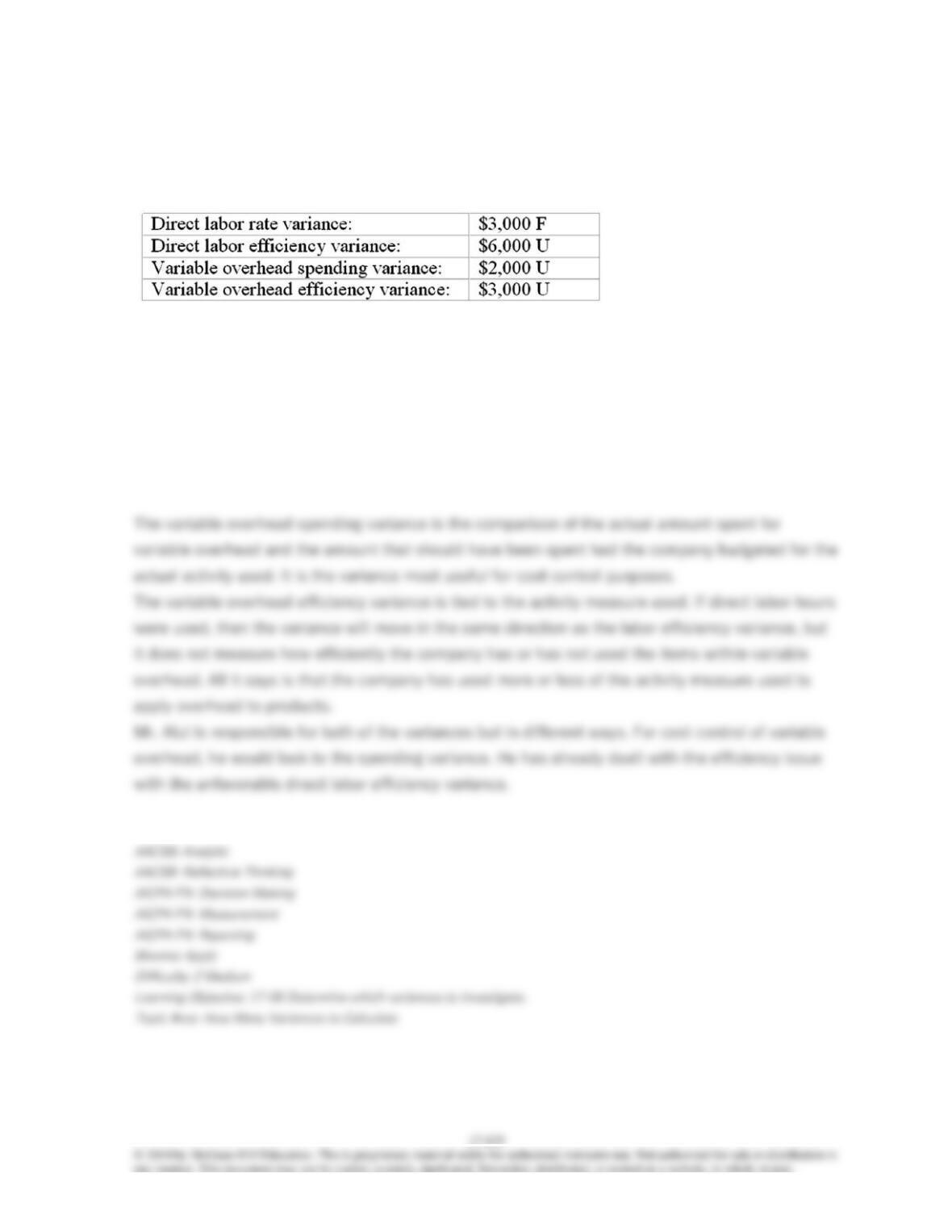
143. Alexky Company uses labor hours to allocate its variable overhead costs. Mr. Alul, the
production manager has been told that his direct labor and variable overhead variances for the
past month were as follows:
The production V.P. has asked Mr. Alul to account for his overhead variances for the month.
Required:
Explain the meaning of the two variable overhead variances and Mr. Alul’s responsibility for them.
144. Cucto Company uses machine hours to allocate its fixed overhead costs. Mr. Salezar, the
production manager has been told that his fixed overhead variances for the past month were as
follows:
Fixed overhead budget variance: $2,000 F
Fixed overhead volume variance: $20,000 U
The production V.P. has asked Mr. Salezar to account for his underutilization of capacity for the
month.
Required:
Explain the meaning of the two variances and Mr. Salezar’s responsibility for them.

17-135
145. Maxym Yattselev, the managerial accountant has been asked by the Keepit Cool Ceiling
Fan Company president to prepare an analysis of the effectiveness of the new management team.
They manufacture paper fans.
2012 standards:
Budget
Direct materials – 4 parts @ $2 per part
Direct labor – one half hour (0.5) @ $10 per hour
Variable overhead – 2 machine hours @ $3 per hour
Fixed overhead – $900,000
Estimated production – 100,000
Actual results 2012:
Direct materials – 585,000 parts at a total cost of $1,462,500 were purchased and used
Direct labor – 51,000 hours at a cost of $561,000
Variable overhead – 240,000 machine hours at a cost of $840,000
Fixed overhead – $870,000
Actual production – 130,000 fans
Required:
Requirement 1: Compute the direct material and direct labor budget variances.
Requirement 2: Compute the variable and fixed overhead variances.
17-138
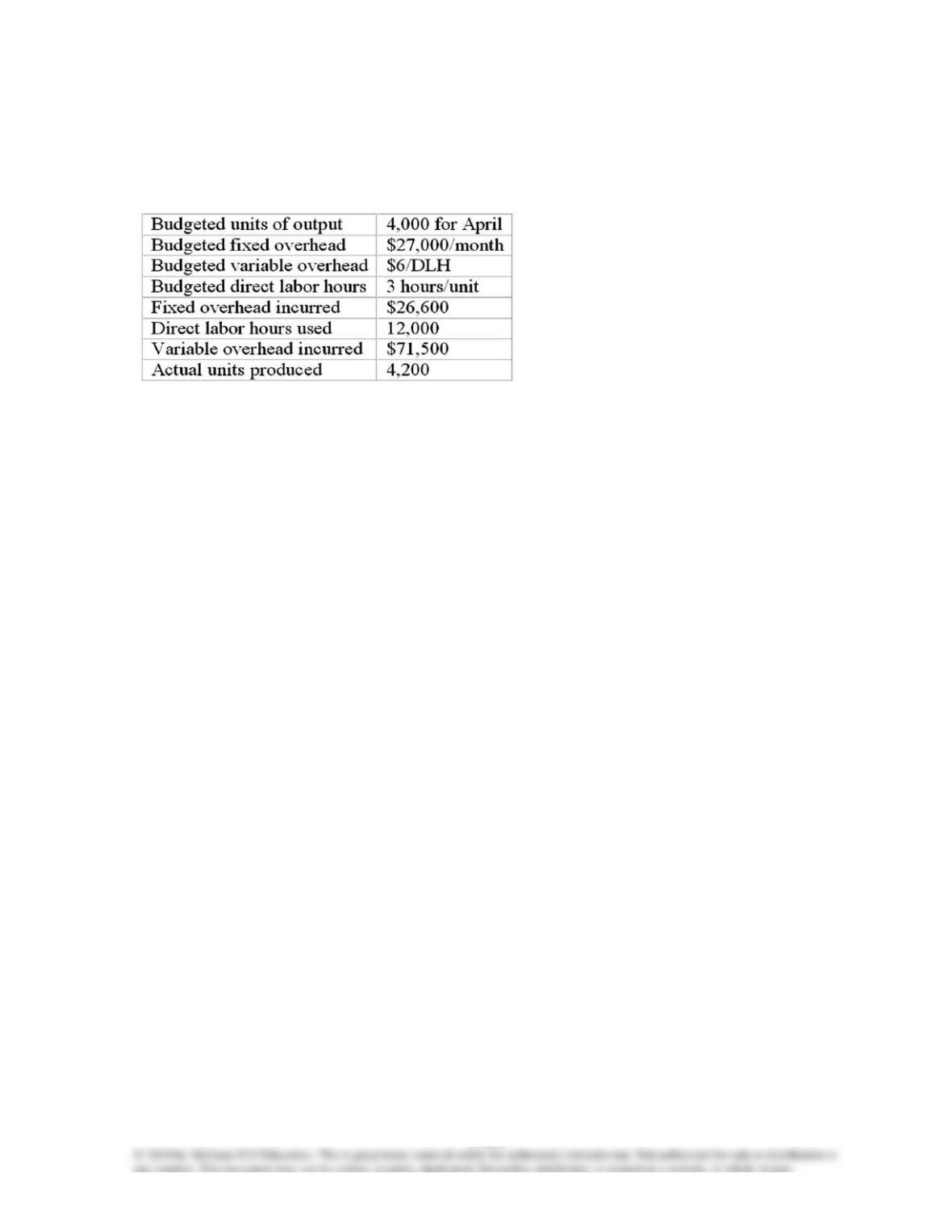
146. Menendez Incorporated is trying to decide which method of analyzing its overhead
variances provides the most useful information. The following information is available from the
records for April:
Required:
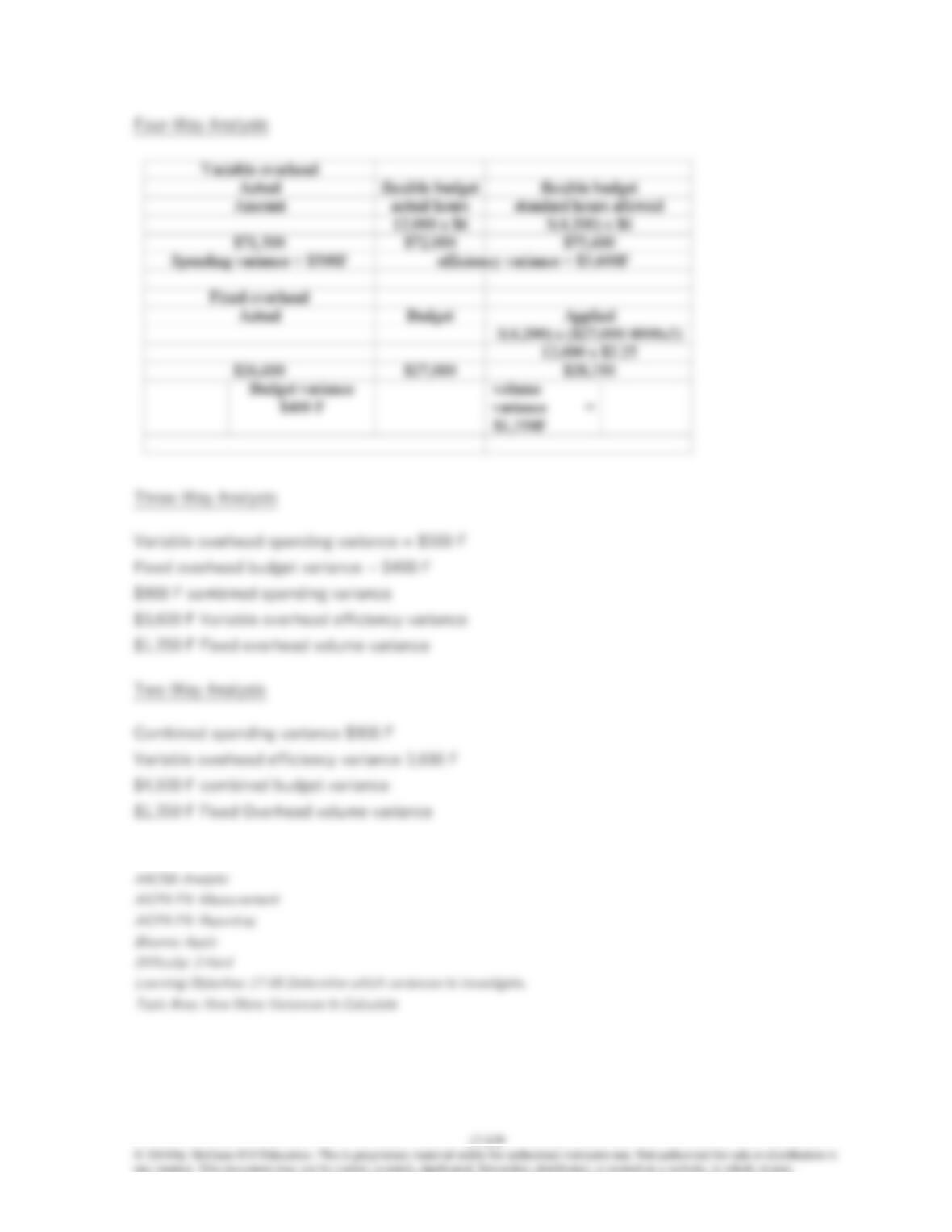
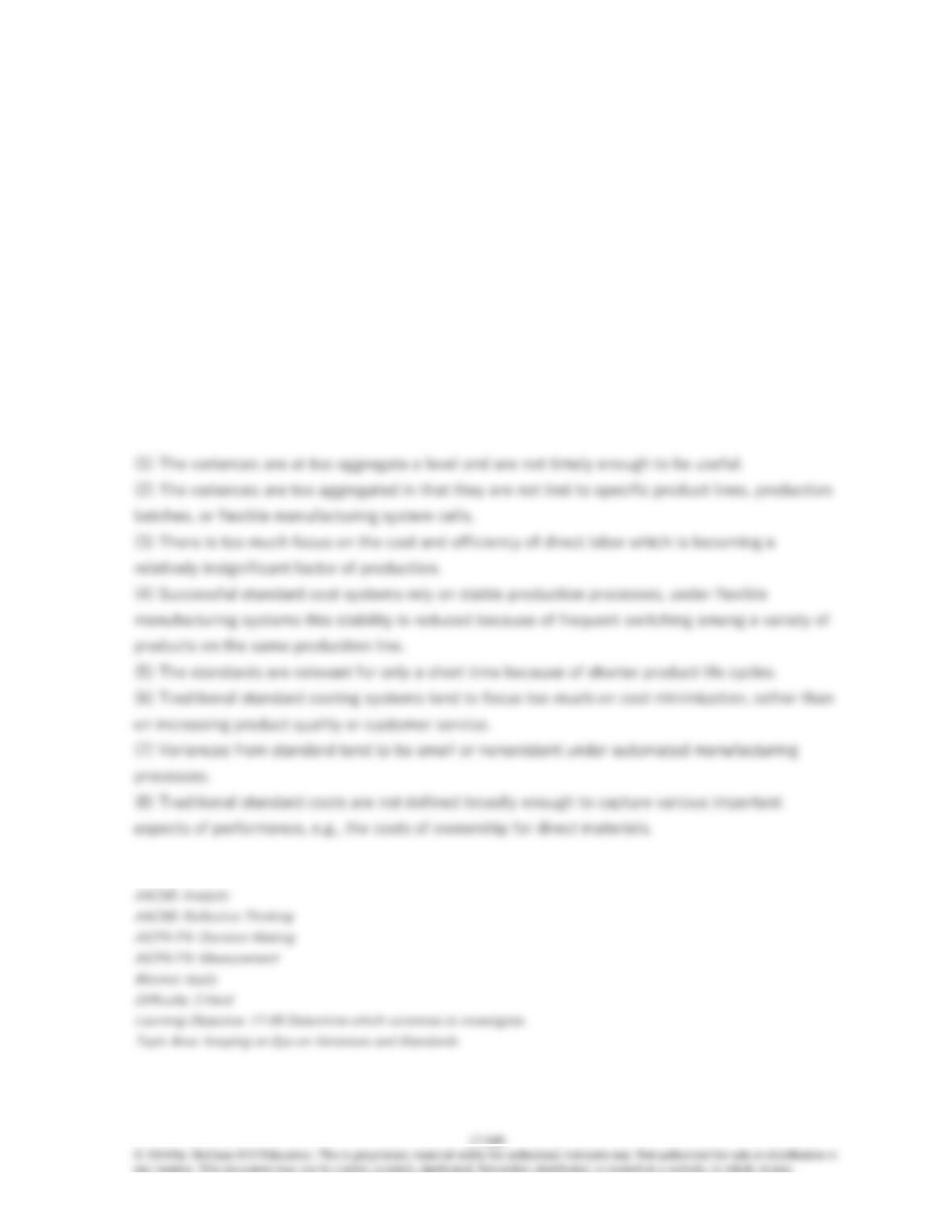
Compute the overhead variances using the following approaches;
(1) Four-way analysis
(2) Three-way analysis
(3) Two-way analysis
147. Az Company currently uses a traditional standard costing system. During the past two
years the company has been modernizing its plant and has tried to keep the old standard costing
system in place by changing some of the features to reflect the more automated situation. It has
now come to a point, however, where the old system just isn’t providing useful information for
product costing, pricing, decision making, etc. The CEO, Ms. Yamaguchi, has set up a team to look
into the situation and come up with reasons why the old system isn’t working anymore.
Required:
What are the problems with traditional standard costing under the current manufacturing
environment?
148. Coiller Company uses a standard cost system for its only product. The bickering between
purchasing and production that occurs every month after the material variances are developed
has the production vice president, Mr. Adath, at his wits end. He has checked the job descriptions
of the individuals involved and notes that the purchasing department is responsible for the price
at which materials and supplies are purchased and the manufacturing department is responsible
for the quantity of material used. This seems very clear cut to him so he has gone to the cost
accountant for some additional help.
Required:
As the cost accountant, explain to Mr. Adath why, or why not, this division of duties solves the
conflict between price and quantity variances.

17-142
149. Mercury Company is meeting with the consultants it hired to help it with problems arising
from its increasing sales and increasing production to meet them. The consultants have informed
the company that they need to make price concessions in order to have their product sold over a
large area. To do this, costs need to be reduced and controlled. They recommended installation of
a standard costing system and a flexible budgeting system.
The CEO took the recommendations back to the company management, explained to all, and a
team was set up to develop the standards. The team was composed of the purchasing manager,
processing manager, production engineer, and V.P. of sales. Each member of the team, rather
than working to develop standards, came up with reasons why they wouldn’t work. The team
made its report to the CEO who told them to come up with the standards or he would have the
consultants set them.
Required:
(1) What are the advantages and disadvantages of standard costing?
(2) What has gone wrong in this situation and will having the outside consultant do the work
change anything?
150. In the new cost management scheme of things, what are some of the disadvantages of the
traditional standard cost system (list at least four)?