Chapter 17 – Allocation of Support Activity Costs and Joint Costs
83. Many companies use the dual-rate method of cost allocation.
Required:
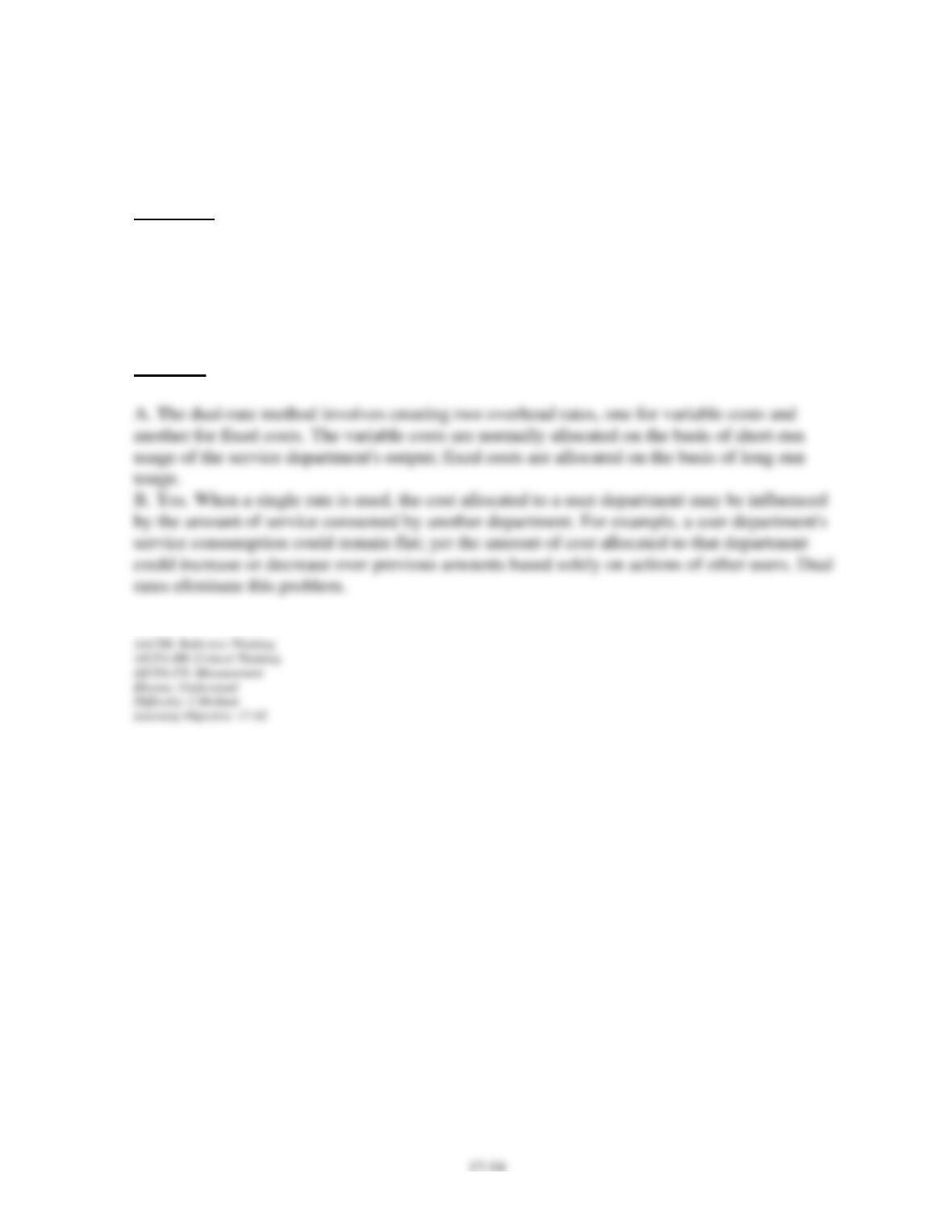
A. How does the dual-rate method work?
B. Is there any advantage of the dual-rate method over a method that uses a combined, lump-
sum single rate? Briefly explain.
Solution:

17–55
84. Bowden Outfitters manufactures a complete line of running shoes. The firm has three
manufacturing departments: Molding, Component, and Assembly. There are also two service
departments: Power and Maintenance.
The soles of the shoes are manufactured in the Molding Department. The tops of the shoes
are manufactured in the Component Department. The shoes are then completed in the
Assembly Department. Varying amounts of materials, time, and effort are required for each of
the shoe models. The Power Department and Maintenance Department provide services to the
three manufacturing departments.
Bowden has always used a plantwide overhead rate. Direct-labor hours are used to assign
overhead to products. The predetermined overhead rate is calculated by dividing the
company’s total estimated overhead by the total estimated direct-labor hours to be worked in
the three manufacturing departments.
Christine Macguire, director of cost management, has recommended that Bowden use
departmental overhead rates. The planned operating costs and expected levels of activity for
the coming year have been developed by Macguire and are presented by department in the
following schedules. (All numbers are in thousands.)
Service Departments
Power
Maintenance
Departmental activity measures:
Maximum capacity
1,000 kilowatt-hours
Adjustable
Estimated usage for the coming year
800 kilowatt-hours
125 hours
Departmental costs:
Materials and supplies
$ 6,000
$2,500
Variable labor
1,400
2,250
Fixed overhead
13,000
1,250
Total service department costs
$20,400
$6,000
Manufacturing Departments
Molding
Component
Assembly
Department activity measures:
Direct-labor hours
1,500
3,000
2,500
Machine hours
1,875
1,125
–0–
Departmental costs:
Direct material
$12,400
$30,000
$ 1,250
Direct labor
3,500
20,000
12,000
Variable overhead
4,500
11,000
20,500
Fixed overhead
18,500
7,200
7,100
Total departmental costs
$38,900
$68,200
$40,850
Use of service departments:
Maintenance:
Estimated usage in labor
hours for the coming year
90
25
10
Power (in kilowatt-hours):
Estimated usage for the
coming year
360
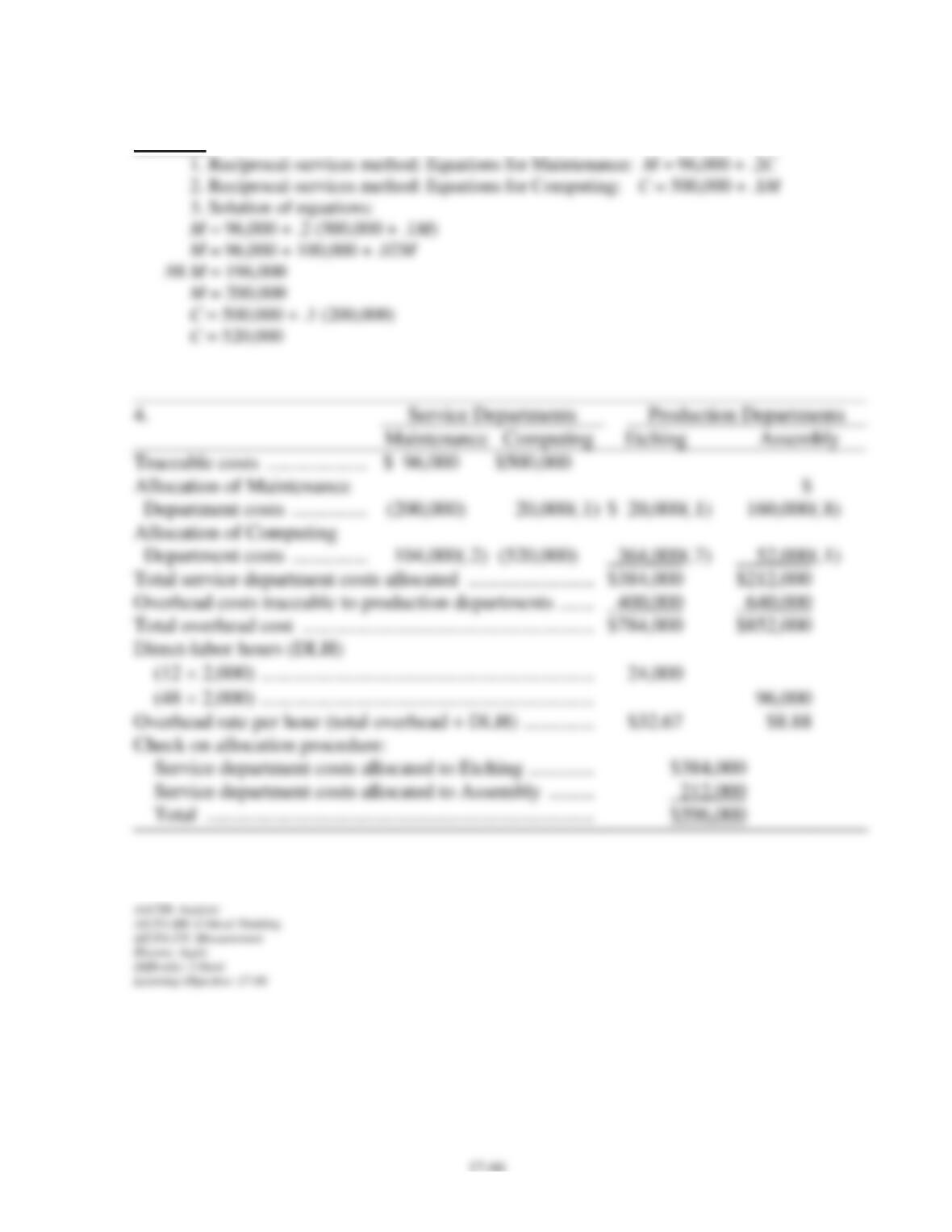
320
120
Maximum allotted capacity
500
350
150

Chapter 17 – Allocation of Support Activity Costs and Joint Costs
17–56
Required:
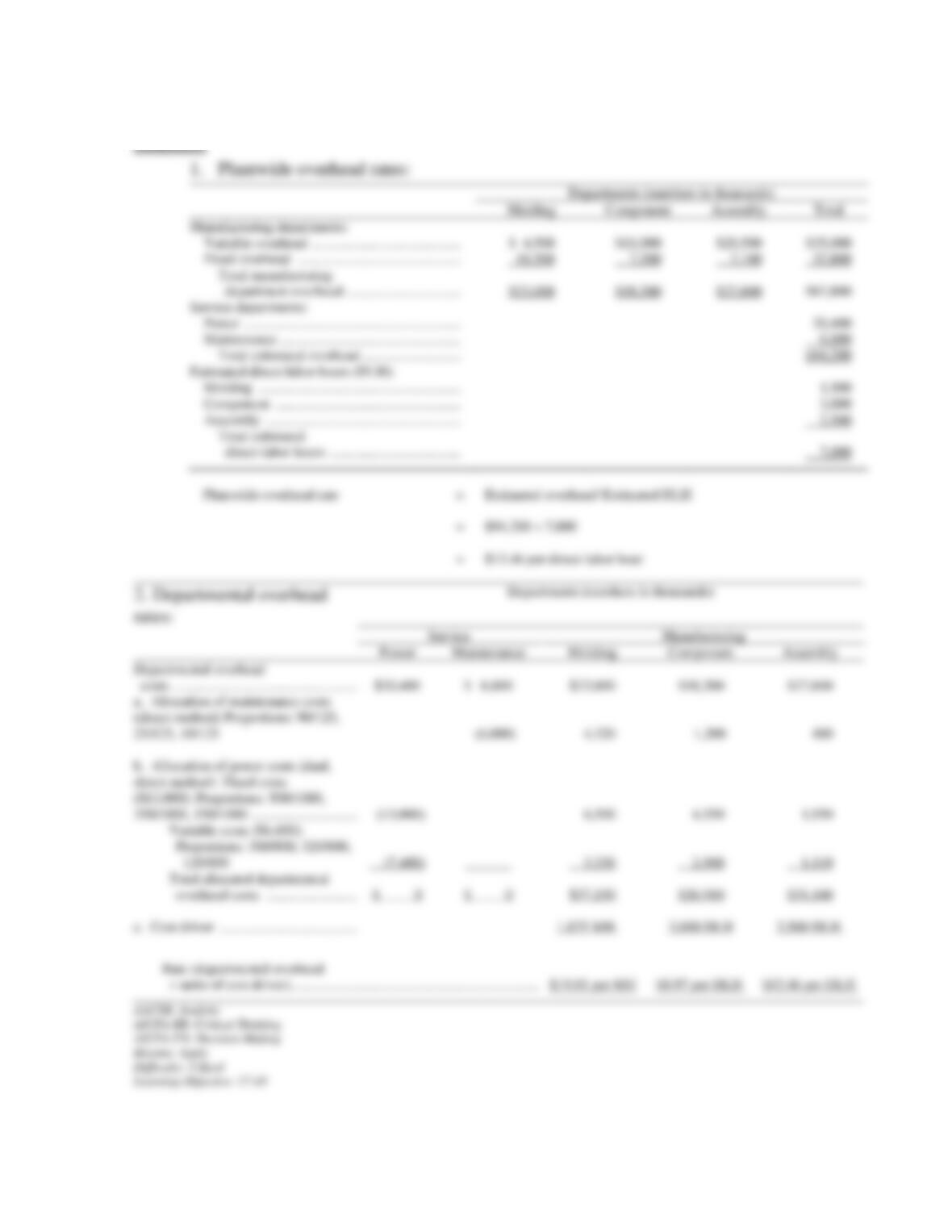
1. Calculate the plantwide overhead rate for Bowden Company for the coming year using the
same method as used in the past.
2. Christine Macguire has been asked to develop departmental overhead rates for
comparison with the plantwide rate. The following steps are to be followed in developing
the departmental rates.
a. The Maintenance Department costs should be allocated to the three manufacturing
departments using the direct method.
b. The Power Department costs should be allocated to the three manufacturing
departments using the dual method combined with the direct method. Fixed costs are
to be allocated according to maximum allotted capacity, and variable costs are to be
allocated according to planned usage for the coming year.
c. Calculate departmental overhead rates for the three manufacturing departments
using a machine-hour cost driver for the Molding Department and a direct-labor-hour
cost driver for the Component and Assembly departments.
Chapter 17 – Allocation of Support Activity Costs and Joint Costs
17–57
Solution:
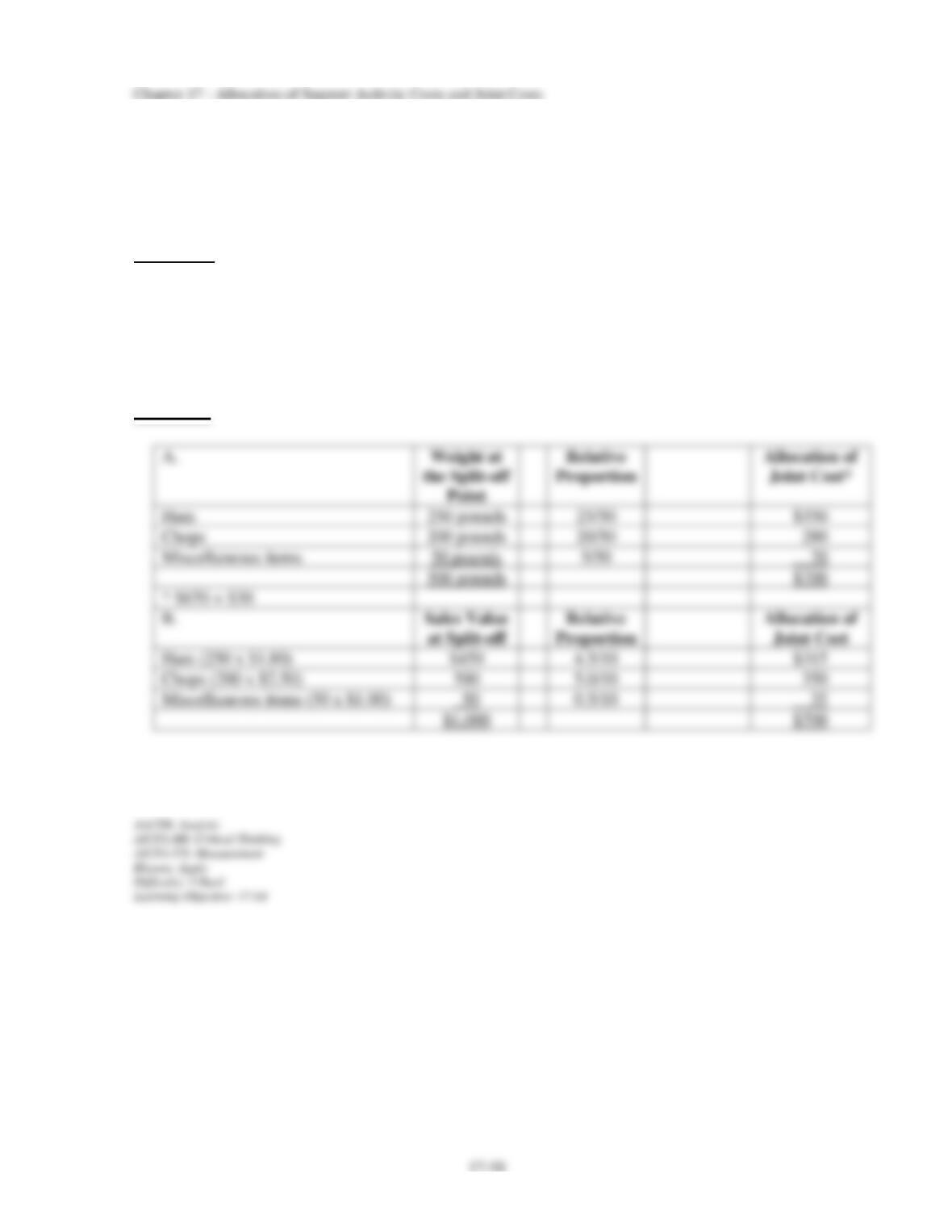
85. Suppose that one hog yields 250 pounds of ham, 200 pounds of chops, and 50 pounds of
miscellaneous items. The sales value of ham is $1.80 per pound; chops, $2.50 per pound; and
miscellaneous items, $1.00 per pound. The hog costs $670, and processing costs are $30.
Required:
A. Determine the proper allocation of joint costs to the three products by using the physical-
units method.
B. Repeat part “B” by using the relative-sales-value method.
Solution:
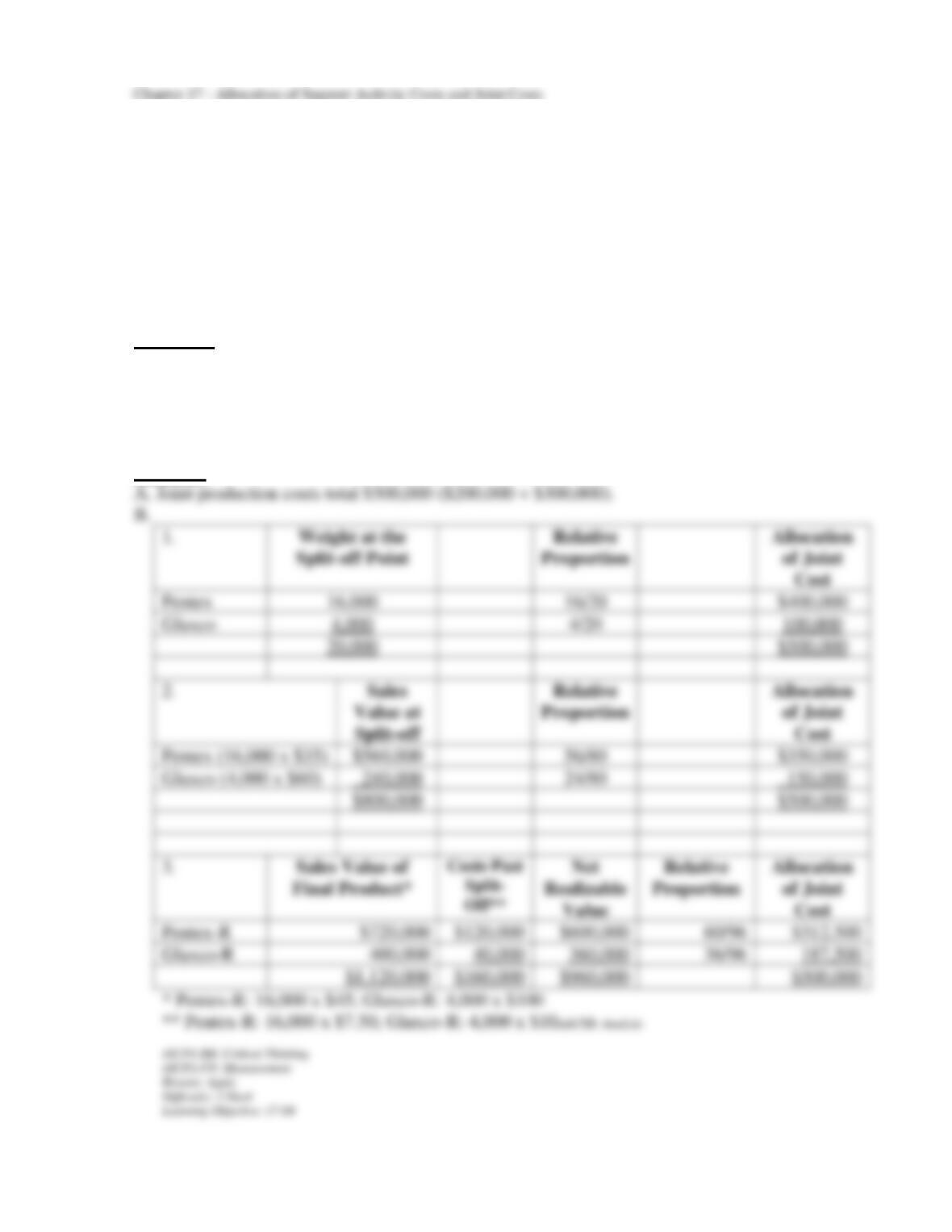
86. Quatro Corporation manufactures two chemicals (Flextra and Hydro) in a joint process.
Data from a recent month follow.
Direct materials used: $360,000
Direct labor: $150,000
Manufacturing overhead: $690,000
Manufacturing output:
Flextra: 40,000 gallons
Hydro: 120,000 gallons
Flextra sells for $15 per gallon and Hydro sells for $20 per gallon.
Required:
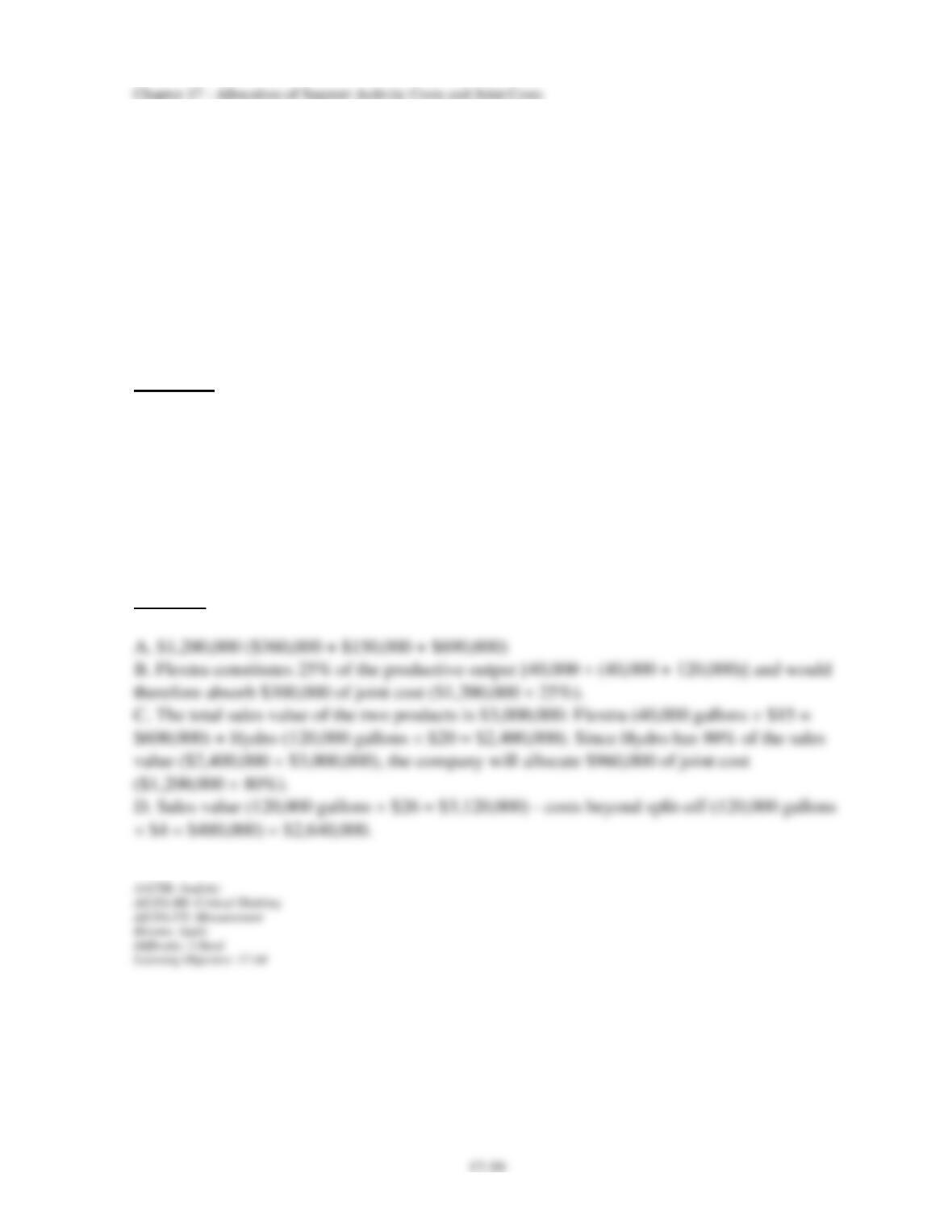
A. Compute the total joint costs to be allocated to Flextra and Hydro.
B. Compute the joint costs that would be allocated to Flextra by using the physical-units
method.
C. Compute the joint costs that would be allocated to Hydro by using the relative-sales-value
method.
D. Assume that Hydro can be converted into a more refined product, Hydro-R, in a totally
separable process at an additional cost of $4 per gallon. If the refined product can be sold in
the marketplace for $26 per gallon, compute the net realizable value of Hydro-R.
Solution:
17–60
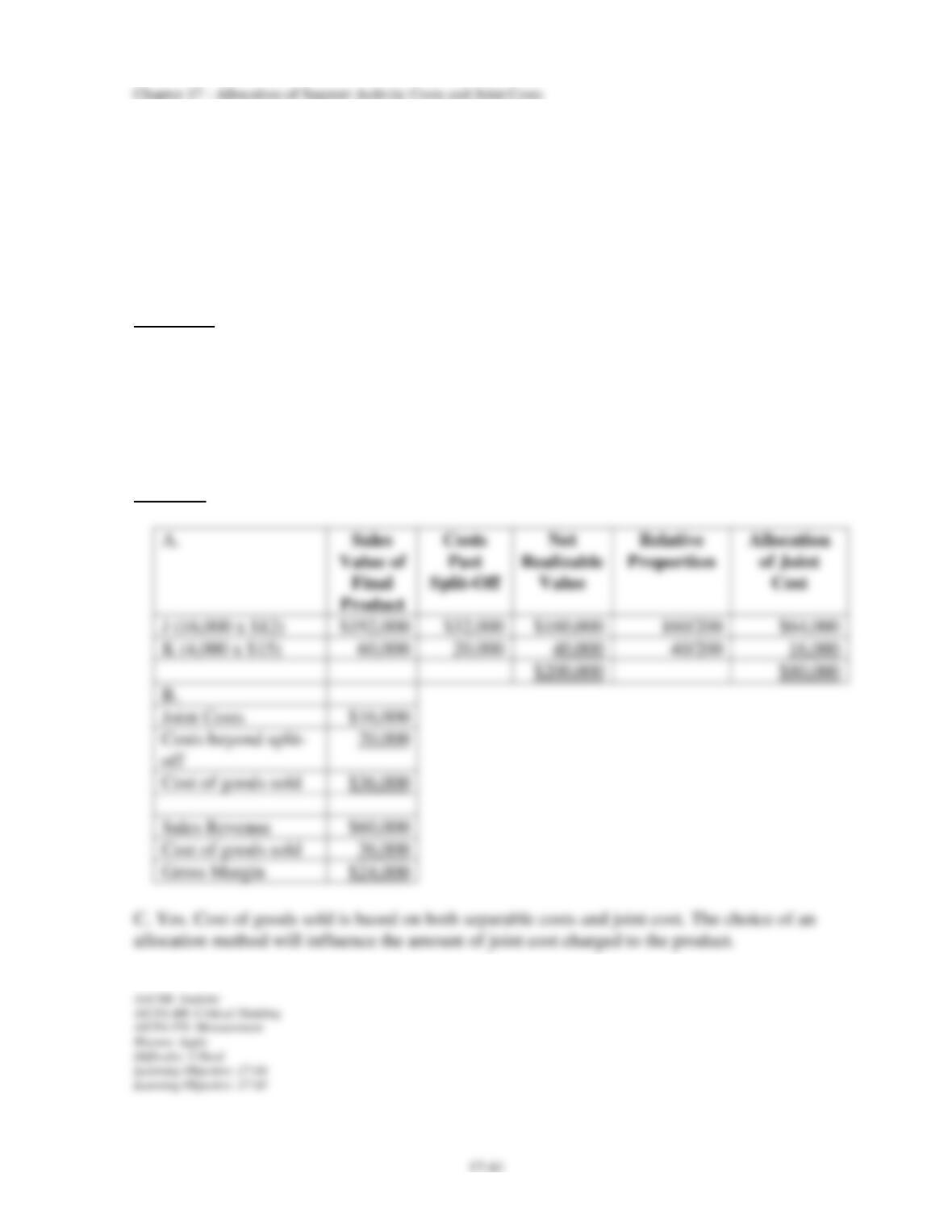
87. Lowrey Chemical manufactures two industrial chemicals in a joint process. In October,
$200,000 of direct materials were processed at a cost of $300,000, resulting in 16,000 pounds
of Pentex and 4,000 pounds of Glaxco. Pentex sells for $35 per pound and Glaxco sells for
$60 per pound. Management generally processes each of these chemicals further in separable
processes to manufacture more refined products. Pentex is processed separately at a cost of
$7.50 per pound, with the resulting product, Pentex-R, selling for $45 per pound. Glaxco is
processed separately at a cost of $10 per pound, and the resulting product, Glaxco-R, sells for
$100 per pound.
Required:
A. Compute the company’s total joint production costs.
B. Assuming that total joint production costs amounted to $500,000, allocate these costs by
using: (1) The physical-units method; (2) The relative-sales-value method; (3) The net-
realizable-value method.
Solution:
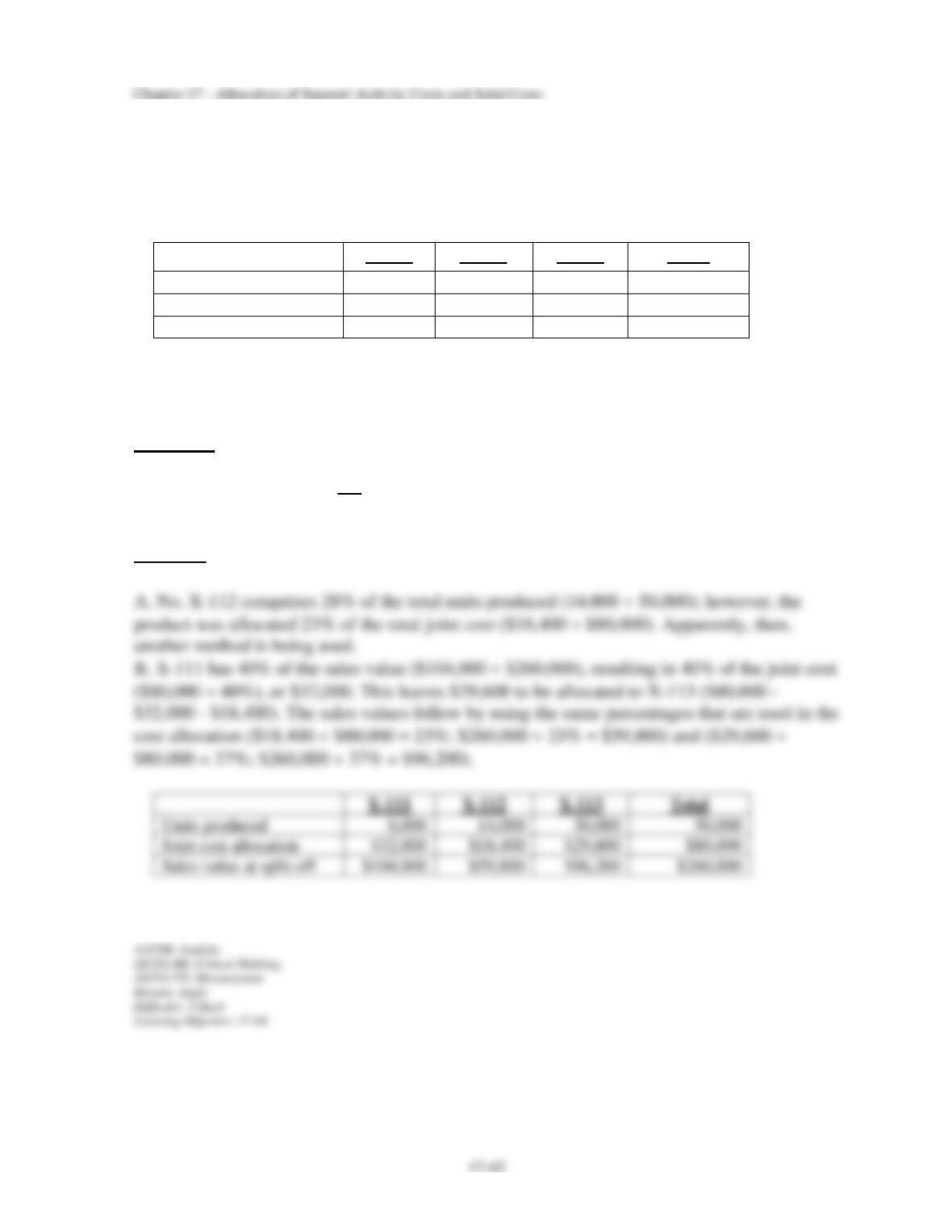
88. Clarion Company, a new firm, manufactures two products, J and K, in a common process.
The joint costs amount to $80,000 per batch of finished goods. Each batch results in 20,000
liters of output, of which 80% are J and 20% are K.
The two products are processed beyond the split-off point, with Clarion incurring the
following separable costs: J, $2 per liter; K, $5 per liter. After the additional processing, the
selling price of J is $12 per liter, and the selling price of K is $15 per liter.
Required:
A. Determine the proper allocation of joint costs if the company uses the net-realizable-value
method.
B. Assume that Clarion sold all of its production of K during the current accounting period.
Compute K’s sales revenue, cost of goods sold, and gross margin.
C. Is the firm’s cost-of-goods-sold figure influenced by the choice of a joint-cost allocation
method? Briefly explain.
Solution:
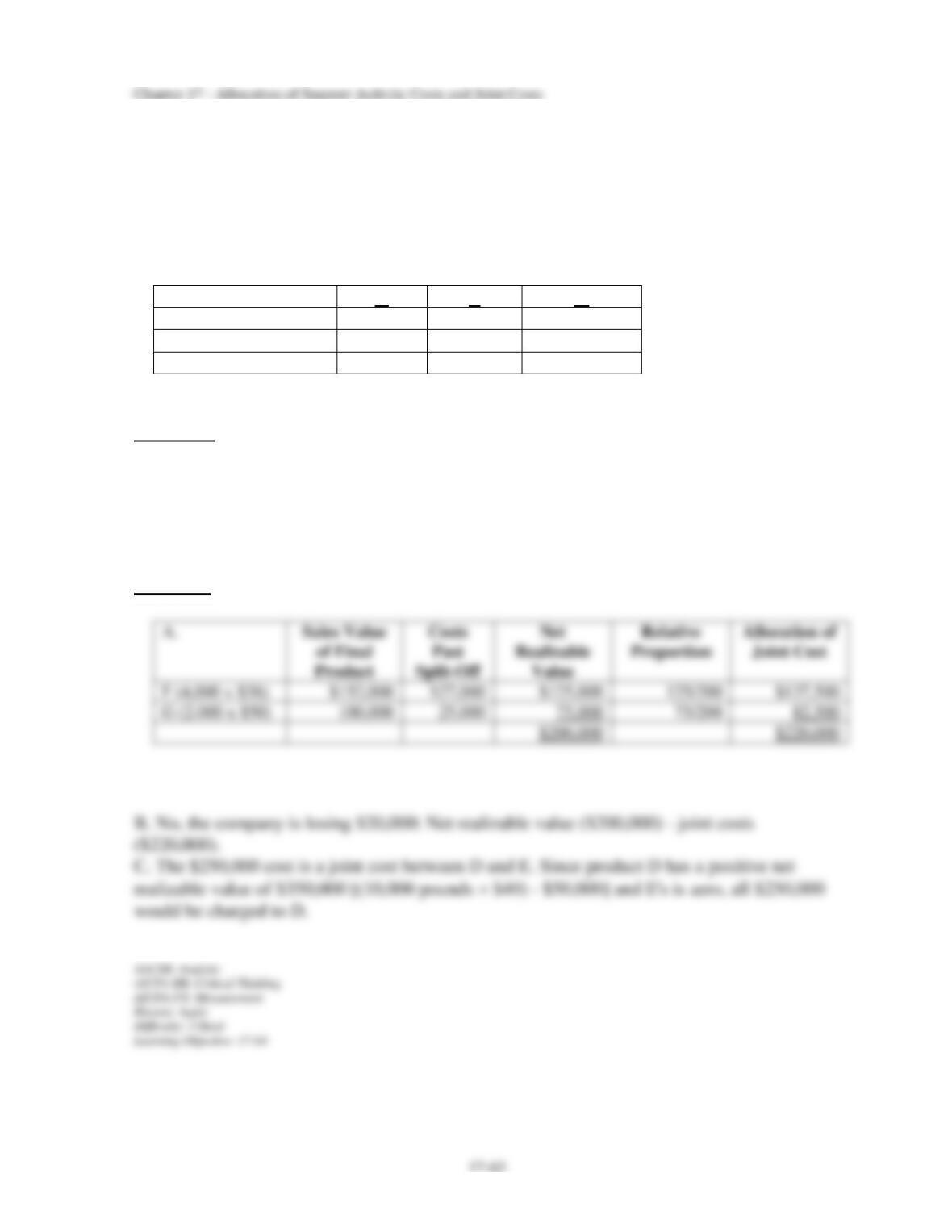
89. Palen Chemical Company manufactures X-111, X-112, and X-113 from a joint process.
The following information is available for the period just ended:
X-111
X-112
X-113
Total
Units produced
6,000
14,000
30,000
50,000
Joint cost allocation
?
$18,400
?
$80,000
Sales value at split-off
$104,000
?
?
$260,000
Required:
A. Does Palen allocate joint costs by using the physical-units method? Explain.
B. Assume that Palen does not use the physical-units method but instead allocates joint costs
by using the relative-sales-value method. Find the four unknowns in the preceding table.
Solution:
90. Clandestine Corporation allocates joint costs by using the net-realizable-value method. In
the company’s Texas plant, products D and E emerge from a joint process that costs $250,000.
E is then processed at a cost of $220,000 into products F and G. Data pertaining to D, F, and
G follow.
D
F
G
Costs beyond split-off
$50,000
$27,000
$25,000
Selling price
40
38
50
Pounds produced
10,000
4,000
2,000
Required:
A. Allocate the $220,000 processing cost between products F and G.
B. From a profitability perspective, should product E be processed into products F and G?
Show your calculations.
C. Assume that the net realizable value associated with E is zero. How would you allocate the
joint cost of $250,000?
Solution:
91. Companies are free to use the direct, step-down, and reciprocal allocation methods when
dealing with service-department costs.
Required:
A. How does the direct method work? What is its chief limitation?
B. Is the step-down method an improvement over the direct method? Explain.
C. Which of the three methods is the most correct from a conceptual viewpoint? Why?
Solution:
17–65
92. Crystal Magic Company is developing departmental overhead rates based on direct-labor
hours for its two production departments in the production of light-catcher art pieces,
Etching and Assembly. The Etching Department employs 12 people and the Assembly
Department employs 48 people. Each person in these two departments works 2,000 hours
per year. The production-related overhead costs for the Etching Department are budgeted at
$400,000, and the Assembly Department costs are budgeted at $640,000. Two service
departments, Maintenance and Computing, directly support the two production
departments. These service departments have budgeted costs of $96,000 and $500,000,
respectively. The production departments’ overhead rates cannot be determined until the
service departments’ costs are allocated. The following schedule reflects the use of the
Maintenance Department’s and Computing Department’s output by the various
departments.
Using Department
Service Department
Maintenance
Computing
Etching
Assembly
Maintenance (maintenance hours)
0
1,000
1,000
8,000
Computing (minutes)
240,000
0
840,000
120,000
Required:
(Use M for Maintenance and C for Computing in your equations.)
1. What is the equation for the total cost of the maintenance department when using the
reciprocal services method?
2. What is the equation for the total cost of the computing department when using the
reciprocal services method?
3. Solve each equation.
4. Using the reciprocal-services method to allocate service department costs, calculate the
overhead rates per direct-labor hour for the Etching Department and the Assembly
Department.
Chapter 17 – Allocation of Support Activity Costs and Joint Costs
Solution: