Chapter 17 – Allocation of Support Activity Costs and Joint Costs
74. Downtown Hospital has two service departments (Patient Records and Accounting) and
two “production” departments (Internal Medicine and Surgery). Which of the following
allocations would likely take place under the reciprocal-services method of cost allocation?
75. State Hospital has two service departments (Patient Records and Accounting) and two
“production” departments (Internal Medicine and Surgery). Which of the following
allocations would not take place under the reciprocal-services method of cost allocation?
Chapter 17 – Allocation of Support Activity Costs and Joint Costs
17–42
Essay Questions
76. Tempest Industries has two service departments (General Factory and Human Resources)
and two production departments (Machining and Assembly). The company uses the direct
method of service-department cost allocation, allocating General Factory cost on the basis of
square feet and Human Resources cost on the basis of employees. Budgeted allocation-base
and operating data for the four departments follow.
General
Factory
Human
Resources
Machining
Assembly
Square feet
7,000
3,000
90,000
30,000
Employees
50
30
120
180
Machine hours
200
—
80,000
20,000
Labor hours
45,000
25,000
100,000
150,000
Additional information:
· Budgeted costs of General Factory and Human Resources respectively amount to
$1,560,000 and $950,000.
· The anticipated overhead costs incurred directly in the Machining and Assembly
Departments respectively total $3,650,000 and $2,340,000.
· The manufacturing overhead application bases used by Tempest’s production departments
are: Machining, machine hours; Assembly, labor hours.
· Company policy holds that a department’s overhead application rate is based on a
department’s own overhead plus an allocated share of service-department cost.
Required:
A. Allocate the company’s service-department costs to the producing departments.
B. Compute the overhead application rates for Machining and Assembly.
Chapter 17 – Allocation of Support Activity Costs and Joint Costs
Solution:
17–44
77. Midwest Alabama State College has two service departments, the Library and Computing
Services that assist the School of Business and the School of Health. Budgeted costs of the
Library and Computing Services are $800,000 and $1,800,000, respectively. Usage of the
service departments’ output during the year is anticipated to be:
Provider of Service
User of Services
Library
Computing Services
Library
—
10%
Computing Services
—
—
School of Business
20%
60%
School of Health
80%
30%
Required:
A. Use the direct method to allocate the costs of the Library and Computing Services to the
School of Business and the School of Health.
B. Repeat requirement “A” using the step-down method. Midwest allocates the cost of
Computing Services first.
Chapter 17 – Allocation of Support Activity Costs and Joint Costs
17–46
78. Claremore Electronics, Inc. manufactures gauges for automobile dashboards. The
company has two production departments, Molding and Assembly. There are three service
departments: Human Resources, Maintenance, and Engineering. Usage of services by the
various departments follows.
Human
Resources
Maintenance
Engineering
Human Resources
—
—
—
Maintenance
5%
—
—
Engineering
5%
10%
—
Molding
40%
40%
75%
Assembly
50%
50%
25%
The budgeted costs in Claremore’s service departments are: Human Resources, $180,000;
Maintenance, $270,000; and Engineering, $200,000. The company rounds all calculations to
the nearest dollar.
Required:
A. Use the direct method to allocate Claremore’s service department costs to the production
departments.
B. Determine the proper departmental sequence to use in allocating the company’s service
costs by the step-down method.
C. Ignoring your answer in part “B,” assume that Human Resources costs are allocated first,
Maintenance costs second, and Engineering costs third. Use the step-down method to allocate
Claremore’s service department costs.
Chapter 17 – Allocation of Support Activity Costs and Joint Costs
Solution:
A.
17–48
79. Dodge City Corporation is developing departmental overhead rates based on direct labor
hours for its two production departments, Molding and Assembly. The Molding Department
worked 20,000 hours during the period just ended, and the Assembly Department worked
40,000 hours. The overhead costs incurred by Molding and Assembly were $151,250 and
$440,750, respectively.
Two service departments, Repair and Power, directly support the two production departments.
These service departments have costs of $90,000 and $250,000, respectively. The following
schedule reflects the use of Repair and Power’s output by the various departments:
Repair
Power
Molding
Assembly
Repair (repair hours)
500
500
4,000
Power (kilowatt hours)
120,000
420,000
60,000
Required:
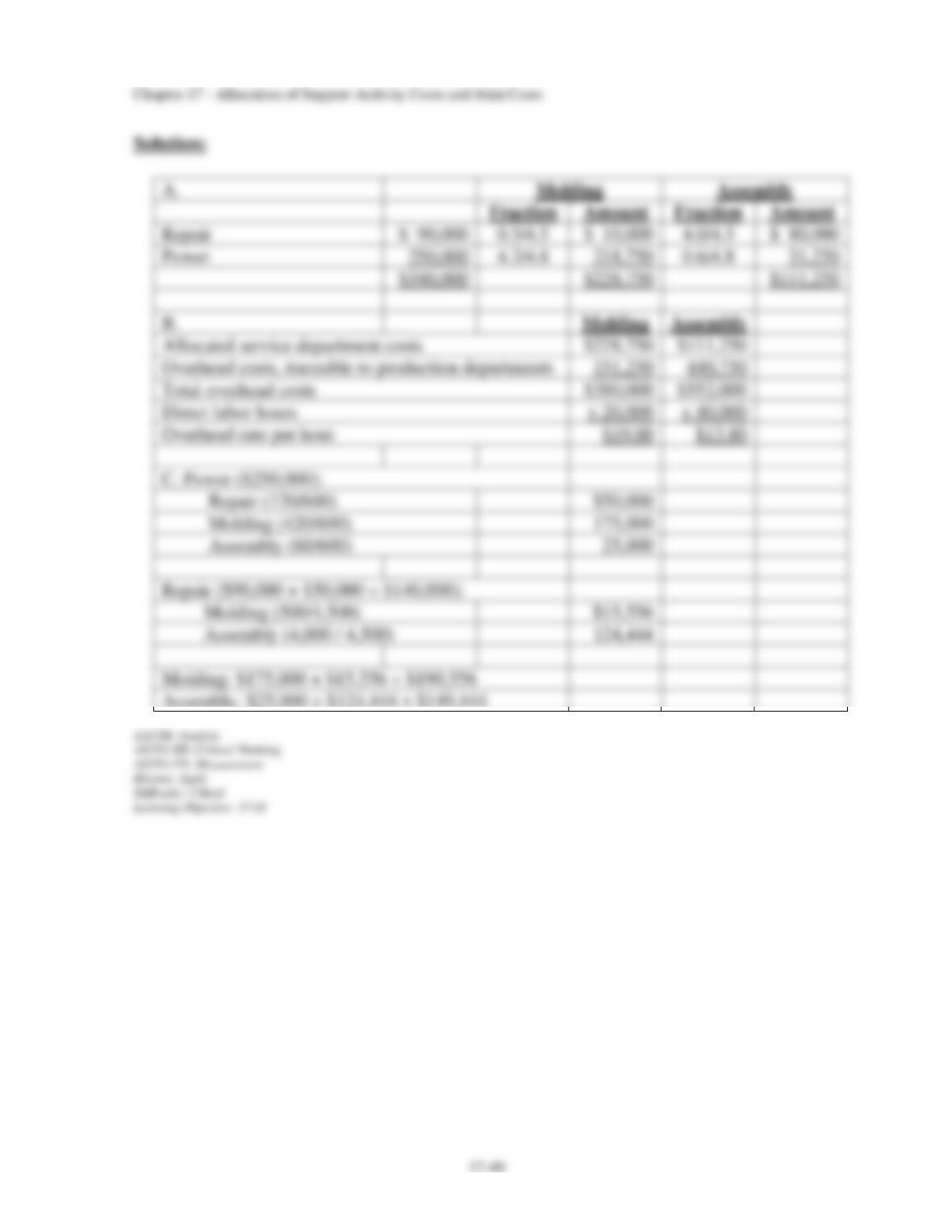
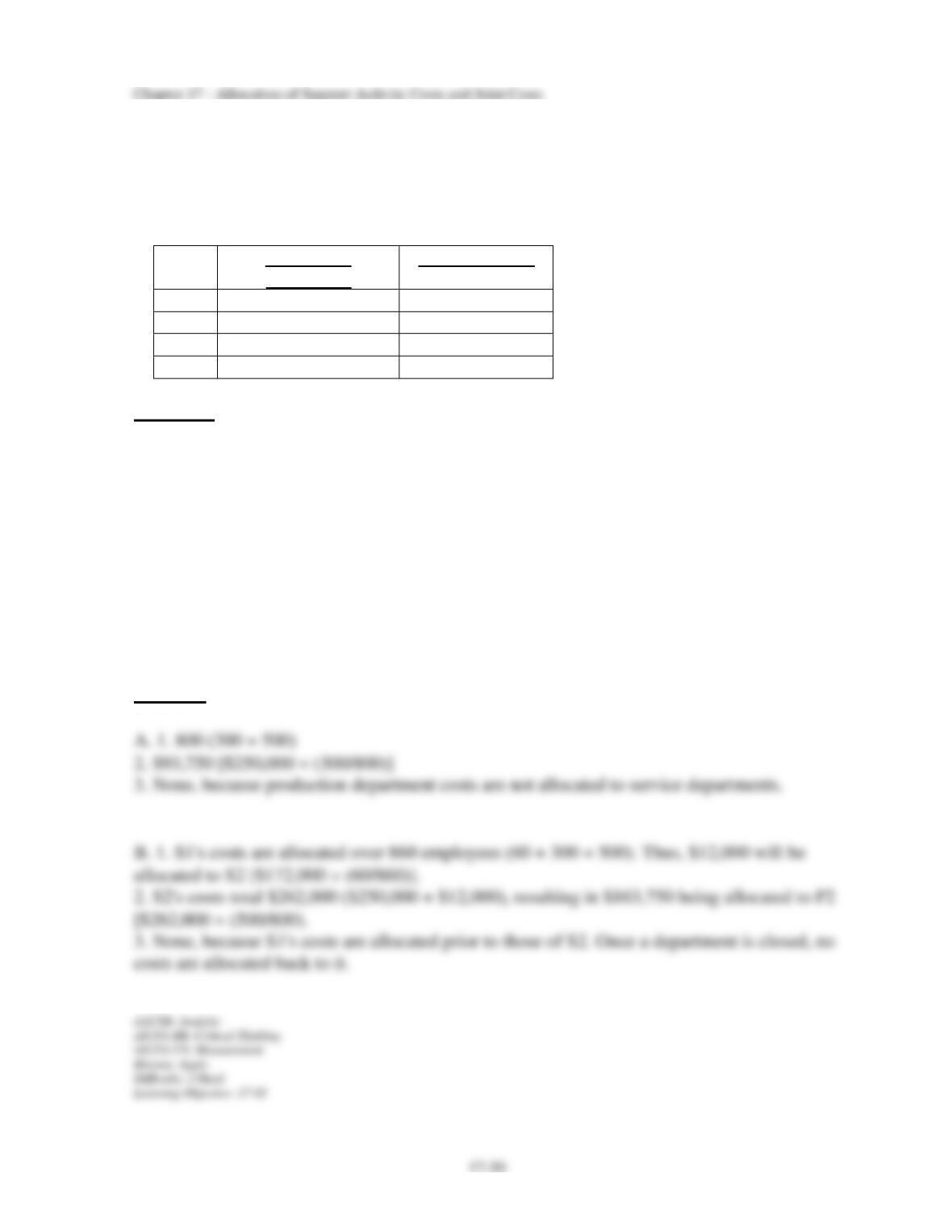
A. Allocate the company’s service department costs to production departments by using the
direct method.
B. Calculate the overhead application rates of the production departments. Hint: Consider
both directly traceable and allocated overhead when deriving your answer.
C. Allocate the company’s service department costs to production departments by using the
step-down method. Begin with the Power Department, and round calculations to the nearest
dollar.
80. Allegiance Corporation has two service departments (S1 and S2) and two production
departments (P1 and P2). S1 and S2 both use the number of employees as an allocation base.
The following data are available:
Number of
Employees
Budgeted Cost
S1
40
$172,000
S2
60
250,000
P1
300
660,000
P2
500
840,000
Required:
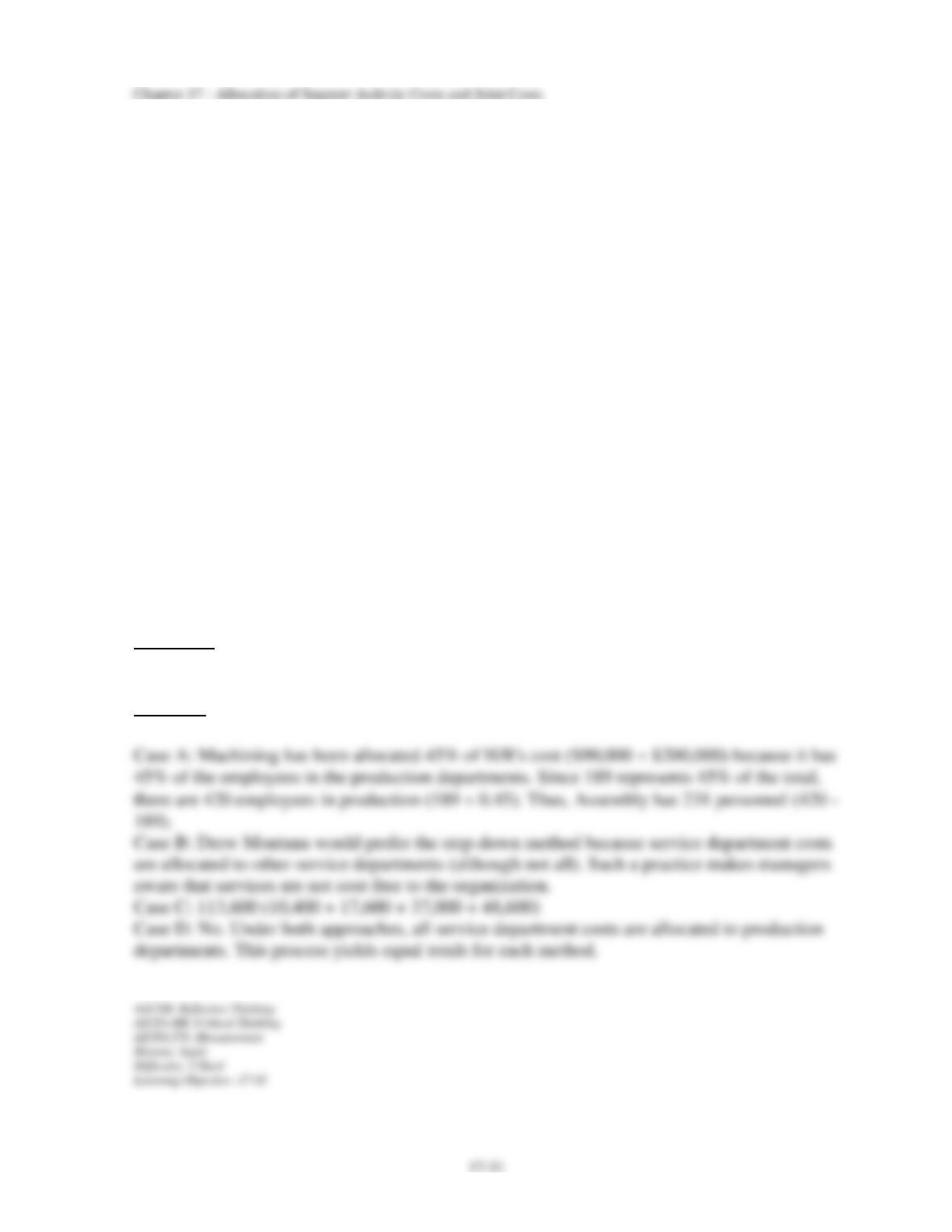
A. Assuming use of the direct method:
1. Over how many employees would S1’s budgeted cost be allocated?
2. How much of S2’s cost would be allocated to P1?
3. How much of P1’s cost would be allocated to S1?
B. Assuming use of the step-down method:
1. How much of S1’s cost would be allocated to S2? Allegiance allocates S1’s costs prior to
allocating those of S2.
2. How much of S2’s total cost would be allocated to P2?
3. How much of S2’s total cost would be allocated to S1?
Solution:
81. Consider the following independent cases that relate to service department cost
allocations:
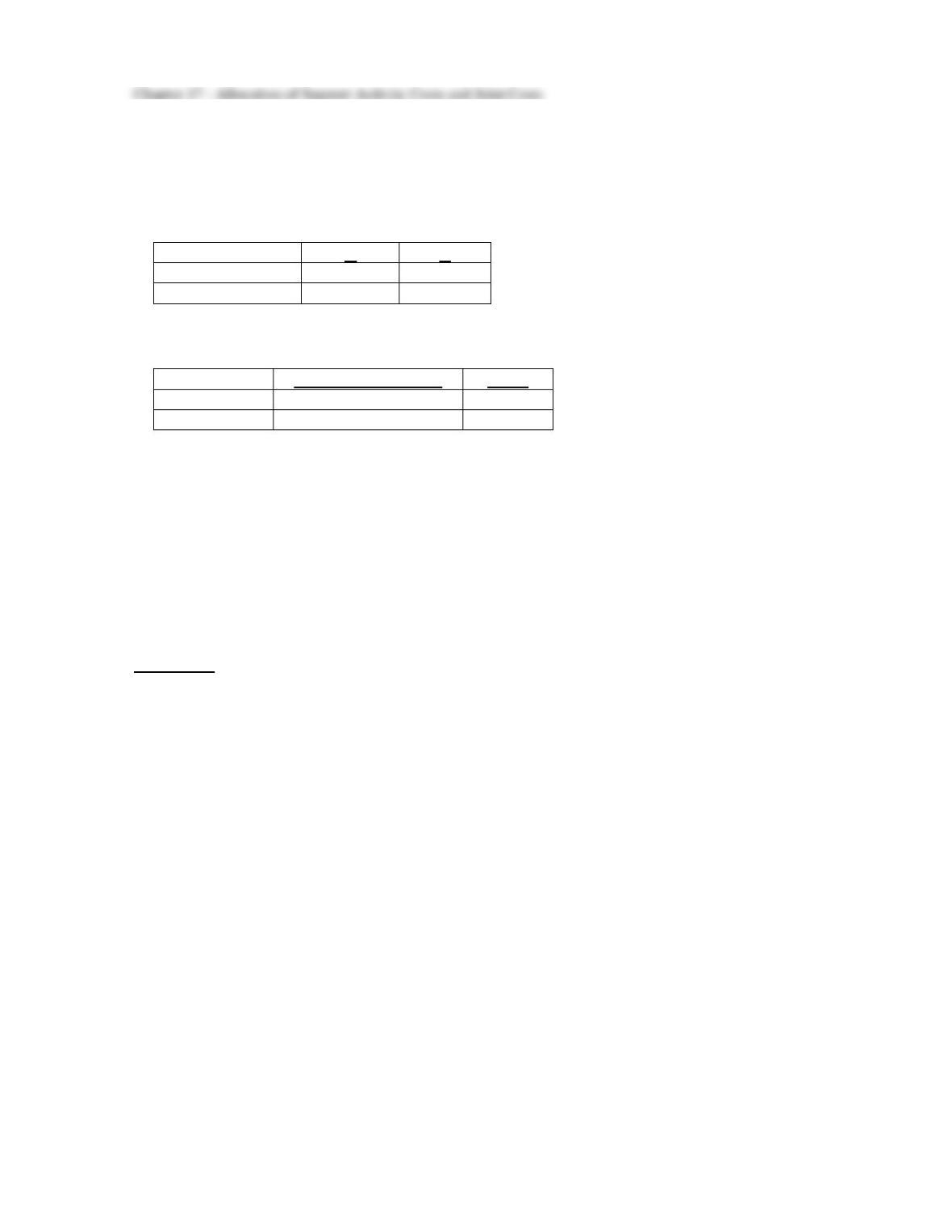
Case A: Aaron Company has two service departments [Human Resources (H/R) and
Information Systems] and two production departments (Machining and Assembly). Human
Resource cost is allocated by using the direct method based on the number of personnel in
each department. For the period just ended, there were 189 employees in Machining, and
Machining received $90,000 of H/R’s overhead of $200,000. How many employees are in the
Assembly Department?
Case B: Drew Montana, controller of Butte Enterprises, wants service department managers
to be aware that their use of other service departments costs the firm a substantial amount of
money. Would Drew prefer the direct method or the step-down method of cost allocation?
Why?
Case C: Laramie Company has four service departments (S1, S2, S3, and S4) and two
production departments (P1 and P2). The costs of S1 are allocated first, followed in order by
the costs of S2, S3, and S4. Laramie uses the step-down method, and the costs of S2 are
allocated based on the number of computer hours used. Computer hours logged during the
period were as follows: S1, 4,600; S2, 7,100; S3, 10,400; S4, 17,600; P1, 37,000; and P2,
48,600. Over how many hours would S2’s cost be allocated?
Case D: A recently hired staff accountant noted that given the nature of the allocations, the
total cost allocated to production departments is typically less under the step-down method
than under the direct method. Do you agree with the accountant? Why?
Required:
Answer the questions that are raised in Cases A, B, C, and D.
Solution:
17–52
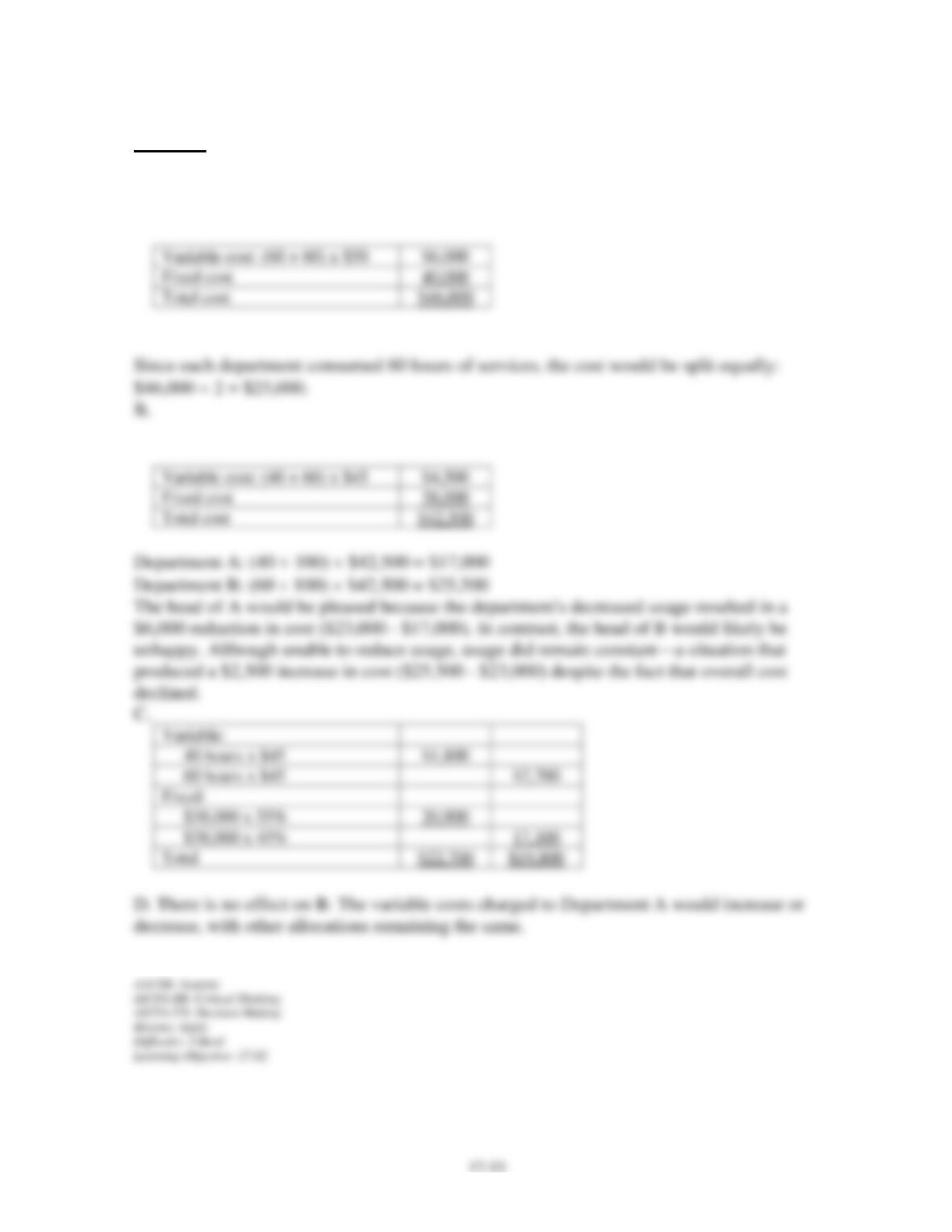
82. Carlson, Inc. has centralized much of its specialized data processing operation, with the
Computer Department performing services for Departments A and B. Service hours
consumed during Quarter No. 1 and Quarter No. 2 follow.
A
B
Quarter No. 1
60
60
Quarter No. 2
40
60
Computer Department operating costs were:
Variable (Per Hour)
Fixed
Quarter No. 1
$50
$40,000
Quarter No. 2
45
38,000
Company policy currently requires that total variable and fixed costs be combined and
allocated as a lump-sum to users based on service hours.
Carlson has been financially healthy for a number of years but began to experience problems
toward the end of Quarter No. 1. In response to these problems, management issued a
directive to closely monitor costs and computer usage, effective with the start of Quarter No.
2.
Required:
A. Compute Quarter No. 1’s total computer cost and determine the allocation to Department A
and Department B.
B. How much cost would be allocated to Departments A and B during Quarter No. 2, and how
would the heads of these departments likely react to the allocations in light of management’s
directive?
C. Assume that at the beginning of quarter no. 2, the company switched to dual-cost
allocations, with variable costs allocated based on current usage and fixed costs allocated
based on long-run average utilization. An analysis of projected usage found that work for
Department A was expected to consume 55% of the Computer Department’s time over the
forthcoming year. How much cost would be allocated to A and B in Quarter No. 2?
D. Given the use of dual allocations, how, if at all, would a short-term increase or decrease in
A’s current usage affect the quarterly cost allocation that is charged to Department B?
Chapter 17 – Allocation of Support Activity Costs and Joint Costs
Solution:
A.