
Chapter 17—Acquiring and Implementing Accounting Information
Systems Key
1. An important segment of the outsourcing market is the application service provider (ASP), which hosts,
manages, and provides access to hardware and software over the Internet to multiple users.
2. The purpose of systems selection is to develop specifications for a new or revised system.
3. The purpose of AIS implementation is to begin using the new system.
4. The primary tasks of systems operation are to conduct post-implementation review and perform systems
maintenance.
5. The accountant as an implementer can become involved with systems survey and needs analysis tasks.
6. As an analyst, the accountant could be involved in change management issues and/or technical aspects of
converting data, software, and hardware from the old to the new AIS.
7. The internal auditor may review AIS development/acquisition projects to ensure that the process has been
efficient and effective and that the acquisition team has followed the organization’s standard procedures for
systems development/acquisition.

8. The external auditor may perform an independent review to assess if and how internal controls have been
impacted by the AIS development/acquisition.
9. A problem has an economically feasible solution if it can be solved with existing software and hardware
technology.
10. Users, managers, and auditors are required to participate in the systems development project. These people
generally provide approvals, often called signoffs, at preestablished management control points.
11. Structured systems analysis is a set of procedures conducted to generate the specifications for a new (or
modified) information system or subsystem.
12. Specific reports and other documentation, called process documents, must be produced periodically during
systems development to make development personnel accountable for faithful execution of systems
development tasks.
13. Deliverables signify approval of the development process and the system being developed.
14. The logical specification, physical requirements, and budget and schedule are all part of the systems
analysis deliverable called an approved systems analysis document.
15. Similar to the developer of an industrial park, an organization’s management or IT steering committee
approves a systems development project for further systems development.

16. The analysis team conducts a cost/effectiveness study, which provides quantitative and certain qualitative
information concerning each of the system alternatives.
17. The cost/benefit study attempts to answer the questions, “which alternative accomplishes the user’s goals for
the least cost (or greatest benefit)?” and “which alternative best accomplishes a user’s goals for the system being
developed?”
18. The cost/effectiveness study attempts to answer the questions, “which alternative accomplishes the user’s
goals for the least cost (or greatest benefit)?” and “which alternative best accomplishes the user’s goals for the
system being developed?”
19. An indirect cost is one that is directly attributable to the system or the system.
20. A tangible cost is one that can be reasonably quantified, such as software purchase and insurance.
21. An intangible cost is one that cannot be reasonably quantified, such as productivity losses caused by low
employee morale.
22. A direct cost is one that is directly attributable to the system or the system change, such as reduced overhead
costs.
23. Indirect benefits are not directly attributable to the system or the system change.

24. Tangible benefits are those that can be reasonably quantified, such as reduced equipment costs and
increased revenues.
25. Intangible benefits are those that cannot be reasonably quantified, such as those that result from having
improved information.
26. The first analysis deliverable, the logical specification, is used in systems selection to choose the appropriate
software to be acquired from external sources.
27. The second analysis deliverable, the physical requirements are used in systems selection to acquire
computer equipment for the new system.
28. Systems design is a set of procedures performed to choose the software specifications and hardware
resources for an information system.
29. As depicted in the text, the approved configuration plan is the final output of the software and hardware
study.
30. A service bureau is a firm providing information processing services, including hardware and software, for a
fee.
31. Outsourcing is a term that describes an organization’s assigning any of its internal functions (e.g.,
accounting, legal, or IT) to an outside vendor.

32. An RFP is a document sent to vendors that invites submissions of plans for providing hardware, software,
and related services.
33. To validate vendor proposals for supplying computer hardware, an organization will assess both a system’s
specifications and performance.
34. A benchmark is a representative workload, processed on each vendor’s proposed system configuration, to
obtain comparative throughput measures.
35. As data from the existing system are mapped into the new system, exception-reporting situations must be
devised to ensure that the data are converted accurately.
36. The design of interfaces involves how data from the existing system are mapped into the new system.
37. Structured systems design is a set of procedures performed to convert the logical specification into a design
38. The approved systems design document documents the system design and summarizes the implementation
39. The approved systems design document is used by programmers, the personnel department, and information
systems personnel.

40. Systems developed using structured systems design techniques are more costly over the life of the system
because maintenance of such structured systems is problematic.
41. Systems operation includes the post-implementation review.
42. Systems maintenance is a set of procedures performed to complete the design contained in the approved
systems design document and to test, install, and begin to use the new/revised information system.
43. In the parallel approach to systems implementation, both the new and old systems operate together for a
period of time.
44. Of the three approaches to systems implementation presented in the text, the parallel approach is the
riskiest.
45. With the modular approach to systems implementation, the new system either is implemented one
subsystem at a time or is introduced into one organizational unit at a time.
46. Enterprise systems are often implemented using the direct approach.
47. The direct approach is also known as the “big bang” or “cold turkey” approach.
48. The modular approach forces the users to learn the new system because they do not have the old system to
fall back on.

49. The modular approach is also referred to as the phased approach.
50. As an analyst, the accountant could be the development team member who conducts a preliminary survey.
51. As an internal auditor the accountant could be called in to complete the design, help prepare the contracts, or
help plan, conduct, and evaluate the system tests.
52. As a user, the accountant might initiate the AIS acquisition.
53. After the conversion is completed, the systems development project team writes the project completion
report.
54. Conversion to new computer programs must be undertaken using contingency plans to ensure that only
authorized, tested, and approved versions of the programs are promoted to production status.
55. The user, the programmer, and another member of the programming team do a walkthrough of the module
specifications and the test plan to determine that the test plan is adequate; then the programmer codes the
program.
56. The removal of program errors is called debugging.
57. Making program changes, correcting errors in the programs, and adding enhancements to the programs is
called systems development.

58. The systems development life cycle (SDLC) methodology is an informal, ad-hoc, set of activities used to
manage a systems development project.
59. The acceptance test is a user-directed test of the complete system in a test environment.
60. Software as a Service (SaaS) is a Web-based model for software distribution where multiple users may
simultaneously use the software.
61. The post-implementation review is an examination of a working system, conducted soon after the system’s
implementation.
62. Systems maintenance is the modification of existing applications.
63. Perfective maintenance is performed to fix errors.
64. Corrective maintenance is conducted to improve the performance of an application.
65. Adaptive maintenance adjusts applications to reflect changing business needs and environmental
challenges.
66. The Sarbanes-Oxley Act prohibits CPA firms from serving as system consultants.
67. Which of the following is the assignment of an internal function to an outside vendor?
68. Which of the following hosts, manages, and provides access to software and hardware over the Internet to
multiple customers?
69. Which of the following functions cannot be outsourced?
A. Accounting
70. Which of the following has the task of evaluating alternative AIS solutions?
71. Which development phase has the purpose of developing specifications for the new or revised system?
72. Which development phase has the task of post-implementation review?
A. analysis
73. Which of the following includes activities for the successful switch from the old to the new AIS?
74. Which of the accountant roles involves contributing to systems survey and needs analysis?
75. Which role in the AIS Development/Acquisition process requires the accountant to be equally adept at
dealing with people, accounting, and technology?
A. User
76. In which role might the accountant be the person who initiates the AIS acquisition cycle, and is in a prime
position to recognize deficiencies and incompatibilities related to the existing AIS?
77. In which role might the accountant help meet the organization’s AIS needs by selecting the final system for
purchase?
A. consultant
78. Outputs of the systems analysis phase of development typically would include all of the following except:
79. The system development step that immediately precedes the structured system design step is:
A. structured systems analysis
80. Which of the following is a deliverable from the structured systems analysis step of systems development?
81. Which of the following is not a task required to complete structured systems analysis?
A. develop the physical requirements for the selected design
82. Determination of user requirements in the analysis step of systems development is more difficult in an e–
business implementation because:
83. Which of the following would be the likely trigger for the structured systems analysis step of systems
development?
84. Software as a Service (SaaS) may include:
A. video hosting and streaming
85. In structured systems analysis, the analysis preferably should start with analysis and documentation of:
86. After the analysis team studies and documents the current physical system they should next:
87. The following is a jumbled list of the four steps in structured systems analysis that were presented in the
text:
I.
Define the future logical system.
II.
Document the current logical system.
III.
Study the current physical system.
IV.
Design the future physical system.
Which of the following is the logically correct sequence of steps?
88. After defining the requirements for the new system, the current logical DFD should be modified to reflect
the components of the future system. The development team may propose logical design alternatives for the
future logical system that may involve derivatives of the following except:
89. Which of the following ranks each alternative on its relative capability to satisfy the user’s requirements
(goals) for the system?
90. The cost of computer hardware to be purchased for a new system is an example of a(n) ____ cost for that
system.
91. Personnel fringe benefits are an example of a(n) ____ cost.
92. Which of the following benefits can be reasonably quantified?
93. Insurance on a computer installation is an example of a(n) ____ cost.
94. Productivity losses caused by reduced employee morale are an example of a(n) ____ cost.
95. Which of the following is a cost that cannot be reasonably quantified?
A. nonrecurring cost
96. Reduced salaries and wages that will result from a systems change are an example of a(n) ____ benefit.
97. Following a systems development methodology during systems development:
98. The physical requirements of a proposed system would include all of the following except:
99. Structured systems design in the systems development process is analogous to which of the following tasks
required in constructing an industrial park?
100. The systems selection tasks include all of the following except:
101. Which of the following is not specified in the approved configuration plan?
A. chosen software configuration and expected performance specifications
102. Which of the following triggers the systems selection process?
103. Which of the following is a characteristic of internal hardware sources?
104. Which of the following is a characteristic of external hardware sources?
105. Which of the following issues is not a task of systems selection?
A. determine what software design will implement the logical specification
106. An organization might request bids for computer resources from only one vendor for all of the following
reasons except:
107. Which of the following statement regarding use of a service bureau is false?
108. Which of the following statements regarding software acquisition (purchase vs. in-house development) is
false?
A. software developed in house can cost 10 times more than purchased software
109. The process of evaluating the vendor proposals includes all of the following except:
110. The goal of validating vendor proposals is to determine:
111. A representative workload, processed on a vendor’s proposed system configuration, to obtain comparative
throughput measures is called a(n):
112. The number of sales transactions that can be entered within a specified period of time is a measure of the
computer system’s:
113. A detailed vendor comparison would normally include all of the following except:
114. Typically, all of the following are tasks of structured systems design except:
115. Which of the following statements regarding SDLC methodology is false?
116. To write computer programs and interfaces, programmers use:
117. As presented in this text, systems operation comprises two steps¾namely, ____ and ____.
118. A building inspection shortly after completing the construction of an industrial park is analogous to the
____ step in the systems development process.
119. Making repairs and modifications to the system is known as:
120. Checking to see if the new system is doing what it is supposed to do is part of:
121. Which of the following is not a task of systems implementation?
A. complete the design contained in the approved systems design document
B. write, test, and document the programs and procedures required by the approved systems design document
122. Which of the following statements related to implementation approaches is false?
123. Which of the following statements related to implementation approaches is true?
A. The parallel system significantly decreases employee’s work load during the conversion period.
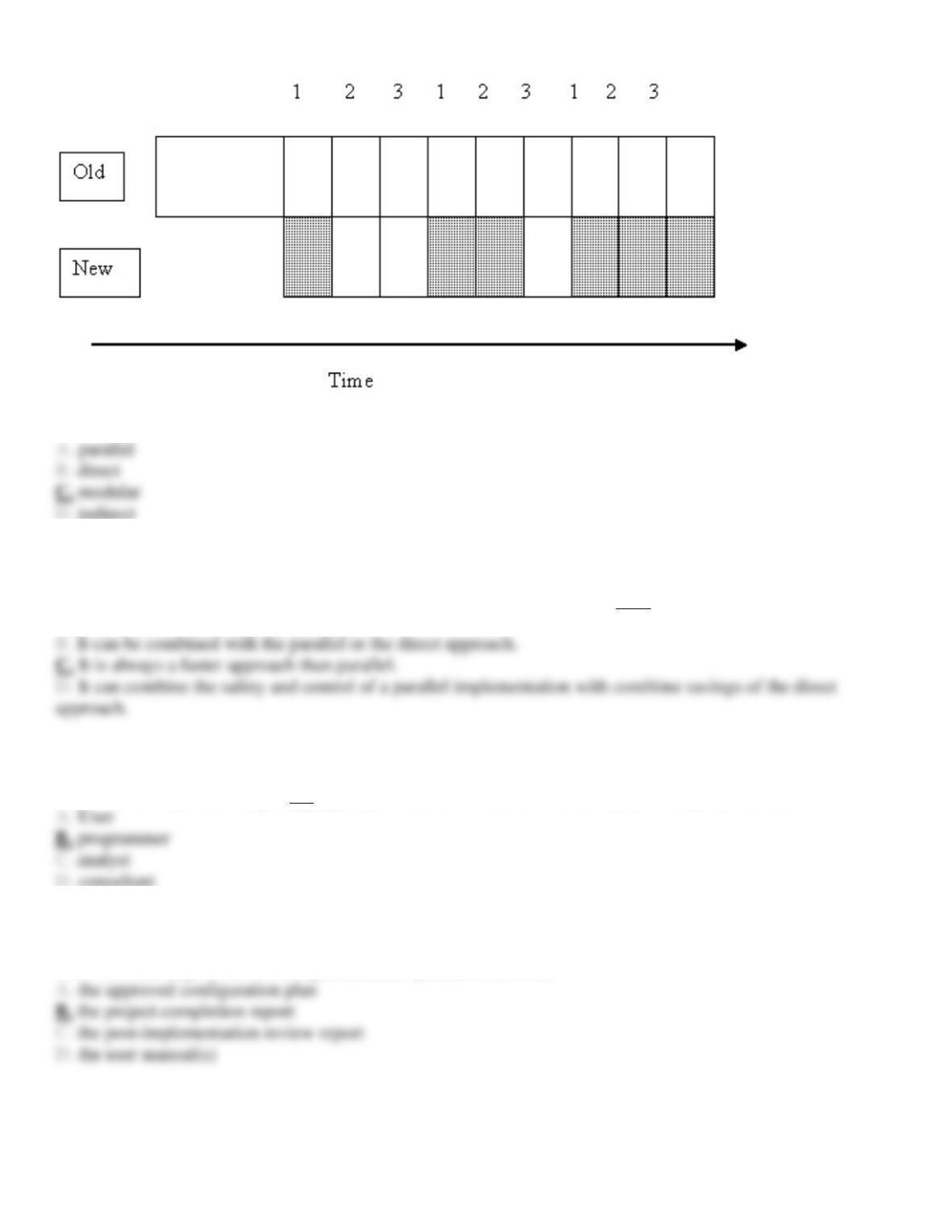
124. If a new payroll system is installed for the employees of plant 1 at time A, followed by plant 2 at time B,
and finally plant 3 at time C, this is an example of the ____ approach to systems implementation.
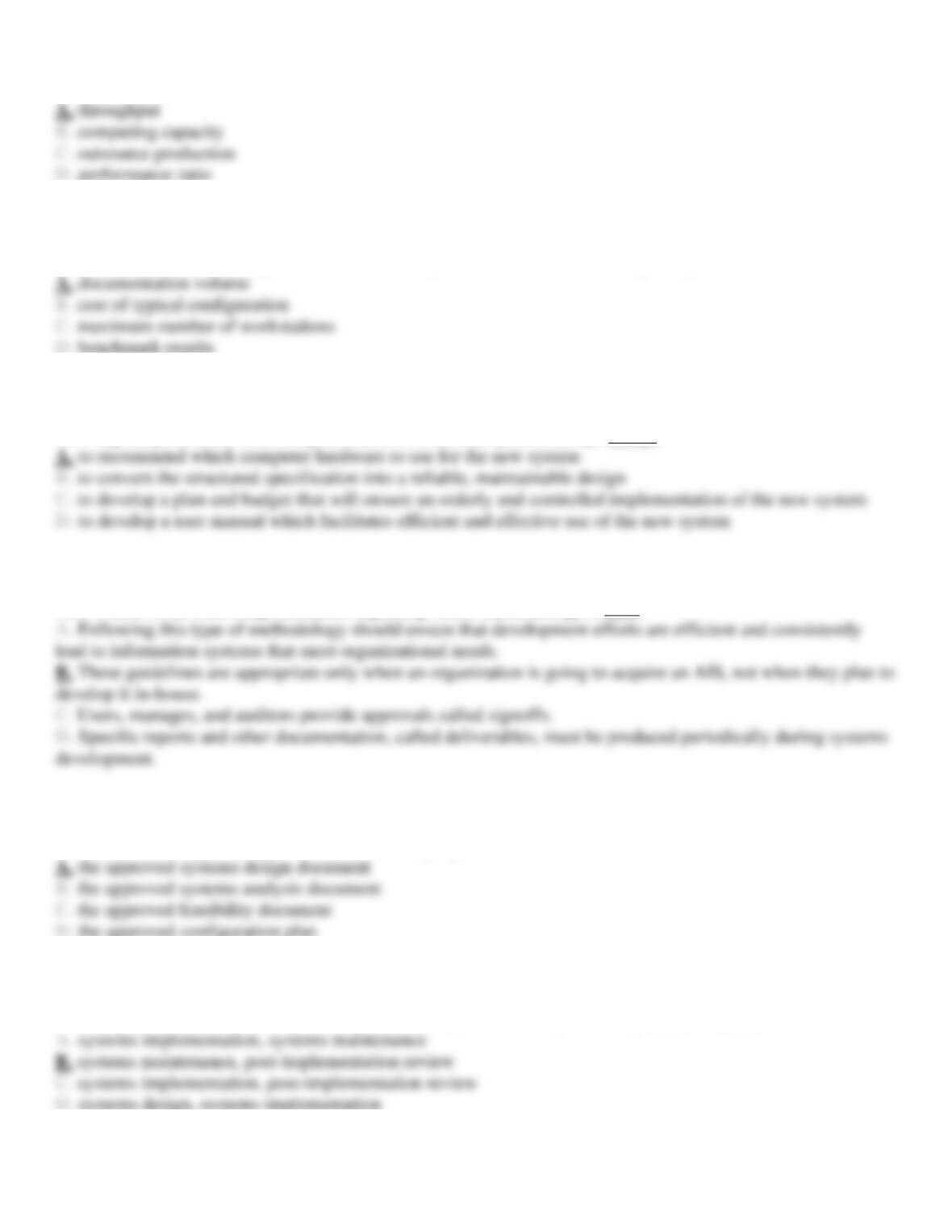
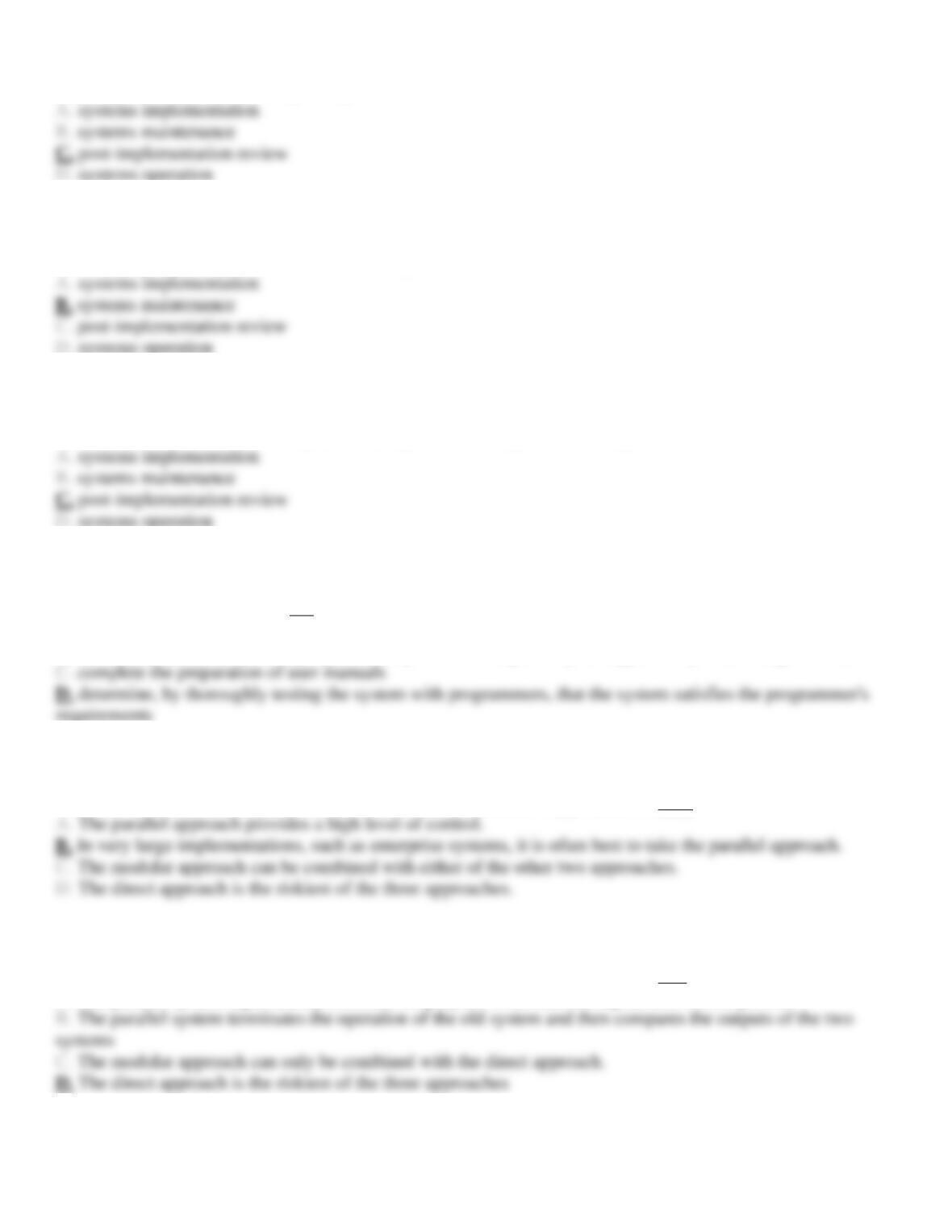
125. The following picture from the text illustrates the ____ approach to systems implementation:
126. The following picture from the text illustrates the ____ approach to systems implementation:
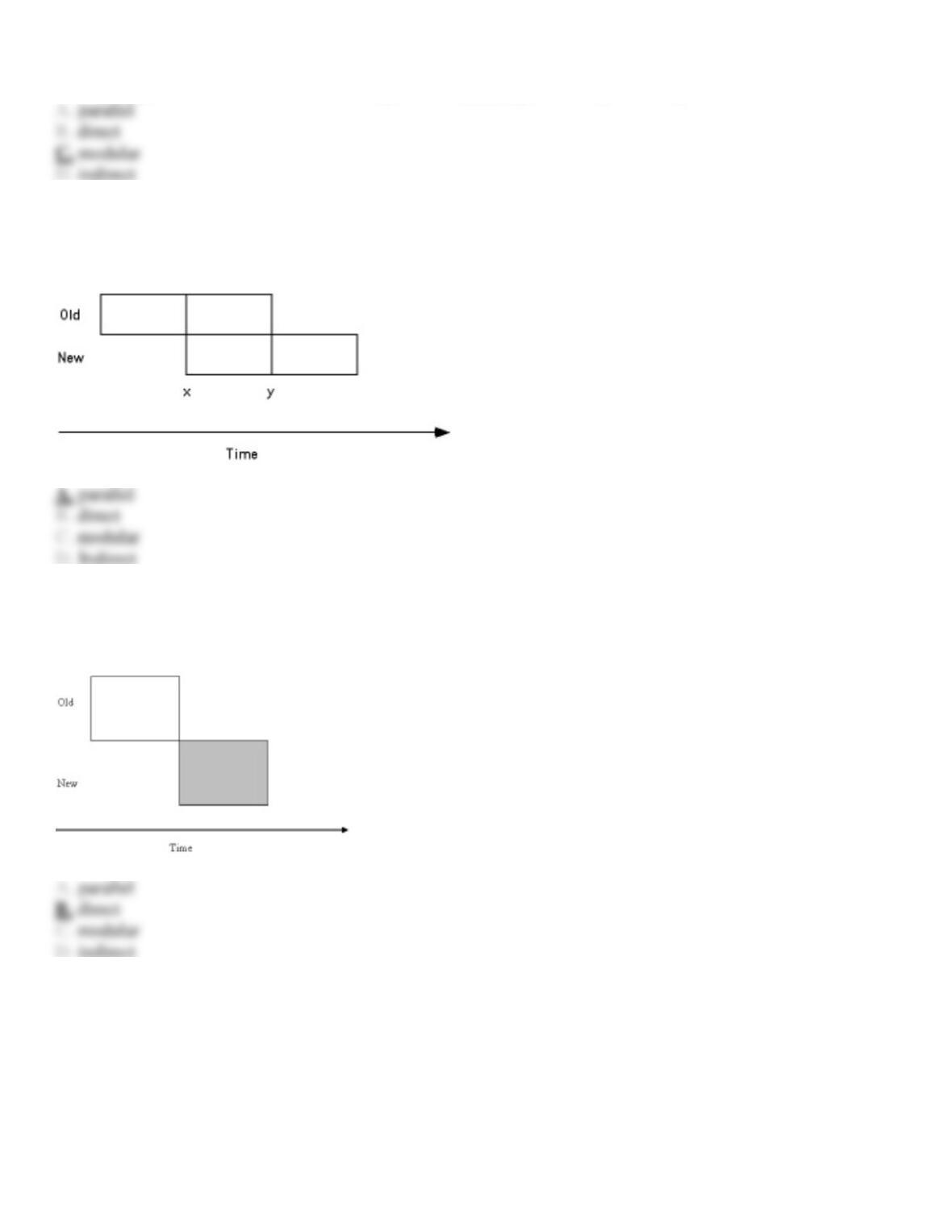
127. The following picture from the text illustrates the ____ approach to systems implementation:
128. Which of the following statements regarding the modular approach is false?
A. It is also referred to as the phased approach.
129. Which of the following is not typically a role for the accountant in a system’s implementation?
130. The final step in the in the implementation process is to write: