Chapter 17 – Allocation of Support Activity Costs and Joint Costs
17-1
Chapter 17
Allocation of Support Activity Costs and Joint Costs
Answer Key
True / False Questions
1. The direct method ignores the fact that some service departments provide service to other
service departments.
2. The step-down method of service department cost allocation completely ignores the
provision of services by one service department to another service department.
Chapter 17 – Allocation of Support Activity Costs and Joint Costs
17-2
3. City Hospital has two service departments (Patient Records and Accounting) and two
“production” departments (Internal Medicine and Surgery). It uses the reciprocal-services
method of cost allocation and should allocate Internal Medicine cost to Surgery.
4. When allocating service department costs, companies should use actual costs rather than
budgeted costs, and separate rates for variable and fixed costs.
5. Dual cost allocation works with either the direct method or the step-down method of
allocation.
Chapter 17 – Allocation of Support Activity Costs and Joint Costs
17-3
6. A company that uses activity-based costing would likely allocate costs from activity-cost
pools to products and services.
7. The breakdown of costs by departments is much finer than a breakdown by activities in an
ABC system.
8. The Gross Margin at Split-Off method should be selected if a company terminates all
processing at the split-off point and desires to use a cost-allocation approach that considers
the “revenue-producing ability” of each product.
Chapter 17 – Allocation of Support Activity Costs and Joint Costs
17-4
9. In the net-realizable-value method, the joint cost is allocated to the joint products in
proportion to the joint products’ net realizable values.
10. The net-realizable-value method is the least preferred cost allocation method since it does
not consider the economic characteristics of the joint products.
11. A joint product with minimal value relative to the other joint products is known as a by-
product.
12. The reciprocal-services method is less accurate than the direct and step-down methods.
Chapter 17 – Allocation of Support Activity Costs and Joint Costs
17-5
13. The reciprocal-services method cannot be combined with the dual-allocation approach.
Multiple Choice Questions
14. Which of the following would be considered a service department for an airline?
A. Maintenance.
Chapter 17 – Allocation of Support Activity Costs and Joint Costs
17-6
15. Which of the following would not be considered a service department in a hospital?
A. Security.
16. Consider the following statements about service department costs:
I. The costs of the Human Resources Department in a manufacturing organization must be
allocated to production departments in order to achieve a correct costing of inventory.
II. The allocation of service department costs requires that an organization select both an
allocation base and an allocation method.
III. Service department cost allocations are more relevant for firms involved in service
industries (e.g., repair, health care) than for those involved with manufacturing.
Which of the above statements is (are) correct?
A. I only.
B. II only.
Chapter 17 – Allocation of Support Activity Costs and Joint Costs
17-7
17. Which of the following methods ignores the fact that some service departments provide
service to other service departments?
18. Which of the following methods fully recognizes the fact that some service departments
provide service to other service departments?
Chapter 17 – Allocation of Support Activity Costs and Joint Costs
17-8
19. Which of the following methods recognizes the fact that fixed and variable service
department costs should be allocated separately?
20. Consider the following statements about the direct method of service department cost
allocation:
I. Under the direct method, all service department costs are eventually allocated to production
departments.
II. The order in which service department costs are allocated to production departments is
important.
III. Once a service department’s costs have been allocated, no costs are re-circulated back to
that department.
Which of the above statements is (are) correct?
A. I only.
Chapter 17 – Allocation of Support Activity Costs and Joint Costs
17-9
21. The Buckaneer Clinic has two service departments (Human Resources and Information
Resources) and two “production” departments (In-patient Treatment and Out-patient
Treatment). The service departments service the “production” departments as well as each
other, and studies have shown that Information Resources provides the greater amount of
service. Which of the following allocations would occur if Buckaneer uses the direct method
of cost allocation?
22. Tennison Corporation has two service departments (Maintenance and Human Resources)
and three production departments (Machining, Assembly, and Finishing). Maintenance is the
larger service department and Assembly is the largest production department. The two service
departments service each other as well as the three producing departments. On the basis of
this information, which of the following cost allocations would not occur under the direct
method?
A. Machining cost would be allocated to Assembly.
Chapter 17 – Allocation of Support Activity Costs and Joint Costs
17–10
23. Which of the following methods recognizes some (but not all) of the services that occur
between service departments?
A. Direct method.
24. When the step-down method is used, the service department whose costs are allocated
first is often the department that:
A. obtains the highest yield.
Chapter 17 – Allocation of Support Activity Costs and Joint Costs
17–11
25. Consider the following statements about the step-down method of service department cost
allocation:
I. Under the step-down method, all service department costs are eventually allocated to
production departments.
II. The order in which service department costs are allocated is important.
III. After a service department’s costs have been allocated to other departments, no costs are
re-circulated back to that service department.
Which of the above statements is (are) correct?
A. I only.
26. Oxmoor Corporation has two service departments (Maintenance and Human Resources)
and three production departments (Machining, Assembly, and Finishing). The two service
departments service the production departments as well as each other, and studies have shown
that Maintenance provides the greater amount of service. On the basis of this information,
which of the following cost allocations would likely occur under the step-down method?
A. Machining cost would be allocated to Assembly.
Chapter 17 – Allocation of Support Activity Costs and Joint Costs
17–12
27. The Covington Clinic has two service departments (Human Resources and Information
Systems) and two “production” departments (In-patient Treatment and Out-patient
Treatment). The service departments service the “production” departments as well as each
other, and studies have shown that Information Systems provides the greater amount of
service. Which of the following allocations would not occur if Covington uses the step-down
method of cost allocation?
A. Information Systems cost would be allocated to Human Resources.
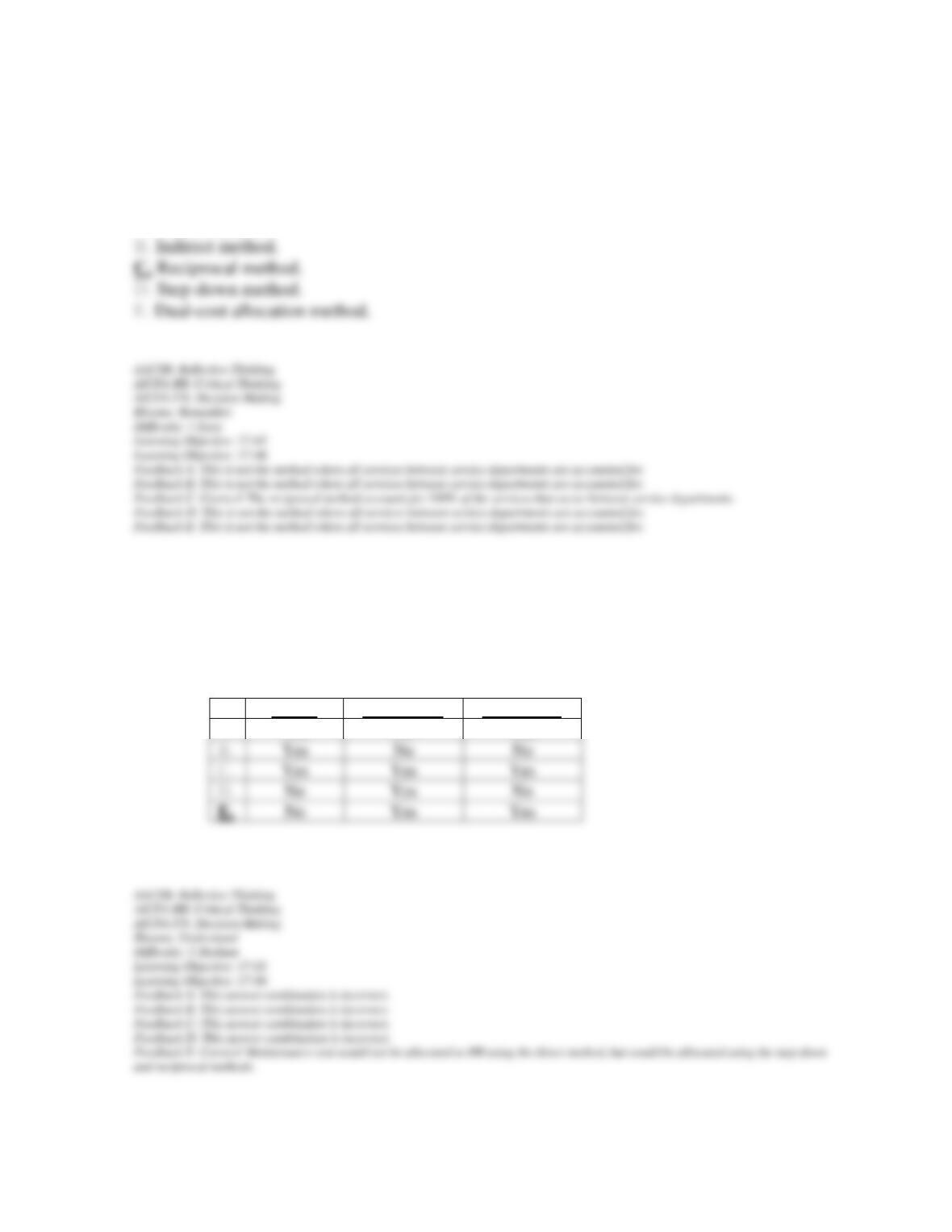
28. The Blue Sky Clinic has two service departments (S1 and S2) and two “production”
departments (P1 and P2). The service departments service the “production” departments as
well as each other, and studies have shown that S2 provides the greater amount of service.
Which of the following choices correctly denotes an allocation that would not occur under (1)
the direct method and (2) the step-down method of cost allocation?
Direct Method
Step-Down Method
A
S1’s cost would be allocated to P1.
S1’s cost would be allocated to P1.
P1’s cost would be allocated to P2.
P1’s cost would be allocated to P2.
S2’s cost would be allocated to S1.
S2’s cost would be allocated to S1.
P1’s cost would be allocated to S1.
P1’s cost would be allocated to S1.
Chapter 17 – Allocation of Support Activity Costs and Joint Costs
17–13
29. Which of the following methods accounts for 100% of the services that occur between
service departments?
A. Direct method.
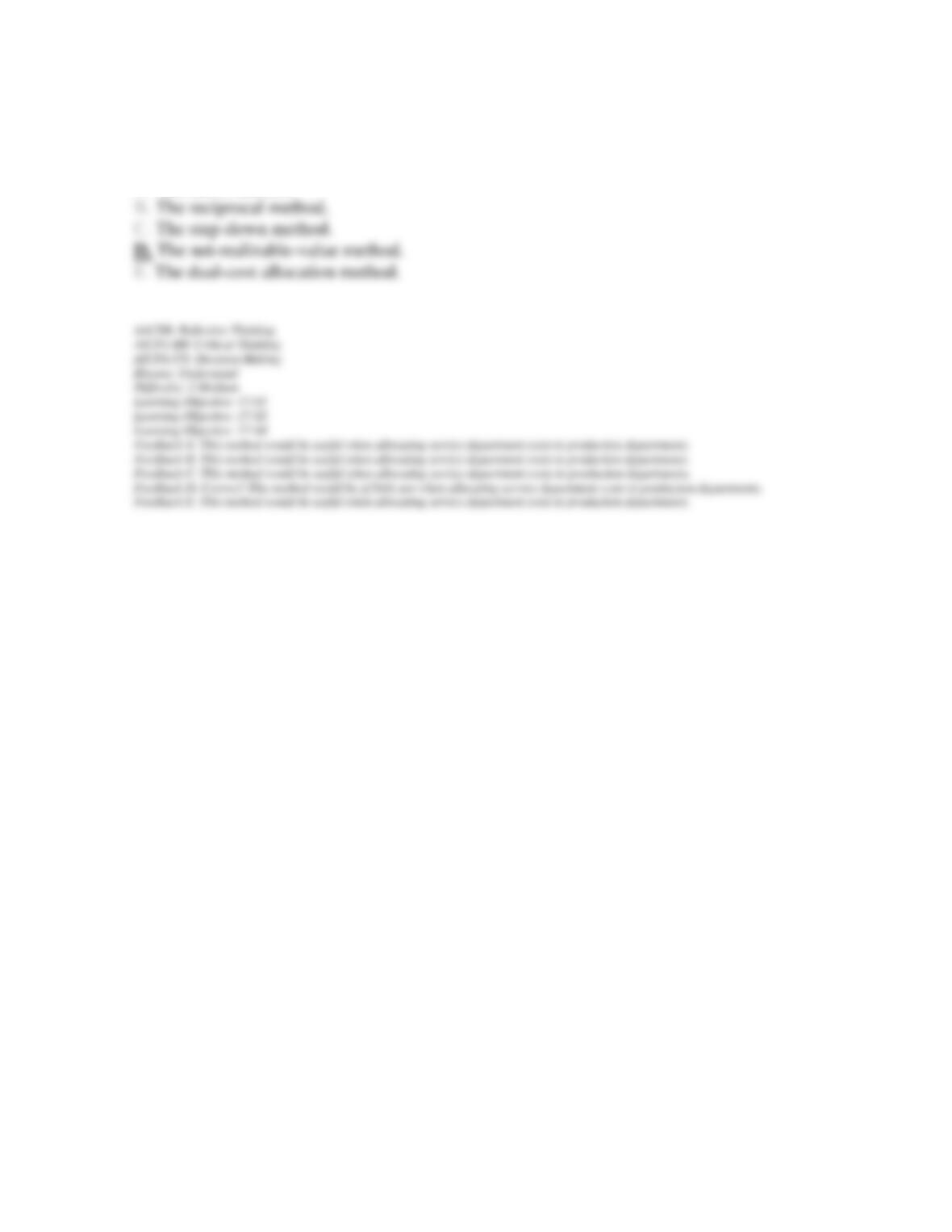
30. Naples Corporation has two service departments (Maintenance and Human Resources)
and three production departments (Machining, Assembly, and Finishing). The two service
departments service each other, and studies have shown that Maintenance provides the greater
amount of service. Given the various cost allocation methods, which of the following choices
correctly denotes whether Maintenance cost would be allocated to Human Resources?
Direct
Step-Down
Reciprocal
A
Yes
No
Yes
Yes
No
No
Yes
Yes
Yes
Yes
No
Yes
Yes
Chapter 17 – Allocation of Support Activity Costs and Joint Costs
17–14
31. Which of the following methods would be of little use when allocating service department
costs to production departments?
A. The direct method.
Chapter 17 – Allocation of Support Activity Costs and Joint Costs
17–15
Use the following information to answer Questions 32 & 33.
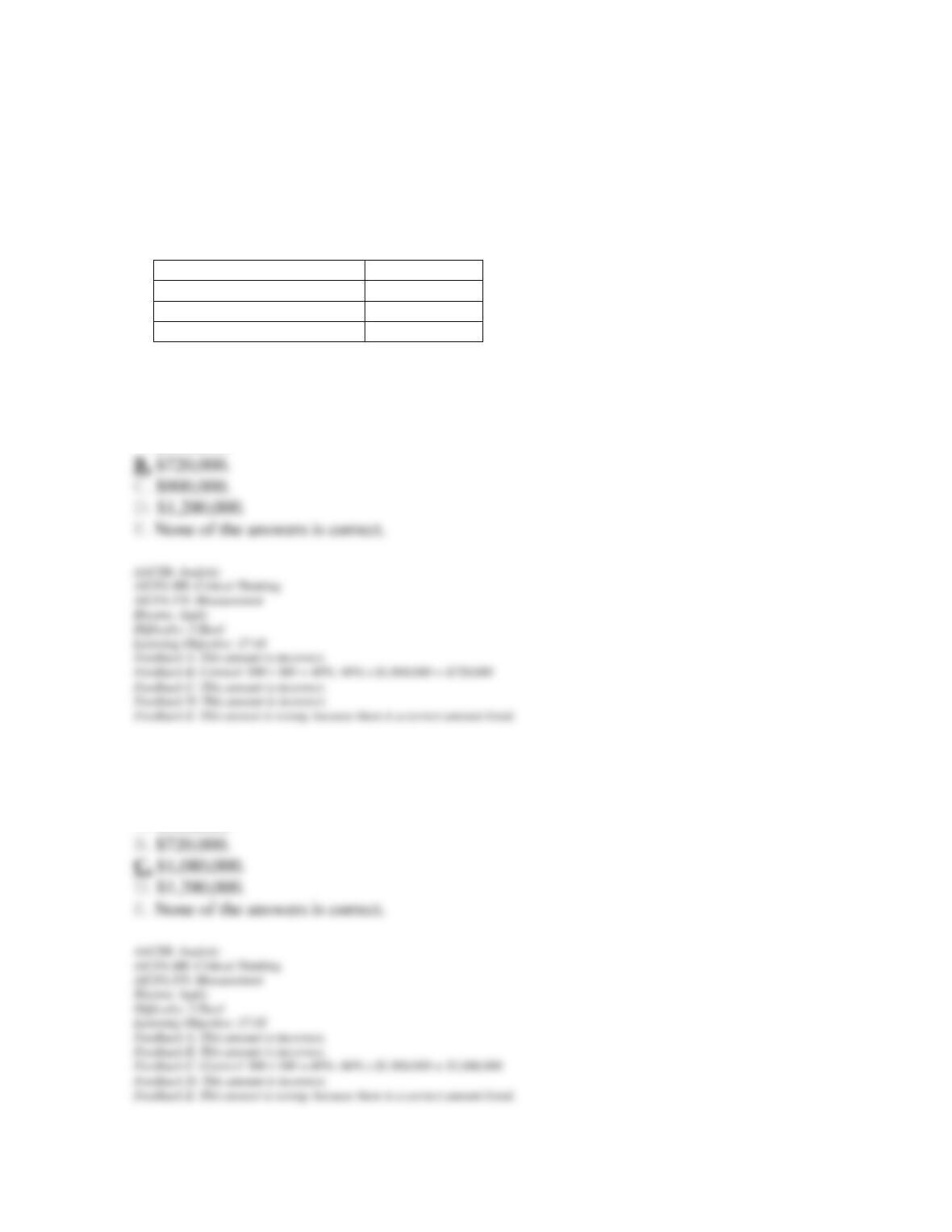
Aldo Industries, Inc. has two service departments (Human Resources and Building
Maintenance) and two production departments (Machining and Assembly). The company
allocates Building Maintenance cost on the basis of square footage and believes that Building
Maintenance provides more service than Human Resources. The square footage occupied by
each department follows.
Human Resources
6,000
Building Maintenance
13,000
Machining
18,000
Assembly
26,000
32. Assuming use of the direct method, over how many square feet would the Building
Maintenance cost be allocated (i.e., spread)?
A. 19,000.
33. Assuming use of the step-down method, over how many square feet would the Building
Maintenance cost be allocated (i.e., spread)?
A. 19,000.
Chapter 17 – Allocation of Support Activity Costs and Joint Costs
17–16
Use this information to answer questions 34-35.
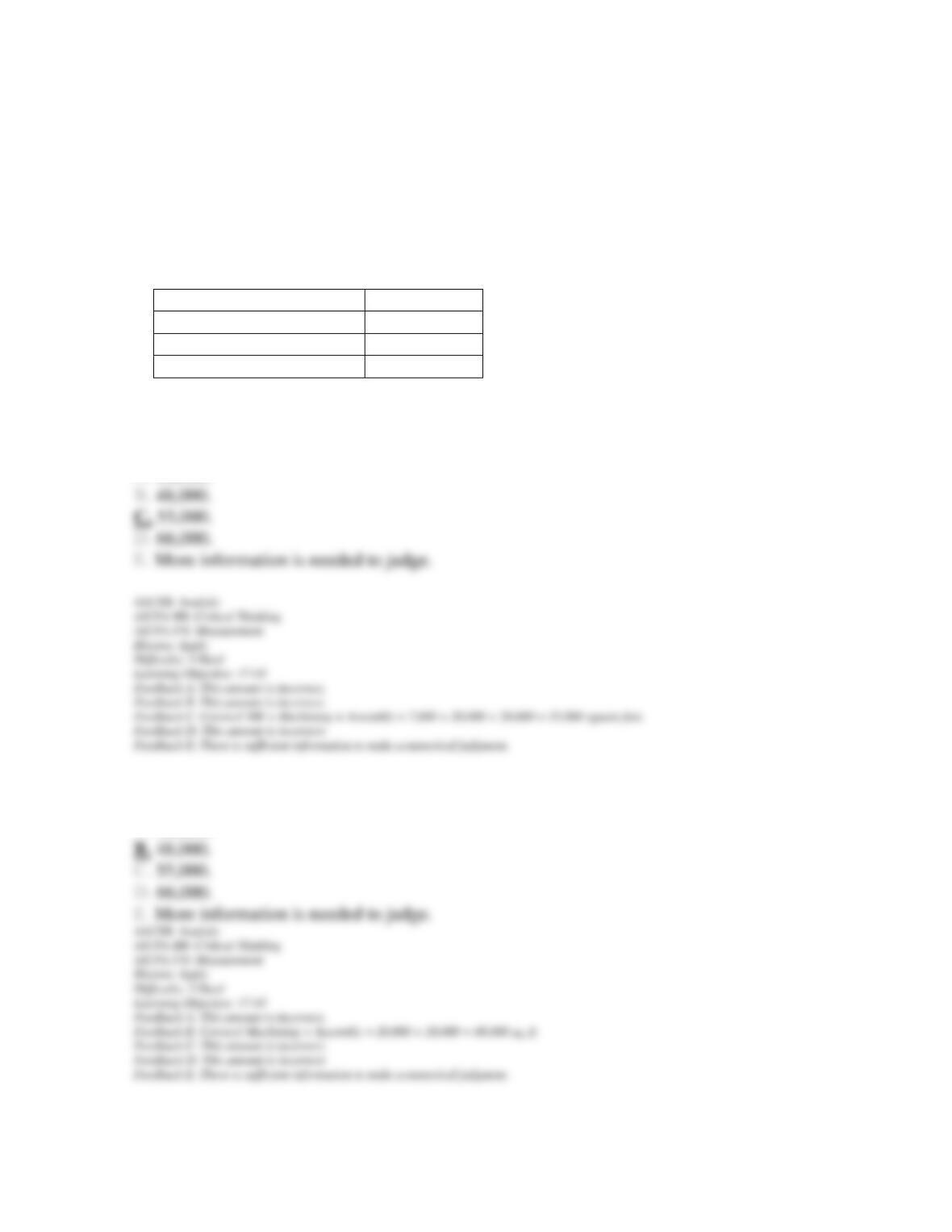
Rave Reviews Company has two service departments (Cafeteria and Human Resources) and
two production departments (Machining and Assembly). The number of employees in each
department follows.
Cafeteria
40
Human Resources
60
Machining
200
Assembly
300
34. Rave Reviews uses the direct method of cost allocation and allocates cost on the basis of
employees. If Human Resources cost amounts to $1,800,000, how much of the department’s
cost would be allocated to Machining?
A. $600,000.
35. Rave Reviews uses the direct method of cost allocation and allocates cost on the basis of
employees. If Human Resources cost amounts to $1,800,000, how much of the department’s
cost would be allocated to Assembly?
A. $900,000.
Chapter 17 – Allocation of Support Activity Costs and Joint Costs
17–17
Use this information to answer questions 36-37.
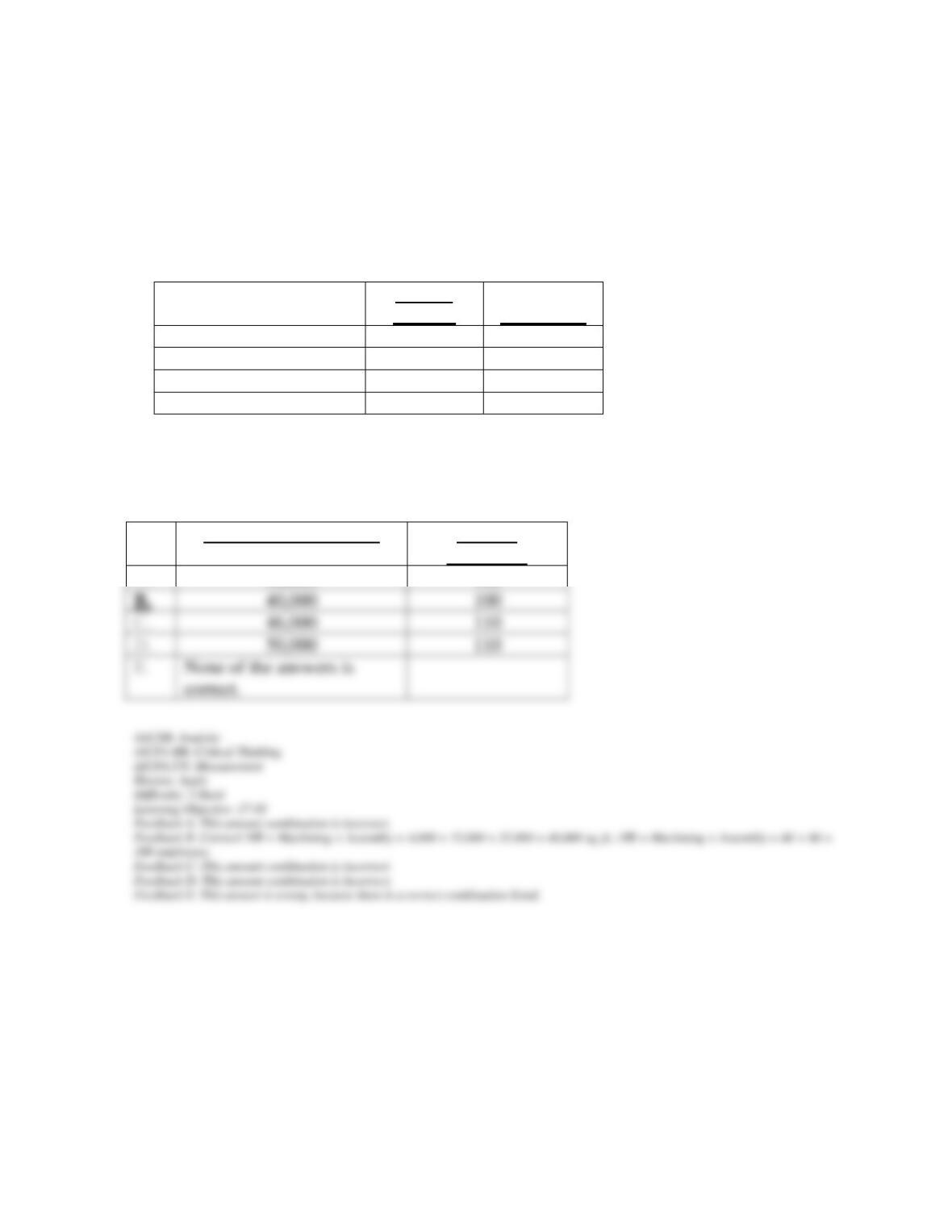
Trek, Inc. has two service departments (Human Resources and Building Maintenance) and
two production departments (Machining and Assembly). The company allocates Building
Maintenance cost on the basis of square footage and believes that Building Maintenance
provides more service than Human Resources. The square footage occupied by each
department follows.
Human Resources
7,000
Building Maintenance
11,000
Machining
20,000
Assembly
28,000
36. Assuming use of the step-down method, over how many square feet would the Building
Maintenance cost be allocated (i.e., spread)?
A. 18,000.
37. Assuming use of the direct method, over how many square feet would the Building
Maintenance cost be allocated (i.e., spread)?
A. 18,000.
Chapter 17 – Allocation of Support Activity Costs and Joint Costs
17–18
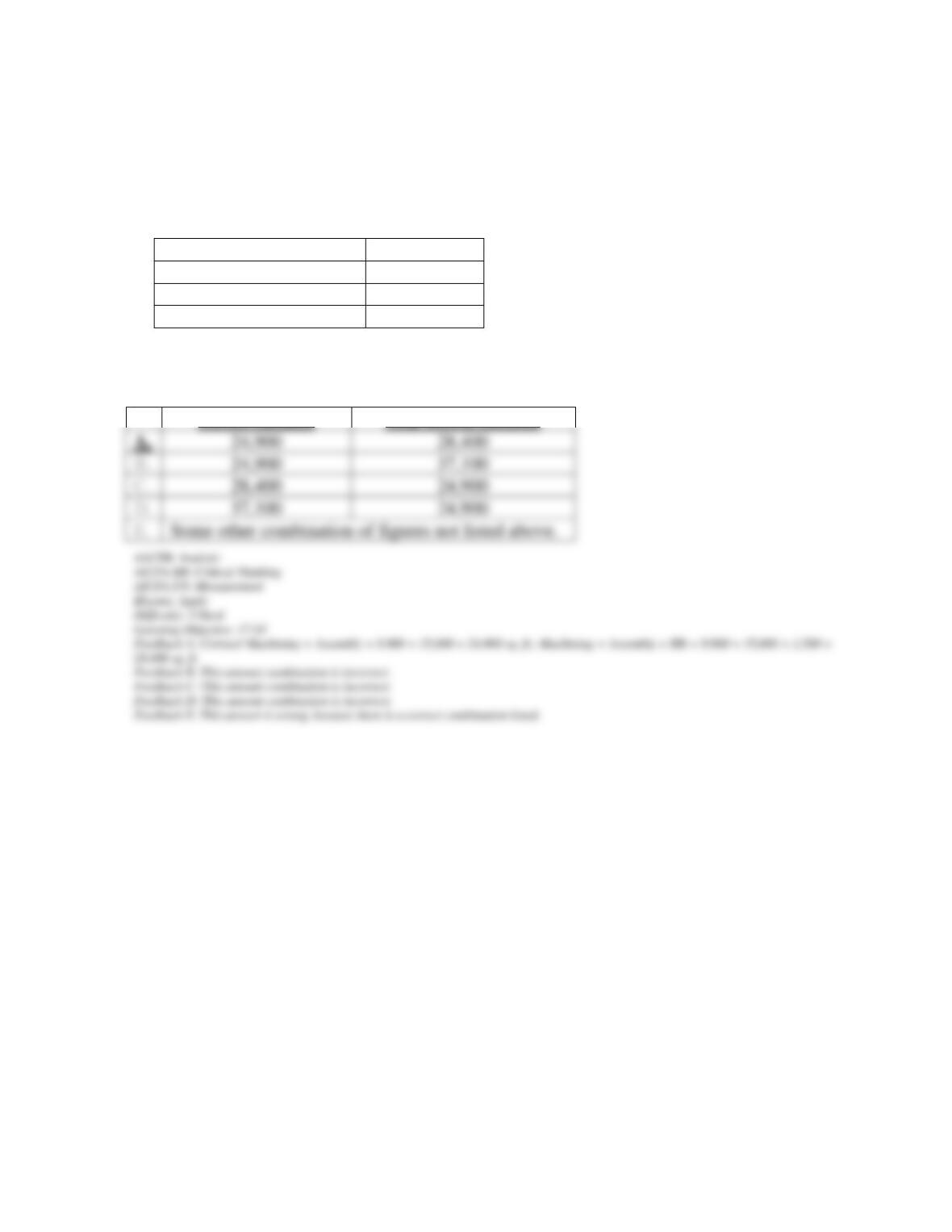
38. Sparkle Metallurgy, Inc. has two service departments (Human Resources and Building
Maintenance) and two production departments (Machining and Assembly). The company
allocates Building Maintenance cost on the basis of square footage and Human Resources cost
on the basis of employees. It believes that Building Maintenance provides more service than
Human Resources. The square footage and employees in each department follow.
Square
Footage
Employees
Human Resources
4,000
10
Building Maintenance
10,000
15
Machining
15,000
40
Assembly
21,000
60
Assuming use of the step-down method, which of the following choices correctly denotes the
number of square feet and employees over which the Building Maintenance cost and Human
Resources cost would be allocated (i.e., spread)?
Building Maintenance
Human
Resources
A.
36,000
100
40,000
100
46,000
110
D.
50,000
110
None of the answers is
correct.
Chapter 17 – Allocation of Support Activity Costs and Joint Costs
17–19
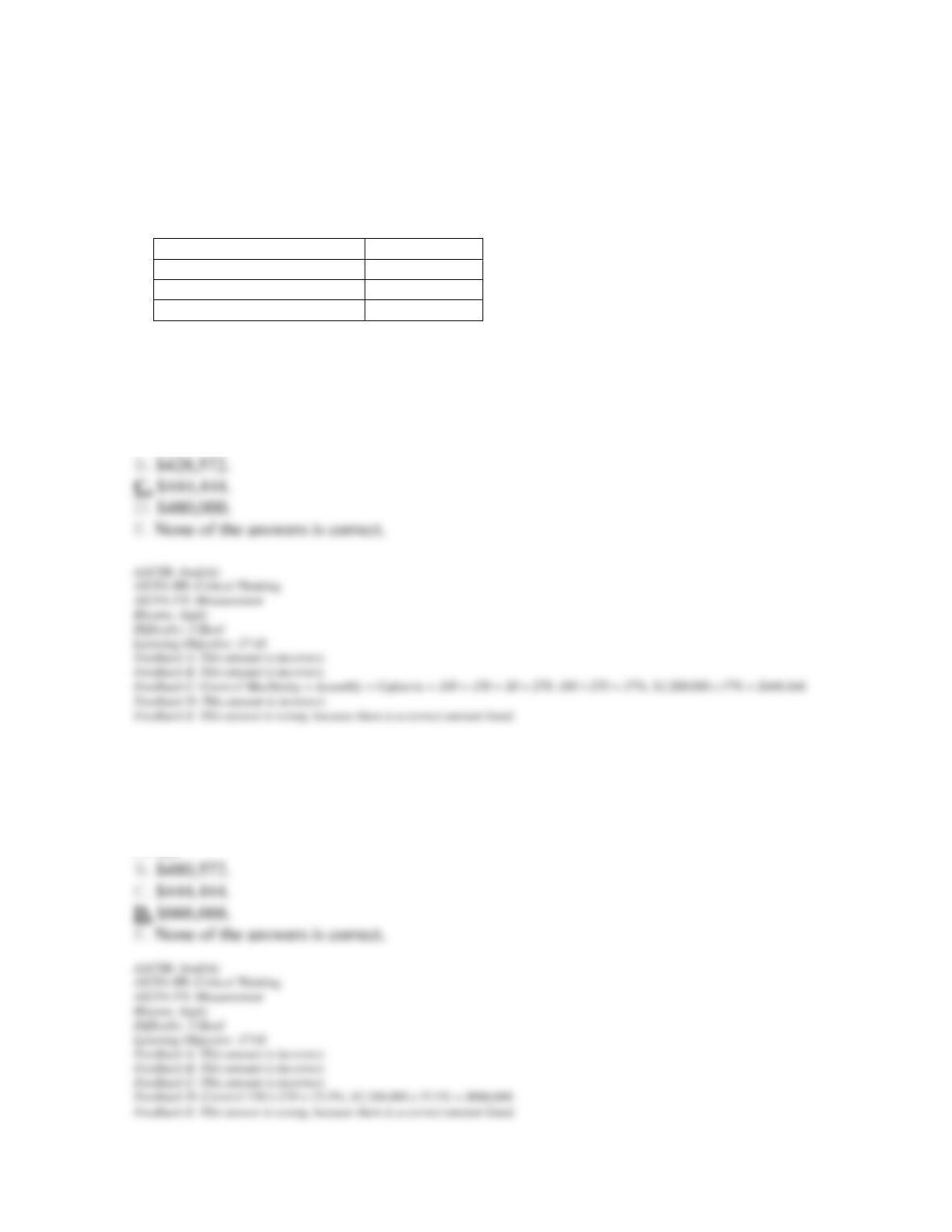
39. Visions, Inc. has two service departments (Human Resources and Building Maintenance)
and two production departments (Machining and Assembly). The company allocates Building
Maintenance cost on the basis of square footage and believes that Building Maintenance
provides more service than Human Resources. The square footage occupied by each
department follows.
Human Resources
3,500
Building Maintenance
8,700
Machining
9,900
Assembly
15,000
Over how many square feet would the Building Maintenance cost be allocated (i.e., spread)
with the direct method and the step-down method?
Direct Method
Step-Down Method
Some other combination of figures not listed above.
Chapter 17 – Allocation of Support Activity Costs and Joint Costs
17–20
Use the following information to answer Questions 40-42.
Marshall Welding Company has two service departments (Cafeteria and Human Resources)
and two production departments (Machining and Assembly). The number of employees in
each department follows.
Cafeteria
20
Human Resources
30
Machining
100
Assembly
150
40. Marshall Welding uses the step-down method of cost allocation and allocates cost on the
basis of employees. Human Resources cost amounts to $1,200,000, and the department
provides more service to the firm than Cafeteria. How much Human Resources cost would be
allocated to Machining?
A. $0.
41. Marshall Welding uses the step-down method of cost allocation and allocates cost on the
basis of employees. Human Resources cost amounts to $1,200,000, and the department
provides more service to the firm than Cafeteria. How much Human Resources cost would be
allocated to Assembly?
A. $0.