Accounting, 9e (Horngren)
Chapter 17 Job Order and Process Costing
Learning Objective 17-1
1) Accounting firms, building contractors, and healthcare providers are companies that use job order costing.
2) Process costing is used by companies that produce large numbers of identical units in a continuous fashion.
3) Which of the following companies would NOT use job order costing?
A) A lawn maintenance company
B) A legal firm
C) An auto repair shop
D) A beverage manufacturer
4) Which of the following is an industry that would use a process costing system rather than a job order costing
system?
A) Custom furniture manufacturer
B) Music production studio
C) Paint manufacturer
D) Home remodeling contractor
5) Job order costing is most likely used in which of the following industries?
A) Pharmaceutical manufacturing
B) Medical clinic
C) Oil refinery
D) Food and beverage manufacturing
6) Which of the following statements is FALSE?
A) A job order costing system would be used by manufacturers of custom made products.
B) A process costing system would be used by manufacturers of commodities, such as flour or sugar.
C) A service firm would likely use a job order costing system.
D) A print and copy shop would likely use a process costing system.
7) A process costing system is useful in which of the following circumstances?
A) Providing specialized services
B) Production of unique products
C) Production of multiple products in separate batches
D) Mass production of a single type of product
8) A job order costing system is useful in which of the following circumstances?
A) Mass production of a commodity
B) Manufacturing multiple products in separate batches
C) Continuous flow production of a single product
D) Manufacturing a product in a multi-step flow of production
Learning Objective 17-2
1) When materials are requisitioned for a job, the materials inventory account is debited.
2) Work in process inventory is debited for the incurrence of both direct and indirect labor in a job costing system.
3) Indirect materials and indirect labor are tracked to individual job costing records and recorded in the Work in
process account.
4) When direct materials are requisitioned, the Work in process account will be debited.
5) Indirect materials issued and indirect labor costs incurred are debited to the Manufacturing overhead account.
6) Direct materials and direct labor are assigned to individual job cost records, and recorded with a debit to Work in
process.
7) The entry to record the purchase of materials on account using a job order costing system would include a:
A) debit to materials inventory.
B) debit to accounts payable.
C) debit to work in process inventory.
D) credit to materials inventory.
8) Which of the following would be included in the journal entry to record the requisition of direct materials?
A) Debit to Cost of goods sold
B) Debit to Work in process inventory
C) Debit to Finished goods inventory
D) Debit to Materials inventory
9) Which of the following would be included in the journal entry to record direct labor costs actually incurred?
A) Debit to Work in process Inventory
B) Debit to Wages payable
C) Debit to Manufacturing overhead
D) Debit to Finished goods inventory
10) Which of the following would be included in the journal entry to record the incurrence of indirect labor costs?
A) Debit to Manufacturing overhead
B) Debit to Wages payable
C) Debit to Finished goods inventory
D) Debit to Work in process inventory
11) Which of the following would be included in the journal entry to record the requisition of indirect materials?
A) Debit to Manufacturing overhead
B) Debit to Work in process inventory
C) Debit to Materials inventory
D) Debit to Finished goods inventory
12) In job order costing, the journal entry to issue indirect materials to production should include which of the
following?
A) Credit to Finished goods inventory
B) Credit to Materials inventory
C) Credit to Manufacturing overhead
D) Credit to Work in process inventory
13) The journal entry to issue $500 of direct materials and $30 of indirect materials to production includes which of
the following?
A) Debit to Work in process for $500 and debit to Finished goods for $30
B) Debit to Manufacturing overhead for $530
C) Debit to Work in process for $500 and debit to Manufacturing overhead for $30
D) Debit to Work in process inventory for $530
14) The journal entry to record the incurrence of $1,500 of direct labor and $200 of indirect labor includes which of
the following?
A) Debit to Manufacturing overhead for $1,700
B) Debit to Work in process inventory for $1,500 and debit to Finished goods for $200
C) Debit to Work in process inventory for $1,700
D) Debit to Work in process for $1,500, debit to Manufacturing overhead for $200
15) Specialty Wood Products company had the following manufacturing labor costs last month:
Woodworkers’ wages
$100,000
Indirect laborers’ wages
$20,000
Maintenance personnel wages
$10,000
What is the journal entry to record the incurrence of these wages?
A)
Work in process inventory
100,000
Manufacturing overhead
30,000
Wages payable
130,000
B)
Work in process inventory
130,000
Wages payable
130,000
C)
Wages payable
130,000
Finished goods inventory
100,000
Work in process inventory
30,000
D)
Manufacturing overhead
130,000
Wages payable
130,000
16) Broxsie Fabrication Company issued $40,000 of direct materials to production and $5,500 of indirect materials
to production. Which of the following transactions would correctly record the transaction?
A)
Materials inventory
45,500
Finished goods inventory
40,000
Work in process inventory
5,500
B)
Work in process inventory
45,500
Materials inventory
45,500
C)
Work in process inventory
40,000
Manufacturing overhead
5,500
Materials inventory
45,500
D)
Manufacturing overhead
45,500
Materials inventory
45,500
17) Carlton Manufacturing Company purchased $65,000 of raw materials on account. The materials will be used to
produce furniture. Which of the following journal entries correctly records this transaction?
A)
Accounts payable
65,000
Materials inventory
65,000
B)
Finished goods inventory
65,000
Accounts payable
65,000
C)
Work in process inventory
65,000
Accounts payable
65,000
D)
Materials inventory
65,000
Accounts payable
65,000
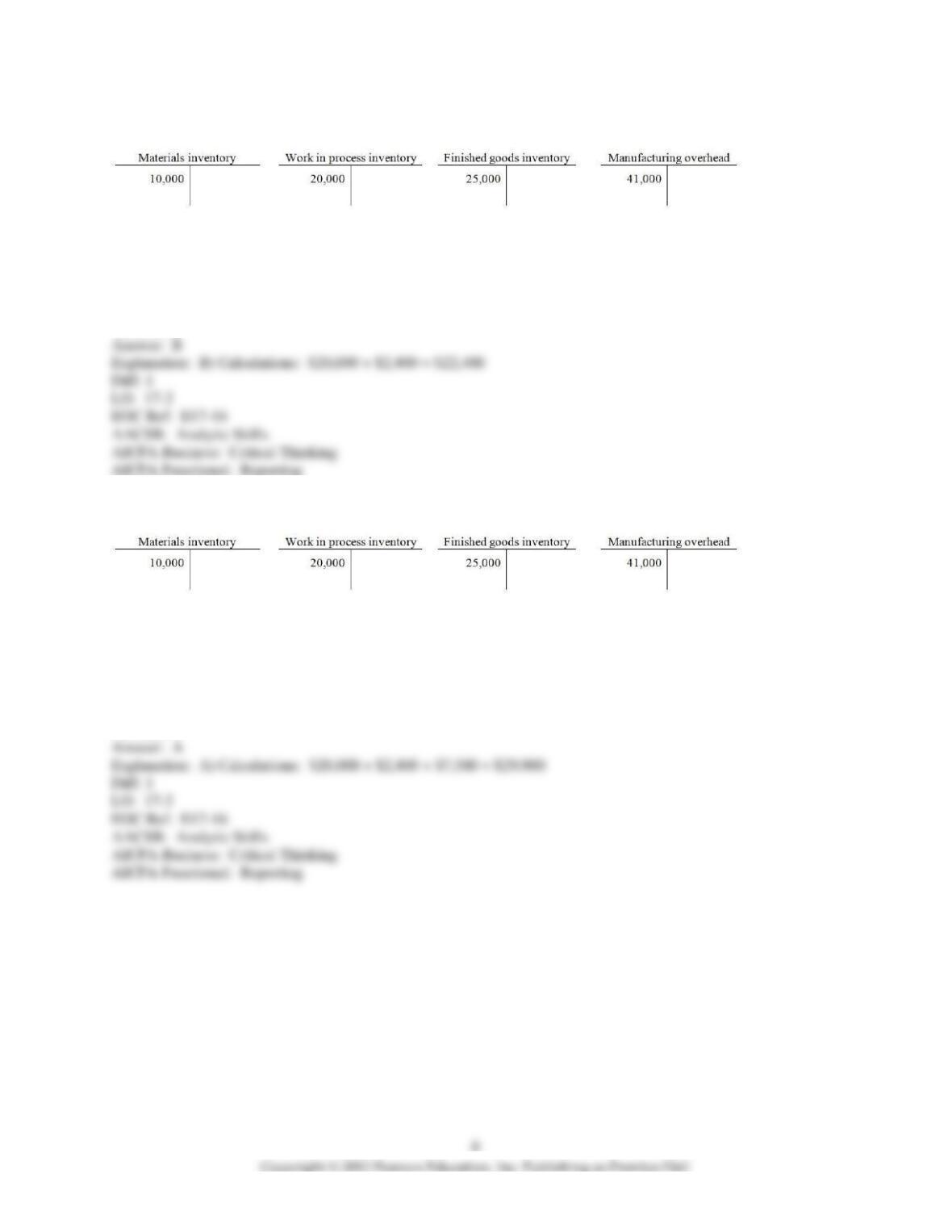
18) On June 1, 2012, Dalton Production Company had beginning balances as shown in the T-accounts below.
During June, the following transactions took place:
June 2: Issue $2,400 of direct materials and $200 of indirect materials to production.
Following this transaction, what was the balance in the Work in process inventory account?
A) $20,000
B) $22,400
C) $22,600
D) $20,200
19) On June 1, 2012, Dalton Production Company had beginning balances as shown in the T-accounts below.
During June, the following transactions took place:
June 2: Issue $2,400 of direct materials and $200 of indirect materials to production.
June 13: Pay $7,500 of direct factory labor cost, and $14,100 of indirect factory labor cost.
Following these transactions, what was the balance in the Work in process inventory account?
A) $29,900
B) $9,900
C) $44,200
D) $22,200
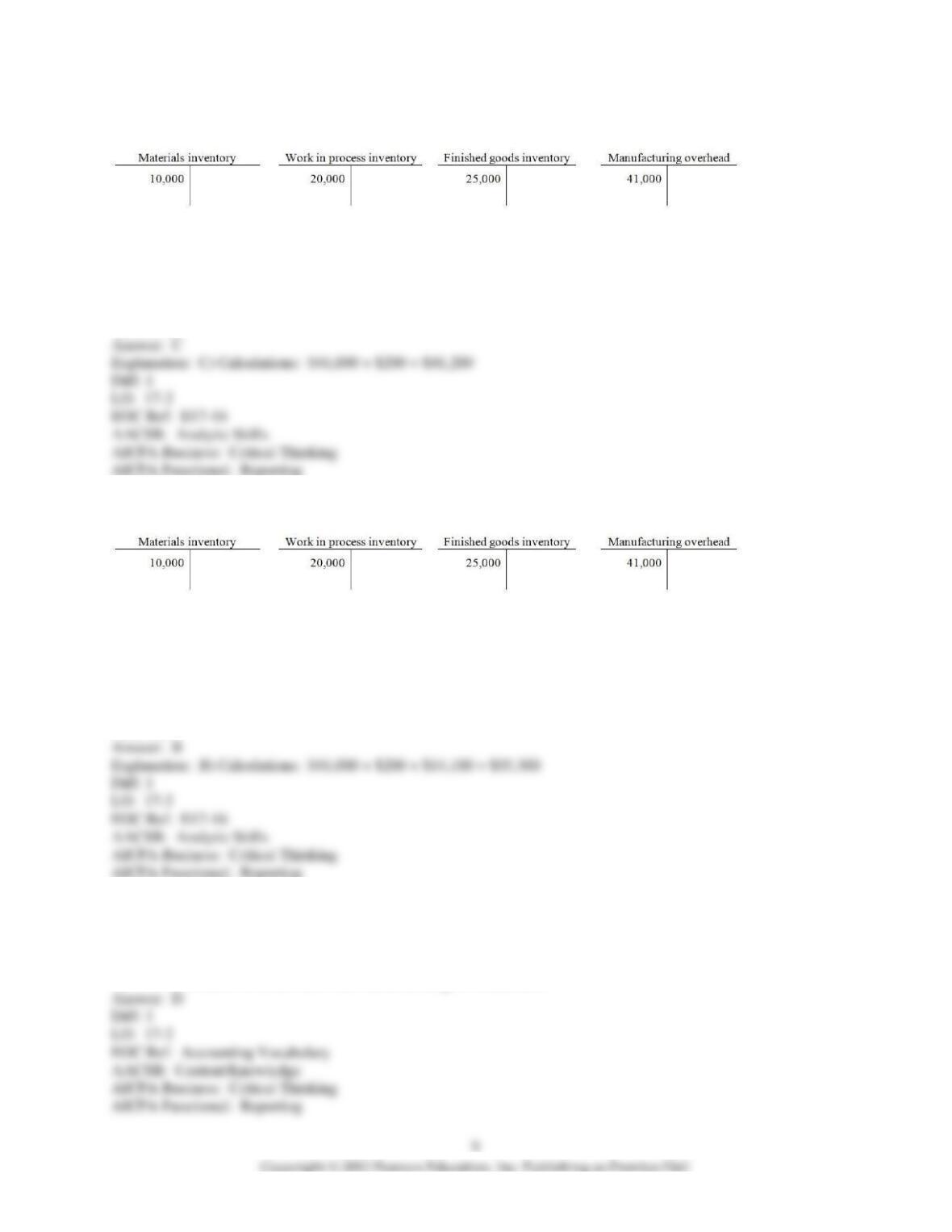
20) On June 1, 2012, Dalton Production Company had beginning balances as shown in the T-accounts below.
During June, the following transactions took place:
June 2: Issue $2,400 of direct materials and $200 of indirect materials to production.
Following this transaction, what was the balance in the Manufacturing overhead account?
A) $43,600
B) $43,400
C) $41,200
D) $41,000
21) On June 1, 2012, Dalton Production Company had beginning balances as shown in the T-accounts below.
During June, the following transactions took place:
June 2: Issue $2,400 of direct materials and $200 of indirect materials to production.
June 13: Pay $7,500 of direct factory labor cost, and $14,100 of indirect factory labor cost.
Following these transactions, what was the balance in the Manufacturing overhead account?
A) $50,900
B) $55,300
C) $44,200
D) $65,200
22) Which of the following correctly describes the term conversion costs?
A) The combination of direct plus indirect labor costs
B) The combination of indirect labor plus indirect materials cost
C) The combination of direct materials, direct labor, and manufacturing overhead costs
D) The combination of direct labor and manufacturing overhead costs
23) Specialty Wood Products company had the following manufacturing labor costs last month:
Woodworkers’ wages
$100,000
Indirect laborers’ wages
$20,000
Maintenance personnel wages
$10,000
Please provide the journal entry to record the incurrence of these labor costs.
Work in process inventory
Manufacturing overhead
24) Broxsie Fabrication Company issued $40,000 of direct materials to production and $5,500 of indirect materials
to production. Please prepare the journal entry to record the transaction.
Work in process inventory
Manufacturing overhead
25) Carlton Manufacturing Company purchased $65,000 of raw materials on account. The materials will be used to
produce furniture. Please provide the journal entry for the purchase of materials.
Materials inventory
Learning Objective 17-3
1) All manufacturing overhead costs incurred are accumulated as debits to a general ledger account titled
Manufacturing overhead.
2) In a manufacturing operation, depreciation of the plant and plant equipment should be debited to Depreciation
expense.
3) The entry to allocate manufacturing overhead costs to work in process requires a debit to Manufacturing
overhead.
4) In a manufacturing operation, taxes and insurance for the plant should be debited to Manufacturing overhead.
5) When manufacturing overhead is allocated, the amount is recorded as a debit to Finished goods and a credit to
Work in process.
6) When manufacturing overhead is allocated, the amount is recorded as a debit to Work in process and a credit to
Manufacturing overhead.
7) When manufacturing overhead costs are incurred, the amounts are recorded as a credit to Manufacturing
overhead.
8) Which of the following describes the allocation base for allocating manufacturing overhead costs?
A) The factor that reflects the relationship between goods produced and the amount of overhead costs incurred
B) The estimated base amount of manufacturing overhead costs in a year
C) The percentage used to allocate direct labor to work in process
D) The formula for allocating depreciation expense over the life on an asset
9) Which of the following correctly describes the term cost driver?
A) The inflation rate which causes costs to rise
B) The initial purchase price of direct materials
C) The primary factor which is correlated with the amount of cost incurred to produce a product
D) The total material, labor, and overhead cost of a completed job
10) Which of the following would NOT be considered a manufacturing overhead cost?
A) Depreciation of plant equipment
B) Direct labor cost
C) Plant utilities costs
D) Indirect labor
11) Which of the following would NOT be considered a manufacturing overhead cost?
A) Insurance for the factory
B) Indirect labor cost
C) Property tax for the plant
D) Direct labor
12) Which of the following correctly describes the predetermined manufacturing overhead rate?
A) The rate for factory utilities costs
B) The rate of actual overhead costs per day
C) The rate used to allocate overhead to production
D) The rate of increase in factory costs
13) When calculating the predetermined manufacturing overhead rate, what is the correct basis of calculation?
A) Estimated overhead costs divided by the number of days in a year
B) Estimated amount of the cost driver divided by the estimated total overhead costs
C) Actual overhead costs of the prior year divided by the actual amount of the cost driver or allocation base
D) Estimated overhead costs divided by the estimated amount of the cost driver or allocation base
14) When is the predetermined manufacturing overhead rate for a given production year calculated?
A) At the end of the production year
B) Before the production year begins
C) After each job is completed
D) At the mid-point of the production year
15) Falstaff Products estimates manufacturing overhead costs for the coming year at $500,000. Falstaff will allocate
based on machine hours. Falstaff estimates 8,000 machine hours for the coming year. What is the predetermined
manufacturing overhead rate?
A) $62.50 per machine hour
B) $0.016 per machine hour
C) $32.00 per machine hour
D) $6.25 per machine hour
16) Gardner Machine Shop estimates manufacturing overhead costs for the coming year at $316,000. They will
allocate based on direct labor hours. Gardner estimates 5,000 direct labor hours for the coming year. What is the
predetermined manufacturing overhead rate?
A) $6.32 per direct labor hour
B) $0.016 per direct labor hour
C) $63.20 per direct labor hour
D) $16.00 per direct labor hour
17) Falstaff Products allocates manufacturing overhead with a rate of $62.50 per machine hour. Job number 300
was just completed. It used 12 machine hours. How much overhead was allocated to the job?
A) $625
B) $75
C) $750
D) $7,500
18) Falstaff Products estimated manufacturing overhead costs for the year at $500,000. Falstaff also estimated 8,000
machine hours for the year. Falstaff bases their predetermined manufacturing overhead rate on machine hours. On
January 31, job 300 was completed. It required 12 machine hours to produce. How much manufacturing overhead
was allocated to the job?
A) $62.50
B) $19.20
C) $750.00
D) $42.00
19) Haverhill Products just completed job number 440. In addition to direct labor and direct materials cost,
Haverhill allocated $450 of manufacturing overhead to the job. Which of the following describes the correct
journal entry to record the allocation of overhead to the job?
A) Debit Finished goods, credit Manufacturing overhead
B) Debit Work in process, credit Cash
C) Debit Manufacturing overhead, credit Work in process
D) Debit Work in process, credit Manufacturing overhead
20) Inglesias Company just completed job number 12. See details below.
Direct labor cost: $840
Direct materials cost: $1,100
Machine hours for milling machinery: 7
Direct labor hours: 22
Predetermined manufacturing overhead allocation rate: $90 per machine hour
What was the total job cost?
A) $2,570
B) $1,940
C) $1,947
D) $3.920
21) Gardner Machine Shop estimates manufacturing overhead costs for the coming year at $316,000. They will
allocate based on direct labor hours. Gardner estimates 5,000 direct labor hours for the coming year. In January,
Gardener completed job number A33, which included 15 direct labor hours. How much overhead was allocated to
the job?
A) $948
B) $632
C) $1,204
D) $990
22) Gardner Machine Shop uses a predetermined manufacturing overhead rate of $63.20 per direct labor hour. In
January, Gardener completed job number A33, which included 15 direct labor hours. Which of the following
correctly describes the journal entry needed to allocate overhead to the job?
A) Debit Finished goods for $948, credit Manufacturing overhead for $948
B) Debit Manufacturing overhead for $948, credit Work in process for $948
C) Debit Work in process for $948, credit Manufacturing overhead for $948
D) Debit Cost of goods sold for $948, credit Finished goods for $948
23) Halcyon Company just completed job number 10B. See details below.
Direct labor cost: $2,040
Direct materials cost: $90
Machine hours for milling machinery: 5
Direct labor hours: 75
Predetermined manufacturing overhead allocation rate: $34.00 per direct labor hour
What was the total job cost?
A) $2,640
B) $4,680
C) $2,550
D) $4,590
24) Halcyon Company just completed job number 10-B. See details below.
Direct labor cost: $2,040
Direct materials cost: $90
Direct labor hours: 75
Predetermined manufacturing overhead allocation rate: $34.00 per direct labor hour
Number of units of finished product: 200 units
What was cost per unit of finished product? (Please round to nearest cent.)
A) $26.40
B) $46.80
C) $25.50
D) $23.40
25) Inglesias Company just completed job number 12. See details below.
Direct labor cost: $840
Direct materials cost: $1,100
Machine hours for milling machinery: 7
Direct labor hours: 22
Predetermined manufacturing overhead allocation rate: $90 per machine hour
Number of units of finished product: 25 units
What was cost per unit of finished product? (Please round to nearest cent.)
A) $77.88
B) $102.80
C) $12.40
D) $156.80
26) Arabica Manufacturing Company uses a predetermined manufacturing overhead rate based on a percentage of
direct labor cost. At the beginning of 2012, they estimated total manufacturing overhead costs at $1,050,000, and
they estimated total direct labor costs at $840,000. What was the predetermined manufacturing overhead rate?
A) 80% of direct labor cost
B) $1.25 per direct labor hour
C) 125% of direct labor cost
D) $35.00 per direct labor hour
27) Arabica Manufacturing Company uses a predetermined manufacturing overhead rate based on a percentage of
direct labor cost. At the beginning of 2012, they estimated total manufacturing overhead costs at $1,050,000, and
they estimated total direct labor costs at $840,000. In June, 2012, Arabica completed job number 511. Job stats are
as follows:
Direct materials cost $27,500
Direct labor cost $13,000
Direct labor hours 400 hours
Units of product produced: 200 crates
How much manufacturing overhead was allocated to the job?
A) $16,250
B) $10,400
C) $5,000
D) $34,375
28) Arabica Manufacturing Company uses a predetermined manufacturing overhead rate based on a percentage of
direct labor cost. At the beginning of 2012, they estimated total manufacturing overhead costs at $1,050,000, and
they estimated total direct labor costs at $840,000. In June, 2012, Arabica completed job number 511. Job stats are
as follows:
Direct materials cost $27,500
Direct labor cost $13,000
Direct labor hours 400 hours
Units of product produced: 200 crates
How much was the total job cost?
A) $40,500
B) $56,750
C) $50,900
D) $74,875
29) Arabica Manufacturing Company uses a predetermined manufacturing overhead rate based on a percentage of
direct labor cost. At the beginning of 2012, they estimated total manufacturing overhead costs at $1,050,000, and
they estimated total direct labor costs at $840,000. In June, 2012, Arabica completed job number 511. Job stats are
as follows:
Direct materials cost $27,500
Direct labor cost $13,000
Direct labor hours 400 hours
Units of product produced: 200 crates
How much was the cost per unit (cost per crate) of finished product? (Please round to the nearest cent.)
A) $374.38
B) $202.50
C) $254.50
D) $283.75