Fundamentals of Cost Accounting, 6e (Lanen)
Chapter 17 Additional Topics in Variance Analysis
1) The variable production cost variances are computed using the units produced instead of the
units sold.
2) If variances are not prorated at the end of the accounting period, they are closed to the Cost of
Goods Sold.
3) If the number of units produced exceeds the number of units sold, the full-absorption
operating profit will be lower than variable costing operating profit.
4) The direct materials price variance is based on the quantity of materials purchased when the
quantity purchased is different from the quantity used.
5) The market share variance is more controllable by the marketing department than the industry
volume variance.
6) The industry volume variance is the portion of the sales activity variance due to a change in
the company’s proportion of sales in the markets in which they operate.
7) An increase in an industry’s volume and a decrease in a company’s market share implies that
the company’s sales price variance is unfavorable.
8) The general approach in variance analysis is to separate the variance into components based
on a budgeting formula.
9) If a company sells two products, it is possible for both products to have a favorable sales mix
variance.
10) The sales quantity variance is the same as the sales activity variance on a flexible budget
performance report.
11) If a company sells two products, it is possible for both products to have an unfavorable sales
quantity variance.
12) The production yield variance is conceptually the same as the sales quantity variance.
13) The production mix variance measures the impact of substituting one material for another
material during the production process.
14) The direct labor yield variance is unfavorable when the total hours worked during a period
are less than the total standard hours allowed for the actual number of units produced.
15) The basic variance analysis framework used for manufacturing companies can also be used
in service organizations.
16) Labor variances are more important than material variances in service organizations.
17) Professional accounting firms could not compute a labor mix and labor yield variance for
their auditors because labor in accounting is not substitutable.
18) Output is usually defined as sales units in merchandising, but service organizations use
measures of activity units, like patient days.
19) Two important characteristics to consider when deciding how many variances to review are
is the impact of the variance and the extent to which the variance can be controlled.
20) The only variances that should be investigated are those for which the expected benefits of
correction exceed the costs of investigating and correcting.
21) Some variances are the result of accounting errors and omissions, including timing
differences.
22) Some variances are the result of standards that are inaccurate or do not reflect the current
production process.
23) Which of the following statements is(are) true?
(A) If variances are prorated at the end of the accounting period, an unfavorable direct materials
price variance will, when prorated, increase the value of the Finished Goods Inventory.
(B) Insignificant variances are not generally prorated at the end of the accounting period and are
closed to the Cost of Goods Sold.
A) Only A is true.
B) Only B is true.
C) Both of these are true.
D) Neither of these is true.
24) Standards are estimates and should be based on:
A) perfect performance.
B) an average of past conditions.
C) the most likely level of performance.
D) current conditions.
25) In a standard costing system, overhead is applied to production on a basis of:
A) the denominator hours chosen for the period.
B) the budgeted hours for the normal production level of activity.
C) the actual hours required to complete the output of the period.
D) the standard hours allowed to complete the output of the period.
26) One advantage of using a standard costing system is that it:
A) makes the record keeping process more complex and difficult.
B) never requires updating if standard costs have been carefully determined.
C) reduces the amount of information available to a manager.
D) provides managers with information that is useful in making decisions to improve
performance.
27) Which of the following statements is(are) false?
(A) All variances should be prorated to inventories and cost of goods sold at the end of the
accounting period.
(B) If the number of units produced exceeds the number of units sold, the full-absorption
operating profit will be lower than variable costing operating profit.
A) Only A is false.
B) Only B is false.
C) Both of these are false.
D) Neither of these is false.
28) If raw materials are carried in the Materials Inventory at standard cost, then it is reasonable
to assume that the:
A) price variance is recognized when materials are purchased.
B) price variance is recognized when materials are placed into production.
C) company does not follow generally accepted accounting principles.
D) efficiency variance is recognized when the materials are purchased.
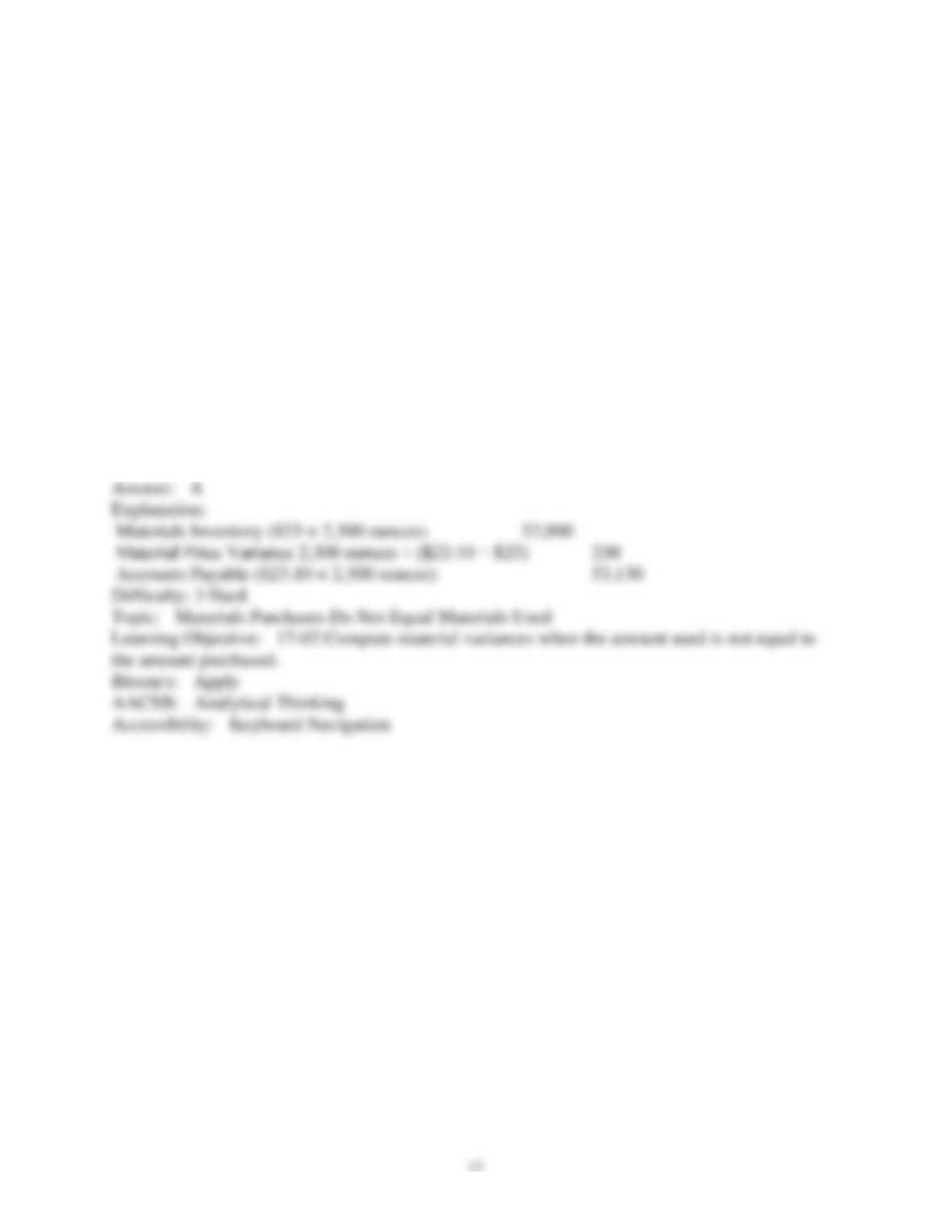
29) Ingredient A12H is a material used to make Calvin Corporation’s major product. The
standard cost of Ingredient A12H is $23.00 per ounce and the standard quantity is 3.8 ounces per
unit of output. Data concerning the compound for October appear below:
Cost of material purchased in October $ 23.10 per ounce
Material purchased in October 2,300 ounces
Material used in production in October 2,120 ounces
Actual output in October 600 units
The material was purchased on account and Calvin Corporation uses a standard costing system.
The debit to the Materials Inventory account for October would total:
A) $52,900.
B) $52,440.
C) $48,760.
D) $53,130.
30) Ingredient A12H is a material used to make Calvin Corporation’s major product. The
standard cost of Ingredient A12H is $23.00 per ounce and the standard quantity is 3.8 ounces per
unit of output. Data concerning the compound for October appear below:
Cost of material purchased in October $ 23.10 per ounce
Material purchased in October 2,300 ounces
Material used in production in October 2,120 ounces
Actual output in October 600 units
The material was purchased on account and Calvin Corporation uses a standard costing system.
The credit to the Materials Inventory account for October would total:
A) $52,440.
B) $48,760.
C) $52,900.
D) $53,130.
31) Ingredient A12H is a material used to make Calvin Corporation’s major product. The
standard cost of Ingredient A12H is $23.00 per ounce and the standard quantity is 3.8 ounces per
unit of output. Data concerning the compound for October appear below:
Cost of material purchased in October $ 23.10 per ounce
Material purchased in October 2,300 ounces
Material used in production in October 2,120 ounces
Actual output in October 600 units
The material was purchased on account and Calvin Corporation uses a standard costing system.
The Material Price Variance for October would be recorded as a:
A) debit of $230.
B) credit of $212.
C) debit of $212.
D) credit of $230.
32) Ingredient A12H is a material used to make Calvin Corporation’s major product. The
standard cost of Ingredient A12H is $23.00 per ounce and the standard quantity is 3.8 ounces per
unit of output. Data concerning the compound for October appear below:
Cost of material purchased in October $ 23.10 per ounce
Material purchased in October 2,300 ounces
Material used in production in October 2,120 ounces
Actual output in October 600 units
The material was purchased on account and Calvin Corporation uses a standard costing system.
The Material Efficiency Variance for October would be recorded as a:
A) credit of $3,680.
B) debit of $4,140.
C) credit of $4,140.
D) debit of $3,680.
33) Ingredient B4376 is used to make Razor Corporation’s major product. The standard cost of
Ingredient B4376 is $24.50 per ounce and the standard quantity is 6.1 ounces per unit of output.
In the most recent month, 5,030 ounces of the compound were used to make 700 units of the
output. When recording the use of materials in production under a standard costing system,
Materials Inventory would be:
A) credited for $123,235.
B) debited for $123,235.
C) debited for $104,615.
D) credited for $104,615.
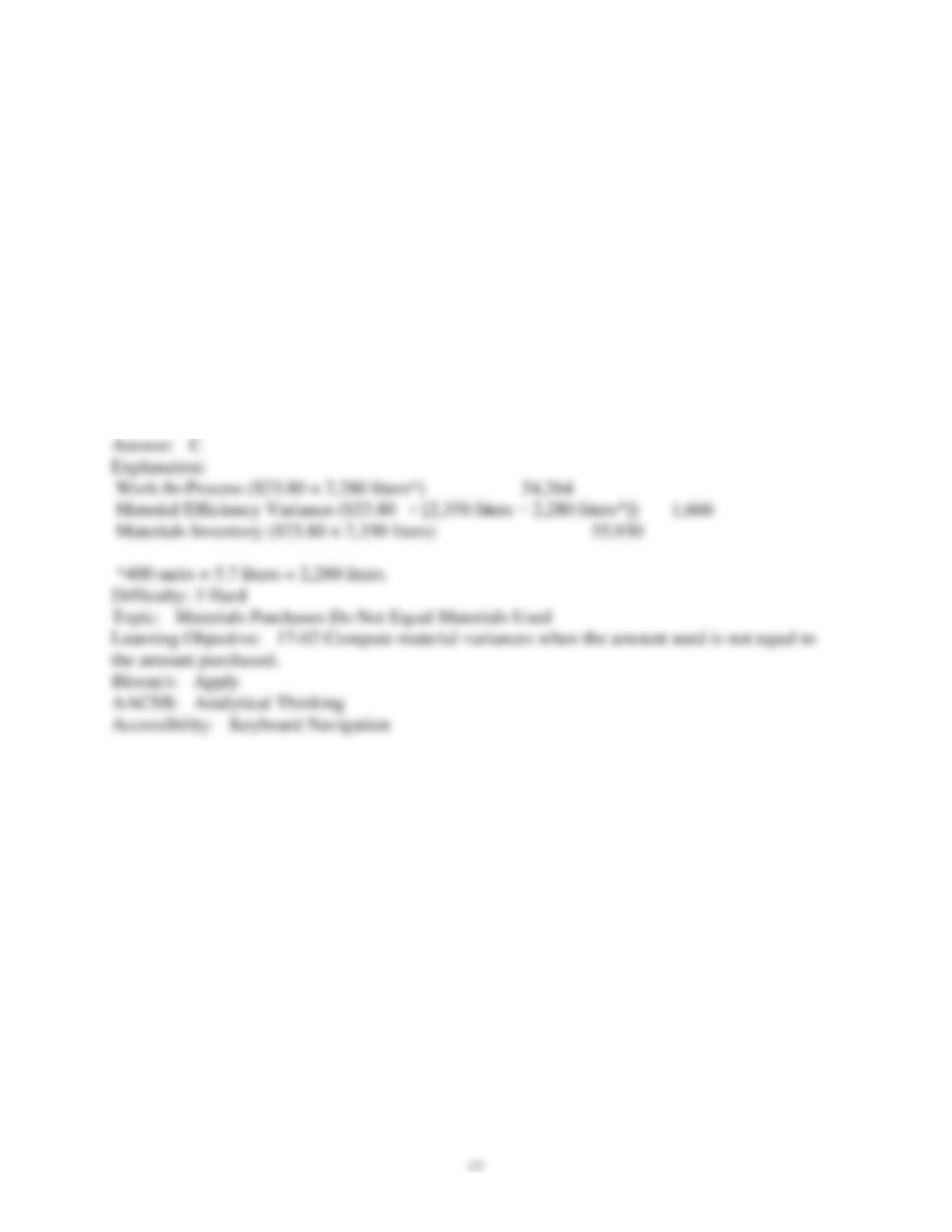
34) Barium Corporation has provided the following data concerning its most important raw
material, Compound XYY2:
Standard cost $ 23.80 per liter
Standard quantity 5.7 liters per unit of output
Material used in production in August 2,350 liters
Actual output in August 400 units
When recording the use of materials in production under a standard costing system, Materials
Inventory would be:
A) debited for $55,930.
B) debited for $54,264.
C) credited for $55,930.
D) credited for $54,264.
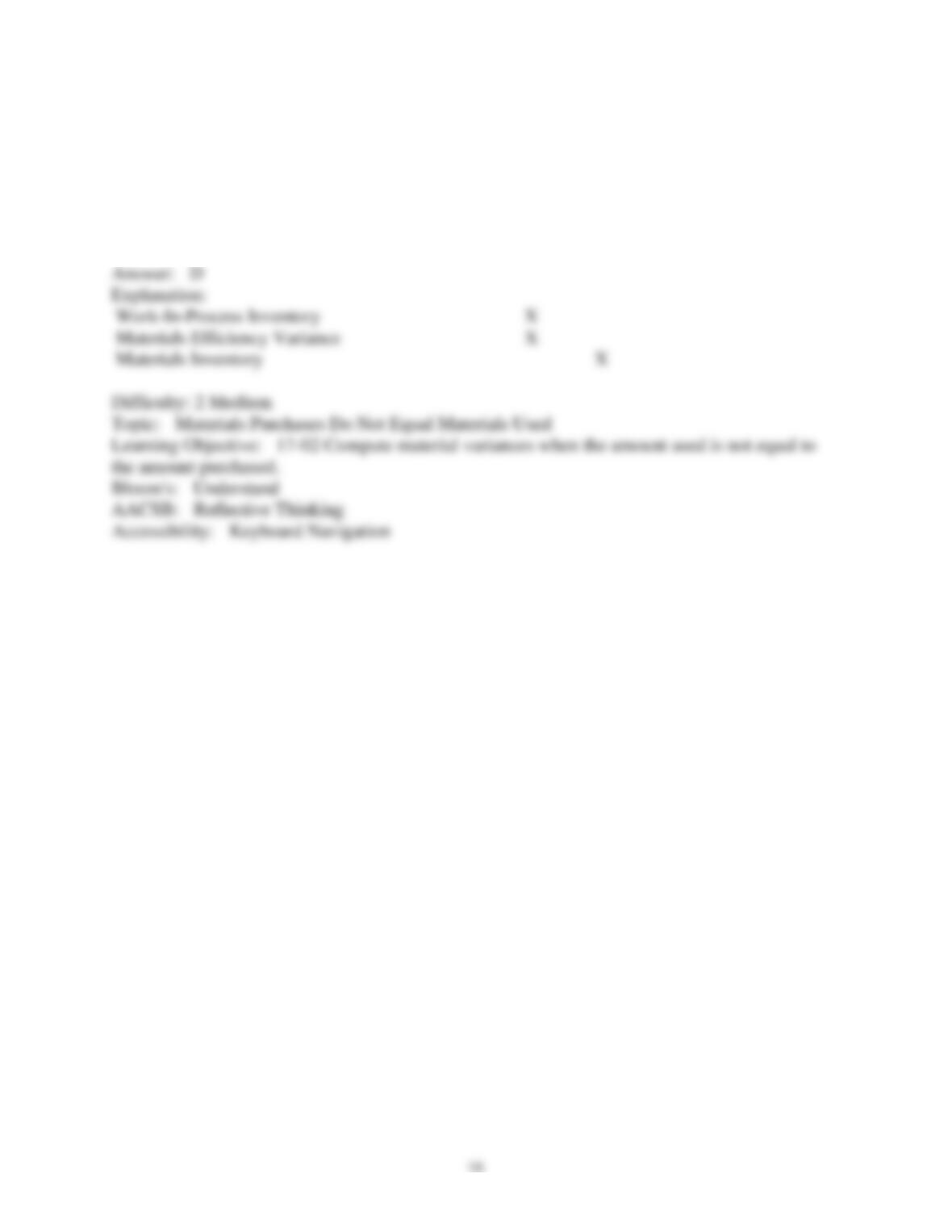
35) When the actual amount of a material used in production is greater than the standard amount
allowed for the actual output, the journal entry would include:
A) debit to Materials Inventory; credit to Materials Efficiency Variance.
B) debit to Work-In-Process Inventory; credit to Materials Efficiency Variance.
C) debit to Materials Inventory; debit to Materials Efficiency Variance.
D) debit to Work-In-Process Inventory; debit to Materials Efficiency Variance.
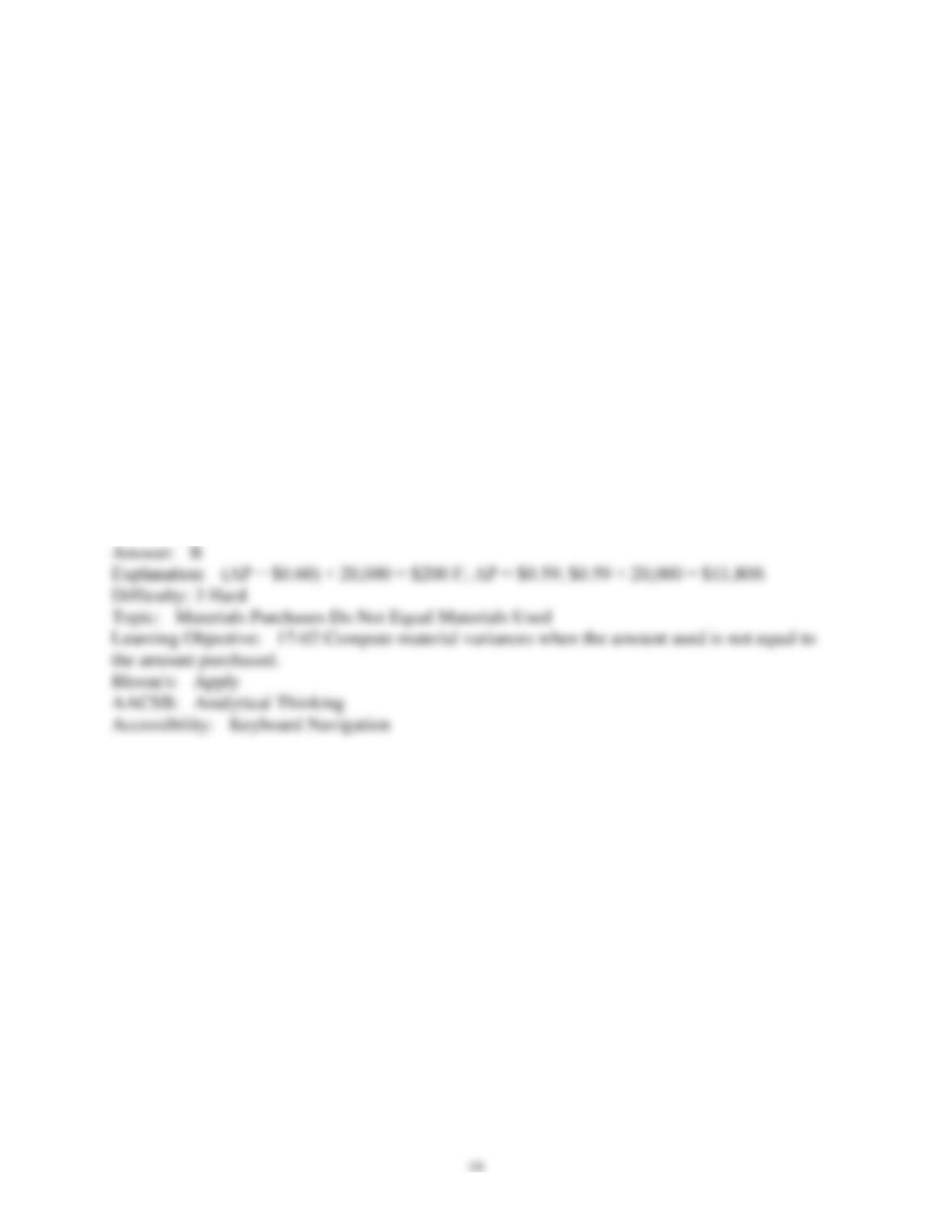
36) The Fantasy Gifts Company, a maker of Holiday novelties, needs your help immediately.
The company’s accountant resigned without leaving adequate records or explanations for what
she did. In reviewing the records, you find the following information for May:
Materials Purchased 20,000 units
Materials Used 15,000 units
You find a copy of the budget which shows that materials were budgeted at $0.60/unit. You
know that the material price variance is recorded at the time of purchase and you find some
handwritten notes among the accountant’s work papers, which indicate the following:
Material price variance $ 200 F
Material efficiency variance $ 600 F
What was the total actual cost of the direct materials purchased during May?
A) $9,000.
B) $11,800.
C) $12,000.
D) $12,200.
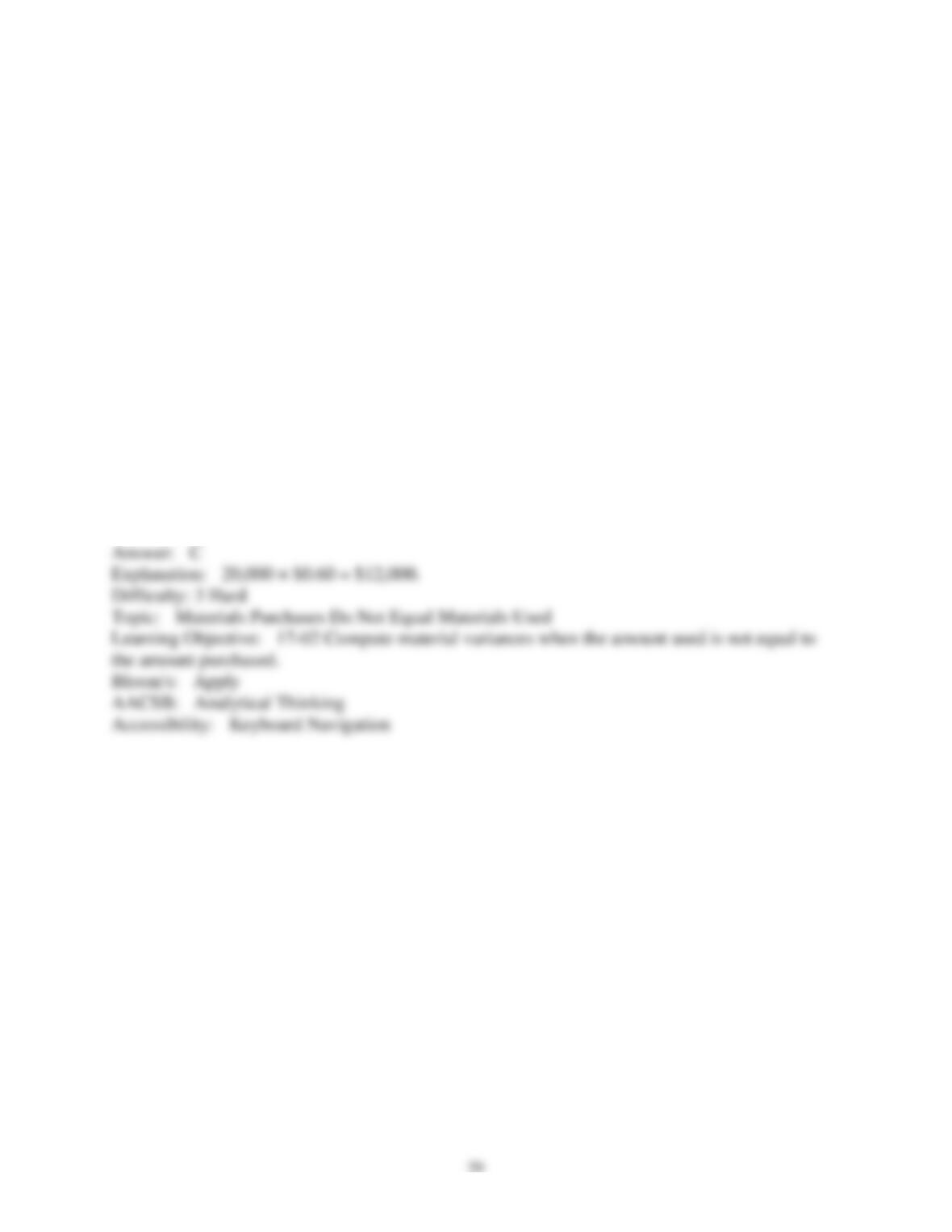
37) The Fantasy Gifts Company, a maker of Holiday novelties, needs your help immediately.
The company’s accountant resigned without leaving adequate records or explanations for what
she did. In reviewing the records, you find the following information for May:
Materials Purchased 20,000 units
Materials Used 15,000 units
You find a copy of the budget which shows that materials were budgeted at $0.60/unit. You
know that the material price variance is recorded at the time of purchase and you find some
handwritten notes among the accountant’s work papers, which indicate the following:
Material price variance $ 200 F
Material efficiency variance $ 600 F
What was the total standard cost of direct materials purchased during May?
A) $9,150.
B) $11,800.
C) $12,000.
D) $12,200.