70) If a department that applies process costing starts the reporting period with 50,000 physical
units that were 25% complete with respect to direct materials and 40% complete with respect to
direct labor, it must add 12,500 equivalent units of direct materials and 20,000 equivalent units
of direct labor to complete them.
71) If a department that applies process costing starts the reporting period with 40,000 physical
units that were 80% complete with respect to direct materials and 50% complete with respect to
direct labor, it must add 8,000 equivalent units of direct materials and 20,000 equivalent units of
direct labor to complete them.
72) One section of the process cost summary describes the equivalent units of production for the
department during the reporting period and presents the calculations of the direct materials and
conversion costs per equivalent unit.
73) A process cost summary for a production department accounts for all costs assigned to that
department during the period plus costs that were in the department’s Work in Process Inventory
account at the beginning of the period.
74) The process cost summary presents calculations of the cost of units completed during the
reporting period, but does not present any information about the ending Work in Process
inventory.
75) Since the process cost summary describes the activities of a production department for a
specified reporting period, it does not present information about any costs incurred in prior
periods.
76) The cost of units transferred from Work in Process Inventory to Finished Goods Inventory is
called the cost of goods manufactured.
77) The Finishing Department transferred out completed units with a cost of $74,000. This
transfer should be recorded with the following entry:
Finished Goods Inventory
74,000
Work in Process Inventory, Finishing Dept.
74,000
78) Which of the following products is least likely to be produced in a process operation?
A) Smartphones
B) Slacks for casual wear
C) Baseball caps
D) Calculators
E) Custom cabinets
79) Which of the following products is most likely to be produced in a process operation?
A) Airplanes
B) Cereal
C) Bridges
D) Designer bridal gowns
E) Custom cabinets
80) Which of the following characteristics does not usually apply to process operations?
A) Each unit of product is separately identifiable.
B) Partially completed products are transferred between processes.
C) Each process is a separate department.
D) A separate Work in Process Inventory is used for each process.
E) Costs are computed using equivalent units.
81) Yamada Company applies factory overhead to its production departments on the basis of
90% of direct labor costs. In the Assembly Department, Yamada had $125,000 of direct labor
cost, and in the Finishing Department, Yamada had $35,000 of direct labor cost. The entry to
apply overhead to these production departments is:
A) Debit Factory Overhead—Assembly $112,500; debit Factory Overhead—Finishing $31,500;
credit Work in Process Inventory $144,000.
B) Debit Factory Overhead $144,000; credit Work in Process Inventory—Assembly $112,500;
credit Work in Process—Finishing $31,500.
C) Debit Factory Overhead $144,000; credit Factory Wages Payable $144,000.
D) Debit Work in Process Inventory—Assembly $112,500; debit Work in Process Inventory—
Finishing $31,500; credit Factory Overhead $144,000.
E) Debit Factory Wages Payable $144,000; credit Cash $144,000.
82) Clarksen Company uses a process costing system. The company requisitioned $93,000 of
materials for Department A and $67,000 of materials for Department D. The entry to record the
use of the direct materials by these two departments is:
A) Debit Raw Materials Inventory $160,000; credit Accounts Payable $160,000.
B) Debit Work in Process Inventory—Dept. A $93,000; debit Work in Process Inventory—Dept.
D $67,000; credit Raw Materials Inventory $160,000.
C) Debit Factory overhead $160,000; credit Raw Materials Inventory $160,000.
D) Debit Raw Materials Inventory—Dept. A $93,000; debit Raw Materials Inventory—Dept. D
$67,000; credit Work in Process Inventory $160,000.
E) Debit Work in Process Inventory—Dept. A $93,000; debit Work in Process Inventory—Dept.
D $67,000; credit Accounts Payable $160,000.
83) Which of the following characteristics does not apply to job order cost accounting?
A) Aims to compute the cost per unit of product.
B) Identifiable units of production.
C) Equivalent units of production.
D) Use of job cost sheets.
E) Use of a single Work in Process Inventory account.
84) A key idea in process costing that refers to the number of units that could have been started
and completed given the costs incurred during the period is known as:
A) Manufacturing overhead.
B) Units in process.
C) A job cost sheet.
D) Equivalent units of production.
E) Process cost summary.
85) Equivalent units of production are equal to:
A) The number of units that could have been started and completed given the costs incurred
during the period.
B) The number of finished units actually produced during a period.
C) The number of units started into the process during a period.
D) The number of units still in process at the end of a period.
E) Physical units that were started and completed during a period.
86) Which of the following is the best explanation for why it is necessary to calculate equivalent
units of production in a process costing environment?
A) In most manufacturing environments, it is not possible to conduct a physical count of units.
B) Companies often use a combination of a process costing and job order costing systems.
C) In most process costing systems, direct materials are added at the beginning of the process
while conversion costs are added evenly throughout the manufacturing process.
D) All of the work to make a unit 100% complete and ready to move to the next stage of
production or to finished goods inventory may not have been completed in a single time period.
E) In most cases, there is no difference between physical units and equivalent units of
production.
87) The combined costs of direct labor and factory overhead per equivalent unit used by many
businesses with process operations is called:
A) Physical cost per equivalent unit
B) Overhead cost per equivalent unit
C) Combined cost per equivalent unit
D) Conversion cost per equivalent unit
E) Finished cost per equivalent unit
88) Using conversion cost per equivalent unit is appropriate for many businesses that use process
costing because:
A) Direct materials and direct labor are usually entered into the production process at the same
rate.
B) All manufacturing costs are entered into the production process in the same period.
C) Equivalent cost per unit is not sufficient measurement of production activity.
D) The weighted average method of calculating equivalent units requires it.
E) Direct labor and factory overhead enter the production process at the same rate.
89) Which of the following is not one of the four steps in accounting for production activity and
assigning costs during a period under a process cost system?
A) Determine over or underapplied overhead.
B) Determine the physical flow of units.
C) Compute the equivalent units of production.
D) Compute the cost per equivalent unit of production.
E) Assign and reconcile costs.
90) Which of the following statements is most accurate?
A) In process costing, estimating the degree of completion of units is usually more accurate for
conversion costs than for direct materials.
B) The FIFO method includes the cost of the beginning Work in Process inventory account in
calculating cost per equivalent units.
C) The FIFO method computes equivalent units based only on production activity in the current
period, ignoring the percentage of completion in beginning Work in Process inventory.
D) The FIFO method of calculating equivalent units of production merges the work and the costs
of the beginning inventory with the work and the costs done during the current period.
E) It is not possible for there to be a significant difference between the cost of completed units
between the weighted average and the FIFO methods.
91) A production department’s output for the most recent month consisted of 10,000 units
completed and transferred to the next stage of production and 10,000 units in ending Work in
Process inventory. The units in ending Work in Process inventory were 50% complete with
respect to both direct materials and conversion costs. There were 1,000 units in beginning Work
in Process inventory, and they were 70% complete with respect to both direct materials and
conversion costs. Calculate the equivalent units of production for the month, assuming the
company uses the weighted average method.
A) 10,000 units.
B) 10,300 units.
C) 15,000 units.
D) 15,300 units.
E) 10,700 units.
92) A production department’s output for the most recent month consisted of 8,000 units
completed and transferred to the next stage of production and 5,000 units in ending Work in
Process inventory. The units in ending Work in Process inventory were 50% complete with
respect to both direct materials and conversion costs. Calculate the equivalent units of production
for the month, assuming the company uses the weighted average method.
A) 6,500 units.
B) 9,000 units.
C) 13,000 units.
D) 5,500 units.
E) 10,500 units.
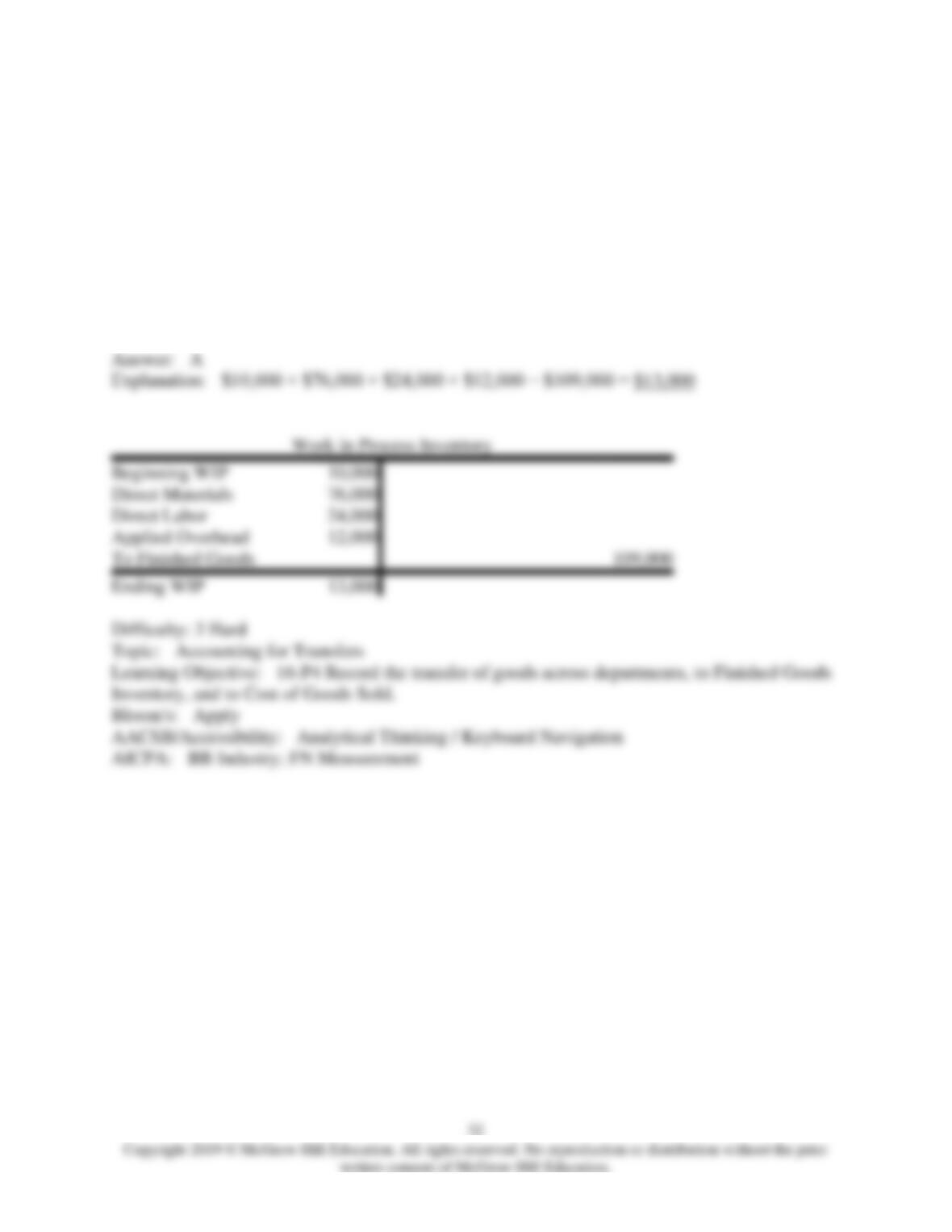
93) The Fabricating Department started the current month with a beginning Work in Process
inventory of $10,000. During the month, it was assigned the following costs: direct materials,
$76,000; direct labor, $24,000; and factory overhead, 50% of direct labor cost. Also, inventory
with a cost of $109,000 was transferred out of the department to the next phase in the process.
The ending balance of the Work in Process Inventory account for the Fabricating Department is:
A) $13,000.
B) $56,000.
C) $59,000.
D) $110,000.
E) $165,000.
94) A company uses a process costing system. Its Assembly Department’s beginning inventory
consisted of 30,000 units, 75% complete with respect to direct labor and overhead. The
department completed and transferred out 127,500 units this period. The ending inventory
consists of 20,000 units that are 25% complete with respect to direct labor and overhead. All
direct materials are added at the beginning of the process. The department incurred direct labor
costs of $24,000 and overhead costs of $32,000 for the period. Assuming the weighted average
method, the direct labor cost per equivalent unit (rounded to the nearest cent) is:
A) $0.14.
B) $0.16.
C) $0.18.
D) $0.30.
E) $0.37.
95) A company’s beginning Work in Process inventory consisted of 20,000 units that were 20%
complete with respect to direct labor. These beginning units were completed and another 90,000
units were started during the current period. Of those started, 60,000 were finished and the
remaining 30,000 were 40% complete at the end of the period. Using the weighted-average
method, the equivalent units of production with regard to direct labor were:
A) 88,000.
B) 74,000.
C) 76,000.
D) 92,000.
E) 96,000.
96) A company’s beginning Work in Process inventory consisted of 20,000 units that were 80%
complete with respect to direct labor. A total of 90,000 were finished during the period and
25,000 remaining in Work in Process inventory were 40% complete with respect to direct labor
at the end of the period. Using the weighted-average method, the equivalent units of production
with regard to direct labor were:
A) 46,000.
B) 100,000.
C) 76,000.
D) 90,000.
E) 116,000.
97) The following refers to units processed by a breakfast cereal maker in August. Compute the
total equivalent units of production with respect to conversion for August using the weighted-
average inventory method.
Units of
Product
Percent of
Conversion Added
Beginning Work in Process
230,000
60
%
Units started
570,000
100
%
Units completed
620,000
100
%
Ending Work in Process
180,000
70
%
A) 758,000
B) 800,000
C) 620,000
D) 746,000
E) 884,000
EUP completed & transferred out
EUP in End WIP (180,000 × 70%)
EUP
98) At the beginning of the recent period, there were 900 units of product in a department, 35%
completed. These units were finished and an additional 5,000 units were started and completed
during the period. 800 units were still in process at the end of the period, 25% completed. Using
the weighted average method, the equivalent units produced by the department were:
A) 5,000 units.
B) 5,900 units.
C) 6,100 units.
D) 5,500 units.
E) 6,700 units.
99) A company uses the weighted average method for inventory costing. During a period,
Department B finished and transferred 50,000 units to Department C. Also in Department B
during the period, 10,000 units were started but brought only to a stage of being 60% completed.
The number of equivalent units produced by Department B during the period was:
A) 44,000 units.
B) 50,000 units.
C) 54,000 units.
D) 56,000 units.
E) 60,000 units.
100) Metaline Corp. uses the weighted average method for inventory costs and had the following
information available for the year. The number of units transferred to finished goods during the
year is:
Beginning Work in Process (40% complete, $1,100)
200
units
Ending inventory of Work in Process (80% complete)
400
units
Total units started during the year
3,200
units
A) 3,200 units.
B) 3,000 units.
C) 3,400 units.
D) 3,160 units.
E) 3,500 units.
Ending WIP
)
Transferred
3,000
101) Metaline Corp. uses the weighted average method for inventory costs and had the following
information available for the year. Calculate the equivalent units of production for the year:
Beginning Work in Process (40% complete, $1,100)
200
units
Ending inventory of Work in Process (80% complete)
400
units
Total units started during the year
3,200
units
A) 3,200 units.
B) 3,320 units.
C) 3,240 units.
D) 3,520 units.
E) 3,800 units.
Beginning WIP
200
Started
3,200
EWIP
)
Transferred
3,000
Ending WIP (400 × 80%)
320
Total EUP
3,320