83. When recording the conversion of preferred stock into common stock, if the total contributed capital
eliminated in regard to the preferred stock is less than the common stock par value, the difference is debited to
84. The preference to dividends that preferred stockholders have is
85. According to APB Opinion No. 14, when convertible preferred stock is issued, the conversion provision is
86. When callable preferred stock is recalled, if the recall price exceeds the total of the par value in the preferred
stock account and the additional paid-in capital associated with the recalled preferred stock, the difference is
87. In regard to cumulative preferred stock
88. McKay Co. has three separate issues of preferred stock outstanding. One issue is callable. One issue is
convertible. One issue is cumulative. When declaring dividends, which issue of preferred stock is taken into
consideration?
89. Wang Corporation issued 8,000 shares of $50 par preferred stock at $74 a share. A stock warrant attached to
each preferred share allows the holder to buy one share of $10 par common stock for $20. Right after issuance,
the preferred stock sells ex-rights for $63 per share. The warrants began selling at $7 per warrant. The amount
credited to Common Stock Warrants at issuance of the preferred stock is
90. Which of the following items could appropriately be shown in the contributed capital section of
stockholders’ equity on the balance sheet?
91. All of the following would appear in the contributed capital section of stockholders’ equity on the balance
sheet except
92. The following information is provided for Murphy Corporation:
Common stock, $10 par
$340,000
Bonds payable
28,000
Additional paid-in capital from conversion of preferred
stock into common
3,000
Retained earnings
100,000
Additional paid-in capital on preferred stock
10,000
Common stock subscribed
30,000
Unrealized capital
5,600
Premium on bonds payable
2,000
Preferred stock, 6%, $100 par
80,000
What is the amount of contributed capital for Murphy Corporation?
93. The following information is provided for Spring Company:
Retained earnings
$ 35,000
Preferred stock, 5%, $50 par
100,000
Organization expense
2,500
Premium on common stock
?
Additional paid-in capital from recall of preferred stock
1,000
Premium on bonds payable
3,000
Common stock, $10 par
300,000
If total contributed capital is $406,000, what is the amount of premium on common stock for Spring Company?
94. Which of the following is not a reason for a corporation to acquire treasury stock?
95. Which one of the following statements concerning treasury stock is true?
96. If a company does not maintain its treasury stock records on a specific identification basis, which of the
following approaches may be used to record a reduction in the treasury stock account when the stock is
reissued?
97. When a company reacquires its own stock, the entry to record the reacquisition could include an entry to
Additional Paid-in Capital from Treasury Stock under which of the following methods?
Cost Method
Par Value Method
I.
Yes
Yes
II.
Yes
No
III.
No
No
IV.
No
Yes
98. Under the cost method of accounting for treasury stock transactions, when the proceeds from a sale are
greater than the cost, the excess over cost is treated as a(n)
99. When a company acquires treasury stock, what effect does this transaction have on earnings per share and
legal capital, respectively?
100. Under the par value method of accounting for treasury stock, the treasury stock is reported on the balance
sheet as a deduction from
101. When a company pays more than the fair market value to acquire treasury stock in order to prevent a
takeover attempt, the “greenmail” from the transaction is recorded as a(n)
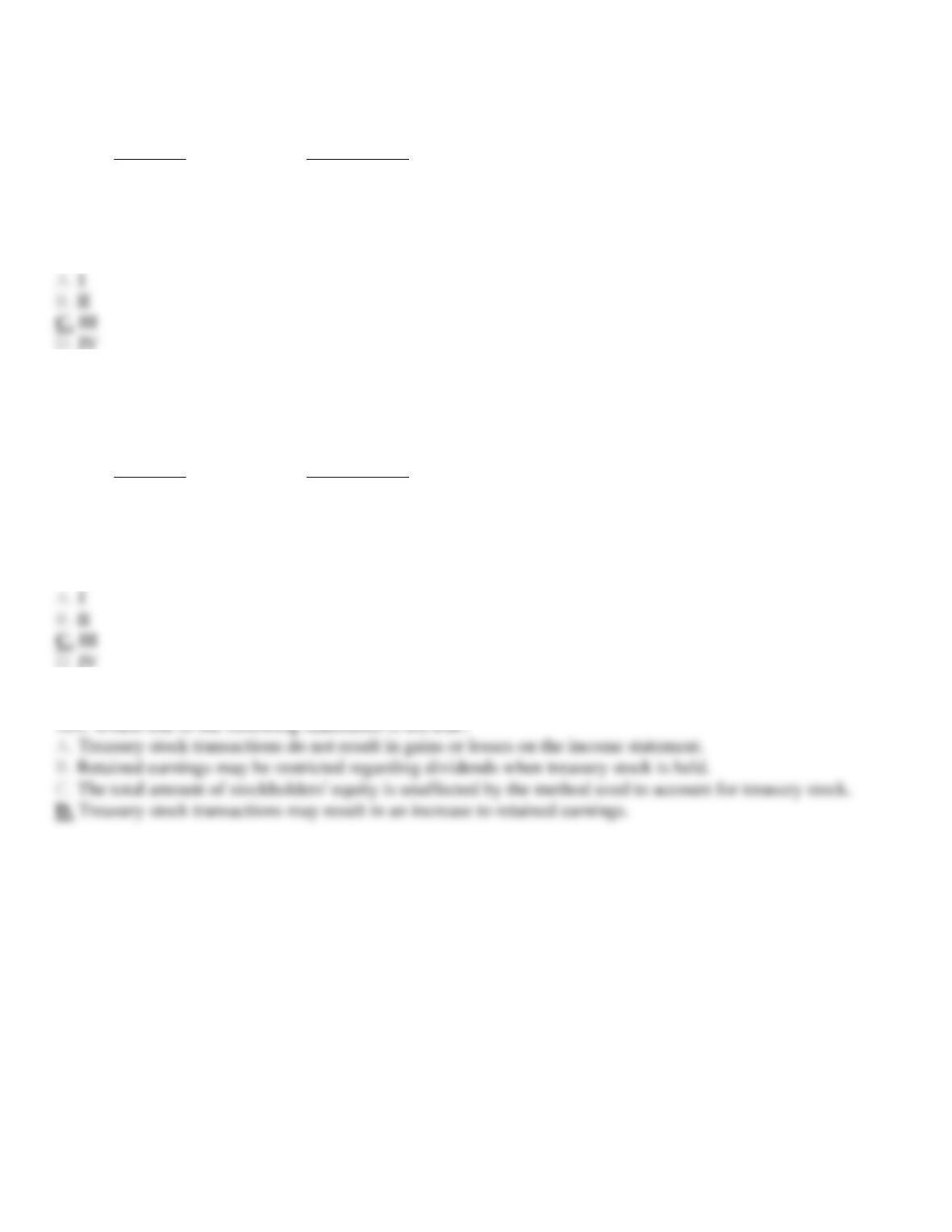
102. When donated treasury stock is reissued for cash, the entire proceeds are credited to Donated Capital under
which of the following methods?
Cost Method
Par Value Method
I.
Yes
Yes
II.
Yes
No
III.
No
No
IV.
No
Yes
103. When retiring treasury stock, retained earnings could be affected under which of the following methods?
Cost Method
Par Value Method
I.
No
No
II.
No
Yes
III.
Yes
No
IV.
Yes
Yes
105. Exhibit 16-9
Battleground, Inc. had never had a treasury stock transaction prior to 2010. It experienced the following
treasury stock transactions during 2010:
4/1/2010:
Reacquired 1,000 shares of its own $5 par common stock, originally sold at $12 a share, for $10 a share. This was the first
time that Battleground had reacquired its own stock.
4/8/2010:
Reissued 400 shares at $8 a share.
5/2/2010:
Reissued 500 shares at $13 a share.
5/10/2010:
Retired the remaining 100 shares.
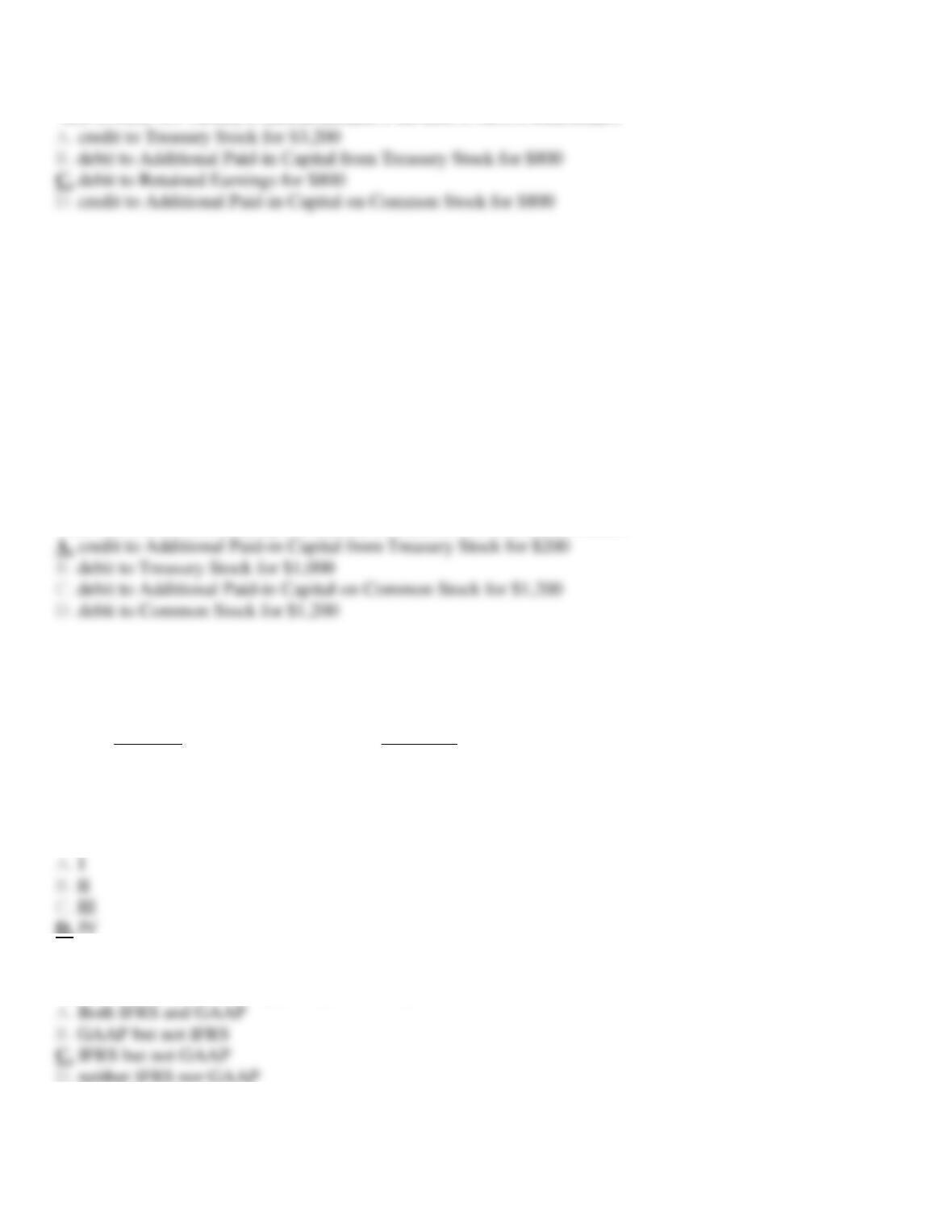
Assume the cost method is used.
Refer to Exhibit 16-9. The entry to record the reissuance of 400 shares on 4/8/2010 would include a
106. Exhibit 16-9
Battleground, Inc. had never had a treasury stock transaction prior to 2010. It experienced the following
treasury stock transactions during 2010:
4/1/2010:
Reacquired 1,000 shares of its own $5 par common stock, originally sold at $12 a share, for $10 a share. This was the first
time that Battleground had reacquired its own stock.
4/8/2010:
Reissued 400 shares at $8 a share.
5/2/2010:
Reissued 500 shares at $13 a share.
5/10/2010:
Retired the remaining 100 shares.
Assume the cost method is used.
Refer to Exhibit 16-9. The entry to record the retirement of 100 shares on 5/10/2010 would include a
107. The accounting method required for share-based compensation arrangements is
Under IFRS
Under GAAP
I.
intrinsic method
intrinsic method
II.
intrinsic method
fair value method
III.
fair value method
intrinsic method
IV.
fair value method
fair value method
108. Which set of accounting principles directly uses the term “reserve”?

109. Under IFRS, owners’ equity is subdivided into which of the following classifications in addition to capital
stock and additional paid-in capital?
110. Listed below are various classifications of corporations. Following the list is a series of descriptive
statements.
a.
public corporations
e.
stock companies
b.
open corporations
f.
foreign corporations
c.
domestic corporations
g.
closed corporations
d.
nonstock companies
____
1.
Companies that do not issue stock or operate for profit.
____
2.
As viewed by a state, companies operating within that state that are incorporated in another state.
____
3.
Companies that do not allow the sale of their stock to the general public.
____
4.
Companies owned or operated by governmental units.
____
5.
Companies that issue stock and operate for profit.
____
6.
As viewed by that state, companies that are incorporated in the state.
____
7.
Companies whose stock is available for purchase by the public.
Required:
Match the corporate classifications to the descriptive statements that best describe them.
1.
d
5.
e
2.
f
6.
c
3.
g
7.
b
4.
a
111. Lefty, Inc., entered into a stock subscription contract that called for the purchase by investors of 10,000
shares of $5 par common stock at a price of $30 per share. The contract required a down payment of $12 per
share, with the remaining $18 per share collectible at the end of three months.
Required:
a.
Prepare the journal entry to record the stock subscription and down payment.
b.
The subscribers paid the remainder at the end of three months. Prepare the journal entry(ies) to record the final payment and the
issuance of the shares of stock.
112. On January 1, Martha Corp. entered into a subscription contract for 100 shares of its $20 par common
stock at a price of $50 per share. The contract required on a per share basis an immediate down payment of $10
and two $20 payments on February 1 and March 1 from subscribers. All the down payments were received on
January 1 and all the installments due on February 1 were received on February 1. On March 1, the rest of the
payments were received except from one subscriber of ten shares, who defaulted. These shares were later sold
for $40 per share. An amount necessary to bring the proceeds up to the total subscription price was retained and
the balance of the payments received from the defaulted subscriber was returned.
Required:
a.
List the two stockholders’ equity credits in the January 1 journal entry.
Account
Amount
_________________________________________
___________________
_________________________________________
___________________
b.
Prepare the journal entries for the receipt of cash and the issuance of stock on March 1.
c.
Prepare the journal entry completing the transaction with the defaulted subscriber, after
the defaulted shares were sold.
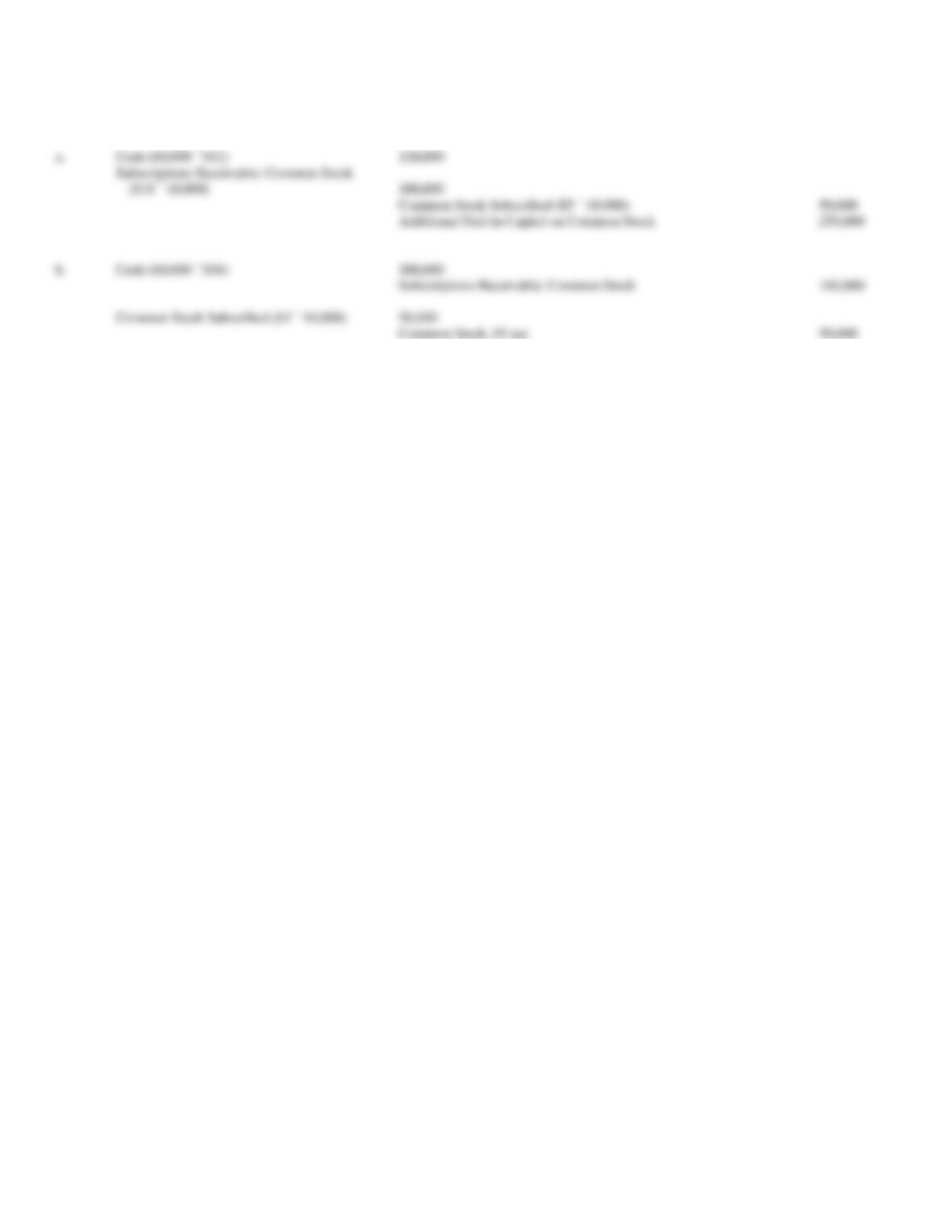
a.
Cash (10,000 ´ $12)
120,000
Subscriptions Receivable: Common Stock
($18 ´ 10,000)
180,000
Common Stock Subscribed ($5 ´ 10,000)
Additional Paid-in Capital on Common Stock
b.
Cash (10,000 ´ $18)
180,000
Subscriptions Receivable: Common Stock
Common Stock Subscribed ($5 ´ 10,000)
50,000
Common Stock, $5 par
113. Magic Minnows issued 400 shares of $50 par preferred stock and 800 shares of $1 par common stock in a
“package” sale for $150,000. The preferred stock market value was $88 per share, and the common stock
market value was $156 per share.
Required:
Fill in the lines below to indicate the accounts and amounts credited in the entry to record the issuance of the
stock.
Account
Amount
______________________________________________
_____________________
______________________________________________
_____________________
______________________________________________
_____________________
______________________________________________
_____________________
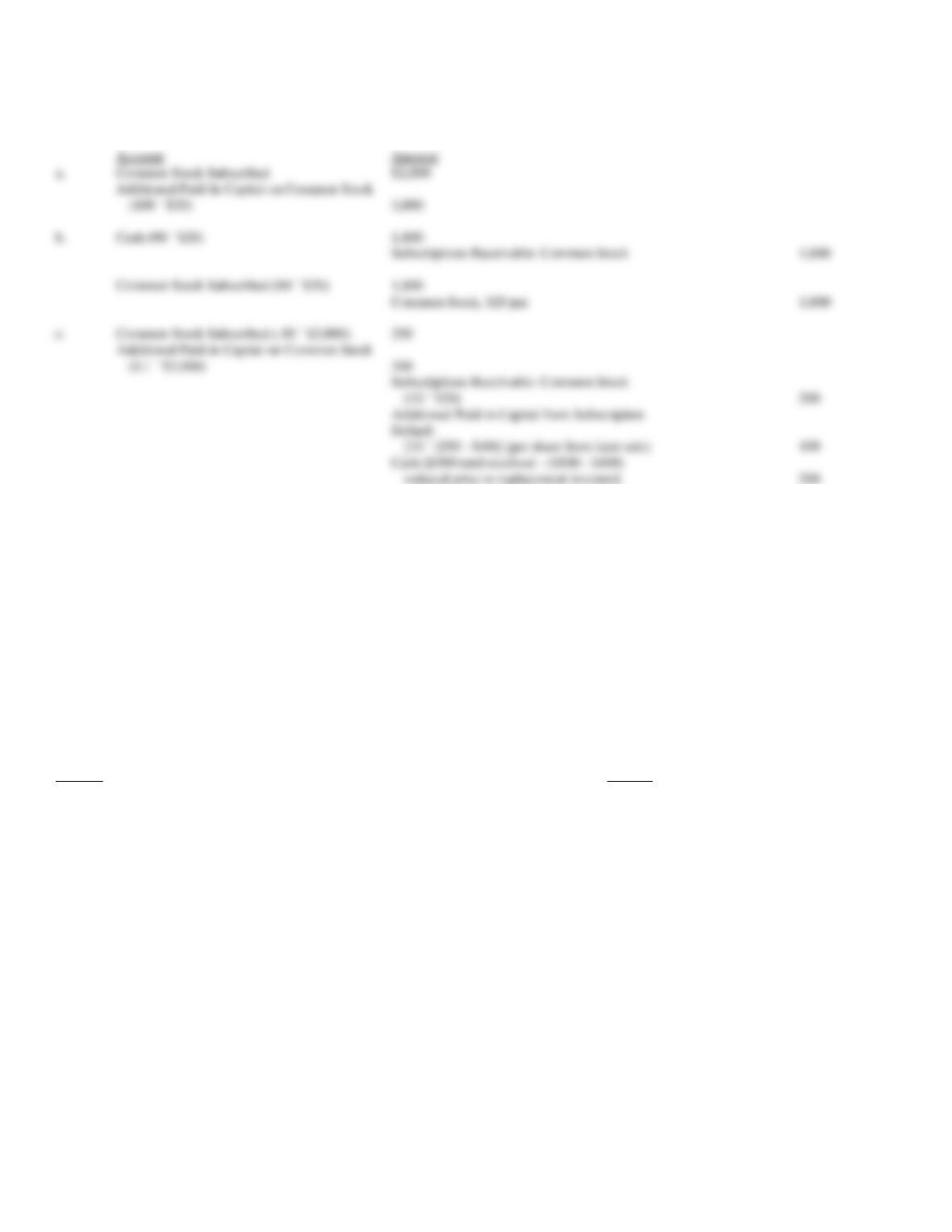
Account
Amount
Common Stock Subscribed
$2,000
Additional Paid-In Capital on Common Stock
(100 ´ $30)
3,000
Cash (90 ´ $20)
1,800
Subscriptions Receivable: Common Stock
1,800
Common Stock Subscribed (90 ´ $20)
1,800
Common Stock, $20 par
1,800
Common Stock Subscribed (.10 ´ $2,000)
Additional Paid-in Capital on Common Stock
(0.1 ´ $3,000)
Subscriptions Receivable: Common Stock
(10 ´ $20)
[10 ´ ($50 – $40)] (per share from later sale)
Cash [$300 total received – ($500 – $400)
reduced price to replacement investor]
114. Consider each situation for Kartchner, Inc. below independently.
·
Kartchner, Inc. issued 10,000 shares of its $25 par common stock (current fair value of common is $39 per share) for a large tract of
land. The land was appraised at $400,000. Kartchner already had 500,000 shares of common stock outstanding.
·
Kartchner, Inc. issued 2,000 shares of $10 par Class A common stock at $12 and 100 shares of no-par Class B common stock at $20.
Required:
a.
At what amount should land be recorded?
b.
What is the total amount that should be recorded for additional paid-in capital from the second situation?
a.
$390,000 (10,000 ´ $39)
$4,000 (2,000 ´ $2)
115. Drapery Unlimited had outstanding 400 shares of $100 par common stock that had been issued at $120. On
March 18, 2010, a four-for-one split was declared and new $20 par stock was issued.
Required:
Provide the required journal entry, if any, to record the stock split.
Additional Paid-in Capital from Stock Split
8,000
Account
Amount
Common Stock, $1 par (800 shares)
$ 800
Additional Paid-in Capital on Common Stock
116,200
Preferred Stock, $50 par (400 shares)
20,000
Additional Paid-in Capital on Preferred Stock
13,000
Common: 800 ´ $156 =
$124,800
Preferred: 400 ´ $88 =
35,200
$160,000
116. Shahim Sports Co. entered into a subscription contract with various investors. The terms were as follows:
·
2,000 shares of $5 par common at $24.
·
$10 down payment per share; two subsequent payments of $7 each.
Required:
a.
Record the subscription and the receipt of the down payment.
b.
The first subsequent $7 payment was received from all subscribers.
c.
When the final $7 payment was due, 90% of the final total amount due was received and stock was issued. Record this receipt and stock
issuance.
d.
The remaining 10% of the final payment was not received. According to contract provisions, half of any previous payments should be
returned to the subscriber with the remaining half forfeited by the subscriber. Record the entry related to the default.
117. Tommy, Inc. issued 4,000 shares of $100 par preferred stock at $155 a share. Each share of stock has a
warrant attached to it that allows the holder to purchase one share of $20 par value common stock at $50.
Shortly after the preferred stock was issued, the stock sold for $150 ex-rights and the warrants sold for $10
each.
Required:
a.
Prepare the journal entry to record the issuance of the preferred stock.
b.
Prepare the journal entry to record the exercise of 3,200 of the warrants.
c.
Prepare the journal entry to record the expiration of the remaining 800 warrants.
Cash ($10 ´ 2,000)
20,000
Subscriptions Receivable: Common Stock
28,000
Common Stock Subscribed
10,000
Additional Paid-in Capital on Common Stock
38,000
b.
Cash ($7 ´ 2,000)
14,000
Subscriptions Receivable: Common Stock
14,000
Cash ($7 ´ 2,000 ´ 0.90)
12,600
Subscriptions Receivable: Common Stock
12,600
Common Stock Subscribed (0.90 ´ $10,000)
9,000
Common Stock, $10 par
9,000
d.
Common Stock Subscribed (0.10 ´ $10,000)
1,000
Additional Paid-in Capital on Common Stock
(0.10 ´ $38,000)
3,800
Subscriptions Receivable:
Common Stock (0.10 ´ 2,000 ´ $7)
1,400
Cash (200)($10 + $7)(1/2)
1,700
Additional Paid-in Capital from Subscription
Default
1,700
118. On January 3, 2010, Martin Corporation issued 4,000 shares of $50 par convertible preferred stock at $90
per share. Each share is convertible into four shares of $10 par common stock.
Required:
a.
Prepare the journal entry to record the issuance of the stock on January 3, 2010.
b.
On March 5, 2012, each share of preferred was converted. Prepare the journal entry to record this conversion.
c.
Assume that instead of the above circumstances regarding conversion, the company agrees to convert each share of preferred into ten
shares of $10 par common stock on March 5, 2012. Prepare the journal entry to record this conversion.
Cash (4,000 ´ $155)
620,000
Additional Paid-in Capital
on Preferred Stock*
181,250
Cash (3,200 ´ $50)
160,000
Common Stock Warrants*
31,000
Common Stock (3,200 ´
64,000
*
3,200/4,000 ´ $38,750
Common Stock Warrants
7,750
Additional Paid-in Capital
7,750
119. Chicago Bagel had outstanding 12,000 shares of $50 par callable preferred stock. The corporation called
40% of the shares (originally issued at $75 per share) at a call price of $80 per share.
Required:
Record the journal entry for the call of this preferred stock.
Preferred Stock, $50 par (12,000 ´ 40% ´ $50)
240,000
Additional Paid-in Capital on Preferred Stock (4,800 ´ $25)
120,000
Retained Earnings
24,000
Cash (4,800 ´ $80)
384,000
120. Several years ago, Walker, Inc. issued 12,000 shares of $40 par preferred stock at $60. Each share of
preferred was convertible into three shares of $10 par common stock. On January 10, 2010, one-half of the
preferred stock was converted.
Required:
Indicate the credits that should be made in the entry to record this conversion.
Account
Amount
______________________________________________
_____________________
______________________________________________
_____________________
Cash (4,000 ´ $90)
360,000
Preferred Stock, $100 par (4,000 ´ $50)
200,000
Additional Paid-in Capital on Preferred Stock
160,000
Preferred Stock, $50 par
200,000
Common Stock, $10 par (4,000 ´ 4 ´ $10)
160,000
Additional Paid-in Capital from Preferred
Stock Conversion
200,000
Preferred Stock, $50 par
200,000
Retained Earnings
40,000
Common Stock, $10 par (4,000 ´ 10 ´ $10)
400,000
121. On January 1, 2010, Rogers Company created a fixed compensatory stock option plan for employees to
acquire 18,000 shares of $3 par common stock for $22 a share. The options vest after four years of employment,
and therefore, they cannot be exercised until January 1, 2014. On the grant date, the fair value of the options
was $5 per option. All options were exercised on June 30, 2014. Rogers Company accounts for this plan using
the fair value method.
Required:
Record all entries relating to this stock option plan over the life of the plan.
Compensation Expense ($90,000/4)
22,500
Common Stock Option Warrants
22,500
Cash ($22 ´ 18,000)
396,000
Common Stock Option Warrants
90,000
Common Stock ($3 ´ 18,000)
54,000
Additional Paid-in Capital on Common Stock
432,000
122. On January 1, 2010, sixty executives are offered a fixed compensatory stock option plan in which each of
them will receive options to buy 5,000 shares of $10 par common stock at $30 a share. On the grant date, the
fair value per option is $7.50. There is a three-year service period and an estimated annual employee turnover
rate of 3%.
Required:
a.
Compute the expected total compensation cost.
b.
Compute the compensation expense for 2011.
c.
Prepare the journal entry to record the exercise of options by six of the executives on January 1, 2013.
Account
Amount
Common Stock (6,000 ´ 3 ´ $10)
$180,000
Additional Paid-in Capital from Preferred Stock Conversion
[(1/2 ´ $720,000) – $180,000]