
Name:
Class:
Date:
chapter 16
Indicate whether the statement is true or false.
1. Current position analysis is used by short-term creditors to assess how quickly they will be repaid.
a.
True
b.
False
2. When computing the return on common stockholders’ equity, preferred stock dividends are subtracted from net income.
a.
True
b.
False
3. In horizontal analysis, the current year is the base year.
a.
True
b.
False
4. The auditor’s report is where the auditor certifies that the financial statements are correct and accurate.
a.
True
b.
False
5. Comparing dividends per share to earnings per share indicates the extent to which the corporation is retaining its
earnings for use in operations.
a.
True
b.
False
6. Using vertical analysis of the income statement, a company’s net income as a percentage of sales is 15%; therefore, the
cost of goods sold as a percentage of sales must be 85%.
a.
True
b.
False
7. Ratios and various other analytical measures are not a substitute for sound judgment, nor do they provide definitive
guides for action.
a.
True
b.
False
8. In the vertical analysis of a balance sheet, the base for current liabilities is total liabilities.
a.
True
b.
False
9. A decrease in the ratio of liabilities to stockholders’ equity indicates an improvement in the margin of safety for
creditors.
a.
True
b.
False
10. The report on internal control required by the Sarbanes-Oxley Act of 2002 may be prepared by either management or
the company’s auditors.
a.
True
b.
False

Name:
Class:
Date:
chapter 16
11. If a company has issued only one class of stock, the earnings per share are determined by dividing net income plus
interest expense by the number of shares outstanding.
a.
True
b.
False
12. The analysis of increases and decreases in the amount and percentage of comparative financial statement items is
referred to as horizontal analysis.
a.
True
b.
False
13. If Epsilon Company’s price-earnings ratio on common stock is greater than Iota Company’s, then Iota Company would
be expected to have the best potential for future common stock price appreciation.
a.
True
b.
False
14. The ratio of the market price per share of common stock on a specific date to the annual earnings per share is referred
to as the price-earnings ratio.
a.
True
b.
False
15. An increase in the accounts receivable turnover may be due to a change in how credit is granted and/or in collection
practices.
a.
True
b.
False
16. In the vertical analysis of an income statement, each item is generally stated as a percentage of total assets.
a.
True
b.
False
17. Earnings per share amounts are only required to be presented for income from continuing operations and net income
on the face of the statement.
a.
True
b.
False
18. In computing the return on total assets, interest expense is subtracted from net income before dividing by average total
assets.
a.
True
b.
False
19. If two companies have the same current ratio, their ability to pay short-term debt is the same.
a.
True
b.
False
20. The number of days’ sales in inventory is one means of expressing the relationship between the cost of goods sold and
inventory.
a.
True
b.
False

Name:
Class:
Date:
chapter 16
b.
False
21. A balance sheet shows cash, $75,000; marketable securities, $115,000; receivables, $150,000; and inventories,
$222,500. Current liabilities are $225,000. The current ratio is 2.5.
a.
True
b.
False
22. Unusual items affecting the current period’s income statement consist of changes in accounting principles and
discontinued operations.
a.
True
b.
False
23. The ratio of the sum of cash, receivables, and marketable securities to current liabilities is referred to as the current
ratio.
a.
True
b.
False
24. When the return on total assets is greater than the return on common stockholders’ equity, the management of the
company has effectively used leverage.
a.
True
b.
False
25. A clean audit opinion is not the same as an unmodified opinion.
a.
True
b.
False
26. Using measures to assess a business’s ability to pay its current liabilities is called current position analysis.
a.
True
b.
False
27. When a corporation discontinues a segment of its operations at a loss, the loss should be reported as a separate item
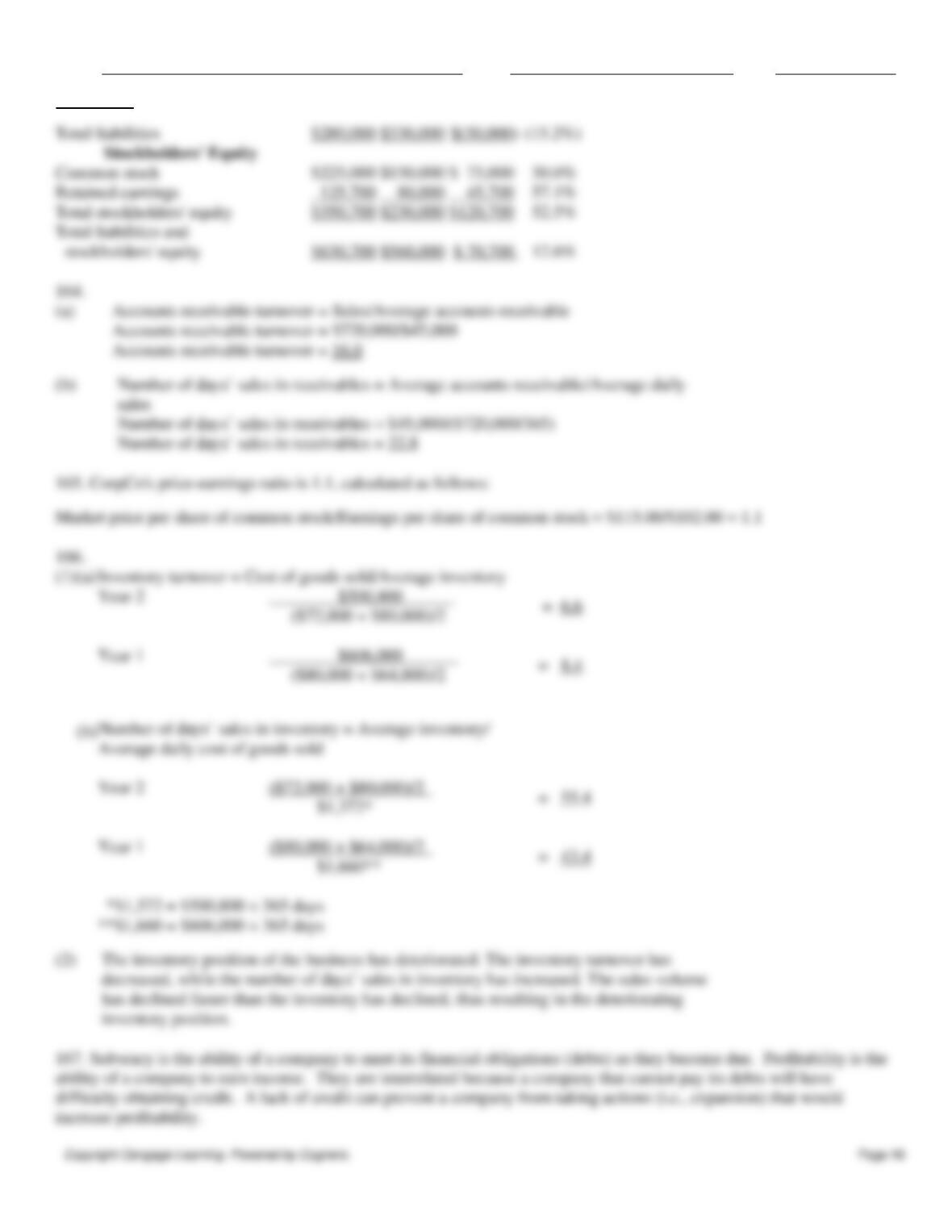
after income from continuing operations on the income statement.
a.
True
b.
False
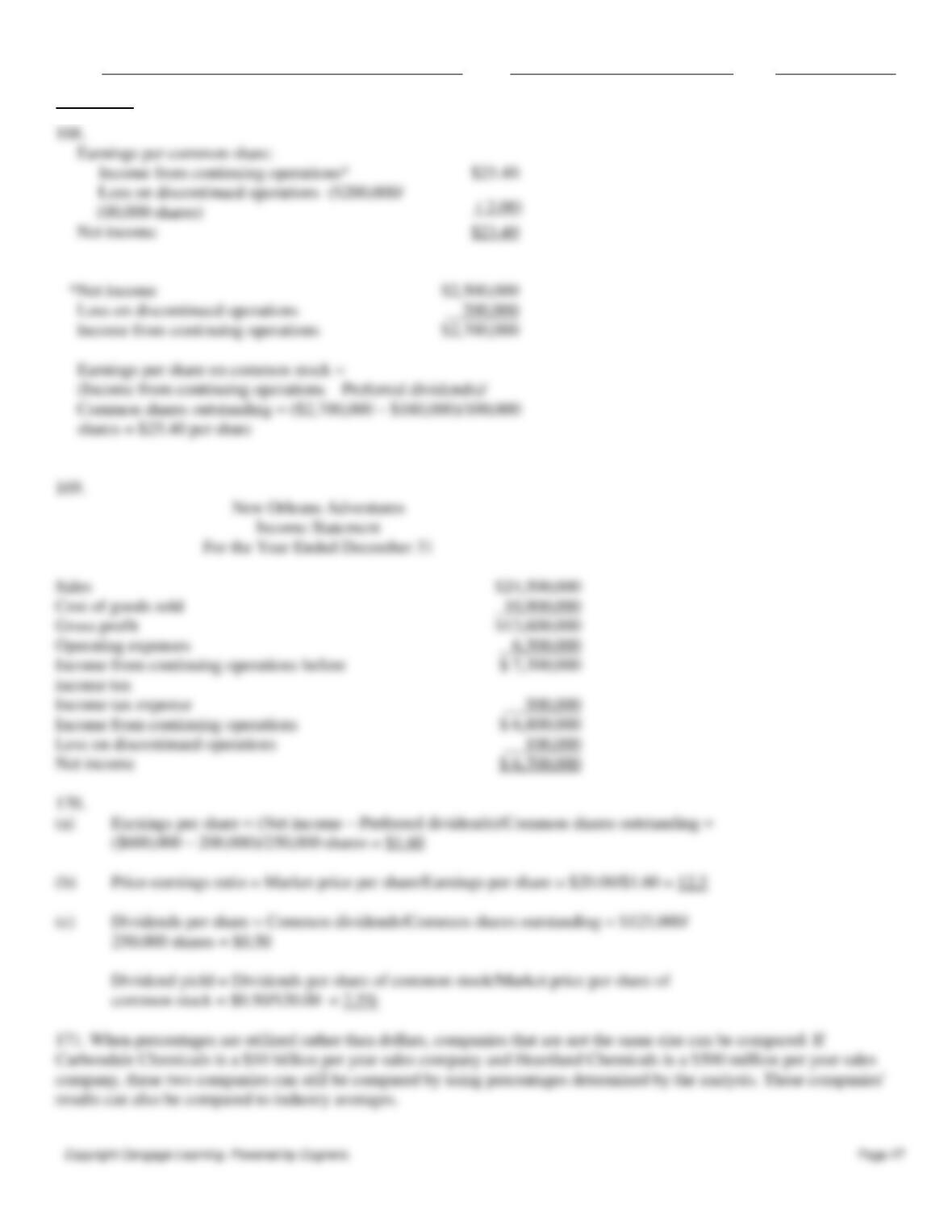
28. The effects of differences in accounting methods are of little importance when analyzing comparable data from
competing businesses.
a.
True
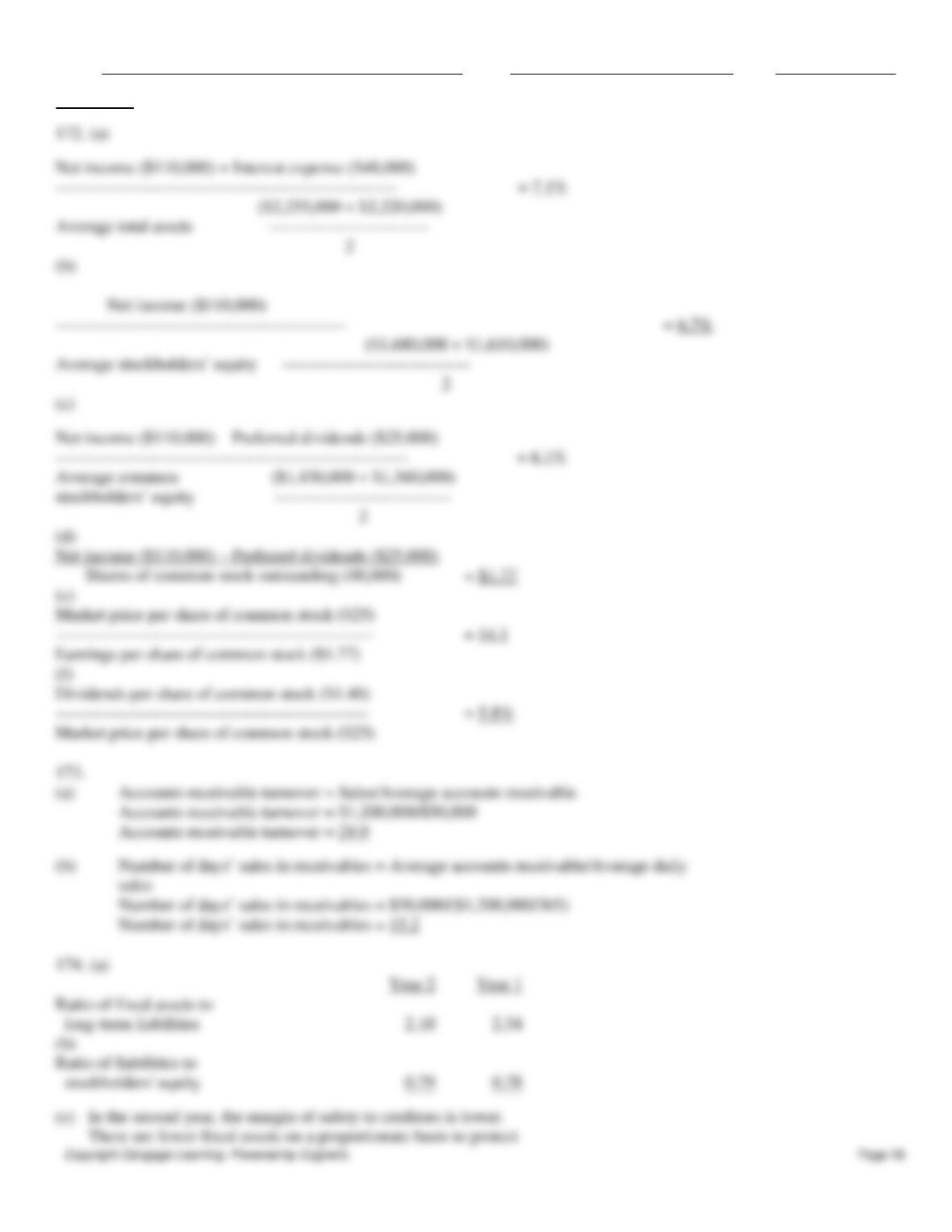
b.
False
29. The number of days’ sales in receivables is one means of expressing the relationship between average daily sales and
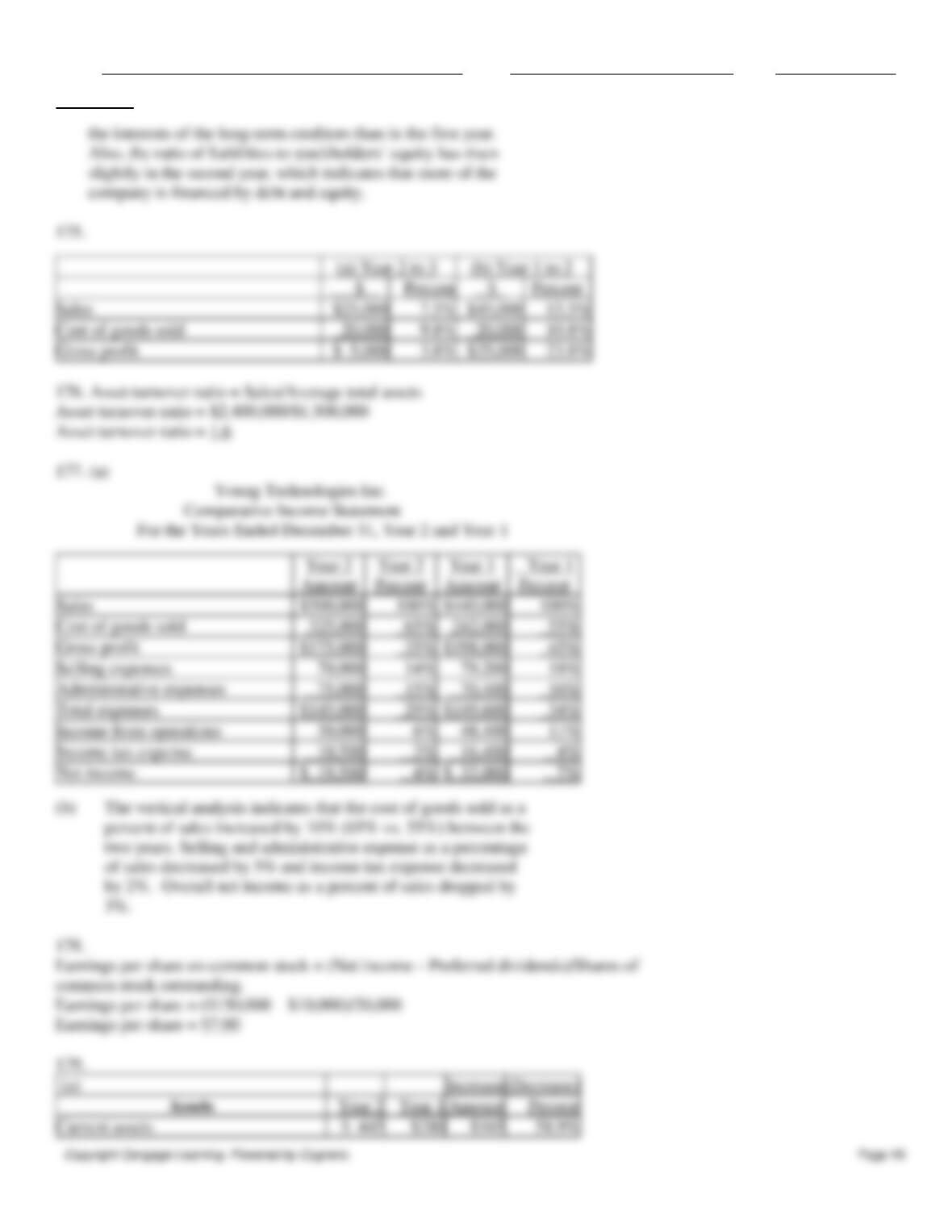
accounts receivable.
a.
True
b.
False
30. The relationship of each asset item as a percent of total assets is an example of vertical analysis.
a.
True

Name:
Class:
Date:
chapter 16
31. An advantage of the current ratio is that it considers the makeup of the current assets.
a.
True
b.
False
32. The excess of current assets over current liabilities is referred to as working capital.
a.
True
b.
False
33. In computing the asset turnover ratio, long-term investments are excluded from average total assets.
a.
True
b.
False
34. Vertical analysis refers to comparing the financial statements of a single company over several years.
a.
True
b.
False
35. If the accounts receivable turnover for the current year has decreased when compared with the ratio for the preceding
year, there has been an acceleration in the collection of receivables.
a.
True
b.
False
36. In a common-sized income statement, each item is expressed as a percentage of net income.
a.
True
b.
False
37. The denominator of the return on total assets ratio is the average total assets.
a.
True
b.
False
38. Comparative financial statements are designed to compare the financial statements of two or more corporations.
a.
True
b.
False
39. On a common-sized income statement, all items are stated as a percent of total assets or equities at year-end.
a.
True
b.
False
40. The return on total assets measures the profitability of total assets, without considering how the assets are financed.
a.
True
b.
False
41. If a firm has a quick ratio of 1, the subsequent payment of an account payable will cause the ratio to increase.
a.
True
b.
False

Name:
Class:
Date:
chapter 16
42. A financial statement showing each item on the statement as a percentage of one key item on the statement is called a
common-sized financial statement.
a.
True
b.
False
43. The dividend yield is equal to the dividends per share divided by the par value per share of common stock.
a.
True
b.
False
44. When you are interpreting financial ratios, it is useful to compare a company’s ratios to the same ratios from a prior
period or to the ratios of another company in the same industry.
a.
True
b.
False
45. A company can compare its financial data to the data of other companies and industry averages to evaluate its
position.
a.
True
b.
False
46. Unusual items affecting the prior period’s income statement consist of changes in or errors in applying accounting
principles.
a.
True
b.
False
47. A 15% change in sales will result in a 15% change in net income.
a.
True
b.
False
48. The ratio of fixed assets to long-term liabilities provides a measure of a firm’s ability to pay dividends.
a.
True
b.
False
49. In a company’s annual report, the section called Management Discussion and Analysis provides critical information
for interpreting the financial statements and assessing the future of the company.
a.
True
b.
False
50. Factors that reflect the ability of a business to pay its debts and earn a reasonable amount of income are referred to as
solvency, profitability, and liquidity.
a.
True
b.
False
51. If a firm has a current ratio of 2, the subsequent collection of a 60-day note receivable on account will cause the ratio
to decrease.
a.
True
b.
False

Name:
Class:
Date:
chapter 16
52. Solvency analysis focuses on the ability of a business to pay its current and noncurrent liabilities.
a.
True
b.
False
53. Assuming that the quantities of inventory on hand during the current year were sufficient to meet all demands for
sales, a decrease in the inventory turnover for the current year when compared with the turnover for the preceding year
indicates an improvement in inventory management.
a.
True
b.
False
54. Reporting unusual items separately on the income statement allows investors to isolate the effects of these items on
income and cash flows.
a.
True
b.
False
55. Analyzing a company’s performance should take into account conditions peculiar to the industry and the general
economic conditions.
a.
True
b.
False
56. A firm selling food should have higher inventory turnover rate than a firm selling office furniture.
a.
True
b.
False
57. Dollar amounts of working capital are difficult to assess when comparing companies of different sizes or in comparing
such amounts with industry figures.
a.
True
b.
False
58. An unusual item is often related to current operations and occurs infrequently.
a.
True
b.
False
Indicate the answer choice that best completes the statement or answers the question.
59. Income statement information for Sadie Company is below:
Sales
$175,000
Cost of goods sold
115,000
Gross profit
$ 60,000
Using vertical analysis of the income statement for Sadie Company, determine the gross profit margin.
a.
100%
b.
66%
c.
34%
d.
29%

Name:
Class:
Date:
chapter 16
60. The independent auditor’s report
a.
describes which financial statements are covered by the audit
b.
gives the auditor’s opinion regarding the fairness of the financial statements
c.
summarizes what the auditor did
d.
states that the financial statements were presented on time
61. The purpose of an audit is to
a.
determine whether or not a company is a good investment
b.
render an opinion on the fairness of the statements
c.
determine whether or not a company complies with corporate social responsibility
d.
determine whether or not a company is a good credit risk
62. The relationship of $325,000 to $125,000, expressed as a ratio, is
a.
2.0
b.
2.6
c.
2.5
d.
0.45
63. A balance sheet that displays only component percentages is a
a.
trend balance sheet
b.
comparative balance sheet
c.
condensed balance sheet
d.
common-sized balance sheet
64. A loss on disposal of a segment would be reported in the income statement as a(n)
a.
administrative expense
b.
other expense
c.
deduction from income from continuing operations
d.
selling expense
65. The following information is available for Jase Company:
Market price per share of common stock
$25.00
Earnings per share on common stock
$1.25
Which of the following statements is correct?
a.
The price-earnings ratio is 20 and a share of common stock was selling for 20 times the amount of earnings
per share at the end of the year.
b.
The price-earnings ratio is 5% and a share of common stock was selling for 5% more than the amount of
earnings per share at the end of the year.
c.
The price-earnings ratio is 10 and a share of common stock was selling for 125 times the amount of earnings
per share at the end of the year.
d.
The market price per share and the earnings per share are not statistically related to each other.
66. A company with $70,000 in current assets and $50,000 in current liabilities pays a $1,000 current liability. As a result
of this transaction, the current ratio and working capital will

Name:
Class:
Date:
chapter 16
a.
both decrease
b.
both increase
c.
increase and remain the same, respectively
d.
remain the same and decrease, respectively
67. Which of the following is not an unusual item?
a.
a segment of the business being sold
b.
corporate income tax being paid
c.
a change from one accounting method to another acceptable accounting method
d.
closure of all outlet stores
68. In horizontal analysis, each item is expressed as a percentage of the
a.
base year figure
b.
retained earnings figure
c.
total assets figure
d.
net income figure
69. Based on the following data for the current year, what is the number of days’ sales in inventory?
Sales on account during year
$1,204,500
Cost of goods sold during year
657,000
Accounts receivable, beginning of year
75,000
Accounts receivable, end of year
85,000
Inventory, beginning of year
85,600
Inventory, end of year
98,600
a.
51.2
b.
44.4
c.
6.5
d.
7.5
70. Based on the following data for the current year, what is the number of days’ sales in receivables?
Sales on account during year
$584,000
Cost of goods sold during year
300,000
Accounts receivable, beginning of year
45,000
Accounts receivable, end of year
35,000
Inventory, beginning of year
90,000
Inventory, end of year
110,000
a.
7.3
b.
2.5
c.
14.6
d.
25
71. A common measure of liquidity is
a.
the asset turnover ratio
b.
dividends per share of common stock
c.
the accounts receivable turnover

Name:
Class:
Date:
chapter 16
d.
the profit margin
The following information pertains to Diane Company. Assume that all balance sheet amounts represent both average and
ending balance figures and that all sales were on credit.
Assets
Cash and short-term investments
$ 30,000
Accounts receivable (net)
20,000
Inventory
15,000
Property, plant, and equipment
185,000
Total assets
$250,000
Liabilities and Stockholders’ Equity
Current liabilities
$ 45,000
Long-term liabilities
70,000
Common stock
80,000
Retained earnings
55,000
Total liabilities and stockholders’ equity
$250,000
Income Statement
Sales
$85,000
Cost of goods sold
45,000
Gross margin
$40,000
Operating expenses
(15,000)
Interest expense
(5,000)
Net income
$20,000
Number of shares of common stock outstanding
6,000
Market price of common stock
$20
Total dividends paid
$9,000
Cash provided by operations
$30,000
72. What is the return on common stockholders’ equity for Diane Company?
a.
6.75%
b.
14.8%
c.
7.4%
d.
13.5%
73. The following information is available for Meyer Company:
Dividends per share of common stock
$1.80
Market price per share of common stock
$30.00
Which of the following statements is correct?
a.
The dividend yield is 6.0%, which is of interest to investors seeking an increase in market price of their stocks.
b.
The dividend yield is 6.0%, which is of special interest to investors seeking to earn revenue on their
investments.
c.
The dividend yield is 16.7%, which is of interest to bondholders.
d.
The dividend yield is 16.7% which is an important measure of solvency.

Name:
Class:
Date:
chapter 16
Current liabilities
74. A loss due to a discontinued operation should be reported on the income statement
a.
above income from continuing operations
b.
without related tax effect
c.
below income from continuing operations
d.
as an operating expense
75. Which of the following is considered an unusual item affecting the prior period’s income statement?
a.
a change in accounting principles
b.
fixed asset impairments
c.
sale of company stores in Florida
d.
discontinued operations
76. The numerator of the return on common stockholders’ equity is
a.
net income
b.
net income minus preferred dividends
c.
income before income tax
d.
operating income minus interest expense
77. A company reports the following:
Net income
$160,000
Preferred dividends
$10,000
Shares of common stock outstanding
20,000
Market price per share of common stock
$35
The company’s earnings per share on common stock is
a.
$13.33
b.
$8.50
c.
$7.50
d.
$35.00
78. Times interest earned is computed as
a.
net income plus interest expense, divided by interest expense
b.
income before income tax plus interest expense, divided by interest expense
c.
net income divided by interest expense
d.
income before income tax divided by interest expense
The following information pertains to Diane Company. Assume that all balance sheet amounts represent both average and
ending balance figures and that all sales were on credit.
Assets
Cash and short-term investments
$ 30,000
Accounts receivable (net)
20,000
Inventory
15,000
Property, plant, and equipment
185,000
Total assets
$250,000
Liabilities and Stockholders’ Equity

Name:
Class:
Date:
chapter 16
Paid-in capital in excess of par—Common stock
Long-term liabilities
70,000
Common stock
80,000
Retained earnings
55,000
Total liabilities and stockholders’ equity
$250,000
Income Statement
Sales
$85,000
Cost of goods sold
45,000
Gross margin
$40,000
Operating expenses
(15,000)
Interest expense
(5,000)
Net income
$20,000
Number of shares of common stock outstanding
6,000
Market price of common stock
$20
Total dividends paid
$9,000
Cash provided by operations
$30,000
79. What is the return on total assets for Diane Company?
a.
10.0%
b.
8.0%
c.
0.10%
d.
1.0%
80. An acceleration in the collection of receivables will tend to cause the accounts receivable turnover to
a.
decrease
b.
remain the same
c.
either increase or decrease
d.
increase
81. Which of the following is not included in the computation of the quick ratio?
a.
inventory
b.
marketable securities
c.
accounts receivable
d.
cash
The balance sheets at the end of each of the first two years of operations indicate the following:
Kellman Company
Year 2
Year 1
Total current assets
$600,000
$560,000
Total investments
60,000
40,000
Total property, plant, and equipment
900,000
700,000
Total current liabilities
125,000
65,000
Total long-term liabilities
350,000
250,000
Preferred 9% stock, $100 par
100,000
100,000
Common stock, $10 par
600,000
600,000

Name:
Class:
Date:
chapter 16
Retained earnings
310,000
210,000
82. Using the balance sheets for Kellman Company, if net income is $150,000 and interest expense is $20,000 for Year 2,
what is the return on total assets for the year?
a.
10.4%
b.
11.9%
c.
10.5%
d.
8.4%
83. Balance sheet and income statement data indicate the following:
Bonds payable, 10% (due in two years)
$1,000,000
Preferred 5% stock, $100 par (no change during year)
300,000
Common stock, $50 par (no change during year)
2,000,000
Income before income tax for year
550,000
Income tax for year
80,000
Common dividends paid
50,000
Preferred dividends paid
15,000
Based on the data presented, what is the times interest earned ratio? (Round to one decimal point.)
a.
1.5
b.
6.4
c.
6.5
d.
5.5
84. Which of the following is required by the Sarbanes-Oxley Act?
a.
a price-earnings ratio
b.
a report on internal control
c.
a vertical analysis
d.
a common-sized statement
85. The tendency of the return on stockholders’ equity to vary disproportionately from the return on total assets is because
of
a.
leverage
b.
solvency
c.
yield
d.
quick assets
86. Assume the following sales data for a company:
Current year
$1,025,000
Preceding year
820,000
What is the percentage increase in sales from the preceding year to the current year?
a.
100%
b.
25%
c.
125%

Name:
Class:
Date:
chapter 16
d.
75%
87. Percentage analyses, ratios, turnovers, and other measures of financial position and operating results are
a.
a substitute for sound judgment
b.
useful analytical measures
c.
enough information for analysis; industry information is not needed
d.
unnecessary for analysis if industry information is available
88. Based on the following data, what is the accounts receivable turnover?
Sales on account during year
$700,000
Cost of goods sold during year
270,000
Accounts receivable, beginning of year
45,000
Accounts receivable, end of year
35,000
Inventory, beginning of year
90,000
Inventory, end of year
110,000
a.
17.5
b.
2.6
c.
20.0
d.
15.5
89. The ability of a business to pay its debts as they come due and to earn a reasonable net income is
a.
solvency and leverage
b.
solvency and profitability
c.
solvency and liquidity
d.
solvency and equity
Privett Company
Accounts payable
$ 30,000
Accounts receivable
35,000
Accrued liabilities
7,000
Cash
25,000
Intangible assets
40,000
Inventory
72,000
Long-term investments
100,000
Long-term liabilities
75,000
Marketable securities
36,000
Notes payable (short-term)
20,000
Property, plant, and equipment
400,000
Prepaid expenses
2,000
90. Based on the data for Privett Company, what is the amount of working capital?
a.
$213,000
b.
$113,000
c.
$153,000
d.
$39,000
Name:
Class:
Date:
chapter 16
The following information pertains to Diane Company. Assume that all balance sheet amounts represent both average and
The following information pertains to Diane Company. Assume that all balance sheet amounts represent both average and
ending balance figures and that all sales were on credit.
Assets
Cash and short-term investments
$ 30,000
Accounts receivable (net)
20,000
Inventory
15,000
Property, plant, and equipment
185,000
Total assets
$250,000
Liabilities and Stockholders’ Equity
Current liabilities
$ 45,000
Long-term liabilities
70,000
Common stock
80,000
Retained earnings
55,000
Total liabilities and stockholders’ equity
$250,000
Income Statement
Sales
$85,000
Cost of goods sold
45,000
Gross margin
$40,000
Operating expenses
(15,000)
Interest expense
(5,000)
Net income
$20,000
Number of shares of common stock outstanding
6,000
Market price of common stock
$20
Total dividends paid
$9,000
Cash provided by operations
$30,000
91. What is the dividend yield for Diane Company?
a.
7.5%
b.
0.75%
c.
13.3%
d.
1.3%
92. Which of the following items appear on the corporate income statement before income from continuing operations?
a.
cumulative effect of a change in accounting principle
b.
income tax expense
c.
presentation of earnings per share
d.
loss on discontinued operations
93. Accumulated other comprehensive income is presented in the financial statements
a.
either on the income statement or in a separate statement of comprehensive income.
b.
on the balance sheet as part of stockholders’ equity.
c.
on the income statement only.
d.
in a separate statement only.
Name:
Class:
Date:
chapter 16
ending balance figures and that all sales were on credit.
Assets
Cash and short-term investments
$ 30,000
Accounts receivable (net)
20,000
Inventory
15,000
Property, plant, and equipment
185,000
Total assets
$250,000
Liabilities and Stockholders’ Equity
Current liabilities
$ 45,000
Long-term liabilities
70,000
Common stock
80,000
Retained earnings
55,000
Total liabilities and stockholders’ equity
$250,000
Income Statement
Sales
$85,000
Cost of goods sold
45,000
Gross margin
$40,000
Operating expenses
(15,000)
Interest expense
(5,000)
Net income
$20,000
Number of shares of common stock outstanding
6,000
Market price of common stock
$20
Total dividends paid
$9,000
Cash provided by operations
$30,000
94. What are the dividends per common share for Diane Company?
a.
$20.00
b.
$3.00
c.
$0.67
d.
$1.50
95. Horizontal analysis of comparative financial statements includes
a.
development of common-sized statements
b.
calculation of liquidity ratios
c.
calculation of dollar amount changes and percentage changes from the previous to the current year
d.
evaluation of each component in a financial statement to a total within the statement
96. The following information pertains to Dallas Company. Assume that all balance sheet amounts represent both average
and ending balance figures and that all sales were on credit.
Assets
Cash and short-term investments
$ 40,000
Accounts receivable (net)
30,000
Inventory
25,000
Property, plant, and equipment
280,000
Total assets
$375,000

Name:
Class:
Date:
chapter 16
Operating expenses
20,000
Liabilities and Stockholders’ Equity
Current liabilities
$ 60,000
Long-term liabilities
95,000
Common stock, $20 par
120,000
Retained earnings
100,000
Total liabilities and stockholders’ equity
$375,000
Income Statement
Sales
$90,000
Cost of goods sold
45,000
Gross margin
$45,000
Operating expenses
15,000
Net income
$30,000
Number of shares of common stock
6,000
Market price of common stock
$20
Dividends per share
$1.00
Cash provided by operations
$40,000
What is the return on stockholders’ equity?
a.
7.3%
b.
13.6%
c.
20.5%
d.
40.9%
97. The current ratio is
a.
used to evaluate a company‘s liquidity and short-term debt paying ability
b.
a solvency measure that indicates the margin of safety for bondholders
c.
calculated by dividing current liabilities by current assets
d.
calculated by subtracting current liabilities from current assets
98. The following information pertains to Newman Company. Assume that all balance sheet amounts represent both
average and ending balance figures and that all sales were on credit.
Assets
Cash and short-term investments
$ 40,000
Accounts receivable (net)
30,000
Inventory
25,000
Property, plant, and equipment
215,000
Total Assets
$310,000
Liabilities and Stockholders’ Equity
Current liabilities
$ 60,000
Long-term liabilities
95,000
Common stock, no par
80,000
Retained earnings
75,000
Total liabilities and stockholders’ equity
$310,000
Income Statement
Sales
$90,000
Cost of goods sold
45,000
Gross margin
$45,000

Name:
Class:
Date:
chapter 16
Net income
$25,000
Number of shares of common stock
6,000
Market price of common stock
$40
Dividends per share
$1.00
Cash provided by operations
$40,000
What is the return on total assets for this company?
a.
8.1%
b.
6.8%
c.
10.5%
d.
16.1%
Harding Company
Accounts payable
$ 40,000
Accounts receivable
65,000
Accrued liabilities
7,000
Cash
30,000
Intangible assets
40,000
Inventory
72,000
Long-term investments
110,000
Long-term liabilities
75,000
Marketable securities
36,000
Notes payable (short-term)
30,000
Property, plant, and equipment
625,000
Prepaid expenses
2,000
99. Based on the data for Harding Company, what is the amount of working capital?
a.
$238,000
b.
$128,000
c.
$168,000
d.
$203,000
100. The numerator in calculating the accounts receivable turnover is
a.
total assets
b.
sales
c.
accounts receivable at year-end
d.
average accounts receivable
101. The percent of fixed assets to total assets is an example of
a.
vertical analysis
b.
solvency analysis
c.
profitability analysis
d.
horizontal analysis
102. Which of the following would appear as an unusual item on the income statement?
a.
loss resulting from the sale of fixed assets

Name:
Class:
Date:
chapter 16
b.
gain resulting from the disposal of a segment of the business
c.
presentation of earnings per share
d.
stock split
103. The numerator of the return on total assets is
a.
net income
b.
net income plus tax expense
c.
net income plus interest expense
d.
net income minus preferred dividends
104. The price-earnings ratio on common stock is calculated as
a.
market price per share of common stock, divided by earnings per share on common stock.
b.
earnings per share of common stock, divided by market price per share of common stock.
c.
market price per share of common stock, divided by dividends per share of common stock.
d.
dividends per share of common stock, divided by earnings per share on common stock.
105. Which of the following ratios provides a solvency measure that shows the margin of safety of bondholders and also
gives an indication of the potential ability of the business to borrow additional funds on a long-term basis?
a.
ratio of fixed assets to long-term liabilities
b.
asset turnover ratio
c.
number of days’ sales in receivables
d.
return on stockholders’ equity
106. One reason that a common-sized statement is a useful tool in financial analysis is that it enables the user to
a.
judge the relative potential of two companies of similar size in different industries
b.
determine which companies in a single industry are of the same value
c.
determine which companies in a single industry are of the same size
d.
make a better comparison of two companies of different sizes in the same industry
Privett Company
Accounts payable
$ 30,000
Accounts receivable
35,000
Accrued liabilities
7,000
Cash
25,000
Intangible assets
40,000
Inventory
72,000
Long-term investments
100,000
Long-term liabilities
75,000
Marketable securities
36,000
Notes payable (short-term)
20,000
Property, plant, and equipment
400,000
Prepaid expenses
2,000
107. Based on the data for Privett Company, what is the amount of quick assets?
a.
$168,000

Name:
Class:
Date:
chapter 16
110. Select the correct presentation for other comprehensive income on the financial statements of Puma Company.
b.
$96,000
c.
$60,000
d.
$61,000
108. Richards Corporation had net income of $250,000 and paid dividends to common stockholders of $50,000. It had
50,000 shares of common stock outstanding during the entire year. Richards Corporation’s common stock is selling for
$35 per share. The price-earnings ratio is
a.
7 times
b.
14 times
c.
2 times
d.
5 times
The following information pertains to Diane Company. Assume that all balance sheet amounts represent both average and
ending balance figures and that all sales were on credit.
Assets
Cash and short-term investments
$ 30,000
Accounts receivable (net)
20,000
Inventory
15,000
Property, plant, and equipment
185,000
Total assets
$250,000
Liabilities and Stockholders’ Equity
Current liabilities
$ 45,000
Long-term liabilities
70,000
Common stock
80,000
Retained earnings
55,000
Total liabilities and stockholders’ equity
$250,000
Income Statement
Sales
$85,000
Cost of goods sold
45,000
Gross margin
$40,000
Operating expenses
(15,000)
Interest expense
(5,000)
Net income
$20,000
Number of shares of common stock outstanding
6,000
Market price of common stock
$20
Total dividends paid
$9,000
Cash provided by operations
$30,000
109. What is the asset turnover for Diane Company?
a.
1.00
b.
2.94
c.
0.18
d.
0.34

Name:
Class:
Date:
chapter 16
a.
Puma Company
Income Statement
For the Year Ended December 31, 20Y3
Sales
$625,000
Cost of goods sold
350,000
Gross profit
$275,000
Operating expenses
135,000
Net income
$140,000
Other comprehensive income
20,000
Comprehensive income
$160,000
b.
Puma Company
Statement of Comprehensive Income
For the Year Ended December 31, 20Y3
Net income
$140,000
Other comprehensive income
20,000
Comprehensive income
$160,000
c.
Both are correct
d.
Neither is correct
Harding Company
Accounts payable
$ 40,000
Accounts receivable
65,000
Accrued liabilities
7,000
Cash
30,000
Intangible assets
40,000
Inventory
72,000
Long-term investments
110,000
Long-term liabilities
75,000
Marketable securities
36,000
Notes payable (short-term)
30,000
Property, plant, and equipment
625,000
Prepaid expenses
2,000
111. Based on the data for Harding Company, what is the quick ratio, rounded to one decimal point?
a.
2.7
b.
2.6
c.
1.7
d.
0.9
112. Based on the data for Harding Company, what is the amount of quick assets?
a.
$205,000
b.
$203,000
c.
$131,000
d.
$66,000

Name:
Class:
Date:
chapter 16
113. Leverage implies that a company
a.
contains debt financing
b.
contains equity financing
c.
has a high current ratio
d.
has a high earnings per share
114. Dividend yield on common stock is calculated as…
a.
dividends on common stock, divided by shares of common stock outstanding.
b.
net income minus preferred dividends, divided by shares of common stock outstanding.
c.
dividends per share of common stock, divided by earnings per share.
d.
dividends per share of common stock, divided by market price per share of common stock.
115. The percentage analysis of increases and decreases in individual items in comparative financial statements is called
a.
vertical analysis
b.
solvency analysis
c.
profitability analysis
d.
horizontal analysis
116. The particular analytical measures chosen to analyze a company may be influenced by all of the following except
a.
industry type
b.
general economic environment
c.
diversity of business operations
d.
product quality or service effectiveness
The balance sheets at the end of each of the first two years of operations indicate the following:
Kellman Company
Year 2
Year 1
Total current assets
$600,000
$560,000
Total investments
60,000
40,000
Total property, plant, and equipment
900,000
700,000
Total current liabilities
125,000
65,000
Total long-term liabilities
350,000
250,000
Preferred 9% stock, $100 par
100,000
100,000
Common stock, $10 par
600,000
600,000
Paid-in capital in excess of par—Common stock
75,000
75,000
Retained earnings
310,000
210,000
117. Using the balance sheets for Kellman Company, if net income is $150,000 and interest expense is $20,000 for Year
2, what is the return on stockholders’ equity for Year 2?
a.
6.9%
b.
14.5%
c.
16.4%
d.
13.8%

Name:
Class:
Date:
chapter 16
118. Based on the following data for the current year, what is the inventory turnover?
Sales on account during year
$700,000
Cost of goods sold during year
270,000
Accounts receivable, beginning of year
45,000
Accounts receivable, end of year
35,000
Inventory, beginning of year
90,000
Inventory, end of year
110,000
a.
2.7
b.
9.7
c.
2.5
d.
3.0
119. Horizontal analysis is a technique for evaluating financial statement data
a.
for one period of time
b.
over a period of time
c.
on a certain date
d.
as it may appear in the future
The following information pertains to Diane Company. Assume that all balance sheet amounts represent both average and
ending balance figures and that all sales were on credit.
Assets
Cash and short-term investments
$ 30,000
Accounts receivable (net)
20,000
Inventory
15,000
Property, plant, and equipment
185,000
Total assets
$250,000
Liabilities and Stockholders’ Equity
Current liabilities
$ 45,000
Long-term liabilities
70,000
Common stock
80,000
Retained earnings
55,000
Total liabilities and stockholders’ equity
$250,000
Income Statement
Sales
$85,000
Cost of goods sold
45,000
Gross margin
$40,000
Operating expenses
(15,000)
Interest expense
(5,000)
Net income
$20,000
Number of shares of common stock outstanding
6,000
Market price of common stock
$20
Total dividends paid
$9,000
Cash provided by operations
$30,000
120. What is the price-earnings ratio for Diane Company?

Name:
Class:
Date:
chapter 16
b.
total current assets
a.
8.0 times
b.
2.5 times
c.
4.0 times
d.
6.0 times
The balance sheets at the end of each of the first two years of operations indicate the following:
Kellman Company
Year 2
Year 1
Total current assets
$600,000
$560,000
Total investments
60,000
40,000
Total property, plant, and equipment
900,000
700,000
Total current liabilities
125,000
65,000
Total long-term liabilities
350,000
250,000
Preferred 9% stock, $100 par
100,000
100,000
Common stock, $10 par
600,000
600,000
Paid-in capital in excess of par—Common stock
75,000
75,000
Retained earnings
310,000
210,000
121. Using the balance sheets for Kellman Company, if net income is $250,000 and interest expense is $20,000 for Year
2, and the market price of common shares is $30, what is the price-earnings ratio on common stock for Year 2? (Round
intermediate calculation to two decimal places and final answers to one decimal place.)
a.
7.5
b.
13.4
c.
12.1
d.
8.5
122. Hsu Company reported the following on its income statement:
Income before income taxes
$420,000
Income tax expense
120,000
Net income
$300,000
Interest expense was $80,000. Hsu Company’s times interest earned ratio is
a.
8 times
b.
6.25 times
c.
5.25 times
d.
5 times
123. Which of the following is the most useful in analyzing companies of different sizes?
a.
comparative statements
b.
common-sized financial statements
c.
price-level accounting
d.
audit report
124. In a common-sized balance sheet, 100% is
a.
total property, plant, and equipment

Name:
Class:
Date:
chapter 16
c.
total liabilities
d.
total assets
125. Assume the following sales data for a company:
Current year
$325,000
Preceding year
250,000
What is the percentage increase in sales from the preceding year to the current year?
a.
70%
b.
76.9%
c.
30%
d.
50%
Privett Company
Accounts payable
$ 30,000
Accounts receivable
35,000
Accrued liabilities
7,000
Cash
25,000
Intangible assets
40,000
Inventory
72,000
Long-term investments
100,000
Long-term liabilities
75,000
Marketable securities
36,000
Notes payable (short-term)
20,000
Property, plant, and equipment
400,000
Prepaid expenses
2,000
126. Based on the data for Privett Company, what is the quick ratio, rounded to one decimal point?
a.
1.7
b.
2.9
c.
1.1
d.
1.0
127. What type of analysis is indicated by the following?
Increase (Decrease)
Current Year
Preceding Year
Amount
Percent
Current assets
$ 430,000
$ 500,000
$(70,000)
(14%)
Fixed assets
1,740,000
1,500,000
240,000
16%
a.
vertical analysis
b.
horizontal analysis
c.
liquidity analysis
d.
common-size analysis
128. Which of the following measures a company’s ability to pay its current liabilities?
a.
earnings per share
b.
inventory turnover

Name:
Class:
Date:
chapter 16
c.
current ratio
d.
times interest earned
129. A change from one acceptable accounting method to another is reported
a.
on the statement of stockholders’ equity, as a correction to the beginning balance
b.
on the income statement, below income from continuing operations
c.
on the income statement, above income tax expense
d.
through a retroactive restatement of prior-period earnings
130. A company with working capital of $720,000 and a current ratio of 2.2 pays a $125,000 short-term liability. The
amount of working capital immediately after payment is
a.
$845,000
b.
$595,000
c.
$720,000
d.
$125,000
131. Manx Company owns one investment, purchased several years ago for $20,000. As of the end of the year two years
ago, the investment had increased in value to $26,000. As of the end of the current year, the investment had decreased
somewhat in value to $24,000. Manx anticipates selling the investment in the coming year, and expects to receive
$28,000. Under fair value accounting, what would be the value of the investments account on the current year’s
December 31 balance sheet?
a.
$24,000
b.
$20,000
c.
$26,000
d.
$28,000
132. All of the following are typically included in the management’s discussion and analysis in annual reports except
a.
explanations of any significant changes between the current and prior years’ financial statements
b.
management’s assessment of liquidity
c.
journal entries
d.
off-balance-sheet arrangements
133. In a vertical analysis, the base for cost of goods sold is
a.
total selling expenses
b.
sales
c.
total expenses
d.
gross profit
134. In a common-sized income statement, 100% is the
a.
net cost of goods sold
b.
net income
c.
gross profit
d.
sales
135. An analysis in which all the components of an income statement are expressed as a percentage of sales is a

Name:
Class:
Date:
chapter 16
Sales
a.
vertical analysis
b.
horizontal analysis
c.
liquidity analysis
d.
solvency analysis
136. Short-term creditors are typically most interested in analyzing a company’s
a.
marketability
b.
profitability
c.
operating results
d.
liquidity
137. Which of the following is not a characteristic evaluated in ratio analysis?
a.
liquidity
b.
profitability
c.
solvency
d.
marketability
138. Which of the following items should be classified as an unusual item on an income statement?
a.
gain on the retirement of a bond payable
b.
gain on a sale of a long-term investment
c.
loss due to a discontinued operation in Colorado
d.
selling treasury stock for more than the company paid for it
139. Corporate annual reports typically do not contain
a.
management discussion and analysis
b.
an SEC statement expressing an opinion
c.
accompanying notes
d.
an auditor’s report
140. Brock Company’s financial information is listed below. Assume that all balance sheet amounts represent both
average and ending balance figures and that all sales were on credit.
Assets
Cash and short-term investments
$ 40,000
Accounts receivable (net)
30,000
Inventory
25,000
Property, plant, and equipment
215,000
Total assets
$310,000
Liabilities and Stockholders’ Equity
Current liabilities
$ 60,000
Long-term liabilities
95,000
Common stock, $10 par
60,000
Retained earnings
95,000
Total liabilities and stockholders’ equity
$310,000
Income Statement

Name:
Class:
Date:
chapter 16
Cost of goods sold
45,000
Gross margin
$45,000
Operating expenses
20,000
Net income
$25,000
Number of shares of common stock
6,000
Market price of common stock
$20
What is the current ratio?
a.
1.42
b.
1.17
c.
1.58
d.
0.67
The balance sheets at the end of each of the first two years of operations indicate the following:
Kellman Company
Year 2
Year 1
Total current assets
$600,000
$560,000
Total investments
60,000
40,000
Total property, plant, and equipment
900,000
700,000
Total current liabilities
125,000
65,000
Total long-term liabilities
350,000
250,000
Preferred 9% stock, $100 par
100,000
100,000
Common stock, $10 par
600,000
600,000
Paid-in capital in excess of par—Common stock
75,000
75,000
Retained earnings
310,000
210,000
141. Using the balance sheets for Kellman Company, if net income is $250,000 and interest expense is $30,000 for Year
2, what are the earnings per share on common stock for Year 2?
a.
$4.16
b.
$4.32
c.
$4.02
d.
$2.49
Match each ratio that follows to its use (items a–h). Items may be used more than once.
a.
assess the profitability of the assets
b.
assess how effectively assets are used
c.
indicate the ability to pay current liabilities
d.
indicate how much of the company is financed by debt and equity
e.
indicate instant debt-paying ability
f.
assess the profitability of the investment by common stockholders
g.
indicate future earnings prospects
h.
indicate the extent to which earnings are being distributed to common stockholders
142. price-earnings (P/E) ratio

Name:
Class:
Date:
chapter 16
143. working capital
144. return on total assets
145. ratio of liabilities to stockholders’ equity
146. quick ratio
147. return on common stockholders’ equity
148. current ratio
149. asset turnover ratio
150. dividends per share
151. earnings per share (EPS) on common stock
Match each definition that follows with the term (a–h) it defines.
a.
solvency
b.
leverage
c.
times interest earned
d.
horizontal analysis
e.
vertical analysis
f.
common-sized financial statements
g.
current position analysis
h.
profitability analysis
152. a percentage analysis of increases and decreases in related items on comparative financial statements
153. use debt to increase the return on an investment
154. an analysis of a company’s ability to pay its current liabilities
155. the percentage analysis of the relationship of each component in a financial statement to a total within the statement
156. a company’s ability to make interest payments and repay debt at maturity
157. focuses on a company’s ability to generate net income
158. useful for comparing one company to another or to industry averages
159. measures the risk that interest payments will not be made if earnings decrease
160. Cash and accounts receivable for Ashfall Co. are provided below:
Current Year
Prior Year

Name:
Class:
Date:
chapter 16
Cash
$62,400
$58,000
Accounts receivable (net)
42,000
50,000
Based on this information, what is the amount and percentage of increase or decrease that would be shown on a balance
sheet with horizontal analysis? Round percentages to one decimal place.
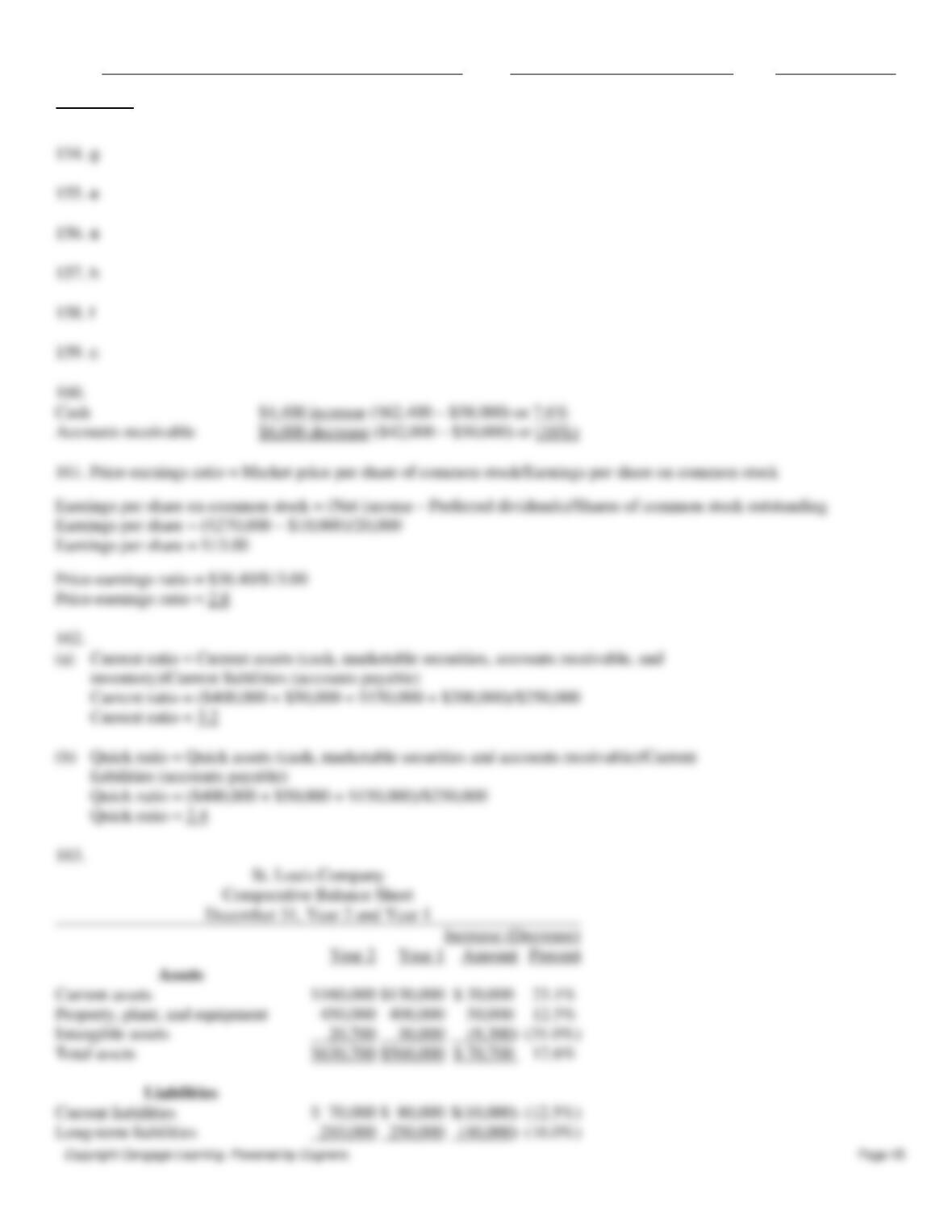
161. A company reported the following:
Net income
$270,000
Preferred dividends
$10,000
Shares of common stock outstanding
20,000
Market price per share of common stock
$36.40
Calculate the company’s price-earnings ratio. Round your answer to one decimal place.
162. The following items are reported on a company’s balance sheet:
Cash
$400,000
Marketable securities
50,000
Accounts receivable
150,000
Inventory
200,000
Accounts payable
250,000
Determine the (a) current ratio, and (b) quick ratio. Round your answer to one decimal place.
163. Condensed data taken from the ledger of St. Louis Company at December 31, for the current and preceding years, are
as follows:
Year 2
Year 1
Current assets
$160,000
$130,000
Property, plant, and equipment
450,000
400,000
Intangible assets
20,700
30,000
Current liabilities
70,000
80,000
Long-term liabilities
210,000
250,000
Common stock
225,000
150,000
Retained earnings
125,700
80,000
Prepare a comparative balance sheet, with horizontal analysis, for December 31, Year 2 and Year 1. (Round percents to
one decimal point.)
164. A company reports the following:
Sales
$720,000
Average accounts receivable (net)
45,000
Determine the (a) accounts receivable turnover, and (b) number of days’ sales in receivables. Round your answer to one
decimal place.
165. CorpCo gathered the following information at the end of the current fiscal year:
Dividends on common stock
$125,000
Market price per share of common stock
$115.00
Shares of common stock outstanding
5,000
Name:
Class:
Date:
chapter 16
Dividends on preferred stock
$65,000
Shares of preferred stock outstanding
600
Earnings per share on common stock
$102.00
Dividends per share of common stock
$25.00
Net income
$575,000
What is CorpCo’s price-earnings ratio? Round your answer to one decimal place.
166. The following data are available for Martin Solutions, Inc.
Year 2
Year 1
Sales
$1,139,600
$1,192,320
Beginning inventory
80,000
64,000
Cost of goods sold
500,800
606,000
Ending inventory
72,000
80,000
(1)
Determine for each year:
(a)
The inventory turnover
(b)
The number of days’ sales in inventory (Round intermediate calculation to the nearest
whole number and your final answer to one decimal place).
(2)
What conclusions can be drawn from these data concerning the inventories?
167. Define solvency and profitability. How are they alike?
168. Gallant Company reported net income of $2,500,000. The income statement included a $200,000 loss on
discontinued operations, after applicable income tax. There were 100,000 shares of $10 par common stock and 40,000
shares of 4% preferred stock of $100 par outstanding throughout the current year.
Prepare the earnings per share section of Gallant Company’s income statement.
169. Prepare an income statement using the following data for New Orleans Adventures for the year ended December 31:
New Orleans Adventures
Income Statement
For the Year Ended December 31
Sales
$24,500,000
Cost of goods sold
10,900,000
Operating expenses
6,300,000
Income tax expense
500,000
Loss on discontinued operations
100,000
170. The following information was taken from the financial statement of Fox Resources for December 31 of the current
fiscal year:
Common stock, $20 par value (no change during the year)
$5,000,000
Preferred 10% stock, $40 par (no change during the year)
2,000,000
The net income was $600,000, and the declared dividends on the common stock were $125,000 for the current year. The
market price of the common stock is $20 per share.
Calculate for the common stock:
(a) earnings per share

Name:
Class:
Date:
chapter 16
(b) the price-earnings ratio
(c) the dividends per share and the dividend yield
Round to one decimal place except earnings per share, which should be rounded to two decimal places.
171. What is a major advantage of using percentages rather than dollar changes in doing horizontal and vertical analysis?
172. The following data are taken from the financial statements:
Current
Year
Preceding
Year
Current assets
$ 745,000
$ 820,000
Property, plant, and equipment
1,510,000
1,400,000
Current liabilities
(non-interest-bearing)
160,000
140,000
Long-term liabilities, 12%
400,000
400,000
Preferred 10% stock
250,000
250,000
Common stock, $25 par
1,200,000
1,200,000
Retained earnings,
beginning of year
230,000
160,000
Net income for year
110,000
155,000
Preferred dividends declared
(25,000)
(25,000)
Common dividends declared
(70,000)
(60,000)
Determine for the current year the (a) return on total assets, (b) return on stockholders’ equity,
(c) return on common stockholders’ equity, (d) earnings per share on common stock, (e) price-earnings
ratio on common stock, and (f) dividend yield. The current market price per share of
common stock is $25.
Round dollar values to two decimal places and other final answers to one decimal place.
173. A company reports the following:
Sales
$1,200,000
Average accounts receivable (net)
50,000
Determine the (a) accounts receivable turnover, and (b) number of days’ sales in receivables. Round your answer to one
decimal place.
174. The following information has been condensed from the December 31 balance sheets of Gabriel Co.:
Year 2
Year 1
Assets:
Current assets
$ 825,500
$ 674,300
Fixed assets (net)
1,473,600
1,275,300
Total assets
$2,299,100
$1,949,600
Liabilities:
Current liabilities
$ 313,500
$ 309,600
Long-term liabilities
703,000
545,000
Total liabilities
$1,016,500
$ 854,600
Stockholders’ equity
$1,282,600
$1,095,000
Total liabilities and
stockholders’ equity
$2,299,100
$1,949,600
Name:
Class:
Date:
chapter 16
(a)
Determine the ratio of fixed assets to long-term liabilities for each year.
(b)
Determine the ratio of liabilities to stockholders’ equity for each year.
(c)
Comment on the year-to-year changes for both ratios.
Round your answers to two decimal places.
175. The following items were taken from the financial statements of Tilden, Inc., over a three-year period:
Item
Year 3
Year 2
Year 1
Sales
$360,000
$335,000
$290,000
Cost of goods sold
225,000
205,000
185,000
Gross profit
$135,000
$130,000
$105,000
Compute the following for each of the items listed.
(a)
The amount and percentage change from Year 2 to Year 3.
(b)
The amount and percentage change from Year 1 to Year 2.
Round percentages to one decimal place.
176. A company reports the following:
Sales
$2,400,000
Average total assets (excluding long-term investments)
1,500,000
Determine the asset turnover ratio. Round your answer to one decimal place.
177. Revenue and expense data for Young Technologies Inc. are as follows:
Year 2
Year 1
Sales
$500,000
$440,000
Cost of goods sold
325,000
242,000
Selling expenses
70,000
79,200
Administrative expenses
75,000
70,400
Income tax expense
10,500
16,400
(a)
Prepare an income statement in comparative form, stating each item for both years as an
amount and as a percent of sales. Round to the nearest whole percent.
(b)
Comment on the significant changes disclosed by the comparative income statement.
178. A company reports the following:
Net income
$150,000
Preferred dividends
$10,000
Shares of common stock outstanding
20,000
Market price per share of common stock
$35
Calculate the company’s earnings per share on common stock.
179. The balance sheet data of Randolph Company for two recent years appears below:
Assets:
Year 2
Year 1
Current assets
$ 445
$280
Plant assets
680
520
Name:
Class:
Date:
chapter 16
Total assets
$1,125
$800
Liabilities and stockholders’
equity:
Current liabilities
$ 285
$120
Long-term debt
255
160
Common stock
325
320
Retained earnings
260
200
Total liabilities and
stockholders’ equity
$1,125
$800
(a)
Using horizontal analysis, show the percentage change for each balance sheet item
using Year 1 as a base year.
(b)
Using vertical analysis, prepare a comparative balance sheet.
Round percentages to one decimal place.
180. The following data are taken from the financial statements:
Current
Preceding
Year
Year
Sales
$3,600,000
$4,000,000
Cost of goods sold
2,000,000
2,700,000
Beginning inventory
372,000
352,000
Inventory, end of year
390,000
372,000
(a)
Determine for each year (1) the inventory turnover, round answer to one decimal place.
(2) the number of days’ sales in inventory. Round intermediate calculations to whole
numbers and final answers to two decimal places.
(b)
Comment on the favorable and unfavorable trends revealed by the data.
181. Income statement information for Lucy Company is provided below:
Sales
$175,000
Cost of goods sold
105,000
Gross profit
$ 70,000
Prepare a vertical analysis of the income statement for Lucy Company.
182. Cash and accounts receivable for Adams Company are provided below:
Current Year
Prior Year
Cash
$70,000
$50,000
Accounts receivable (net)
70,400
80,000
What is the amount and percentage of increase or decrease that would be shown with horizontal analysis?
183. The following data are taken from the balance sheet at the end of the current year.
Cash
$154,000
Accounts receivable
210,000
Inventory
240,000
Prepaid expenses
15,000
Marketable securities
350,000
Name:
Class:
Date:
chapter 16
Property, plant, and equipment
375,000
Accounts payable
245,000
Accrued liabilities
4,000
Income tax payable
10,000
Notes payable, short-term
85,000
Determine the (a) working capital, (b) current ratio, and (c) quick ratio. Round ratios to one decimal place.
184. Comparative information taken from the Friction Company’s financial statements is shown below:
Year 2
Year 1
(a)
Notes receivable
$ 25,500
$ 30,000
(b)
Accounts receivable
106,200
90,000
(c)
Retained earnings
77,000
70,000
(d)
Sales
654,000
600,000
(e)
Operating expenses
160,000
200,000
(f)
Income taxes payable
28,000
20,000
Using horizontal analysis, show the percentage change and direction (increase or decrease) from Year 1 to Year 2 with
Year 1 as the base year.
185. Zeus Company reports the following for the current year:
Income from continuing operations before income tax
$500,000
Loss from discontinued operations
$90,000*
Weighted average number of common shares outstanding
40,000
Applicable tax rate
40%
*Net of any tax effect
(a)
Prepare a partial income statement for Zeus Company beginning with income from
continuing operations before income tax.
(b)
Calculate the earnings per common share for Zeus.
186. A company reports the following:
Income before income tax
$600,000
Interest expense
150,000
Determine the times interest earned. Round your answer to one decimal place.
187. A company reports the following:
Cost of goods sold
$610,000
Average inventory
80,000
Determine the (a) inventory turnover, and (b) number of days’ sales in inventory. Round your answer to one decimal
place.
188. For Garrison Corporation, the working capital at the end of the current year is $10,000 more than the working capital
at the end of the preceding year, reported as follows:
Year 2
Year 1
Name:
Class:
Date:
chapter 16
Current assets:
Cash, marketable securities, and receivables
$ 80,000
$ 84,000
Inventories
120,000
66,000
Total current assets
$200,000
$150,000
Current liabilities
100,000
60,000
Working capital
$100,000
$ 90,000
Has the current position of Garrison Corporation improved? Explain.
189. The balance sheet for Seuss Company at the end of the current fiscal year indicated the following:
Bonds payable, 10% (20-year term)
$5,000,000
Preferred 10% stock, $100 par
1,000,000
Common stock, $10 par
2,000,000
Income before income tax was $1,500,000 and income taxes were $200,000 for the current year. Cash dividends paid on
common stock during the current year totaled $150,000. The common stock sells for $75 per share at the end of the year.
Determine each of the following:
(a)
Times interest earned
(b)
Earnings per share on common stock
(c)
Price-earnings ratio
(d)
Dividends per share of common stock
(e)
Dividend yield
Round to one decimal place except earnings per share and dividends per share, which should be rounded to two decimal
places.
190. What information is generally included in the Management Discussion and Analysis (MD&A) section of a corporate
annual report?
191. The following data are taken from or calculated from the financial statements:
Current
Preceding
Year
Year
Average accounts receivable (net)
$123,000
$ 95,000
Sales on account
950,000
825,000
(a)
Assuming that credit terms on all sales are n/45, determine for each year (1) the accounts receivable
turnover and (2) the number of days’ sales in receivables.
Round intermediate calculations to whole numbers and final answers to two decimal places.
(b)
Comment on any significant trends revealed by the data.
192. A company reports the following:
Net income
$ 350,000
Preferred dividends
50,000
Average stockholders’ equity
1,000,000
Average common stockholders’ equity
800,000
Determine the (a) return on stockholders’ equity, and (b) return on common stockholders’ equity. Round your answer to
one decimal place.
Name:
Class:
Date:
chapter 16
193. Abigail Company reports the following:
Net income
$ 295,000
Preferred dividends
30,000
Average stockholders’ equity
1,000,000
Average common stockholders’ equity
700,000
Determine the (a) return on stockholders’ equity, and (b) return on common stockholders’ equity. Round your answer to
one decimal place.
194. The following information was taken from Slater Company’s balance sheet:
Fixed assets (net)
$1,250,000
Long-term liabilities
500,000
Total liabilities
672,000
Total stockholders’ equity
1,680,000
Determine the company’s (a) ratio of fixed assets to long-term liabilities, and (b) ratio of liabilities to stockholders’
equity. Round your answer to one decimal place.
195. Revenue and expense data for Bluestem Company are as follows:
Year 2
Year 1
Administrative expenses
$ 37,000
$ 20,000
Cost of goods sold
350,000
320,000
Income tax expense
40,000
32,000
Sales
800,000
700,000
Selling expenses
150,000
110,000
(a)
Prepare a comparative income statement, with vertical analysis, stating each item for both
years as a percent of sales.
(b)
Comment upon significant changes disclosed by the comparative income statement.
Round percentages to one decimal place.
196. Rho, Sigma, and Tau Companies have the following data for the current year:
Rho Company
Sigma Company
Tau Company
Price-earnings ratio
23.7
16.9
30.1
Which company would be expected to have the best potential for future common stock price appreciation?
197. For the current year, Lynx Company’s comprehensive income was $245,000 and its net income was $198,000. What
is Lynx Company’s other comprehensive income?
198. A company reports the following:
Sales
$2,520,000
Average total assets (excluding long-term investments)
1,400,000
Determine the asset turnover ratio. Round your answer to one decimal place.
199. CorpCo gathered the following information as of the end of the current fiscal year:
Name:
Class:
Date:
chapter 16
Dividends on common stock
$125,000
Market price per share of common stock
$115.00
Shares of common stock outstanding
5,000
Dividends on preferred stock
$65,000
Shares of preferred stock outstanding
600
Earnings per share on common stock
$102.00
Dividends per share of common stock
$25.00
Net income
$575,000
What is CorpCo’s dividend yield? Write your answer as a percent, rounded to one decimal place.
200. Why would you or why wouldn’t you compare an organization like Ford Motor Company to the local car dealer
“Johnson City Ford/Lincoln/Mercury” using vertical and horizontal analysis?
201. The following items are reported on a company’s balance sheet:
Cash
$230,000
Marketable securities
50,000
Accounts receivable
200,000
Inventory
240,000
Accounts payable
300,000
Determine the (a) current ratio, and (b) quick ratio. Round your answer to one decimal place.
202. From the following data for Norton Company for the year ended December 31, prepare a multiple-step income
statement. Include the earnings per share presentation on the income statement.
Common stock, $50 par
$200,000
Cost of goods sold
342,000
Administrative expenses
48,250
Income tax (applicable to continuing operations)
142,000
Interest expense
3,750
Loss on discontinued operations,
net of applicable tax of $2,700
5,400
Sales
865,000
Selling expenses
83,000
203. A company reports the following income statement and balance sheet information for the current year:
Net income
$ 180,000
Interest expense
20,000
Average total assets
2,000,000
Determine the return on total assets. Round your answer to one decimal place.
204. The following selected data were taken from the financial statements of the Winter Group for the three most recent
years of operations:
Dec. 31,
Year 3
Dec.31,
Year 2
Dec. 31,
Year 1
Total assets
$3,000,000
$2,700,000
$2,400,000
Name:
Class:
Date:
chapter 16
Notes payable (10% interest)
1,000,000
1,000,000
1,000,000
Common stock
400,000
400,000
400,000
Preferred $6 stock, $100 par
200,000
200,000
200,000
Retained earnings
1,126,000
896,000
600,000
The Year 3 net income was $242,000 and the Year 2 net income was $308,000. No dividends on common stock were
declared during the 3 years.
(a) Determine the return on total assets, the return on stockholders’ equity, and the return on
common stockholders’ equity for Years 2 and 3. Round to one decimal place.
(b) What conclusion can be drawn from these data as to the company’s profitability?
205. The following items are reported on Denver Company’s balance sheet:
Cash
$190,000
Marketable securities
160,000
Accounts receivable (net)
240,000
Inventory
350,000
Accounts payable
600,000
Determine (a) the current ratio and (b) the quick ratio. Round to one decimal place.
206. Selected data from the Carmen Company at year end are presented below:
Total assets
$2,000,000
Average total assets
2,200,000
Net income
250,000
Sales
1,300,000
Average common stockholders’ equity
1,000,000
Net cash provided by operating activities
275,000
Shares of common stock outstanding
10,000
Long-term investments
400,000
Calculate: (a) asset turnover ratio; (b) return on total assets; (c) return on common stockholders’
equity; and (d) earnings per share on common stock. Assume the company had no preferred stock or interest
expense. Round dollar values to two decimal places and other final answers to one decimal place.
Name:
Class:
Date:
chapter 16
Answer Key

Name:
Class:
Date:
chapter 16
Name:
Class:
Date:
chapter 16
Name:
Class:
Date:
chapter 16
Name:
Class:
Date:
chapter 16
Name:
Class:
Date:
chapter 16
Name:
Class:
Date:
chapter 16
Name:
Class:
Date:
chapter 16
Name:
Class:
Date:
chapter 16
Name:
Class:
Date:
chapter 16
Name:
Class:
Date:
chapter 16
Name:
Class:
Date:
chapter 16
Name:
Class:
Date:
chapter 16
Name:
Class:
Date:
chapter 16
Name:
Class:
Date:
chapter 16
Name:
Class:
Date:
chapter 16
Name:
Class:
Date:
chapter 16
Name:
Class:
Date:
chapter 16