
95
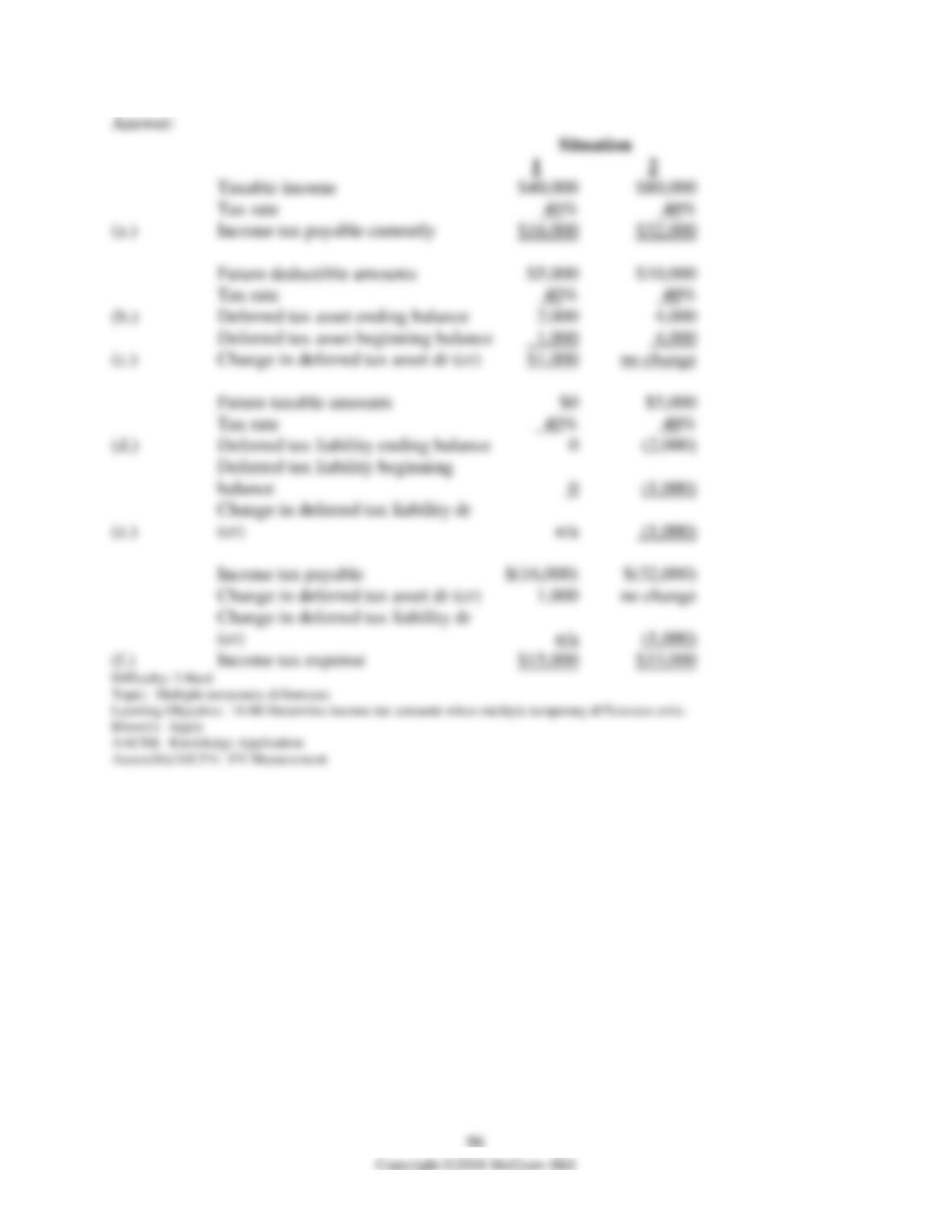
163) Two independent situations are described below. Each involves future deductible amounts
and/or future taxable amounts produced by temporary differences:
SITUATION
1
2
Taxable income
$40,000
$80,000
Amounts at year-end:
Future deductible amounts
5,000
10,000
Future taxable amounts
0
5,000
Balances at beginning of year, dr (cr):
Deferred tax asset
$1,000
$4,000
Deferred tax liability
0
1,000
The enacted tax rate is 40% for both situations.
Required:
For each situation determine the:
(a.) Income tax payable currently.
(b.) Deferred tax asset – balance at year-end.
(c.) Deferred tax asset change dr or (cr) for the year.
(d.) Deferred tax liability – balance at year-end.
(e.) Deferred tax liability change dr or (cr) for the year.
(f.) Income tax expense for the year.

97
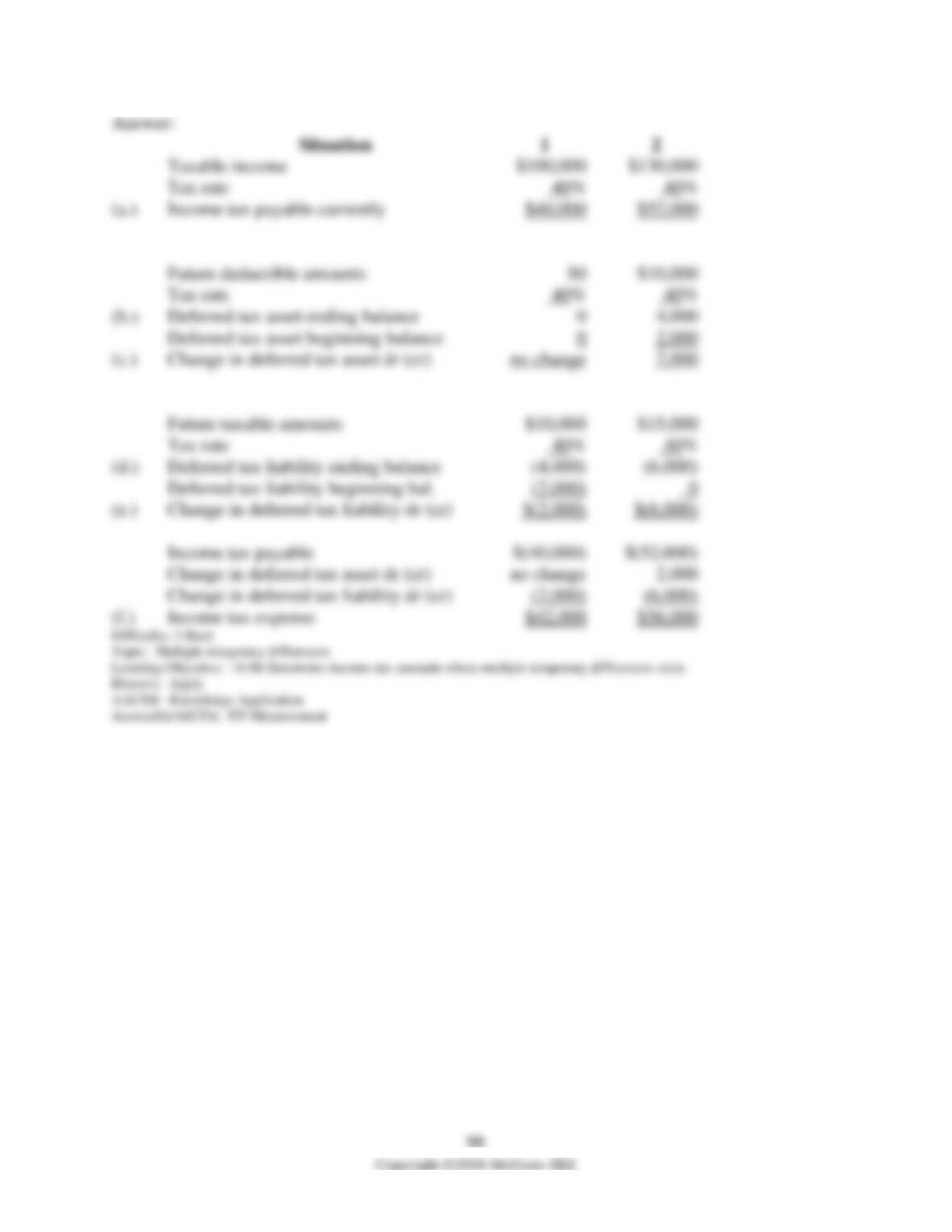
164) Two independent situations are described below. Each involves future deductible amounts
and/or future taxable amounts produced by temporary differences:
SITUATION
1
2
Taxable income
$100,000
$130,000
Amounts at year-end:
Future deductible amounts
0
10,000
Future taxable amounts
10,000
15,000
Balances at beginning of year:
Deferred tax asset
0
$2,000
Deferred tax liability
2,000
0
The enacted tax rate is 40% for both situations.
Required:
For each situation determine the:
(a.) Income tax payable currently.
(b.) Deferred tax asset – balance at year-end.
(c.) Deferred tax asset change dr or (cr) for the year.
(d.) Deferred tax liability – balance at year-end.
(e.) Deferred tax liability change dr or (cr) for the year.
(f.) Income tax expense for the year.
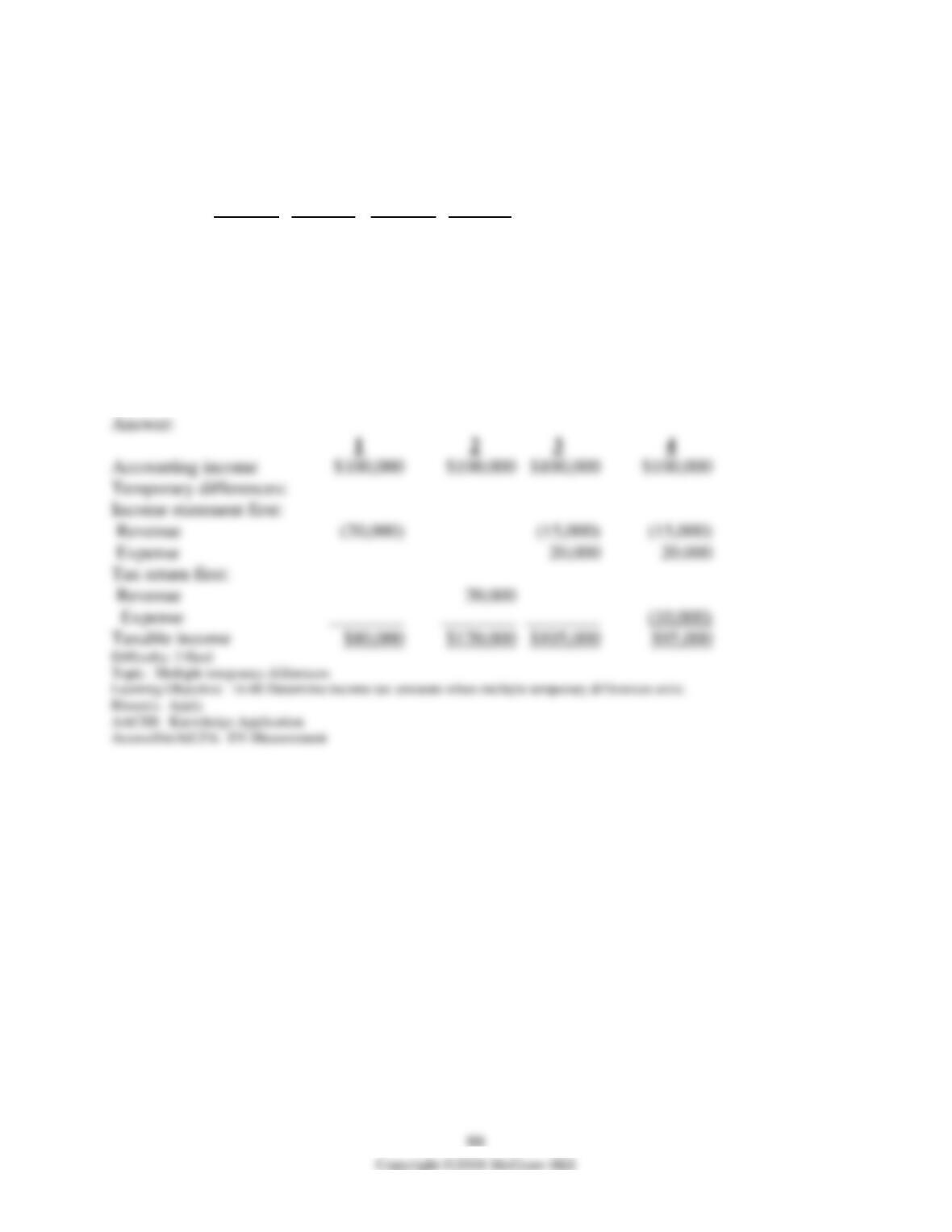
165) Four independent situations are described below. Each involves future deductible amounts
and/or future taxable amounts produced by temporary differences reported first on:
Income Statement
Tax Return
Revenue
Expense
Revenue
Expense
(1.)
$20,000
(2.)
$20,000
(3.)
$15,000
$20,000
(4.)
$15,000
$20,000
$10,000
Required:
For each situation, determine the taxable income assuming pretax accounting income is
$100,000. Show well-labeled computations.
Accounting income
Temporary differences:
Income statement first:
Revenue
Expense
Tax return first:
Revenue
Expense
Taxable income
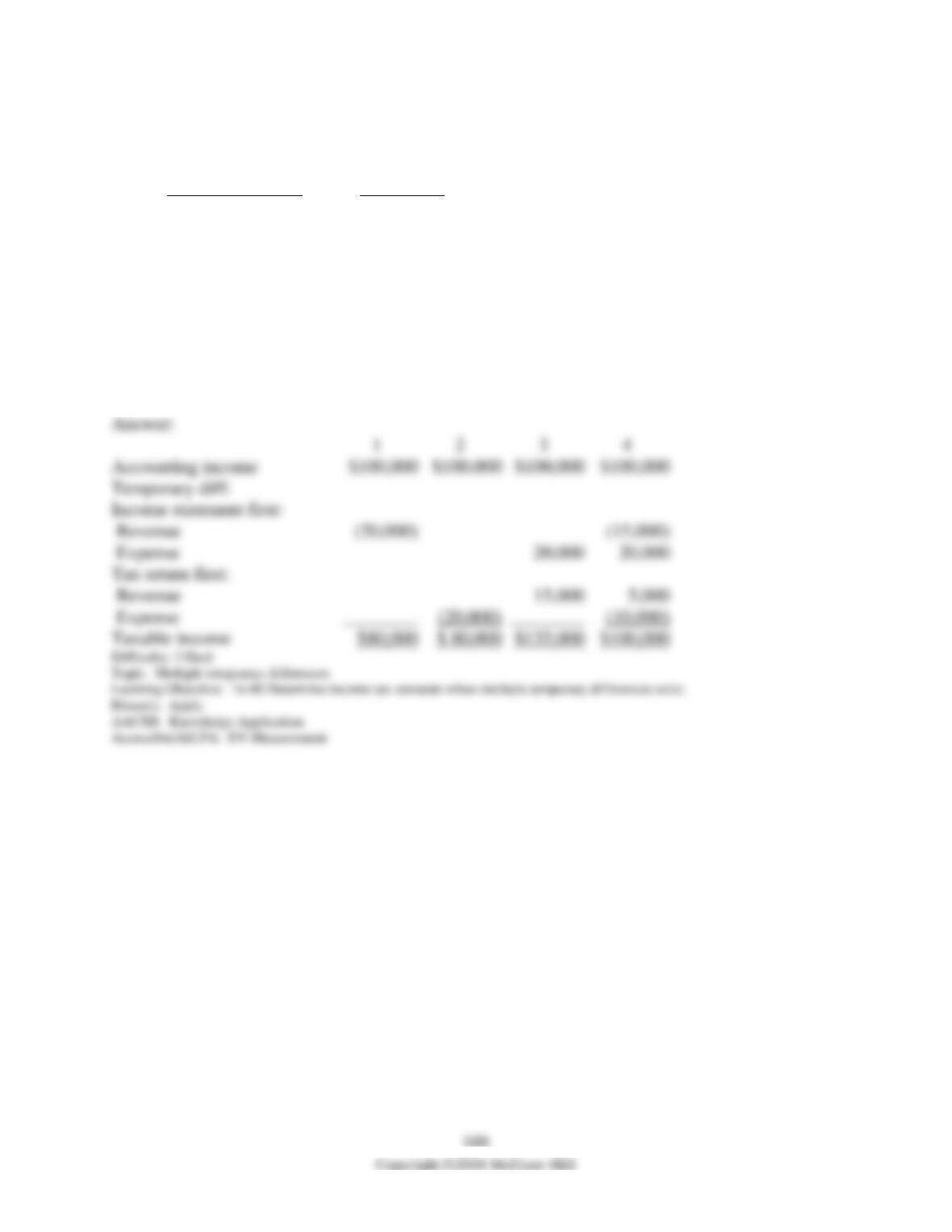
166) Four independent situations are described below. Each involves future deductible amounts
and/or future taxable amounts produced by temporary differences reported first on:
Income Statement
Tax Return
Revenue
Expense
Revenue
Expense
(1.)
$20,000
(2.)
$20,000
(3.)
$20,000
$15,000
(4.)
$15,000
$20,000
$ 5,000
$10,000
Required:
For each situation, determine the taxable income assuming pretax accounting income is
$100,000. Show well-labeled computations.
1
3
Accounting income
Temporary diff:
Income statement first:
Revenue
(20,000)
(15,000)
Expense
Tax return first:
Revenue
Expense
(10,000)
Taxable income
$80,000
$ 80,000
167) Cabot Company reported a pretax operating loss of $50,000 for financial reporting and tax
purposes in 2018. The enacted tax rate is 40% for 2018 and subsequent years. Assume that Cabot
requests a refund of taxes already paid by electing a loss carryback. Taxable income, tax rates,
and income taxes paid in Cabot’s first four years of operations were as follows:
Taxable
Tax
Taxes
income
rates
paid
2014
$30,000
30%
$9,000
2015
35,000
30%
10,500
2016
42,000
35%
14,700
2017
40,000
40%
16,000
Required:
1.) Prepare the journal entry to record Cabot’s income taxes for the year 2018. Show well-labeled
computations.
2.) Compute Cabot’s net loss for 2018.
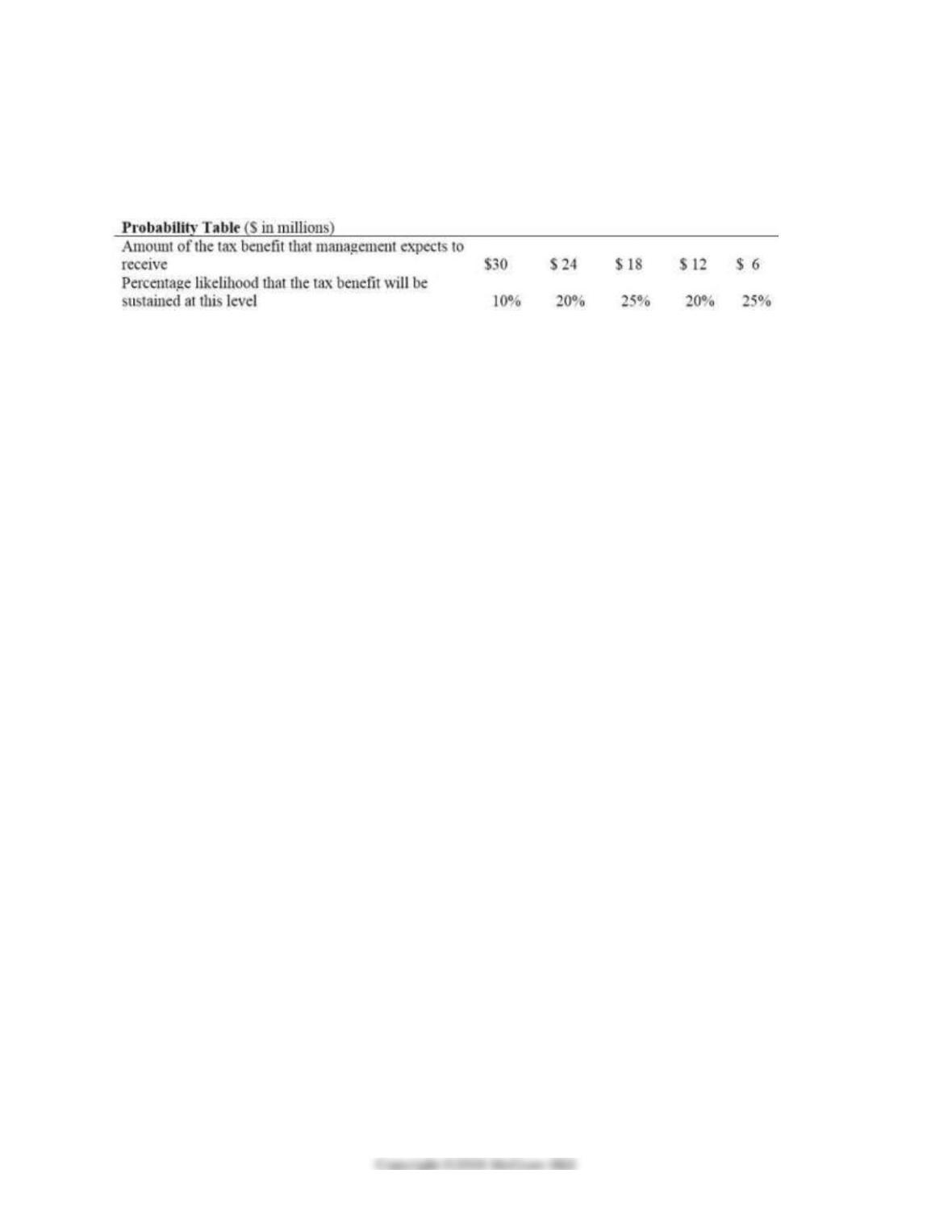
(1.)
Receivable income tax refund ($14,700 + 3,200)
Income tax benefit operating loss (to balance)
Current year
2018
Operating loss
Loss carryback
Tax rates
40%
Tax refund
102
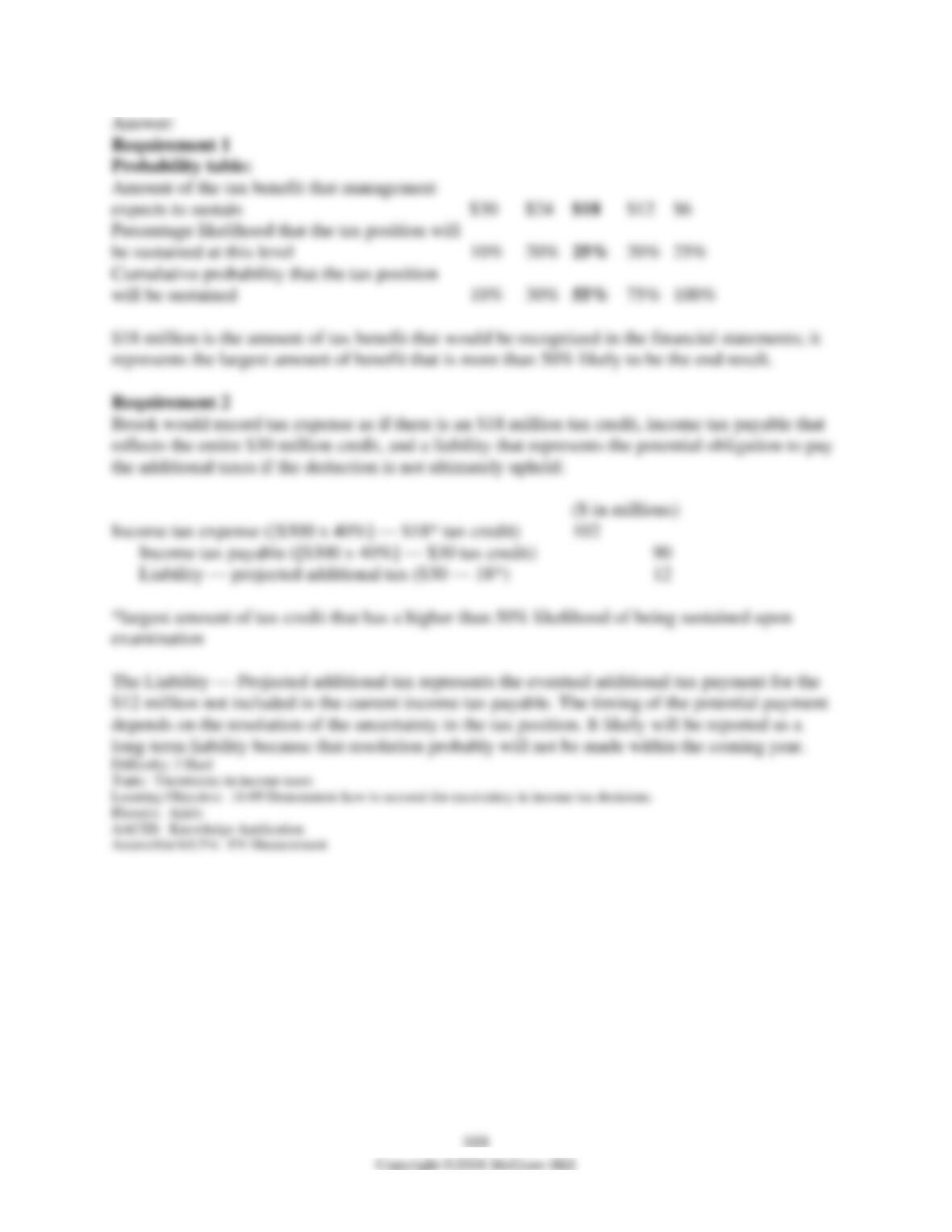
168) Brook Company has taken a position on its tax return to claim a tax credit of $30 million
(direct reduction in taxes payable) and has determined that its sustainability is “more likely than
not” based on its technical merits. Brook’s management has developed the probability table
shown below of all possible material outcomes:
Brook’s taxable income is $300 million for the year, and its effective tax rate is 40%. The tax
credit would be a direct reduction in current taxes payable.
Required:
1. At what amount would Brook measure the tax benefit in its income statement?
2. Prepare the appropriate journal entry for Brook to record its income taxes for the year.
169) What is the justification for a corporation determining income for financial reporting
purposes differently than the way it is determined for tax purposes?
170) What argument serves as the basis for the GAAP requirement that deferred taxes should be
recognized for all temporary differences?
171) Sometimes a temporary difference will produce future deductible amounts. Explain what is
meant by future deductible amounts. Describe at least one situation that has this effect. How are
future deductible amounts recognized in the financial statements?
172) What is a valuation allowance for deferred tax assets and when is it used?
173) Identify three examples of permanent differences between accounting income and taxable
income.
174) What events create permanent differences between accounting income and taxable income?
What effect do these events have on the determination of income taxes payable and deferred
income taxes?
175) When a new tax rate is enacted, what adjustment, if any, is made to the retained earnings
account as a result of the change?
176) Some accountants believe that deferred taxes should not be recognized for certain
temporary differences. What is the conceptual basis for this argument?
177) How are deferred tax assets arising from net operating loss carryforwards classified with
regard to GAAP accounting for income taxes?
178) How are deferred tax assets and deferred tax liabilities reported in a classified balance
sheet?
179) The way companies deal with uncertainty in tax positions is prescribed by GAAP in FASB
ASC 740—10: Income Taxes—Overall (previously FASB Interpretation No. 48 (FIN 48)).
Describe the two-step process provided by GAAP (previously FIN 48).
180) What disclosures for deferred taxes, pertaining to the income statement, are required by
GAAP regarding accounting for income taxes?
181) Why are differences in reported amounts for deferred taxes are among the most frequent
between IFRS and U.S. GAAP, despite the fact that the two follow similar approaches for
accounting for taxation?