168) Following is a partial process cost summary for Mitchell Manufacturing’s Canning
Department.
Equivalent Units of Production
Direct Materials
Conversion
Units Completed and transferred
out
50,000
50,000
Units in Ending Work in Process:
Direct Materials (15,000 × 100%)
15,000
Conversion (15,000 × 80%)
12,000
Equivalent Units of Production
65,000
62,000
Cost per Equivalent Unit
Costs of beginning work in
process
$
40,500
$
59,700
Costs incurred this period
136,000
183,100
Total costs
$
176,500
$
242,800
Cost per equivalent unit
$
2.71
per EUP
$
3.92
per EUP
If the units completed were transferred to the Labeling Department, what is the appropriate
journal entry to transfer the conversion costs?
A) Work in Process—Labeling $183,100; Work in Process—Canning $183,100.
B) Work in Process—Labeling $196,000; Work in Process—Canning $196,000.
C) Finished Goods—Labeling $183,100; Finished Goods—Canning $183,100.
D) Work in Process—Labeling $196,000; Finished Goods—Canning $196,000.
E) Finished Goods $242,800; Work in Process $242,800.
169) Williams Company computed its cost per equivalent unit for direct materials to be $2.60
and its cost per equivalent unit for conversion to be $3.75. A total of 250,000 units of product
were completed and transferred out as finished goods during the month. The ending Work in
Process inventory consists of 36,000 equivalent units of direct materials and 36,000 equivalent
units of conversion costs. The amount that should be reported in ending Work in Process
Inventory is:
A) $93,600.
B) $135,000.
C) $1,816,100.
D) $1,587,500.
E) $228,600.
170) Williams Company computed its cost per equivalent unit for direct materials to be $2.60
and its cost per equivalent unit for conversion to be $3.75. A total of 250,000 units of product
were completed and transferred out as finished goods during the month, and 36,000 of equivalent
units remained unfinished at the end of the month. The amount that should be reported in
Finished Goods Inventory is:
A) $650,000.
B) $135,000.
C) $1,816,100.
D) $1,587,500.
E) $228,600.
171) During March, the production department of a process operations system completed and
transferred to finished goods 25,000 units that were in process at the beginning of March and
110,000 that were started and completed in March. March’s beginning inventory units were
100% complete with respect to materials and 55% complete with respect to conversion. At the
end of March, 30,000 additional units were in process in the production department and were
100% complete with respect to materials and 30% complete with respect to conversion. Compute
the number of equivalent units with respect to both materials and conversion respectively for
March using the FIFO method.
A) 165,000 materials; 165,000 conversion.
B) 135,000 materials; 119,000 conversion.
C) 140,000 materials; 130,250 conversion.
D) 165,000 materials; 144,000 conversion.
E) 144,000 materials; 144,000 conversion.
172) A company uses the weighted average method for inventory costing. At the beginning of a
period the production department had 20,000 units in beginning Work in Process inventory
which were 40% complete; the department completed and transferred 165,000 units. At the end
of the period, 22,000 units were in the ending Work in Process inventory and are 75% complete.
Compute the number of equivalent units produced by the department.
A) 181,500.
B) 165,000.
C) 173,500.
D) 145,000.
E) 187,000.
173) A company uses the FIFO method for inventory costing. At the beginning of a period, the
production department had 20,000 units in beginning Work in Process inventory which were
40% complete; the department completed and transferred 165,000 units. At the end of the period,
22,000 units were in the ending Work in Process inventory and are 75% complete. Compute the
number of equivalent units produced by the department.
A) 181,500.
B) 165,000.
C) 173,500.
D) 145,000.
E) 187,000.
174) A company uses the weighted average method for inventory costing. At the start of a period
the production department had 20,000 units in beginning Work in Process inventory which were
40% complete; the department completed and transferred 165,000 units. At the end of the period,
22,000 units were in the ending Work in Process inventory and are 75% complete. The
production department had conversion costs in the beginning goods is process inventory of
$99,000 and total conversion costs added during the period are $726,825. Compute the
conversion cost per equivalent unit.
A) $4.40.
B) $4.76.
C) $4.19.
D) $4.55.
E) $4.61.
175) A company uses the FIFO method for inventory costing. At the start of the period the
production department had 20,000 units in beginning Work in Process inventory which were
40% complete; the department completed and transferred 165,000 units. At the end of the period,
22,000 units were in the ending Work in Process inventory and are 75% complete. The
production department had labor costs in the beginning goods is process inventory of $99,000
and total labor costs added during the period are $726,825. Compute the equivalent cost per unit
for labor.
A) $4.40.
B) $4.76.
C) $4.19.
D) $4.55.
E) $4.61.
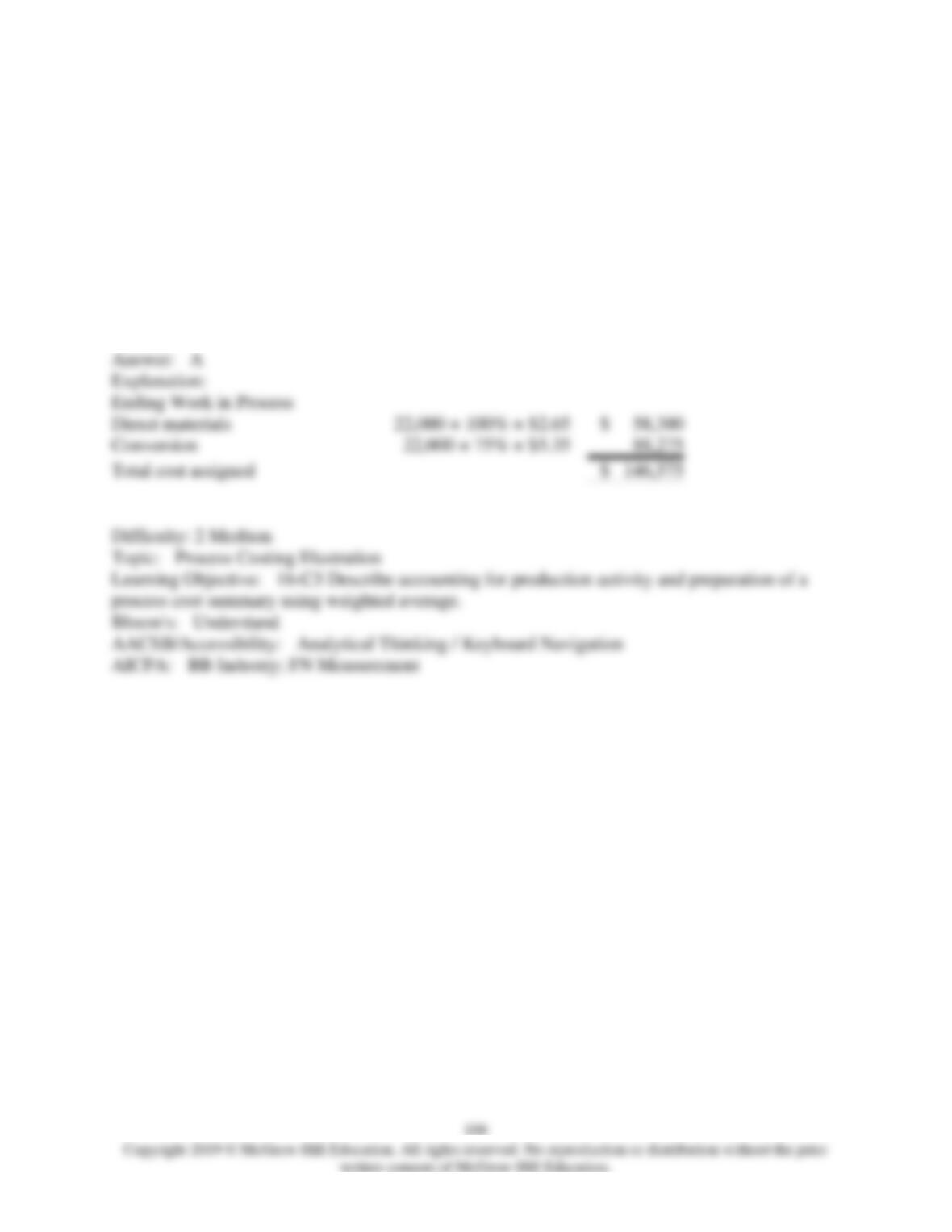
176) A company uses the weighted-average method for inventory costing. At the end of the
period, 22,000 units were in the ending Work in Process inventory and are 100% complete for
materials and 75% complete for conversion. The equivalent costs per unit are materials, $2.65
and conversion $5.35. Compute the cost that would be assigned to the ending Work in Process
inventory for the period.
A) $146,575.
B) $176,000.
C) $87,725.
D) $93,775.
E) $132,000.
177) Match the following terms with the definitions.
________ (1) Equivalent units of production
________ (2) Job order costing system
________ (3) Hybrid costing system
________ (4) Process operations
________ (5) Process costing system
________ (6) Materials consumption report
________ (7) Process cost summary
A. Costing system that measures costs per unit upon completion of a job.
B. Document that summarizes the materials a department uses when inventory moves
continuously through the manufacturing process during a reporting period; replaces materials
requisition.
C. Report of total costs charged to a department, describes its equivalent units of production
achieved, and allocates costs among units worked on in the period.
D. A manufacturing system that contains features of both process costing and job order costing
systems.
E. Number of units that could have been started and completed given the costs incurred during
the period.
F. System of measuring unit costs at the end of a period by combining costs per equivalent unit
from each separate department.
G. Mass production of similar products in a continuous flow of sequential processes.
178) What is meant by equivalent units of production, and why are they important when a
process costing system is used?
179) What are the four steps in accounting for production activity in a period?
180) Why is the Process Cost Summary important to management and how does the Process
Cost Summary accomplish its purposes?
181) Briefly explain the conditions under which job order cost accounting systems and process
costing systems are commonly applied.
182) Job order costing and process costing are two major costing systems used in manufacturing.
Briefly contrast the characteristics of these two systems.
183) What is a hybrid costing system? When is a hybrid costing system appropriate for a
manufacturer?
184) Describe the flow of materials in a process costing system, including accounts used.
185) Describe the flow of labor in a process costing system, including accounts used.
186) Describe the flow of overhead costs in a process costing system, including accounts used.
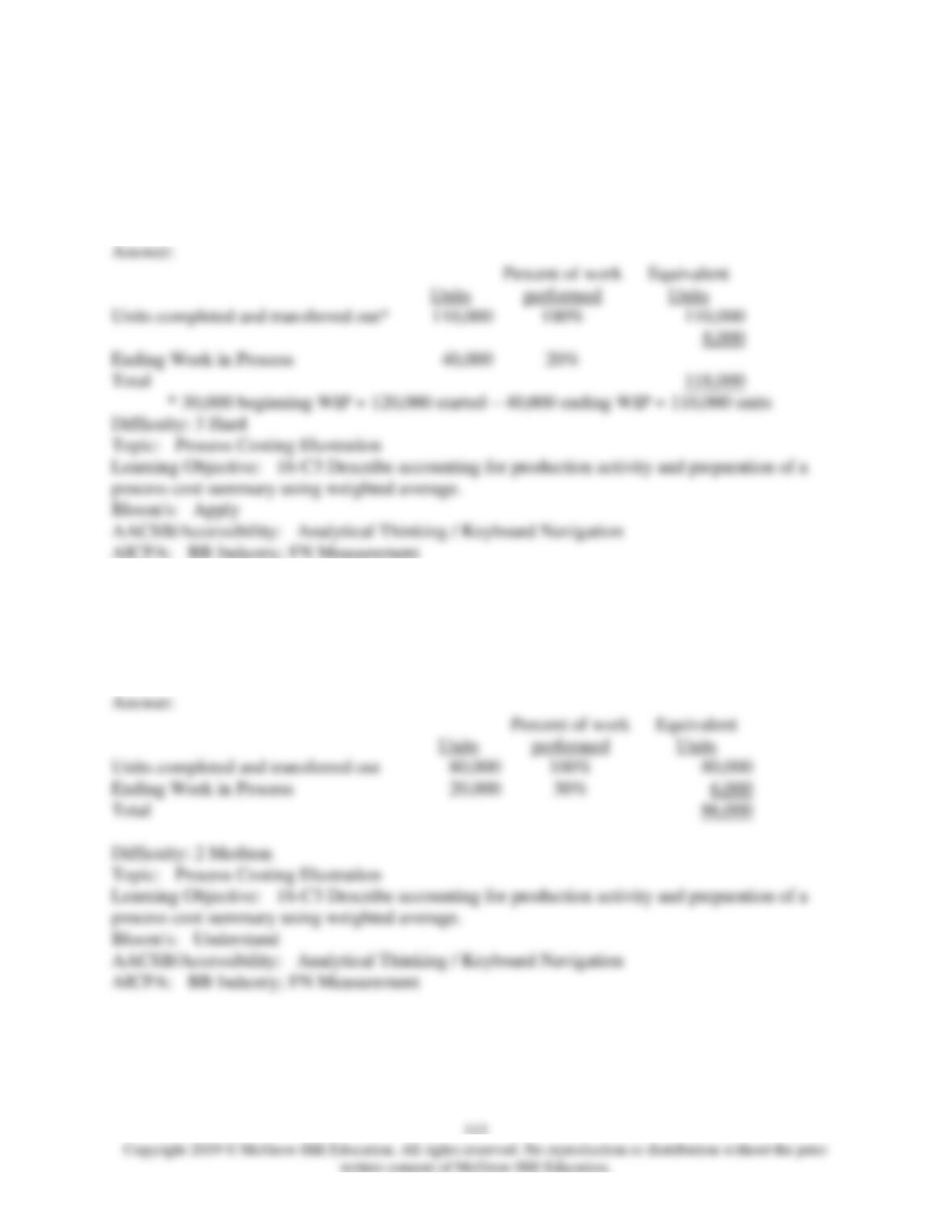
187) A company’s January 1 Work in Process inventory contained 30,000 units that were 25%
complete with respect to direct labor. The beginning inventory was completed this year and
another 120,000 units were started. Of those started, 80,000 were finished and the remaining
40,000 were left 20% complete. Calculate the equivalent units of production for the year using
the weighted average method.
188) Sutton Company uses a process costing system. In May, 80,000 units were finished and
transferred to finished goods. Ending Work in Process included 20,000 unfinished units 30%
complete. Calculate the equivalent units of production for the year using the weighted average
method.
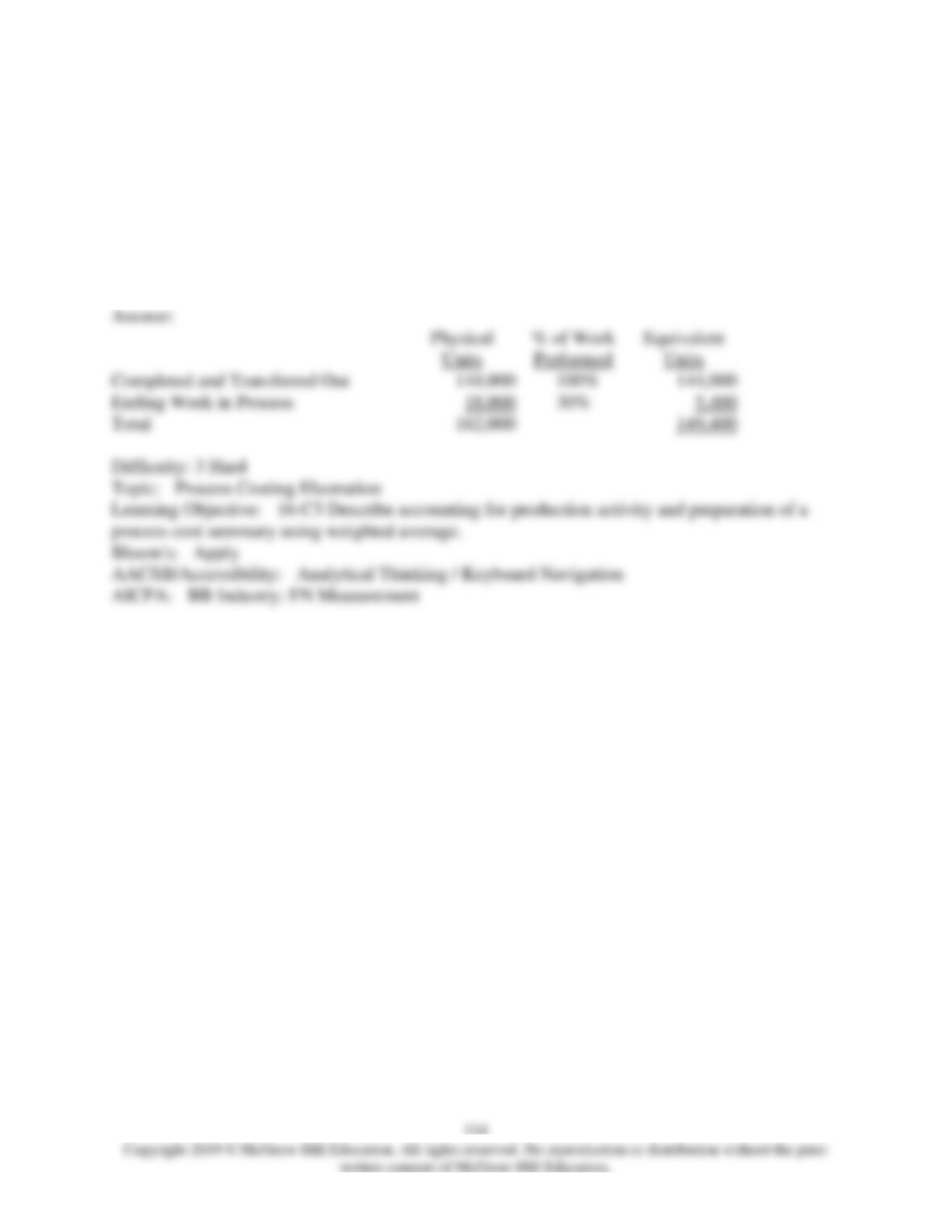
189) The following data is available for Donaldson Corp. for the current year:
Beginning inventory of Work in Process 12,000 units, 60% completed
Ending inventory of Work in Process 18,000 units, 30% completed
Units completed and transferred to
finished goods during the year 144,000 units
Calculate the equivalent units of production for the year using the weighted average method.
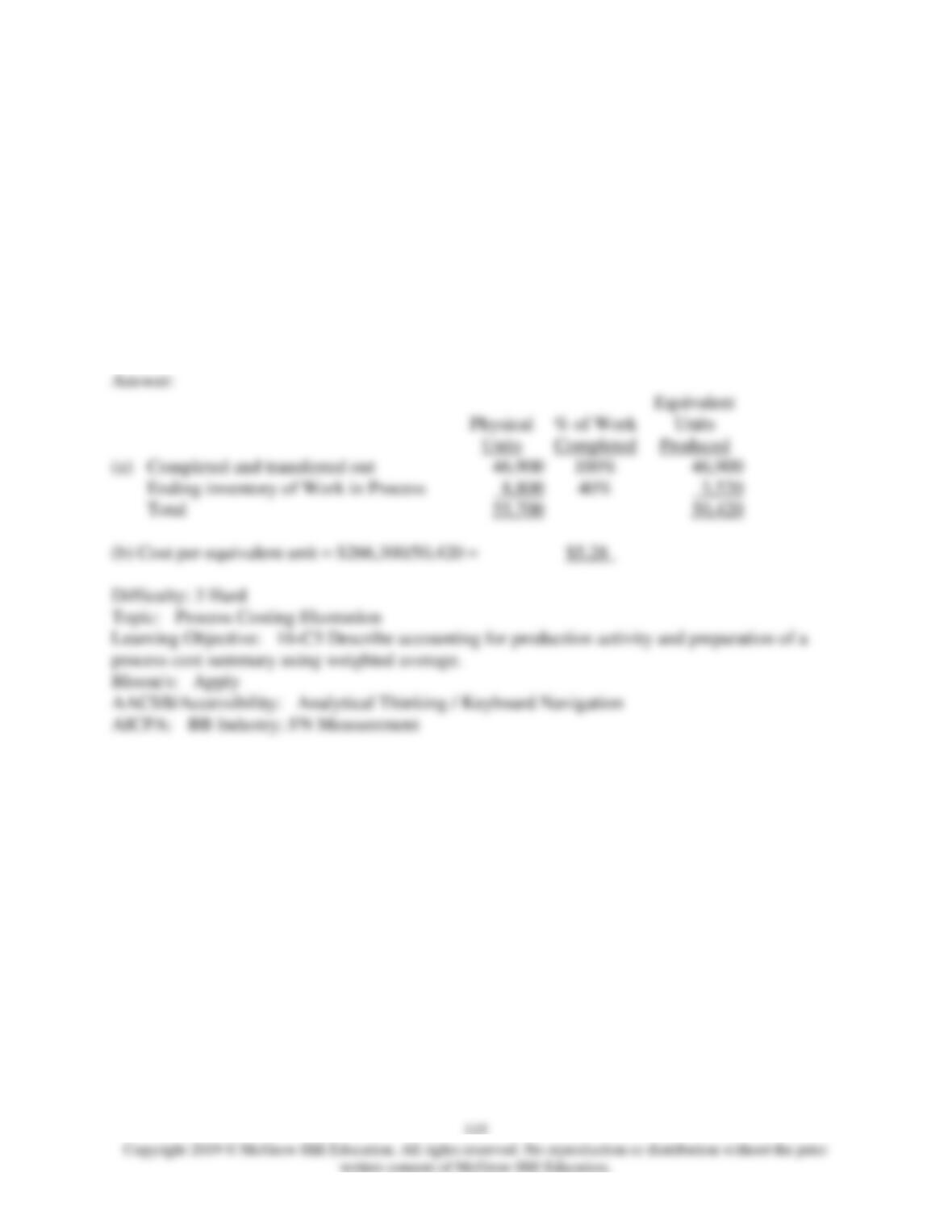
190) A company uses a process costing system and the weighted average method for inventory
costs. The following information is available regarding direct labor for the current year:
Work in Process, January 1 5,500 units, 80% complete
Work in Process, December 31 8,800 units, 40% complete
Units completed and transferred to
finished goods 46,900 units
Direct labor costs during the year $266,300
(a) Calculate the equivalent units of production for direct labor for the year.
(b) Calculate the cost per equivalent unit for direct labor (round to the nearest cent).
191) A company uses a process costing system and the weighted average method for inventory
costs. The following information is available regarding conversion activities for the current year:
Work in Process, January 1 5,500 units, 80% complete
Work in Process, December 31 7,800 units, 50% complete
Units completed and transferred to finished goods 46,900 units
Calculate the equivalent units of production for conversion costs for the year.
192) A company uses a process costing system and the weighted average method for inventory
costs. The following information is available regarding direct labor for the current year:
Ending Work in Process 5,300 units, 50% complete
Units completed and transferred to finished goods 28,700 units
Direct labor costs during the year $199,300
Calculate the average cost per equivalent unit for direct labor (round to the nearest cent).
193) Refer to the following information about the Finishing Department in the Davidson Factory
for the month of June. Davidson Factory uses the FIFO method of inventory costing.
Beginning Work in Process inventory:
Physical units…………………………………………… 5,000 units
% complete for materials………………………………. 70%
% complete for labor and overhead……………………. 25%
Materials cost from May……………………………….. $7,350
Labor and overhead cost from May……………………. $3,125
Product started and completed:
Physical units…………………………………………… 40,000 units
Ending Work in Process inventory:
Physical units……………………………………………. 4,000 units
% complete for materials………………………………. 40%
% complete for labor and overhead……………………. 10%
Manufacturing costs for June:
Materials………………………………………………… $96,975
Labor and overhead……………………………………… $79,470
Compute equivalent units for direct materials, direct labor and overhead for June.

119
194) Refer to the following information about the Finishing Department in the Davidson Factory
for the month of June. Davidson Factory uses the FIFO method of inventory costing.
Beginning Work in Process inventory:
Physical units…………………………………………… 5,000 units
% complete for materials………………………………. 70%
% complete for labor and overhead……………………. 25%
Materials cost from May……………………………….. $7,350
Labor and overhead cost from May……………………. $3,125
Product started and completed:
Physical units…………………………………………… 40,000 units
Ending Work in Process inventory:
Physical units……………………………………………. 4,000 units
% complete for materials………………………………. 40%
% complete for labor and overhead……………………. 10%
Manufacturing costs for June:
Materials………………………………………………… $96,975
Labor and overhead……………………………………… $79,470
Compute the equivalent cost per unit for direct materials, direct labor and overhead for June.