123. On January 1, 2010, Microtech Company awarded a fixed compensation stock option plan to 40
executives. The plan allows each executive to buy 2,000 shares of the company’s $10 par common stock for $25
a share after a four-year service period. The fair value of each option on the grant date is $12. The company
expects an annual executive turnover rate of 4%. In 2011, the rate changed to 2% for the entire service period.
On December 31, 2013, 60,000 options vest and the rest are forfeited. On January 5, 2014, 10 executives of
Microtech exercised their options.
Required:
a.
Prepare the journal entries for 2010 through 2013.
b.
Prepare the journal entry for January 5, 2014.
.97)
b.
$684,505 ($2,053,514/3 years)
c.
Cash (6 ´ 5,000 shares ´ $30)
900,000
Common Stock (6 ´ 5,000 shares ´ $10)
300,000
Additional Paid-in Capital on Common Stock
805,351
124. On January 1, 2010, Aspire Company adopts a performance-based stock option plan with a four-year
vesting and service period, a $35 exercise price, and a $6 per option fair value. The plan grants a maximum of
2,000 shares of $5 par common stock to each of the company’s 30 executives. The number of shares that vest
depends on the increase in sales during the service period, based on the following scale:
Sales Increase
at Least
No. of Shares
5%
1,000
10%
1,500
15%
2,000
January 1, 2010:
December 31, 2010:
Compensation Expense*
203,843
Common Stock Option Warrants
203,843
*
40 ´ 2000 shares ´ $12 ´ .96 ´ .96 ´ .96 ´ .96 = 815,373;
$815,373/4 years = $203,843
December 31, 2011:
Compensation Expense*
238,894
Common Stock Option Warrants
238,894
*
[40 ´ 2000 shares ´ $12 ´ .98 ´ .98 ´ .98 ´ .98 = 885,473;
$885,473 ´ (1/2) = $442,737;
$442,737 – 203,843 = $238,894]
December 31, 2012:
Compensation Expense*
221,368
Common Stock Option Warrants
221,368
*
$885,473 ´ (3/4) years = $221,368;
or $885,473 ´ 3/4 = $664,105; $664,105 – ($203,843 + $238,894) = $221,368
December 31, 2013:
Compensation Expense*
55,895
Common Stock Option Warrants
55,895
*
$60,000 ´ $12 = $720,000;
$720,000 – ($203,843 + $238,894 + $221,368) = $55,895
Cash (20,000 ´ $25)
500,000
Common Stock (20,000 ´ $10)
200,000
Additional Paid-in Capital on Common Stock
540,000
Aspire estimates that sales will increase by 12% during the service period. The estimate is achieved and all options are exercised on January 1, 2014.
Required:
Assuming Aspire uses the fair value method to account for its stock option plan, prepare all of the journal entries over the life of Aspire’s stock option
plan (2010 through 2014).
125. On January 1, 2010, Dresser Company granted a performance-based stock option plan to 40 executives to
buy a maximum of 3,000 shares each of its $10 par common stock at $30 a share. The fair value per option is
$8. The terms of the plan, which has a three-year service and vesting period, are based on the following scale:
Sales Increase
at Least
No. of Shares
10%
1,000
15%
2,000
20%
3,000
Dresser expects an annual employee turnover rate of 4%, and the company initially anticipates an increase in sales during the service period of 18%.
By the end of 2012, the actual sales increase is 17%.
Required:
a.
Compute the estimated total compensation cost.
b.
Compute the annual compensation expense for each of the three years.
c.
Prepare the January 1, 2013, entry when 10 executives exercise their options.
a.
$566,231 (2,000 shares ´ $8 ´ 40 ´ .96 ´ .96 ´ .96)
b.
$188,744/year ($566,231/3 years)
Additional Paid-in Capital on Common Stock
Each December 31, 2010 through 2013:
Compensation Expense*
67,500
Common Stock Option Warrants
67,500
*
1,500 shares ´ $6 ´ 30 = $270,000;
$270,000/4 years = $67,500
January 1, 2014:
Cash ($35 ´ 1,500 shares ´ 30)
1,575,000
Common Stock Option Warrants
270,000
Common Stock ($5 ´ 1,500 shares ´ 30)
225,000
Additional Paid-in Capital on Common Stock
1,620,000
126. On January 1, 2010, Nickelson Company gave 50 executives a performance-based stock option plan that
allowed them to buy a maximum of 2,000 shares each of the company’s $5 par common stock at $15 a share.
On the grant date, the fair value per option was $7. The shares will be awarded based on the increase in sales
over a four-year service and vesting period as follows:
Sales Increase
at Least
No. of Shares
5%
500
10%
1,000
15%
2,000
The company estimates sales will increase by 8% during the service period and that the annual employee turnover rate will be 3%. During 2012, the
estimated annual employee turnover rate was changed to 5% for the entire service period. At the end of the four-year period, options vested for the
remaining 40 executives and sales actually increased by 12%.
Required:
Prepare the journal entries to reflect the events affecting Nickelson’s plan for the four-year service period.
December 31, 2010 and 2011:
Compensation Expense*
38,732
Common Stock Option Warrants
*
50 ´ $7 ´ 500 shares ´ .97 ´ .97 ´ .97 ´ .97 = $154,926; $154,926 ´ 1/4 = $38,732
December 31, 2012:
Compensation Expense*
29,440
Common Stock Option Warrants
*
50 ´ $7 ´ 500 shares ´ .95 ´ .95 ´ .95 ´ .95 = $142,539;
$142,539 ´ 3/4 = $106,904;
$106,904 – ($38,732 + $38,732) = $29,440
December 31, 2013:
Compensation Expense*
173,096
Common Stock Option Warrants
*
40 ´ $7 ´ 1,000 shares = $280,000;
$280,000 – ($38,732 + $38,732 + $29,440) = $173,096
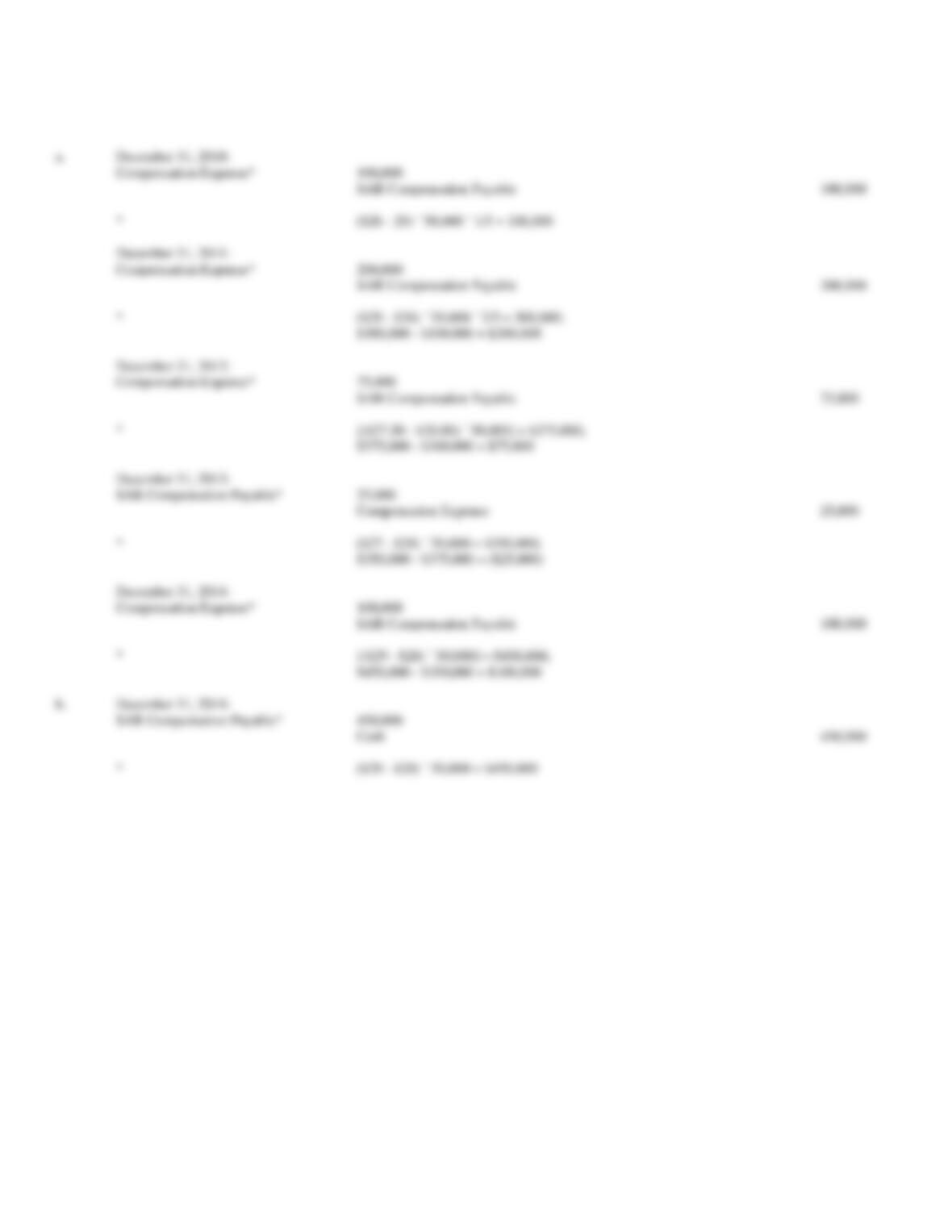
127. On January 1, 2010, the Lacey Corporation granted 50,000 stock appreciation rights (SARs) to the
company’s president, Lacey Darling. Lacey will be entitled to receive cash or common stock or some
combination of cash and common stock for the difference between the quoted market price at the date of
exercise and a $20 option price per SAR. It is assumed that Lacey will elect to receive cash when she exercises
her SARs. The service period is three years, and she may exercise her SARs during the period January 1, 2013,
through December 31, 2014. The market prices per share of Lacey Corporation’s common stock are as follows:
January 1, 2010
$22.00
December 31, 2010
26.00
December 31, 2011
29.00
December 31, 2012
27.50
December 31, 2013
27.00
December 31, 2014
29.00
On December 31, 2014, Lacey Darling exercises her 5,000 SARs and elects to receive cash.
Required:
a.
Prepare the journal entries to record each year’s compensation expense related to the SARs.
b.
Prepare the December 31, 2014 entry to record the exercise of the 50,000 SARs.
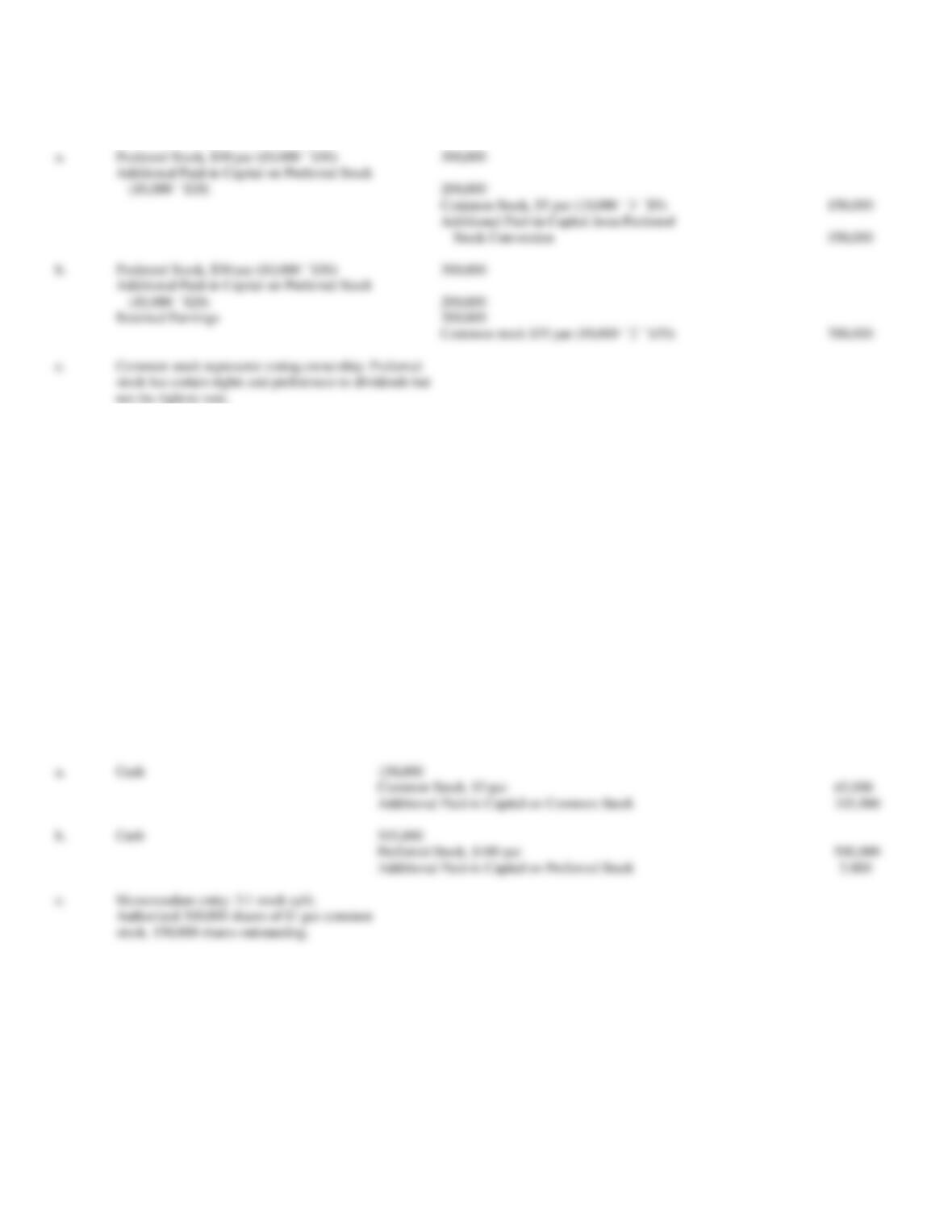
128. Travis had outstanding 40,000 shares of $30 par convertible preferred stock that had been sold at $50 a
share. One-fourth of these shares were converted into common stock at the stated ratio of three shares of $5 par
common stock (now selling at $15 a share) for each share of preferred stock.
Required:
a.
Record the conversion of preferred into common stock.
b.
Use the same information as in requirement a except assume that each share of preferred stock is convertible into two shares of $35 par
common stock (now selling at $40 a share). Record this conversion of preferred into common stock.
c.
Why did Travis not have common stock converted into preferred stock?
a.
December 31, 2010:
Compensation Expense*
100,000
SAR Compensation Payable
*
($26 – 20) ´ 50,000 ´ 1/3 = 100,000
December 31, 2011:
Compensation Expense*
200,000
SAR Compensation Payable
*
($29 – $20) ´ 50,000 ´ 2/3 = 300,000;
$300,000 – $100,000 = $200,000
December 31, 2012:
Compensation Expense*
75,000
SAR Compensation Payable
*
[($27.50 – $20.00) ´ 50,000] = $375,000;
$375,000 – $300,000 = $75,000
December 31, 2013:
SAR Compensation Payable*
25,000
Compensation Expense
*
($27 – $20) ´ 50,000 = $350,000;
$350,000 – $375,000 = ($25,000)
December 31, 2014:
Compensation Expense*
100,000
SAR Compensation Payable
*
[($29 – $20) ´ 50,000] = $450,000;
$450,000 – $350,000 = $100,000
December 31, 2014:
SAR Compensation Payable*
450,000
Cash
*
($29 – $20) ´ 50,000 = $450,000
129. During 2010, Goodnight has the following transactions involving its common and preferred stock:
a.
Issued 15,000 shares of $3 par common stock for $10 a share. This brings total shares outstanding to 50,000 shares.
b.
Issued 5,000 shares of $100 par, 6%, cumulative preferred stock for $101 per share.
c.
When the market value of the common stock reached $15 a share, Goodnight declared a 3-for-1 stock split, reducing the par value to $1
per share.
Required:
Prepare a journal entry for each transaction.
a.
Cash
150,000
Additional Paid-in Capital on Common Stock
b.
Cash
505,000
Additional Paid-in Capital on Preferred Stock
Authorized 300,000 shares of $1 par common
a.
Preferred Stock, $30 par (10,000 ´ $30)
300,000
Additional Paid-in Capital on Preferred Stock
Common Stock, $5 par (10,000 ´ 3 ´ $5)
Additional Paid-in Capital from Preferred
Stock Conversion
b.
Preferred Stock, $30 par (10,000 ´ $30)
300,000
Additional Paid-in Capital on Preferred Stock
(10,000 ´ $20)
200,000
Retained Earnings
200,000
not the right to vote.
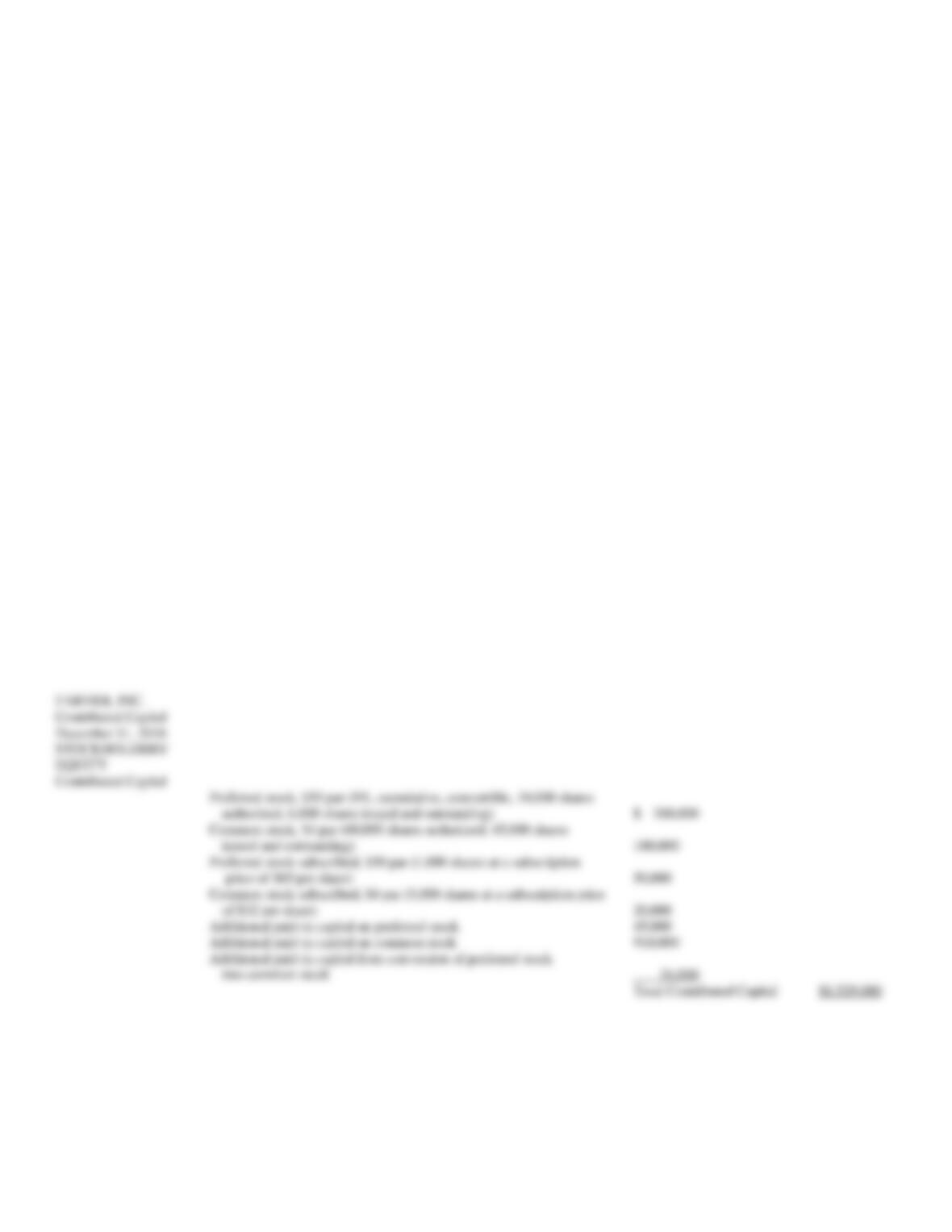
130. A partial listing of accounts and ending balances for Farver, Inc., on December 31, 2010, is shown below:
Investments in long-term notes receivable
$ 40,000
Bonds payable
300,000
Temporary investment in equity securities available for sale
120,000
Premium on bonds payable
26,000
Common stock
180,000
Subscriptions receivable: common stock
120,000
Additional paid-in capital from preferred stock conversion
24,000
Retained earnings
650,000
Preferred stock
300,000
Long-term investment in equity securities available for sale
150,000
Additional paid-in capital on common stock
910,000
Common stock subscribed
20,000
Goodwill
46,000
Donated capital
35,000
Preferred stock subscribed
50,000
Additional paid-in capital on preferred stock
45,000
Following is additional information relative to the above accounts:
·
The preferred stock is 8% cumulative with par value of $50. For the preferred stock, 10,000 shares have been authorized, 6,000 shares
are issued and outstanding, and 1,000 shares have been subscribed at a price of $65 per share. Each share of preferred stock is
convertible into four shares of common.
·
Bonds payable mature on September 30, 2018. They have a stated interest rate of 10%, payable semiannually. The straight-line method
is used to amortize the premium.
·
Common stock has a par value of $4 per share. For the common stock, 60,000 shares have been authorized, 45,000 shares are issued
and outstanding, and 5,000 shares have been subscribed at $32 per share.
Required:
Prepare the contributed capital section of the December 31, 2010 balance sheet for Farver, Inc. Include appropriate parenthetical notes for the
common and preferred stock.
FARVER, INC.
December 31, 2010
STOCKHOLDERS’
EQUITY
Contributed Capital
Preferred stock, $50 par (8%, cumulative, convertible, 10,000 shares
authorized, 6,000 shares issued and outstanding)
$ 300,000
Common stock, $4 par (60,000 shares authorized, 45,000 shares
issued and outstanding)
180,000
Preferred stock subscribed, $50 par (1,000 shares at a subscription
price of $65 per share)
50,000
Common stock subscribed, $4 par (5,000 shares at a subscription price
of $32 per share)
20,000
Additional paid-in capital on preferred stock
45,000
Additional paid-in capital on common stock
910,000
Additional paid-in capital from conversion of preferred stock
into common stock
24,000
Total Contributed Capital

131. Given the following information for Fox Company:
Bonds payable
$50,000
Common stock
20,000
Premium on preferred stock
9,000
Long-term investments in equity securities held for sale
10,000
Preferred stock subscribed
22,000
Retained earnings
53,500
Premium on common stock
28,460
Common stock subscribed
3,800
Subscriptions receivable: preferred stock
7,000
Premium on bonds payable
4,000
Preferred stock
40,000
Temporary investments in equity securities held for sale
15,000
Subscriptions receivable: common stock
5,600
Required:
Compute the total amount of contributed capital for Fox Company.
132. Several items appear below.
____
a.
Additional paid-in capital on preferred stock
____
b.
Subscriptions receivable: preferred stock
____
c.
Premium on bonds payable
____
d.
Organization expense
____
e.
Long-term investments in equity securities held for sale
____
f.
Common stock subscribed
____
g.
Authorized common stock
____
h.
Treasury stock
____
i.
Additional paid-in capital from treasury stock
____
j.
Retained earnings
Required:
Place an X in front of each item that will appear in the stockholders’ equity section of the balance sheet.
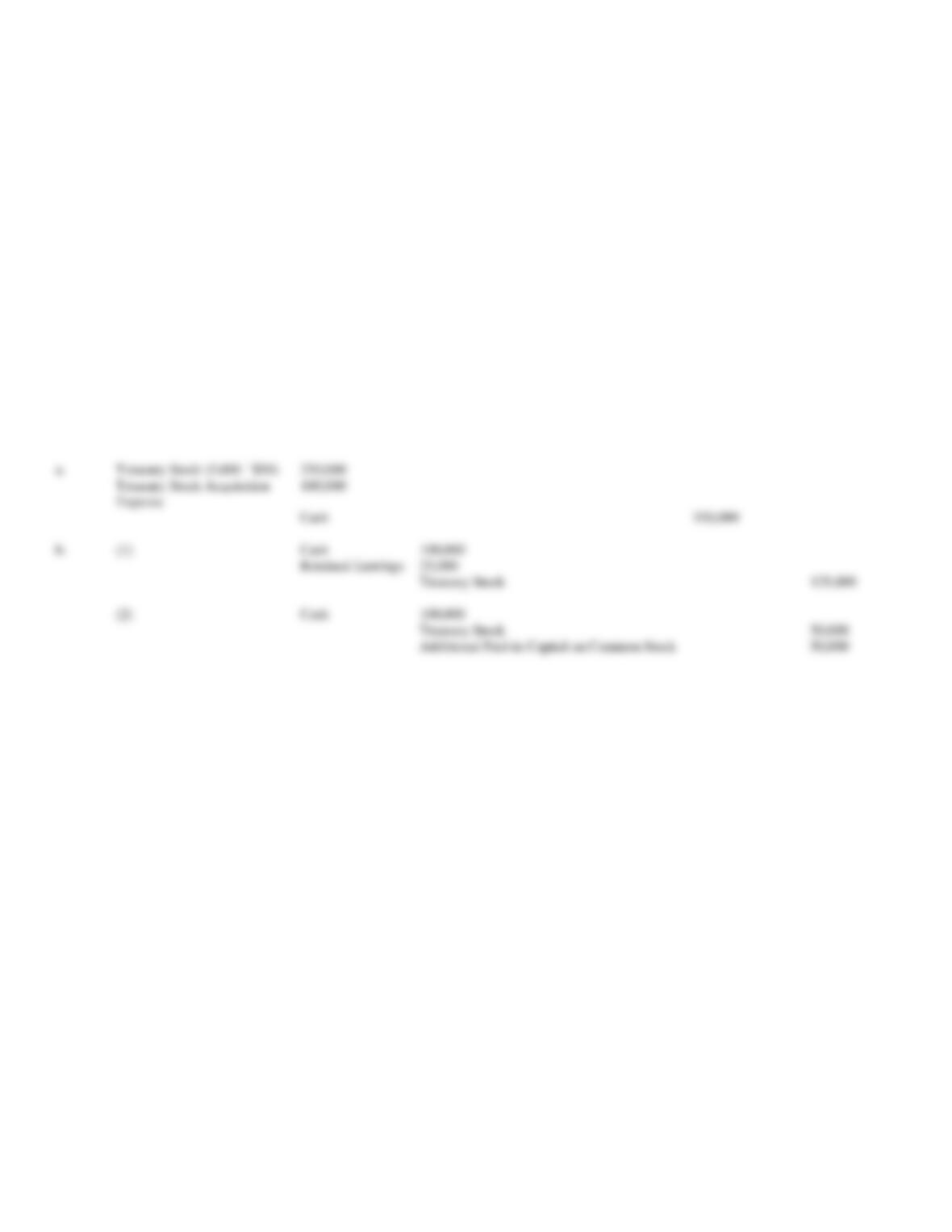
133. Brown Bear Co. originally issued 25,000 shares of its $20 par common stock for $30 a share. Recently, in
order to prevent a takeover attempt, Brown Bear reacquired 5,000 shares of its common stock for $70 a share.
At the time the stock was reacquired, the fair market value was $50 a share.
Required:
a.
Prepare the journal entry necessary to record this
reacquisition.
b.
Assume 2,500 shares are subsequently reissued at $40 a
share.
(1)
Prepare the journal entry to record the reissuance using the cost method.
(2)
Prepare the journal entry to record the reissuance using the par value method.
134. Quick Xray, Inc. reacquired 2,000 shares of its $5 par common stock at $15 a share. The stock originally
sold for $10 a share.
Required:
a.
Prepare the journal entry to record the reacquisition under the
(1)
cost method
(2)
par value method
b.
Prepare the journal entry to record the reissuance of 500 shares at $18 a share under the
(1)
cost method
(2)
par value method
c.
Prepare the journal entry to record the reissuance of 1,000 shares at $12 a share under the
(1)
cost method
(2)
par value method
d.
Prepare the journal entry to record the retirement of the remaining 500 shares under the
(1)
cost method
(2)
par value method
Treasury Stock (5,000 ´ $50)
250,000
Treasury Stock Acquisition
Expense
100,000
Cash
350,000
b.
(1)
Cash
100,000
Retained Earnings
25,000
Treasury Stock
125,000
(2)
Cash
100,000
Treasury Stock
50,000
Additional Paid-in Capital on Common Stock
50,000
135. Corporate stockholders can only lose the amount of their investment, in accordance with the concept of
limited liability. State laws have established protection for a corporation’s creditors with the concept of legal
capital.
Required:
Explain how legal capital protects a corporation’s creditors and discuss two different ways that legal capital can
be established by a corporation.
136. There is disagreement among accountants as to how subscriptions receivable should be reported on the
balance sheet.
Required:
Describe three different ways in which subscriptions receivable can be reflected on the balance sheet and
provide a justification for each alternative.
137. Current GAAP recommends that the fair value method be used to account for compensatory stock option
plans. From a conceptual point of view, this method is an improvement over the intrinsic value method.
Required:
Explain how the fair value method is an improvement over the intrinsic value method.
138. Many states limit the amount that may be paid to acquire treasury stock to the balance in Retained
Earnings. States also restrict the amount of retained earnings available for dividends by the cost of the treasury
stock.
Required:
Explain why these restrictions are necessary and how they can be removed.