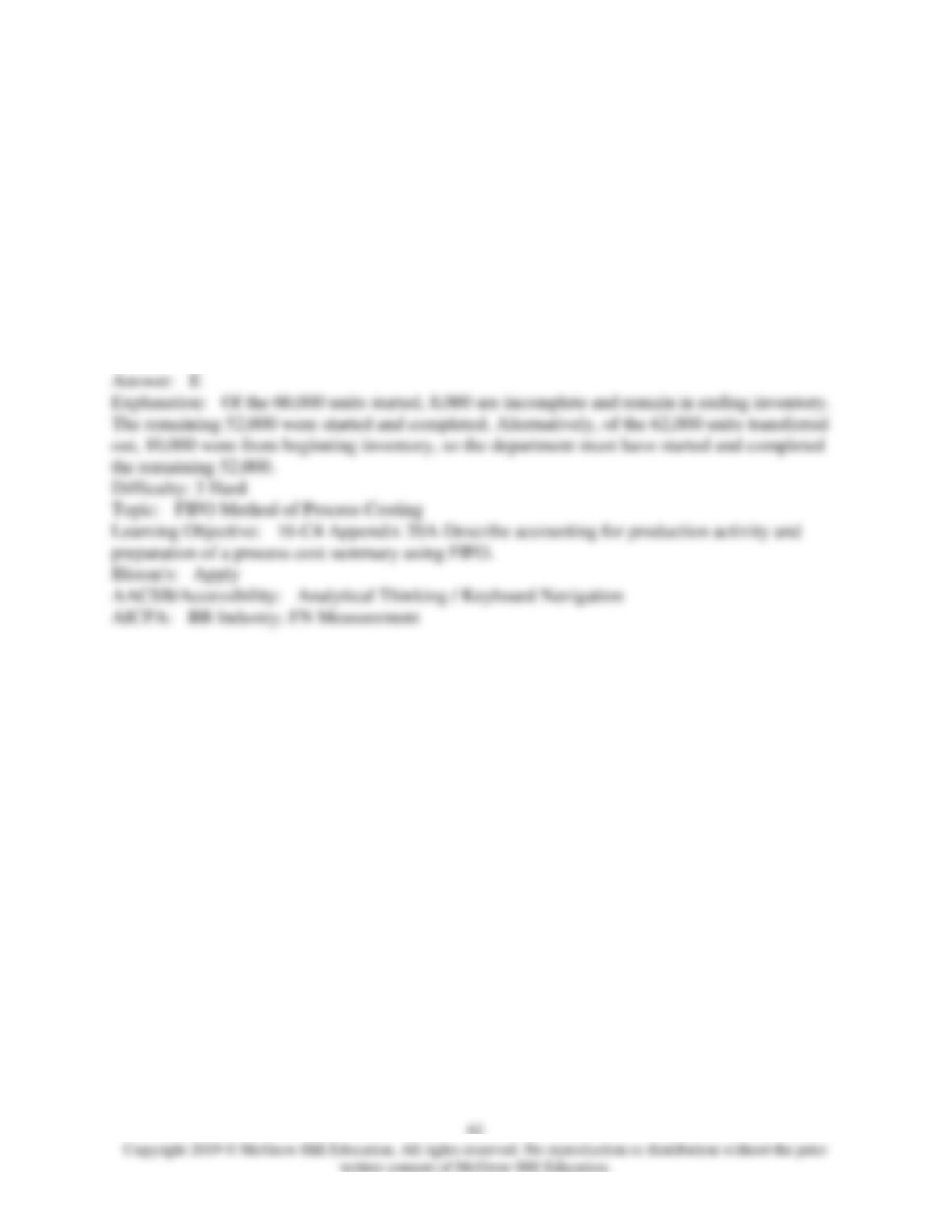
119) At the beginning of the month, the Forming Department of Martin Manufacturing had
10,000 units in inventory, 30% complete as to materials, and 10% complete as to conversion.
During the month the department started 60,000 units and transferred 62,000 units to the next
manufacturing department. At the end of the month, the department had 8,000 units in inventory,
80% complete as to materials and 60% complete as to conversion. How many units did the
Forming Department start and complete in the current month?
A) 62,000
B) 60,000
C) 58,000
D) 68,000
E) 52,000
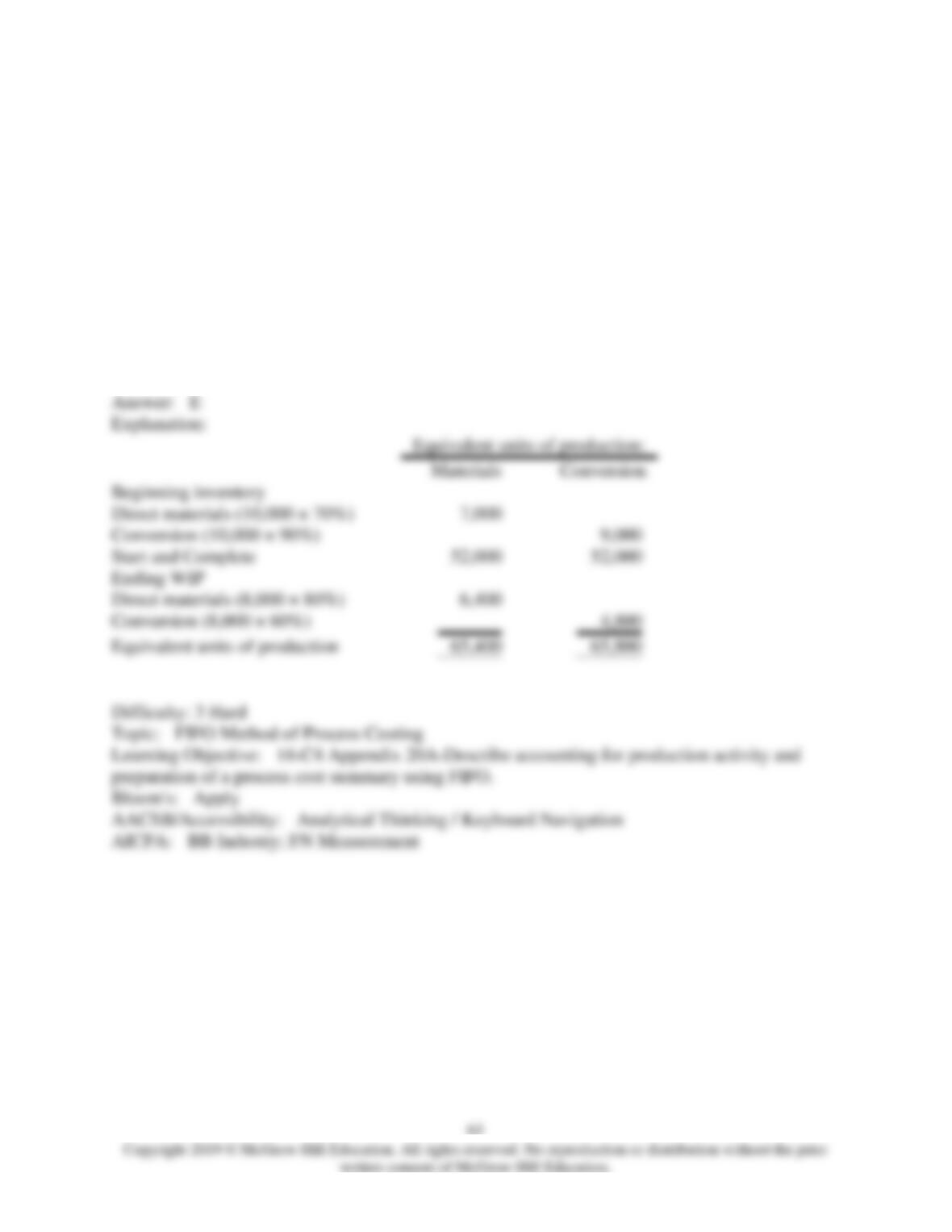
120) At the beginning of the month, the Forming Department of Martin Manufacturing had
10,000 units in inventory, 30% complete as to materials, and 10% complete as to conversion.
During the month the department started 60,000 units and transferred 62,000 units to the next
manufacturing department. At the end of the month, the department had 8,000 units in inventory,
80% complete as to materials and 60% complete as to conversion. If Martin Manufacturing uses
the FIFO method of process costing, compute the equivalent units for materials and conversion
respectively for the Forming Department.
A) 68,400 materials; 66,800 conversion.
B) 58,400 materials; 56,800 conversion.
C) 59,000 materials; 61,000 conversion.
D) 65,400 materials; 66,800 conversion.
E) 65,400 materials; 65,800 conversion.
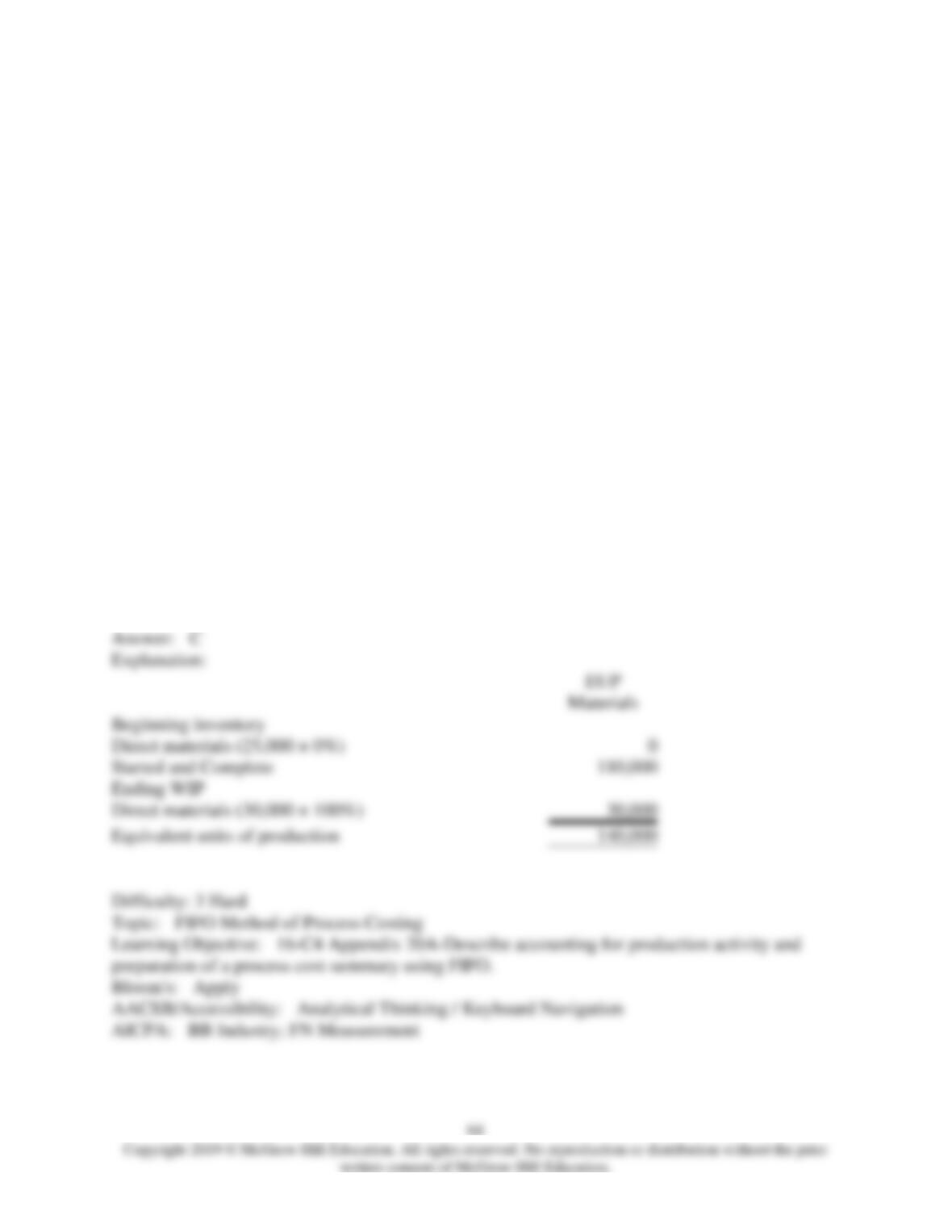
121) Sparky Corporation uses the FIFO method of process costing. The following information is
available for February in its Molding Department:
Units:
Beginning Inventory: 25,000 units, 100% complete as to materials and 55% complete as to
conversion.
Units started and completed: 110,000.
Units completed and transferred out: 135,000.
Ending Inventory: 30,000 units, 100% complete as to materials and 30% complete as to
conversion.
Costs:
Costs in beginning Work in Process – Direct Materials: $43,000.
Costs in beginning Work in Process – Conversion: $48,850.
Costs incurred in February – Direct Materials: $287,000.
Costs incurred in February – Conversion: $599,150.
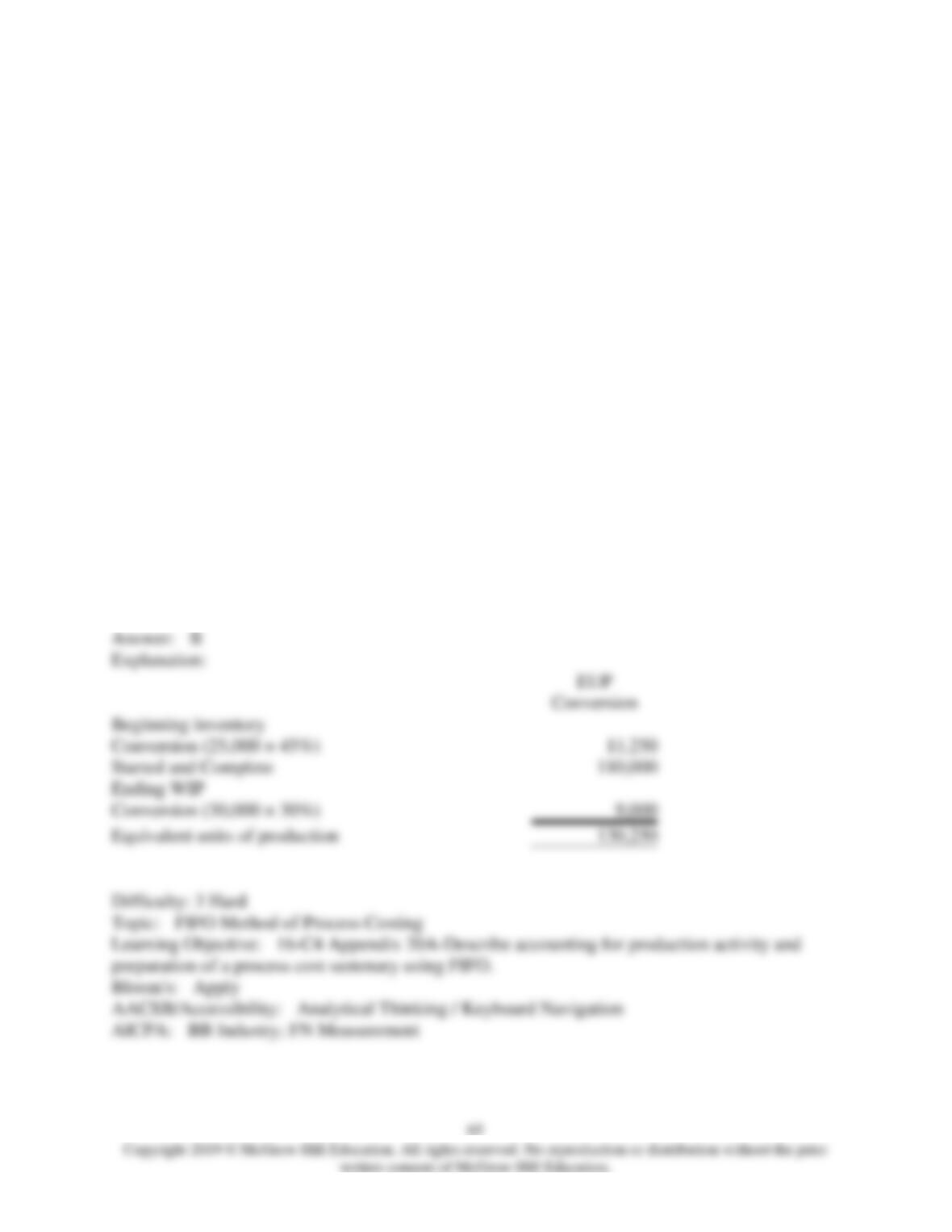
Calculate the equivalent units of materials.
A) 165,000
B) 144,000
C) 140,000
D) 130,250
E) 110,000
122) Sparky Corporation uses the FIFO method of process costing. The following information is
available for February in its Molding Department:
Units:
Beginning Inventory: 25,000 units, 100% complete as to materials and 55% complete as to
conversion.
Units started and completed: 110,000.
Units completed and transferred out: 135,000.
Ending Inventory: 30,000 units, 100% complete as to materials and 30% complete as to
conversion.
Costs:
Costs in beginning Work in Process – Direct Materials: $43,000.
Costs in beginning Work in Process – Conversion: $48,850.
Costs incurred in February – Direct Materials: $287,000.
Costs incurred in February – Conversion: $599,150.
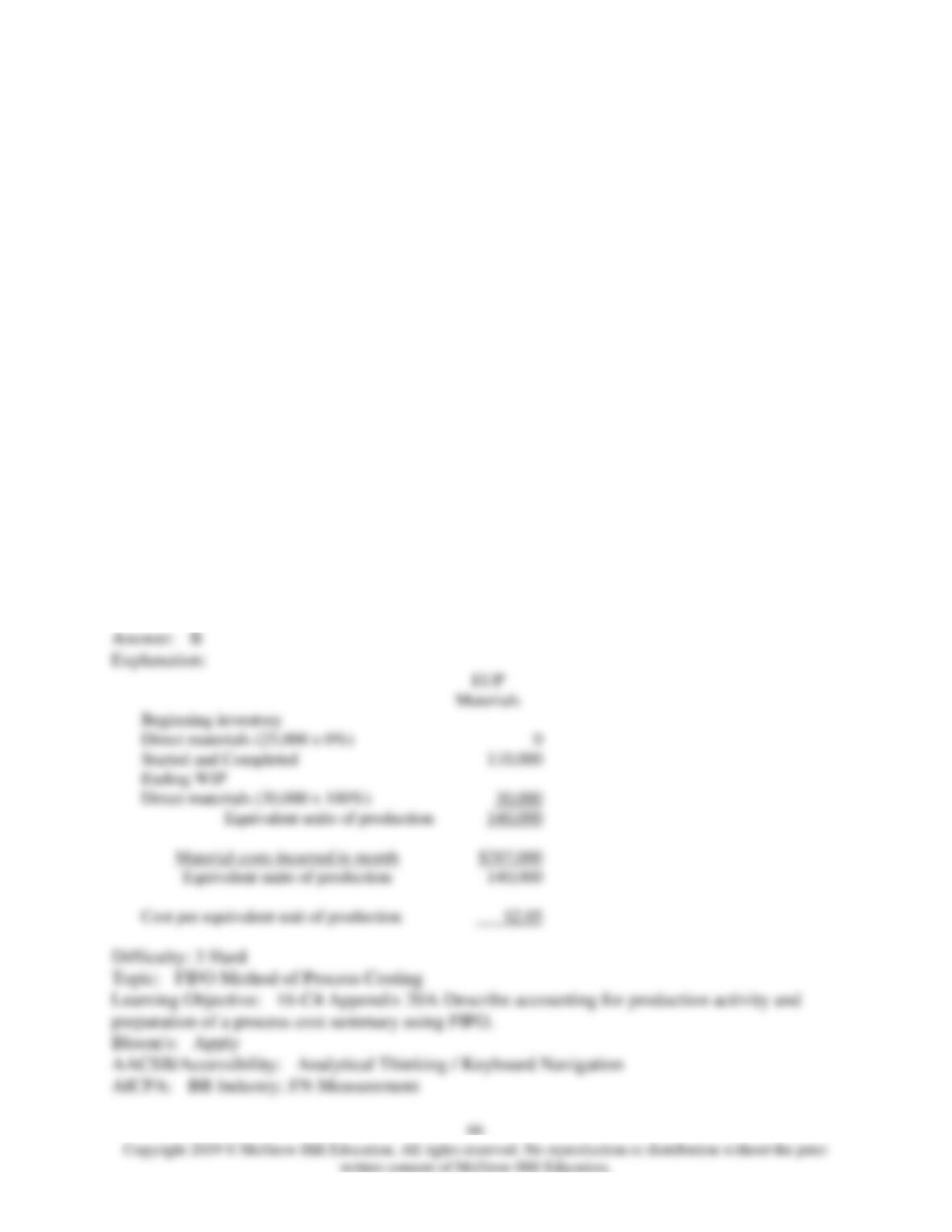
Calculate the equivalent units of conversion.
A) 165,000
B) 130,250
C) 140,000
D) 144,000
E) 110,000
123) Sparky Corporation uses the FIFO method of process costing. The following information is
available for February in its Molding Department:
Units:
Beginning Inventory: 25,000 units, 100% complete as to materials and 55% complete as to
conversion.
Units started and completed: 110,000.
Units completed and transferred out: 135,000.
Ending Inventory: 30,000 units, 100% complete as to materials and 30% complete as to
conversion.
Costs:
Costs in beginning Work in Process – Direct Materials: $43,000.
Costs in beginning Work in Process – Conversion: $48,850.
Costs incurred in February – Direct Materials: $287,000.
Costs incurred in February – Conversion: $599,150.
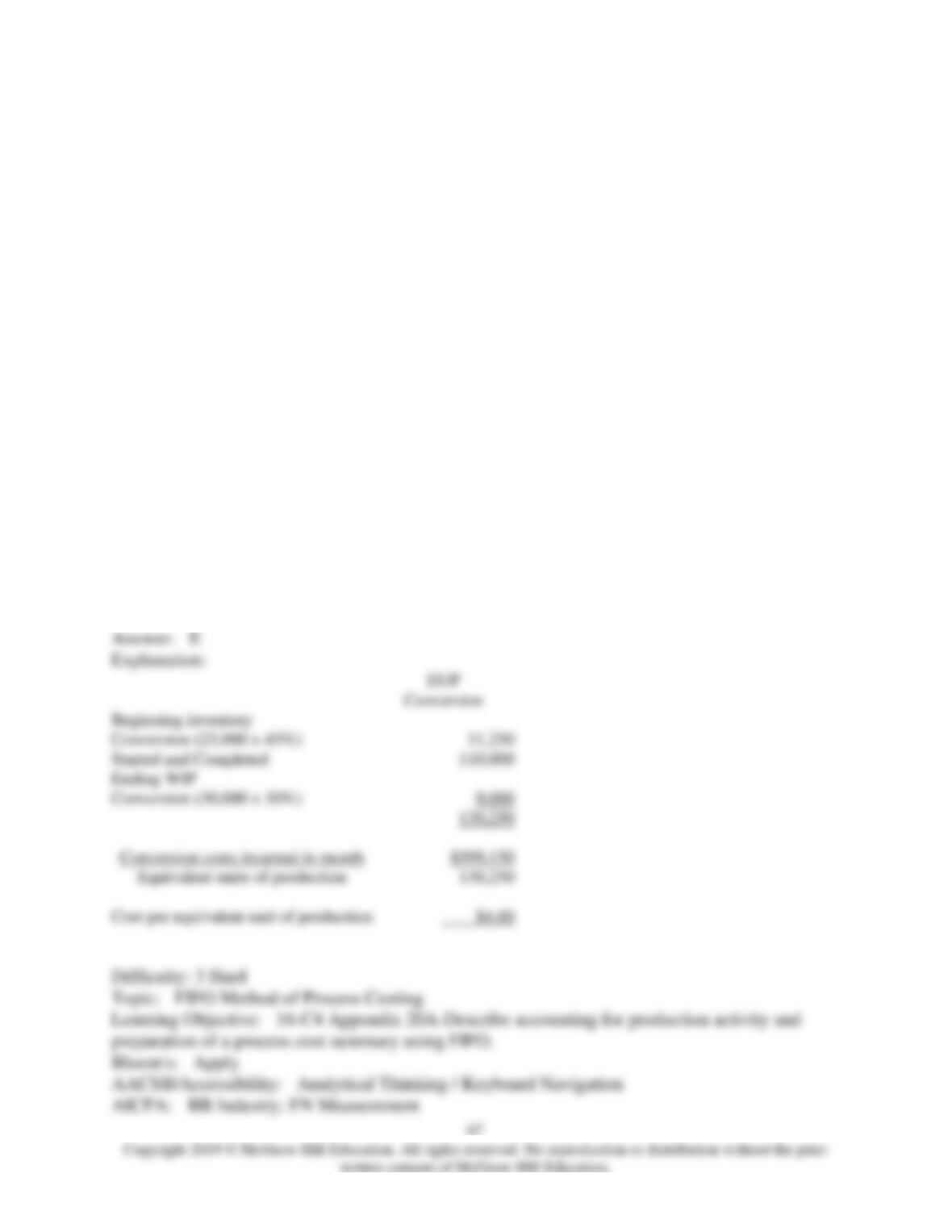
Calculate the cost per equivalent unit of materials.
A) $2.00
B) $2.05
C) $1.74
D) $2.36
E) $2.61
124) Sparky Corporation uses the FIFO method of process costing. The following information is
available for February in its Molding Department:
Units:
Beginning Inventory: 25,000 units, 100% complete as to materials and 55% complete as to
conversion.
Units started and completed: 110,000.
Units completed and transferred out: 135,000.
Ending Inventory: 30,000 units, 100% complete as to materials and 30% complete as to
conversion.
Costs:
Costs in beginning Work in Process – Direct Materials: $43,000.
Costs in beginning Work in Process – Conversion: $48,850.
Costs incurred in February – Direct Materials: $287,000.
Costs incurred in February – Conversion: $599,150.
Calculate the cost per equivalent unit of conversion.
A) $5.45
B) $4.50
C) $4.16
D) $4.98
E) $4.60
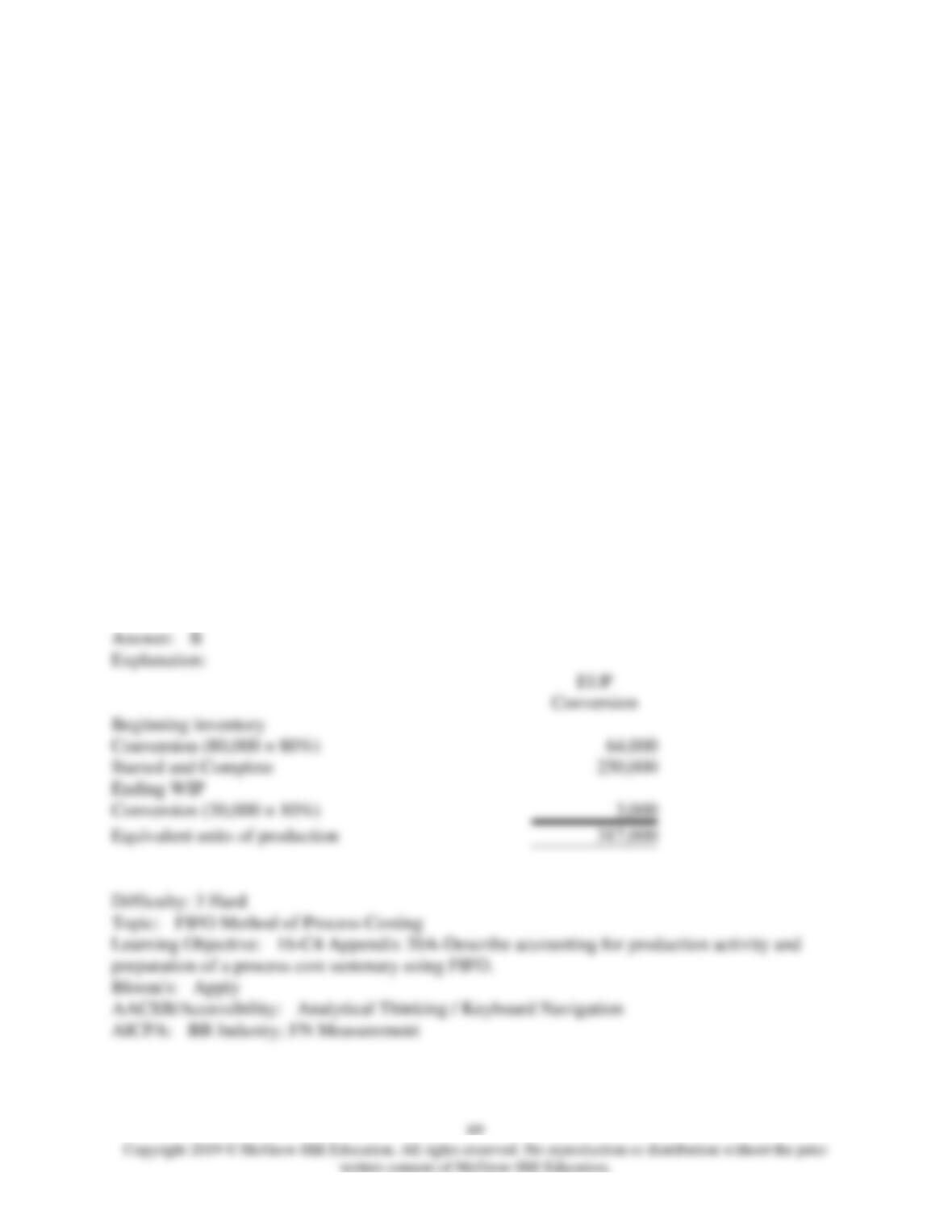
125) Richards Corporation uses the FIFO method of process costing. The following information
is available for October in its Fabricating Department:
Units:
Beginning Inventory: 80,000 units, 60% complete as to materials and 20% complete as to
conversion.
Units started and completed: 250,000.
Units completed and transferred out: 330,000.
Ending Inventory: 30,000 units, 40% complete as to materials and 10% complete as to
conversion.
Costs:
Costs in beginning Work in Process – Direct Materials: $37,200.
Costs in beginning Work in Process – Conversion: $79,700.
Costs incurred in October – Direct Materials: $646,800.
Costs incurred in October – Conversion: $919,300.
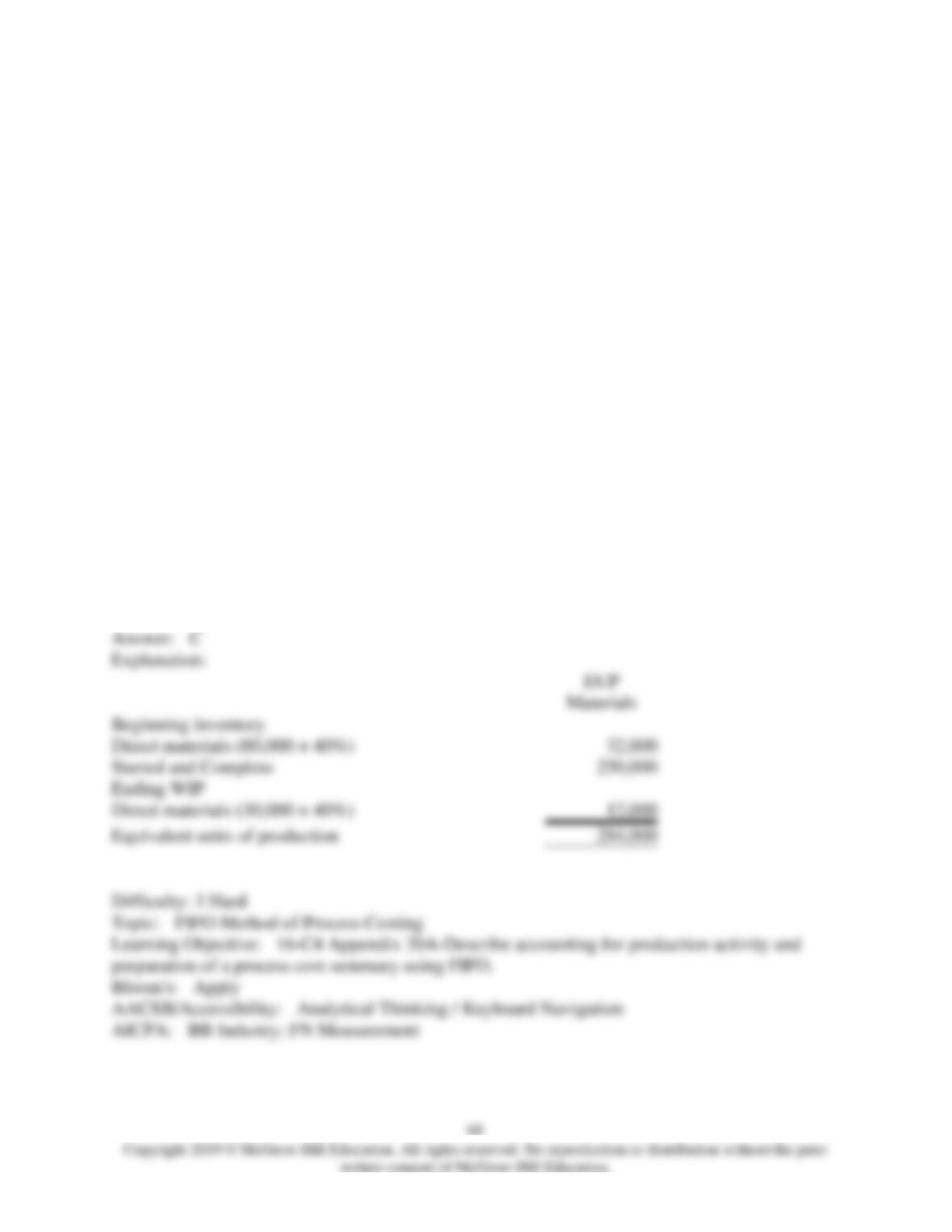
Calculate the equivalent units of materials.
A) 250,000
B) 317,000
C) 294,000
D) 333,000
E) 342,000
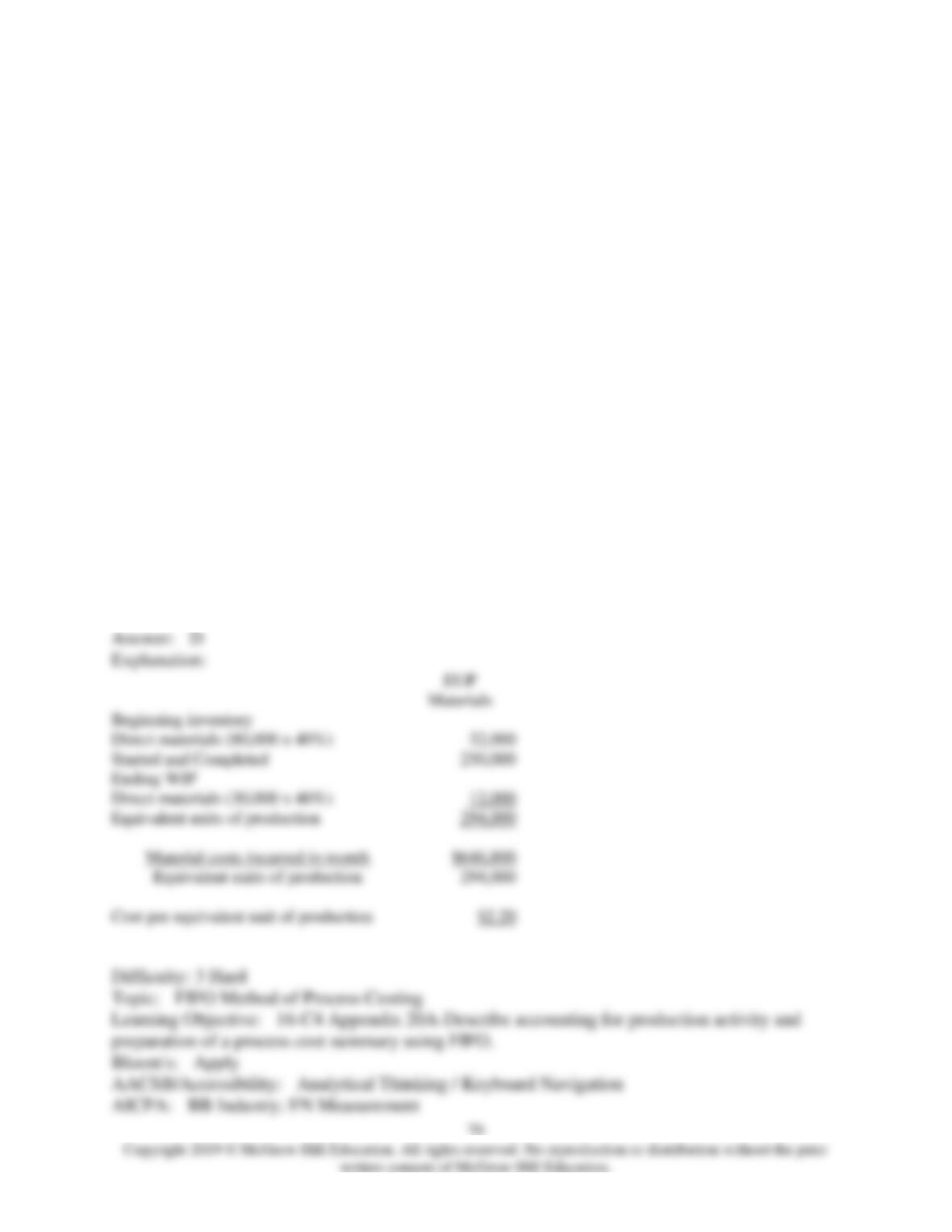
126) Richards Corporation uses the FIFO method of process costing. The following information
is available for October in its Fabricating Department:
Units:
Beginning Inventory: 80,000 units, 60% complete as to materials and 20% complete as to
conversion.
Units started and completed: 250,000.
Units completed and transferred out: 330,000.
Ending Inventory: 30,000 units, 40% complete as to materials and 10% complete as to
conversion.
Costs:
Costs in beginning Work in Process – Direct Materials: $37,200.
Costs in beginning Work in Process – Conversion: $79,700.
Costs incurred in October – Direct Materials: $646,800.
Costs incurred in October – Conversion: $919,300.
Calculate the equivalent units of conversion.
A) 250,000
B) 317,000
C) 294,000
D) 333,000
E) 342,000
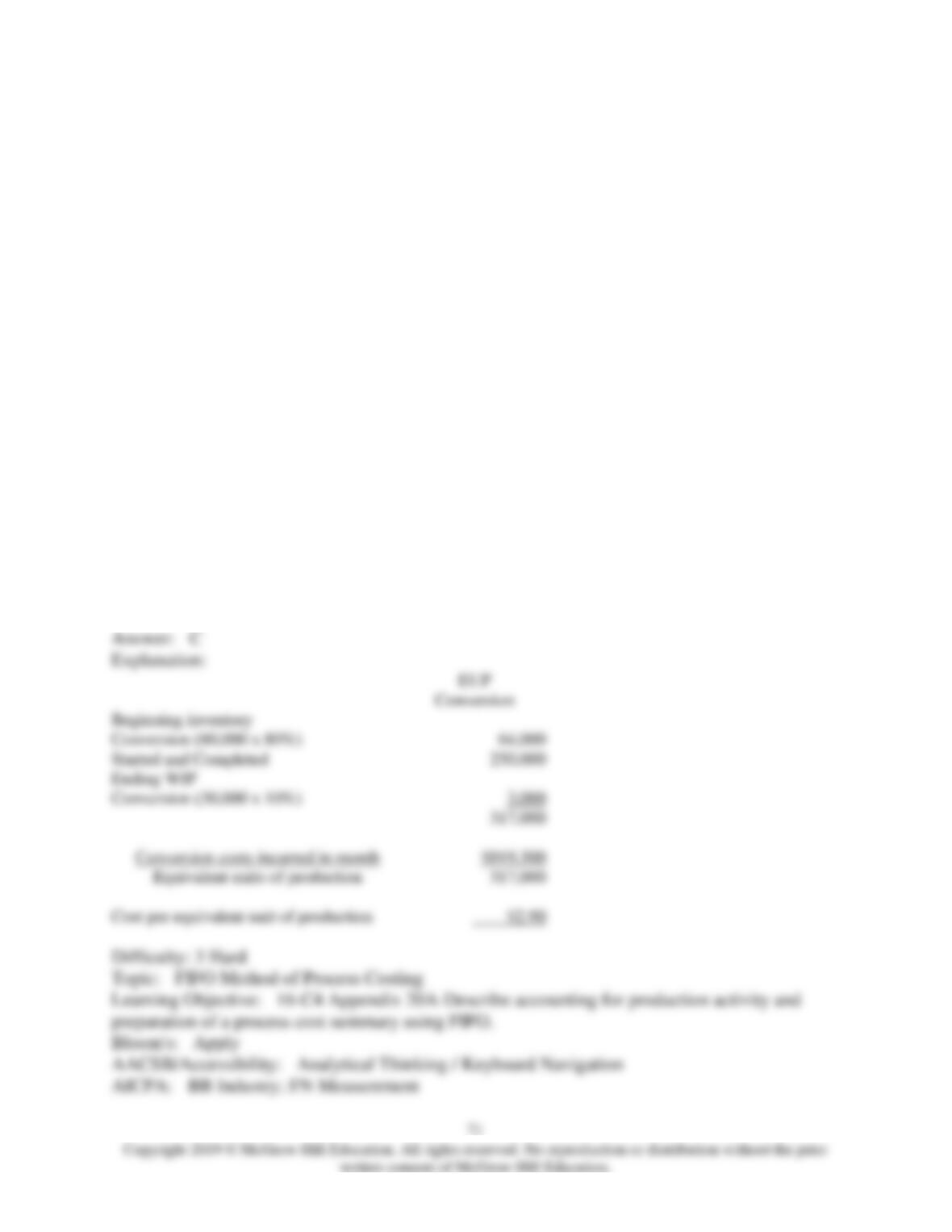
127) Richards Corporation uses the FIFO method of process costing. The following information
is available for October in its Fabricating Department:
Units:
Beginning Inventory: 80,000 units, 60% complete as to materials and 20% complete as to
conversion.
Units started and completed: 250,000.
Units completed and transferred out: 330,000.
Ending Inventory: 30,000 units, 40% complete as to materials and 10% complete as to
conversion.
Costs:
Costs in beginning Work in Process – Direct Materials: $37,200.
Costs in beginning Work in Process – Conversion: $79,700.
Costs incurred in October – Direct Materials: $646,800.
Costs incurred in October – Conversion: $919,300.
Calculate the cost per equivalent unit of materials.
A) $2.59
B) $2.33
C) $1.89
D) $2.20
E) $2.00
128) Richards Corporation uses the FIFO method of process costing. The following information
is available for October in its Fabricating Department:
Units:
Beginning Inventory: 80,000 units, 60% complete as to materials and 20% complete as to
conversion.
Units started and completed: 250,000.
Units completed and transferred out: 330,000.
Ending Inventory: 30,000 units, 40% complete as to materials and 10% complete as to
conversion.
Costs:
Costs in beginning Work in Process – Direct Materials: $37,200.
Costs in beginning Work in Process – Conversion: $79,700.
Costs incurred in October – Direct Materials: $646,800.
Costs incurred in October – Conversion: $919,300.
Calculate the cost per equivalent unit of conversion.
A) $2.76
B) $3.15
C) $2.90
D) $3.68
E) $3.00
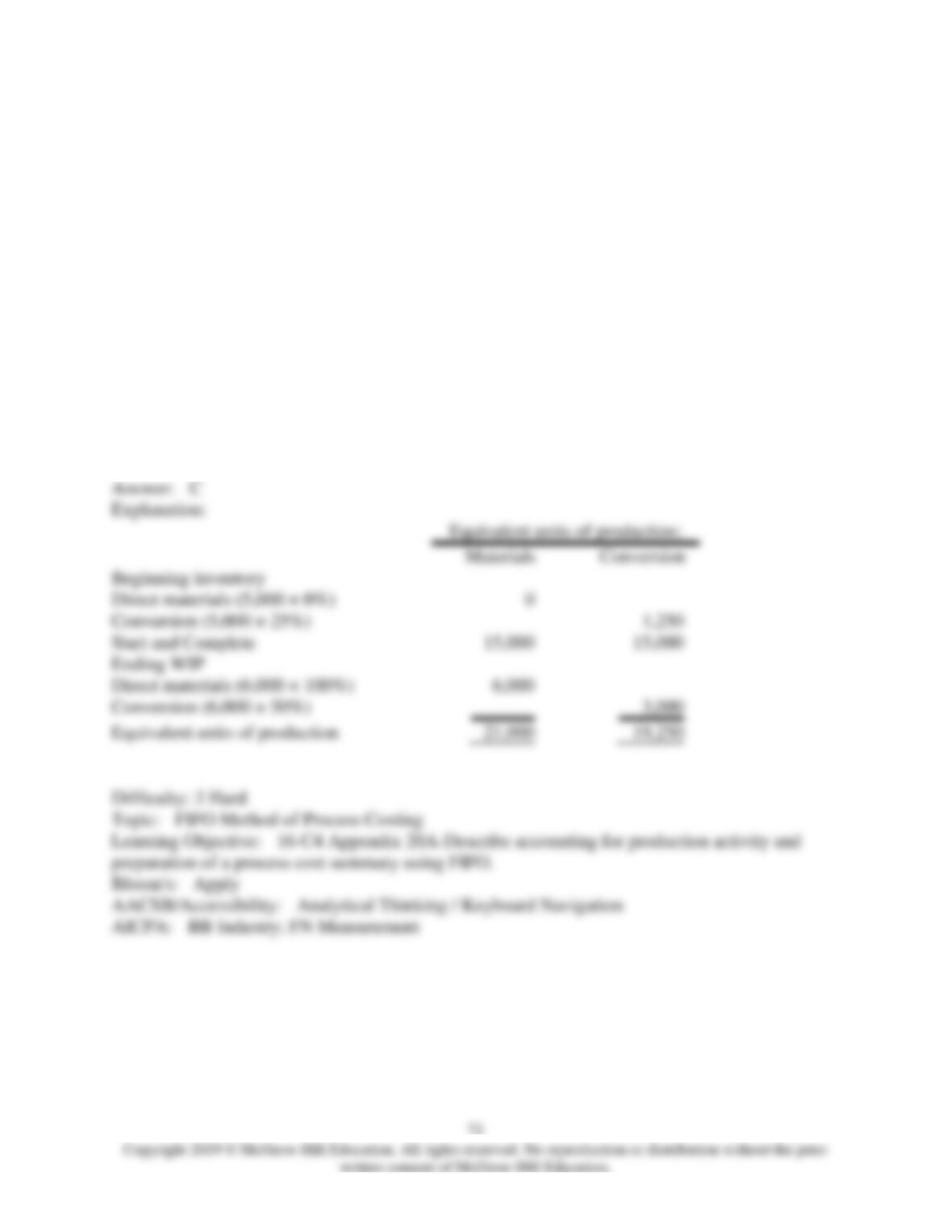
129) The following data are available for a company’s manufacturing activities:
Beginning Work in Process inventory
5,000
units
75% completed as to conversion
Units started and completed
15,000
Ending Work in Process inventory
6,000
units
50% completed as to conversion
If materials are added when the production process begins and conversion costs are applied
uniformly throughout the process, what are the equivalent units for direct materials and for
conversion, respectively using the FIFO method of process costing?
A) 16,250 materials; 19,250 conversion.
B) 16,250 materials; 21,750 conversion.
C) 21,000 materials; 19,250 conversion.
D) 19,250 materials; 18,750 conversion.
E) 21,000 materials; 22,250 conversion.
Beginning inventory
Direct materials (5,000 × 0%)
Conversion (5,000 × 25%)
Start and Complete
15,000
Ending WIP
Direct materials (6,000 × 100%)
6,000
Conversion (6,000 × 50%)
Equivalent units of production
130) A system of accounting in which costs are accumulated and then measured per unit at the
end of a period by combining costs per equivalent unit from various departments is a:
A) General cost accounting system.
B) Process costing system.
C) Job order cost accounting system.
D) Manufacturing cost accounting system.
E) Work in Process accounting system.
131) A company that applies process costing is most frequently characterized by:
A) Low standardization and high production volume.
B) Custom orders and mass production.
C) Repetitive production and unique products.
D) Repetitive production and low production volume.
E) Similar products and high production volume.
132) An organizational unit of a factory that has the responsibility for partially manufacturing or
producing a product is called a:
A) Production department.
B) Service department.
C) Primary department.
D) Responsibility department.
E) Control department.
133) A hybrid costing system would be most appropriate when:
A) A manufacturer is able to standardize processes while at the same time attempting to meet
individual customer needs.
B) Large quantities of identical products are being produced.
C) The volume of production is low and costs are high.
D) There is no standardization of units of production.
E) All the products produced are unique.
134) In a process costing system, direct material costs incurred are recorded:
A) Indirectly to a Work in Process Inventory account from Factory Overhead.
B) Indirectly to a Finished Goods Inventory account from Factory Overhead.
C) Directly to a Work in Process Inventory account.
D) Directly to a Finished Goods Inventory account.
E) Directly to a Cost of Goods Sold account.
135) The purchase of raw materials on account in a process costing system is recorded with a:
A) Debit to Purchases and credit to Cash.
B) Debit to Purchases and a credit to Accounts Payable.
C) Debit to Raw Materials Inventory and a credit to Accounts Payable.
D) Debit to Accounts Payable and a credit to Raw Materials Inventory.
E) Debit to Work in Process Inventory and a credit to Accounts Payable.
136) When raw materials are purchased on account for use in a process costing system, the
corresponding journal entry that should be recorded will include:
A) A debit to Work in Process Inventory.
B) A debit to Accounts Payable.
C) A credit to Cash.
D) A debit to Raw Materials Inventory.
E) A credit to Raw Materials Inventory.
137) Direct labor and indirect labor are recorded, respectively, to:
A) Factory Overhead and Work in Process Inventory.
B) Work in Process Inventory and Finished Goods Inventory.
C) Finished Goods Inventory and Work in Process Inventory.
D) Work in Process Inventory and Factory Overhead.
E) Cost of Goods Sold and Finished Goods Inventory.
138) Wilturner Company incurs $97,000 of labor related directly to the product in the Assembly
Department, and $10,000 of labor for services that help production in both the Assembly and
Finishing departments. The amount of direct labor and factory overhead respectively are:
A) $74,000 and $33,000.
B) $97,000 and $10,000.
C) $84,000 and $23,000.
D) $107,000 and $0.
E) $74,000 and $10,000.
139) Wilturner Company incurs $82,000 of labor related directly to the product in the Assembly
Department, $31,000 of labor related to the Assembly Department as a whole, and $18,000 of
labor for services that help production in both the Assembly and Finishing departments. The
journal entries to record the labor for the Assembly Department would include:
A) Debit Work in Process Inventory $82,000; debit Factory Overhead $49,000.
B) Debit Work in Process Inventory $82,000; debit Wages Expense $49,000.
C) Debit Work in Process Inventory $113,000; debit Wages Expense $18,000.
D) Debit Work in Process Inventory $131,000.
E) Debit Work in Process Inventory $113,000; debit Factory Overhead $18,000.
140) In a process operation, the direct labor of a production department includes:
A) All labor used exclusively by that department, even if the labor is not applied to the product
itself.
B) All labor used exclusively by that department, but only if the labor is applied to the product
itself.
C) All labor for that department, including labor for services that help more than one production
department, such as clerical, repair, and computer technicians.
D) Only labor that helps more than one production department, such as clerical, repair, and
computer technicians.
E) Only labor that relates to goods finished during the period.
141) All of the following are true about using a predetermined overhead rate to apply overhead
except,
A) Estimates are used to calculate the rate.
B) Using this rate provides managers with up-to-date estimates of the costs of their processes
during the period.
C) A single allocation basis may fail to provide useful allocations for all production departments.
D) The rate is prepared at the beginning of the period.
E) The rate is used to apply overhead at the end of the accounting period.
142) In a process costing system, when manufacturing overhead costs are applied to the cost of
production, they are debited to:
A) the Finished Goods Inventory account.
B) the Cost of Goods Sold account.
C) the Work in Process Inventory account.
D) the Manufacturing Overhead account.
E) the Raw Materials Inventory account.
143) To compute equivalent units of production, one must be able to reasonably estimate:
A) The percentage of completion.
B) Units completed.
C) Units started and completed.
D) Direct labor cost.
E) Materials cost.
144) The following is an account for a production department, showing its costs for one month:
Work in Process Inventory
Beginning Balance
5,400
Completed and transferred out
49,410
Direct materials
21,600
Direct labor
16,200
Overhead
10,800
Ending Balance
4,590
Assume that materials are added at the beginning of the production process and that direct labor
and overhead are applied uniformly. If the started and completed units cost $41,850, what was
the cost of completing the units in the beginning Work in Process inventory?
A) $12,150.
B) $2,160.
C) $7,560.
D) $54,000.
E) $37,260.
145) Wyman Corporation uses a process costing system. The company manufactured certain
goods at a cost of $800 and sold them on credit to Percy Corporation for $1,075. The complete
journal entry to be made by Wyman at the time of this sale is:
A) Debit Accounts Receivable $1,075; credit Sales $1,075; debit Cost of Goods Sold $800;
credit Finished Goods Inventory $800.
B) Debit Accounts Receivable $1,075; credit Sales $275; credit Finished Goods Inventory $800.
C) Debit Cost of Goods Sold $1,075; credit Sales $1,075.
D) Debit Finished Goods Inventory $800; debit Sales $1,075; credit Accounts Receivable
$1,075; credit Cost of Goods Sold $800.
E) Debit Accounts Receivable $1,075; debit Selling expense $800; credit Sales $1,075; credit
Cost of Goods Sold $800.
146) Luker Corporation uses a process costing system. The company had $160,500 of beginning
Finished Goods Inventory on October 1. It transferred in $837,000 of units completed during the
period. The ending Finished Goods Inventory balance on October 31 was $158,200. The entry to
account for the cost of goods sold in October is:
A) Debit Cost of Goods Sold $837,000; credit Finished Goods Inventory $837,000.
B) Debit Cost of Goods Sold $839,300; credit Work in Process Inventory $839,300.
C) Debit Finished Goods Inventory $837,000; credit Work in Process Inventory $837,000.
D) Debit Finished Goods Inventory $158,200; credit Cost of Goods Sold $158,200.
E) Debit Cost of Goods Sold $839,300; credit Finished Goods Inventory $839,300.