125) The condensed flexible budget of the Texas Company for the year is given as $160,000 +
$1.25/direct labor hour. The company produces a single product that requires 2.5 direct labor-
hours to complete.
Assume that the company chooses 100,000 direct labor-hours as the denominator level of
activity, but actually worked 96,000 hours during the year producing 37,000 units.
Actual overhead costs for the year are:
Variable costs $ 124,800
Fixed costs 158,800
Total overhead costs $ 283,600
Required:
(Be sure to indicate whether the variances are favorable or unfavorable.)
a. Compute the variable overhead price variance and the variable overhead efficiency variance.
b. Compute the fixed overhead spending (budget) variance and the production volume variance.
126) The following information relates to the month of April for The Trolley Manufacturing
Company, which uses a standard cost accounting system.
Actual direct labor hours used 7,000
Standard hours allowed for good output 7,500
Fixed overhead spending variance – unfavorable $ 300
Actual total overhead $ 16,000
Budgeted fixed costs $ 4,500
Normal activity in hours 6,000
Total overhead application rate per DLH $ 2.25
Required:
(Be sure to indicate whether the variances are favorable or unfavorable.)
a. What is the variable overhead efficiency variance?
b. What is the variable overhead price variance?
c. What is the fixed production volume variance?
127) The data below relate to a product of AirWay Company.
Standard costs:
Labor(3 hours at $15 per hour) $ 45 per unit
Variable overhead at $8 per labor hour $ 24 per unit
Budgeted fixed production costs $ 140,000 per year
Budgeted production for the year 4,000 units
Actual results:
Production 3,600 Units
Labor(10,360 hours) $ 160,580
Overhead incurred ($142,700 fixed) $ 222,200
Required:
(Be sure to indicate whether the variances are favorable or unfavorable.)
a. What is the variable overhead efficiency variance?
b. What is the variable overhead price variance?
c. What is the fixed overhead budget variance?
d. What is the fixed production volume variance?
128) The Matten Company has developed standard overhead costs based upon a capacity of
180,000 direct labor hours:
Standard costs per unit:
Variable portion 2 hours @ $3 = $ 6
Fixed portion 2 hours @ $5 = 10
$ 16
During April, 85,000 units were scheduled for production; however, only 80,000 units were
actually produced. The following data relate to April:
Actual direct labor cost incurred was $644,000 for 165,000 actual hours of work.
Actual overhead incurred totaled $1,378,000; $518,000 variable and $860,000 fixed.
All inventories are carried at standard cost.
Required:
(Be sure to indicate whether the variances are favorable or unfavorable.)
a. Compute the fixed overhead spending (budget) variance.
b. Compute the production volume variance.
129) The following information relates to the month of April for The Kennedy Manufacturing
Company, which uses a standard cost accounting system.
Actual total direct labor $ 43,400
Actual direct labor hours used 14,000
Standard hours allowed for actual output 15,000
Variable overhead price variance – unfavorable $ 1,400
Actual total overhead $ 32,000
Budgeted fixed costs $ 9,000
Normal activity in hours 12,000
Total overhead application rate per DLH $ 2.25
Required:
(Be sure to indicate whether the variances are favorable or unfavorable.)
a. What is the variable overhead efficiency variance?
b. What is the fixed overhead spending variance?
c. What is the fixed production volume variance?
86
130) The Fort Company produces and sells a single product. Standards have been established for
the product as follows:
Direct materials: 5 pounds @ $3.50 per pound = $17.50.
Direct labor: 3 hours @ $5.50 per hour = $16.50.
Actual cost and usage figures for the past month follow:
Units produced 750
Direct materials used 4,000 pounds
Direct materials purchased (4,500 pounds) $ 14,400
Direct labor cost (2,000 hours) $ 11,200
Required:
Prepare journal entries to record:
a. The purchase of raw materials.
b. The usage of raw materials in production.
c. The incurrence of direct labor cost.
88
131) The following standards have been established for a raw material used in the production of
product U98:
Standard quantity of the material per unit of output 2.6 pounds
Standard price of the material $ 14.50 per pound
The following data pertain to a recent month’s operations:
Actual material purchased 7,600 Pounds
Actual cost of material purchased $ 110,960
Actual material used in production 7,300 Pounds
Actual output 2,800 units of product U98
Required:
a. What is the materials price variance for the month?
b. What is the materials quantity variance for the month?
c. Prepare journal entries to record the purchase and use of the raw material during the month.
(All raw materials are purchased on account.)
132) The standards for product J42 call for 3.6 feet of a raw material that costs $14.00 per feet.
Last month, 5,500 feet of the raw material were purchased for $76,175. The actual output of the
month was 1,260 units of product J42. A total of 4,800 feet of the raw material were used to
produce this output.
Required:
a. What is the materials price variance for the month?
b. What is the materials quantity variance for the month?
c. Prepare journal entries to record the purchase and use of the raw material during the month.
(All raw materials are purchased on account.)
133) Compound Y23Z is used by Overton Corporation to make one of its products. The standard
cost of compound Y23Z is $38.70 per ounce and the standard quantity is 4.6 per unit of output.
Data concerning the compound in the most recent month appear below:
Cost of material purchased in November, per ounce $ 39.20
Material purchased in November, ounces 2,800
Material used in production in November, ounces 2,360
Actual output in November, units 500
The raw material was purchased on account.
Required:
a. Record the purchase of the raw material in a journal entry.
b. Record the use of the raw material in production in a journal entry.
134) The standards for product A22G specify 8.2 direct labor-hours per unit at $11.90 per direct
labor-hour. Last month 200 units of product A22G were produced using 1,700 direct labor-hours
at a total direct labor wage cost of $20,060.
Required:
a. What was the labor rate variance for the month?
b. What was the labor efficiency variance for the month?
c. Prepare a journal entry to record direct labor costs during the month, including the direct labor
variances.
135) Angler Corporation has provided the following data concerning its direct labor costs for
November:
Standard wage rate $ 14.70 per DLH
Standard hours 2.4 DLHs per unit
Actual wage rate $ 14.80 per DLH
Actual hours 5,990 DLHs
Actual output 2,600 units
Required:
Prepare the journal entry to record the incurrence of direct labor costs.
94
136) The Norris Company uses a standard cost accounting system and estimates production for
the year to be 60,000 units. At this volume, the company’s variable overhead costs are $0.50 per
direct labor hour.
The company’s single product has a standard cost of $30.00 per unit. Included in the $30.00 is
$13.20 for direct materials (3 yards) and $12.00 of direct labor (2 hours). Production information
for the month of March follows:
Number of units produced 6,000
Materials purchased (18,500 yards) $ 88,800
Materials used in production (yards) 18,500
Direct labor cost incurred ($6.50/hour) $ 75,400
Required:
Prepare the journal entries to record the following:
a. Purchase and use of direct materials (Assume materials are used as purchased and no
inventory is maintained).
b. Recognition of direct labor.
137) Darren Company adopted a standard cost system several years ago. The standard costs for
the prime costs of its single product are as follows:
95
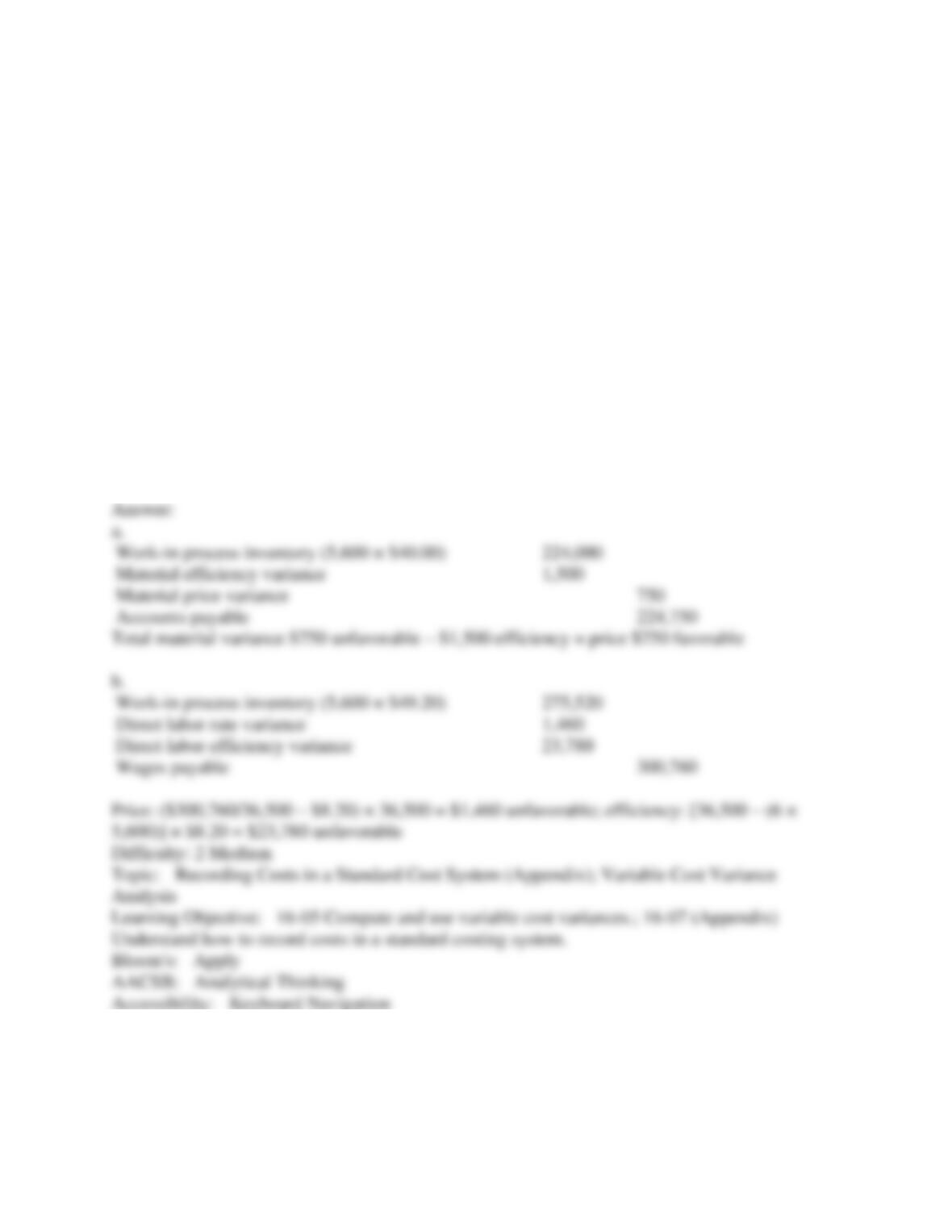
Material: 8 kilograms @ $5 per kilogram $ 40.00
Labor: 6 hours @ $8.20 per hour $ 49.20
The following operating data were taken from the records for November:
Units completed 5,600 units
Budgeted output 6,000 units
Purchase of materials 50,000 kilograms
Total actual labor costs $ 300,760
Actual labor hours 36,500 hours
Material efficiency (quantity) variance $ 1,500 unfavorable
Total material variance $ 750 unfavorable
Required:
Prepare the journal entries to record the following:
a. Purchase and use of direct materials (Assume materials are used as purchased and no
inventory is maintained).
b. Recognition of direct labor.
138) The Fox Company uses a standard cost accounting system and estimates production for the
year to be 60,000 units. At this volume, the company’s variable overhead costs are $0.50 per
direct labor hour.
The company’s single product has a standard cost of $30.00 per unit. Included in the $30.00 is
96
$13.20 for direct materials (3 yards) and $12.00 of direct labor (2 hours). Production information
for the month of March follows:
Number of units produced 6,000
Materials purchased (18,500 yards) $ 88,800
Materials used in production (yards) 18,500
Variable overhead costs incurred $ 6,380
Fixed overhead costs incurred $ 20,400
Direct labor cost incurred ($6.50/hour) $ 75,400
Required:
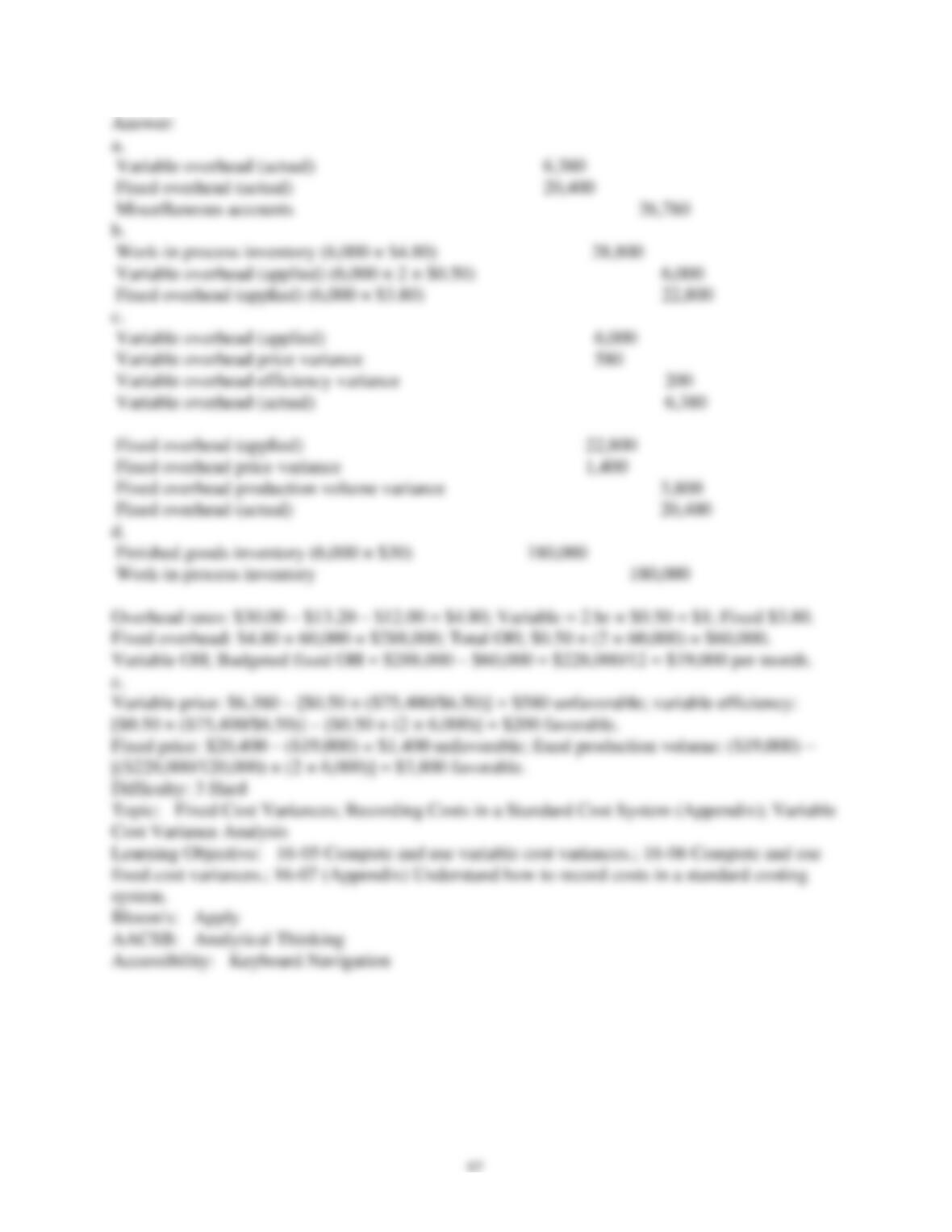
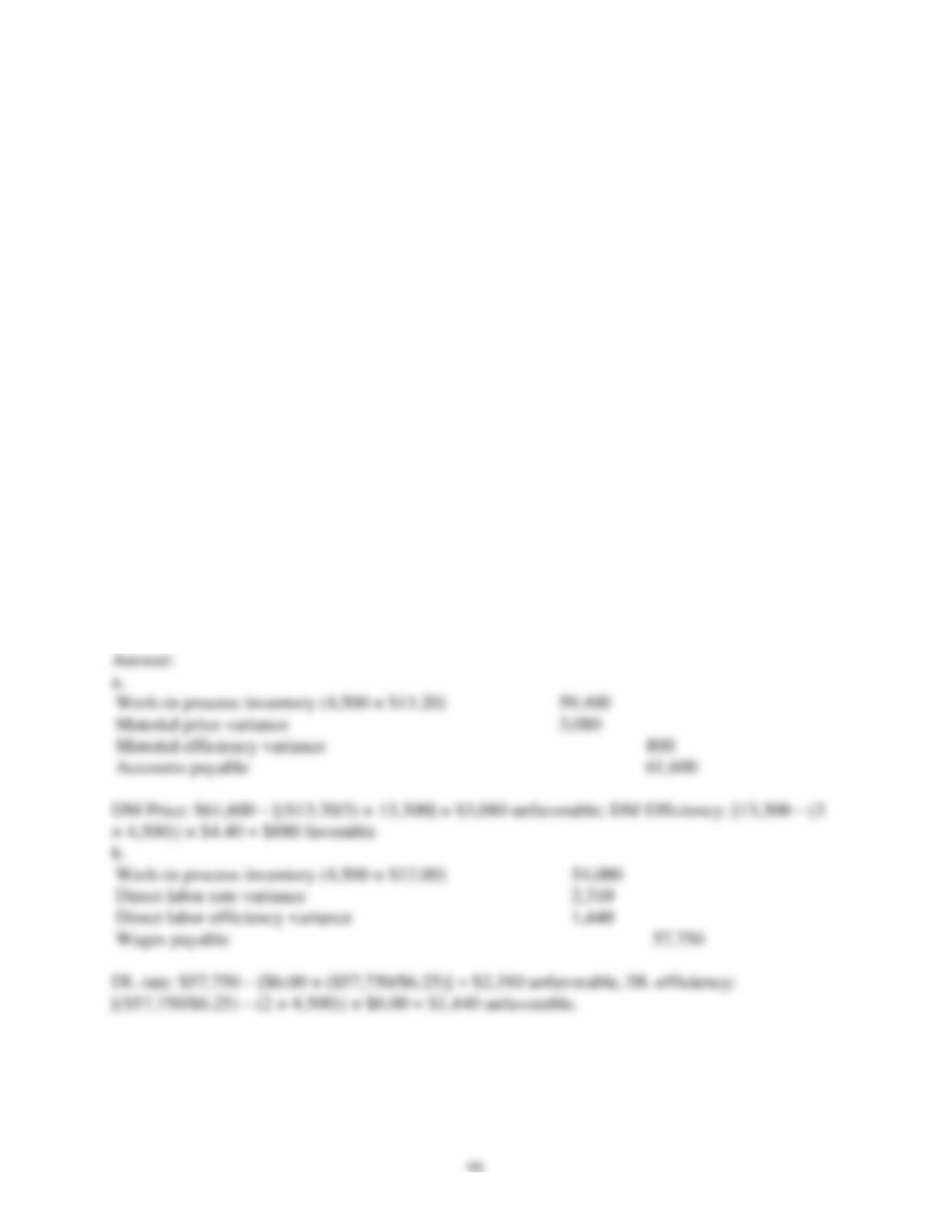
Prepare the journal entries to record the following:
a. Incurring actual overhead.
b. Application of overhead to production.
c. Closing of overhead accounts and recognizing variances.
d. Transferring production to finished goods.
139) The Morocco Company uses a standard cost accounting system and estimates production
for the year to be 60,000 units. At this volume, the company’s variable overhead costs are $0.50
per direct labor hour.
The company’s single product has a standard cost of $30.00 per unit. Included in the $30.00 is
$13.20 for direct materials (3 yards) and $12.00 of direct labor (2 hours). Production information
for the month of March follows:
Number of units produced 4,500
Materials purchased (13,300 yards) $ 61,600
Materials used in production (yards) 13,300
Variable overhead costs incurred $ 4,380
Fixed overhead costs incurred $ 20,400
Direct labor cost incurred ($6.25/hour) $ 75,750
Required:
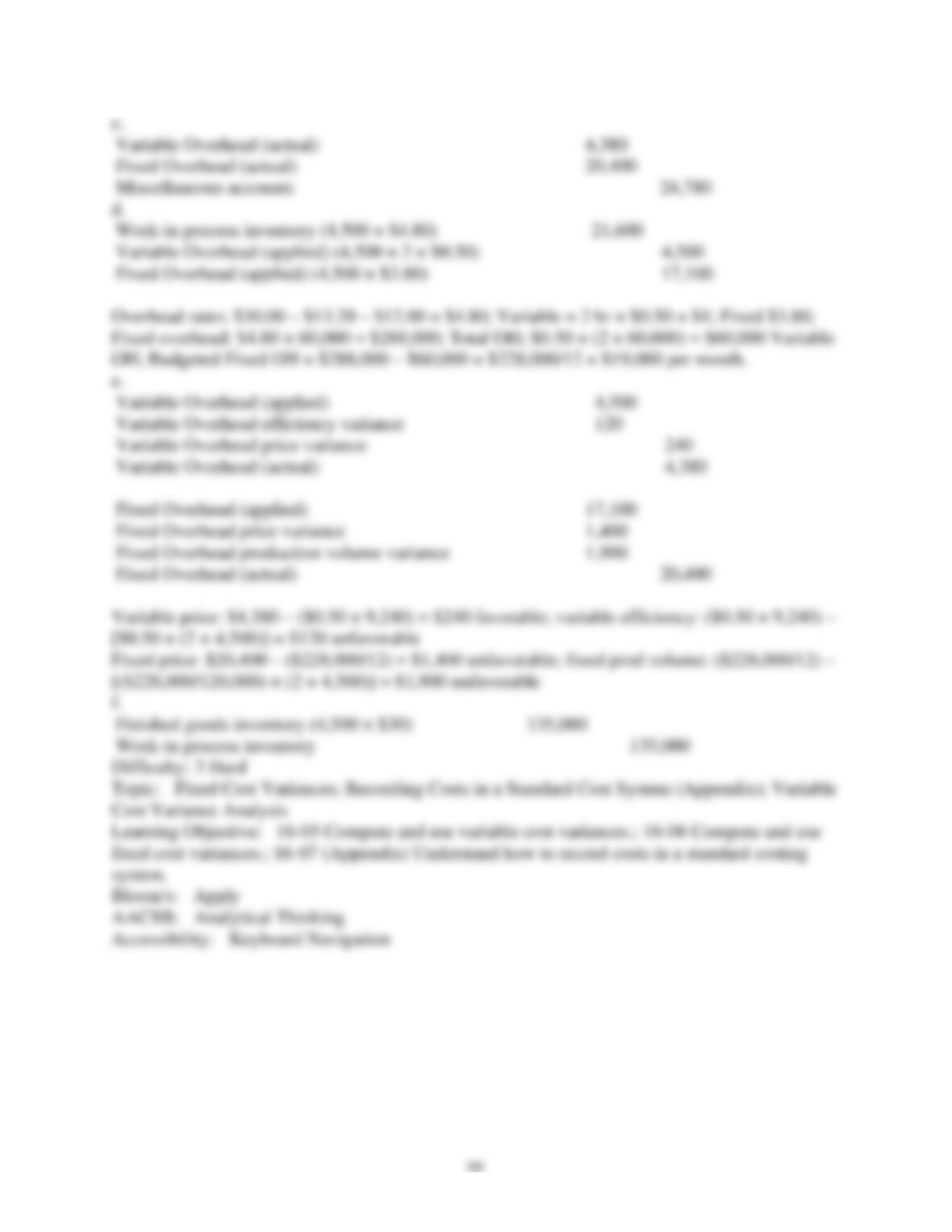
Prepare the journal entries to record the following:
a. Purchase and use of direct materials (Assume materials are used as purchased and no
inventory is maintained).
b. Recognition of direct labor.
c. Incurring actual overhead.
d. Application of overhead to production.
e. Closing of overhead accounts and recognizing variances.
f. Transferring production to finished goods.
140) Explain two reasons for preparing a variance analysis.
141) Explain the difference between operating budgets, financial budgets, and flexible budgets.
142) Explain the difference between the sales volume variance and the production volume
variance.