Chapter 16 – Capital Expenditure Decisions
124. Postaudits are an important part of capital budgeting.
Required:
A. What is a postaudit of a capital investment project?
B. What are the benefits of a postaudit?
C. A manager prepared an unsuccessful proposal for a capital project, as her firm decided not
to fund and pursue the project. The manager observed, “The company’s postaudit process will
show that this project should have been funded.” Comment on the manager’s understanding of
the postaudit process.
Solution:
125. Depreciation is often described as a “tax shield.”
Required:
A. Explain how depreciation provides such a shield.
B. MACRS is an accelerated depreciation system. Explain how an accelerated system can
provide a more beneficial tax shield than, say, a straight-line depreciation system.
Solution:
16–80
126. Tatum Corporation recently purchased a $1,200,000 asset that has a three-year service
life and no salvage value. The company is subject to a 30% income tax rate and employs a
12% after-tax hurdle rate in capital investment decisions.
Management is studying whether to depreciate the asset by using the straight-line method or
the Modified Accelerated Cost Recovery System (MACRS). Assume that the following
MACRS factors are in effect: year 1, 33%; year 2, 45%; year 3, 15%; and year 4, 7%
Year
FV of $1 at
12%
FV of an
ordinary
annuity at
12%
PV of $1 at
12%
PV of an
ordinary
annuity at
12%
1
1.120
1.000
0.893
0.893
2
1.254
2.120
0.797
1.690
3
1.405
3.374
0.712
2.402
4
1.574
4.779
0.636
3.037
5
1.762
6.353
0.567
3.605
6
1.974
8.115
0.507
4.111
Required:
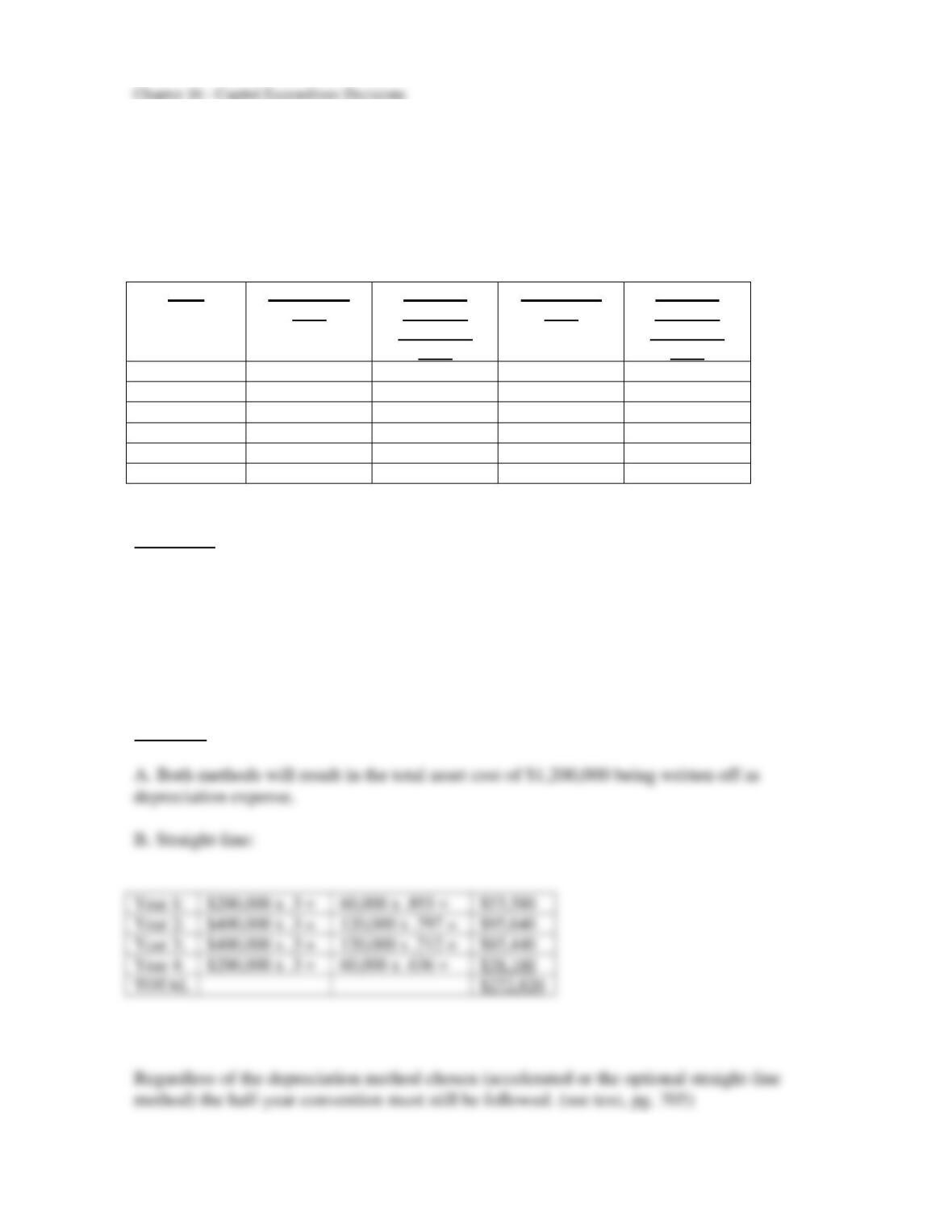
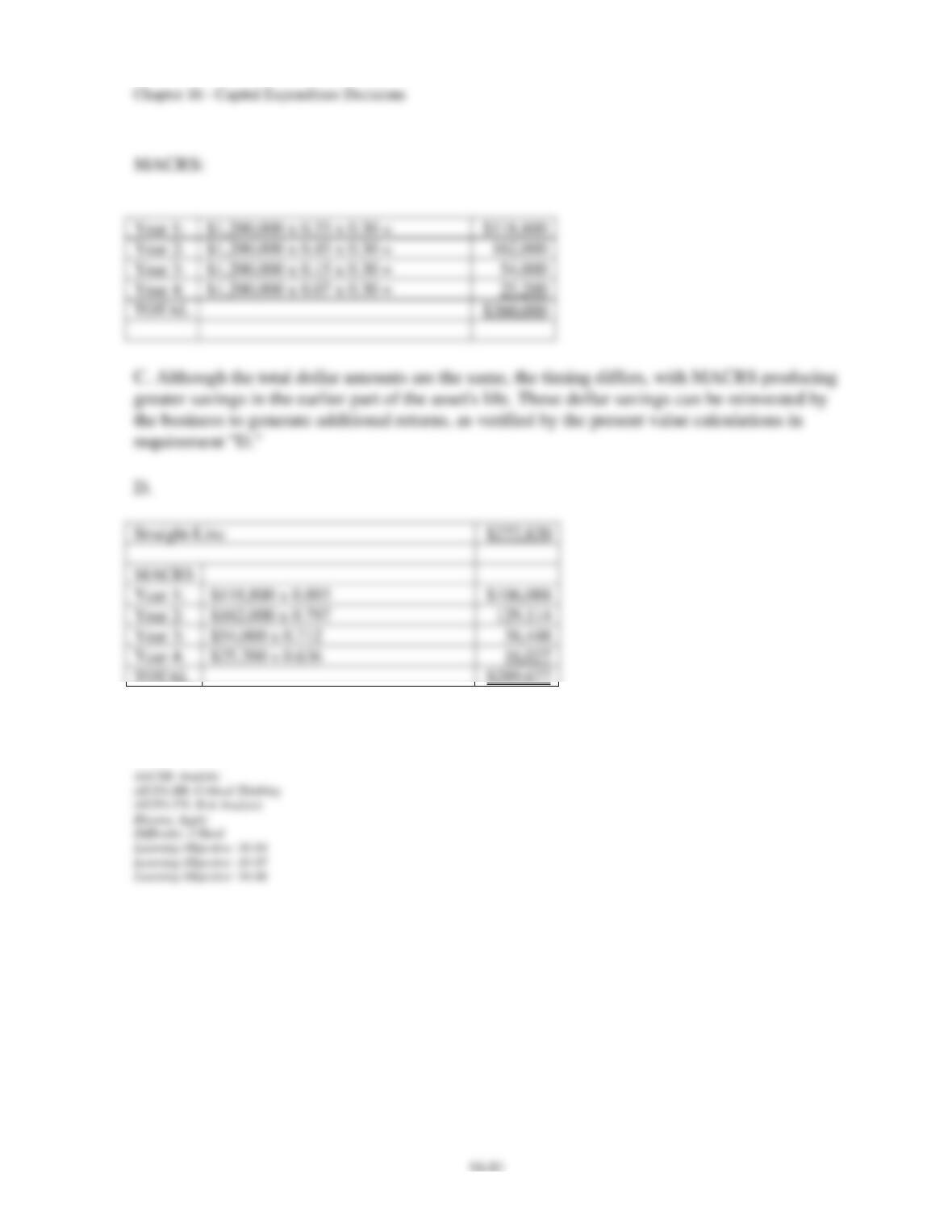
A. Calculate the total depreciation expense that Tatum will record under each method.
B. Calculate the total tax savings that will occur with each method.
C. On the basis of your calculations in part “B,” which of the two methods will management
likely prefer? Explain your answer.
D. Compute the present value of the tax savings for each method, rounding to the nearest
dollar.
Solution:
16–82
127. Marker Sail Company plans to purchase $4.5 million of equipment in the not-too-distant
future. The equipment will be depreciated by the optional straight-line method over the
MACRS life of 5 years. Marker is subject to a 30% income tax rate.
The company’s accountant is about to perform a net-present-value analysis, assuming a 10%
after-tax hurdle rate.
Year
FV of $1 at
10%
FV of an ordinary
annuity at 10%
PV of $1 at
10%
PV of an ordinary
annuity at 10%
1
1.100
1.000
0.909
0.909
2
1.210
2.100
0.826
1.736
3
1.331
3.310
0.751
2.487
4
1.464
4.641
0.683
3.170
5
1.611
6.105
0.621
3.791
6
1.772
7.716
0.564
4.355
Required:
A. Determine the discounted cash flows that would be reflected in the analysis in year 0 and
year 1.
B. Determine the discounted cash flow that would be reflected in the analysis in year 6,
assuming that Marker sells the equipment for $450,000,
Solution:
128. You are reviewing some material that deals with investment analysis, preparing for your
first day on the job at Enrique Enterprises. Consider the cash flows that follow.
1. The immediate payment required to purchase a $600,000 milling machine.
2. Straight-line depreciation of $20,000 in year 2 of a long-term investment.
3. Annual savings in cash operating costs of $50,000 over the next eight years.
4. Sale of a machine for $35,000 at the end of its six-year service life. The machine has a
book value of $25,000.
5. A $6,000 equipment overhaul in year 5 that is fully deductible for income tax purposes.
Year
FV of $1 at
10%
FV of an ordinary
annuity at 10%
PV of $1 at
10%
PV of an ordinary
annuity at 10%
1
1.100
1.000
0.909
0.909
2
1.210
2.100
0.826
1.736
3
1.331
3.310
0.751
2.487
4
1.464
4.641
0.683
3.170
5
1.611
6.105
0.621
3.791
6
1.772
7.716
0.564
4.355
Required:
Calculate the discounted cash flow that is appropriate for each of the preceding items. Assume
a 10% after-tax hurdle rate and a 30% income tax rate, and round to the nearest dollar.
Solution:

16–84
129. The Excon Machine Tool Company is considering the addition of a computerized lathe
to its equipment inventory. The initial cost of the equipment is $600,000, and the lathe is
expected to have a useful life of five years and no salvage value. The cost savings and
increased capacity attributable to the machine are estimated to generate increases in the firm’s
annual cash inflows (before considering depreciation) of $180,000. The machine will be
depreciated using MACRS for tax purposes. The 5-year MACRS depreciation percentages as
computed by the IRS are: Year 1 = 20.00%; Year 2 = 32.00%; Year 3 = 19.20%; Year 4 =
11.52%; Year 5 = 11.52%; Year 6 = 5.76%.
Warren is currently in the 40% income tax bracket. A 10% after-tax rate of return is desired.
Year
FV of $1 at
10%
FV of an ordinary
annuity at 10%
PV of $1
at 10%
PV of an ordinary
annuity at 10%
1
1.100
1.000
0.909
0.909
2
1.210
2.100
0.826
1.736
3
1.331
3.310
0.751
2.487
4
1.464
4.641
0.683
3.170
5
1.611
6.105
0.621
3.791
6
1.772
7.716
0.564
4.355
Required:
A. What is the net present value of the investment? Round to the nearest dollar.
B. Should the machine be acquired by the firm?
C. Assume that the equipment will be sold at the end of its useful life for $100,000. If the
depreciation amounts are not revised, calculate the dollar impact of this change on the total
net present value.
130. Warner Corporation is considering the acquisition of a new machine that costs $350,000.
The machine is expected to have a four-year service life and will produce annual savings in
cash operating costs of $100,000. Warner uses the optional straight-line method of
depreciation and depreciates the asset over its four-year service life. The company is subject
to a 30% income tax rate, has an after-tax hurdle rate of 12%, and rounds calculations to the
nearest dollar.
Year
FV of $1 at
12%
FV of an ordinary
annuity at 12%
PV of $1 at
12%
PV of an ordinary
annuity at 12%
1
1.120
1.000
0.893
0.893
2
1.254
2.120
0.797
1.690
3
1.405
3.374
0.712
2.402
4
1.574
4.779
0.636
3.037
5
1.762
6.353
0.567
3.605
6
1.974
8.115
0.507
4.111
Required:
A. Determine the annual after-tax cash flows that result from acquisition of the machine.
B. Calculate the machine’s net present value. Is the machine an attractive investment? Why?
Solution:
212,590

16–87
131. Kansas Corporation is reviewing an investment proposal that has an initial cost of
$52,500. An estimate of the investment’s end-of-year book value, the yearly after-tax net cash
inflows, and the yearly net income are presented in the schedule below. Yearly after-tax net
cash inflows include savings from the depreciation tax shield. The investment’s salvage value
at the end of each year is equal to book value, and there will be no salvage value at the end of
the investment’s life.
Year
Initial Cost
and Book
Value
Yearly After-
Tax Net cash
Inflows
Yearly
Net
Income
1
$35,000
$20,000
$2,500
2
21,000
17,500
3,500
3
10,500
15,000
4,500
4
3,500
12,500
5,500
5
—
10,000
6,500
$75,000
$22,500
Kansas uses a 14% after-tax target rate of return for new investment proposals.
Year
FV of $1 at
14%
FV of an
ordinary
annuity at
14%
PV of $1 at
14%
PV of an
ordinary
annuity at
14%
1
1.140
1.000
0.877
0.877
2
1.300
2.140
0.769
1.647
3
1.482
3.440
0.675
2.322
4
1.689
4.921
0.592
2.914
5
1.925
6.610
0.519
3.433
6
2.195
8.536
0.456
3.889
Required:
A. Calculate the project’s payback period.
B. Calculate the accounting rate of return on the initial investment.
C. Calculate the proposal’s net present value. Round to the nearest dollar.
Chapter 16 – Capital Expenditure Decisions
Solution:
16–89
132. Tanner Corporation is considering the acquisition of a new machine that is expected to
produce annual savings in cash operating costs of $30,000 before income taxes. The machine
costs $100,000, has a useful life of five years, and no salvage value. Tanner uses straight-line
depreciation on all assets, is subject to a 30% income tax rate, and has an after-tax hurdle rate
of 8%.
Year
FV of $1 at
8%
FV of an ordinary
annuity at 8%
PV of $1 at
8%
PV of an ordinary
annuity at 8%
1
1.080
1.000
0.926
0.926
2
1.166
2.080
0.857
1.783
3
1.260
3.246
0.794
2.577
4
1.361
4.506
0.735
3.312
5
1.469
5.867
0.681
3.993
6
1.587
7.336
0.630
4.623
Required:
A. Compute the machine’s accounting rate of return on the initial investment.
B. Compute the machine’s net present value.
Solution:
133. A profitability index can be used to rank investment proposals.
Required:
A. Define the profitability index.
B. Two projects are under consideration. Project I has a net present value of $20,000 whereas
project II has a net present value of $200,000. Which project is better? Explain. What
weakness in a net-present-value analysis does the profitability index address?
Solution:
134. Marcus & Tyler sells frozen custard and sandwiches. It is considering a new site that will
require a $2 million investment for land acquisition and construction costs. The following
operating results are expected:
Sales Revenue
$980,000
Less operating expenses:
Food & Supplies
$320,000
Wages & Salaries
180,000
Insurance & Taxes
40,000
Utilities
10,000
Depreciation
70,000
620,000
Operating income
$360,000
Disregard income taxes.
Required:
A. If management requires a payback period of four years or less, should the new site be
opened? Why?
B. Compute the accounting rate of return on the initial investment.
C. What significant limitation of payback and the accounting rate of return is overcome by the
net-present-value method?
Solution:
135. The payback method is a popular way to analyze investment proposals.
Required:
A. Explain how the payback period is determined. Generally speaking, from a payback
perspective, which projects are viewed to be the most attractive?
B. Can the payback method take income taxes into consideration? Explain.
C. What are the deficiencies of the payback method?
Solution:
136. An increased number of companies are investing in advanced manufacturing systems.
Required:
A. Many proposed advanced manufacturing systems have a negative net present value when
discounted-cash-flow analysis is used. Explain several causes of this situation.
B. Two major benefits of advanced systems are greater flexibility in the manufacturing
process and improvements in product quality. Explain how these benefits can create problems
when performing discounted-cash-flow analysis.
Solution: