105) Which of the following is not an alternative name for the production volume variance?
A) Capacity variance.
B) Idle capacity variance.
C) Denominator variance.
D) Fixed overhead efficiency variance.
106) The production volume variance must be computed when a company uses:
A) activity-based costing.
B) process costing.
C) job-order costing.
D) full-absorption costing.
107) Which of these variances is least significant for cost control?
A) Labor price variance.
B) Material quantity variance.
C) Fixed overhead price variance.
D) Production volume variance.
108) A debit balance in the direct labor efficiency variance account indicates that
A) standard hours exceed actual hours.
B) actual hours exceed standard hours.
C) standard rate and standard hours exceed actual rate and actual hours.
D) actual rate and actual hours exceed standard rate and standard hours.
109) If materials are carried in the direct materials inventory account at standard cost, then it is
reasonable to assume that the:
A) raw materials inventory account is understated.
B) price variance is recognized when materials are purchased.
C) company does not follow generally accepted accounting principles.
D) price variance is recognized when materials are placed into production.
63
110) The Elon Company had great difficulty in controlling overhead costs. At a recent
convention, the president heard about a control device for overhead costs known as a flexible
budget and she has hired you to implement this budgeting program. After some effort, you
develop the following cost formulas for the company’s machining department. These costs are
based on a normal operating range of 15,000 to 23,000 machine-hours per month:
Machine setup $ 0.20 per machine-hour
Lubricants $ 1.00 per machine-hour plus $8,000 per month
Utilities $ 0.70 per machine-hour
Indirect labor $ 0.60 per machine-hour plus $20,000 per month
Depreciation $ 32,000 per month
During March, the first month after your preparation of the above data, the machining
department worked 18,000 machine-hours and produced 9,000 units of product. The actual costs
of this production were:
Machine set-up $ 4,800
Lubricants 24,500
Utilities 12,000
Indirect labor 32,500
Depreciation 32,500
$ 106,300
The department had originally been budgeted to work 19,000 machine-hours during March.
Required:
Prepare a performance report for the machining department for the month of March including
columns for the (a) actual results, (b) flexible budget, (c) flexible budget variance, (d) master
budget, and (e) sales activity variance.
111) The Ornate Company has the following information pertaining to the month of March:
Units of output, actual 21,000
Fixed costs, actual $ 497,000
Operating profit, master budget $ 220,000
Sales price variance $ 84,000 U
Beginning and ending inventories 0
Sales volume variance, revenue $ 300,000 U
Budgeted selling price per unit $ 100
Variable costs, master budget $ 1,680,000
Contribution margin, actual $ 516,000
Required:
Prepare a performance report for March including columns for the (a) actual results, (b) flexible
budget, (c) flexible budget variance, (d) master budget, and (e) sales activity variance.
66
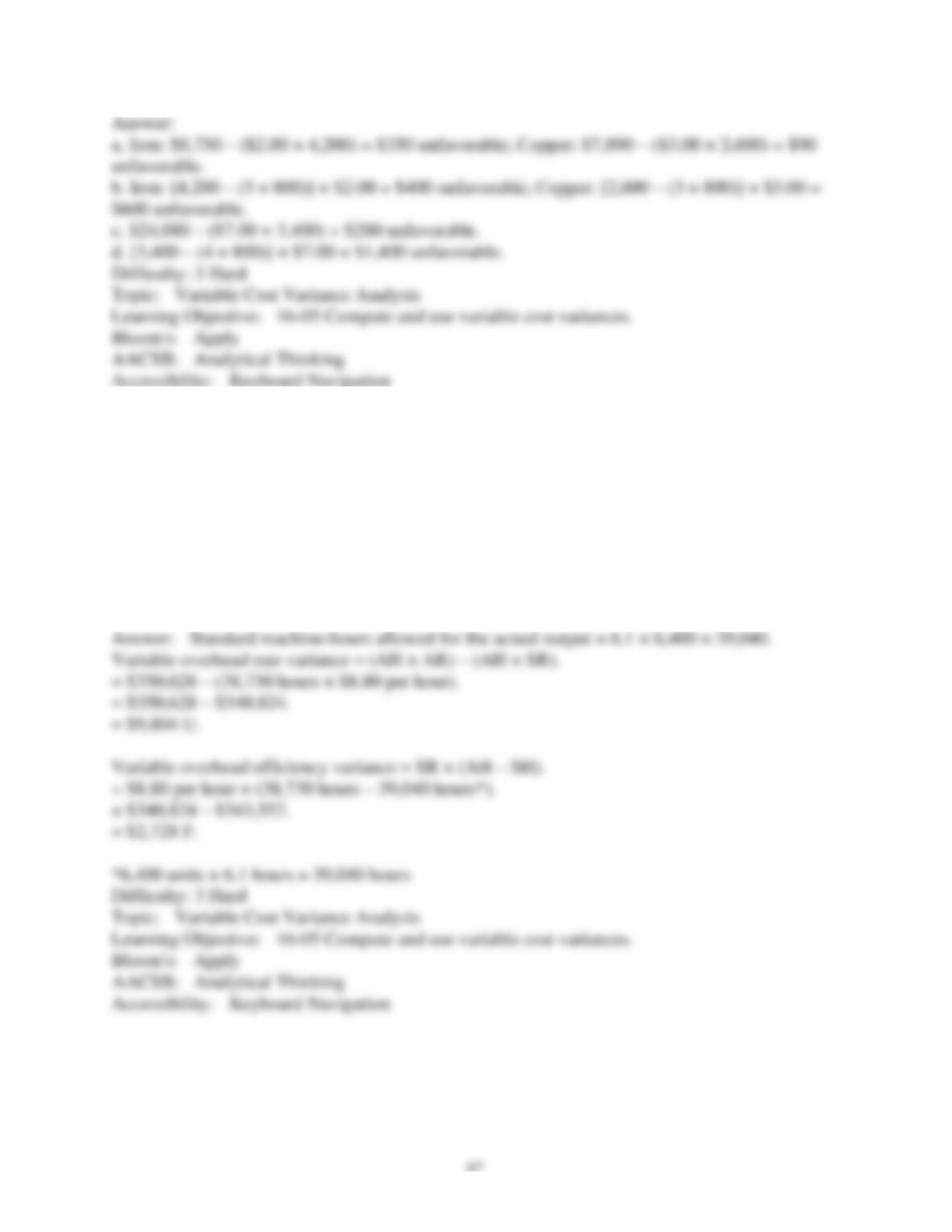
112) Fargo Company manufactures special electrical equipment and parts. Eastern employs a
standard cost accounting system with separate standards established for each product.
A special transformer is manufactured in the Transformer Department. Production volume is
measured by direct labor hours in this department and a flexible budget system is used to plan
and control department overhead. Standard costs for the special transformer are determined
annually in September for the coming year. The standard cost of a transformer was computed at
$67.00 as shown below.
Direct materials:
Iron 5 sheets @ $ 2.00 $ 10.00
Copper 3 spools @ $ 3.00 9.00
Direct labor 4 hours @ $ 7.00 28.00
Variable overhead 4 hours @ $ 3.00 12.00
Fixed overhead 4 hours @ $ 2.00 8.00
Total $ 67.00
Overhead rates were based upon normal and expected monthly capacity, both of which were
4,000 direct labor hours. Practical capacity for this department is 5,000 direct labor hours per
month. Variable overhead costs are expected to vary with the number of direct labor hours
actually used. During October, 800 transformers were produced. This was below expectations
because a work stoppage occurred at the copper supplier and shipments were delayed.
The following costs were incurred in October:
Direct materials:
Iron: purchased 4,200 sheets, total cost $8,750
Used: 4,200 sheets
Copper: purchased 2,600 spools, total cost $7,890
Used: 2,600 spools
Direct labor: 3,400 hours
Total payroll: $24,080
Required:
Compute each of the following variances, showing all your work. Be sure to indicate whether the
variances are favorable or unfavorable.
a. Direct materials price variance for both iron and copper.
b. Direct material efficiency variance for both iron and copper
c. Direct labor rate variance.
d. Direct labor efficiency variance.
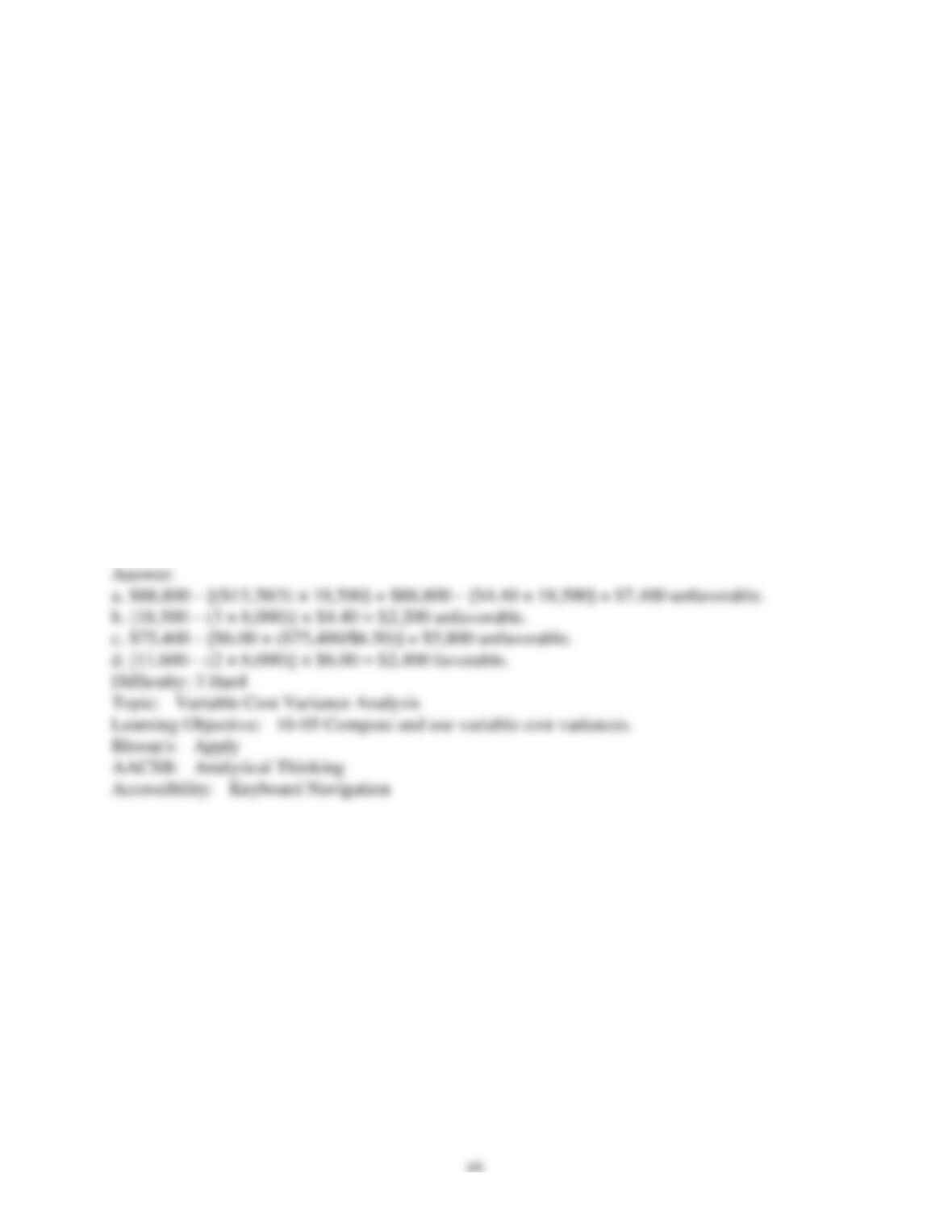
113) Jemco Corporation makes automotive engines. For the most recent month, budgeted
production was 6,000 engines. The standard power cost is $8.80 per machine-hour. The
company’s standards indicate that each engine requires 6.1 machine-hours. Actual production
was 6,400 engines. Actual machine-hours were 38,730 machine-hours. Actual power cost totaled
$350,628.
Required:
Determine the rate and efficiency variances for the variable overhead power cost and indicate
whether those variances are unfavorable or favorable. Show your work.
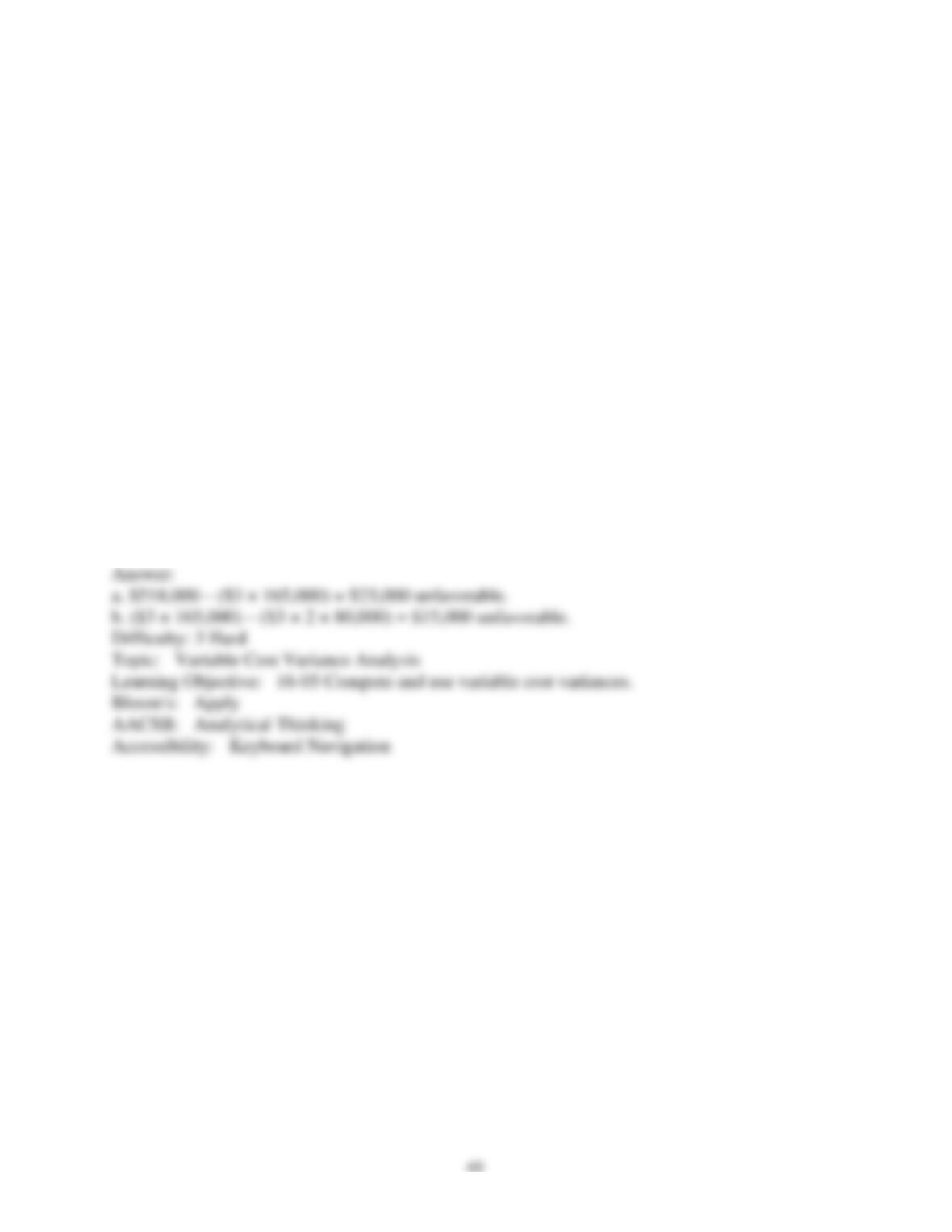
114) The Rogers Company uses a standard cost accounting system and estimates production for
the year to be 60,000 units. At this volume, the company’s variable overhead costs are $0.50 per
direct labor hour.
The company’s single product has a standard cost of $30.00 per unit. Included in the $30.00 is
$13.20 for direct materials (3 yards) and $12.00 of direct labor (2 hours). Production information
for the month of March follows:
Number of units produced 6,000
Materials purchased (18,500 yards) $ 88,800
Materials used in production (yards) 18,500
Direct labor cost incurred ($6.50/hour) $ 75,400
Required:
(Be sure to indicate whether the variances are favorable or unfavorable and show your work.)
a. Compute the direct material price variance.
b. Compute the direct material efficiency variance.
c. Compute the direct labor price (rate) variance.
d. Compute the direct labor efficiency variance.
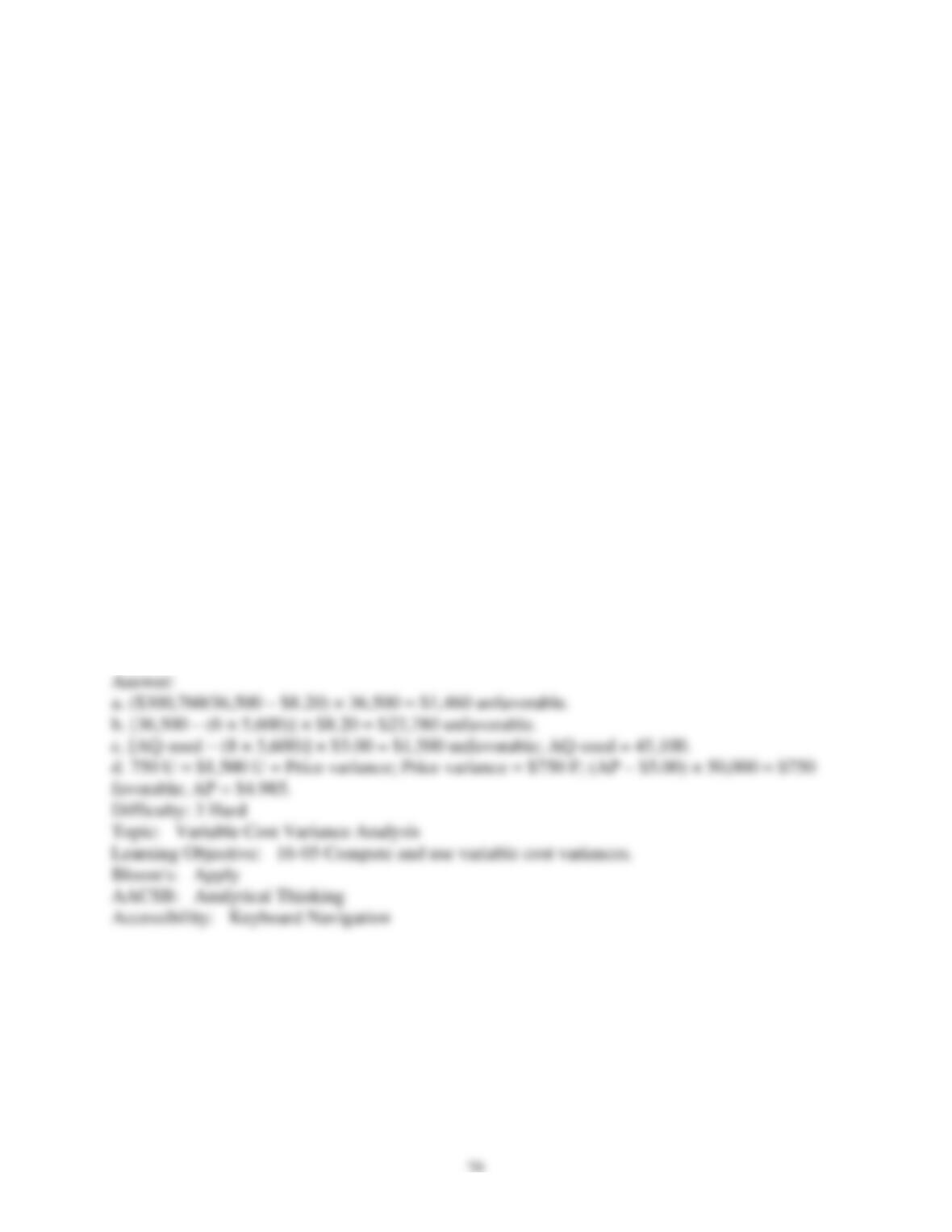
115) The Atlas Company has developed standard overhead costs based upon a capacity of
180,000 direct labor hours:
Standard costs per unit:
Variable portion 2 hours @ $3 = $ 6
Fixed portion 2 hours @ $5 = 10
$ 16
During April, 85,000 units were scheduled for production; however, only 80,000 units were
actually produced. The following data relate to April:
Actual direct labor cost incurred was $644,000 for 165,000 actual hours of work.
Actual overhead incurred totaled $1,378,000; $518,000 variable and $860,000 fixed.
All inventories are carried at standard cost.
Required:
(Be sure to indicate whether the variances are favorable or unfavorable and show your work.)
a. Compute the variable overhead price variance.
b. Compute the variable overhead efficiency variance.
116) Horton Company adopted a standard cost system several years ago. The standard costs for
the prime costs of its single product are as follows:
Material: 8 kilograms @ $5 per kilogram $ 40.00
Labor: 6 hours @ $8.20 per hour $ 49.20
The following operating data were taken from the records for November:
Units completed 5,600 units
Budgeted output 6,000 units
Purchase of materials 50,000 kilograms
Total actual labor costs $ 300,760
Actual labor hours 36,500 hours
Material efficiency (quantity) variance $ 1,500 unfavorable
Total material variance $ 750 unfavorable
Required:
(Be sure to indicate whether the variances are favorable or unfavorable and show your work.)
a. What is the direct labor rate variance for November?
b. What is the direct labor efficiency variance for November?
c. What is the actual kilograms of material used in the production process during November?
d. Assume the purchasing department is responsible for the material price variance, what is the
actual price paid per kilogram of material during November (assume no increase/decrease in
inventory during the month)?
117) The following standards have been established for a raw material used to make product
JN36:
Standard quantity of material per unit of output 6.3 pounds
Standard price of the material $ 15.50 per pound
The following data pertain to a recent month’s operations:
Actual material purchased 6,700 pounds
Actual cost of material purchased $ 100,500
Actual material used in production 6,400 pounds
Actual output 920 units of product JN36
Required:
a. What is the materials price variance for the month?
b. What is the materials quantity variance for the month?
118) The data below relate to a product of Bellingham Company.
Standard costs:
Materials, 2 pounds at $6 per pound $ 12 per unit
Labor, 3 hours at $15 per hour $ 45 per unit
Actual results were:
Production 3,600 units
Material purchased & used, 7,300 pounds $ 42,340
Labor, 10,360 hours $ 160,580
Required:
(Be sure to indicate whether the variances are favorable or unfavorable and show your work.)
a. Compute the direct material price variance.
b. Compute the direct material usage variance.
c. Compute the direct labor rate variance.
d. Compute the direct labor efficiency variance.
119) The following data have been provided by Vegas Corporation:
Budgeted production 8,300 units
Standard machine-hours per unit 4.5 machine-hours
Standard lubricants $ 5.10 per machine-hour
Standard supplies $ 2.90 per machine-hour
Actual production 8,600 units
Actual machine-hours 38,270 machine-hours
Actual lubricants (total) $ 211,801
Actual supplies (total) $ 107,566
Required:
Compute the variable overhead rate variances for lubricants and for supplies. Indicate whether
each of the variances is favorable (F) or unfavorable (U). Show your work.
120) The following data for November have been provided by Mazzio Corporation, a producer
of precision drills for oil exploration:
Budgeted production 4,000 drills
Standard machine-hours per drill 8.4 machine-hours
Standard indirect labor $ 9.40 per machine-hour
Standard power $ 2.90 per machine-hour
Actual production 4,300 drills
Actual machine-hours 36,530 machine-hours
Actual indirect labor $ 362,756
Actual power $ 97,693
Required:
Compute the variable overhead rate variances for indirect labor and for power for November.
Indicate whether each of the variances is favorable (F) or unfavorable (U). Show your work.

121) Shum Company manufactures special electrical equipment and parts. Shum employs a
standard cost accounting system with separate standards established for each product.
A special transformer is manufactured in the Transformer Department. Production volume is
measured by direct labor hours in this department and a flexible budget system is used to plan
and control department overhead. Standard costs for the special transformer are determined
annually in September for the coming year. The standard cost of a transformer was computed at
$67.00 as shown below.
Direct materials:
Iron 5 sheets @ $ 2.00 $ 10.00
Copper 3 spools @ $ 3.00 9.00
Direct labor 4 hours @ $ 7.00 28.00
Variable overhead 4 hours @ $ 3.00 12.00
Fixed overhead 4 hours @ $ 2.00 8.00
Total $ 67.00
Overhead rates were based upon normal and expected monthly capacity, both of which were
4,000 direct labor hours. Practical capacity for this department is 5,000 direct labor hours per
month. Variable overhead costs are expected to vary with the number of direct labor hours
actually used. During October, 800 transformers were produced. This was below expectations
because a work stoppage occurred at the copper supplier and shipments were delayed.
The following data pertain to October’s operations:
Direct materials:
Iron: purchased 5,000 sheets @ $2.00/sheet
Used: 3,900 sheets
Copper: purchased 2,200 spools @ $3.10
Used: 2,600 spools
Direct labor: 3,400 hours
Total payroll: $24,080
Overhead:
Variable $ 10,000
Fixed $ 8,800
Required:
Compute each of the following variances, showing all your work. Be sure to indicate whether the
variances are favorable or unfavorable.
a. Variable overhead spending variance.
b. Variable overhead efficiency variance.
c. Fixed overhead spending (budget) variance.
d. Production volume variance.
77
122) Ole Company manufactures special electrical equipment and parts. Ole employs a standard
cost accounting system with separate standards established for each product.
A special transformer is manufactured in the Transformer Department. Production volume is
measured by direct labor hours in this department and a flexible budget system is used to plan
and control department overhead. Standard costs for the special transformer are determined
annually in September for the coming year. The standard cost of a transformer was computed at
$57.00 as shown below.
Direct materials:
Copper 3 spools @ $ 3.00 $ 9.00
Direct labor 4 hours @ $ 7.00 28.00
Variable overhead 4 hours @ $ 3.00 12.00
Fixed overhead 4 hours @ $ 2.00 8.00
Total $ 57.00
Overhead rates were based upon normal and expected monthly capacity, both of which were
4,000 direct labor hours. Practical capacity for this department is 5,000 direct labor hours per
month. Variable overhead costs are expected to vary with the number of direct labor hours
actually used.
During October, 900 transformers were produced. This was below expectations because a work
stoppage occurred during contract negotiations with the labor force. Once the contract was
settled, the wage rate was increased to $7.25/hour and overtime was scheduled in an attempt to
catch up to expected production levels.
The following costs were incurred in October:
Direct materials:
Copper: purchased 2,600 spools @ $3.08/spool
Used: 2,600 spools
Direct labor:
Regular time 2,000 hours @ $7.00
Overtime 1,400 hours @ $7.25
600 of the 1,400 hours were subject to overtime premium. The total overtime premium is
included in variable overhead in accordance with company accounting practices.
Overhead:
Variable $ 16,670
Fixed $ 8,800
Required:
Compute each of the following variances, showing all your work. Be sure to indicate whether the
variances are favorable or unfavorable.
a. Direct materials price variance.
b. Direct material efficiency (quantity) variance.
c. Direct labor rate variance.
d. Direct labor efficiency variance.
e. Variable overhead spending variance.
f. Variable overhead efficiency variance.
g. Fixed overhead spending (budget) variance.
h. Production volume variance.
123) The Bartok Company uses a standard cost accounting system and estimates production for
the year to be 60,000 units. At this volume, the company’s variable overhead costs are $0.50 per
direct labor hour.
The company’s single product has a standard cost of $30.00 per unit. Included in the $30.00 is
$13.20 for direct materials (3 yards) and $12.00 of direct labor (2 hours). Production information
for the month of March follows:
Number of units produced 6,000
Materials purchased (18,500 yards) $ 88,800
Materials used in production (yards) 18,500
Variable overhead costs incurred $ 6,380
Fixed overhead costs incurred $ 20,400
Direct labor cost incurred ($6.50/hour) $ 75,400
Required:
(Be sure to indicate whether the variances are favorable or unfavorable.)
a. Compute the predetermined overhead rate used for the year
b. Compute the budgeted fixed costs for the month.
c. Compute the variable overhead spending variance.
d. Compute the variable overhead efficiency variance.
e. Compute the fixed overhead spending (budget) variance.
f. Compute the production volume variance.
124) The condensed flexible budget of the Evergreen Company for the year is given below:
Direct labor-hours
Direct labor- hours
Overhead costs: 30,000 40,000 50,000
Variable costs $ 75,000 ? ?
Fixed costs ? ? $ 320,000
The company produces a single product that requires 2.5 direct labor-hours to complete. The
direct labor wage rate is $7.50 per hour. Three yards of raw material are required for each unit of
product, at a cost of $5 per yard.
Assume that the company chooses 50,000 direct labor-hours as the denominator level of activity,
but actually worked 48,000 hours during the year, producing 18,500 units.
Actual overhead costs for the year are:
Variable costs $ 124,800
Fixed costs 321,700
Total overhead costs $ 446,500
Required:
(Be sure to indicate whether the variances are favorable or unfavorable.)
a. Compute the variable overhead price variance and the variable overhead efficiency variance.
b. Compute the fixed overhead spending (budget) variance and the production volume variance.