Chapter 16 – Capital Expenditure Decisions
104. Which of the following project evaluation methods focuses on accounting income rather
than cash flows?
105. The accounting rate of return focuses on the:
106. Which of the following choices correctly depicts whether discounted cash flows are used
by the method noted when evaluating long-term investments?
Net Present Value
Internal Rate of Return
Accounting Rate of Return
107. Consider the following statements about the accounting rate of return:
I. The accounting rate of return focuses on a project’s income rather than its cash flows.
II. Companies can figure the accounting rate of return on either the initial investment figure or
an average investment figure.
III. The accounting rate of return considers the time value of money.
Which of the above statements is (are) correct?
108. Barrel Corporation, which is subject to a 30% income tax rate, is considering a $420,000
asset that will result in the following over its six-year life:
Average revenue: $920,000
Average operating expenses (excluding depreciation): $770,000
Average depreciation: $70,000
The after-tax accounting rate of return on the initial investment is:
109. San Marco has a $4,000,000 asset investment and is subject to a 30% income tax rate.
Cash inflows are expected to average $600,000 before tax over the next few years; in contrast,
average income before tax is anticipated to be $500,000. The company’s after-tax accounting
rate of return is:
110. When making investment decisions that involve advanced manufacturing systems, the
use of net present value:
111. Twilight Corporation will evaluate a potential investment in an advanced manufacturing
system by use of the net-present-value (NPV) method. Which of the following system
benefits is least likely to be omitted from the NPV analysis?
112. A cash flow measured in nominal dollars is:
113. A cash flow measured in real dollars:

114. Consider the following statements about the accounting for inflation in a capital
budgeting analysis:
I. An analyst can use nominal dollars in conjunction with a nominal interest rate.
II. An analyst can use real dollars in conjunction with a real interest rate.
III. An analyst can use nominal dollars in conjunction with a real interest rate.
Which of the above statements is (are) correct?
Chapter 16 – Capital Expenditure Decisions
Essay Questions
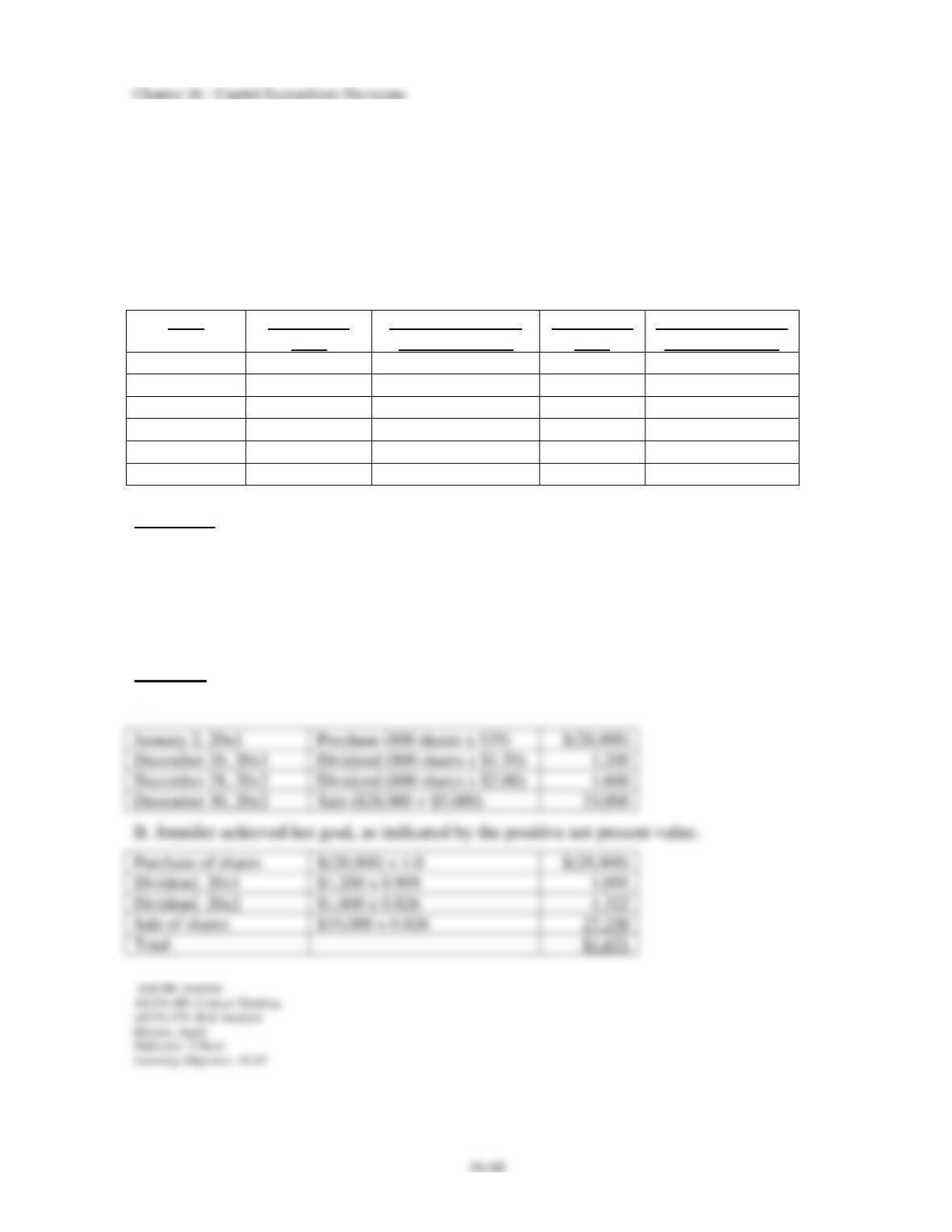
115. Randi Corp. is considering the replacement of some machinery that has zero book value
and a current market value of $2,800. One possible alternative is to invest in new machinery
that costs $30,000. The new equipment has a four-year service life and an estimated salvage
value of $3,500, will produce annual cash operating savings of $9,400, and will require a
$2,200 overhaul in year 3. The company uses straight-line depreciation.
Year
FV of $1 at
8%
FV of an
ordinary
annuity at 8%
PV of $1 at
8%
PV of an
ordinary
annuity at 8%
1
1.080
1.000
0.926
0.926
2
1.166
2.080
0.857
1.783
3
1.260
3.246
0.794
2.577
4
1.361
4.506
0.735
3.312
5
1.469
5.867
0.681
3.993
6
1.587
7.336
0.630
4.623
Required:
Prepare a net-present-value analysis of Randi’s replacement decision, assuming an 8% hurdle
rate and no income taxes. Should the machinery be acquired? Note: Round calculations to the
nearest dollar.
Solution:
116. On January 2, 20×1, Jennifer Grey purchased 800 shares of Sounder
Telecommunications common stock at $35 per share. The company paid a $1.50 dividend per
share on December 28 of that year, and raised the amount by $0.50 per share for a distribution
on December 28, 20×2. Jennifer sold her entire investment on December 30, 20×2, generating
a $5,000 gain on the sale of stock.
Year
FV of $1 at
10%
FV of an ordinary
annuity at 10%
PV of $1 at
10%
PV of an ordinary
annuity at 10%
1
1.100
1.000
0.909
0.909
2
1.210
2.100
0.826
1.736
3
1.331
3.310
0.751
2.487
4
1.464
4.641
0.683
3.170
5
1.611
6.105
0.621
3.791
6
1.772
7.716
0.564
4.355
Required:
A. Prepare a dated listing of the cash inflows and outflows related to Jennifer’s stock
investment. Ignore income taxes.
B. Assume that Jennifer has a 10% hurdle rate for all investments. Rounding to the nearest
dollar, compute the net present value of her investment in Sounder and determine whether she
achieved her 10% goal.
Solution:
A.
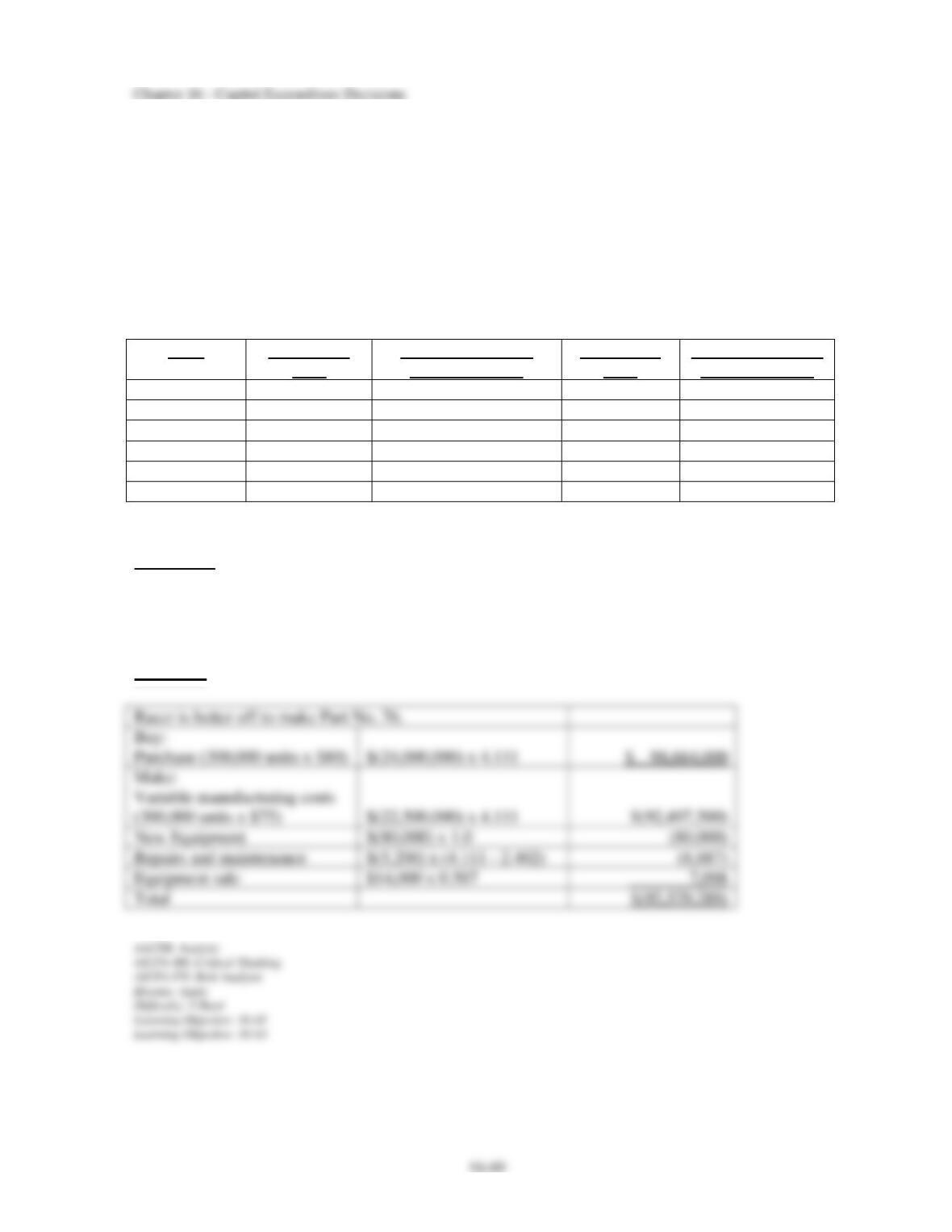
117. Racer Industries is currently purchasing Part No. 76 from an outside supplier for $80 per
unit. Because of supplier reliability problems, the company is considering producing the part
internally in an idle manufacturing plant. Annual volume over the next six years is expected
to total 300,000 units at variable manufacturing costs of $75 per unit.
Racer must acquire $80,000 of new equipment if it reopens the plant. The equipment has a
six-year service life, a $14,000 salvage value, and will be depreciated by the straight-line
method. Repairs and maintenance are expected to average $5,200 per year in years 4-6, and
the equipment will be sold at the end of its life.
Year
FV of $1 at
12%
FV of an ordinary
annuity at 12%
PV of $1 at
12%
PV of an ordinary
annuity at 12%
1
1.120
1.000
0.893
0.893
2
1.254
2.120
0.797
1.690
3
1.405
3.374
0.712
2.402
4
1.574
4.779
0.636
3.037
5
1.762
6.353
0.567
3.605
6
1.974
8.115
0.507
4.111
Required:
Rounding to the nearest dollar, use the net-present-value method (total-cost approach) and a
12% hurdle rate to determine whether Mark should make or buy Part No. 76. Ignore income
taxes.
Solution:
$ 98,664,000

16–70
118. Clear Skies Airline Company is planning a project that is expected to last for six years
and generate annual net cash inflows of $75,000. The project will require the purchase of a
$280,000 machine, which is expected to have a salvage value of $10,000 at the end of the six-
year period. The machine will require a $50,000 overhaul at the end of the fourth year. The
company presently has a 12% minimum desired rate of return.
Based on this information, an accountant prepared the following analysis:
Annual net cash inflow
$75,000
Annual depreciation
$45,000
Annual average cost of overhaul
8,333
(53,333)
Average annual income
$21,667
Return on investment
$21,667 ÷ $280,000 = 7.74%
The accountant recommends that the project be rejected because it does not meet the
company’s minimum desired rate of return. Ignore income taxes.
Required:
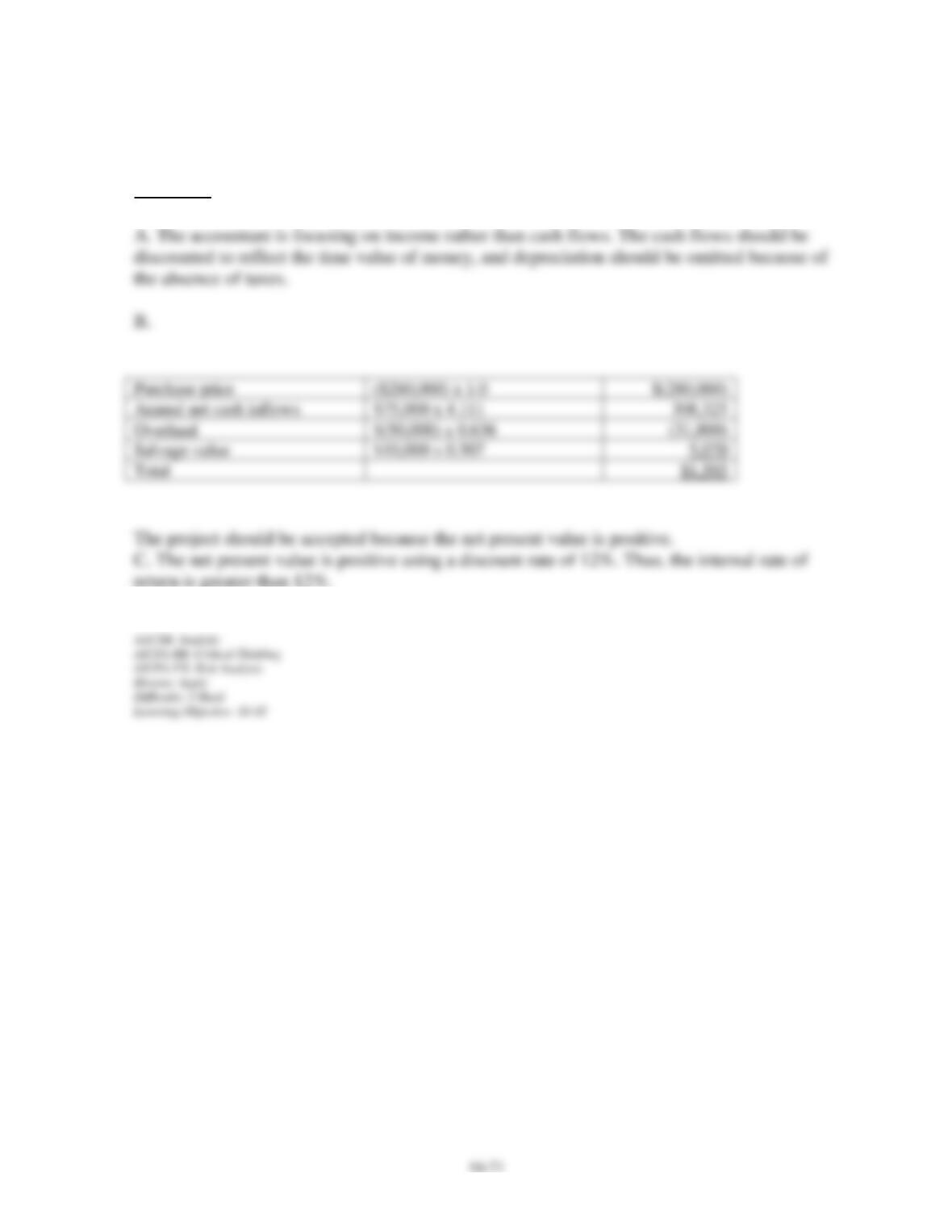
A. What criticism(s) would you make of the accountant’s evaluation?
B. Use the net-present-value method and determine whether the project should be accepted.
C. Based on your answer in requirement “B,” is the internal rate of return greater or less than
12%? Explain.
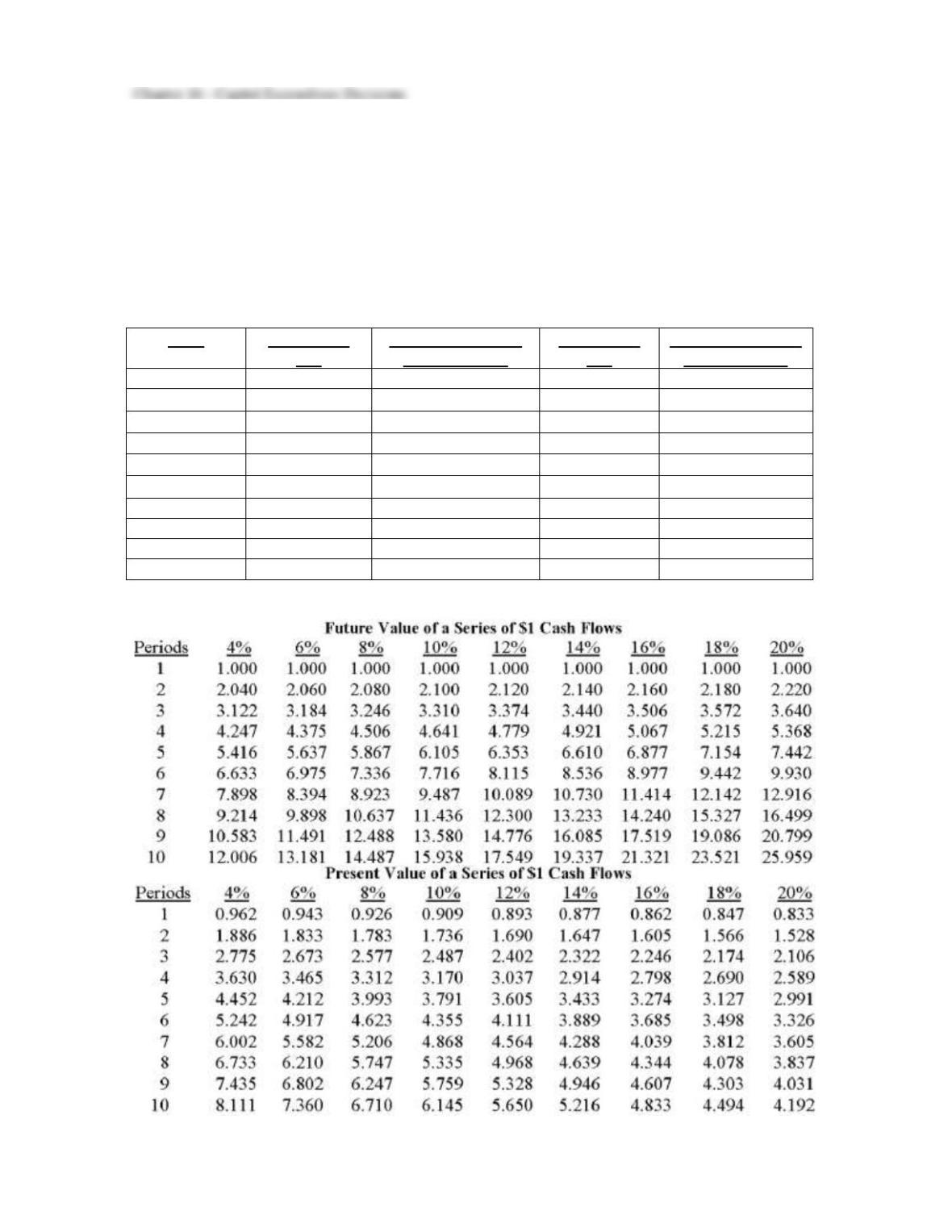
Year
FV of $1 at
12%
FV of an
ordinary
annuity at
12%
PV of $1 at
12%
PV of an
ordinary
annuity at
12%
1
1.120
1.000
0.893
0.893
2
1.254
2.120
0.797
1.690
3
1.405
3.374
0.712
2.402
4
1.574
4.779
0.636
3.037
5
1.762
6.353
0.567
3.605
6
1.974
8.115
0.507
4.111
Chapter 16 – Capital Expenditure Decisions
Solution:
16–72
119. Fulton Township is studying a 700-acre site for a new landfill. The new site will save
$70,000 in annual operating costs for 10 years, as Fulton currently uses the landfill of a
neighboring municipality. Other data are:
Purchase price per acre: $550
Site preparation costs: $110,000
Hurdle rate: 6%
Ignore income taxes.
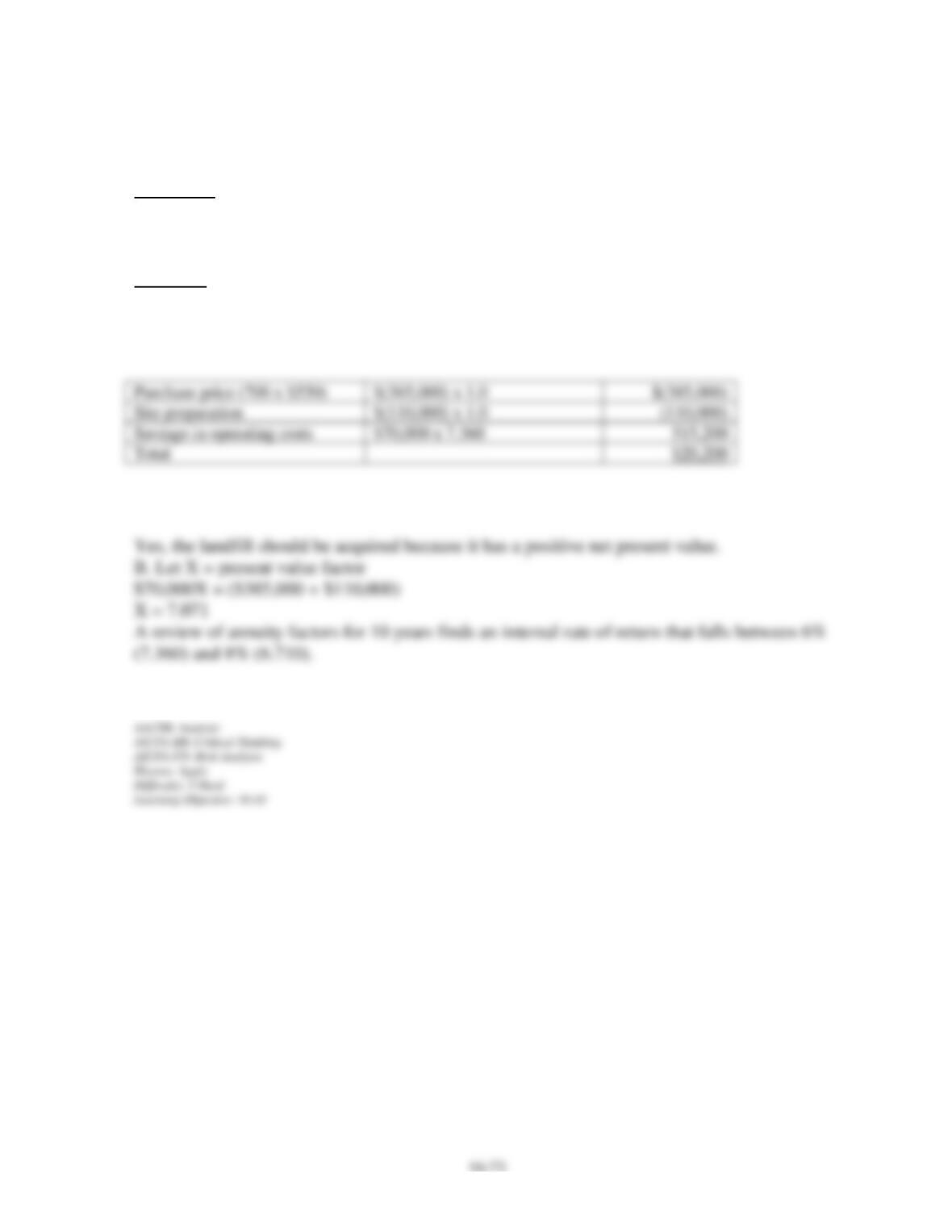
Year
FV of $1 at
6%
FV of an ordinary
annuity at 6%
PV of $1 at
6%
PV of an ordinary
annuity at 6%
1
1.060
1.000
0.943
0.943
2
1.124
2.060
0.890
1.833
3
1.191
3.184
0.840
2.673
4
1.263
4.375
0.792
3.465
5
1.338
5.637
0.747
4.212
6
1.419
6.975
0.705
4.917
7
1.504
8.394
0.665
5.582
8
1.594
9.898
0.627
6.210
9
1.690
11.491
0.592
6.802
10
1.791
13.181
0.558
7.360
Chapter 16 – Capital Expenditure Decisions
Required:
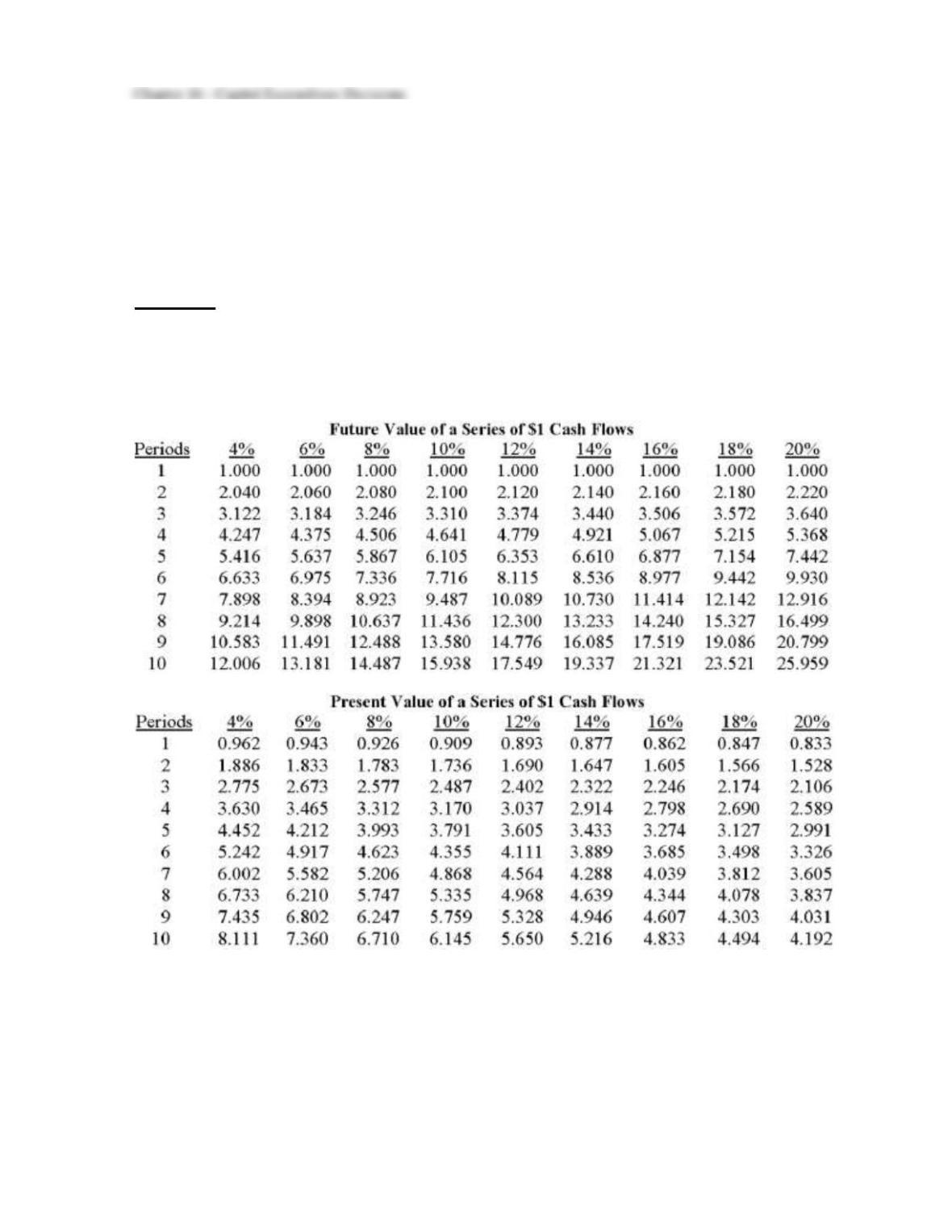
A. Use the net-present-value method and determine whether the landfill should be acquired.
B. Determine the landfill’s approximate internal rate of return, using the tables above.
Solution:
A.
16–74
120. Canton Corporation is considering the acquisition of a new machine that costs $149,040.
The machine is expected to have a four-year service life and will produce annual savings in
cash operating costs of $45,000. Canton evaluates investments by using the internal rate of
return and ignores income taxes.
Required:
A. Briefly define the internal rate of return.
B. What relationship holds true at the internal rate of return with respect to discounted cash
inflows and discounted cash outflows? With respect to net present value?
C. Compute the machine’s internal rate of return, using the tables that follow.
Chapter 16 – Capital Expenditure Decisions
Solution:
121. Both net present value (NPV) and the internal rate of return (IRR) have a reinvestment
assumption.
Required:
A. State the assumption for each method.
B. One of the advantages of the NPV method is that users can adjust for risk considerations.
Explain how this is done.
Solution:
122. Consider the five items that follow, which are related to independent investment
opportunities.
Purchase price of a new machine: $850,000
Annual straight-line depreciation: $75,000
Annual savings in cash operating costs: $120,000
Advertising expenses related to a new marketing campaign in year 2: $35,000
Sale of an asset in year 6: Loss on sale, $60,000; proceeds received by seller, $23,000
Required:
Complete the following table, inserting the (pre-discounted) cash flow amounts that would be
used in a net-present-value analysis. Column A should be completed based on the assumption
of no income taxes; in contrast, Column B should be completed assuming the relevant
company is subject to a 30% income tax rate. Be sure to note cash outflows in parentheses.
Column A:
No Income Taxes
Column B:
30% Tax Rate
Purchase price of new machine
Annual straight-line depreciation
Annual savings in cash operating costs
Advertising expenses
Sale of Asset
Solution:
Purchase price of new machine
Column B: $120,000 x 0.7
Column B: $(35,000) x 0.7
$18,000 + $23,000
123. Spear Company is considering a $5.4 million asset investment that has a four-year
service life and a $400,000 salvage value. The investment is expected to produce annual
savings in cash operating costs of $860,000 and will require a $250,000 overhaul in year 3,
which is fully-deductible for tax purposes.
Spear uses the net-present-value method to analyze investments. Asset investments are
depreciated by the straight-line method, ignoring salvage values in related computations.
Required:
A. Ignoring income taxes, determine the (pre-discounted) cash-flow amounts that would be
used in a net-present-value analysis for (1) the asset acquisition, (2) annual savings in cash
operating costs, (3) annual straight-line depreciation, (4) the overhaul in year 3, and (5)
disposal of the asset in year 4. Note cash outflows in parentheses.
B. Repeat requirement “A,” assuming the company is subject to a 30% income tax rate.
Assume the company depreciates the asset using the optional straight-line method.
Additionally, it depreciates it over the asset’s service life (not its MACRS life).
Solution: