
Chapter 16 – Capital Expenditure Decisions
72. A depreciation tax shield is a(n):
73. Consider the following statements about depreciation tax shields:
I. A depreciation tax shield provides distinct benefits to a business.
II. A depreciation tax shield should be ignored when doing a net-present-value analysis.
III. A depreciation tax shield can occur in more than one year.
Which of the above statements is (are) correct?
74. A company that uses accelerated depreciation:
A. would write off a larger portion of an asset’s cost sooner than under the straight-line
method.
75. Poston Company is considering the use of accelerated depreciation rather than straight-
line depreciation for a new asset acquisition. Which of the following choices correctly shows
when the majority of depreciation would be taken (early or late in the asset’s life), when most
of the tax savings occur (early or late in the asset’s life), and which depreciation method
would have the higher present value?
When Majority of
Depreciation is Taken
When Majority of
Tax Savings Occur
Depreciation Method with
Higher Present Value

76. Julio Company purchased a $200,000 machine that has a four-year life and no salvage
value. The company uses straight-line depreciation on all asset acquisitions and is subject to a
30% tax rate. The proper cash flow to show in a discounted-cash-flow analysis as occurring at
77. If a company desires to be in compliance with current income tax law and write off the
cost of its assets rapidly, the firm would use:
78. The Modified Accelerated Cost Recovery System (MACRS) assumes that, on average,
assets will be placed in service:
79. A company used the net-present-value method to analyze an investment and found the
investment to be very attractive. If the firm used straight-line depreciation and changes to the
Modified Accelerated Cost Recovery System (MACRS), the investment’s net present value
will:
80. A company used the net-present-value method to analyze an investment and found the
investment to be very attractive. If the firm used Modified Accelerated Cost Recovery System
(MACRS) and changes to the straight-line depreciation, the investment’s net present value
will:
81. Young Company received $18,000 cash from the sale of a machine that had a $13,000
book value. If the company is subject to a 30% income tax rate, the net cash flow to use in a
discounted-cash-flow analysis would be:

82. Dapper Company received $7,000 cash from the sale of a machine that had an $11,000
book value. If the company is subject to a 30% income tax rate, the net cash flow to use in a
discounted-cash-flow analysis would be:
83. A machine was sold in December 20×3 for $9,000. It was purchased in January 20×1 for
$15,000, and depreciation of $12,000 was recorded from the date of purchase through the date
of disposal. Assuming a 40% income tax rate, the after-tax cash inflow at the time of sale is:

84. Donata Company purchased equipment for $30,000 in December 20×1. The equipment is
expected to generate $10,000 per year of additional revenue and incur $2,000 per year of
additional cash expenses, beginning in 20×2. Under MACRS, depreciation in 20×2 will be
$3,000. If the firm’s income tax rate is 40%, the after-tax cash flow in 20×2 would be:
Use the following information to answer Questions 85 & 86.
Carmen Company has an asset that cost $5,000 and currently has accumulated depreciation of
$2,000. Suppose the firm sold the asset for $2,500 and is subject to a 30% income tax rate.
85. The loss on disposal would be:

86. The net after-tax cash flow of the disposal is:
87. Workman Company is considering a five-year project that requires a typical investment in
working capital, in this case, $100,000. Consider the following statements about this situation:
I. Workman should include a $100,000 outflow that occurs at time 0 in a discounted-cash-
flow analysis.
II. Workman should include separate $100,000 outflows in each year of the project’s five-year
life.
III. Workman should include a $100,000 recovery of its working-capital investment in year 5
of a discounted-cash-flow analysis.
Which of the above statements is (are) correct?

88. A machine is expected to produce annual savings in cash operating costs of $400,000 for
the next six years.
FV of 1 (i=10%, n=6): 1.772
FV of a series of $1 cash flows (i=10%, n=6): 7.716
PV of $1 (i=10%; n = 6): 0.564
PV of a series of $1 cash flows (i=10%, n=6): 4.355
If the company has a 10% after-tax hurdle rate and is subject to a 30% income tax rate, the
correct discounted net cash flow would be:

89. A machine is expected to produce increases in cash operating costs of $200,000 for the
next six years.
FV of 1 (i=14%, n=6): 2.195
FV of a series of $1 cash flows (i=14%, n=6): 8.536
PV of $1 (i=14%; n = 6): 0.456
PV of a series of $1 cash flows (i=14%, n=6): 3.889
If the company has a 14% after-tax hurdle rate and is subject to a 30% income tax rate, the
correct discounted net cash flow would be:
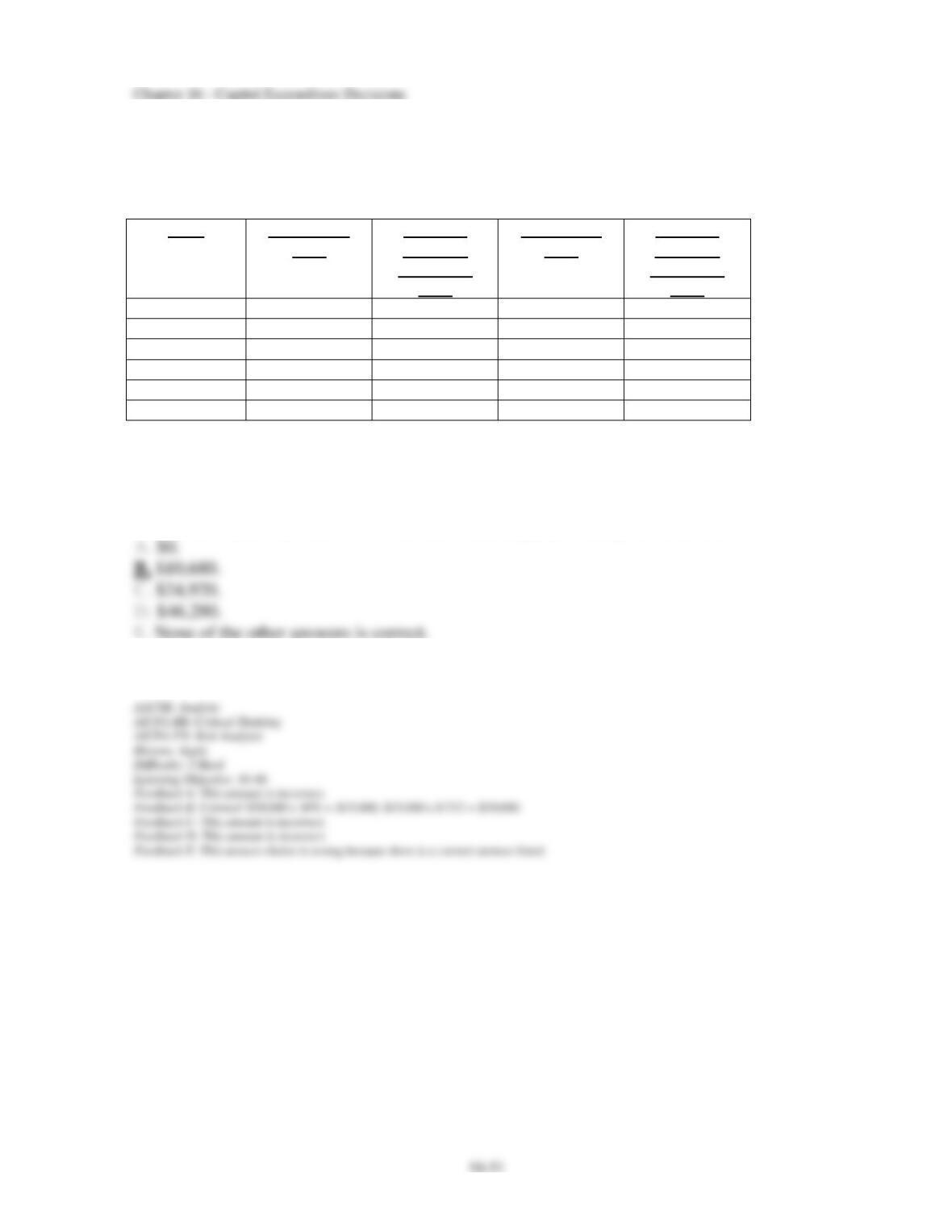
90. A new machine is expected to produce a MACRS deduction in three years of $50,000.
Year
FV of $1 at
12%
FV of an
ordinary
annuity at
12%
PV of $1 at
12%
PV of an
ordinary
annuity at
12%
1
1.120
1.000
0.893
0.893
2
1.254
2.120
0.797
1.690
3
1.405
3.374
0.712
2.402
4
1.574
4.779
0.636
3.037
5
1.762
6.353
0.567
3.605
6
1.974
8.115
0.507
4.111
If the company has a 12% after-tax hurdle rate and is subject to a 30% income tax rate, the
correct discounted net cash flow to include in an acquisition analysis would be:

91. In 10 years, Hopkins Company plans to receive $9,000 cash from the sale of a machine
that has a $5,000 book value.
Year
FV of $1 at
8%
FV of an
ordinary
annuity at 8%
PV of $1 at
8%
PV of an
ordinary
annuity at 8%
1
1.080
1.000
0.926
0.926
2
1.166
2.080
0.857
1.783
3
1.260
3.246
0.794
2.577
4
1.361
4.506
0.735
3.312
5
1.469
5.867
0.681
3.993
6
1.587
7.336
0.630
4.623
If the firm is subject to a 30% income tax rate and has an 8% after-tax hurdle rate, the correct
discounted net cash flow would be:

92. In eight years, Shu Company plans to receive $11,000 cash from the sale of a machine
that has a $16,000 book value.
Year
FV of $1 at
12%
FV of an
ordinary
annuity at
12%
PV of $1 at
12%
PV of an
ordinary
annuity at
12%
1
1.120
1.000
0.893
0.893
2
1.254
2.120
0.797
1.690
3
1.405
3.374
0.712
2.402
4
1.574
4.779
0.636
3.037
5
1.762
6.353
0.567
3.605
6
1.974
8.115
0.507
4.111
If the firm is subject to a 30% income tax rate and has a 12% after-tax hurdle rate, the correct
discounted net cash flow would be:

93. Consider the following statements about the investment in working capital in a capital
budgeting analysis:
I. Working capital often increases as the result of higher balances in accounts receivable or
inventory necessary to support a project.
II. Working capital increases are sources of cash and should be included in a discounted-cash-
flow analysis.
III. The time 0 cash investment in working capital is included in a discounted-cash-flow
analysis as a cash outflow.
Which of the above statements is (are) correct?
94. Which of the following tools is sometimes used to rank investment proposals?
95. If a proposal’s profitability index is greater than one:
96. St. Michaels School ranks investments by using the profitability index (PI). The following
data relate to Project X and Project Y:
Project X
Project Y
Initial Investment
$400,000
$1,300,000
Present value of inflows
600,000
1,800,000
Which project would be more attractive as judged by its ranking, and why?

97. Upton evaluates future projects by using the profitability index. The company is currently
reviewing five similar projects and must choose one of the following:
Project
Initial
Investment
Present Value of
Cash Inflows
1
$100,000
$97,000
2
50,000
80,000
3
75,000
110,000
4
60,000
100,000
5
150,000
200,000
Which project should Upton select if the decision is based entirely on the profitability index?
98. The payback period is best defined as:
99. Consider the following statements about the payback period:
I. As shown in your text, the payback period considers the time value of money.
II. The payback period can only be used if net cash inflows are uniform throughout a project’s
life.
III. The payback period ignores cash inflows that occur after the payback period is reached.
Which of the above statements is (are) correct?

100. A piece of equipment costs $30,000, and is expected to generate $8,500 of annual cash
revenues and $1,500 of annual cash expenses. The disposal value at the end of the estimated
10-year life is $3,000. Ignoring income taxes, the payback period is:
101. Sinclair is considering the acquisition of new machinery that will produce uniform
benefits over the next eight years. The following information is available:
Annual savings in cash operating costs: $350,000
Annual depreciation expense: $250,000
If the company is subject to a 30% tax rate, what denominator should be used to compute the
machinery’s payback period?

102. Krate Inc. is considering a $600,000 investment in new equipment that is anticipated to
produce the following net cash inflows:
Year
Net Cash Inflows
1
$120,000
2
250,000
3
110,000
4
80,000
5
160,000
If cash flows occur evenly throughout a year, the equipment’s payback period is:
103. Ocean Wave Packaging is considering a $600,000 investment in new equipment that is
anticipated to produce the following data over a five-year life:
Year
Cash Inflows
Cash Outflows
Depreciation
1
$350,000
$130,000
$120,000
2
450,000
190,000
120,000
3
450,000
170,000
120,000
4
340,000
150,000
120,000
5
300,000
130,000
120,000
Ignoring income taxes and assuming that cash flows occur evenly throughout a year, the
equipment’s approximate payback period is: