Explanation: This question is not available in MyAccountingLab.
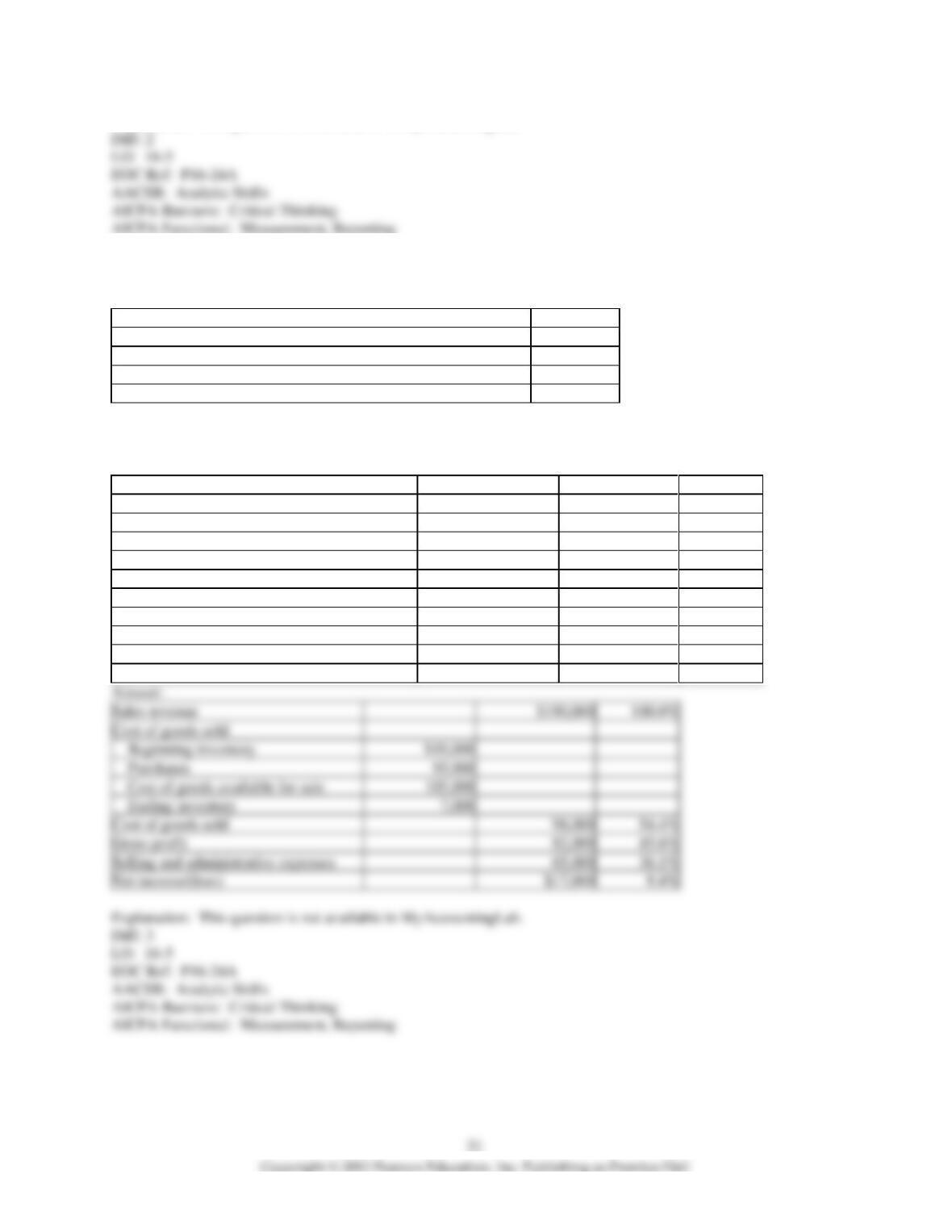
18) Excellent Company sells accounting textbooks. The following information summarizes Excellent’s operating
activities for 2012:
Merchandise inventory, January 1, 2012
$10,000
Merchandise inventory, December 31, 2012
$7,000
Purchases
$95,000
Selling and Administrative Expenses
$65,000
Sales Revenue
$180,000
Required: Prepare an income statement for the year ended December 31, 2012. Please use the format provided
below, and include a vertical analysis showing percentages rounded to the nearest tenth of a percent.
Sales revenue
Cost of goods sold
Beginning inventory
Purchases
Cost of goods available for sale
Ending inventory
Cost of goods sold
Gross profit
Selling and administrative expenses
Net income/(loss)
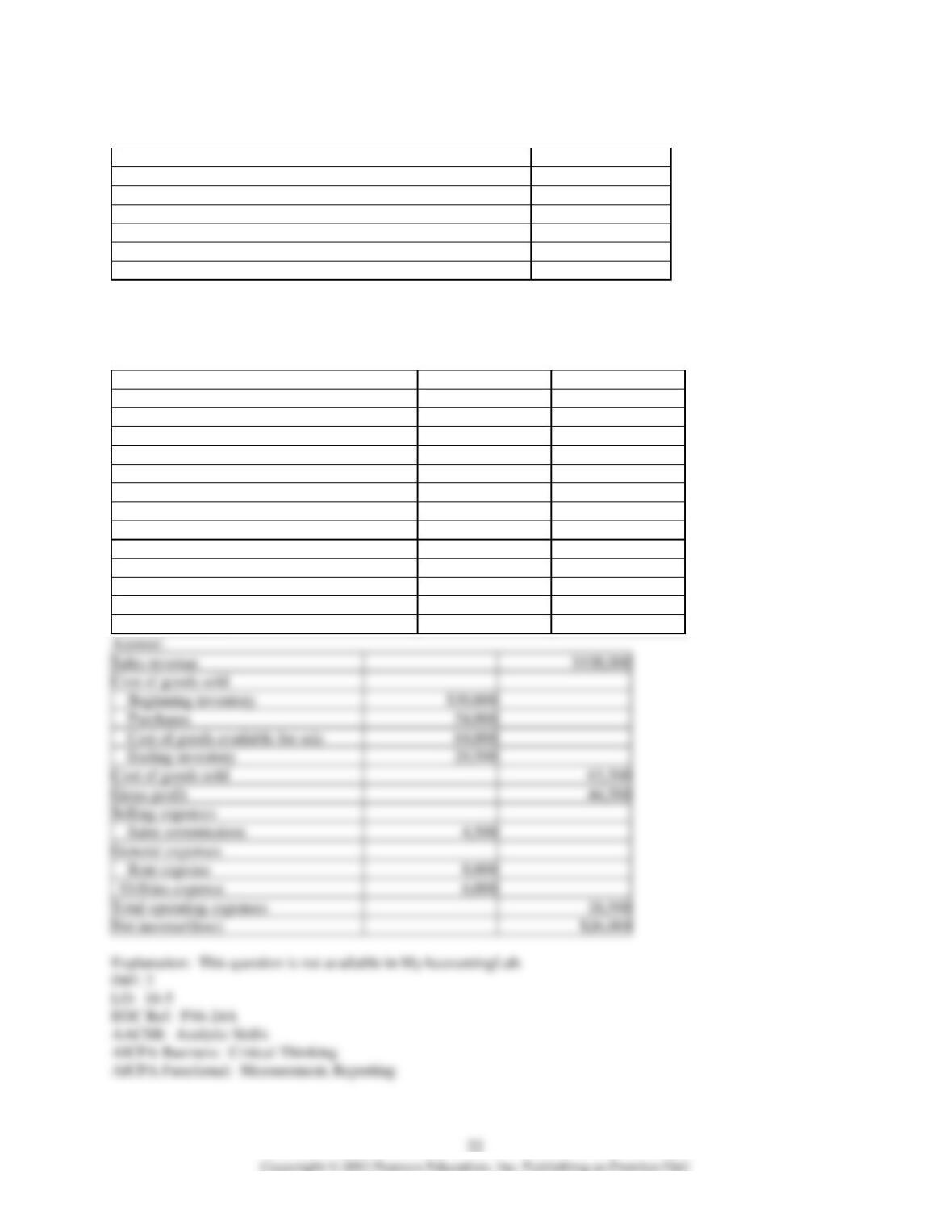
19) Best Company sells office supplies. The following information summarizes Best’s operating activities for 2012:
Utilities for store
$6,000
Rent for store
$8,000
Sales commissions
$4,500
Purchases of merchandise
$54,000
Inventory on January 1, 2012
$30,000
Inventory on December 31, 2012
$20,500
Sales revenue
$108,000
Required: Prepare an income statement for Best Company, a merchandiser, for the year ended December 31,
2012.using the format below:
Sales revenue
Cost of goods sold
Beginning inventory
Purchases
Cost of goods available for sale
Ending inventory
Cost of goods sold
Gross profit
Selling expenses
Sales commissions
General expenses
Rent expense
Utilities expense
Total operating expenses
Net income/(loss)
Sales revenue
Cost of goods sold
Beginning inventory
Purchases
Cost of goods available for sale
Ending inventory
Cost of goods sold
Gross profit
Selling expenses
Sales commissions
General expenses
Rent expense
Utilities expense
Total operating expenses
Net income/(loss)
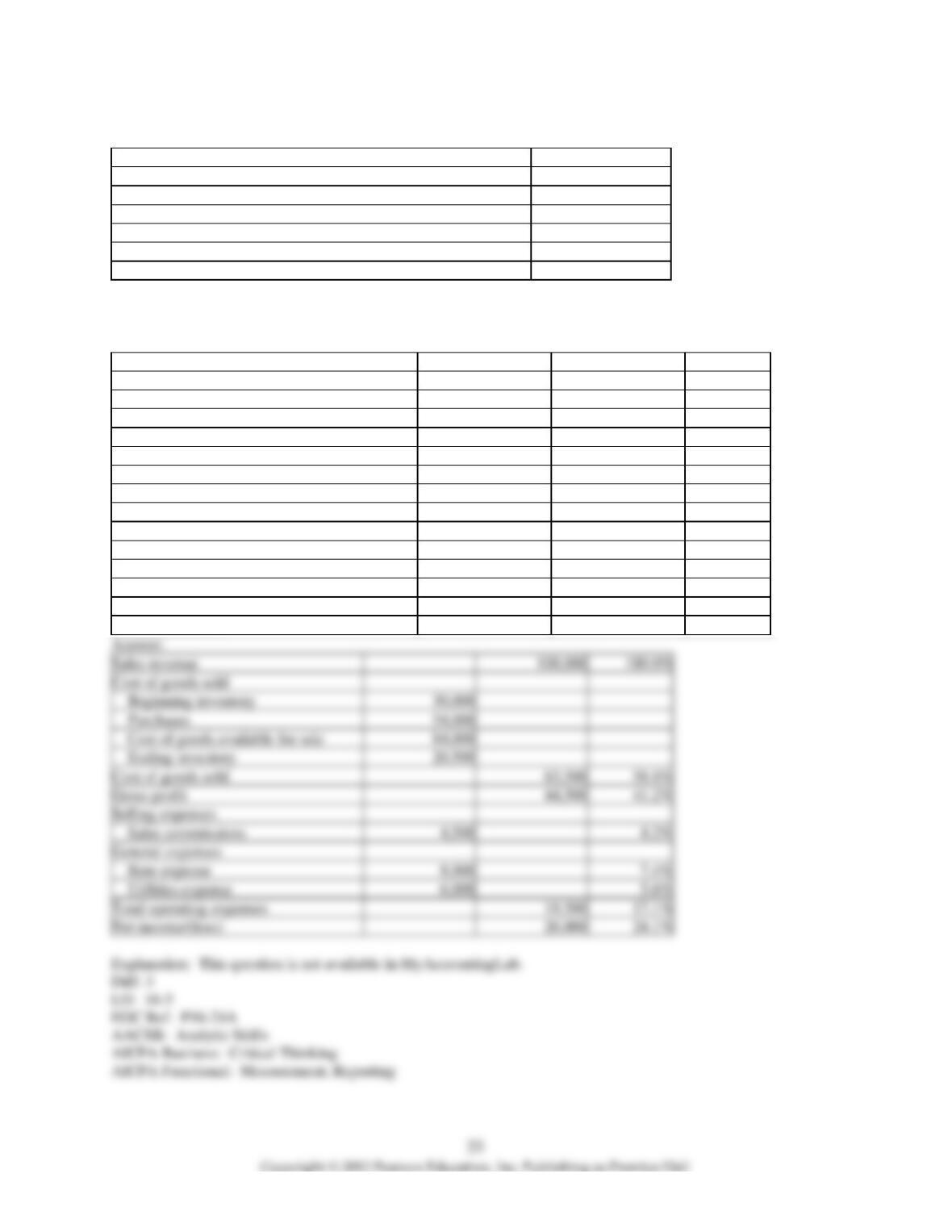
20) Best Company sells office supplies. The following information summarizes Best’s operating activities for 2012:
Utilities for store
$6,000
Rent for store
$8,000
Sales commissions
$4,500
Purchases of merchandise
$54,000
Inventory on January 1, 2012
$30,000
Inventory on December 31, 2012
$20,500
Sales revenue
$108,000
Required: Prepare an income statement for Best Company, a merchandiser, for the year ended December 31,
2012.using the format below. Please include a vertical analysis rounded to the nearest tenth of a percent.
Sales revenue
Cost of goods sold
Beginning inventory
Purchases
Cost of goods available for sale
Ending inventory
Cost of goods sold
Gross profit
Selling expenses
Sales commissions
General expenses
Rent expense
Utilities expense
Total operating expenses
Net income/(loss)
Sales revenue
Cost of goods sold
Beginning inventory
Purchases
Cost of goods available for sale
Ending inventory
Cost of goods sold
Gross profit
Selling expenses
Sales commissions
General expenses
Rent expense
Utilities expense
Total operating expenses
Net income/(loss)
Learning Objective 16-6
1) GAAP requires companies to treat product costs such as factory overhead as an asset until the product is sold.
2) Cost of goods manufactured includes direct materials, direct labor, and manufacturing overhead.
3) Manufacturing overhead includes all manufacturing costs, such as direct labor and direct materials.
4) Manufacturing overhead includes indirect costs, such as insurance and depreciation on the factory building.
5) A manufacturer’s inventory consists of merchandise inventory, work in process inventory, and finished goods
inventory.
6) Selling and administrative expenses are subtracted from cost of goods sold to obtain gross profit.
7) The costs of indirect materials cannot easily be traced to the manufactured product and is therefore a component
of manufacturing overhead.
8) The total manufacturing costs to account for during the year minus the beginning work in process equals cost of
goods manufactured.
9) The wages and benefits of the assembly line workers are product costs.
10) The wages and benefits of the assembly line workers are included in manufacturing overhead.
11) The wages and benefits of the factory manager are product costs.
12) The wages and benefits of the factory manager are included in manufacturing overhead.
13) The wages and benefits of the sales staff are product costs.
14) The wages and benefits of the factory janitors are included in manufacturing overhead.
15) Indirect materials costs like lubes and cleaning fluids are product costs.
16) Indirect materials costs like lubes and cleaning fluids are included in manufacturing overhead.
17) Factory rent, taxes and insurance are product costs.
18) Factory rent, taxes and insurance are included in manufacturing overhead.
19) Transportation costs to ship products to customers are product costs.
20) Sales commissions are included in manufacturing overhead.
21) Advertising and marketing costs are product costs.
22) Advertising and marketing costs are included in manufacturing overhead.
23) Accounting, legal and administrative costs are product costs.
24) Accounting, legal and administrative costs are included in manufacturing overhead.
25) Repair and maintenance costs for factory equipment are product costs.
26) Repair and maintenance costs for factory equipment are included in manufacturing overhead.
27) Repair and maintenance costs of vehicles used to deliver products to the customers are product costs.
28) Repair and maintenance costs of vehicles used to deliver products to the customers are included in
manufacturing overhead.
29) Which of the following costs do NOT go directly into the work in process account?
A) Factory overhead
B) Indirect labor
C) Factory janitorial costs
D) The purchase of raw materials
30) Which of the following are period costs?
A) Current assets on the balance sheet
B) Costs incurred and expensed during the accounting period
C) Costs related to the manufacture of products
D) Current liabilities on the balance sheet
31) Which of the following is an example of a period cost?
A) Advertising expense
B) Depreciation on factory equipment
C) Indirect materials
D) Property taxes for the factory
32) Which of the following costs would appear on the income statements for both a merchandiser and a
manufacturer?
A) Direct labor
B) Cost of goods manufactured
C) Direct materials
D) Operating expenses
33) Which of the following is NOT a part of manufacturing overhead?
A) Indirect materials
B) Indirect labor
C) Factory insurance
D) Depreciation on delivery vehicles
34) Which of the following is NOT a product cost?
A) Indirect labor
B) Depreciation of factory equipment
C) Indirect materials
D) Depreciation of corporate headquarters
35) Period costs do NOT include which of the following?
A) Sales commissions
B) Factory janitorial costs
C) Insurance on delivery vehicles
D) Advertising costs
36) Which of the following is an example of direct labor?
A) Wages of assembly line personnel
B) Salary of vice president of production
C) Wages of factory security guard
D) Salary of production manager
37) Manufacturing overhead includes which of the following?
A) Indirect labor and indirect materials
B) Salaries of salesmen
C) Direct materials and direct labor
D) Delivery costs to ship goods to customers
38) All of the following are examples of manufacturing overhead EXCEPT for:
A) utilities incurred in the factory.
B) insurance on factory equipment.
C) wages of assembly line workers.
D) indirect materials.
39) Which of the following describes the term cost object?
A) An object which costs money to purchase
B) Any type of cost which is incurred to produce a finished product
C) Anything which requires a detailed record of its component costs to be kept
D) Any cost which is treated as a period expense
40) Wright Company reports production costs for 2012 as follows:
Direct materials used
$375,000
Direct labor incurred
$250,000
Manufacturing overhead incurred
$400,000
Operating expenses
$145,000
How much are Wright Company’s period costs?
A) $250,000
B) $575,000
C) $145,000
D) $375,000
41) Wright Company reports production costs for 2012 as follows:
Direct materials used
$375,000
Direct labor incurred
$250,000
Manufacturing overhead incurred
$400,000
Operating expenses
$145,000
How much are Wright Company’s inventoriable product costs for 2009?
A) $925,000
B) $605,000
C) $975,000
D) $1,025,000
42) Which of the following describes the cost of goods manufactured?
A) The cost of the goods that were sold during the period
B) The total cost of all goods that were completed, or partially completed during the period
C) The cost of those goods which were completed during the period
D) The total costs in inventory at the end of the period
43) At the beginning of 2011, the Taylor Company’s work in process inventory account had a balance of $30,000.
During 2011, $68,000 of direct materials were used in production, and $66,000 of direct labor costs were incurred.
Manufacturing overhead in 2011 amounted to $90,000. The cost of goods manufactured was $220,000 in 2011.
What is the balance in work in process inventory on December 31, 2011?
A) $24,000
B) $66,000
C) $6,000
D) $34,000
44) Selected data for Young Company for 2012 is presented below:
Direct labor incurred
$30,000
Indirect labor incurred
21,000
Factory depreciation
5,000
Factory utilities
7,000
Indirect materials used
2,000
Direct materials used
12,000
Property taxes on factory building
3,000
Sales commissions
8,000
What is the manufacturing overhead?
A) $47,000
B) $50,000
C) $38,000
D) $46,000
45) Village Company’s selected cost data for 2012 are shown below:
Cost of goods manufactured
$145,200
Work in process inventory, Jan. 1, 2012
18,500
Work in process inventory, Dec. 31, 2012
22,500
Direct materials used
15,800
What are total manufacturing costs incurred by Village Company in 2012?
A) $149,200
B) $158,300
C) $139,800
D) $117,100
46) Village Company’s selected cost data for 2012 are shown below:
Cost of goods manufactured
$145,200
Work in process inventory, Jan. 1, 2012
18,500
Work in process inventory, Dec. 31, 2012
22,500
Direct materials used
15,800
Assuming manufacturing overhead costs of $83,375, what is the amount of direct labor incurred by Village
Company in 2012?
A) $50,025
B) $62,550
C) $41,700
D) $83,400
47) Harrison Company reports the following cost information for August:
Cost of goods manufactured
$135,800
Finished goods inventory, Aug. 1
30,200
Finished goods inventory, Aug. 31
35,300
Work in process inventory, Aug. 1
22,500
Work in process inventory, Aug. 31
18,500
Direct materials used
25,300
What is cost of goods sold for August?
A) $154,500
B) $125,100
C) $130,700
D) $139,800
48) Harrison Company reports the following cost information for August:
Cost of goods manufactured
$135,800
Finished goods inventory, Aug. 1
30,200
Finished goods inventory, Aug. 31
35,300
Work in process inventory, Aug. 1
22,500
Work in process inventory, Aug. 31
18,500
Direct materials used
25,300
What is the amount of direct labor incurred by Harrison Company in August?
A) $131,800
B) $61,944
C) $49,556
D) $63,900
49) Harrison Company reports the following cost information for August:
Cost of goods manufactured
$135,800
Manufacturing overhead
42,600
Work in process inventory, Aug. 1
22,500
Work in process inventory, Aug. 31
18,500
Direct labor incurred
63,900
What is the amount of direct materials used by Harrison Company in August?
A) $25,300
B) $61,944
C) $49,556
D) $63,900
50) Harrison Company reports the following cost information for August:
Cost of goods manufactured
$135,800
Direct materials used
25,300
Work in process inventory, Aug. 1
22,500
Work in process inventory, Aug. 31
18,500
Direct labor incurred
63,900
What is the amount of manufacturing overhead incurred by Harrison Company in August?
A) $25,300
B) $61,944
C) $42,600
D) $63,900
51) A company used $35,000 of direct materials, incurred $73,000 in direct labor cost, and $114,000 in
manufacturing overhead costs during the period. If beginning and ending work in process inventories were $28,000
and $21,000 respectively. What is the cost of goods manufactured?
A) $250,000
B) $229,000
C) $215,000
D) $222,000
52) Given the following information, determine the cost of goods manufactured.
Direct labor incurred
$126,000
Manufacturing overhead incurred
359,000
Direct materials used
1,000
Finished goods inventory, 1/1/2012
395,000
Finished goods inventory, 12/31/2012
442,000
Work in process inventory, 1/1/2012
193,000
Work in process inventory, 12/31/2012
218,000
A) $781,000
B) $461,000
C) $731,000
D) $765,000
53) Given the following information, determine the cost of goods sold.
Direct labor incurred
$126,000
Manufacturing overhead incurred
359,000
Direct materials used
1,000
Finished goods inventory, 1/1/2012
395,000
Finished goods inventory, 12/31/2012
442,000
Work in process inventory, 1/1/2012
193,000
Work in process inventory, 12/31/2012
218,000
A) $781,000
B) $461,000
C) $731,000
D) $414,000
54) The cost of goods sold for Frye Manufacturing in 2012 was $233,000. The January 1, 2012 finished goods
inventory balance was $31,600, and the December 31, 2012 finished goods inventory balance was $24,200. What
was cost of goods manufactured during 2012?
A) $288,800
B) $233,000
C) $225,600
D) $240,400
55) Which of the following would probably be considered an indirect material cost in a bakery?
A) Spices
B) Flour
C) Milk
D) Eggs
56) Which of the following is NOT a period cost?
A) Sales commissions
B) CEO’s salary
C) Delivery van depreciation
D) Factory janitorial costs
57) Which of the following properly describes the accounting for indirect labor costs?
A) Indirect labor costs are product costs and are expensed as incurred.
B) Indirect labor costs are period costs and are expensed as incurred.
C) Indirect labor costs are product costs and are expensed when the manufactured product is sold.
D) Indirect labor costs are period costs and are expensed when the manufactured product is sold.
58) Which of the following properly describes the accounting for factory depreciation?
A) Factory depreciation is a product cost and is expensed as incurred.
B) Factory depreciation is a period cost and is expensed as incurred.
C) Factory depreciation is a product cost and is expensed when the manufactured product is sold.
D) Factory depreciation is a period cost and is expensed when the manufactured product is sold.
59) Which of the following properly describes the accounting for corporate headquarters’ property taxes?
A) The property taxes are product costs and are expensed as incurred.
B) The property taxes are period costs and are expensed as incurred.
C) The property taxes are product costs and are expensed when the manufactured product is sold.
D) The property taxes are period costs and are expensed when the manufactured product is sold.
60) Which of the following properly describes the accounting for advertising costs?
A) Advertising costs are product costs and are expensed as incurred.
B) Advertising costs are period costs and are expensed as incurred.
C) Advertising costs are product costs and are expensed when the manufactured product is sold.
D) Advertising costs are period costs and are expensed when the manufactured product is sold.
61) The following information has been provided by LeMaire Company:
• Direct labor: $50,000
• Direct materials used: $20,000
• Materials purchased: $27,000
• Cost of goods manufactured: $100,000
• Ending work in process: $16,000
• Corporate headquarters’ property taxes: $6,000
• Manufacturing overhead: $39,000
The beginning work in process was:
A) $23,000.
B) $7,000.
C) $9,000.
D) $1,000.
62) The following information was obtained from Sizzler Company:
• Advertising costs: $7,900
• Indirect labor: $9,000
• Direct Labor: $31,000
• Indirect materials: $7,200
• Direct materials: $47,000
• Factory utilities: $3,000
• Factory repair and maintenance : $700
• Factory janitorial costs: $1,900
• Manufacturing equipment depreciation: $1,600
• Delivery vehicle depreciation: $790
• Administrative wages and salaries: $19,000
How much were Sizzler’s period costs?
A) $27,690
B) $7,900
C) $19,790
D) $19,000