
Chapter 16 – Capital Expenditure Decisions
40. A machine costs $25,000; it is expected to generate annual cash revenues of $8,000 and
annual cash expenses of $2,000 for five years. The required rate of return is 12%.
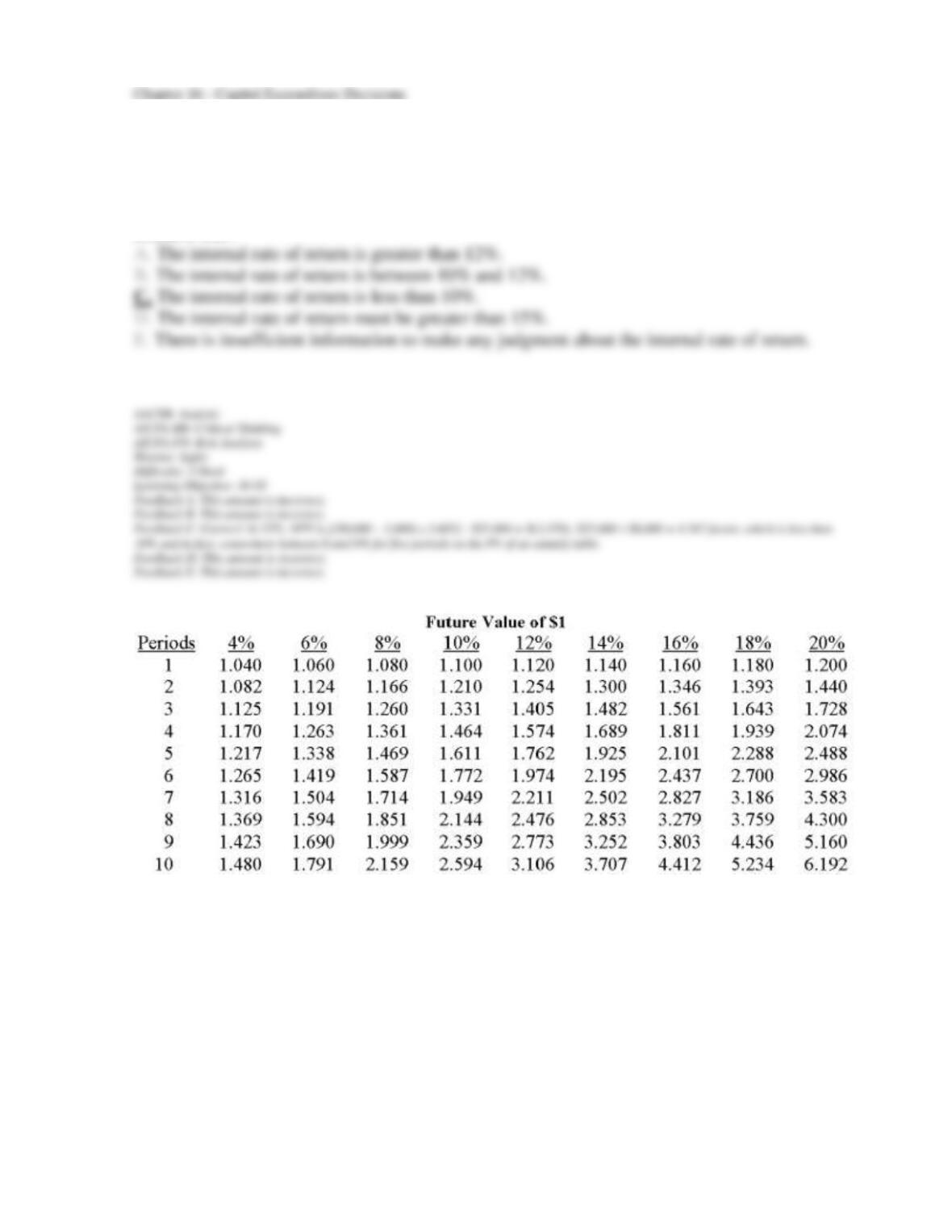
FV of 1 (i=12%, n=5): 1.762
FV of a series of $1 cash flows (i=12%, n=5): 6.353
PV of $1 (i=12%; n = 5): 0.567
PV of a series of $1 cash flows (i=12%, n=5): 3.605
16–22
41. A machine costs $25,000; it is expected to generate annual cash revenues of $8,000 and
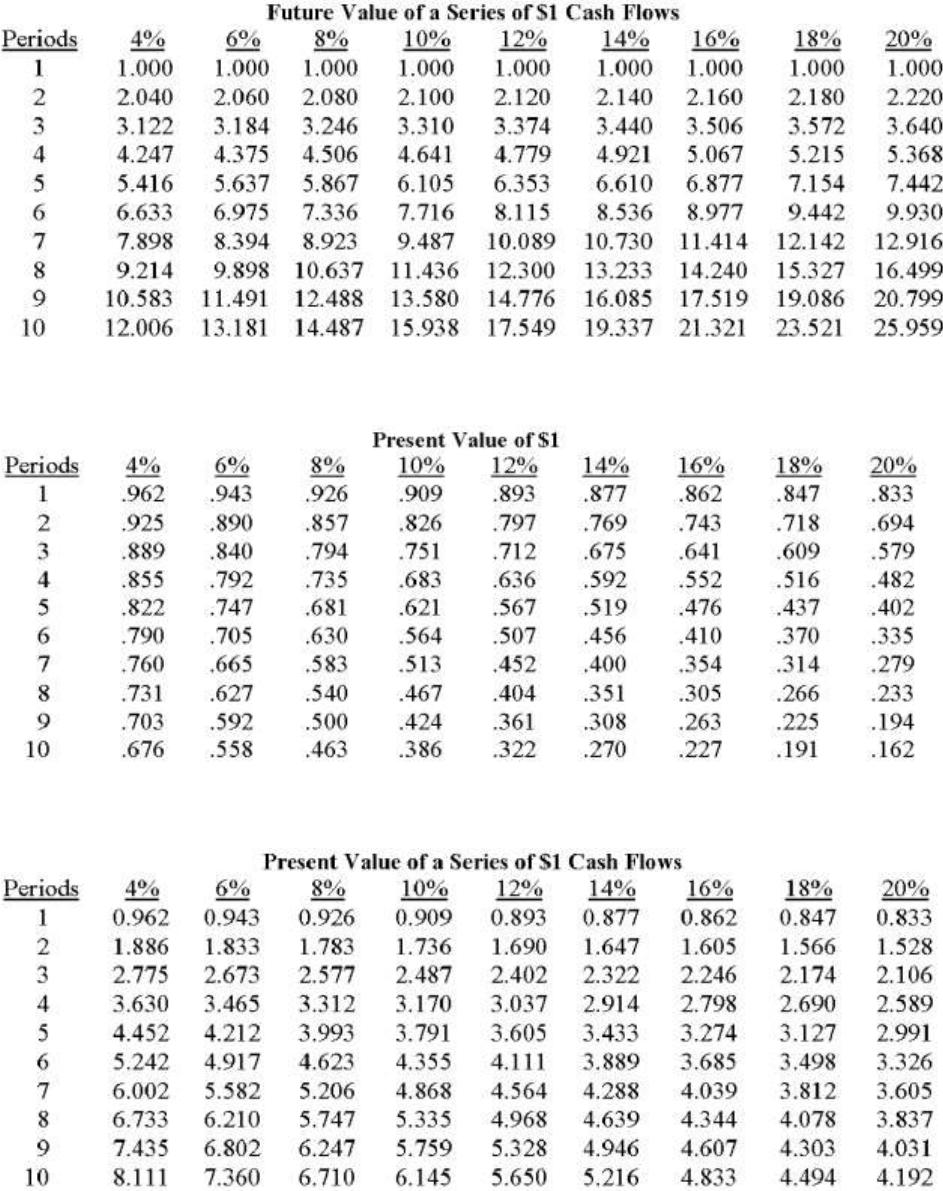
annual cash expenses of $2,000 for five years. The required rate of return is 12%. Using the
tables that follow, which of the following statements about the machine’s internal rate of
return is true?
Chapter 16 – Capital Expenditure Decisions
16–23

Chapter 16 – Capital Expenditure Decisions
42. The mayor of Trenton is considering the purchase of a new computer system for the city’s
tax department. The system costs $75,000 and has an expected life of five years. The mayor
estimates the following savings will result if the system is purchased:
Year or
Period
Savings
PV of $1 at
10%
PV of an
ordinary
annuity at
10%
1
$20,000
0.909
.909
2
25,000
0.826
1.736
3
30,000
0.751
2.487
4
15,000
0.683
3.170
5
12,000
0.621
3.791
If Trenton uses a 10% discount rate for capital-budgeting decisions, the net present value of
the computer system would be:

43. The mayor of Trenton is considering the purchase of a new computer system for the city’s
tax department. The system costs $75,000 and has an expected life of five years. The mayor
estimates the following savings will result if the system is purchased:
Year
Savings
1
$20,000
2
25,000
3
30,000
4
15,000
5
12,000
What can be said about the computer system’s internal rate of return if the net present value at
12% is positive? Trenton uses a 10% discount rate for capital-budgeting decisions.

44. The mayor of Trenton is considering the purchase of a new computer system for the city’s
tax department. The system costs $75,000 and has an expected life of five years. The mayor
estimates the following savings will result if the system is purchased:
Year
Savings
PV of $1 at
10%
PV of an
ordinary
annuity at
10%
1
$20,000
0.909
.909
2
25,000
0.826
1.736
3
30,000
0.751
2.487
4
15,000
0.683
3.170
5
12,000
0.621
3.791
Trenton uses a 10% discount rate for capital-budgeting decisions.
A salesperson from a different computer company claims that his machine, which costs
$85,000 and has an estimated service life of four years, will generate annual savings for the
city of $32,000. If the discount rate is 10%, the net present value of this system would be:
45. A company that is using the internal rate of return (IRR) to evaluate projects should accept
a project if the IRR:
46. Which of the following choices correctly states the rules for project acceptance under the
net-present-value method and the internal-rate-of-return method?
Net Present Value
Internal Rate of Return

47. The rule for project acceptance under the net-present-value method is that:
48. The rule for project acceptance under the internal rate of return method is that:

49. The net-present-value method assumes that project funds are reinvested at the:
50. The internal-rate-of-return method assumes that project funds are reinvested at the:
51. Which of the following choices correctly states how funds are assumed to be reinvested
under the net-present-value method and the internal-rate-of-return method?
Net Present Value
Internal Rate of Return
52. A company’s hurdle rate is generally influenced by:
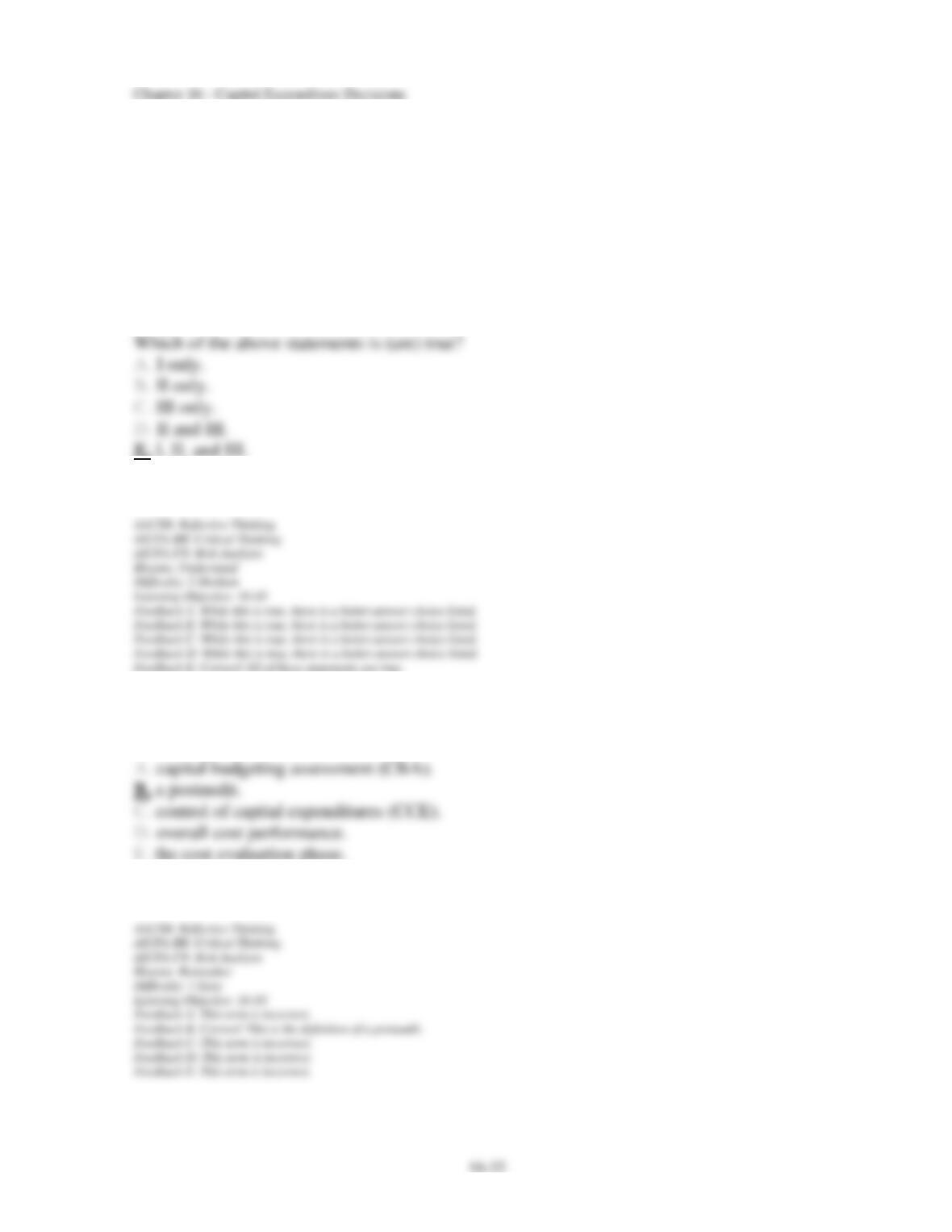
53. If income taxes are ignored, which of the following choices correctly notes how a project’s
depreciation is treated under the net-present-value method and the internal-rate-of-return
method?
Net Present Value
Internal Rate of Return
54. Consider the following statements about the total-cost and the incremental-cost
approaches of investment evaluation:
I. Both approaches will yield the same conclusions.
II. Choosing between these approaches is a matter of personal preference.
III. The incremental approach focuses on cost differences between alternatives.
55. The systematic follow-up on a capital project to see how the project actually turns out is
commonly known as:

56. Consider the following statements about capital budgeting postaudits:
I. Postaudits can be used to detect desirable projects that were rejected.
II. Postaudits can be used to detect undesirable projects that were accepted.
III. Postaudits may reveal shortcomings in cash-flow projections, providing insights that allow
a company to improve future predictions.
Which of the above statements is (are) correct?
57. Generally speaking, which of the following would not directly affect a company’s income
tax payments?

58. A company’s cash flows for income taxes are normally affected by:
59. Consider the following statements about taxes and after-tax cash flows:
I. Capital budgeting analyses should incorporate after-tax cash flows rather than before-tax
cash flows.
II. Added company revenues will result in lower taxes for a firm.
III. Operating expenses may actually provide a tax benefit for an organization.
Which of the above statements is (are) correct?
60. When income taxes are considered in capital budgeting, the cash flows related to a
company’s advertising expense would be correctly figured by taking the cash paid for
advertising and:
61. Of the five expenses that follow, which one is most likely treated differently than the
others when income taxes are considered in a discounted-cash-flow analysis?
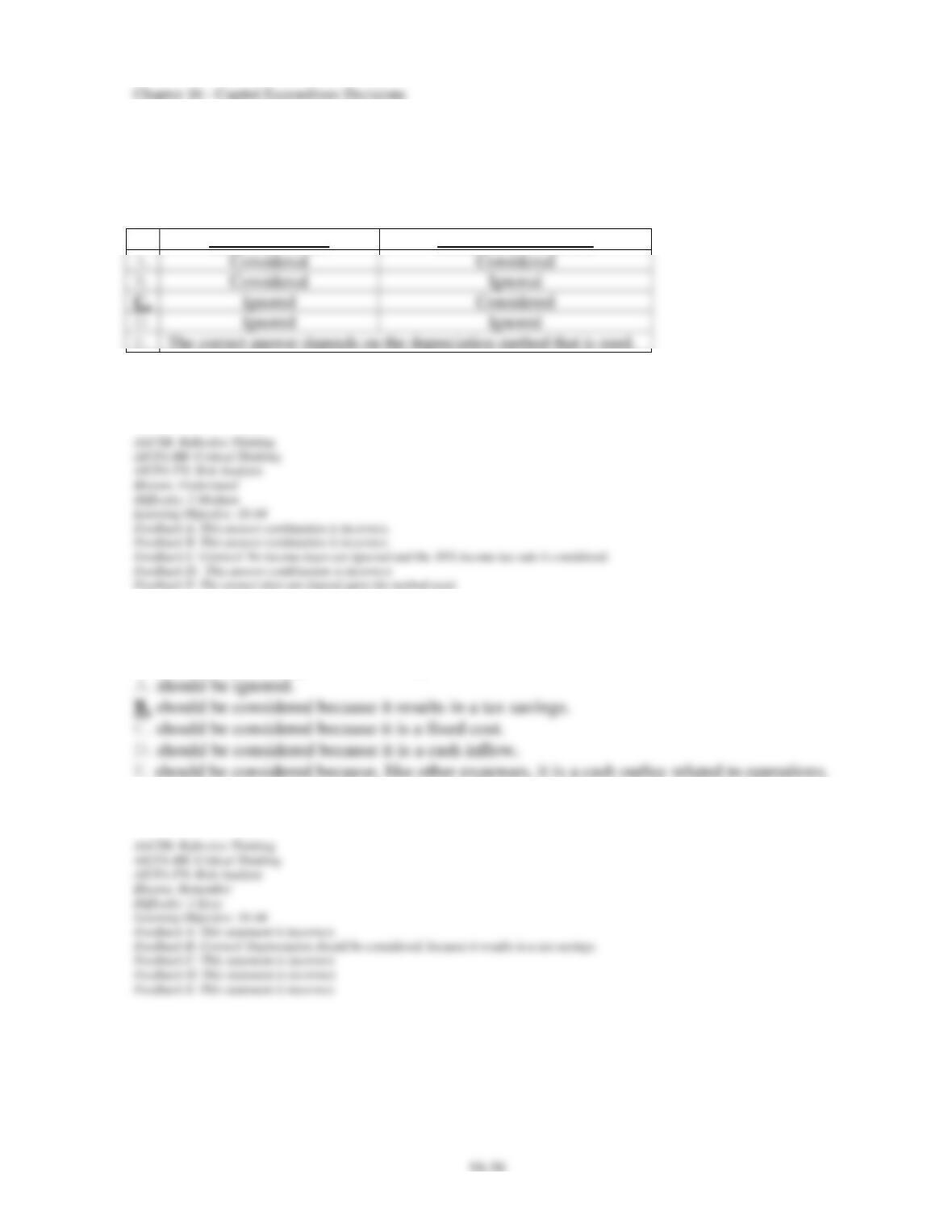
62. Assume that a capital project is being analyzed by a discounted-cash-flow approach, and
an employee first assumes no income taxes and then later assumes a 30% income tax rate.
How would depreciation expense be incorporated in the analysis?
No Income Taxes
30% Income Tax Rate
63. When a company is analyzing a capital project by a discounted-cash-flow approach and
income taxes are being considered, depreciation:
64. When income taxes are considered in capital budgeting, the cash flows related to a
company’s depreciation expense would be correctly figured by taking the cash paid for
depreciation and:
65. Jenkins plans to generate $650,000 of sales revenue if a capital project is implemented.
Assuming a 30% tax rate, the sales revenue should be reflected in the analysis by a:

66. Higgins Company plans to incur $350,000 of salaries expense if a capital project is
implemented. Assuming a 30% tax rate, the salaries should be reflected in the analysis by a:
67. Bowers Company plans to incur $190,000 of salaries expense and produce $320,000 of
additional sales revenue if a capital project is implemented. Assuming a 30% tax rate, these
two items collectively should appear in a capital budgeting analysis as:

68. Hampton Company plans to incur $230,000 of additional cash operating expenses and
produce $410,000 of additional sales revenue if a capital project is implemented. Assuming a
30% tax rate, these two items collectively should appear in a capital budgeting analysis as:
69. Pizza Company has $70,000 of depreciation expense and is subject to a 30% income tax
rate. On an after-tax basis, depreciation results in a:

70. Coulter Company is studying a capital project that will produce $600,000 of added sales
revenue, $400,000 of additional cash operating expenses, and $50,000 of depreciation.
Assuming a 30% income tax rate, the company’s after-tax cash inflow (outflow) is:
71. Which of the following is the proper calculation of a company’s depreciation tax shield?