
Chapter 16 – Capital Expenditure Decisions
16-1
Chapter 16 Capital Expenditure Decisions
Answer Key
True / False Questions
1. The internal rate of return equates the present value of a project’s cash inflows with the
present value of the cash outflows.
2. Two widely used methods of discounted-cash-flow analysis are the net-present-value
method and the return on assets method.

Chapter 16 – Capital Expenditure Decisions
16-2
3. A company’s hurdle rate is generally influenced by whether management uses the net-
present-value method or the internal-rate-of-return method.
4. An advantage of the NPV method is that the analyst can adjust for risk considerations.
5. The last step in any investment analysis is to determine the cash flows that are relevant to
the analysis.

Chapter 16 – Capital Expenditure Decisions
16-3
6. The incremental-cost approach looks at the difference in the NPVs of the cost of each
relevant item under two alternatives in an analysis.
7. All expenses represent cash outflows.
8. When income taxes are considered in capital budgeting, the cash flows related to a
company’s advertising expense would be correctly figured by taking the cash paid for
advertising and subtracting the result of multiplying [or advertising expense (1 ‒ tax rate)].
9. Under MACRS, an asset’s estimated salvage value is not subtracted in computing the
asset’s depreciation basis.

Chapter 16 – Capital Expenditure Decisions
16-4
10. MACRS depreciation is based on straight-line depreciation and is typically used for
published financial statements.
11. When preparing an NPV analysis on the disposal of an asset, like equipment, capital gains
12. Some investment proposals require additional outlays for working capital.

Chapter 16 – Capital Expenditure Decisions
16-5
13. Valid methods exist for ranking independent investment projects with positive net present
values.
14. If a proposal’s profitability index is greater than one then the net present value is positive.
15. The payback period can only be used if net cash inflows are uniform throughout a
project’s life.
16. There is no adjustment in the payback method for the time value of money.

Chapter 16 – Capital Expenditure Decisions
16-6
17. Activity-based-costing systems are costly, time-consuming to implement, and do not
improve the ability of an analyst to estimate the cash flows associated with a proposed
project.
18. When benefits are difficult to quantify in an NPV approach to a CIM investment decision,
it is best to exclude them.
19. Inflation is defined as a decline in the general purchasing power of a monetary unit, such
as a dollar, across time.
20. Nominal dollars is another name for real dollars.
Chapter 16 – Capital Expenditure Decisions
16-7
Multiple Choice Questions
21. Capital-budgeting decisions primarily involve:
A. emergency situations.

Chapter 16 – Capital Expenditure Decisions
16-8
23. The decision process that has managers select from among several acceptable investment
proposals to make the best use of limited funds is known as:
24. Capital budgeting tends to focus primarily on:
Chapter 16 – Capital Expenditure Decisions
16-9
25. Discounted-cash-flow analysis focuses primarily on:
26. In a net-present-value analysis, the discount rate is often called the:
Chapter 16 – Capital Expenditure Decisions
16–10
27. The hurdle rate that is used in a net-present-value analysis is the same as the firm’s:
28. Which of the following is taken into account by the net-present-value method?

Chapter 16 – Capital Expenditure Decisions
16–11
29. Consider the following factors related to an investment:
I. The net income from the investment.
II. The cash flows from the investment.
III. The timing of the cash flows from the investment.
Which of the preceding factors would be important considerations in a net-present-value
analysis?
30. The true economic yield produced by an asset is summarized by the asset’s:
A. non-discounted cash flows.
Chapter 16 – Capital Expenditure Decisions
16–12
31. The internal rate of return on an asset can be calculated:
A. if the return is greater than the hurdle rate.
32. The internal rate of return:
A. ignores the time value of money.
Chapter 16 – Capital Expenditure Decisions
16–13
33. Grenada Company is contemplating the acquisition of a machine that costs $50,000 and
promises to reduce annual cash operating costs by $11,000 over each of the next six years.
PV of $1 (i=12%; n = 6): 0.507
PV of a series of $1 cash flows (i=12%, n=6): 4.111
Which of the following is a proper way to evaluate this investment if the company desires a
12% return on all investments?
A. $50,000 versus – $11,000 6.
34. Barton Company can acquire a $900,000 machine now that will benefit the firm over the
next 6 years.
FV of 1 (i=8%, n=6): 1.587
FV of a series of $1 cash flows (i=8%, n=6): 7.336
PV of $1 (i=8%; n = 6): 0.630
PV of a series of $1 cash flows (i=8%, n=6): 4.623
Annual savings in cash operating costs are expected to total $190,000. If the hurdle rate is 8%,
the investment’s net present value is:
A. $(181,800).

Chapter 16 – Capital Expenditure Decisions
16–14
35. Carlin Company, which uses net present value to analyze investments, requires a 10%
minimum rate of return. A staff assistant recently calculated a $500,000 machine’s net present
value to be $86,400, excluding the impact of straight-line depreciation.
FV of 1 (i=10%, n=5): 1.611
FV of a series of $1 cash flows (i=10%, n=5): 6.105
PV of $1 (i=10%; n = 5): 0.621
PV of a series of $1 cash flows (i=10%, n=5): 3.791
If Carlin ignores income taxes and the machine is expected to have a five-year service life, the
correct net present value of the machine would be:
A. $(13,600).

Chapter 16 – Capital Expenditure Decisions
16–15
36. A new asset is expected to provide service over the next four years. It will cost $500,000,
generates annual cash inflows of $150,000, and requires cash operating expenses of $30,000
each year. In addition, a $10,000 overhaul will be needed in year 3.
Period
FV of 1
(i=10%)
FV of a series of $1
cash flows (i=10%)
PV of $1
(i=10%)
PV of a series of $1
cash flows (i=10%)
1
1.100
1.000
0.909
0.909
2
1.210
2.100
0.826
1.736
3
1.331
3.310
0.751
2.487
4
1.464
4.641
0.683
3.170
If the company requires a 10% rate of return, the net present value of this machine would be:
A. $(127,110), and the machine meets the company’s rate-of-return requirement.

Chapter 16 – Capital Expenditure Decisions
16–16
37. Swiss Imports can acquire a $700,000 machine now that will benefit the firm over the
next 5 years. A newly hired staff assistant correctly computed the net present value to be
$134,020 by using a 10% hurdle rate.
FV of 1 (i=10%, n=5): 1.611
FV of a series of $1 cash flows (i=10%, n=5): 6.105
PV of $1 (i=10%; n = 5): 0.621
PV of a series of $1 cash flows (i=10%, n=5): 3.791
On the basis of this information, the machine was expected to produce annual cash operating
savings of approximately:
A. $166,804.
Chapter 16 – Capital Expenditure Decisions
16–17
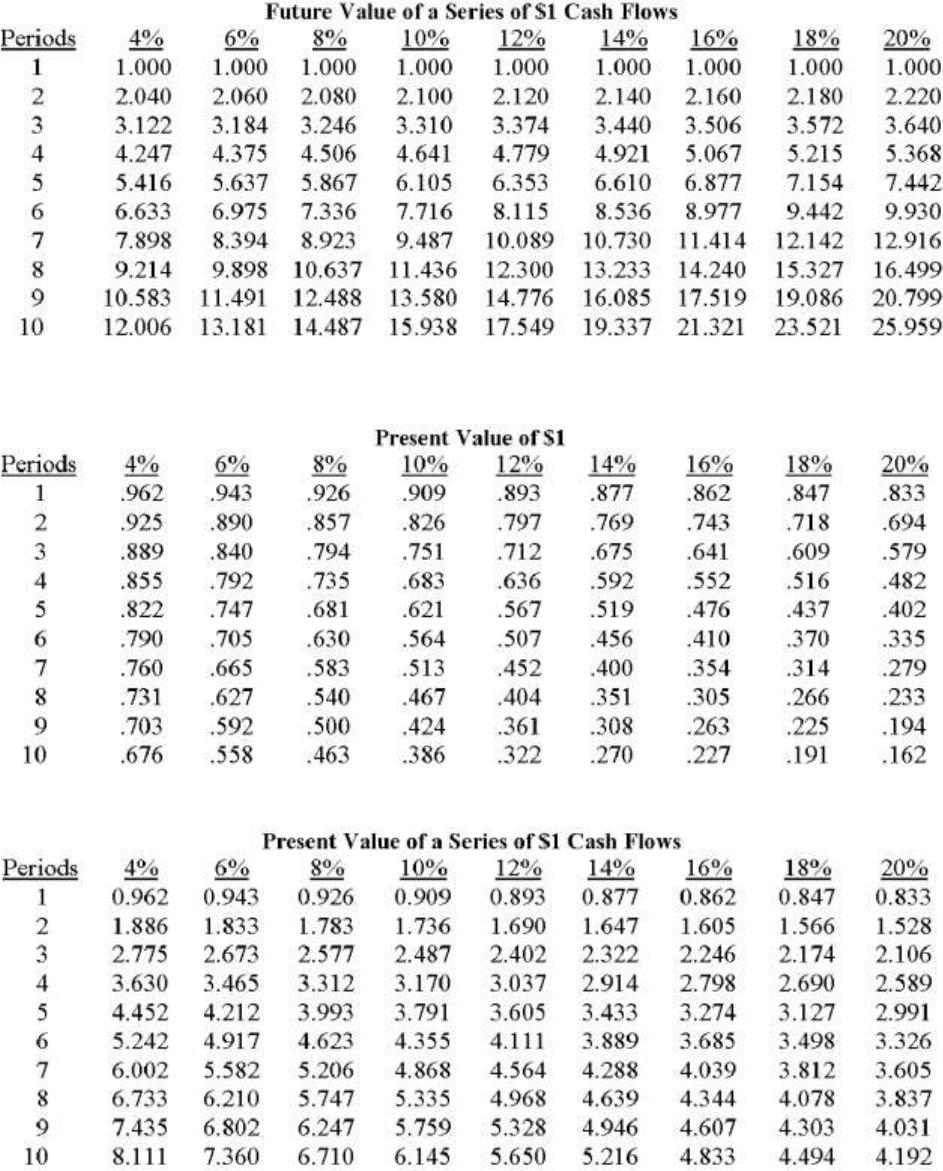
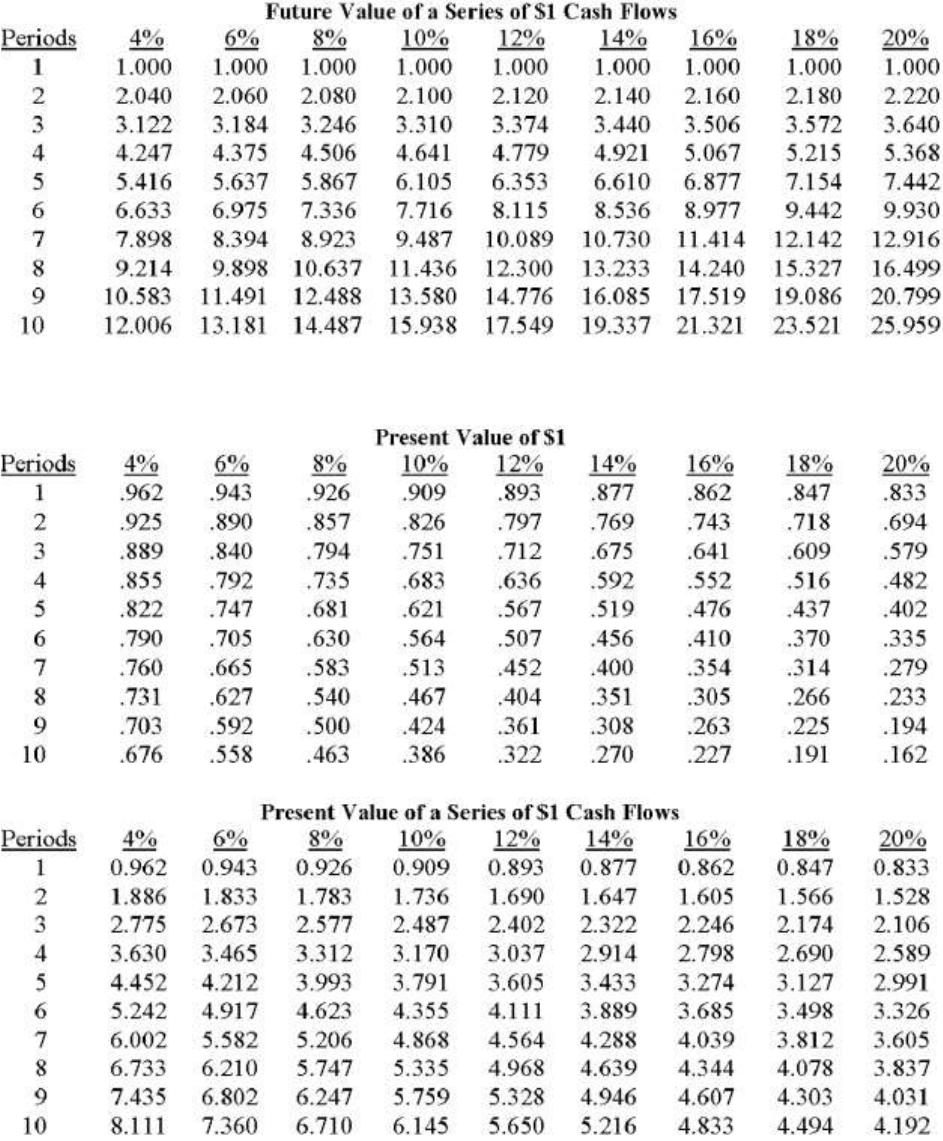
38. A new machine that costs $172,100 is expected to save annual cash operating costs of
$40,000 over each of the next nine years. Using the tables that follow, the machine’s internal
rate of return is:
Chapter 16 – Capital Expenditure Decisions
16–18
Chapter 16 – Capital Expenditure Decisions
16–19
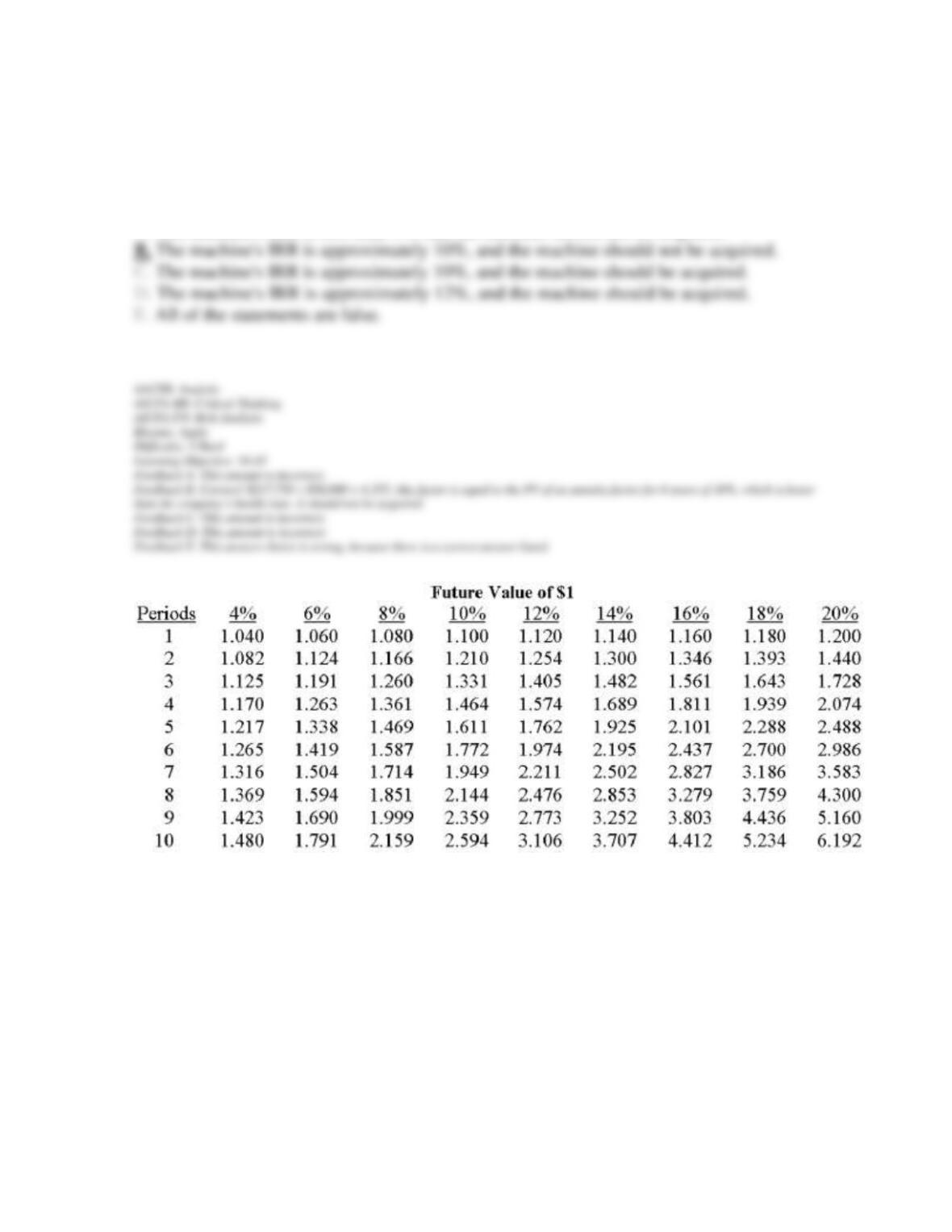
39. Excaliber is considering the acquisition of a $217,750 machine that is expected to
produce annual savings in cash operating costs of $50,000 over the next six years. If Excaliber
uses the internal rate of return (IRR) to evaluate new investments and the company has a
hurdle rate of 12%, which of the following statements is correct, using the tables that follow?
A. The machine’s IRR is less than 4%, and the machine should not be acquired.
Chapter 16 – Capital Expenditure Decisions
16–20